Europe Luxury Car Market Research Report By Vehicle Type (SUVs, Sports/Super Luxury Cars, Sedans, and Others), Propulsion (Internal Combustion Engine [ICE] Vehicles, Electric/Hybrid Vehicles, and Others), Component (Interior Components, Electronics, and Others), and Country (Germany, United Kingdom, France, Italy, Switzerland, and Rest of Europe) – Industry Analysis on Size, Share, Trends, and Growth Forecast (2026 to 2034)
Europe Luxury Car Market Size
The europe luxury car market was valued at USD 323.14 billion in 2025, is expected to have a 6.61% CAGR from 2026 to 2034, and be worth USD 547.84 billion by 2034 from USD 344.48 billion in 2026.

Luxury cars are premium and ultra-premium passenger vehicles characterized by superior engineering, advanced technology, bespoke craftsmanship, and brand heritage that are typically positioned at price points significantly above mass market segments. This category includes vehicles from established marques such as Mercedes-Benz Benz BMW, Audi, Porsche, Ferrari, and Rolls-Royce, as well as high-performance electric entrants like Lucid and premium variants from global manufacturers. Unlike standard automotive segments, luxury vehicles in Europe are often acquired as expressions of personal achievement, lifestyle alignment, or connoisseurship rather than mere transportation. According to the European Environment Agency (EEA), more than 300 European cities have instituted low-emission zones (LEZs) aimed at influencing vehicle choice and fleet composition. As per Eurostat, households in the top income decile across Western Europe allocate a significant portion of their discretionary spending to personal mobility, with luxury vehicles representing a notable share. This intersection of affluence, regulation, and cultural value defines the unique contours of Europe’s luxury automotive landscape.
MARKET DRIVERS
Affluent Consumer Base with Strong Brand Loyalty
Europe hosts one of the world’s densest concentrations of high-net-worth individuals whose purchasing behaviour is deeply influenced by heritage, exclusivity, and emotional resonance with automotive marques. According to the UBS Global Wealth Report 2024, Western Europe accounts for 28% of the world’s millionaires. Households in Germany, France, and the UK alone number in the millions with investable assets exceeding US$1 million, which reflects the significant affluent population of Europe. Consumers in Europe’s luxury automotive segment exhibit pronounced brand loyalty, with one survey revealing that about 37% of luxury-car buyers globally declared they were likely to make a repeat purchase from the same manufacturer. Personalized ownership experiences such as factory tours, bespoke interior commissions, and concierge after-sales services reinforce this loyalty. In affluent micro-markets such as the Principality of Monaco o brand prestige often outweighs functional considerations of purchase. Automakers capitalise on this by maintaining heritage centres and limited-edition releases that cultivate emotional attachment. Such deep-rooted brand affinity ensures consistent demand even during macro-economic fluctuations, anchoring the luxury segment’s resilience.
Accelerated Electrification of Premium Vehicle Portfolios
European luxury automakers are leveraging regulatory pressure and consumer expectations to transform their lineups with high-performance electric and plug-in hybrid models that retain premium attributes while meeting sustainability mandates, which is likely to boost the regional market expansion. According to the European Union’s regulation, a ban on new internal combustion engine sales from 2035 has spurred manufacturers to fast-track electrification without compromising driving dynamics or craftsmanship. According to the European Automobile Manufacturers Association, Porsche delivered 40,629 Taycan units globally in 2023 and recorded double-digit growth, which is making it one of the best-performing luxury electric sedans in Europe. The Mercedes-Benz EQS saw strong growth in its European registrations in 2023, owing to its advanced battery technology and luxury interior appointments. According to the International Energy Agency, new electric car registrations in Europe reached nearly 3.2 million in 2023, which is an increase of almost 20% compared to 2022. Affluent buyers are increasingly receptive to electric luxury, with a study by the German Automotive Research Institute indicating that 57% of luxury car shoppers in Scandinavia and the Benelux region prioritize electrified powertrains. Automakers are responding with 800-volt architectures, ultra-fast charging compatibility, ty, and sustainable interior materials features that align environmental responsibility with uncompromised premium experience, thereby expanding the addressable market among eco-conscious elites.
MARKET RESTRAINTS
Stringent Urban Mobility Regulations and Low Emission Zones
Cities across Europe are implementing increasingly restrictive policies that limit access for high-emission vehicles, directly challenging the usability of traditional luxury cars in urban centers and impeding the growth of the European luxury cars market. According to the European Commission’s Urban Mobility Observatory, a large and growing number of European cities now operate low-emission zones, with many imposing daily charges or outright bans on non-compliant vehicles. According to Ultra‑Low Emission Zone (ULEZ) rules, in London, non-compliant vehicles must pay a £12.50 daily charge to drive in the zone. These measures disproportionately affect older luxury models with larger displacement engines, which remain popular among collectors and traditionalists. In Germany, the Federal Administrative Court upheld city-level diesel bans in 2023, which is grounding thousands of high-end diesel sedans from urban use. Consequently, even affluent buyers face practical barriers to daily operation,n and this factor is reducing the appeal of non-electrified luxury vehicles. While manufacturers pivot to electric models, the transition period creates uncertainty as residual values of internal-combustion luxury cars decline and infrastructure gaps persist in Southern and Eastern Europe. This regulatory headwind tempers demand despite strong brand equity
Rising Total Cost of Ownership and Insurance Premiums
The escalating expenses associated with owning a luxury vehicle, including insurance, maintenance, and depreciation, are deterring even high-income consumers from frequent upgrades or multiple acquisitions, which is one of the significant restraints on the European market growth. According to the European Residual Value Index, luxury sedans can lose up to 55% of their value within three years. Affluent buyers are increasingly prompted to extend ownership cycles or shift toward leasing and subscription models. Maintenance costs are equally burdensome, and a routine service for a Mercedes S Class in Switzerland averages several thousand Swiss francs. Average annual premiums for luxury cars in France and the Netherlands have risen significantly in recent years, with high-performance models like the BMW M5 or Audi RS6 commanding premiums exceeding several thousand euros per year. In Sweden, a strong share of new luxury car transactions in 2023 were leases rather than outright purchases, which reflects cost sensitivity that was once uncommon in the segment and recalibrates purchasing behavior toward long-term value retention over immediate acquisition.
MARKET OPPORTUNITIES
Growth of Personalized and Bespoke Manufacturing Services
Luxury automakers are capitalizing on rising demand for individualization by expanding bespoke programs that transform vehicles into unique expressions of owner identity, which is one of the potential opportunities in the European luxury car market. According to internal brand disclosures, the tailor-made customisation programmes at Ferrari and Rolls‑Royce now account for over 30% of European deliveries in their respective ultra-luxury segments. Customers can select from thousands of paint hues, custom embroidery, monogrammed treadplates, and even handcrafted wood or metal inlays sourced from heritage suppliers. According to Bentley’s Mulliner division, bespoke commissions rose by 43% in 2023, with about 75% of customers choosing custom-spec cars. Automakers are investing in digital configurators with augmented reality previews and dedicated client advisors to streamline the co-creation process. By transforming cars from mass-produced assets into curated artefacts, brands enhance emotional engagement, command premium pricing, and insulate themselves from commoditisation pressures in an increasingly competitive landscape.
Expansion of Luxury Mobility Subscription Models
Premium automakers and third-party platforms are introducing flexible ownership alternatives that cater to affluent consumers seeking variety, convenience, and reduced asset commitment, which is another considerable opportunity in the regional market. In 2023, PPorscherive reported over 12,000 active subscribers across Germany, France, and Italy, which allows users to switch between a 911 Taycan and Panamera on a monthly cycle. Similarly, Volvo’s Care by Volvo premium subscription has influenced the segment by normalizing all-inclusive monthly payments covering insurance, maintenance roadside assistance. A 2024 survey by the European Mobility Consumer Panel revealed that 38% of high-income individuals aged 30 to 45 in urban centers prefer subscription access over ownership for premium vehicles. Companies like Care by Porsche and Audi Select now offer tiered plans with concierge delivery and guaranteed residual values. These models reduce the financial and logistical burdens of ownership while enabling brand experimentation. As digital platforms mature and trust in shared premium assets grows, subscription services present a scalable avenue to capture younger affluent demographics and increase brand touchpoints without requiring permanent purchase decisions.
MARKET CHALLENGES
Supply Chain Vulnerabilities: High-Precision Component Sourcing
The production of luxury vehicles relies on specialized components such as hand-stitched leather, artisanal wood trims, and advanced semiconductor systems that are susceptible to geopolitical and logistical disruptions, which is a significant challenge to the expansion of the European luxury car market. According to the Porsche Drive program, over 12,000 active subscribers across Germany, France, and Italy in 2023 could switch between a 911, Taycan, and Panamera on a monthly cycle. Similarly, Volvo’s Care by Volvo premium subscription model has influenced the segment by normalizing all-inclusive monthly payments covering insurance, maintenance, and roadside assistance.
Shifting Cultural Perceptions of Conspicuous Consumption
In several European markets, particularly in Northern and Western Europe, traditional displays of wealth through large or ostentatious vehicles are increasingly viewed as socially and environmentally irresponsible. According to the European Commission’s Urban Mobility Observatory, a large number of European cities now operate low‐emission zones, with many imposing daily charges or outright bans on non-compliant vehicles.
SEGMENTAL ANALYSIS
By Vehicle Type Insights
The SUV segment dominated the Europe luxury car market by accounting for 53.5% of the regional market share in 2024. The growth of the SUV segment in the European market is attributed to its versatile blend of elevated driving ppositionpremiumm interior space, and perceived safety, which resonates strongly with affluent families and urban professionals alike. According to the survey by the European Mobility Consumer Panel, over 60% of luxury car buyers aged 35 to 55 in Germany and France cited practicality and all-weather capability as decisive factors in choosing an SUV over a sedan. Premium SUVs like the BMW X5, Mercedes GLE, and Range Rover offer seating for five with cargo volumes exceeding 600 litres, which is bridging the gap between executive comfort and lifestyle utility. Automakers have invested heavily in refining ride dynamics and noise insulation to match sedan-level refinement, eroding traditional handling objections. The domination of the SUV segment in the European luxury car market is also driven by the strong residual values. As per a study by the European Residual Value Index, luxury SUVs retained 58% of their value after three years in 2023, outperforming sedans by 9% points. This combination of functionality, prestige, and financial resilience primarily contributes to the domination of the SUV segment in the European luxury car market.
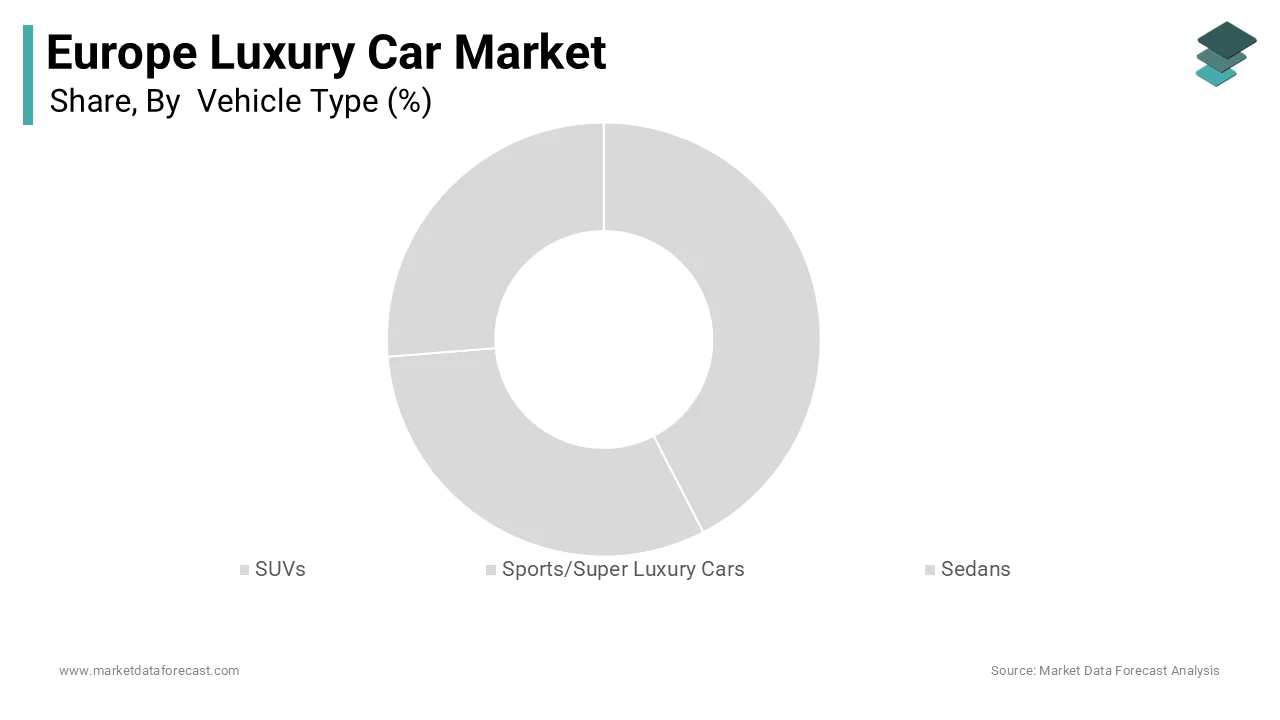
The sports/super luxury cars segment is predicted to witness the fastest CAGR of 8.8% over the forecast period, owing to the rising demand among ultra-high net worth individuals for limited production vehicles that combine extreme performance with artisanal craftsmanship. According to internal brand disclosures, the tailor-made customisation programmes at Ferrari and Rolls‑Royce now account for over 30% of European deliveries in their respective ultra-luxury segments. Customers can select from thousands of paint hues, custom embroidery, monogrammed tread-plates, and even handcrafted wood or metal inlays sourced from heritage suppliers. According to the Bentley Mulliner division, bespoke commissions rose by 45% in 2023, with average customisation costs exceeding £85,000 per vehicle. This trend is amplified by generational shifts. According to a 2024 study by the European Luxury Goods Council, 71% of millennial luxury-car buyers in Germany and Spain consider personalisation a decisive purchase factor. Automakers are investing in digital configurators with augmented-reality previews and dedicated client advisors to streamline the co-creation process. By transforming cars from mass-produced assets into curated artefacts, brands enhance emotional engagement, command premium pricing, and insulate themselves from commoditisation pressures in an increasingly competitive landscape. These factors are driving the growth of the sports/super luxury cars segment in the European market.
By Propulsion Insights
The internal combustion engine (ICE) vehicles segment captured the dominating share of 54.9% of the European luxury car market by propulsion type in 2024. Despite aggressive electrification policies, ICE remains dominant due to established infrastructure long distance usability, and consumer hesitation around battery longevity in premium segments. According to the European Alternative Fuels Observatory, in Southern and Eastern Europe, public fast-charging density remains below 5 stations per 100 km. The legacy emotional attachment to engine sound and mechanical feedback also persists. As per a 2023 study by the German Automotive Research Institute, 63% of Porsche 911 buyers cited the flat-six engine note as irreplaceable. Luxury brands continue to refine ICE powertrains with mild-hybrid systems to meet Euro 7 standards without full electrification. This transitional phase, uneven charging infrastructure, and residual-value uncertainty for early EVs are propelling the growth of the ICE segment in the European market.
The electric/hybrid segment is predicted to showcase the fastest CAGR of 22.9% over the forecast period, owing to the stringent CO2 fleet targets, expanding charging infrastructure, and the successful integration of electric drivetrains into flagship luxury models without compromising brand essence. According to the regulation adopted by the European Commission, manufacturers must reduce the average fleet CO₂ emissions of new cars by -55% by 2030 compared to 2021. According to the Norwegian Road Federation, fully electric vehicles made up approximately 82% of all new passenger cars sold in Norway in 2023. Affluent buyers are drawn to the silent refinement and instant torque of electric powertrains with a strong shift toward electric luxury vehicles as manufacturers prioritise high-margin EVs to offset mass-market deficits. As battery energy density improves and 800-volt architectures enable 10-80% charging in under 18 minutes, the electric luxury vehicles segment is expected to experience significant growth.
By Component Insights
The interior components segment occupied the leading share of 34.8% of the European market in 2024, owing to the rising emphasis on sensory luxury, where materials and craftsmanship define ownership experience more than mechanical performance. Premium interiors feature hand-stitched semi-aniline leather, sustainably sourced open-pore wood, and metal accents machined to micron precision. According to the internal disclosures from Rolls‑Royce, over 40% of Phantom buyers in 2023 selected bespoke interior themes involving custom embroidery and artisanal marquetry. The shift toward electric platforms has further elevated interior importance as silent cabins become canvases for acoustic refinement and ambient lighting. Suppliers such as Dräxlmaier and Magna International have invested in micro-factories across Germany and Italy to produce low-volume, high-quality trim with artisan oversight. As vehicles become digital living spaces, the interior evolves from a cabin to a curated environment by commanding disproportionate engineering and material investment. These factors are expected to continue to drive the growth of the interior segment in the European market over the forecast period.
The electronics segment is predicted to grow at the fastest CAGR of 17.1% over the forecast period in the European market, owing to the integration of advanced driver assistance systems, immersive digital cockpit, ts aover-the-airair update capabilities that define modern luxury. According to the analysis by McKinsey & Company, modern vehicles may have as many as 150 electronic control units in a distributed software architecture. Regulatory mandates are also contributing; the EU General Safety Regulation requires automatic emergency braking and driver-drowsiness detection systems in all new cars from 2024. Additionally, the demand for vehicle-to-everything (V2X) cybersecurity is growing rapidly and is resulting in the rising cybersecurity investment across connected premium vehicles. Flagship luxury vehicles such as the BMW i7 feature large theatre-style screens, rear-seat tablets, and AI-powered voice assistants that learn driver preferences are indicating the shift from mechanical excellence to intelligent experience in premium mobility.
COUNTRY LEVEL ANALYSIS
Germany Luxury Car Market Analysis
Germany dominated the luxury car market in Europe by holding 24.1% of the European market share in 2024. The leading position of Germany in the European market is primarily attributed to the status of Germany as the home of Mercedes-Benz Benz BMW, and Audi, which collectively account for more than 60% of domestic luxury registrations. German consumers exhibit a strong preference for engineering excellence and driving dynamics, with many luxury buyers prioritising handling and chassis tuning over infotainment features. High disposable income among professionals in Bavaria and Baden-Württemberg sustains demand for high-performance variants ike the M and RS series. Additionally, corporate fleet policies favour premium sedans and SUVs as executive benefits, with large German companies registering a substantial number of luxury vehicles. The presence of the Nürburgring and the extensive autobahn network further cultivates a performance-oriented culture. This ecosystem of domestic manufacturing, consumer sophistication, and corporate demand is majorly contributing to the domination of Germany in the European market.
United Kingdom Luxury Car Market Analysis
The United Kingdom held a considerable share of the European market in 2024. The luxury car market in the UK is distinguished by its affinity for ultra luxury and bespoke vehicles, with Rolls-Royce Royce Bentley, and Aston Martin maintaining strong domestic followings. London alone remains a major global hub for luxurious motor-car sales due to the international residents and wealth managers who view these cars as mobile status symbols. Despite high vehicle excise duties and congestion charges, demand remains resilient due to leasing structures that absorb costs. According to a regional survey, nearly half of luxury car buyers in the UK’s South East preferred British marques for their heritage and coach-building traditions. The UK market also shows strong uptake of plug-in hybrids, with British luxury marques seeing a significant portion of their UK sales coming from hybrid models. This blend of national pride, regulatory adaptation, and concentrated global wealth is propelling the luxury car market growth in the UK.
France Luxury Car Market Analysis
France is expected to occupy a notable share of the European luxury car market over the forecast period. The luxury car market in France is shaped by a dual dynamic that is strong domestic support for premium French brands like DS Automobiles and high demand for German SUVs among urban elites. Paris and Lyon host a significant number of luxury dealerships with many offerings, concierge delivery, and atelier customization services. The French government’s 2023 bonus-malus system penalises high-emission vehicles with substantial fees that are accelerating the adoption of plug-in hybrids such as the BMW X5 xDrive45e, which saw notable sales gains in 2023. Affluent consumers increasingly prioritise sustainability without sacrificing prestige. According to sources, a majority of luxury buyers in Île-de-France consider CO₂ output when selecting a vehicle. Additionally, France’s extensive high-speed rail network reduces long-distance driving needs, which is making compact luxury sedans and crossovers ideal for urban mobility. This policy-driven yet style-conscious environment is primarily boosting the luxury car market in France.
Italy Luxury Car Market Analysis
Italy is projected to register a healthy CAGR in the European luxury car market over the forecast period, owing to the aesthetic passion and emotional connection to automotive design, with Ferrari, Lamborghini, and Maserati enjoying cult like domestic followings. More than 40% of Ferrari’s European deliveries occur in Italy,y, where owners often commission bespoke liveries inspired by historic racing colours. The winding coastal and alpine roads of Italy favour agile sports cars and grand tourers, which is sustaining demand despite urban congestion charges in Milan and Rome. According to research, a large majority of luxury-car buyers aged 40 to 60 view their vehicle as an extension of personal identity rather than mere transportation. Additionally, tax incentives under Italy’s 2023 Ecobonus programme boosted registrations of plug-in-hybrid models like the Porsche Cayenne E‑Hybrid by a substantial margin. This fusion of design heritage, performance culture, and selective electrification is driving the luxury car market in Italy.
Switzerland Luxury Car Market Analysis
Switzerland is estimated to exhibit a prominent CAGR in the European luxury car market over the forecast period. Despite its small population, Switzerland exerts n outsized influence through its concentration of ultra-high net worth individuals and neutrality as a tax-efficient vehicle registration hub. Geneva and Zurich are home to over 80 luxury dealerships serving both domestic clients and international residents who register cars in Switzerland for favourable depreciation and import rules. The luxury car market in Switzerland shows strong demand for high-specification electric and hybrid models, though the electrification rate in new luxury car sales is lower than often claimed. Privacy laws and Switzerland’s discreet wealth culture favour understated luxury, with brands like Lexus and Porsche outperforming flashier rivals. Additionally, the mountainous terrain and all-season road conditions of Switzerland drive preference for all-wheel-drive SUVs like the Range Rover and Audi Q8. This unique blend of financial privacy, alpine practicality, and eco-conscious affluence is a few of the key factors driving the luxury car market in Switzerland.
COMPETITVE LANDSCAPE
The Europe luxury car market features intense rivalry among established German marquess, British ultra luxury houses, and Italian performance specialists, each leveraging heritage technology and regional identity. Competition is defined not by price but by brand narrative, engineering precision, and ownership experience. German manufacturers dominate volume segments through platform sharing and electrification scale, while British and Italian brands compete on emotional appeal, scarcity, and artisanal quality. New entrants like Lucid and Tesla challenge incumbents with software-defined vehicles yet struggle to replicate tactile luxury and service networks. Regulatory pressures accelerate innovation but also raise entry barriers through compliance costs. Customer loyalty remains high yet is increasingly contingent on sustainability credentials and digital fluency. The market rewards those who balance tradition with transformation,n offering vehicles that are both timeless and ndfuture-readyy. This dynamic fosters continuous investment in R&D craftsmanship and customer engagement, ensuring Europe remains the global epicenter of automotive luxury.
KEY MARKET PLAYERS
Some of the companies that are playing a dominating role in the global Europe Luxury Car Market include
- BMW AG
- Mercedes-Benz Group AG (Daimler AG)
- Audi AG
- Volkswagen AG (Bentley, Porsche, Lamborghini)
- Rolls-Royce Motor Cars Limited (a BMW subsidiary)
- Jaguar Land Rover Limited
- Ferrari N.V.
- Aston Martin Lagonda Global Holdings plc
- Maserati S.p.A.
- Volvo Car Corporation
- Lexus (a division of Toyota Motor Corporation)
- Tesla, Inc.
- McLaren Automotive Ltd.
- Bugatti Automobiles S.A.S.
- Alfa Romeo (Stellantis N.V.)
- Bentley Motors Limited
- Porsche AG
- Maybach (Mercedes-Benz division)
- Genesis Motor (Hyundai Motor Company)
- Polestar Automotive Holding UK PLC
TOP LEADING PLAYERS IN THE MARKET
- Mercedes-Benz maintains a commanding presence in the Europe luxury car market through its comprehensive portfolio spanning executive sedans, SUVs, and high-performance AMG variants. The company has accelerated its electrification strategy with the dedicated EQ sub-brand offering models like the EQS and EQE tailored to European urban and regulatory environments. In 2023, Mercedes-Benz expanded its battery production capacity at its Stuttgart plant and launched a closed-loop recycling initiative for lithium-ion cells in partnership with German tech firms. It also enhanced its digital retail platform across France, Italy, and Spain, enabling end-to-end online configuration and home delivery. These actions reinforce its commitment to sustainable luxury while preserving the brand’s legacy of engineering excellence and comfort.
- BMW Group plays a pivotal role in the European luxury segment by balancing driving dynamics with progressive electrification through its i sub-brand and plug-in hybrid technologies. The company has deepened its regional integration by sourcing battery cells from European gigafactories and developing hydrogen fuel cell prototypes in collaboration with German research institutes. In 2023, BMW upgraded its Driving Experience Centers in Munich and Paris to include immersive EV handling courses and augmented reality configurators. It also introduced a circular design philosophy for the Neue Klasse platform launching in 202,5, featuring secondary aluminum and recycled textiles. These initiatives position BMW as a leader in bot-performance-oriented and environmentally conscious luxury mobility across Europe.
- Volkswagen Group exerts significant influence in the Europe luxury car market through its multi-brand portfolio that spans premium mainstream to ultra luxury and hyper performance segments. Audi leads in digital cockpit innovation while Porsche dominates high-performance electrification with the Taycan. Bentley and Lamborghini cater to ultra-high-net-worth clients with bespoke craftsmanship and limited editions. In 2023, the group consolidated its European EV charging network under the Elli brand and launched a carbon-neutral leather sourcing program for its luxury interiors. It also established a joint venture with a Swiss battery recycler to recover cobalt and nickel from end-of-life vehicles. This ecosystem approach allows the group to address diverse luxury preferences while advancing sustainability across price tiers.
TOP STRATEGIES USED BY THE KEY MARKET PARTICIPANTS
Key players in the Europe luxury car market prioritize electrification, digital integration experiential ownership to maintain differentiation. Automakers are investing heavily in dedicated electric architectures with 800-volt systems, ultra-fast charging, and sustainable interior materials to meet EU regulatory deadlines and consumer expectations. Digital retail platforms now enable full online configuration, virtual test drives, and home delivery, enhancing convenience without sacrificing personalization. Brands are also expanding bespoke programs offering handcrafted interiors, limited edition, and factory build experiences to reinforce exclusivity. Concurrently, companies are strengthening circular economy initiatives, including battery recycling, closed-loop material sourcing, and carbon-neutral production. These strategies collectively ensure that luxury remains synonymous with innovative craftsmanship, IPpIPand responsibility in an increasingly regulated and conscious European market.
EUROPE LUXURY CAR MARKET NEWS
- In March 2024, Mercedes-Benz Group AG inaugurated a carbon-neutral battery recycling pilot plant in Kuppenheim, Germany, in collaboration with a European raw materials consortium to recover lithium and cobalt and strengthen the Europe luxury car market's sustainability leadership.
- In May 2024, BMW Group launched its Neue Klasse experience center in Paris, France, featuring immersive virtual reality configurators and hands-on workshops on circular design principles to enhance customer engagement and strengthen the Europe luxury car market's digital retail presence.
- In February 2024, Volkswagen Group unified its premium EV charging services under the Elli brand across Germany, Italy, and the Netherlands, offering luxury customers seamless access to over 400,000 public charging pointsstrengtheninggthen the Europe luxury car market charging infrastructure.
- In June 2024, Porsche AG introduced a certified pre-owned electrified vehicle program with extended battery warranties and home charger installation support across Sweden, Denmark, and Switzerland to build trust in electric ownership and strengthen the Europe luxury car market residual value stability.
- In April 202,4, Audi AG partnered with a Milan-based sustainable textile startup to integrate ocean plastic-derived upholstery into its Q8 e-tron and A8 models sold in Southern Europe, promoting
MARKET SEGMENTATION
This research report on the europe luxury car market is segmented and sub-segmented into the following categories.
By Vehicle Type
- SUVs
- Sports/Super Luxury Cars
- Sedans
- Others
By Propulsion
- Internal Combustion Engine (ICE) Vehicles
- Electric/Hybrid Vehicles
- Others
By Component
- Interior Components
- Electronics
- Others
By Country
- Germany
- United Kingdom
- France
- Italy
- Switzerland
- Rest of Europe
Frequently Asked Questions
1. Which vehicle types dominate the Europe Luxury Car Market?
SUVs currently hold a dominant share in the Europe Luxury Car Market, as European customers prefer spacious, versatile luxury SUVs that offer enhanced comfort, safety, and family-friendly features
2. How is electrification affecting the Europe Luxury Car Market?
Rapid electrification is a key trend in the Europe Luxury Car Market, with luxury automakers investing heavily in electric and hybrid models to meet EU emissions standards and evolving consumer preferences for green mobility.
3. Which countries lead in the Europe Luxury Car Market?
Germany, the United Kingdom, and France are top contributors to the Europe Luxury Car Market, with Germany leading in production, innovation, and ownership due to its heritage brands and affluent buyer base.
4. What is the outlook for electric luxury cars in the Europe Luxury Car Market?
Electric luxury cars are forecast to see significant growth in the Europe Luxury Car Market, driven by stricter environmental regulations and growing consumer interest in sustainable, high-performance vehicles.
5. How has the COVID-19 pandemic influenced the Europe Luxury Car Market?
Although the pandemic posed challenges, the Europe Luxury Car Market rebounded quickly as economic confidence returned, tourism recovered, and luxury buyers shifted preferences towards innovative, eco-friendly models.
6. Which brands are leading the Europe Luxury Car Market?
The Europe Luxury Car Market is dominated by renowned brands such as Mercedes-Benz, BMW, Audi, Porsche, and Tesla, who maintain market leadership through innovation, branding, and extensive premium vehicle portfolios.
7. What is the growth forecast for the Europe Luxury Car Market?
The Europe Luxury Car Market is projected to grow robustly in the coming years, fueled by the expanding electric and hybrid segment and continued innovation from leading manufacturers.
8. What are the main consumer trends in the Europe Luxury Car Market?
Key trends in the Europe Luxury Car Market include rising demand for electric and hybrid models, autonomous driving technology, and personalized, connected vehicle experiences for affluent buyers.
9. What role do SUVs play in the Europe Luxury Car Market?
SUVs play a pivotal role in the Europe Luxury Car Market, capturing the largest segment share due to their practicality, comfort features, and broad appeal among European households and executives.
10. How are sustainability and emissions policies impacting the Europe Luxury Car Market?
Sustainability regulations such as the EU’s emission targets are accelerating the introduction of cleaner, low-carbon electric and hybrid vehicles in the Europe Luxury Car Market.
Related Reports
Access the study in MULTIPLE FORMATS
Purchase options starting from
$ 2000
Didn’t find what you’re looking for?
TALK TO OUR ANALYST TEAM
Need something within your budget?
NO WORRIES! WE GOT YOU COVERED!
Call us on: +1 888 702 9696 (U.S Toll Free)
Write to us: sales@marketdataforecast.com