- Product Description Description
- Table of Contents TOC
- List of Table & Figure LOT
- Get Free Sample PDF Sample PDF
Market Size, 2025
$12.69 BnMarket Estimate, 2026
$13.24 BnMarket Forecast, 2034
$18.63 BnCAGR, 2026–2034
4.36%Executive Summary: Europe Luxury Furniture Market
- Market Scope: European market analysis covering application segments, material classifications, distribution channels, country-level regional leadership, and high-end tourism/real estate metrics.
- Market Valuation: Valued at USD 12.69 billion (2025), estimated at USD 13.24 billion (2026), and projected to reach USD 18.63 billion by 2034, growing at a CAGR of 4.36% (2026–2034).
- Primary Growth Drivers: High demand for bespoke craftsmanship, rich European design heritage, sustainable luxury practices, and expanding premium residential and hospitality projects. Key market context highlights 747 million international tourist arrivals in Europe (2025), a 22% increase in bespoke orders from Italian ultra-high-net-worth individuals, and high consumer eco-consciousness (68% of buyers under 50 considering environmental credentials essential), balanced against production constraints (78% of workshops employing fewer than 20 artisans).
Key Market Segment Metrics (2026–2034)
| Category | Leading Segment (2025 Position) | Fastest-Growing Segment |
|---|---|---|
| By Application | Luxury Home Furniture (supported by >42,000 new luxury residential units in Monaco, Milan, Paris, London) | Luxury Office Furniture (9.1% CAGR) |
| By Material | Wood (62.3% market share) | Metal (identified as the fastest-growing material) |
| By Distribution Channel | B2C / Retail (led market share) | B2B / Project Sales (10.7% CAGR) |
| By Region / Country | Italy (26.3% share; France second at 19.2%; Italian exports at €5.2B and Salone del Mobile attracting ~340,000 visitors) | — |
Major Market Players & Market Structure
Market Structure: Fragmented yet prestigious luxury manufacturing landscape focusing on traditional craftsmanship, sustainable material sourcing, high-end bespoke customization, digital configurators, circular economy integration, and strategic partnerships with architects and interior designers.
Key Companies: Ashley Furniture Industries, Lee Industries, Maiden Home, Williams-Sonoma, Kimball International, Century Furniture, Duresta Upholstery, Giovanni Visentin, Scavolini, and Muebles Pico.
Europe Luxury Furniture Market Size
The Europe luxury furniture market size was valued at USD 12.69 billion in 2025 and is anticipated to reach USD 13.24 billion in 2026 from USD 18.63 billion by 2034, growing at a CAGR of 4.36% during the forecast period from 2026 to 2034.
The luxury furniture is a high-end residential and contract furnishings characterised by artisanal craftsmanship, premium material,,s heritage design, and limited production runs. The European Cultural Heritage Index confirmed that 14 European cities, including Milan, Paris, and Copenhagen, rank among the world’s top 20 design capitals, anchoring regional creative ecosystems. Furthermore, as per the United Nations World Tourism Organisation, Europe welcomed 747 million international tourists in 2025, many of whom visited design districts, showrooms, and heritage ateliers, indirectly sustaining artisanal demand.
MARKET DRIVERS
Rising Affluence Among Ultra High Net Worth Individuals Is Fueling Bespoke Demand
Europe’s expanding cohort of ultra-high net worth individuals is a principal engine of luxury furniture consumption for custom and heritage pieces, fuelling the growth of Europe's luxury furniture market. These clients prioritise uniqueness, legacy, and personal narrative that often commissioning furniture from storied maisons like Poltrona Frau or B&B Italia with lead times exceeding 18 months. In Italy alone, bespoke furniture orders from domestic UHNWIs increased by 22% in 2025. Moreover, second home ownership among this demographic averages 2.4 properties per household. These residences, often in Tuscany, the French Riviera, or the Swiss Alps, require fully curated interiors where luxury furniture serves as both a functional asset and a cultural statement.
Cultural Capital and Design Heritage Reinforce Brand Authority
Europe’s historical dominance in furniture design, like spanning Baroque cabinets, Bauhaus minimalism, and Scandinavian modernism that provides an unmatched reservoir of authenticity that global competitors cannot replicate. The cultural capital and design heritage will additionally propel the growth of Europe's luxury furniture market. According to UNESCO, 37 European furniture-making traditions are inscribed in national intangible cultural heritage lists, including French ébénisterie and Italian intarsia. This legacy enables brands like Cassina, Carl Hansen & Son, and Roche Bobois to position products as living artefacts rather than commodities. The Milan Furniture Fair, which attracted over 340000 visitors in 2025 as per Fiera Milano, remains the world’s most influential design event, which is reinforcing Europe’s curatorial authority.
MARKET RESTRAINTS
Extended Lead Times and Artisanal Bottlenecks Limit Scalability
The very attributes that define luxury furniture handcraftsmanship, rare materials, and bespoke detailing, which create inherent production, are solely hampering the growth of the European luxury furniture market. According to the European Federation of Craft Enterprises, 78% of luxury furniture workshops employ fewer than 20 artisans, with master cabinetmakers requiring 12 to 15 years of training to achieve certification. Similarly, French marquetry workshops often operate at 95% capacity, with waiting lists stretching into 2026 for heritage pieces. These are exacerbated by material scarcity, where European regulations restrict the use of tropical hardwoods, and certified walnut or olive wood supplies meet only 40% of demand as per the European Forest Institute.
Sensitivity to Macroeconomic Volatility in Discretionary Spending
The shift towards consumer confidence and asset valuations is also restricting the growth of the European luxury furniture market. According to the European Commission’s Consumer Confidence Indicator, luxury home goods spending declined by 7% in Q3 2023 during a period of stock market correction and rising interest rates. Real estate dynamics further amplify this sensitivity; as per the European Central Bank, luxury residential transactions in London, Paris, and Monaco fell by 14% year on year in 2025, directly reducing furniture procurement for new properties.
MARKET OPPORTUNITIES
Integration of Sustainable Luxury Is Reshaping Material Innovation
A new paradigm of “conscientious opulence” is emerging in Europe, where sustainability enhances rather than compromises luxury. Therefore, the integration of sustainable luxury is amplifying new opportunities for the expansion of the European luxury furniture market. According to the European Sustainability Observatory, 68% of luxury furniture buyers under 50 now consider environmental credentials essential to purchasing decisions. This has spurred innovation in bio-based and reclaimed materials; Italian brand Minotti launched a 2025 collection featuring upholstery dyed with algae pigments and frames from FSC-certified ash, while Danish company GUBI introduced chairs crafted from ocean-recovered plastics. Brands like B&B Italia and Vitra now publish full life cycle assessments for flagship pieces, verified by third parties such as the Environmental Product Declaration Secretariat. Furthermore, the European Investment Bank allocated €180 million in 2025 to artisanal workshops adopting circular production models, including closed-loop wood recycling and non-toxic finishing.
Expansion of Luxury Residential and Hospitality Projects Is Driving B2B Growth
The high-end contract projects in hospitality and premium real estate are substantially elevating new opportunities for the growth of the European luxury furniture market. These developments require fully furnished show apartments and common areas by creating bulk orders for designer furniture. Simultaneously, the luxury hotel sector is rebounding, where Europe welcomed 128 million international luxury travellers in 2025 by driving renovations at iconic properties like Hotel de Crillon and The Gritti Palace.
MARKET CHALLENGES
Counterfeit Unauthorised Replicas Erode Brand Equity and Revenue
The proliferation of high-fidelity replicas that are often marketed as “inspired by” originals poses a persistent threat to Europe’s luxury furniture houses. According to the European Union Intellectual Property Office, over 2,30,000 counterfeit furniture items were seized at EU borders in 2025, with 68% mimicking iconic designs by names like Arne Jacobsen and Le Corbusier. Online marketplaces exacerbate the issue. A 2025 investigation by the Italian Competition Authority found that best-selling “designer style” sofas on major e-commerce platforms infringed registered EU design rights. While European design law provides strong protection that EU Registered Community Designs last 25 years, enforcement remains fragmented across jurisdictions. A Carl Hansen & Son executive noted in 2025 that unauthorised Wishbone Chair copies cost the company an estimated €15 million annually in lost sales.
Intergenerational Shifts in Aesthetic Preferences Challenge Traditional Design Codes
The younger affluent consumers are redefining luxury through minimalism, functionality, and digital integration, which values that sometimes clash with ornate or purely decorative traditions. According to a 2025 European Luxury Consumer Insights Survey, 57% of buyers under 40 prioritise “quiet luxury” and multifunctionality over brand ostentation, favouring pieces that blend seamlessly into smart homes. This shift pressures heritage brands to modernise without alienating core clientele, where a B&B Italia internal study revealed that 39% of legacy customers resist tech-embedded furniture, viewing wiring as aesthetically disruptive. Meanwhile, Scandinavian and Dutch designers gain traction with modular systems and neutral palettes by capturing share in urban markets like Berlin and Amsterdam, where 72% of new luxury apartments are under 90 square meters, as per the European Urban Knowledge Network. Balancing archival reverence with contemporary relevance is thus a delicate act; too much innovation risks eroding authenticity, while excessive tradition invites obsolescence in a rapidly evolving definition of domestic luxury.
REPORT COVERAGE
| REPORT METRIC | DETAILS |
| Market Size Available | 2025 to 2034 |
| Base Year | 2025 |
| Forecast Period | 2026 to 2034 |
| CAGR | 4.36% |
| Segments Covered | By Application, Material, Distribution Channel, and Region |
| Various Analyses Covered | Global, Regional, & Country Level Analysis; Segment-Level Analysis; DROC, PESTLE Analysis; Porter’s Five Forces Analysis; Competitive Landscape; Analyst Overview of Investment Opportunities |
| Regions Covered | UK, France, Spain, Germany, Italy, Russia, Sweden, Denmark, Switzerland, Netherlands, Turkey, and the Czech Republic |
| Market Leaders Profiled | Ashley Furniture Industries, LLC, Lee Industries, Inc. (American Leather Holdings LLC), Maiden Home, Inc., Williams-Sonoma, Inc., Kimball International, Inc., Century Furniture LLC (RHF Investments, Inc.), Duresta Upholstery Limited, Giovanni Visentin S.r.l., Scavolini S.p.A., and Muebles Pico S.A. |
SEGMENTAL ANALYSIS
By Application Insights
The luxury home furniture segment held a dominant share of the European luxury furniture market in 2025, with the cultural primacy of the domestic sphere as a canvas for personal expression, heritage, and status in European high-net-worth lifestyles. According to the European Real Estate Observatory, over 42000 new luxury residential units, that defined as priced above €15000 per square meter, were completed in 2025, across Monaco, Milan, Paris and London. These properties require fully curated interiors featuring bespoke sofas, dining ensembles, and artisanal cabinetry. In Italy alone, luxury home refurbishment projects increased by 18% year on year as reported by the Italian National Institute of Statistics. This structural linkage between real estate activity and interior design ensures sustained demand for high craftsmanship home furniture even amid macroeconomic fluctuations.
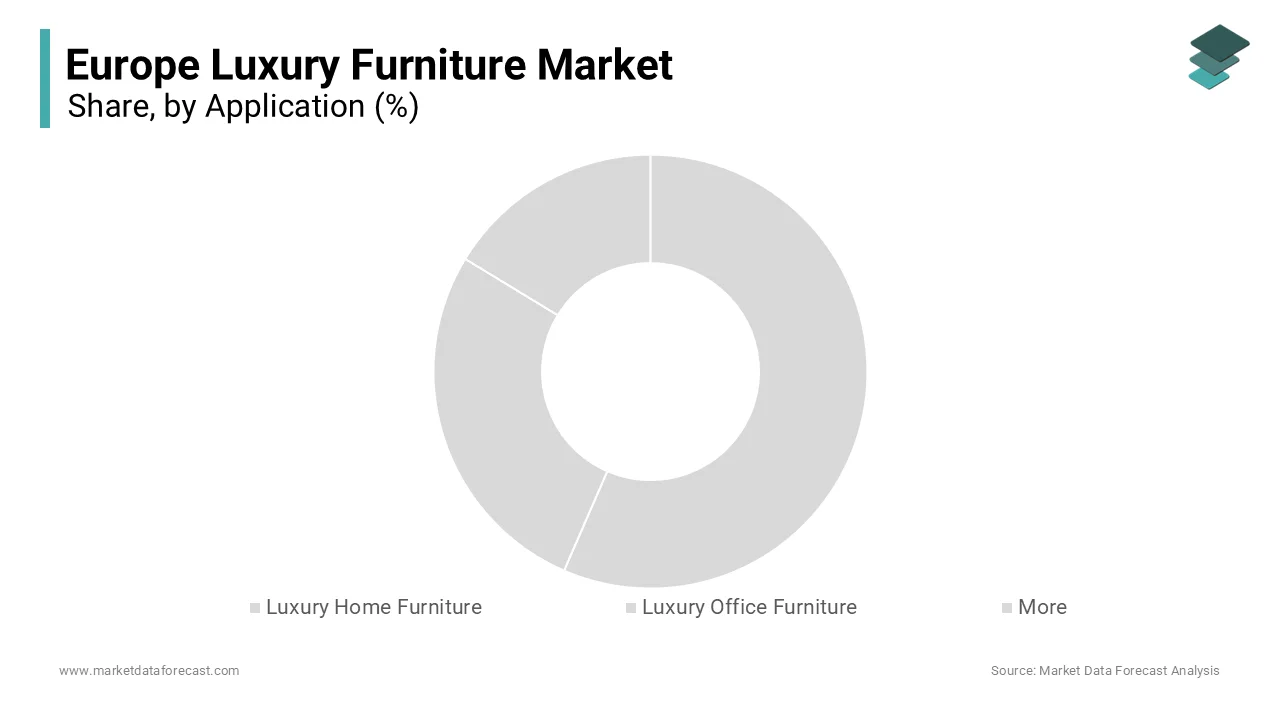
European affluence is traditionally expressed through the home rather than overt consumption, with dining salons, living rooms and studies serving as stages for social and familial rituals. Similarly, in Italy, the “cucina abitabile” concept integrates kitchen and living area, as requiring high-end furnishings. The United Nations World Tourism Organisation noted that 31% of luxury tourists in Europe visit designer showrooms and historic ateliers as part of cultural itineraries, reinforcing domestic design as heritage.
The luxury office furniture is expected to grow at the fastest CAGR of 9.1% throughout the forecast period. Post-pandemic corporate strategies emphasise premium in office experiences to attract leadership back to physical spaces. According to the European Corporate Real Estate Federation, 78% of Fortune 500 European headquarters upgraded executive suites in 2025, featuring custom desks, acoustic privacy panels and ergonomic luxury seating. Brands like Poltrona Frau and Vitra now offer integrated executive systems with wireless charging, ambient lighting, and sustainably tanned leather finishes. These spaces are no longer utilitarian but serve as status markers and wellness sanctuaries, blending productivity with aesthetic refinement. This strategic investment in workplace experience drives consistent B2B demand for high-end office solutions.
By Material Insights
The wood segment was the largest by occupying 62.3% of the European luxury furniture market share in 2025, with centuries of artisanal tradition, tactile warmth, and cultural symbolism across European design movements from Baroque to Scandinavian modernism. European luxury furniture is inseparable from its mastery of fine woodworking techniques passed through generations. According to UNESCO, 37 national intangible heritage listings in Europe pertain to wood craftsmanship, including French ébénisterie and Italian intarsia. Workshops in Italy’s Brianza region and Denmark’s Funen island continue to produce pieces with a hand-cut joinery and natural oil finishes that cannot be replicated industrially. The Milan Furniture Fair 2025 featured over 200 collections where solid walnut, oak, and olive wood were central design elements, as reported by Fiera Milano.
Metal is the fastest-growing material segment in the European luxury furniture market, projected to expand at a compound annual growth rate of 11.4% through 202,8, according to the European Metals in Design Association. This growth is driven by minimalist aesthetics and structural innovation in contemporary luxury.
Contemporary luxury increasingly embraces metal for its clean lines, structural integrity and compatibility with smart home integration. Brands like B&B Italia and Cassina now use aerospace-grade aluminium and brushed stainless steel in frame construction, allowing for slender profiles and cantilevered forms impossible with wood. According to the Politecnico di Milano’s 2025 Design Trends Report 58% of new luxury furniture prototypes featured metal as a primary or accent material. These components often house wiring for integrated lighting or wireless charging, requiring high-tolerance machining. In Germany, metal frame sofas with modular upholstery grew by 27% in 2025, as documented by the Scandinavian Design Council. This fusion of industrial precision and domestic comfort aligns with the “quiet luxury” ethos favoured by younger affluent consumers.
By Distribution Channel Insights
The B2C segment was the largest with a prominent share of the European luxury furniture market in 2025. European luxury furniture brands invest heavily in immersive retail environments that transcend transactional spaces to become design temples. According to Fiera Milano, the average flagship store investment in Milan, Paris and London exceeded €5 million in 202,4 with features like material libraries, custom ateliers and digital configurators. Roche Bobois’ Paris showroom hosts monthly design talks attended by over 2000 clients annually, as reported by the French Design Council. These spaces enable tactile engagement with textures, finishes, and craftsmanship—critical for products costing tens of thousands of euros. The United Nations World Tourism Organisation noted that 28% of luxury tourists in Europe include designer showrooms in their itineraries, reinforcing retail as a cultural gateway. Luxury furniture purchasing remains a high-involvement process requiring expert guidance and personalisation. Brands like Poltrona Frau and Minotti employ certified design advisors who create pieces using 3D visualisation tools and material samples.
The B2B segment is expected to grow at the fastest CAGR of 10.7% throughout the forecast period. High-end real estate and hospitality projects are major drivers of bulk luxury furniture procurement. Similarly, the World Travel & Tourism Council reported that Europe welcomed 128 million luxury travellers in 202,4, prompting renovations at iconic hotels like Hotel de Crillon and The Gritti Palace. Multinational corporations are using luxury furniture to signal innovation and culture in their European headquarters. According to the European Corporate Real Estate Federation, 78% of Fortune 500 companies upgraded executive suites and reception areas in 2025, featuring pieces by Cassina, Poltrona Frau and Carl Hansen & Son. These spaces serve as brand narratives where furniture communicates values like sustainability, craftsmanship and heritage.
REGIONAL ANALYSIS
Italy Market Analysis
Italy was the top performer in the European luxury furniture market with 26.3% of share in 2025, with its unrivalled concentration of heritage ateliers, design schools and artisanal districts like Brianza and Tuscany. Milan’s Salone del Mobile attracted 340000 visitors in 2025, reinforcing Italy as the global design capital. The government’s Art Bonus scheme provides 65% tax credits for the restoration of artisan workshops sustaining craftsmanship. Furthermore, Italian luxury furniture exports reached €5.2 billion in 2025, with Germany, France and the US as top destinations according to ISTAT.
France Market Analysis
France luxury furniture market was positioned second by holding 19.2% of share in 2025 that lies in its fusion of historical savoir faire and contemporary design innovation centered in Paris Lyon and Marseille. French ébénisterie is inscribed in UNESCO’s intangible cultural heritage list with over 2200 master cabinetmakers certified nationally as reported by the Ministry of Culture. Parisian maisons like Roche Bobois and Ligne Roset lead in blending heritage techniques with modern aesthetics appealing to global collectors. This synergy of state patronage cultural prestige and market dynamism sustains France’s elite position.
Germany Market Analysis
Germany luxury furniture market growth is likely to be driven by the engineering precision, functional minimalism and strong demand from affluent urban professionals. German consumers prioritise durability, sustainability, and understated elegance, with 76% willing to pay 30% more for fFFSC-certified food and non-toxic finishes, as per the studies. Brands like Walter Knoll and Bulthaup exemplify the “quiet luxury” ethos through modular systems and timeless forms.
United Kingdom Market Analysis
The United Kingdom luxury furniture market growth has been growing steadily over the past few years and is likely to continue the same in the coming years through its historic design houses, strong auction market, nd London’s status as a global wealth hub. British heritage brands like Linley and Benchmark emphasise craftsmanship with royal warrants and bespoke commissions. The Victoria and Albert Museum’s 2025 exhibition on British furniture heritage attracted over 250000 visitors, where cultural resonance. Additionally, the UK’s flexible planning laws enable the rapid conversion of historic buildings into luxury residences requiring custom interiors.
COMPETITIVE LANDSCAPE
KEY MARKET PLAYERS
Some of the companies that are playing a dominating role in the European luxury furniture Market include
- Ashley Furniture Industries, LLC
- Lee Industries, Inc. (American Leather Holdings LLC)
- Maiden Home, Inc.
- Williams-Sonoma, Inc.
- Kimball International, Inc.
- Century Furniture LLC (RHF Investments, Inc.)
- Duresta Upholstery Limited
- Giovanni Visentin S.r.l.
- Scavolini S.p.A.
- Muebles Pico S.A.
TOP STRATEGIES USED BY THE KEY MARKET PLAYERS
Leading participants in the European luxury furniture market emphasise heritage storytelling through immersive flagship experiences and digital configurators that enable bespoke co-creation. They invest in sustainable material innovation, including bio-textiles, FSC-certified wood, and reclaimed metals to al,ign w aligning with EU environmental regulations and conscious consumerism. Companies are expanding certified pre-owned and restoration services to support circularity and enhance brand longevity. Strategic collaborations with architects, interior designers, and luxury automotive brands extend influence beyond traditional retail. Additionally, firms are strengthening direct client relationships through atelier programs and private client advisory services to deepen emotional loyalty and justify premium pricing in a competitive landscape.
COMPETITION OVERVIEW
Competition in the European luxury furniture market is defined by a delicate balance between heritage authenticity and contemporary relevance. The landscape is dominated by century-old European maisons such as Poltrona Frau, Roche Bobois, and Carl Hansen & Son that leverage artisanal legacy design archives and cultural prestige as primary differentiators. However, they face increasing pressure from emerging design studios that prioritise sustainability, modularity and digital integration, appealing to younger affluent consumers. Competition is not price-driven but centred on narrative craftsmanship and experiential retail. Regulatory shifts under the EU Ecodesign for Sustainable Products Regulation are raising the bar for material traceability and circularity, favouring brands with transparent supply chains.
TOP PLAYERS IN THE MARKET
- Poltrona Frau is an Italian luxury furniture icon with a heritage dating back to 1912, renowned for its handcrafted leather seating and bespoke interiors. The company contributes globally through its integrated portfolio, including Cappellini and Cassina, serving residential yachts and private aviation markets. Poltrona Frau supplies interiors for luxury automotive brands like Maserati and Bugatti, reinforcing its sector design authority. In 2025, the company launched its Atelier program across flagship stores in Milan, Paris, and London, enabling clients to co-design pieces with master artisans using digital visualisation tools. This initiative deepens emotional engagement and aligns with Europe’s growing demand for personalised heritage craftsmanship.
- Roche Bobois is a French luxury furniture maison celebrated for its artistic collaborations and modular design systems. The company operates over 250 showrooms worldwide with a strong presence in Europe, North America, and Asia. Roche Bobois partners with global designers such as Marcel Wanders and Jean Nouvel to create limited edition collections that blend avant-garde aesthetics with artisanal production.
- Carl Hansen & Son is a Danish design house synonymous with Scandinavian modernism and timeless craftsmanship. The company holds exclusive rights to produce furniture by Hans JWegenerr and other mid-century masters, ensuring authenticity and heritage value. It exports to more than 80 countries with flagship boutiques in Copenhagen, New York, and Tokyo.
Europe Luxury Furniture Market News
- On March 20,24, Poltrona Frau launched its Atelier customisation program in flagship stores across Milan, Pari, and London, enabling clients to cocoon-design bespoke leather and wood pieces with master artisans using real-time visualisation tools.ls..
MARKET SEGMENTATION
The research report on the European luxury furniture Market has been segmented and sub-segmented based on categories.
By Application
- Luxury Home Furniture
- Luxury Office Furniture
- More
By Material
- Wood
- Metal
- Glass
- More
By Distribution Channel
- B2C / Retail
- B2B / Project
By Country
- UK
- France
- Spain
- Germany
- Italy
- Russia
- Sweden
- Denmark
- Switzerland
- Netherlands
- Turkey
- Czech Republic
- Rest of Europe