- Product Description Description
- Table of Contents TOC
- List of Table & Figure LOT
- Get Free Sample PDF Sample PDF
Market Size, 2025
$10.10 BnMarket Estimate, 2026
$10.64 BnMarket Forecast, 2034
$16.12 BnCAGR, 2026–2034
5.33%Europe Luxury Handbags Market Size
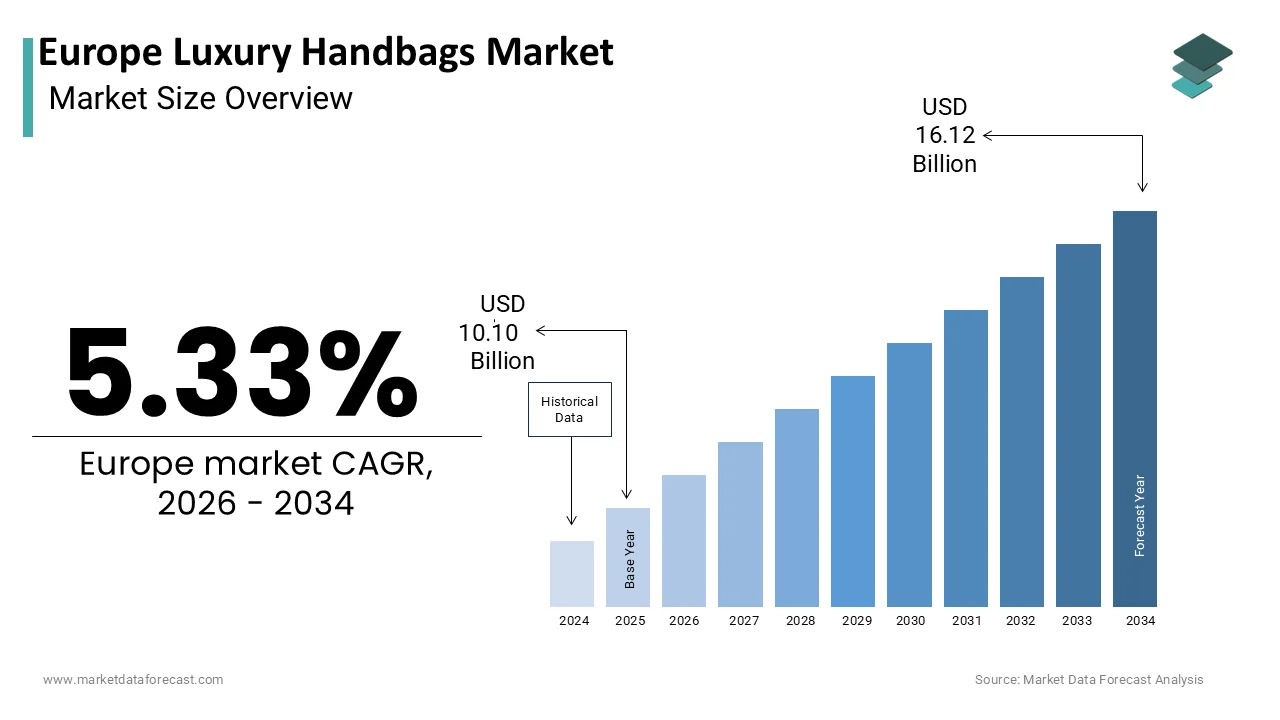
The Europe luxury handbags market was valued at USD 10.10 billion in 2025, is estimated to reach USD 10.64 billion in 2026, and is projected to reach USD 16.12 billion by 2034, growing at a CAGR of 5.33% from 2026 to 2034.
The luxury handbags are the pinnacle of the accessories sector, defined by exclusive designs, superior craftsmanship, and heritage branding that transcends mere utility to become a symbol of status and investment. This ecosystem encompasses high-end leather goods, exotic skin creations, and limited-edition pieces produced by historic houses primarily located in France, Italy, and the United Kingdom. The definition has evolved to include not just physical artifacts but an entire narrative of artisanal legacy, ethical sourcing, and digital exclusivity. Europe serves as the global epicenter for this industry, hosting the headquarters of major conglomerates like LVMH and Kering. According to Eurostat, the European Union recorded over 530 million international tourist arrivals in 2023, a significant portion of whom engage in luxury shopping as a core component of their travel experience, particularly in cities like Paris, Milan, and London. Furthermore, the European Commission notes that the creative industries contribute approximately 4% to the EU GDP, with luxury leather goods being a dominant sub-sector driving exports. The market is characterized by rigorous adherence to quality standards, often protected by geographical indications such as "Made in Italy" or "Made in France." As per the European Environment Agency, there is an increasing regulatory push towards circularity, forcing brands to redefine value through durability and repairability.
MARKET DRIVERS
Resurgence of High-Net-Worth Individual Demographics and Wealth Concentration
The significant expansion of the high-net-worth individual population and the concentration of wealth within the region, which directly fuels demand for exclusive leather goods,s is majorly boosting the growth of Europe luxury handbags market. This includes a surge in younger entrepreneurs, who view luxury handbags as symbols of success and social capital. These consumers are less price-sensitive and more driven by brand narrative and limited-edition releases. Furthermore, the inheritance wave expected over the next two decades is poised to inject trillions of euros into the hands of younger generations already acculturated to luxury lifestyles. Statistics from the European Central Bank reveal that household savings rates in key markets like Germany and France remain historically high, providing a financial buffer that supports discretionary spending on premium fashion even during periods of inflation. This accumulation of wealth ensures a steady and expanding demand pipeline for high-end handbag houses.
Integration of Digital Omnichannel Experiences and Social Commerce
The sophisticated integration of digital omnichannel experiences and the rise of social commerce, which has democratized access while maintaining an aura of exclusivity,ity is escalating the growth of Europe luxury handbags. European luxury brands have moved beyond simple e-commerce transactions to create immersive digital ecosystems that blend online convenience with the tactile allure of physical boutiques. According to McKinsey and Company, digital channels now influence over 90% of luxury sales in Europe, either through direct online purchases or by informing offline decisions. The adoption of augmented reality for virtual try-ons, live-streamed fashion shows, and personalized AI-driven styling services has significantly enhanced customer engagement. Data from the European Interactive Advertising Association reveals that 68% of European luxury consumers purchased after interacting with a brand on social media platforms like Instagram or TikTok, highlighting the power of visual storytelling. Brands are leveraging these platforms to launch digital-first collections and non-fungible token-linked physical items, appealing to tech-savvy collectors. This digital fluency enables brands to reach customers beyond traditional geographic hubs, capturing demand in secondary cities where physical boutiques are absent.
MARKET RESTRAINTS
Stringent Environmental Regulations and Sustainability Compliance Costs
The implementation of rigorous environmental regulations across the European Union by imposing heavy compliance burdens and operational complexities on manufacturers is restricting the growth of Europe luxury handbags market. The EU Strategy for Sustainable and Circular Textiles introduces strict requirements for product durability, recyclability, and the use of recycled fibers, compelling brands to overhaul their supply chains and production processes. According to the European Commission, the upcoming Digital Product Passport will mandate detailed tracking of every item's lifecycle, from raw material sourcing to end-of-life disposal, requiring immense investment in data infrastructure and transparency. Furthermore, restrictions on the use of certain chemicals in leather tanning and dyeing processes, enforced under the REACH regulation, limit the palette of materials available to designers and force costly reformulations. As per the survey, non-compliance can result in severe fines and reputational damage, deterring rapid innovation and market entry for niche players. The pressure to achieve carbon neutrality by 2050 forces companies to divert resources from marketing and expansion to sustainability initiatives, potentially slowing overall market growth. These regulatory hurdles create a barrier to agility by making it difficult for brands to respond quickly to fleeting fashion trends while maintaining profitability.
Economic Volatility and Inflationary Pressure on Discretionary Spending
The economic volatility and persistent inflationary pressures are eroding consumer confidence and altering spending priorities among the aspirational middle class,s impeding the growth of Europe luxury handbags market. While the ultra-wealthy remain insulated, the broader base of luxury consumers, including millennials and Gen Z, who drive significant volume, are highly sensitive to macroeconomic conditions. The consumer confidence indices have dipped to historic lows in major economies like Germany and Italy, correlating with a noticeable contraction in voluntary spending on non-essential high-value items. The rising interest rates aimed at curbing inflation have also increased the cost of borrowing, affecting both consumer financing options for luxury purchases and the capital availability for brand expansions. Additionally, the uncertainty surrounding global trade relations and energy costs exacerbates supply chain expenses, forcing brands to raise retail prices, which further dampens demand.
MARKET OPPORTUNITIES
Expansion of the Pre-Owned and Circular Luxury Economy
The rapid expansion of the pre-owned and circular luxury economy by shifting consumer values towards sustainability and value retention is substantially to promote new opportunities for the growth of Europe luxury handbags market. European consumers are increasingly viewing second-hand luxury not as a compromise but as a smart, ethical, and stylish choice, creating a burgeoning market for authenticated vintage and resale items. Brands have the opportunity to capitalize on this by launching their own certified resale platforms and buy-back programs, thereby controlling the secondary market narrative and fostering deeper customer loyalty. Furthermore, the integration of blockchain technology for authentication ensures trust and transparency, addressing the primary concern of counterfeit goods in the resale sector.
Personalization Through Artificial Intelligence and Bespoke Services
The integration of artificial intelligence to deliver hyper-personalization and bespoke services to enhance customer exclusivity and engagement is expected to escalate the growth of the Europe luxury handbags market. In an era where mass production is common, the ability to offer tailored experiences and customized products distinguishes true luxury brands. Opportunities exist in developing algorithms that predict micro-trends for specific client clusters, allowing for limited-run productions that feel exclusive. Furthermore, AI can facilitate virtual co-creation sessions where clients design their own handbags in real-time with a digital artisan, bridging the gap between digital convenience and artisanal touch. This level of customization fosters an emotional connection and reduces return rates, as products are inherently suited to the buyer.
MARKET CHALLENGES
Proliferation of Counterfeit Goods and Intellectual Property Theft
The proliferation of counterfeit goods and intellectual property theft undermines the integrity and profitability, undermining brand equity and consumer trust, which is one of the challenges for the growth of Europe's luxury handbags market. According to the European Union Intellectual Property Office, the fashion and luxury goods sector loses an estimated 10 billion EUR annually due to counterfeiting, with online marketplaces and social media platforms serving as major distribution channels for illicit goods. These fake products not only divert revenue but also damage brand reputation when consumers associate poor quality or unethical production practices with the original label. The challenge is exacerbated by the complexity of global supply chains, where counterfeit components can infiltrate legitimate production lines. Combating this requires significant investment in advanced authentication technologies, such as NFC chips and blockchain tracking, as well as extensive legal actions across multiple jurisdictions. The erosion of exclusivity due to the widespread availability of fakes dilutes the brand's allure by making it difficult to justify premium pricing.
Supply Chain Fragility and Scarcity of Artisanal Talent
The supply chain fragility and the scarcity of artisanal talent that threaten the production capacity and quality standards are other attributes that threaten the growth of Europe's luxury handbags market in the coming years. The industry relies heavily on specialized skills passed down through generations, such as leather crafting, embroidery, and stitching, yet there is a growing shortage of young people entering these trades. Furthermore, the supply chain for raw materials like high-grade leather, exotic skins, and hardware is vulnerable to climate change, geopolitical tensions, and animal welfare regulations, leading to volatility in availability and cost. Data from industry logistics analyses show that lead times for premium raw materials have extended in recent years by complicating inventory planning and collection launches. The concentration of manufacturing in specific regions like Northern Italy and France also exposes the sector to localized disruptions, such as energy shortages or labor strikes. Navigating this talent and resource crisis requires substantial investment in vocational training and supply chain diversification, which is capital-intensive and time-consuming, posing a long-term threat to the scalability and consistency of European luxury handbags.
REPORT COVERAGE
| REPORT METRIC | DETAILS |
| Market Size Available | 2025 to 2034 |
| Base Year | 2025 |
| Forecast Period | 2026 to 2034 |
| Segments Covered | By Product Type, Material Type, End User and Region. |
| Various Analyses Covered | Global, Regional, and Country-Level Analysis, Segment-Level Analysis, Drivers, Restraints, Opportunities, Challenges; PESTLE Analysis; Porter’s Five Forces Analysis, Competitive Landscape, Analyst Overview of Investment Opportunities |
| Countries Covered | UK, France, Spain, Germany, Italy, Russia, Sweden, Denmark, Switzerland, Netherlands, Turkey, Czech Republic, Rest of Europe |
| Market Leaders Profiled | LVMH Moët Hennessy Louis Vuitton SE, Kering S.A., Chanel Limited, Hermès International S.A., Prada S.p.A., Burberry Group plc, Dolce & Gabbana S.r.l., Giorgio Armani S.p.A., Hugo Boss AG, Ralph Lauren Corporation, Capri Holdings Limited, Moncler S.p.A. |
SEGMENTAL ANALYSIS
By Product Type Insights
The shoulder bags segment was the largest by holding 32.1% of the Europe luxury handbags market share in 2025, with the timeless versatility of the silhouette, which seamlessly bridges the gap between professional utility and evening elegance, making it the most practical choice for the daily lives of European consumers. The first major driving factor is the enduring popularity of iconic heritage models that define the shoulder bag category, such as the Chanel Classic Flap, the Louis Vuitton Neverfull, and the Gucci Marmont, which have become cultural symbols of status and sophistication. The second factor is the ergonomic design of shoulder bags,s which allows for hands-free mobility, a feature for the urban lifestyle prevalent in major European capitals like Paris, London, and Milan, where commuting via public transport or walking is common.
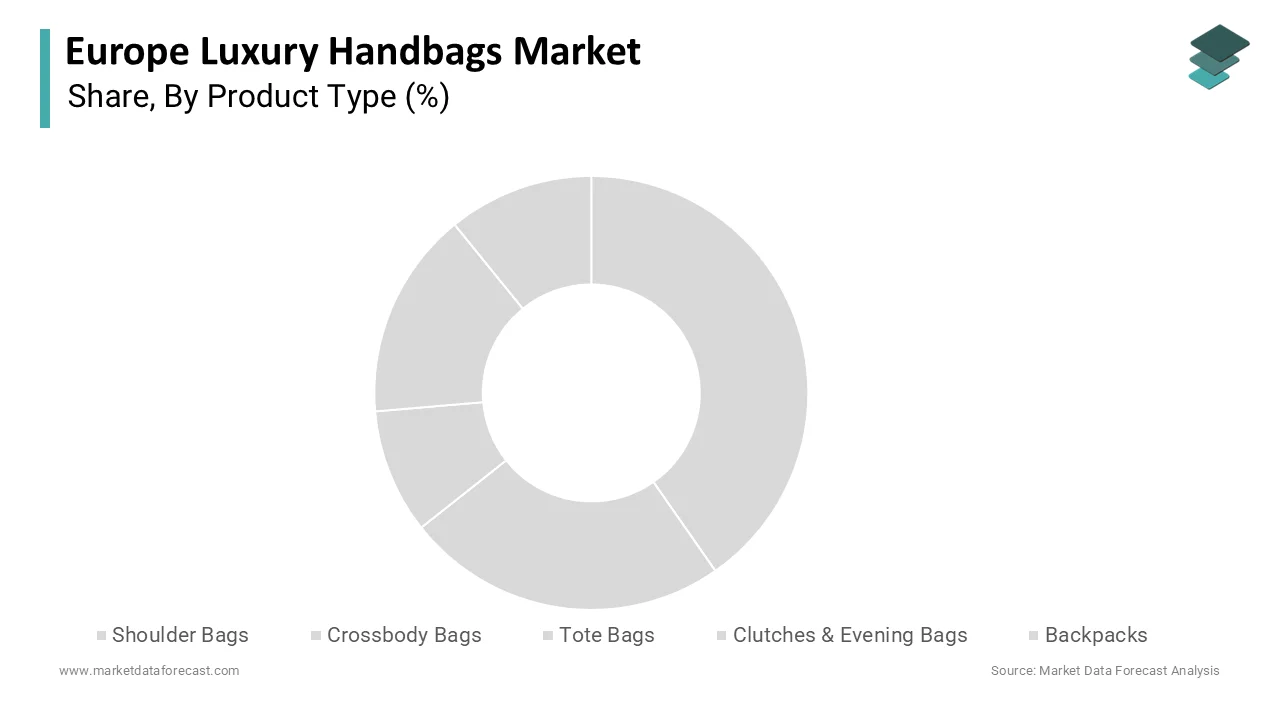
The crossbody bags segment is expected to grow at the fastest 9.4% during the forecast period, with the rising influence of streetwear culture on high fashion and the increasing need for practicality in an active, on-the-go lifestyle. The adoption of luxury crossbody styles by younger demographics, particularly Generation Z and Millennials, who view them as essential statement pieces that complement contemporary casual attire. The enhanced security feature inherent to the crossbody design, which has become increasingly valued in crowded tourist hubs and busy city centers across Europe. Additionally, the versatility of adjustable straps allows these bags to be worn at multiple heights, catering to diverse body types and styling preferences.
By Material Type Insights
The leather segment held a dominant share of the Europe luxury handbags market in 2025, owing to the centuries-old European tradition of leather craftsmanship, the perceived superior durability of the material, and its association with genuine luxury and heritage. The consumer perception that full-grain and exotic leathers represent the pinnacle of quality, offering a patina that improves with age, justifies the high price points associated with luxury brands. The robust supply chain infrastructure in Europe, in regions like Tuscany in Italy and the Auvergne-Rhone-Alpes in France, where specialized tanneries have perfected the art of processing premium hides for generations. Furthermore, advancements in sustainable tanning processes, such as vegetable tanning and chrome-free methods, have addressed growing environmental concerns by allowing leather to maintain its appeal, despite the rise of eco-consciousness. The emotional connection consumers feel towards the tactile experience of real leather ensures its continued reign as the preferred material for luxury handbags.
The synthetic segment is likely to witness a dominant share of the Europe luxury handbags market in 2025, owing to the intensifying demand for cruelty-free and vegan products, driven by ethical considerations and stringent animal welfare regulations within the European Union. A critical driver is the technological innovation in bio-based and lab-grown materials, such as mushroom leather (mycelium), pineapple leaf fiber, and recycled polyester, which now mimic the texture and durability of animal leather with remarkable fidelity. Data reveals that the search volume for "vegan luxury handbags" in Europe has increased by 60% over the last two years, reflecting a shifting consumer mindset among younger generations who prioritize ethics over tradition, according to digital trend analytics. The second factor is the proactive stance of major luxury conglomerates in developing proprietary sustainable materials to future-proof their brands against regulatory changes and resource scarcity. Statistics show that several leading houses have launched dedicated collections made entirely from innovative synthetics, which have seen sell-out rates comparable to their leather counterparts. As technology continues to bridge the gap between performance and ethics, the synthetic segment is poised to capture significant market share from traditional leather.
By End User Insights
The women segment was the largest by holding a significant share of the Europe luxury handbags market in 2025, owing to the historical positioning of handbags as a quintessential female accessory, the vast diversity of styles marketed specifically to women, and the higher frequency of purchase cycles among female consumers. The deep emotional and social significance attached to handbags in female fashion culture, where they serve not just as functional items but as key indicators of personal style, status, and identity. Research indicates that women are responsible for over 90% of luxury handbag purchasing decisions, often buying multiple pieces to match different occasions, outfits, and seasons, according to consumer behavior studies. The second factor is the extensive marketing ecosystems built around female icons, celebrities, and influencers who showcase new collections, driving desire and trends within the female demographic. Furthermore, the gifting culture surrounding holidays, anniversaries, and milestones heavily favors handbags as the premier gift for women, sustaining consistent demand throughout the year. The continuous innovation in designs tailored to female ergonomics and aesthetic preferences ensures that the women's segment remains the financial backbone of the luxury handbag industry.
The men segment is likely to witness the fastest CAGR of 10.5% from 2026 to 2034, with the evolving definition of modern masculinity, the normalization of men carrying bags beyond simple briefcases, and the increasing influence of streetwear and hip-hop culture on male fashion. The dissolution of traditional gender norms by encouraging men to embrace a wider variety of bag styles, such as messenger bags, belt bags, and even smaller crossbody pouches, as fashionable accessories. Data reveals that spending on men's luxury bags has increased by 40% in the last three years, with items from brands like Dior Men, Louis Vuitton, and Prada becoming staples for the style-conscious male, according to menswear market analysis. The growing professional requirement for men to carry more than just a wallet necessitates stylish yet functional solutions for laptops, tablets, and documents that elevate the standard briefcase. Statistics show that 60% of millennial and Gen Z men in Europe now own at least one designer bag, a figure that has doubled since 2019, driven by the desire to project success and sophistication.
COUNTRY LEVEL ANALYSIS
France Luxury Handbags Market Analysis
France was the top performer in the Europe luxury handbags market by occupying 30.4% of the share in 2025, with its role as the global headquarters for the world's largest luxury conglomerates, including LVMH and Kering, and its unparalleled reputation as the capital of haute couture and leather goods. The deep-rooted heritage of French craftsmanship and the "Made in France" label, which serves as a global benchmark for quality and exclusivity, attracts millions of international tourists annually. The strong government support for the creative industries, including tax incentives for artisans and protections for geographical indications that preserve traditional techniques, sissbolstering the growth of the market. The presence of iconic avenues like thChamps-Élyséeses and Rue Saint-Honoré provides a concentrated hub for flagship stores that generate immense foot traffic and brand visibility. Furthermore, the French consumer's innate appreciation for aesthetics and style ensures a robust domestic market that values heritage brands. The synergy between tourism, industrial concentration, and cultural prestige solidifies France's position as the primary engine of the European luxury handbag economy.
Italy Luxury Handbags Market Analysis
Italy's luxury handbags market was ranked second by holding 26.3% of the market share in 2025, with its historic dominance in leather goods, textiles, and manufacturing excellence. The dense network of artisanal districts, particularly in regions like Tuscany, Lombardy, and Veneto, where family-owned businesses have perfected their crafts over centuries. The global reverence for "Made in Italy" as a synonym for superior quality, design innovation, and timeless elegance, which commands premium pricing and fierce loyalty worldwide,e is also to fuel the growth of Europe luxury handbags market. Reports show that Italy exports over 65% of its luxury handbag production, with brands like Gucci, Prada, and Bottega Veneta serving as ambassadors of Italian style on the global stage,ge according to the Italian National Fashion Chamber. The integration of luxury handbags with Italy's thriving tourism sector, where cities like Milan, Florence, and Rome act as magnets for fashion-focused travel. Milan Fashion Week remains one of the "Big Four" global events, drawing buyers, press, and celebrities who stimulate local retail activity. Additionally, the strong collaboration between brands and local artisans ensures a steady supply of high-quality materials and components, maintaining the integrity of the supply chain.
United Kingdom Luxury Handbags Market Analysis
The United Kingdom luxury handbags market growth is anticipated to have a prominent growth opportunity in the coming years,s with its unique blend of traditional tailoring heritage and cutting-edge contemporary design. The market status is marked by London's status as a global fashion capital that nurtures avant-garde talent alongside historic houses, creating a dynamic and diverse luxury market. The UK's advanced digital infrastructure supports a thriving e-commerce sector for luxury goods, with British consumers being among the earliest adopters of online luxury shopping in Europe. The city's vibrant cultural scene, including art fairs and royal events, provides numerous occasions for luxury consumption. Furthermore, the weakening of the pound at times has made luxury goods relatively cheaper for international tourists, boosting inbound shopping. The fusion of historical prestige, modern creativity, and digital adoption ensures the UK remains a critical and influential market for luxury handbags.
Germany Luxury Handbags Market Analysis
Germany's luxury handbags market growth is likely to grow with the pragmatic yet affluent consumer base that values quality, durability, and understated elegance over overt branding. The robust economy and high disposable income levels in regions like Bavaria and Hamburg, which support a steady demand for premium automotive-linked fashion and high-performance outdoor luxury wear. Statistical data suggests that German consumers spend 30% more per capita on luxury accessories compared to the European average, favoring timeless designs that retain value according to consumer spending reports. The strategic location is a central hub for European tourism, with cities like Munich, Berlin, and Düsseldorf attracting wealthy visitors from across the continent and beyond. The presence of high-end department stores like KaDeWe and Galeries Lafayette provides curated environments that cater to discerning tastes. Additionally, the growing awareness of sustainability among German consumers is pushing brands to adopt transparent supply chains and eco-friendly practices, with those meeting these criteria seeing higher engagement.
Spain Luxury Handbags Market Analysis
Spain's luxury handbags market growth is likely to grow with a vibrant and rapidly evolving player in the strong domestic textile industry and a booming tourism sector. The lively consumer culture that embraces fashion as a form of social expression, with a particular affinity for leather goods, footwear, and resort wear. The massive influx of international tourists, especially during the summer months, who flock to coastal destinations and major cities like Madrid and Barcelona, significantly boosts retail sales. The success of homegrown luxury giants like Loewe (part of LVMH but with deep Spanish roots) and Puig has cultivated a strong local appreciation for Spanish design and quality. Spanish consumers are increasingly confident in domestic brands, driving a shift towards locally produced luxury items. Furthermore, the Mediterranean lifestyle promotes a year-round demand for stylish, versatile handbags suitable for both urban and leisure settings.
COMPETITIVE LANDSCAPE
The competition in the Europe luxury handbags market is intensely fierce,e characterized by a strategic battle between massive conglomerates and independent heritage houses for dominance in brand prestige and customer loyalty. Global giants leverage their extensive financial resources to acquire niche brands and secure prime retail locations in key cities like Paris and Milan. However, independent players differentiate themselves through unparalleled craftsmanship and exclusive scarcity models that appeal to discerning collectors. The market sees constant innovation in digital engagement as brands vie for the attention of younger demographics through social media and virtual experiences. Price competition is minimal since brand equity drives value,ue but rivalry exists in securing top creative talent and sustainable raw materials. The rise of the resale market adds another layer of complexity as brands compete to control the secondary lifecycle of their products. Success increasingly depends on balancing heritage storytelling with modern sustainability credentials while adapting quickly to shifting geopolitical and economic landscapes.
KEY MARKET PLAYERS
Some of the companies that are playing a dominating role in the global Europe Luxury Handbags Market include
- LVMH Moët Hennessy Louis Vuitton SE
- Kering S.A.
- Hermès International S.A.
- Chanel Limited
- Prada S.p.A.
- Burberry Group plc
- Capri Holdings Limited
- Tapestry, Inc.
- Fossil Group, Inc.
- Compagnie Financière Richemont S.A.
- PVH Corp.
- Guess, Inc.
TOP LEADING PLAYERS IN THE MARKET
- LVMH Moët Hennessy Louis Vuitton stands as the undisputed global leader in the luxury handbag sector, originating from France and defining the standards of exclusivity worldwide. The conglomerate contributes significantly to the global market by managing a vast portfolio of prestigious brands including Louis Vuitton, Dior, and Celine. Recently, LVMH has strengthened its European position by investing heavily in vertical integration, acquiring specialized tanneries to secure supply chains for its leather goods division. The company actively expands its retail footprint through the renovation of historic flagship stores in Paris and London to offer immersive brand experiences. LVMH also pioneers sustainability initiatives to reduce environmental impact across its operations.
- Kering SA operates as a powerhouse in the Europe luxury handbags market, renowned for its house of iconic brands including Gucci, Saint Laurent, and Bottega Veneta. The company drives global trends by championing creative innovation and sustainable luxury practices that resonate with modern consumers. Kering recently bolstered its market stance by implementing a rigorous sustainability strategy aimed at reducing its environmental footprint significantly within the next decade. The group focuses on direct-to-consumer strategies, minimizing wholesale dependencies to better control brand image and pricing power across European capitals. Kering actively invests in digital transformation, utilizing artificial intelligence to optimize inventory and enhance online customer journeys. Furthermore, the company supports emerging designers through foundations and awards, fostering a pipeline of fresh talent.
- Hermès International maintains a unique and revered position in the Europe luxury handbags market through its unwavering commitment to artisanal craftsmanship and family-owned governance. The company contributes globally by setting the benchmark for quality and scarcity, particularly in its legendary leathergoodso, ds which often appreciate. Hermès recently strengthened its presence by opening new manufacturing workshops in France to increase production capacity while strictly adhering to its handmade traditions. The brand avoids mass marketing, relying instead on exclusive client relationships and waitlists to drive demand and maintain an aura of unattainability. Hermès continues to invest in real estate, acquiring prime locations in major European cities to expand its boutique network without diluting brand exclusivity. The company also emphasizes vertical integration by owning its supply chain from raw materials to retail, ensuring total quality control.
TOP STRATEGIES USED BY KEY MARKET PARTICIPANTS
Key players in the Europe luxury handbags market primarily focus on vertical integration to control entire supply chains from raw material sourcing to final retail distribution, ensuring quality and exclusivity. Companies heavily invest in digital transformation by developing sophisticated e-commerce platforms and utilizing artificial intelligence for personalized client experiences. Major participants prioritize sustainability initiatives by adopting circular economy principles and transparent sourcing to meet evolving consumer expectations and regulatory requirements. Firms also expand their direct-to-consumer networks by renovating flagship stores and reducing reliance on third-party wholesalers to maintain brand equity. Additionally, brands leverage limited edition releases and exclusive collaborations to generate hype and maintain high demand among affluent customers.
MARKET SEGMENTATION
This research report on the europe luxury handbags market is segmented and sub-segmented into the following categories.
By Product Type
- Shoulder Bags
- Crossbody Bags
- Tote Bags
- Clutches & Evening Bags
- Backpacks
- Others
By Material Type
- Leather
- Synthetic (Vegan Leather, Bio-based Materials, Recycled Materials)
By End User
- Women
- Men
By Country
- France
- Italy
- United Kingdom
- Germany
- Spain
- Rest of Europe