- Product Description Description
- Table of Contents TOC
- List of Table & Figure LOT
- Get Free Sample PDF Sample PDF
Market Size, 2025
$17.2 BnMarket Estimate, 2026
$18.55 BnMarket Forecast, 2034
$33.82 BnCAGR, 2026–2034
7.8%Executive Summary: Europe Luxury Jewelry Market
- Market Scope: Comprehensive regional luxury jewelry market analysis covering product segments, material choices, end-user demographics, country-specific leadership frameworks, and key strategic developments.
- Market Valuation: Valued at USD 17.20 billion (2025), estimated at USD 18.55 billion (2026), and projected to reach USD 33.82 billion by 2034, registering a robust CAGR of 7.80% (2026–2034).
- Primary Growth Drivers: Deep-rooted cultural traditions surrounding intergenerational wealth transfer and legacy gifting, alongside rising female economic autonomy shifting consumption toward active self-purchase. Opportunities include augmented reality bespoke experiences and secondary affluent city expansions, balanced against market challenges.
Key Market Segment Metrics (2026–2034)
| Category | Leading Segment (2025 Position) | Fastest-Growing Segment |
|---|---|---|
| By Product & Material | Rings segment (held 38.3% share due to wedding rituals); Gold material (held 45.4% leading share) | Earrings segment (CAGR of 6.8%); Platinum material (fastest CAGR of 7.2%) |
| By End-User | Women’s segment (led the end-user category in 2025) | Men’s segment (experienced fastest growth with a CAGR of 8.1%) |
| By Region / Country | Italy (dominated with 28.3% share in 2025; France second with 24.5% due to haute joaillerie heritage) | Affluent European secondary metropolitan cities and emerging luxury hubs |
Major Market Players & Market Structure
Market Structure: Highly competitive European luxury jewelry landscape featuring premier houses and groups competing intensely on artisanal vertical integration, blockchain provenance storytelling, and certified sustainable gold sourcing.
Key Companies: LVMH Moët Hennessy Louis Vuitton SE, Compagnie Financiere Richemont SA, Kering S.A., Chopard International SA, Bulgari S.p.A., Cartier, Van Cleef & Arpels, Harry Winston, Inc., Tiffany & Co., Graff Diamonds Ltd., Piaget SA, Boucheron, De Beers Group, Swarovski AG, Damiani S.p.A., Pandora A/S, Buccellati Holding Italia S.p.A., Chaumet, Messika Paris, and FRED Paris.
Europe Luxury Jewelry Market Size
The Europe Luxury Jewelry Market is projected to grow from USD 17.20 billion in 2025 to USD 18.55 billion in 2026 and reach USD 33.82 billion by 2034, registering a CAGR of 7.80% from 2026 to 2034.
Luxury jewelry refers to the high-quality pieces crafted from precious metals like gold and platinum, and high-grade gemstones such as diamonds, sapphires, and rubies. It encompasses both haute joaillerie, exclusive one-of-a-kind creations by maisons such as Cartier, Van Cleef, and Boucheron, and premium ready-to-wear fine jewelry targeting affluent consumers seeking emotional resonance and legacy investment. Unlike mass market accessories, luxury jewelry in Europe functions as a cultural artifact embodying generational continuity, ty social distinctiveness, and emotional milestones.
Most households view fine jewelry as an important form of intergenerational transfer, with many engagement rings incorporating heirloom stones or settings, according to sources. Also, as per research, top income earners in major European economies collectively spend a significant amount annually on personal luxury goods, and jewelry makes up a considerable portion of that expenditure. Furthermore, the majority of luxury jewelry workshops in key production countries are family-owned artisanal ateliers. Despite being small operations, these workshops produce a substantial amount of the continent's high-end output. This ecosystem of artisanal excellence, intertwined with deep-seated cultural rituals, defines the market’s unique character beyond mere consumption.
MARKET DRIVERS
Intergenerational Wealth Transfer and Legacy Consumption Patterns
The continent’s entrenched culture of inheritance and legacy gifting, which sustains demand across demographic cohorts, is a key accelerator of the European luxury jewelry market. According to a study, a growing number of wealthy individuals in France, Italy, and Spain plan to pass down significant jewelry pieces to their direct descendants. This intergenerational transfer is not merely transactional but deeply symbolic, with Heirs in Germany and the UK showing a strong emotional attachment to inherited jewelry, opting to keep pieces rather than sell them, as per studies. This behavior fuels both preservation and renewal demand. For instance, A jewelry brand's program for restoring and modernizing vintage items has seen an increase in client requests from European customers. The persistence of this ritualistic consumption, rooted in Europe’s civil law traditions and familial estate planning, creates a resilient demand base insulated from short-term economic fluctuations and reinforces the emotional premium associated with luxury jewelry.
Rising Female Economic Autonomy and Self-Purchase Behavior
The increasing financial independence of European women has fundamentally reshaped luxury jewelry consumption from passive gifting to active self-acquisition, which further propels the expansion of the European luxury jewelry market. As per sources, the representation of women within the highest earning brackets has increased over time. This economic empowerment translates directly into purchasing power. Brands have responded with collections explicitly designed for self-expression rather than ceremonial symbolism. A significant portion of sales for specific luxury jewelry lines is attributed to women purchasing items for themselves, according to a study. Moreover, Independent boutiques in key European cities have seen a rise in the number of solo female clients seeking multi-session consultations for custom commissions. This shift signifies a cultural evolution where luxury jewelry functions not only as a token of affection but as a tangible affirmation of personal agency and success.
MARKET RESTRAINTS
Stringent EU Regulations on Precious Metal and Gemstone Sourcing
The European Union’s progressively rigorous due diligence mandates for responsible sourcing hamper the growth of the European luxury jewelry market. As per research, importers of specific high-value materials are required to implement comprehensive traceability systems that cover the entire supply chain, from the point of extraction to the final retail stage. According to sources, a considerable number of jewelry brands have encountered delays in releasing new collections, a consequence of the time and effort required to meet third-party audit requirements and resolve documentation bottlenecks. These regulations particularly impact artisanal workshops that lack dedicated compliance teams. As per studies, small-scale workshops and ateliers are experiencing higher costs for raw materials due to premiums associated with certified sourcing practices. Furthermore, A forthcoming regulatory directive will broaden liability requirements for corporations, extending their responsibility to include indirect suppliers within their value chain. The market's fluidity is tempered by ethically required frameworks that inhibit design creativity, expand delivery timelines, and raise the entry costs for new designers.
Persistent Consumer Skepticism Toward Lab-Grown Diamonds
European luxury consumers remain notably resistant to lab-grown diamonds. This restrains the expansion of the European luxury jewelry market. According to a study, Luxury jewelry buyers in France, Italy, and Switzerland are notably reluctant to consider high-end pieces featuring lab-created diamonds. This contrasts sharply with the acceptance of lab-grown diamonds is significantly higher in the United States. The skepticism stems from Europe’s deep cultural association of natural diamonds with rarity, authenticity, and heritage value. Consequently, major European maisons have explicitly excluded lab-grown diamonds from their high jewelry lines, reserving them only for entry-level diffusion collections. This stance limits pricing flexibility and prevents brands from leveraging lower-cost synthetics to attract younger demographics without diluting brand equity, a strategic constraint not faced by U.S. peers operating in more pragmatic markets.
MARKET OPPORTUNITIES
Integration of Digital Bespoke Experiences Through Augmented Reality
Luxury jewelry brands in the region are capitalizing on immersive digital tools to bridge the gap between heritage craftsmanship and contemporary client expectations, which creates new opportunities for the expansion of the European luxury jewelry market. According to research, a notable share of European consumers aged 25 to 45 now expect the ability to visualize custom jewelry on themselves before purchase. In response, houses like Piaget and Dior Joaillerie have deployed proprietary augmented reality platforms enabling clients to adjust gemstone settings, view pieces in real time via smartphone, and share designs with family for approval. Moreover, Chaumet’s partnership with a Paris-based AI startup allows clients to input emotional narratives, such as “my first solo trip to Kyoto”, to generate design suggestions rooted in symbolic motifs. These digital bespoke journeys not only enhance accessibility for time-constrained clients but also deepen emotional investment by transforming passive viewing into co-creation. Such tools are projected to drive many new custom orders in Western Europe in the coming years, signaling a paradigm shift in client engagement.
Expansion into High Net Worth Secondary Cities Beyond Traditional Capitals
Brands in this field are strategically penetrating affluent secondary cities where competition is lower, and client loyalty is higher, which generates fresh prospects for the expansion of the European luxury jewelry market. According to sources, in certain European cities like Lyon, Bordeaux, Hamburg, and Porto, luxury residential prices have increased significantly. Luxury retailers are experiencing success with new store openings in emerging luxury hubs, such as Tiffany & Co.'s positive performance in Porto. High-end jewelry and other luxury brands are establishing new presences in cities like Hamburg to serve affluent clients. These satellite expansions benefit from lower real estate costs, more personalized service models, and proximity to regional family offices that manage intergenerational wealth outside financial capitals.
MARKET CHALLENGES
Escalating Insurance and Security Costs for High Value Inventory
The increasing threat of organized retail crime has dramatically increased operational costs for luxury jewelry retailers across the region and thereby negatively impacted the European luxury jewelry market. High-end jewelry stores across Western Europe have reported an increase in smash-and-grab raids. In response, Insurers have raised premiums for luxury goods inventory, both in transit and in-store. Brands are compelled to invest heavily in countermeasures. Major luxury retailers are implementing advanced security measures in their flagship locations, including biometric access controls, bullet-resistant display cases, and AI-powered surveillance systems. Smaller maisons face disproportionate strain. These escalating costs not only compress margins but also deter boutique expansions in high footfall tourist zones where vulnerability is greatest, yet client traffic is essential.
Cultural Resistance to Rapid Trend Cycles in High Jewelry
An inherent commitment to permanence and timelessness, which is reflected in its lengthier design and acquisition cycles, slows down the expansion of the European luxury jewelry market. The cultural norm impedes brands’ ability to drive frequent repurchase or seasonal turnover. While younger consumers show interest in contemporary aesthetics, they remain hesitant to discard classic pieces. Consequently, brands cannot replicate the fast-paced drop culture seen in luxury apparel. Attempts to introduce trend-driven micro collections often underperform, with resale values of such pieces depreciating within a few years. This tension between heritage permanence and modern consumption rhythms presents a structural challenge in accelerating revenue velocity without eroding the core value proposition of enduring legacy.
REPORT COVERAGE
| REPORT METRIC | DETAILS |
| Market Size Available | 2025 to 2034 |
| Base Year | 2025 |
| Forecast Period | 2026 to 2034 |
| Segments Covered | By Product Type, Raw Material, End User and Region. |
| Various Analyses Covered | Global, Regional and Country-Level Analysis, Segment-Level Analysis, Drivers, Restraints, Opportunities, Challenges; PESTLE Analysis; Porter’s Five Forces Analysis, Competitive Landscape, Analyst Overview of Investment Opportunities |
| Countries Covered | UK, France, Spain, Germany, Italy, Russia, Sweden, Denmark, Switzerland, Netherlands, Turkey, Czech Republic, Rest of Europe |
| Market Leaders Profiled | LVMH Moët Hennessy Louis Vuitton SE, Compagnie Financière Richemont SA, Kering S.A., Chopard International SA, Bulgari S.p.A. (a subsidiary of LVMH), Cartier (a subsidiary of Richemont), Van Cleef & Arpels (a subsidiary of Richemont), Harry Winston, Inc. (a subsidiary of Swatch Group), Tiffany & Co. (a subsidiary of LVMH), Graff Diamonds Ltd., Piaget SA (a subsidiary of Richemont), Boucheron (a subsidiary of Kering), De Beers Group, Swarovski AG, Damiani S.p.A., Pandora A/S, Buccellati Holding Italia S.p.A. (a subsidiary of Richemont), Chaumet (a subsidiary of LVMH), Messika Paris, FRED Paris (a subsidiary of LVMH) |
SEGMENTAL ANALYSIS
By Product Insights
The rings segment was the largest in the European luxury jewelry market, accounting for 38.3% in 2025. Deep-rooted cultural rituals and legal traditions surrounding marriage and commitment across the continent are the key contributors to the prominence of the rings segment. In addition, the enduring institution of engagement and wedding rings, which remains near universal in Western and Southern Europe, also fuels the growth of this segment. In Germany, the civil law requires documented proof of engagement for certain visa applications, which further institutionalizes ring gifting. Moreover, the rise of “eternity rings” to mark milestone anniversaries has created a recurring purchase cycle. This ritualistic reinforcement ensures consistent demand independent of fashion trends and positions rings as non-discretionary emotional purchases rather than discretionary accessories.
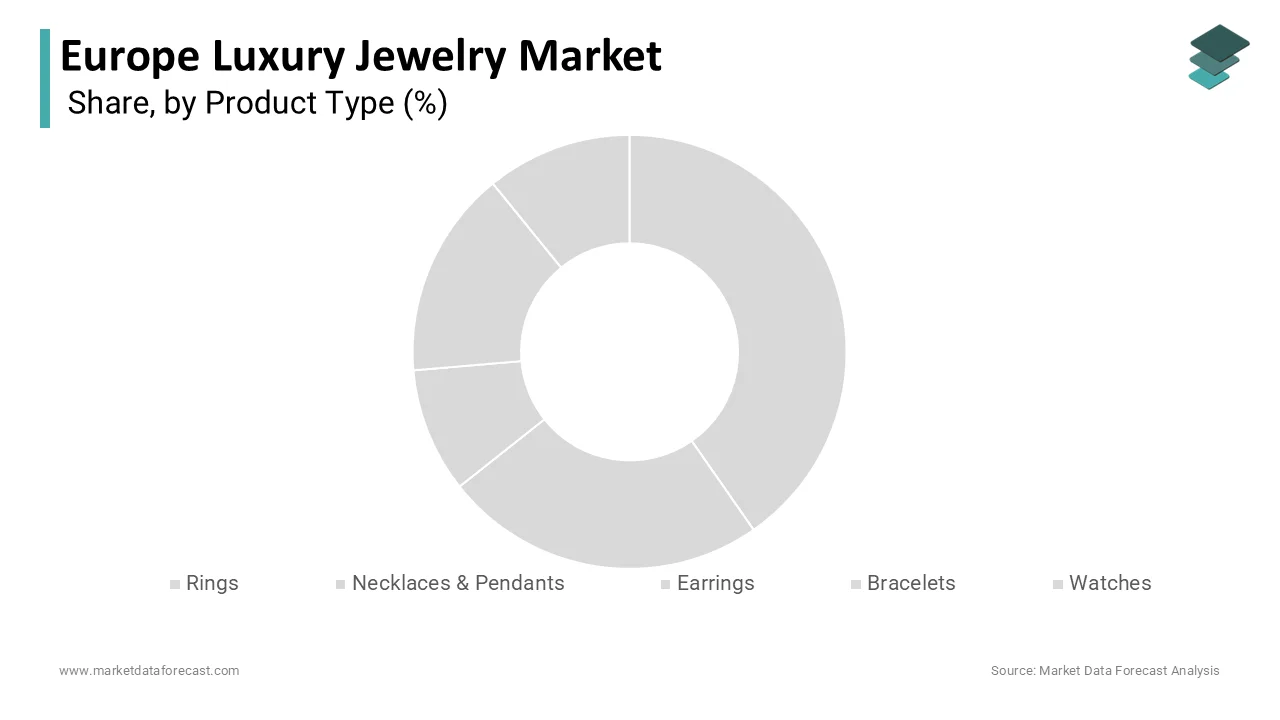
The earrings segment is predicted to witness the highest CAGR of 6.8% from 2025 to 2033 due to shifting aesthetic norms and rising self-gifting behavior among professional women. Unlike rings, earrings are not constrained by sizing or permanence, allowing for greater experimentation. Brands have responded with modular designs such as convertible drops a interchangeable ear cuffs, which saw an increase in European sales. Apart from these, the normalization of multiple ear piercings among younger demographics has expanded addressable inventory per client. This combination of stylistic flexibility, cultural acceptance, and product innovation transforms earrings from accent pieces into core wardrobe investments.
By Raw Material Insights
The gold segment held the leading share of 45.4% of the European luxury jewelry market in 2025. Its dual role as both an aesthetic medium and a store of intergenerational value deeply embedded in European financial culture has mainly propelled the supremacy of the gold segment. In Southern Europe, gold jewelry functions as a quasi-financial instrument. As per sources, a significant majority of households in Italy maintain physical gold jewelry as a component of their overall household wealth reserves. Similarly, Affluent households in Greece largely perceive gold jewelry as a protective measure against economic downturns or periods of crisis, according to research. Moreover, in European goldsmithing traditions, particularly in key Italian jewelry manufacturing hubs, the predominant material used in fine jewelry production is 18-karat gold, as per studies. This cultural and material prestige ensures gold’s centrality despite price volatility as consumers prioritize intrinsic value over transient design.
The platinum segment is estimated to register the fastest CAGR of 7.2% from 2025 to 2033. The rapid growth of the platinum segment is fueled by rising demand for durable hypoallergenic settings in the bridal and high jewelry segments. Platinum’s density and tensile strength make it ideal for securing high-value diamonds with minimal prong visibility, a critical factor in Europe’s heritage-focused market. Furthermore, platinum’s naturally white luster eliminates the need for rhodium plating required by white gold, reducing lifetime maintenance costs. European consumers, increasingly valuing ethical sourcing, are drawn to platinum because its main origins, South Africa and Canada, have stronger environmental governance compared to some gold mining hubs.
By End User Insights
In 2024, the women's segment led the European luxury jewelry market and accounted for a substantial share 2025. Both cultural tradition and evolving economic agency are among the major drivers of the women segment. Historically, jewelry has been a gendered symbol of status and life milestones for women, but the dynamic has expanded to include self-expression and financial autonomy. The rise of self-purchase behavior is pivotal. Brands have responded with collections. This dual role of jewelry, as both inherited heirloom and self-affirmed symbol, cements women as the market’s central demographic.
The men’s segment is likely to experience the fastest CAGR of 8.1% between 2025 and 2033, owing to a broader cultural shift toward gender fluid aesthetics and male emotional expression. Luxury brands are actively cultivating male clientele through discreet yet distinctive designs. The appeal of specific iconic fine jewelry collections, such as Cartier's Juste un Clou and Tiffany's T1, is seeing a significant increase in demand among male consumers in Europe. More than half of men aged 25 to 40 in Europe now view fine jewelry as an essential element of their formal attire. There is a noticeable trend in Sweden and the Netherlands for same-sex male couples to exchange custom platinum wedding bands. This normalization of male adornment transforms jewelry from a niche accessory into a mainstream element of contemporary masculine identity.
COUNTRY LEVEL ANALYSIS
Italy Luxury Jewelry Market Analysis
Italy dominated the European luxury jewelry market and captured a 28.3% share in 2025 because of its unparalleled goldsmithing heritage and vertically integrated manufacturing ecosystem. The country is home to a significant number of artisanal jewelry workshops concentrated in Valenza and Vicenza, which produce a share of Europe’s high-karat gold jewelry. Italy’s dominance is reinforced by global maison,s including Bulgari and Pomella, which maintain primary design and production facilities within the country to leverage local expertise in hand engraving, stone setting, and alloy formulation. Domestic demand remains robust, and household expenditure data reflect the deep cultural integration of gold as both adornment and asset.
France Luxury Jewelry Market Analysis
France was the second-largest player in the European luxury jewelry market, accounting for a 24.5% share in 2025. The growth of luxury jewelry in France is attributed to Paris's status as the birthplace of haute joaillerie and the headquarters of iconic maisons such as Cartier, Van Cleef & Arpels, and Boucheron. The French market thrives on the fusion of artistic legacy and institutional prestige, with the French Ministry of Culture recognizing jewelry craftsmanship as part of the nation’s intangible cultural heritage. According to the French Luxury Goods Federation, over 80 percent of high jewelry pieces sold in Europe originate from French design studios, os with Paris boutiques alone generating 3.2 billion euros in 2024. The country’s appeal is amplified by cultural tourism. A large number of international visitors made luxury jewelry purchases in Paris in 2024, representing a share of total luxury retail tourism spend. Additionally, France leads in ethical innovation with most of its luxury jewelers participating in the Initiative for Responsible Mining Assurance, ensuring traceable gold and gemstone sourcing.
United Kingdom Luxury Jewelry Market Analysis
The United Kingdom maintains a noteworthy position in the European luxury jewelry market, which is propelled by strong bridal demand and growing interest in jewelry as an alternative asset class. The UK also hosts Europe’s most active pre-owned luxury jewelry market, with platforms reporting a year-on-year increase in jewelry auction turnover. This secondary market liquidity enhances consumer confidence in jewelry as a store of value. Moreover, London’s status as a global wealth hub attracts high-net-worth individuals from the Middle East and Asia who contribute a portion of luxury jewelry sales in Mayfair boutiques. This blend of ceremonial tradition and financial perception sustains the UK’s pivotal role.
Germany Luxury Jewelry Market Analysis
Germany experienced a steady growth in the European luxury jewelry market due to its demand for engineering precision, ethical sourcing, and understated design. The country’s stringent implementation of the EU Conflict Minerals Regulation has made it a testing ground for blockchain-enabled provenance systems, with brands achieving high gold traceability from mine to mouth. German craftsmanship is renowned for technical excellence, particularly in clasp mechanisms and wearability, ty with numerous specialized component manufacturers based in Pforzheim, the historic jewelry capital. This rational yet discerning consumer base favors timeless pieces with demonstrable sustainability credentials over conspicuous branding.
Switzerland Luxury Jewelry Market Analysis
Switzerland is predicted to expand in the European luxury jewelry market during the forecast period, owing to ultra-high net worth demand, discretion, and horological synergy. Swiss consumers and residents prioritize understated elegance, with platinum and white gold settings favored for their subtlety and durability. The country’s neutrality and banking legacy attract global we, with Geneva and Zurich serving as key hubs for jewelry asset allocation. Swiss jewelers such as Chopard and De Grisogono leverage their watchmaking expertise to create technically complex pieces, gem-set tourbillon pendants, which command premium valuations. This convergence of horological precision, gemological excellence, and wealth privacy cements Switzerland’s unique high-end position.
COMPETITIVE LANDSCAPE
Competition in the European luxury jewelry market is defined by a delicate balance between heritage preservation and contemporary relevance, where legacy maisons dominate through craftsmanship narrative and emotional resonance rather than price or volume. The market features a clear tiering with Pari, Milan, and London-based houses such as Cartier, Bulgari, and Van Cleef and Arpels commanding the haute joaillerie segment, while independent designers compete on uniqueness in the premium ready-to-wear space. Unlike fast-moving luxury categories, jewelry operates on a long purchase cycle, making brand trust and intergenerational appeal critical differentiators. New entrants face high barriers due to artisanal skill requirements, ts stringent EU material regulations, and entrenched consumer loyalty to historic names. However, digital personalization and ethical sourcing are emerging as new battlegrounds where even established players must continuously innovate to retain relevance among younger affluent audiences who value both legacy and responsibility.
KEY MARKET PLAYERS
Some of the companies that are playing a dominating role in the europe luxury jewelry market include
- LVMH Moët Hennessy Louis Vuitton SE
- Compagnie Financière Richemont SA
- Kering S.A.
- Chopard International SA
- Bulgari S.p.A. (a subsidiary of LVMH)
- Cartier (a subsidiary of Richemont)
- Van Cleef & Arpels (a subsidiary of Richemont)
- Harry Winston, Inc. (a subsidiary of Swatch Group)
- Tiffany & Co. (a subsidiary of LVMH)
- Graff Diamonds Ltd.
- Piaget SA (a subsidiary of Richemont)
- Boucheron (a subsidiary of Kering)
- De Beers Group
- Swarovski AG
- Damiani S.p.A.
- Pandora A/S
- Buccellati Holding Italia S.p.A. (a subsidiary of Richemont)
- Chaumet (a subsidiary of LVMH)
- Messika Paris
- FRED Paris (a subsidiary of LVMH)
TOP LEADING PLAYERS IN THE MARKET
- Cartier is a cornerstone of the European luxury jewelry market, renowned for its timeless designs, such as the Love and Juste un Clou collections, which blend symbolic meaning with architectural precision. As a founding member of the Richemont Group, the maison exerts significant influence on global luxury standards and retail innovation. The brand also integrated blockchain certification across its European boutique, enabling clients to verify the provenance of gold and diamonds in real time. These initiatives reinforce Cartier’s commitment to heritage authenticity and personalized client experience while strengthening its leadership in ready-to-wear and haute joaillerie segments across the continent.
- Bulgari stands as a quintessential Italian luxury jeweler celebrated for its bold use of color, Roman architectural motifs, and mastery of high karat gold craftsmanship. Owned by LV, MH, the brand leverages its Roman heritage to differentiate itself in a competitive landscape, emphasizing artistry over minimalism. The company also inaugurated a new goldsmithing academy in Valenza to train the next generation of artisans, ensuring continuity of its technical excellence. Additionally, Bulgari deepened its sustainability commitment by sourcing certified recycled gold for its B.zero1 collection across all European markets, a move that aligns with evolving consumer ethics without compromising aesthetic legacy.
- Van Cleef and Arpels is distinguished by its poetic design philosophy xe exemplified by the Alhambra motif and mastery of mystery-set gemstones that require a significant number of hours of hand craftsmanship per piece. As part of the Richemont, the maison occupies a rarefied space in Europe’s haute joaillerie ecosystem, catering to connoisseurs who value narrative and technical virtuosity. It also introduced a digital twin service in its London and Paris bboutiquesallowing clients to preview custom Alhambra configurations in augmented reality. These efforts enhance exclusivity while modernizing the client journey without diluting its artisanal soul.
TOP STRATEGIES USED BY THE KEY MARKET PARTICIPANTS
Leading players in the European luxury jewelry market are intensifying investments in vertical integration of artisanal craftsmanship to safeguard design authenticity and production secrecy. They are embedding digital storytelling through augmented reality and blockchain provenance to enhance transparency while preserving mystique. Brands are expanding private salon networks in secondary affluent cities to offer discreet high-touch experiences beyond flagship capitals. Strategic emphasis is placed on training the next generation of goldsmiths through in-house academies to counter artisanal labor shortages. Additionally, companies are aligning material sourcing with EU sustainability mandates by adopting certified recycled gold and traceable diamonds, thus transforming compliance into a brand equity asset.
MARKET SEGMENTATION
This research report on the europe luxury jewelry market is segmented and sub-segmented into the following categories.
By Product Type
- Rings
- Necklaces & Pendants
- Earrings
- Bracelets
- Watches
- Others
By Raw Material
- Gold
- Platinum
- Diamond
- Gemstones
- Silver
- Others
By End User
- Women
- Men
- Unisex
By Country
- Italy
- France
- United Kingdom
- Germany
- Switzerland
- Rest of Europe