Europe Marine Battery Market Size, Share, Growth, Trends, And Forecast Report, Segmented By Battery, Capacity, Design, Application, And By Region (The UK, France, Spain, Germany, Italy, Russia, Sweden, Denmark, Switzerland, Netherlands, Turkey, Czech Republic and Rest of Europe), Industry Analysis From (2026 to 2034)
Market Size, 2025
$0.48 BnMarket Estimate, 2026
$0.57 BnMarket Forecast, 2034
$2.17 BnCAGR, 2026–2034
18.24%Executive Summary: Europe Marine Battery Market
- Market Scope: Comprehensive European marine battery market analysis covering battery chemistries, capacity segments, national leadership shares, regulatory decarbonization mandates, and cost benchmarks.
- Market Valuation: Valued at USD 0.48 billion (2025), rising to USD 0.57 billion (2026), and reaching USD 2.17 billion by 2034, registering a robust CAGR of 18.24% (2026–2034).
- Primary Growth Drivers: Strict maritime environmental regulations and fleet electrification initiatives. Key structural and regulatory benchmarks include the EU FuelEU Maritime mandate requiring ships over 5,000 gross tons to reduce greenhouse gas intensity by 2% in 2025 (progressing to 80% by 2050), Norway initiating over 50 ferry replacement projects requiring 1–5 MWh battery systems each, and marine-grade lithium-ion battery costs declining 12% year-over-year to bring average installed prices below €950/kWh.
Key Market Segment Metrics (2026–2034)
| Category | Leading Segment (2025 Position) | Fastest-Growing Segment |
|---|---|---|
| By Battery Type | Lithium-ion batteries (held a substantial leading share) and solid-state battery designs | Flow batteries (projected to grow at a rapid 41.3% CAGR) |
| By Capacity | Greater than 250 Ah (dominated with a 58.3% market share in 2025) | 100–250 Ah battery capacity segment (projected to grow at a 22.1% CAGR) |
| By Ship / Vessel Type | Commercial ferries, hybrid tugs, and electric coastal vessels | Zero-emission inland waterway cargo ships and luxury yachts |
| By Country / Region | Norway (led with 28.3% of the market in 2025, followed by Germany at 17.4%) | European nations expanding electric ferry fleets and shore-power charging corridors |
Major Market Players & Market Structure
Market Structure: Highly competitive European maritime energy storage marketplace featuring specialized marine battery manufacturers, cell producers, and powertrain integrators competing intensely on vertical integration, localized manufacturing, modular battery architectures, rigorous safety and fire-suppression certifications, strategic shipyard partnerships, recycling frameworks, and next-generation sodium-ion and solid-state technologies.
Key Companies: Akasol AG, EnerSys, Corvus Energy, Northvolt, Exide Industries, Furukawa Battery Solutions, G.S. Yuasa, HBL Power Systems, Johnson Controls International, Leclanché, Saft Groupe, Siemens, Systems Sunlight, Toshiba, and Wärtsilä.
Europe Marine Battery Market Size
The Europe marine battery market size was valued at USD 0.48 billion in 2025 and is anticipated to reach a valuation of USD 0.57 billion in 2026 and USD 2.17 billion by 2034, growing at a CAGR of 18.24% from 2026 to 2034.
Marine battery refers to the energy storage systems specifically engineered for maritime applications, including commercial shipping, inland waterway vessels, ferries, and recreational boats. These batteries primarily support propulsion, auxiliary power, and onboard electrical systems, with lithium-ion chemistries increasingly displacing traditional lead acid technologies due to superior energy density, cycle life, and reduced maintenance requirements. The region’s strategic focus on decarbonizing inland and coastal water transport has accelerated adoption, particularly in short sea shipping and passenger ferry operations. As per the European Maritime Safety Agency, thousands of inland waterway vessels operate across the European Union’s transnational river and canal networks, with many operating in environmentally sensitive zones such as the Rhine and Danube basins. Furthermore, the European Environment Agency notes that maritime transport contributes to the EU’s total greenhouse gas emissions, with inland shipping accounting for a nontrivial share of localized air pollutants in urban port corridors. This regulatory and ecological context underpins a structural shift toward electrified propulsion systems where marine batteries play a central role in enabling zero-emission navigation corridors, especially in Norway’s fjords, the Baltic Sea, and Dutch inland routes. The technical evolution of marine battery standards under the International Maritime Organization’s Interim Guidelines for Lithium Ion Batteries also ensures safer integration into vessel designs, reinforcing confidence among shipowners and operators.
MARKET DRIVERS
Stringent EU Emission Regulations Are Accelerating Electrification of Inland and Coastal Vessels
The European Union’s tightening regulatory framework for maritime emissions serves as a primary factor for marine battery deployment across commercial and passenger vessel segments, which contributes to the expansion of the Europe marine battery market. The revised FuelEU Maritime Regulation requires ships above 5,000 gross tons calling at EU ports to progressively reduce the greenhouse gas (GHG) intensity of their energy use, starting with a 2% reduction in 2025 and rising substantially to an 80% reduction by 2050. These stipulations create compelling operational and compliance incentives for vessel operators to adopt hybrid or fully electric propulsion systems. Norway’s command in this domain is instructive, as per the Norwegian Maritime Authority, many fully electric or hybrid vessels were in commercial operation along its coastline, including the MF Hydra hydrogen hybrid ferry and the Yara Birkeland autonomous container ship. The European Commission’s Alternative Fuels Infrastructure Regulation further mandates the deployment of shore-side electricity supply at key maritime ports by 2030, directly enabling battery-powered operations during berthing and facilitating full route electrification on short sea corridors. This regulatory momentum, coupled with port infrastructure upgrades, ensures sustained demand for high-capacity marine battery systems tailored to European maritime operational profiles.
Rising Demand for Hybrid and Electric Ferries Is Fueling Commercial Uptake of Marine Batteries
Passenger and vehicle ferry operators across Northern and Western Europe are increasingly investing in battery-powered vessels to meet both environmental mandates and passenger expectations for sustainable travel, and this further propels the growth of the Europe marine battery market. "As per a DNV report, the number of battery or hybrid electric vessels globally reached approximately 200 within a few years (as of 2018), demonstrating rapid adoption, with Europe, particularly Norway, representing a significant portion of this market and leading the way in adopting this technology. This concentration stems from national and subnational policies that prioritize zero-emission public transport on water. For instance, the Netherlands has committed to making all public ferries emission-free by 2030, with the Dutch Ministry of Infrastructure and Water Management reporting that electric ferries were already operational on inland and coastal routes. Similarly, in Denmark, the operator Ærø Municipality launched the E-ferry Ellen in 2019, which was a pioneering long-range all-electric car ferry capable of carrying vehicles and has since accumulated thousands of nautical miles of zero-emission operation, as confirmed by the Danish Maritime Authority. It set a world record by sailing 92 kilometers (50 nautical miles) on a single charge in 2022. The economic viability of these vessels is further enhanced by declining battery costs and favorable electricity tariffs during off-peak hours, which enable operators to achieve payback periods under eight years in high utilization scenarios.
MARKET RESTRAINTS
High Upfront Capital Costs Remain a Significant Barrier to Widespread Adoption
The initial investment required for marine-grade energy storage systems continues to impede broader adoption in the region’s diverse vessel fleet, despite declining battery prices globally. As a result, this hampers the expansion of the Europe marine battery market. Unlike automotive applications, marine batteries must meet rigorous safety, durability, and certification standards such as those defined by the International Electrotechnical Commission 62619 and class societies like Lloyd’s Register and DNV, which substantially increase unit costs. For small and medium-sized shipowners operating on thin margins, such as those in the Rhine barge or Mediterranean coastal cargo sectors, this cost premium is often prohibitive without substantial subsidies. The complicated application processes associated with the European Commission’s Innovation Fund and national co-financing programs mean access is still limited. The European Sea Ports Organisation estimates that few EU-based small vessel operators have the financial capacity to undertake full electrification without external support. Furthermore, the total cost of ownership advantage of electric propulsion only materializes over long operational horizons exceeding ten years, a timeframe that exceeds the typical financing cycle for many independent operators. The cost of marine-certified battery systems will severely limit market penetration beyond publicly funded projects until their per-kilowatt-hour price decreases.
Limited Onboard Space and Weight Constraints Challenge System Integration
Marine vessels, particularly retrofitted inland barges and legacy ferries, often lack the physical volume and structural capacity to accommodate large battery banks without compromising cargo or passenger capacity. Consequently, this degrades the growth of the Europe marine battery market. Unlike purpose-built electric vessels optimized for energy storage, most of Europe’s existing commercial fleet was not designed with electrification in mind. Structural reinforcement to support the additional deadweight of battery systems further increases retrofit complexity and cost. The Swedish Maritime Administration has documented cases where retrofitting older ferries required the removal of vehicle decks or passenger seating to meet stability requirements under the International Maritime Organization’s intact stability code. Moreover, classification societies impose strict thermal management and fire protection mandates, necessitating dedicated ventilation, cooling, and containment infrastructure that consumes valuable internal volume. For short sea shipping operators competing on payload efficiency, these trade-offs directly erode commercial viability. Even in newbuild designs, naval architects face difficult compromises between battery size, range, and revenue-generating space. The technical feasibility of electrifying much of Europe's maritime fleet is currently restricted by spatial and weight issues, which will remain a barrier until modular, high-energy-density marine battery formats are standardized and widely accessible.
MARKET OPPORTUNITIES
Expansion of Emission-Controlled Areas Is Creating New Market Entry Points
The progressive designation of Emission Control Areas and zero emission navigation zones in the region’s inland and coastal waters is generating new opportunities for the Europe marine battery market. The most prominent example is Norway’s World Heritage fjords, where the government mandated that all new passenger ferries operating in these sensitive areas must be zero-emission. As per the Norwegian Ministry of Climate and Environment, this policy has already spurred over 50 ferry replacement projects, each requiring battery systems ranging from 1 to 5 megawatt hours. Similarly, the European Union's comprehensive air quality strategy has included separate legislation and amendments, such as those related to Directive 98/70/EC and Council Directive 1999/32/EC, which mandated a maximum sulphur content of 0.1% by mass for fuels used by inland waterway vessels as of January 1, 2010, covering major waterways like the Rhine, Elbe, and Seine. These geographically bounded regulatory interventions create concentrated demand clusters that reduce market fragmentation and enable economies of scale for battery integrators. Apart from thee, cities are piloting electric harbor tour boats and water taxis as part of urban mobility decarbonization plans, opening avenues in the recreational and tourism sectors. The European Clean Hydrogen Partnership has also begun co-funding hybrid battery hydrogen projects for larger ferries, signaling a broader acceptance of electrochemical energy storage as a foundational maritime technology. Such targeted policy instruments lower commercial risk for early adopters and encourage battery manufacturers to develop region-specific product configurations.
Advancements in Solid State Battery Technology Are Poised to Redefine Performance Standards
Emerging solid-state battery technologies offer a major opportunity for the Europe marine battery market. This is driven by addressing critical limitations of current lithium-ion systems, particularly in safety and energy density. Unlike conventional liquid electrolyte cells, solid-state batteries eliminate flammable components, significantly reducing fire risk, a paramount concern in enclosed vessel engine rooms. As part of the European Battery Alliance's initiatives to foster advanced battery development, several EU-backed consortia have demonstrated significant progress in solid-state battery technology. Such gains could halve the weight and volume required for a given range, directly resolving integration challenges on space-constrained vessels. Furthermore, solid-state chemistries exhibit longer cycle lives, which enhances the total cost of ownership despite higher initial outlays. The European Commission's Horizon Europe program, building on previous efforts like Horizon 2020, has allocated substantial funds to support research and innovation in batteries and energy storage for applications including low-carbon mobility. Achieving DNV and Bureau Veritas type approval by the end of the decade would allow solid-state technology to enable a new phase of electrification for larger and longer-range ships, which are presently deemed uneconomical for battery power.
MARKET CHALLENGES
Inconsistent Port Charging Infrastructure Hinders Operational Viability
The absence of harmonized and reliable shore-side charging infrastructure across European ports and inland waterways is a serious operational challenge for the battery-powered vessels, which in turn affects the expansion of the Europe marine battery market. While Norway and the Netherlands have made significant strides, most EU member states lack standardized high-power charging stations capable of delivering the 1 to 6 megawatt levels required for ferries and cargo vessels during typical turnaround windows of 15 to 45 minutes. As per the European Federation of Inland Waterway Administrations, only a few ports along the Rhine-Danube corridor offered megawatt-scale charging as of mid-2025, creating range anxiety for operators planning multi-day itineraries. The situation is exacerbated by incompatible connector types, grid connection delays, and divergent national permitting processes. For example, a Rhine barge operator based in Duisport may be unable to charge in Strasbourg due to differences in voltage protocols and grid capacity limits. A lack of a coordinated EU-level rollout strategy and binding infrastructure targets means vessel operators face unpredictable downtime and logistical bottlenecks, which weakens the business case for electrification. Operational reliability for battery-powered fleets is currently restricted and will continue to be so until charging becomes universally available and standardized like marine fueling.
Recycling and End-of-Life Management Frameworks Remain Underdeveloped
The lack of a mature, EU-wide regulatory and logistical framework for recycling marine batteries poses a growing environmental and compliance problem as the first generation of large-format maritime battery systems approaches the end of life. This impedes the growth of the Europe marine battery market. Unlike automotive batteries covered under the EU Battery Regulation updated in 2023, marine applications face ambiguous classification, sometimes treated as industrial, sometimes as vehicle batteries, leading to inconsistent collection and processing obligations. Current recycling facilities in Europe, such as those operated by Umicore and Northvolt, are optimized for smaller automotive formats and lack the capacity to handle multi-tonne marine battery packs with complex cooling and casing systems. Moreover, the EU’s Waste Framework Directive does not yet mandate producer responsibility schemes specific to marine batteries, leaving shipowners to navigate a patchwork of national regulations. The expanding marine battery market might compromise its sustainability claims without standardized designs for disassembly, certified recycling pathways, and financial incentives for responsible recovery as deployment increases across the continent.
REPORT COVERAGE
| REPORT METRIC | DETAILS |
| Market Size Available | 2025 to 2034 |
| Base Year | 2025 |
| Forecast Period | 2026 to 2034 |
| CAGR | 18.24% |
| Segments Covered | By Battery, Capacity, Design, Application, By Country |
| Various Analyses Covered | Global, Regional & Country Level Analysis; Segment-Level Analysis, DROC, PESTLE Analysis, Porter’s Five Forces Analysis, Competitive Landscape, Analyst Overview of Investment Opportunities |
| Regions Covered | UK, France, Spain, Germany, Italy, Russia, Sweden, Denmark, Switzerland, Netherlands, Turkey, Czech Republic & Rest of Europe |
| Market Leaders Profiled | Akasol AG (Germany), EnerSys (U.S.), Exide Industries Ltd. (India), Furukawa Battery Solutions Co. Ltd. (Japan), G.S. Yuasa Corporation (Japan), HBL Power Systems Ltd. (India), Johnson Controls International (Ireland), Leclanché SA (Switzerland), Saft Groupe S.A. (France), Siemens AG (Germany), Systems Sunlight SA (Greece), Toshiba Corporation (Japan), Wärtsilä Oyj Abp (Finland) |
SEGMENTAL ANALYSIS
By Battery Insights
The lithium-ion batteries segment was the prominent segment in the Europe marine battery market by accounting for a substantial share in 2025. Factors such as its unmatched energy density and declining lifecycle costs are fuelling the growth of the lithium-ion batteries segment. As per DNV, lithium-ion chemistries accounted for a notable share of all marine battery installations in Europe, a figure projected to rise as newbuild electric vessels enter service. This dominance is also due to regulatory and operational imperatives favoring lightweight, high-efficiency storage. Unlike legacy technologies, lithium-ion systems, particularly lithium iron phosphate variants, enable daily charging on high-frequency ferry routes without premature degradation. Apart from these, the European Union’s Marine Equipment Directive has streamlined type approval for lithium-ion systems certified to IEC 62619, which reduces time to market for integrators. Fleet operators also benefit from falling cell prices, with BloombergNEF reporting a 12 percent year-over-year decline in marine-grade lithium-ion battery costs through 2025, bringing average installed prices below 950 euros per kilowatt hour.
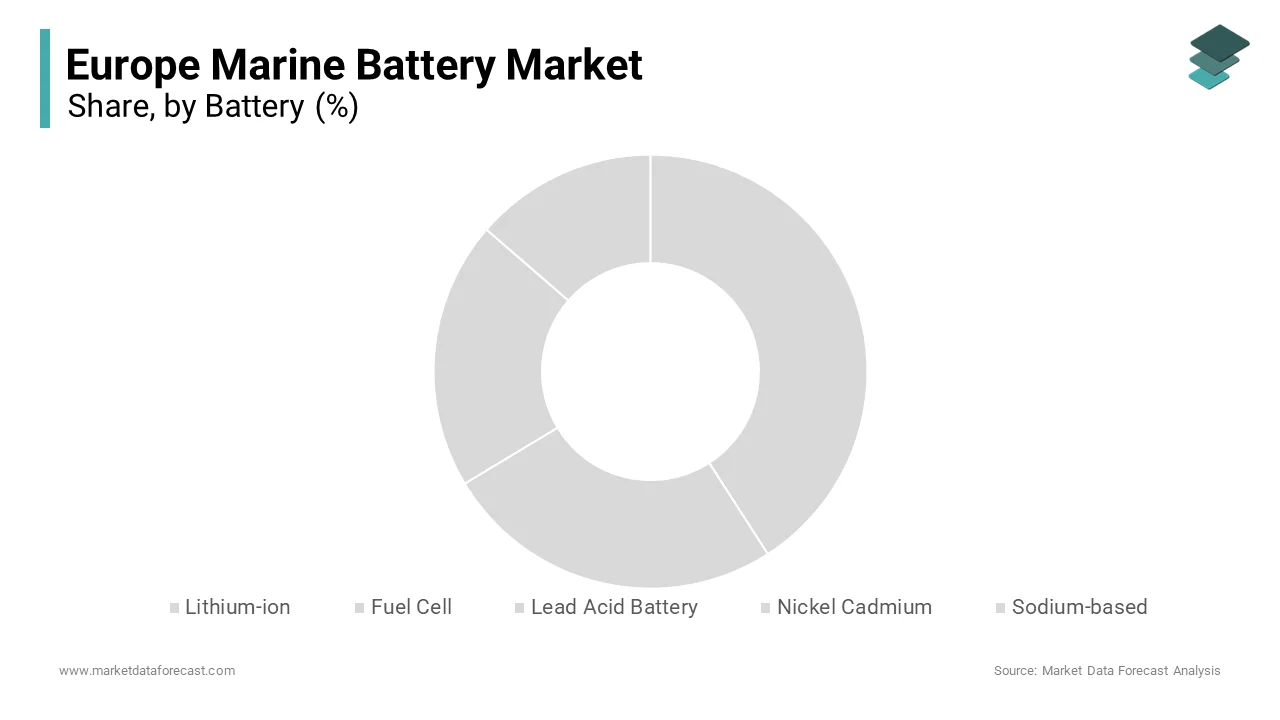
The fuel cell systems segment is on the rise and is expected to be the fastest-growing segment in the market by witnessing a CAGR of 38.4% from 2025 to 2033 due to its ability to deliver long-range zero-emission propulsion, where pure battery solutions fall short, particularly for vessels operating beyond 50 nautical miles per leg. Unlike combustion alternatives, hydrogen fuel cells emit only water vapor and integrate seamlessly with existing hybrid battery architectures for peak shaving and redundancy. As per the European Clean Hydrogen Partnership, many manifold projects are underway across Europe to develop hydrogen-powered ships, including demonstration vessels and those already in service. The MF Hydra in Norway became the world's first liquid hydrogen-powered ferry to commence operations in regular service with passengers and vehicles in the spring of 2023. Also, the HydroTug 1, the world's first hydrogen-powered tugboat, was announced as ready for operation in the Port of Antwerp-Bruges in December 2023 and began operating in early 2025. Germany’s Federal Ministry for Digital and Transport has committed funds to maritime hydrogen infrastructure under its H2Maritime initiative, which targets deployment on Elbe and North Sea routes. Furthermore, the Clean Hydrogen Partnership continues to focus on enhancing fuel cell technologies and improving material durability and safety to tackle market challenges. Fuel cells are the emerging preferred solution for deep-sea and coastal cargo operators seeking decarbonization without sacrificing range or payload, partly due to the EU's Carbon Border Adjustment Mechanism indirectly penalizing traditional fossil-fueled shipping.
By Capacity Insights
The greater than 250 Ah segment dominated the Europe marine battery market by capturing a 58.3% share in 2025. The expansion of the greater than 250 Ah segment is attributed to its suitability for medium and large-sized commercial vessels requiring sustained power delivery. This segment’s dominance is also supported by the operational profile of European short sea shipping, where ferries and RoPax vessels demand high energy throughput during frequent docking cycles. Classification societies such as Bureau Veritas have also updated their rules to favor high-capacity modular designs that simplify thermal management and reduce balance of plant complexity. Moreover, the European Investment Bank points out a preference for larger battery systems in marine electrification projects. This indicates increasing investor confidence in the scalability and reliability of such systems for commercial use.
The 100 to 250 Ah segment is expected to exhibit a noteworthy CAGR of 22.1% over the forecast period. The rapid expansion of the 100 to 250 Ah segment is fueled by rising adoption in small commercial craft, recreational boats, and harbor service vessels that prioritize compactness and modularity over extreme range. Unlike high-capacity systems designed for ferries, this mid-range segment aligns with the power requirements of pilot boats, patrol vessels, and tourist water taxis, which typically operate within 10 to 20 nautical miles of shore. The modular nature of these batteries also enables flexible configuration; operators can parallel multiple units to match specific mission profiles without custom engineering. Apart from these, certification bodies like DNV have introduced streamlined type approval pathways for standardized 200 Ah marine cells, which reduces deployment lead times compared to bespoke high-capacity systems.
By Design Insights
In 2025, the solid-state battery segment led the Europe marine battery market by occupying a significant share. The supremacy of the solid-state battery segment is supported by the near-universal adoption of sealed lithium-ion and nickel-based modules that store energy in solid electrodes, as opposed to liquid tanks. Practically all commercial marine battery installations, including those on Norwegian electric ferries and German Rhine barges, utilize solid-state architectures due to their compact form factor, high power density, and compatibility with existing shipboard power management systems. The expansion is further cemented by class society rules that mandate robust containment and short circuit protection, criteria inherently satisfied by solid-state designs. Even emerging sodium-ion marine batteries retain solid-state cell structures. Solid-state technology will remain the primary standard for European maritime energy storage until flow battery systems can overcome issues related to their size, pumping energy losses, and lack of freeze tolerance in Nordic waters.
The flow batteries segment is expected to exhibit a noteworthy CAGR of 41.3% from 2025 to 2033, owing to its unique decoupling of power and energy, enabling cost-effective scaling for long-duration applications such as overnight energy storage on research vessels or hotel load support on cruise ships at berth. Unlike solid-state systems, where adding capacity increases weight and cost linearly, flow batteries allow energy capacity to be expanded simply by increasing electrolyte tank size, a vital advantage for vessels with abundant hull volume but limited peak power needs. Apart from these, the non-flammable aqueous electrolyte eliminates fire risk, a major concern in passenger vessels. The European Commission has signaled strong institutional backing for marine flow batteries' niche but high-potential role by allocating funds from the Horizon Europe program to advance their integration, even though commercial deployment remains limited.
COUNTRY ANALYSIS
Norway Marine Battery Market Analysis
Norway outperformed other regions in the Europe marine battery market by accounting for a 28.3% share in 2025. The demand for marine batteries in Norway is attributed to aggressive national policies mandating zero-emission operations in ecologically sensitive fjord areas and substantial public investment in maritime electrification infrastructure. According to Norway's Ministry of Trade, Industry and Fisheries, new regulations mandate that all passenger and car ferries operating in World Heritage fjords must achieve zero emissions by 2026, which is driving an increase in orders for battery-powered vessels. Norway currently has the highest global concentration of hybrid or fully electric commercial vessels in service, supported by significant government funding for marine battery projects, including the development of autonomous container ships, and a national charging grid along its western coastline to ensure operational feasibility. Norway continues to establish the technological and regulatory standard for marine battery adoption throughout Europe, driven by its shipyards' pioneering work on integrated electric propulsion systems.
Germany Marine Battery Market Analysis
Germany had the next-biggest share of 17.4% in the Europe marine battery market in 2025. The growth of the German market is driven by its extensive inland waterway network and federal decarbonization mandates for Rhine and Elbe shipping. As per research, several electric or hybrid-assisted vessels were operational on German inland routes by the end of 2025, primarily dry cargo barges and passenger ferries. The country’s leadership is supported by the National Innovation Program for Hydrogen and Fuel Cell Technology, which has allocated funds to maritime electrification. Key projects include the Elektra hydrogen battery pushboat in Berlin and the ELETTA hybrid barge on the Rhine. Germany’s dense network of inland ports provides natural nodes for charging infrastructure deployment, with many ports now equipped with megawatt-scale marine charging stations. Besides, classification and safety standards developed by Germanischer Lloyd have become de facto references for marine battery certification across the EU, reinforcing Germany’s influence beyond its domestic market.
Netherlands Marine Battery Market Analysis
The Netherlands experienced steady growth in the Europe marine battery market, with its systematic electrification of public ferry services and progressive port sustainability policies. The Port of Amsterdam enforces a zero emission requirement for all harbor craft, directly stimulating demand for compact marine battery systems among tugboat and pilot vessel operators. Dutch shipyard Damen has emerged as a key integrator, delivering electric ferries to clients in Sweden, France, and the UK using standardized battery containers developed in partnership with EST-Floattech. Furthermore, the country’s flat geography and dense canal network create ideal conditions for short-range electric navigation with predictable charging windows, making the Netherlands a natural testbed for scalable marine battery business models.
Sweden Marine Battery Market Analysis
Sweden expanded moderately in the Europe marine battery market due to municipal dominance in archipelago and lake transport electrification and strong alignment with national fossil-free shipping goals. The Swedish Maritime Administration’s ElectriFjord program has provided co-financing for vessel electrification projects, which emphasize cold climate performance and ice class compatibility. Besides, Sweden’s commitment to achieving zero-emission domestic shipping by 2045 creates long-term policy certainty for investors. The country’s abundant renewable electricity, with a portion of grid power from hydro and wind, further lowers the carbon intensity of battery charging, enhancing the environmental credibility of electrified maritime operations.
Denmark Marine Battery Market Analysis
Denmark is predicted to grow in the Europe marine battery market between 2025 and 2033, owing to pioneering early adoption and technological demonstration leadership zero-emission ferry operations. Denmark’s influence extends beyond its domestic fleet through technology exports. Copenhagen-based battery integrator X Shore supplies modular marine battery systems to operators in Italy, Greece, and the UK. Moreover, Denmark’s strategic location at the entrance to the Baltic Sea positions it as a logistics and maintenance hub for electric maritime operations across Northern Europe. Denmark continues to shape the technical frontier of maritime electrification in Europe through strong cross-sector collaboration on marine battery R&D between Maersk, A.P. Moller Holding, and the Technical University of Denmark (DTU).
COMPETITIVE LANDSCAPE
The Europe marine battery market features intense but focused competition among a mix of specialized energy storage firms and diversified industrial players. While no single company dominates across all vessel segments, competition is particularly robust in the ferry and inland waterway sectors, where regulatory pressure drives rapid adoption. Companies differentiate through technical innovation, safety certifications, cold-weather performance, and lifecycle cost optimization. Scandinavian and Central European firms hold distinct advantages due to early mover status, policy alignment, and proximity to key shipbuilding clusters. New entrants face high barriers, including type approval requirements, integration complexity, and the need for maritime domain expertise. However, collaboration remains common as players co-develop standards, pilot projects, and charging infrastructure. The competitive landscape is dynamic with frequent product launches, strategic alliances, and capacity expansions reflecting the market’s high growth trajectory and strategic importance in Europe’s broader decarbonization agenda.
KEY MARKET PLAYERS
A few of the market players in the Europe marine battery market include
- Akasol AG (Germany)
- EnerSys (U.S.)
- Corvus Energy
- Northvolt
- Exide Industries Ltd. (India)
- Furukawa Battery Solutions Co., Ltd. (Japan)
- G.S. Yuasa Corporation (Japan)
- HBL Power Systems Ltd. (India)
- Johnson Controls International (Ireland)
- Leclanché SA (Switzerland)
- Saft Groupe S.A. (France)
- Siemens AG (Germany)
- Systems Sunlight SA (Greece)
- Toshiba Corporation (Japan)
- Wärtsilä Oyj Abp (Finland)
Top Players In The Market
- Corvus Energy is a leading provider of energy storage solutions for maritime applications with a strong footprint across Europe. The company specializes in lithium-ion battery systems tailored for ferries, offshore support vessels, and cruise ships. In recent years, Corvus has expanded its manufacturing capacity in Bergen, Norway, and opened a dedicated service center in Hamburg, Germany, to support growing demand. The company has actively collaborated with European shipyards and classification societies to ensure compliance with evolving safety standards. Corvus Energy’s ESS product line has been selected for zero-emission vessel projects in Europe, including hybrid offshore platforms and all-electric coastal ferries, supporting its role as a key enabler of maritime decarbonization across the continent and globally.
- Leclanché SA is a Swiss-based energy storage company with significant involvement in the European marine battery sector. The company designs and integrates high-performance lithium-ion systems for inland waterway vessels, ferries, and port equipment. Leclanché has strengthened its position through strategic partnerships with European ferry operators and shipbuilders, delivering customized battery solutions that meet stringent environmental regulations. Leclanché also participates in EU-funded initiatives such as the CORE POWER consortium, advancing safety and recyclability standards. Its technology is deployed in vessels across the Rhine and Baltic regions, contributing to cleaner inland shipping and supporting global efforts to decarbonize short sea transport.
- Northvolt is a Swedish battery developer that has rapidly expanded into the marine energy storage segment following its success in the electric vehicle and grid storage markets. The company leverages its vertically integrated cell production and sustainable manufacturing practices to offer high-energy-density marine batteries with low embedded carbon. Northvolt’s marine division has supplied battery systems for landmark projects, including Sweden’s Aurora af Helsingborg electric ferry. The company collaborates closely with Scandinavian shipowners and research institutions to validate performance under real-world conditions. Through these initiatives, Northvolt is positioning itself as a next-generation supplier of sustainable marine energy storage with growing influence beyond Europe.
Top Strategies Used by the Key Market Participants
Key players in the Europe marine battery market are pursuing vertical integration to control cell sourcing and ensure supply chain resilience. They are investing heavily in localized manufacturing and service hubs to reduce delivery lead times and enhance after-sales support. Strategic partnerships with shipyards, classification societies, and port authorities are being leveraged to develop compliant and optimized battery solutions. Companies are also prioritizing the development of modular and scalable battery architectures to serve diverse vessel types from small harbor craft to large ferries. Additionally, many are actively participating in EU-funded research consortia to advance safety standards, recycling protocols, nd next-generation chemistries such as sodium ion and solid state. These strategies collectively strengthen market positioning while accelerating adoption across commercial and public maritime fleets.
MARKET SEGMENTATION
This research report on the Europe marine battery market is segmented and sub-segmented into the following categories.
By Battery
- Lithium-ion
- Fuel Cell
- Lead Acid Battery
- Nickel Cadmium
- Sodium-based
By Capacity
- Less than 100 Ah
- 100-250 Ah
- Greater than 250 Ah
By Design
- Solid-state Battery
- Flow Battery
By Application
- Defense
- Commercial
By Country
- UK
- France
- Spain
- Germany
- Italy
- Russia
- Sweden
- Denmark
- Switzerland
- Netherlands
- Turkey
- Czech Republic
- Rest of Europe
Frequently Asked Questions
What is driving growth in the Europe Marine Battery Market?
The Europe Marine Battery Market is accelerating due to EU Green Deal maritime decarbonization targets, zero-emission ferry mandates (e.g., Norway’s fergefri fjords, EU’s AFIR port requirements), and rising demand for hybrid propulsion in inland waterway and coastal vessels.
How are EU regulations shaping battery adoption in marine applications?
The revised EU Emissions Trading System (EU ETS) now includes maritime transport (from 2024), and AFIR mandates shore power + zero-emission capability for new passenger ships by 2030—making batteries essential, not optional, in the Europe Marine Battery Market.
Which vessel types lead adoption in the Europe Marine Battery Market?
Short-sea ferries, inland cargo barges, harbor tugs, and cruise ship hotel-load systems dominate—where predictable routes and frequent port calls maximize ROI on battery-electric or hybrid retrofits in the Europe Marine Battery Market.
Are lithium-ion batteries the only viable option?
Lithium iron phosphate (LFP) dominates for safety and cycle life, but sodium-ion prototypes (e.g., by Northvolt for Stena Line) are emerging for non-critical applications—addressing EU concerns over lithium dependency in the Europe Marine Battery Market.
Which countries are pioneering deployment?
Norway (though EEA, deeply integrated), Germany (inland Rhine fleet), the Netherlands (zero-emission ports initiative), and Finland (icebreaker hybridization) lead in policy and real-world deployment in the Europe Marine Battery Market.
How do classification societies influence design?
DNV, Bureau Veritas, and LR enforce strict safety standards (e.g., DNV-RU-SHIP Pt.6 Ch.7)—mandating fire containment, thermal runaway monitoring, and redundant BMS—raising entry barriers but ensuring reliability in the Europe Marine Battery Market.
Is battery leasing gaining traction?
Yes—business models like “Battery-as-a-Service” (e.g., by Corvus Energy & Echandia) allow operators to avoid CapEx, upgrade tech mid-life, and offset residual value risk—critical for fast-evolving standards in the Europe Marine Battery Market.
What are the biggest technical challenges?
Space/weight constraints on retrofits, grid capacity at small ports for fast charging, and cold-weather performance in Baltic/North Sea operations remain key hurdles in the Europe Marine Battery Market.
How is the circular economy being integrated?
Leading suppliers now offer take-back and second-life programs—repurposing marine batteries for shore-side storage (e.g., port microgrids)—supported by EU Battery Regulation traceability and recycling targets in the Europe Marine Battery Market.
What’s the outlook for the Europe Marine Battery Market through 2030?
Strong growth (CAGR ~22–26%) is expected, driven by regulatory deadlines, green port incentives, and falling $/kWh—making battery-electric propulsion mainstream for short-sea and inland shipping across the Europe Marine Battery Market.
Related Reports
Access the study in MULTIPLE FORMATS
Purchase options starting from
$ 2000
Didn’t find what you’re looking for?
TALK TO OUR ANALYST TEAM
Need something within your budget?
NO WORRIES! WE GOT YOU COVERED!
Call us on: +1 888 702 9696 (U.S Toll Free)
Write to us: sales@marketdataforecast.com