- Product Description Description
- Table of Contents TOC
- List of Table & Figure LOT
- Get Free Sample PDF Sample PDF
Market Size, 2025
$4.11 BnMarket Estimate, 2026
$4.41 BnMarket Forecast, 2034
$7.82 BnCAGR, 2026–2034
7.42%Europe Musical Instruments Market Size, Growth, Trends & Forecast (2026–2034)
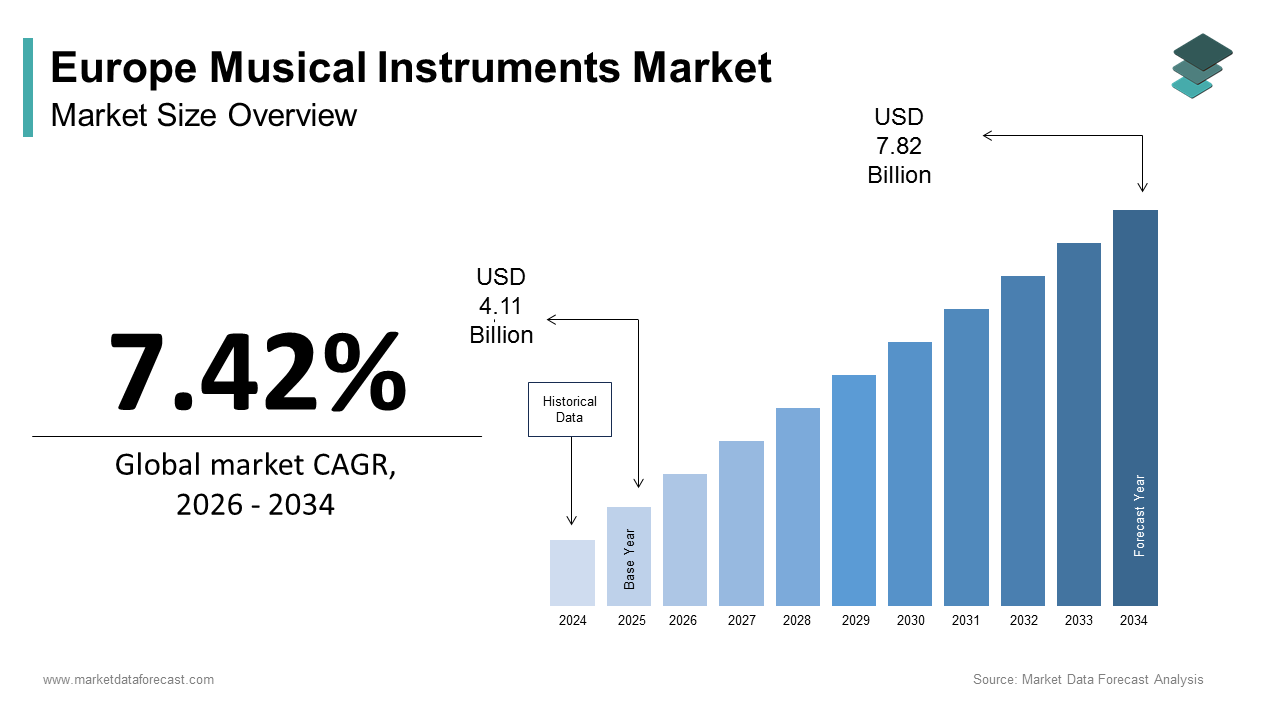
The Europe musical instruments market size was calculated to be USD 4.11 billion in 2025, is anticipated to reach USD 4.41 billion in 2026, and is projected to be worth USD 7.82 billion by 2034, growing at a robust CAGR of 7.42% during the forecast period from 2026 to 2034. Driven by mandatory school music education curricula, historical artisanal legacy, and digital innovations like hybrid learning platforms, the market is expanding steadily across Europe.
Key Executive Metrics (At-a-Glance)
- 2025 Base Valuation: USD 4.11 Billion
- 2026 Current Valuation: USD 4.41 Billion
- 2034 Forecast Valuation: USD 7.82 Billion
- Compound Annual Growth Rate (CAGR): 7.42% (2026–2034)
- Dominant Type Segment: Stringed Instruments (38.6% share in 2025)
- Fastest-Growing Type Segment: Keyboard Instruments (CAGR of 6.9% from 2026 to 2034)
- Dominant Distribution Channel Segment: Specialty Stores (52.4% share in 2025)
- Fastest-Growing Distribution Channel Segment: Online Sales Channel (CAGR of 9.3% during the forecast period)
- Dominant Regional Market: Germany (24.6% share in 2025)
Core Market Drivers
- Mandatory Music Education: Public school curricula across EU member states mandate music instruction, creating a stable, long-term baseline demand for beginner and educational instruments.
- Cultural Heritage & Artisanal Craftsmanship: Centuries-old manufacturing traditions—such as Italian violin making and German wind instrument production—drive a high-value export luxury segment.
Primary Market Restraints & Challenges
- Digital Entertainment Competition: Screen-based entertainment and social media consume youth leisure time, eroding daily practice habits and narrowing the funnel of novice players.
- High Import Barriers: EU import duties, anti-dumping measures, and strict CE compliance standards inflate retail prices for affordable entry-level instruments.
Europe Musical Instruments Market Classification Breakdown
| Segment Category | Largest Segment | Fastest-Growing Segment |
|---|---|---|
| By Type | Stringed Instruments (38.6% share in 2025) | Keyboard Instruments (CAGR of 6.9% from 2026 to 2034) |
| By Distribution Channel | Specialty Stores (52.4% share in 2025) | Online Sales Channel (CAGR of 9.3% during the forecast period) |
| By Region | Germany (24.6% share in 2025) | Netherlands & UK (Digital fulfillment, e-commerce hubs, and tech integration) |
Major Industry Players Profiled
Key market participants include Eastman Music Company, Fender Musical Instruments Corporation (Servco Pacific Inc.), Casio Computer Co., Ltd., Steinway, Inc. (Paulson & Co. Inc.), Kawai Musical Instruments Manufacturing Co., Ltd., Yamaha Corporation, Guangzhou Pearl River Piano Group Co., Ltd., Yanagisawa Wind Instruments Co., Ltd., C.F. Martin & Co., Inc., and Roland Corporation.
Europe Musical Instruments Market Size
The Europe musical instruments market size was calculated to be USD 4.11 billion in 2025 and is anticipated to be worth USD 7.82 billion by 2034, growing from USD 4.41 billion in 2026 at a CAGR of 7.42% during the forecast period.
A musical instrument is any device created or adapted specifically to produce musical sounds. This includes string, wind, percussion, keyboard, and electronic categories ranging from violins and grand pianos to synthesizers and MIDI controllers. Unlike transient consumer electronics, musical instruments often represent long-term cultural and pedagogical investments, deeply embedded in national heritage and institutional curricula. High participation rates in early childhood and school education across the European Union maintain a consistent, long-term baseline demand for educational resources and musical training materials. Sustained support from EU funding initiatives for culture and creativity, alongside national funding, drives ongoing procurement and development in musical education institutions. Germany, Italy, and France serve as historic manufacturing hubs, home to globally renowned brands producing violins, accordions, and brass instruments using centuries-old craftsmanship techniques. Simultaneously, digital innovation is reshaping accessibility, with hybrid pianos and app-integrated guitars bridging tradition and technology. The market functions at the intersection of artisanal legacy, educational policy, and evolving digital creativity, distinguishing it from purely commercial consumer goods sectors.
MARKET DRIVERS
Mandatory Music Education in National School Curricula Sustains Foundational Demand
Public education systems across the region embed music as a compulsory or strongly encouraged subject, generating consistent entry-level demand for beginner instruments, which acts as a key accelerator of the Europe musical instruments market. Music instruction is a mandatory component of the curriculum for the majority of primary and lower secondary education levels across most European Union member states. The Kultusministerkonferenz maintains a sustained commitment to music education through mandatory lessons, requiring public schools to consistently procure and update classroom instruments like recorders and percussion. The Ministry of National Education provides specific funding to schools, supporting the acquisition of musical instruments to facilitate student participation in music education. This institutionalized exposure not only drives bulk purchases but also cultivates lifelong engagement. Such policy-driven pipelines ensure stable demand irrespective of economic cycles, insulating the market from discretionary spending volatility that affects other leisure goods.
Cultural Heritage and Artisanal Craftsmanship Drive Premium Instrument Exports
The region’s global reputation for high-quality acoustic instruments, particularly violins, cellos, brass, and woodwinds, fuels a robust export-oriented luxury segment rooted in centuries of regional craftsmanship, which contributes to the growth of the Europe musical instruments market. Italian cities like Cremona remain synonymous with violin making, where master luthiers produce instruments valued at tens of thousands of euros using techniques passed down since the 17th century. String instrument exports from Italy to major markets in North America and Asia continue to represent a significant portion of the country's luxury musical goods market. The Markneukirchen region in Germany sustains its reputation as a leading international hub for the production of specialized wind instruments, with premier manufacturers maintaining extensive waiting times for professional, handcrafted clarinets and oboes. Moreover, the musical instrument sector in Saxony continues to demonstrate growth, driven by regional expertise in manufacturing, representing a key contribution to Germany's export economy. This artisanal ecosystem benefits from UNESCO recognition. Cremona’s violin craftsmanship was inscribed in 2012, and national apprenticeship programs that preserve tacit knowledge. The resulting scarcity, authenticity, and tonal excellence position European instruments as irreplaceable assets in global classical and jazz communities, sustaining premium pricing and brand equity unmatched by mass-produced alternatives.
MARKET RESTRAINTS
Digital Entertainment Substitutes Compete for Youth Leisure Time and Attention
The proliferation of screen-based entertainment and social media platforms has significantly eroded the time young Europeans allocate to learning and practicing musical instruments. This proliferation hampers the expansion of the Europe musical instruments market. Analyses of youth media consumption indicate that time spent on interactive digital platforms is rising, while traditional creative hobbies are receiving less daily attention. While school music participation has seen a long-term decline in certain regions, recent UK data shows a moderate, contrary increase in GCSE music entries, challenging claims of a direct, steep drop caused by digital media. Data from the European Audiovisual Observatory, OECD, and the UK Department for Education show shifting engagement trends rather than simple, uniform declines. Unlike passive consumption, instrument mastery demands sustained focus and delayed gratification, traits increasingly at odds with algorithm-driven instant reward environments. This behavioral shift reduces the funnel of novice players, compressing future demand for intermediate and professional instruments. Digital instruments offer convenience but fail to match the tactile and emotional depth of acoustic, disrupting the journey from beginner to lifelong musician.
High Import Tariffs and Non-Tariff Barriers Limit Access to Affordable Entry-Level Instruments
The region faces significant trade barriers that restrict access to cost-effective beginner models, despite being a net exporter of premium instruments, and thereby slow down the growth of the Europe musical instruments market. These barriers particularly affect imports from Asia, where mass production dominates the sub-€200 segment. The European Union applies standard import duties to imported string and wind instruments, coupled with targeted anti-dumping measures on certain musical products from China to protect domestic production. These tariffs inflate retail prices, making entry-level instruments less accessible to low-income households. Student string instruments generally retail at higher prices within the European Union compared to the United States, largely driven by higher import tariffs and regulatory costs in the European market. Furthermore, stringent CE marking requirements for electronic instruments, including electromagnetic compatibility and chemical safety testing, add compliance costs that disproportionately affect small importers. Independent music retailers across Europe are scaling back their inventory of affordable instruments, driven by a combination of increased import expenses and complex regulatory compliance requirements. This regulatory friction inadvertently narrows musical participation along socioeconomic lines, contradicting inclusive cultural policies promoted by national ministries.
MARKET OPPORTUNITIES
Integration of AI and App-Based Learning Platforms Expands Accessibility
Emerging technologies are lowering the barrier to musical initiation by embedding real-time feedback and gamified instruction into instruments and companion software, which offers strong prospects for the Europe musical instruments market. Hybrid pianos now feature LED-guided keys synchronized with apps that track progress and correct fingering errors, appealing to self-directed learners. The International Federation of the Phonographic Industry indicates that AI-assisted music learning platforms are increasingly popular among young music learners in Europe. Yamaha’s sustainability reporting indicates that the company is expanding its digital musical instrument initiatives to support the well-being of users through technology. These tools address a critical pain point: the lack of affordable private instruction. In Spain, app-based learning has grown annually since 2021. Technology reverses falling engagement in digital natives by transforming solitary practice into interactive, skill-building experiences.
Revival of Analog and Vintage Instrument Aesthetics Fuels Niche Collectibility
A growing segment of European musicians and collectors is driving demand for analog synthesizers, tube amplifiers, and vintage acoustic instruments, motivated by sonic authenticity and tactile interaction absent in digital counterparts, which provides fresh opportunities for the Europe musical instruments market. This retro trend is particularly strong among electronic music producers and indie artists seeking distinctive timbres. Demand for hardware-based analog synthesizers remains robust, with several major manufacturers experiencing significant order backlogs and production constraints. Interest in vintage and specialized music equipment, such as guitars, has seen a resurgence, resulting in increased attendance at industry-focused shows. This resurgence is amplified by social media, where unboxing videos and tone demos generate viral interest, and YouTube channels like “Andertons” regularly feature vintage gear reviews, garnering millions of views. Crucially, this movement extends beyond nostalgia. It reflects a conscious rejection of homogenized digital sound in favor of imperfection and character. Manufacturers are responding with reissues and limited runs, blending heritage design with modern reliability to capture this high-margin, culturally resonant segment.
MARKET CHALLENGES
Skilled Craft Labor Shortages Threaten Continuity of Artisanal Production
The region’s tradition of handcrafted instrument making faces existential risk due to an aging workforce and insufficient apprenticeship uptake in key manufacturing regions, and poses a major challenge to the Europe musical instruments market. In Cremona, the number of master luthiers officially certified by the local consortium represents only a portion of the city's active artisan community, which continues to support a significant network of independent workshops. Similarly, in Markneukirchen, enrollment in instrument-making programs has decreased over the past decade, reflecting a broader national shift away from traditional manual trades despite the region's continued status as a primary center for artisanal training. This decline stems from perceptions of low financial viability and competition from engineering and IT careers offering higher wages and stability. The loss of tacit knowledge, such as varnish formulation or bore tuning in woodwinds, is not easily codified, making succession planning critical. Without intervention, production capacity for high-end instruments could contract over the next decade, as per estimation. Machines automate production, but they cannot replace the human touch required in final voicing, risking the permanent loss of unique cultural assets.
Counterfeit Instruments Undermine Brand Integrity and Consumer Trust
The influx of counterfeit and mislabeled instruments, particularly online, poses a serious threat to both established manufacturers and novice buyers, and remains a serious impediment to the Europe musical instruments market. Fake versions of iconic models like the Fender Stratocaster or Yamaha YFL flutes are widely available on major e-commerce platforms, often using deceptive branding and false origin claims. According to the European Union Intellectual Property Office, seizures of counterfeit musical instruments at EU borders have significantly increased, with China remaining the dominant source of infringing shipments. These products typically use inferior woods, unstable hardware, and toxic finishes that compromise playability and safety. An investigation by the French Directorate General for Competition Policy, Consumer Affairs, and Fraud Control indicated that a significant portion of budget violins marketed online as having German origin contained no components manufactured in Germany. Such deception damages brand reputation and discourages beginners who associate poor performance with personal inability rather than product fraud. Despite efforts by industry groups like the European Music Council to lobby for stricter platform liability, enforcement remains fragmented, allowing counterfeiters to exploit regulatory gaps in the digital marketplace.
REPORT COVERAGE
| REPORT METRIC | DETAILS |
| Market Size Available | 2025 to 2034 |
| Base Year | 2025 |
| Forecast Period | 2026 to 2034 |
| CAGR | 7.42% |
| Segments Covered | By Type, Distribution Channel, And Region |
| Various Analyses Covered | Global, Regional & Country Level Analysis; Segment-Level Analysis; DROC, PESTLE Analysis; Porter’s Five Forces Analysis; Competitive Landscape; Analyst Overview of Investment Opportunities |
| Regions Covered | UK, France, Spain, Germany, Italy, Russia, Sweden, Denmark, Switzerland, Netherlands, Turkey, and the Czech Republic |
| Market Leaders Profiled | Eastman Music Company, Fender Musical Instruments Corporation (Servco Pacific Inc.), Casio Computer Co., Ltd., Steinway, Inc. (Paulson & Co. Inc.), Kawai Musical Instruments Manufacturing Co., Ltd., Yamaha Corporation, Guangzhou Pearl River Piano Group Co., Ltd., Yanagisawa Wind Instruments Co., Ltd., C.F. Martin & Co., Inc., And Roland Corporation |
SEGMENTAL ANALYSIS
By Type Insights
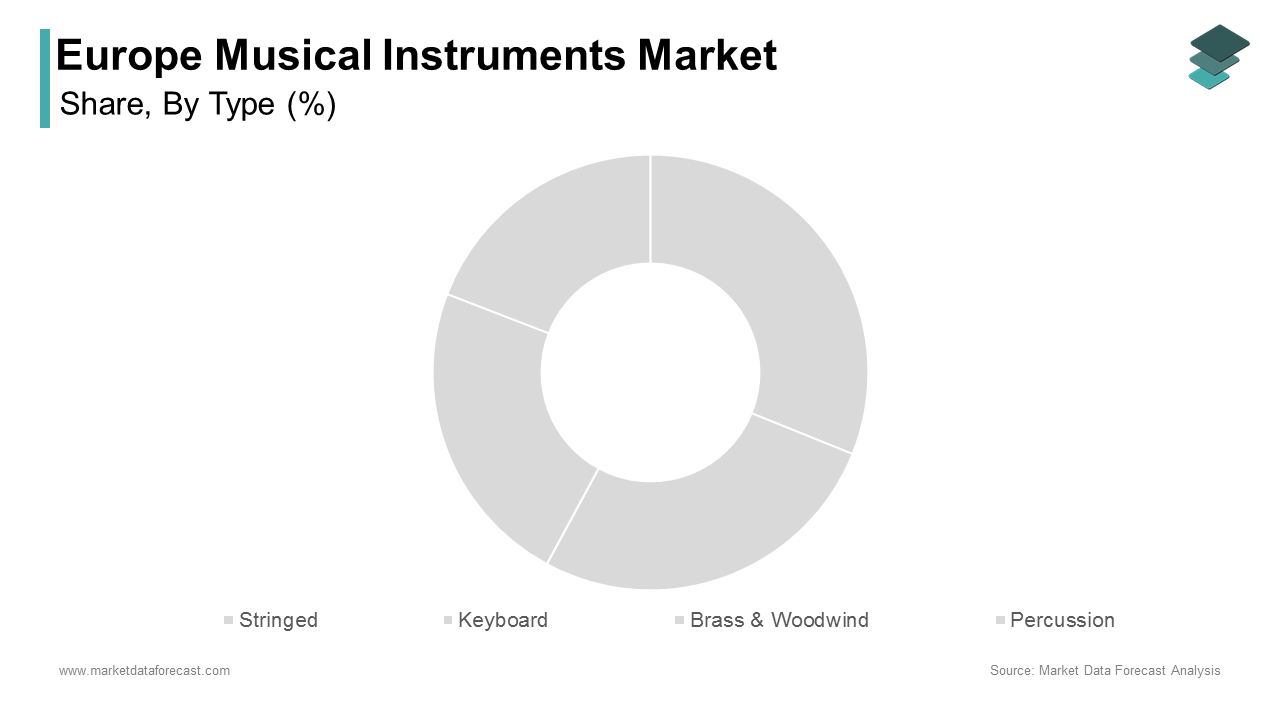
The stringed instruments segment dominated the Europe musical instruments market by accounting for a 38.6% share in 2025. The dominance of the stringed instruments segment is driven by widespread use in education, cultural heritage, and versatile applicability across genres. Stringed instruments, particularly violins, guitars, and cellos, are foundational in European school curricula and conservatory training. Increasing numbers of German students participate in extracurricular string instruction, often supported by public-private partnerships or voluntary, municipal, subsidized music school initiatives. Municipal music schools in France continue to see high demand for accessible, portable instruments such as violins and guitars for beginner education, driven by community-level initiatives. While music is generally a component of primary curricula across the EU, string instrument programs are often optional or integrated into broader, school-level initiatives rather than being uniformly mandatory. The European acoustic guitar market sustains high annual volume due to strong popularity among beginners and learners, supported by both specialized music retailers and e-commerce platforms. This institutional embedding ensures a steady pipeline from beginner to advanced players, reinforcing long-term demand across price tiers, from student models to handcrafted Cremonese violins. Europe’s global reputation for string instrument craftsmanship, centered in Italy’s Cremona, Germany’s Mittenwald, and France’s Mirecourt, fuels high-value exports and collector interest. UNESCO’s recognition of Cremona’s violin-making tradition as intangible cultural heritage has amplified global prestige, attracting international buyers and apprentices. This blend of heritage, scarcity, and tonal excellence creates a dual market: mass-produced student instruments for education and limited edition masterworks for professionals and collectors. Unlike electronic instruments subject to obsolescence, fine string instruments appreciate, reinforcing their role as both tools and cultural assets.
The keyboard instruments segment is predicted to witness the highest CAGR of 6.9% between 2026 and 2034 due to digital innovation and hybrid learning trends. Modern digital pianos now replicate the touch and tone of acoustic grands using advanced hammer action mechanisms and multi-channel sampling, appealing to urban dwellers lacking space or noise tolerance for traditional pianos. Driven by the need for apartment-friendly features such as silent practice and app connectivity, Yamaha experienced a surge in European demand for its digital pianos. Meanwhile, Roland's SuperNATURAL modeling technology gained popularity among conservatory students for providing authentic feedback without requiring maintenance. Additionally, in Sweden, consumer preference has shifted heavily toward digital pianos over acoustic models for new acquisitions. These instruments also integrate with DAWs (Digital Audio Workstations), enabling composition and recording, a functionality absent in acoustic models. This convergence of pedagogy, convenience, and creative production positions keyboards as indispensable in both educational and home studio environments. Keyboard instruments benefit disproportionately from AI-powered learning platforms that offer real-time feedback on timing, dynamics, and fingering. Apps like Simply Piano and Flowkey use a microphone or MIDI input to guide users through songs, reducing reliance on private teachers. Digital education reports indicate a growing trend of young Europeans utilizing digital apps and technology to begin their musical journeys, particularly for keyboard instruments. Casio’s collaboration with digital platforms, such as Yousician, bundles learning subscriptions with Privia instruments to lower the barrier to entry for beginners and increase adoption rates. Unlike wind or string instruments requiring embouchure or bowing technique, keyboards offer immediate melodic gratification, lowering the frustration barrier. This accessibility, combined with declining lesson affordability, makes keyboards the gateway instrument for a digitally native generation.
By Distribution Channel Insights
The specialty stores segment led the Europe musical instruments market by capturing a 52.4% share in 2025. The supremacy of the specialty stores segment is attributed to expert guidance and product authenticity. Specialty music retailers provide critical services beyond transaction, such as guitar setup, violin bow rehairing, and piano tuning, that mass retailers cannot replicate. German parents overwhelmingly prefer visiting specialized music retailers when selecting a child’s first instrument to guarantee proper sizing and instrument quality. French buyers of woodwind and brass instruments predominantly favor in-store testing to verify the ergonomic suitability and intonation of the instrument before purchasing. These stores often employ certified technicians and former musicians who offer personalized advice, reducing return rates and enhancing customer lifetime value. Additionally, many host workshops and recitals, fostering community engagement. This experiential and service-oriented model insulates specialty stores from pure price competition. Specialty retailers maintain direct relationships with luthiers and boutique manufacturers, offering limited edition or custom-ordered instruments unavailable online. In Italy, only authorized dealers in Cremona and Milan can sell new instruments from master workshops like Bellafonte or Sgarbi, as confirmed by the Cremona Violin Making Consortium. Similarly, UK retailers like Forsyth in Manchester hold exclusive rights to distribute certain Yamaha and Steinway models. This curation ensures authenticity and provenance, critical in a market plagued by counterfeits. The tactile nature of instrument selection, feeling neck profiles, testing key action, or hearing room acoustics, remains irreplaceable by digital alternatives, preserving the specialty channel’s centrality in mid to high-tier segments.
The online sales channel segment is estimated to register the fastest CAGR of 9.3% during the forecast period, owing to digital commerce maturity and targeted e learning integrations. Pure play online brands like Gear4music and Thomann have disrupted traditional retail by offering vast inventories, competitive pricing, and rapid delivery across Europe. These platforms leverage data analytics to personalize recommendations, suggesting starter packs with tuners and straps based on browsing history. Additionally, subscription models like Fender Play Live bundle instrument rentals with live lessons, reducing upfront costs. In Spain, online instrument sales grew, with entry-level guitars and keyboards leading volume. The ability to compare reviews, watch demo videos, and access financing options enhances purchase confidence, particularly among younger demographics who distrust traditional retail markups. Platforms like TikTok and Instagram have become discovery engines for musical instruments, with viral challenges and artist tutorials driving spontaneous purchases. Brands collaborate with influencers, such as ukulele artist Grace VanderWaal, to showcase products in relatable settings. YouTube unboxings and tone demos generate millions of views, with links directing viewers to official online stores. The content-driven commerce bypasses traditional marketing funnels, converting passive viewers into buyers through emotional resonance and perceived attainability. The seamless transition from inspiration to checkout, often within the same app, accelerates decision cycles and expands market reach beyond geographic retail footprints.
REGIONAL ANALYSIS
Germany Musical Instruments Market Analysis
Germany was the top performer in the Europe musical instruments market by accounting for a 24.6% share in 2025. The country serves as both a manufacturing powerhouse and a high-volume consumer market, anchored by robust music education and engineering excellence. Home to global brands like Steinway Hamburg, Yamaha Europe, and Warwick basses, Germany produces a notable share of Europe’s professional brass and woodwind instruments. The federal education system mandates music instruction until grade nine, generating annual demand for a significant number of student instruments. The German federal government continues to support musical education through various initiatives, with a focus on facilitating access to instruments for children from diverse socioeconomic backgrounds. Additionally, trade fairs like Musikmesse Frankfurt, though relocated, continue to influence global trends through digital showcases. Germany’s dual vocational training system continues to sustain traditional craftsmanship by training new generations of skilled instrument makers, ensuring the preservation of specialized skills in the cultural sector. This fusion of policy, industry, and pedagogy solidifies Germany’s structural leadership.
Italy Musical Instruments Market Analysis
Italy was the next prominent player in the Europe musical instruments market by securing a 18.4% share in 2025. The demand for these instruments in Italy is supported by its unparalleled legacy in violin making and premium acoustic craftsmanship. Centered in Cremona, the city’s specialized workshops produce a limited volume of handcrafted, artisanal violins, which nevertheless dominate the global auction market for new instruments. UNESCO’s 2012 recognition of this heritage has solidified the city’s international prestige, driving a steady influx of global students and collectors. Italy maintains a strong export market for these high-end stringed instruments, primarily serving established markets in Asia and North America. Local demand is continuously supported by an extensive network of state-run music academies, which require high-quality instruments for artistic performance and education. The government supports luthiers through tax incentives and the Scuola Internazionale di Liuteria, which trains numerous new artisans yearly. Unlike mass markets, Italy’s strength lies in scarcity, authenticity, and centuries-old techniques that resist commoditization, ensuring enduring value and cultural influence disproportionate to volume.
United Kingdom Musical Instruments Market Analysis
The United Kingdom maintains a significant position in the Europe musical instruments market due to a dynamic blend of heritage brands and digital disruption. Home to Marshall amplifiers, Fender UK, and Abbey Road Studios, the UK fosters innovation across rock, pop, and electronic genres. In the UK, while traditional musical instrument sales have faced challenges, electronic instruments designed for home recording continue to show positive demand, even amidst a tighter overall retail environment. The UK also leads in music tech integration; companies like ROLI pioneered expressive touch surfaces now used in film scoring and gaming. Government support remains strong. The UK Department for Education is directing significant annual revenue funding to Music Hubs across England, complemented by additional capital investment for instruments, to facilitate music education in schools. London’s diverse population fuels demand for global instruments; sitar, djembe, and bouzouki sales rose. Despite Brexit-related logistics challenges, the UK’s creative ecosystem, streaming economy, and entrepreneurial spirit sustain its position as a trendsetting hub beyond traditional acoustic boundaries.
France Musical Instruments Market Analysis
France experienced a consistent growth in the Europe musical instruments market owing to one of the world’s most extensive public music education infrastructures. The country operates several municipal conservatories and music schools, enrolling a large volume of students annually. This system drives consistent demand for woodwinds, brass, and pianos, with the state subsidizing a notable portion of instrument costs for low-income families. French craftsmanship remains vital. Mirecourt remains a prestigious global hub for the traditional craftsmanship of stringed instruments and professional bow making. Historic ateliers in the Paris region continue to lead the global market by integrating modern acoustic research with long-standing artisanal techniques to refine woodwind performance. Public and private organizations in France are increasingly focusing on cultural inclusion by providing long-term musical education and instrument access to youth in socially vulnerable regions. Additionally, France’s strict cultural exception laws protect domestic music retail from unchecked e-commerce competition, preserving specialty stores. As per a study, a significant share of French adults had learned an instrument in school, the highest rate in Europe, ensuring intergenerational transmission of musical practice and sustained market vitality.
Netherlands Musical Instruments Market Analysis
The Netherlands is anticipated to expand in the European market from 2026 to 2034. It plays an outsized role as a distribution and innovation nexus. Home to Thomann’s largest European warehouse and Gear4music’s Benelux fulfillment center, the country handles a portion of cross-border instrument e-commerce in Western Europe. Dutch consumers exhibit high openness to digital learning. The government supports this through initiatives like “Music Lab Netherlands,” which funds startups developing AI composition tools. Amsterdam’s vibrant electronic and jazz scenes drive demand for synthesizers and modular gear, with festivals like Dekmantel showcasing cutting-edge instrumentation. Additionally, the Netherlands hosts leading music tech incubators such as MusicTechNL, fostering collaboration between engineers and musicians. This blend of logistical efficiency, digital fluency, and creative experimentation positions the Netherlands as a forward-looking gateway for next-generation musical engagement.
COMPETITION OVERVIEW
The Europe musical instruments market features a multifaceted competitive landscape where global manufacturers coexist with regional artisans, specialty retailers, and digital disruptors. Competition is not solely price-based but revolves around brand heritage, product authenticity, educational integration, and post-purchase support. Large corporations like Yamaha and Steinway leverage scale and innovation while small luthiers in Cremona or Mirecourt compete on craftsmanship and cultural prestige. Online retailers such as Thomann exert pricing pressure yet struggle to replicate hands-on trials essential for high-value purchases. The entry of tech-enabled startups offering app-connected instruments adds another dimension, focusing on beginner accessibility. Regulatory frameworks around cultural goods sustainability and e-commerce further shape strategies. Ultimately, success depends on balancing tradition with technology, maintaining trust through expertise, and adapting to shifting pedagogical and creative behaviors across diverse European markets.
KEY MARKET PLAYERS
A few major players of the Europe musical instruments market include
- Eastman Music Company
- Fender Musical Instruments Corporation (Servco Pacific Inc.)
- Casio Computer Co., Ltd.
- Steinway, Inc. (Paulson & Co. Inc.)
- Kawai Musical Instruments Manufacturing Co., Ltd.
- Yamaha Corporation
- Guangzhou Pearl River Piano Group Co., Ltd.
- Yanagisawa Wind Instruments Co., Ltd.
- C.F. Martin & Co., Inc.
- Roland Corporation
Top Strategies Used by the Key Market Participants
Key players in the Europe musical instruments market are increasingly integrating digital learning platforms with hardware to create end to end educational ecosystems that enhance user engagement and retention. They are investing in sustainable material sourcing and eco-friendly packaging to comply with stringent EU environmental regulations and appeal to conscious consumers. Companies are expanding direct-to-consumer e-commerce capabilities with localized websites, multilingual support, and fast delivery networks to capture online demand. Strategic collaborations with artists, educators, and conservatories reinforce brand credibility and drive institutional procurement. Additionally, they are developing hybrid instruments that combine acoustic authenticity with digital connectivity to serve both traditional performers and modern content creators.
Leading Players in the Europe Musical Instruments Market
- Yamaha Corporation maintains a strong presence across the Europe musical instruments market through its diverse portfolio spanning acoustic pianos, digital keyboards, wind instruments, and professional audio equipment. The company supplies instruments to educational institutions, conservatories, and retail networks throughout the continent while operating manufacturing and R&D facilities in France and the United Kingdom. In recent years, Yamaha has strengthened its position by launchingapp-integratedd learning ecosystems such as Smart Pianist and YEAS, which connect hardware to guided tutorials and performance analytics. The company also expanded its sustainability initiatives by introducingFSC-certifiedd wood sourcing for upright pianos and reducing packaging waste across European distribution centers in alignment with EU circular economy directives.
- Steinway Musical Instruments Inc is renowned in Europe for its premium Steinway & Sons grand pianos and Boston and Essex mid-tier lines, which are widely used in concert halls, conservatories, and private residences. The Hamburg, Germany, factory serves as the cornerstone of its European operations, producing handcrafted instruments that meet exacting artistic standards. To reinforce its legacy positioning, Steinway has invested in artist ambassador programs collaborating with leading European pianists for masterclasses and recitals.
- Thomann GmbH is Europe’s largest online retailer of musical instruments, headquartered in Bavaria, Germany, with extensive reach across all 27 EU member states. The company offers over 150,000 products, including its own brands such as Harley Benton guitars and t.bone microphones, catering to beginners, professionals, and studios alike. Recent initiatives include multilingual AI-powered customer support, localized payment options, and carbon-neutral shipping partnerships. The company also launched interactive product demos and 360-degree instrument views to replicate in-store experiences online, thereby bridging the gap betweene-commercee convenience and tactile decision making.
MARKET SEGMENTATION
This research report on the Europe musical instruments market has been segmented and sub-segmented based on type, distribution channel, and region.
By Type
- Stringed
- Keyboard
- Brass & Woodwind
- Percussion
By Distribution Channel
- Specialty Stores
- Online Sales Channel
- Supermarkets/Hypermarkets
By Region
- UK
- France
- Spain
- Germany
- Italy
- Russia
- Sweden
- Denmark
- Switzerland
- Netherlands
- Turkey
- Czech Republic
- Rest of Europe