- Product Description Description
- Table of Contents TOC
- List of Table & Figure LOT
- Get Free Sample PDF Sample PDF
Market Size, 2025
$2.62 BnMarket Estimate, 2026
$2.77 BnMarket Forecast, 2034
$4.31 BnCAGR, 2026–2034
5.68%Europe Mustard Market Size, Growth, Trends & Forecast (2026–2034)
The Europe mustard market size was calculated to be USD 2.62 billion in 2025, is anticipated to be worth USD 2.77 billion in 2026, and is projected to reach USD 4.31 billion by 2034, registering a compound annual growth rate (CAGR) of 5.68% during the forecast period from 2026 to 2034. Driven by increasing consumer preferences for natural health remedies, evolving culinary diversity, and expansion into organic and functional food product lines, the European market continues to grow steadily.
Key Executive Metrics (At-a-Glance)
- 2025 Base Valuation: USD 2.62 Billion
- 2026 Current Valuation: USD 2.77 Billion
- 2034 Forecast Valuation: USD 4.31 Billion
- Compound Annual Growth Rate (CAGR): 5.68% (2026–2034)
- Dominant Type Segment: White or Yellow Mustard (accounting for 55.4% of the market share in 2025)
- Fastest-Growing Type Segment: Sarepta Mustard (projected at a CAGR of 7.5% during the forecast period)
- Dominant Application Segment: Commercial (holding 45.3% of the market share in 2025)
- Fastest-Growing Application Segment: Industrial (projected at a CAGR of 6.8% from 2026 to 2034)
- Dominant Sales Channel Segment: Indirect Channel (holding a dominant share in 2025 via vast retail networks)
- Fastest-Growing Sales Channel Segment: Direct Channel (projected at a CAGR of 5.5% via direct-to-consumer and e-commerce models)
- Regional Highlights: Germany leads the market with around 25% share, followed by France (20%), the UK (15%), Italy (12%), and Spain (10%).
Core Market Drivers
- Natural Health Remedies: Growing consumer inclination towards mustard's anti-inflammatory, digestive, and heart-healthy omega-3 properties.
- Culinary Diversity & Exports: Integration of mustard into global and fusion cuisines, sustained by strong European export volumes and tourism interest.
- Functional Food & Organic Shift: Rising demand for nutrient-enriched and organic food options aligned with regional sustainability initiatives.
Primary Market Restraints & Challenges
- Climate Variability: Inconsistent weather patterns (such as prolonged dry spells and droughts) disrupting agricultural yields and seed germination.
- Regulatory & Compliance Burdens: Strict EU food safety directives, allergen labeling standards, and rising compliance costs for manufacturers.
- Synthetic Competition & Geopolitics: Market pressure from cheaper synthetic condiments alongside supply chain disruptions from geopolitical tensions.
Europe Mustard Market Segmentation Breakdown
| Segment Category | Largest Segment in 2025/2026 | Fastest Growing Segment / Growth Rate |
|---|---|---|
| By Type | White or Yellow (55.4% in 2025) | Sarepta (7.5% CAGR) |
| By Application | Commercial (45.3% in 2025) | Industrial (6.8% CAGR) |
| By Sales Channel | Indirect Channel | Direct Channel (5.5% CAGR) |
| By Region | Germany (25% share) | Italy & Spain (Driven by culinary innovations and agricultural expansion) |
Major Industry Players Profiled
Key prominent companies operating in the Europe mustard market include Unilever PLC, Colman’s Mustard, Mustard and Co., Tracklements, Charroux Mustard, Bornier Mustard, Maille, Kuhne, Bertman Original Ballpark Mustard, Taylors Mustard, Develey Senf & Feinkost GmbH, Löwensenf GmbH, and Moutarde de Meaux Pommery.
Europe Mustard Market Size
The Europe mustard market size was calculated to be USD 2.62 billion in 2025 and is anticipated to be worth USD 4.31 billion by 2034, from USD 2.77 billion in 2026, growing at a CAGR of 5.68% during the forecast period.
The mustard is derived from the seeds of plants in the Brassica genus, holds historical significance in European agriculture and cuisine, dating back to ancient Roman times when it was used for flavoring and medicinal purposes. According to the Food and Agriculture Organization, Europe accounts for approximately 15% of global mustard seed production, with countries like France and Germany leading in cultivation areas that span over 200,000 hectares annually, influenced by varying climatic conditions. Environmental factors also play a pivotal role, as evidenced by the European Environment Agency's findings that mustard crops contribute to soil health by reducing erosion in regions like the UK and Poland, where arable land covers about 45% of the total area.
MARKET DRIVERS
Increasing consumer preference for natural health remedies
The growing inclination towards natural health alternatives is a major factor propelling the growth of the Europe mustard market. Mustard is renowned for its anti-inflammatory and digestive properties, aligning with this trend in regions where health-conscious behaviors are on the rise. According to the World Health Organization, cardiovascular diseases affect around 49% of the European population, prompting a surge in demand for natural remedies like mustard oil, which contains omega-3 fatty acids that support heart health. This driver is further amplified by the expanding wellness industry, with mustard's role in natural cosmetics growing, as evidenced by the fact that organic product lines in Germany have seen a 30% increase in mustard-derived ingredients since 2018, based on insights from the German Federal Institute for Risk Assessment.
Evolving culinary diversity and export potential
The diversification of European culinary landscapes by integrating mustard into a variety of global and fusion cuisines, thereby expanding its application beyond traditional uses, is propelling the growth of the Europe mustard market. As per the Food and Agriculture Organization, Europe exported around 150,000 metric tons of mustard products in 2022. This demand is further supported by tourism statistics from Eurostat, indicating that 300 million visitors entered Europe in 2019, many seeking authentic local flavors that include mustard-based dishes, thereby stimulating production. The factor's impact is also seen in sustainable farming initiatives, where, as noted by the European.
MARKET RESTRAINTS
Fluctuations in agricultural yields due to climate variability
The inconsistent weather patterns disrupt crop yields and threaten supply stability, which in turn affects production costs and availability is limiting the growth of the Europe mustard market. Climate change exacerbates this issue, with extreme events like droughts and floods directly impacting mustard cultivation. In Poland, a major producer, mustard output dropped by 25% in 2022 compared to 2020, as per statistics from the Polish Central Statistical Office, because of prolonged dry spells that hindered seed germination.
Stringent regulatory requirements on food additives
Regulatory hurdles related to food safety and labeling are limiting product innovation, which is also hindering the growth of the European mustard market. European Union directives impose rigorous standards on additives, which can classify certain mustard derivatives as potential allergens or contaminants, thereby restricting their use in processed foods. As per the European Food Safety Authority, over 30% of food recalls in the EU between 2018 and 2022 involved condiments like mustard due to non-compliance with allergen labeling, which has deterred manufacturers from introducing novel products. In France, regulatory enforcement has led to a 15% increase in compliance costs for producers, based on insights from the French Agency for Food, Environmental and Occupational Health & Safety, making it challenging to compete in price-sensitive segments.
MARKET OPPORTUNITIES
Expansion into organic and sustainable product lines
The shift towards organic farming by enabling producers to capitalize on consumer demand for eco-friendly and chemical-free alternatives is likely to create new opportunities for the growth of the Europe mustard market. According to the European Commission, organic farmland in the EU has grown to cover 8.5% of total agricultural area by 2022, up from 6.2% in 2012, fostering opportunities for mustard cultivation without synthetic inputs.
Integration with the growing functional food sector
Increasing mustard's health benefits for functional foods, with rising demand for nutrient-enriched options, is another attribute enhancing the growth of the European mustard market. As per the World Health Organization, Europe's population aged 65 and above is projected to reach 150 million by 2050, increasing the need for functional ingredients like mustard in fortified foods. In the Netherlands, sales of health-enhanced mustard products have risen by 20% since 2020, according to the Dutch Ministry of Agriculture, Nature and Food Quality, as consumers incorporate them into daily diets for digestive health.
MARKET CHALLENGES
Competition from synthetic alternatives in the condiment industry
The prevalence of synthetic condiments by eroding its market share through cheaper and longer-lasting substitutes. This factor stems from consumer preferences for convenience, where artificial flavors mimic mustard's taste at a lower cost, undermining traditional demand. According to the European Food Safety Authority, synthetic additives account for 40% of the condiment market in Europe, with their usage rising by 15% over the past five years due to affordability. In Spain, where mustard consumption has declined by 12% since 2018, as per data from the Spanish National Statistics Institute, the challenge is evident in retail shelves dominated by lab-created options that offer extended shelf life.
Supply chain disruptions from geopolitical tensions
The geopolitical instability in trade routes affects the flow of seeds and finished products, leading to shortages and price volatility. This attribute is more likely to be a challenge for the growth of the Europe mustard market. As per the World Bank, global agricultural trade disruptions in 2022 resulted in a 10% increase in commodity prices across Europe, directly impacting mustard supply chains.
REPORT COVERAGE
| REPORT METRIC | DETAILS |
| Market Size Available | 2025 to 2034 |
| Base Year | 2025 |
| Forecast Period | 2026 to 2034 |
| CAGR | 5.68% |
| Segments Covered | By Type, Application, Sales Channel, and Region. |
| Various Analyses Covered | Global, Regional, & Country Level Analysis; Segment-Level Analysis; DROC, PESTLE Analysis; Porter’s Five Forces Analysis; Competitive Landscape; Analyst Overview of Investment Opportunities |
| Regions Covered | North America, Europe, APAC, Latin America, Middle East & Africa |
| Market Leaders Profiled | Unilever PLC, Colman’s Mustard, Mustard and Co., Tracklements, Charroux Mustard, Bornier Mustard, Maille, Kuhne, Bertman Original Ballpark Mustard, Taylors Mustard, Develey Senf & Feinkost GmbH, Löwensenf GmbH, Moutarde de Meaux Pommery. |
SEGMENTAL ANALYSIS
By Type Insights
The White or Yellow mustard segment was the largest by accounting for 55.4% of the Europe mustard market share in 2025 due to its mild flavor and widespread use in everyday condiments. This domination is driven by its versatility in food products, which aligns with the growing demand for mild seasonings in household and commercial settings. The White or Yellow mustard's prominence stems from its exceptional adaptability in various culinary uses, particularly in sauces and dressings that cater to a broad consumer base seeking mild flavors. This adaptability is further evidenced by Eurostat statistics indicating that 70% of European households prefer mild mustards for daily meals, contributing to its market lead by reducing waste and extending shelf life in products.
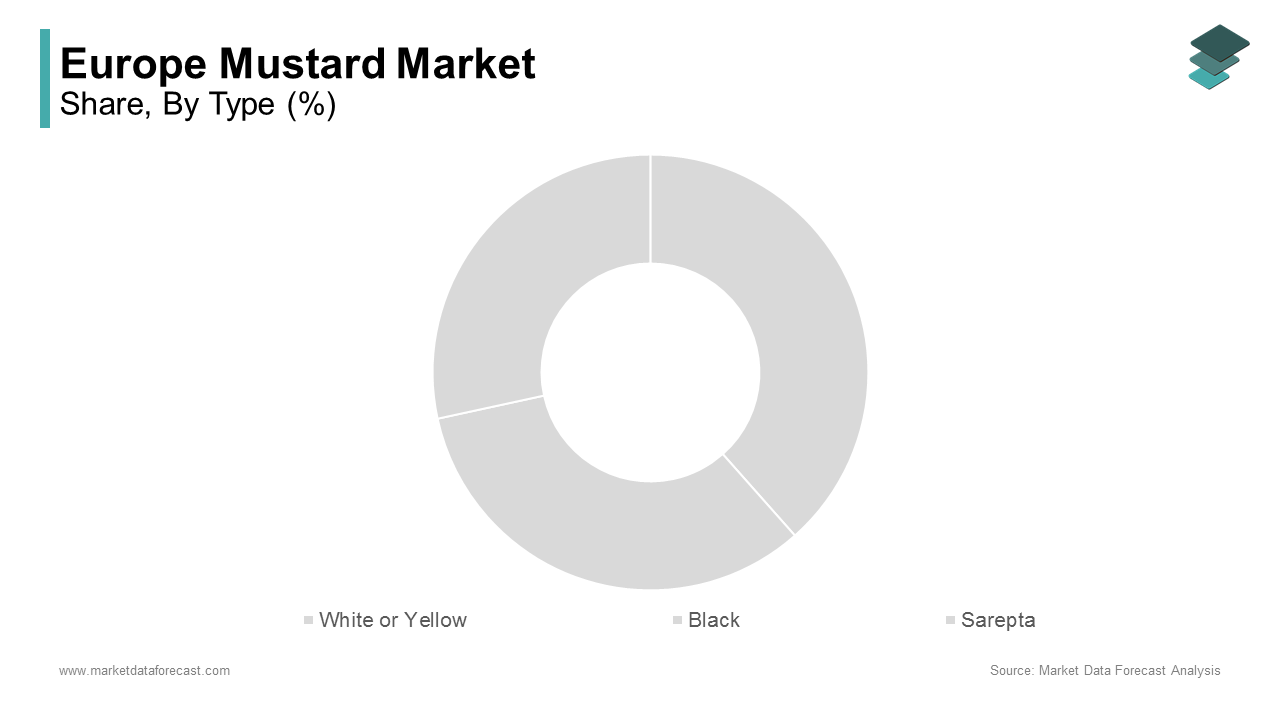
The Sarepta mustard segment is expected to witness a CAGR of 7.5% during the forecast period. With its increasing incorporation into health products, where its high glucosinolate content offers anti-inflammatory benefits, attracting consumers focused on wellness. The rapid expansion of Sarepta mustard is also fueled by innovations in specialty foods, where its intense flavor enhances gourmet and ethnic cuisines, appealing to adventurous consumers. As per the Food and Agriculture Organization, Sarepta production in Europe increased by 12% over five years, with Italy leading at 30,000 metric tons annually due to its suitability for high-end delicacies.
By Application Insights
The commercial segment accounted in holding 45.3% of the Europe mustard market share in 2025. The Commercial application's dominance arises from the booming food service sector, where mustard serves as a key ingredient in restaurants and catering by enhancing menu variety and customer satisfaction. In Germany, commercial mustard usage has grown by 20%, as per the German Federal Ministry of Food and Agriculture, due to its role in fast-casual dining that caters to urban populations.
The Industrial segment is likely to grow with an expected CAGR of 6.8% from 2026 to 2034.
Industrial mustard's rapid growth stems from its demand in pharmaceuticals and cosmetics, where its extracts provide bioactive compounds for various formulations. The segment's acceleration is also due to sustainable practices in manufacturing, where mustard serves as an eco-friendly additive.
By Sales Channel Insights
The indirect channel segment accounted in holding a dominant share of the Europe mustard market in 2025. The growth of the segment is likely to be propelled by its vast retail networks, which enable widespread distribution and consumer reach for mustard products. The marketing strategies that emphasize convenience by allowing consumers easy access via indirect means are also expected to elevate the growth of this segment.
The direct segment is expected to register a CAGR of 5.5% from 2026 to 2034 with the direct-to-consumer models. Direct channel's segment growth is due to e-commerce by enabling direct producer-to-consumer sales that cut intermediaries.
REGIONAL ANALYSIS
Germany Market Analysis
Germany stands as a pivotal player in the Europe mustard market, holding a market share of around 25% due to its robust agricultural infrastructure.
France Market Analysis
In France, the country maintains a leading position with a 20% market share, driven by its historical expertise in mustard production that integrates traditional and modern farming.
United Kingdom Market Analysis
The United Kingdom occupies a significant spot with a 15% market share, bolstered by its dynamic consumer market and import dependencies that fuel demand.
Italy Market Analysis
Italy secures a notable presence with a 12% market share, characterized by innovative applications in cuisine that enhance export opportunities.
Spain Market Analysis
Spain emerges as a key contributor with a 10% market share, supported by its expanding agricultural sector and sustainable practices that address regional demands.
COMPETITION OVERVIEW
The competition in the Europe mustard market is intense and multifaceted, characterized by a blend of established giants and emerging players vying for dominance through innovation and strategic maneuvers. Major companies engage in aggressive product development, introducing variants like organic and flavored mustards to differentiate themselves amid shifting consumer preferences towards healthier and sustainable options. This rivalry fosters continuous improvements in quality and packaging, with firms investing heavily in research to enhance mustard's role in both culinary and health sectors. The market dynamics are influenced by regulatory pressures on food safety, pushing competitors to adopt eco-friendly practices and transparent sourcing, which intensifies the battle for consumer trust. Distribution channels play a crucial role as players expand online presence and partnerships to reach wider audiences, while economic fluctuations affect pricing strategies and supply chain efficiency.
Top Strategies Used by the Key Players in the Europe Mustard Market
Key players in the Europe mustard market employ several major strategies to maintain competitiveness and drive growth, focusing on innovation, sustainability, and market expansion. They prioritize product diversification by introducing new flavors and organic options to meet evolving consumer demands, which helps in capturing niche segments. Strategic acquisitions and partnerships are another core approach, allowing companies to integrate advanced technologies and expand their supply chains across Europe. Additionally, emphasis on sustainable sourcing ensures ethical practices by appealing to environmentally conscious buyers and reducing operational risks.
Leading Players in the Europe Mustard Market
Unilever
Unilever plays a significant role in the global mustard market by leveraging its extensive distribution networks to supply high-quality mustard products worldwide. The company is deeply involved in Europe, focusing on innovative flavor profiles and sustainable sourcing of mustard seeds from various regions. In recent years, Unilever has strengthened its position by investing in eco-friendly packaging and expanding its product line to include organic variants, which appeal to health-conscious consumers. These actions have helped the company maintain a strong presence in international markets, emphasizing quality and environmental responsibility to foster long-term growth.
McCormick & Company
McCormick & Company contributes notably to the global mustard market by providing a wide array of spices and condiments that enhance culinary experiences across continents. In Europe, the company engages in mustard production and distribution, partnering with local farmers to ensure authentic flavors and a consistent supply. Recently, McCormick has taken steps to bolster its market standing by acquiring smaller European producers and launching digital marketing campaigns that promote its mustard products on e-commerce platforms.
French's makes a substantial impact on the global mustard market by offering versatile, ready-to-use mustard solutions that cater to both household and professional kitchens. The company is actively involved in Europe through manufacturing facilities that produce popular mustard variants for export. In recent actions, French's has focused on research and development to introduce low-sodium and flavored mustard options by aligning with wellness trends, and has formed alliances with European retailers to increase accessibility. These efforts have enabled the company to innovate and strengthen its global operations, emphasizing consumer engagement and product adaptability.
KEY MARKET PLAYERS
A few of the dominating players in the Europe mustard market include
- Unilever PLC
- Colman’s Mustard
- Mustard and Co
- Tracklements
- Charroux Mustard
- Bornier Mustard
- Maille
- Kuhne
- Bertman Original Ballpark Mustard
- Taylors Mustard
- Develey Senf & Feinkost GmbH
- Löwensenf GmbH
- Moutarde de Meaux Pommery
EUROPE MUSTARD MARKET NEWS
- In July 2022, McCormick & Company partnered with European farmers to enhance seed quality and supply. This partnership is anticipated to ensure reliable production and strengthen the Europe mustard market presence through improved raw material standards.
MARKET SEGMENTATION
This research report on the European mustard market has been segmented and sub-segmented based on the following categories.
By Type
- White or Yellow
- Black
- Sarepta
By Application
- Commercial
- Industrial
- Household
By Sales Channel
- Direct
- Indirect
By Region
- UK
- France
- Spain
- Germany
- Italy
- Russia
- Sweden
- Denmark
- Switzerland
- Netherlands
- Turkey
- Czech Republic
- Rest of Europe