- Product Description Description
- Table of Contents TOC
- List of Table & Figure LOT
- Get Free Sample PDF Sample PDF
Market Size, 2025
$19.57 BnMarket Estimate, 2026
$23.89 BnMarket Forecast, 2034
$117.86 BnCAGR, 2026–2034
22.08%Europe Nanotechnology Market Size
The Europe nanotechnology market size was valued at USD 19.57 billion in 2025 and is projected to reach USD 117.86 billion by 2034 from USD 23.89 billion in 2026, growing at a CAGR of 22.08%.
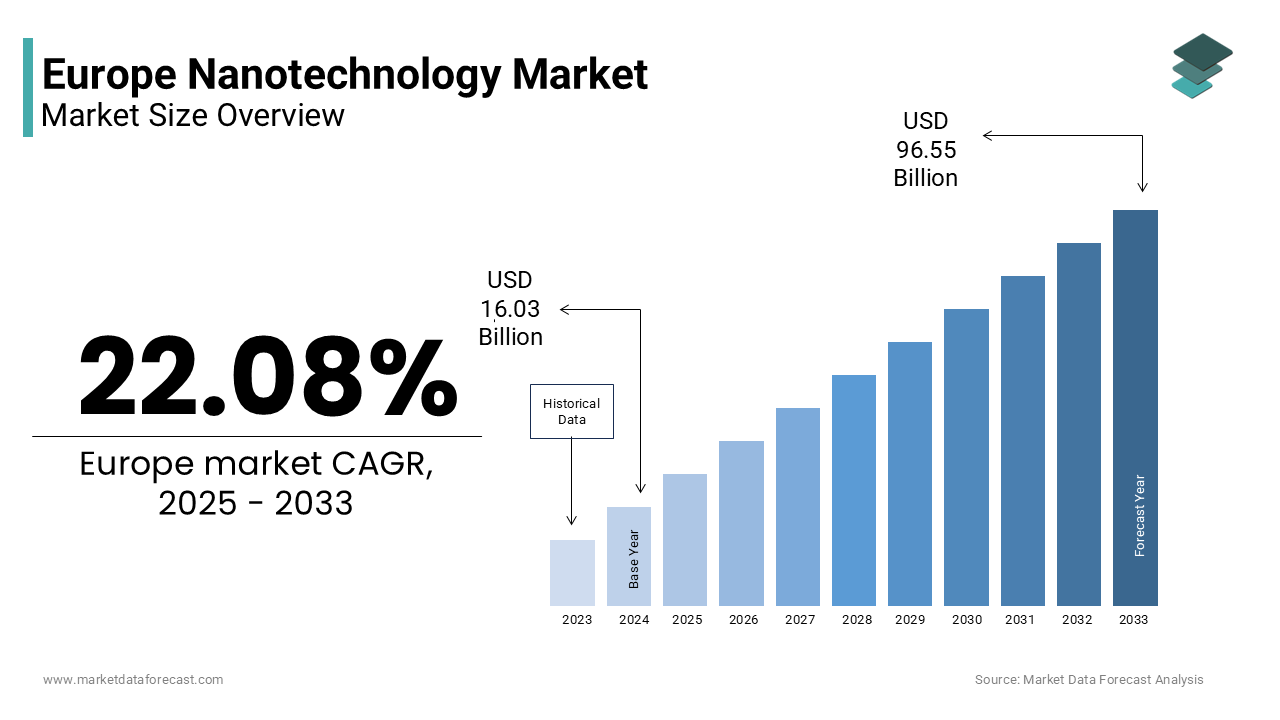
Nanotechnology refers to the science of manipulating matter at the atomic/molecular level (1-100 nm) to create new materials and devices with superior properties (strength, conductivity, efficiency) for revolutionary applications. The field spans diverse applications including healthcare energy electronics and environmental remediation. According to research, the European Commission actively supports a significant and growing number of researchers engaged in nanoscience and nanotechnology-related projects through the Horizon Europe program and its predecessor frameworks, aiming to bolster the European Research Area. Moreover, data indicates substantial investment in research and development by European Union enterprises across various high-tech sectors, including nanotechnology. Small and medium enterprises actively participate in this research landscape alongside larger corporations. The European institutional infrastructure in nanotechnology is robust, featuring numerous specialized centers and state-of-the-art cleanroom facilities strategically distributed across key member states. Academic output in Europe remains robust, with the continent contributing a substantial share of globally published peer-reviewed nanotechnology research, as tracked by international organizations such as the Organisation for Economic Co-operation and Development. This scientific density provides a fertile ground for applied innovation despite regulatory and commercialization complexities inherent to advanced material technologies.
MARKET DRIVERS
Accelerated Integration of Nanomaterials in Medical Diagnostics and Therapeutics
The healthcare sector in the region has become a pivotal driver of the Europe nanotechnology market. This is due to rising demand for precision medicine and early disease detection. Nanoparticle based contrast agents and targeted drug delivery systems are increasingly integrated into clinical workflows particularly for oncology and neurodegenerative disorders. According to various sources, the number of nanomedicine products receiving marketing authorization in the European Union has shown substantial growth since 2000. In addition, as per research, the field of diagnostic imaging is witnessing advancements in contrast agent technology, including ongoing research into nanoscale contrast enhancers, to improve image quality and enable more precise diagnoses across Europe. Research, including studies potentially linked to institutions like the Karolinska Institute, continues to explore the potential of nanotechnology-enabled diagnostics to significantly improve early cancer detection rates. Furthermore, the European Investment Bank is a significant funder of health technology and innovation within the European Union, contributing to the growing investment in cutting-edge medical advancements including nanoscale research and development. This institutional support coupled with an aging population amplifies urgency for advanced therapeutic solutions that nanotechnology can uniquely provide.
Expansion of Nanotechnology in Sustainable Energy Infrastructure
The region’s aggressive decarbonization agenda has caused nanotechnology adoption in renewable energy systems, particularly in photovoltaics energy storage and hydrogen production, which in turn propels the expansion of the Europe nanotechnology market. The European Union has a policy framework in place to achieve climate neutrality by a mid-century target date, a transition heavily reliant on ongoing innovation in critical clean energy technologies such as solar and energy storage. As per various studies, the deployment of solar energy in Europe has been increasing dramatically, with significant annual additions of new capacity, and emerging solar technologies that utilize advanced materials are a focus of research and early-stage development efforts. European research institutions, including the Joint Research Centre, are actively researching advanced battery materials, such as silicon nanowire anodes, which show promise for significantly enhancing energy storage capabilities compared to conventional designs. Furthermore, the European Hydrogen Backbone initiative, a collaboration among a growing number of European transmission system operators, emphasizes the essential role of technological advancements, including nanostructured catalysts, in reducing the costs of green hydrogen production to enable a widespread hydrogen economy by the end of the decade. This strategic alignment between nanotechnology innovation and continental energy policy creates sustained demand that transcends cyclical industrial fluctuations.
MARKET RESTRAINTS
Stringent Regulatory Frameworks Governing Nanomaterial Safety and Environmental Impact
The European Union enforces some of the world’s most comprehensive regulations on nanomaterials, and consequently restricts the growth of the Europe nanotechnology market. These rules, implemented through frameworks like REACH and the Biocidal Products Regulation which require extensive safety dossiers before commercial deployment. Regulatory bodies like the European Chemicals Agency (ECHA) observe a persistent challenge in obtaining complete toxicological and exposure data for nanomaterials within the established registration frameworks. Ensuring that manufacturers provide sufficient and appropriate exposure assessments for nano-enabled consumer products remains a significant regulatory and scientific challenge. The European Food Safety Authority (EFSA) consistently emphasizes data gaps, such as unresolved concerns over potential genotoxicity, which frequently impede the approval of nano-additives for food and feed applications. These rigorous requirements while protective of public health significantly extend time to market. Compliance with emerging nano-specific regulatory requirements is generally understood to extend the timeline and complexity of product development cycles when compared to conventional materials. This regulatory burden disproportionately affects startups and academic spin offs which lack resources for extensive dossiers thereby constraining innovation velocity despite high scientific potential.
Fragmented Cross Border Standardization and Certification Processes
Disparities persist across European nations in the certification testing and labeling of nanotechnology products, despite efforts toward harmonization, and thereby hinder the expansion of the Europe nanotechnology market. According to sources, efforts to achieve uniform adoption of nanotechnology-related technical specifications across European member states have been ongoing, with a recognized need for increased harmonization to support the single market and reduce trade barriers. In medical devices for instance France’s National Agency for the Safety of Medicines and Health Products requires additional nano specific biocompatibility tests beyond EU MDR stipulations while Sweden relies exclusively on centralized European Medicines Agency evaluations.
A two thousand twenty two survey by the VDI Society for Engineering Design revealed that seventy three percent of nanotechnology firms operating in more than three European countries reported duplicated testing procedures increasing compliance costs by an average of two hundred eighty thousand euros annually. Moreover, the lack of universally recognized metrology standards for nanoparticle characterization impedes reproducibility. Regulatory uncertainty and a lack of fully harmonized standards in the European nanotechnology sector have been observed to present challenges for firms, potentially leading to redundant testing procedures and increased compliance burdens as companies navigate different national requirements. This fragmentation dilutes economies of scale and undermines the single market principle critical to technology diffusion.
MARKET OPPORTUNITIES
Rising Public Private Partnerships for Nanoenabled Circular Economy Solutions
The region’s commitment to a circular economy has opened new opportunities for the Europe nanotechnology market. Nanotechnology enhances material recovery and product longevity through strategic collaborations. Public-private collaborations in the European Union are increasingly focused on developing advanced technologies for the recycling of critical raw materials like rare earth elements and lithium to reduce external dependencies. Research into advanced materials, including polymer nanocomposites with components like graphene oxide, is exploring ways to improve the recyclability and performance of complex plastic packaging materials. The European Institute of Innovation and Technology supports innovation projects, including those developing advanced filtration technologies to recover valuable resources such as phosphorus and cobalt from urban wastewater streams. Research institutions such as the Fraunhofer Institute are advancing pilot-scale technologies that use novel separation methods, including magnetic nanoparticles, to improve metal recovery from waste streams. Driven by European Union circular economy goals to significantly increase waste recycling rates and improve resource efficiency, there is a growing demand for advanced separation and sensing technologies in various industrial and waste management sectors.
Emergence of Nanoarchitectonics in Quantum and Neuromorphic Computing
Europe is positioning nanotechnology as a foundational layer for next generation computing paradigms that transcend Moore’s Law limitations. This creates fresh prospects for the Europe nanotechnology market. The Quantum Flagship program includes projects explicitly developing nanoscale qubit architectures using specific types of materials. Concurrently, demonstrations involving silicon-based spin qubits have shown improved coherence times. Separately, the Human Brain Project has transitioned into neuromorphic engineering applications where memristive devices built with specific nanofilms emulate synaptic plasticity. Research indicates that such nano-neuromorphic chips have reduced energy consumption compared to conventional AI accelerators during pattern recognition tasks. These nanoengineered components have been integrated into prototype exascale systems at a specific supercomputing center. The push for technological sovereignty means these advancements could provide a strategic edge in developing next-generation compute architectures, effectively bypassing conventional semiconductor limitations.
MARKET CHALLENGES
Limited Access to Specialized Nanofabrication Infrastructure for SMEs
Europe boasts world-class nanofabrication facilities, but access is difficult for SMEs. Consequently, this challenges the growth of the Europe nanotechnology market. High costs and complex booking procedures create significant innovation barriers. Mapping of cleanroom facilities across the European Union indicates that only a minority of locations provide advanced lithography capabilities at the sub-ten nanometer scale. Access to these high-end facilities is often restricted for non-academic organizations, as many centers do not offer subsidized rates to the private sector. Small and medium-sized enterprises face substantial delays when attempting to secure time at national laboratories, which can hinder the pace of prototyping. In certain regions of Europe, startups frequently identify the availability of specialized infrastructure as a major challenge for their growth. The financial requirements for utilizing state-of-the-art lithography systems remain high, particularly when considering the base cost of equipment operation. This disparity creates a two tier innovation landscape where well funded corporations and elite universities dominate advanced nanomanufacturing while agile SMEs are relegated to computational modeling or bulk nanomaterial synthesis limiting Europe’s ability to translate diverse scientific insights into market ready products.
Ethical and Societal Resistance to Nanoenabled Consumer Applications
Public skepticism toward nanotechnology, particularly in food cosmetics and textiles continues to impede commercial deployment despite scientific assurances of safety to ultimately constrain the expansion of the Europe nanotechnology market. Public apprehension regarding the potential health impacts of nanotechnology in consumer goods has remained consistent over the long term. The implementation of stricter labeling requirements has coincided with a decrease in the introduction of new products containing nanoformulations. Media narratives increasingly emphasize the risks associated with nanotechnology over its potential benefits. This perception gap is exacerbated by inconsistent communication from regulatory bodies. A lack of mechanisms to build confidence could hinder the full use of advantageous nano applications, even when those applications fulfill established technical and regulatory standards.
REPORT COVERAGE
| REPORT METRIC | DETAILS |
| Market Size Available | 2025 to 2034 |
| Base Year | 2025 |
| Forecast Period | 2026 to 2034 |
| CAGR | 22.08% |
| Segments Covered | By Type, Application, and Region |
| Various Analyses Covered | Global, Regional, & Country Level Analysis; Segment-Level Analysis; DROC, PESTLE Analysis; Porter’s Five Forces Analysis; Competitive Landscape; Analyst Overview of Investment Opportunities |
| Regions Covered | UK, France, Spain, Germany, Italy, Russia, Sweden, Denmark, Switzerland, Netherlands, Turkey, and the Czech Republic |
| Market Leaders Profiled | Fujitsu Limited, Bruker Corporation, Thermo Fisher Scientific, Inc., Bayer AG, Infineon Technologies AG, Advanced Nano Products Co., Ltd (ANP Corporation), Kleindiek Nanotechnik GmbH, Altair Nanotechnologies Inc. (YinLong Group), Nanonics Imaging Ltd, and eSpin Technologies, Inc. |
SEGMENTAL ANALYSIS
By Type Insights
The nanodevices segment held the majority share of the Europe nanotechnology market in 2025. Its extensive integration into healthcare electronics and industrial automation systems drives the leading position of the nanodevices segment. According to sources, nanodevices represented the majority of nanotechnology-based commercial deployments across Europe. An additional driver of this segment is the proliferation of implantable and wearable medical nanodevices which support chronic disease management and remote patient monitoring. A significant number of patients in specific European countries were fitted with nano-enabled cardiac rhythm monitors, which indicates a notable increase in their usage. Additionally, the semiconductor industry’s adoption of nanoscale transistors has intensified demand. Shipments of logic chips integrated with nanodevices saw an increase in the automotive and aerospace industries over a one-year period. National research initiatives further bolster this segment. Funding was allocated within a European nation for the purpose of prototyping nanodevices in both quantum and medical fields.
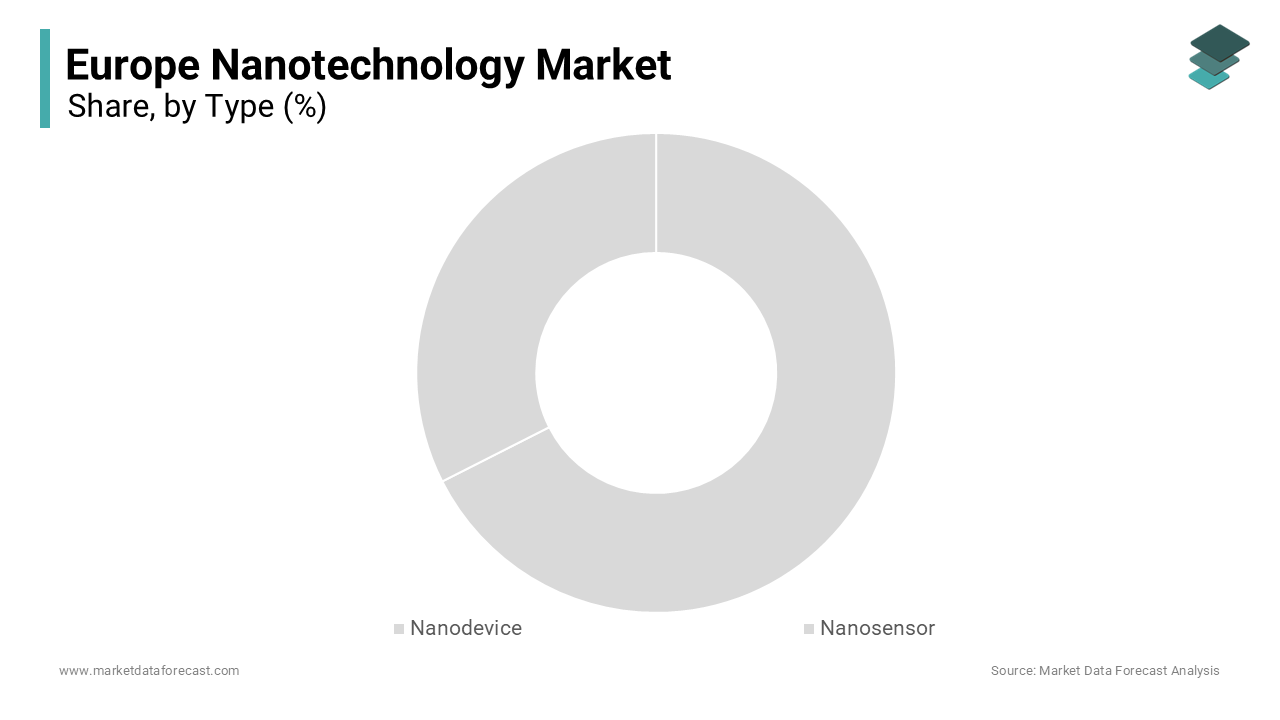
The nanosensors segment is predicted to witness the highest CAGR of 14.7% from 2026 to 2034 due to urgent environmental and public health monitoring needs aligned with EU regulatory mandates. The requirement for comprehensive urban air quality monitoring prompted the deployment of real-time air quality networks in larger urban areas. This initiative encouraged the use of various nanosensor technologies, including those based on metal oxide and carbon nanotubes. Following this shift, a country in Northern Europe deployed many nanosensor units across its major cities. This deployment demonstrated high detection accuracy, particularly for fine particulate matter. Simultaneously, the need for enhanced food safety has become a significant driver for nanosensor demand, with a requirement for extremely low pathogen detection thresholds. Consequently, a startup developed and commercialized advanced nanosensors designed to detect specific pathogens in very short timeframes, proving highly effective in trials. These regulatory technological and societal imperatives underpin nanosensors’ rapid ascent.
REGIONAL ANALYSIS
Germany Nanotechnology Market Analysis
Germany dominated the Europe nanotechnology market and accounted for a 23.4% share in 2025. The supremacy of the German market is attributed to a tightly integrated innovation ecosystem linking Fraunhofer Institutes Max Planck facilities and industrial giants like Siemens and BASF. In the recent period, German businesses were prominent in filing patents related to nanotechnology with a key regional patent office, making up a notable share of the total filings within Europe. The national government's strategic technology plan provided significant funding to advance infrastructure in areas like nanomanufacturing and nano characterization, with particular interest in quantum and biomedical uses. One state within Germany is home to a substantial number of cleanrooms that can handle highly advanced manufacturing needs for various clients. Furthermore, the nation's specific vocational training approach consistently prepares many technicians each year with the necessary skills for nanotechnology, which helps support industrial operations.
France Nanotechnology Market Analysis
France was the second largest player in the Europe nanotechnology market and held a 18.1% share in 2025. The growing demand for nanotechnology in France is driven by a state-led strategic autonomy, particularly in defense, health, and energy domains. French investment in emerging technology programs includes a notable focus on secure communications and aerospace applications. A prominent research center in Grenoble provides advanced facilities for accelerating the development and integration of nanosensors into semiconductor manufacturing processes. France’s hospital network has adopted nano diagnostics at scale. A significant portion of oncology centers have adopted gold nanoparticle-based imaging agents, contributing to a reduction in the time required for diagnosis. This fusion of sovereign industrial policy academic excellence and clinical adoption solidifies France’s competitive edge.
United Kingdom Nanotechnology Market Analysis
The United Kingdom maintains a noteworthy position in the nanotechnology market. Despite post Brexit challenges, the UK maintains command in nanomedicine and quantum nanodevices through globally recognized institutions like Imperial College London and the University of Cambridge. The UK Research and Innovation body committed a substantial sum to the National Quantum Strategy, a plan that encompasses the nanofabrication of spin qubits and photonic circuits. Moreover, the Medicines and Healthcare products Regulatory Agency gave its approval to several nanoformulated therapeutics, a number higher than in other European countries, which was supported by accelerated pathways for specific advanced medicines. Besides, a technology platform that uses protein nanopores for DNA sequencing generated significant global revenue, indicating strong commercial success stemming from domestic innovation in the nano field.
Netherlands Nanotechnology Market Analysis
The Netherlands grew steadily in the Europe nanotechnology market due to its micro and nanoelectronics cluster centered in Eindhoven where ASML’s extreme ultraviolet lithography machines enable sub three nanometer chip production globally. The government allocated funds to an initiative advancing integrated photonic chips for sensing and communications. A water research institute deployed numerous nanoenabled soil moisture and contaminant sensors across a major river delta, tracking salinity and heavy metals with high data reliability. This unique synergy between semiconductor infrastructure agritech and water management creates a multidisciplinary nano advantage unmatched in scale efficiency and real world deployment.
Sweden Nanotechnology Market Analysis
Sweden is likely to expand in the nanotechnology market over the forecast period. The country excels in sustainable and health-oriented nanotechnology driven by its strong welfare state innovation model and green industrial policy. Sweden has directed significant funding toward the development of nanostructured battery materials designed for high-energy-density solid-state systems. Academic institutions have collaborated to establish a national platform that supports the advancement of nano-based drug delivery systems for medical applications. The implementation of public procurement preferences for environmentally certified materials has encouraged the growth of startups specializing in sustainable nanotechnology. This alignment of ethical innovation public health and climate neutrality ensures Sweden’s outsized influence relative to its population size.
COMPETITIVE LANDSCAPE
Competition in the Europe nanotechnology market is characterized by a dynamic interplay between industrial conglomerates specialized startups and publicly funded research entities. Large corporations leverage scale and vertical integration to embed nanotechnology into established sectors such as healthcare automotive and energy while agile startups focus on niche breakthroughs in quantum sensing or nano biointerfaces. The absence of standardized commercialization pathways creates a fragmented competitive landscape where intellectual property and access to cleanroom infrastructure often determine market influence. Public research organizations act as both collaborators and de facto competitors by licensing foundational technologies. Intense collaboration across borders under Horizon Europe mitigates pure rivalry yet national industrial policies foster domestic champions. This ecosystem promotes innovation but complicates consolidation and global scaling for European players facing well funded counterparts in Asia and North America.
KEY MARKET PLAYERS
Some of the notable key players in the Europe nanotechnology market are
- Fujitsu Limited
- Bruker Corporation
- Thermo Fisher Scientific, Inc.
- Bayer AG
- Infineon Technologies AG
- Advanced Nano Products Co., Ltd (ANP CORPORATION)
- Kleindiek Nanotechnik GmbH
- Altair Nanotechnologies Inc. (YinLong Group)
- Nanonics Imaging Ltd
- eSpin Technologies, Inc.
Top Players in the Market
- BASF SE is a leading innovator in nanomaterials with a strong footprint across Europe and globally. The company develops nanostructured catalysts polymer additives and surface coatings that enable energy efficiency and sustainability across automotive construction and chemical industries. In recent years BASF has intensified collaboration with European academic institutions and invested in pilot scale production of nanoengineered battery materials. It launched its ChemCycling project using nanofiltration to recover high purity feedstocks from plastic waste demonstrating commitment to circular economy principles. These initiatives reinforce BASF’s technological leadership and align with EU regulatory priorities on green chemistry and decarbonization.
- Siemens AG leverages nanotechnology to advance digitalization and smart infrastructure across healthcare energy and industrial automation. The company integrates nanosensors and nanoelectronic components into diagnostic imaging systems grid monitoring devices and predictive maintenance platforms. Recently Siemens expanded its nanoelectronics research partnership with CEA Leti in France to develop neuromorphic computing elements for edge AI applications. It also launched a nanoenabled gas detection system for industrial safety that offers parts per billion sensitivity. These actions underscore Siemens’s strategy to embed nanotechnology at the core of its digital industrial transformation and maintain global relevance in high precision engineering.
- Novartis AG is a pioneer in nanomedicine with a robust pipeline of nanoformulated therapeutics targeting oncology immunology and rare diseases. The company utilizes lipid nanoparticles polymer conjugates and targeted nanocarriers to enhance drug bioavailability and reduce systemic toxicity. In two thousand twenty four Novartis initiated a pan European clinical trial for a siRNA nanotherapy in treatment resistant solid tumors using receptor mediated delivery. It also partnered with the Swiss Nanoscience Institute to co develop blood brain barrier penetrating nanoplatforms for neurodegenerative disorders. These efforts reflect Novartis’s dedication to precision medicine and its role in translating European nanoscience into globally impactful healthcare solutions.
Top Strategies Used by the Key Market Participants
Key players in the Europe nanotechnology market prioritize strategic research collaborations with academic and government laboratories to accelerate technology transfer. They invest heavily in pilot scale manufacturing infrastructure to bridge the gap between laboratory innovation and industrial deployment. Companies pursue vertical integration by embedding nanotechnology into existing product lines such as diagnostics energy systems or coatings to demonstrate immediate value. Regulatory foresight is another critical strategy with firms proactively engaging with agencies like ECHA and EMA to shape safety standards. Finally they emphasize sustainability by aligning nano innovations with circular economy principles and EU Green Deal objectives to secure public acceptance and policy support.
MARKET SEGMENTATION
This research report on the European nanotechnology market has been segmented and sub-segmented based on categories.
By Type
- Nanodevice
- Nanosensor
By Application
- Healthcare & Pharmaceuticals
- Electronics & Semiconductor
- Biotechnology
- Chemicals & Advanced Materials
- Automobiles
- Aerospace
- IT & Telecom
- Textile
- Others
By Country
- UK
- France
- Spain
- Germany
- Italy
- Russia
- Sweden
- Denmark
- Switzerland
- Netherlands
- Turkey
- Czech Republic
- Rest of Europe