- Product Description Description
- Table of Contents TOC
- List of Table & Figure LOT
- Get Free Sample PDF Sample PDF
Market Size, 2025
$10.98 BnMarket Estimate, 2026
$12.22 BnMarket Forecast, 2034
$28.68 BnCAGR, 2026–2034
11.26%Europe Network Attached Storage Market Report Summary
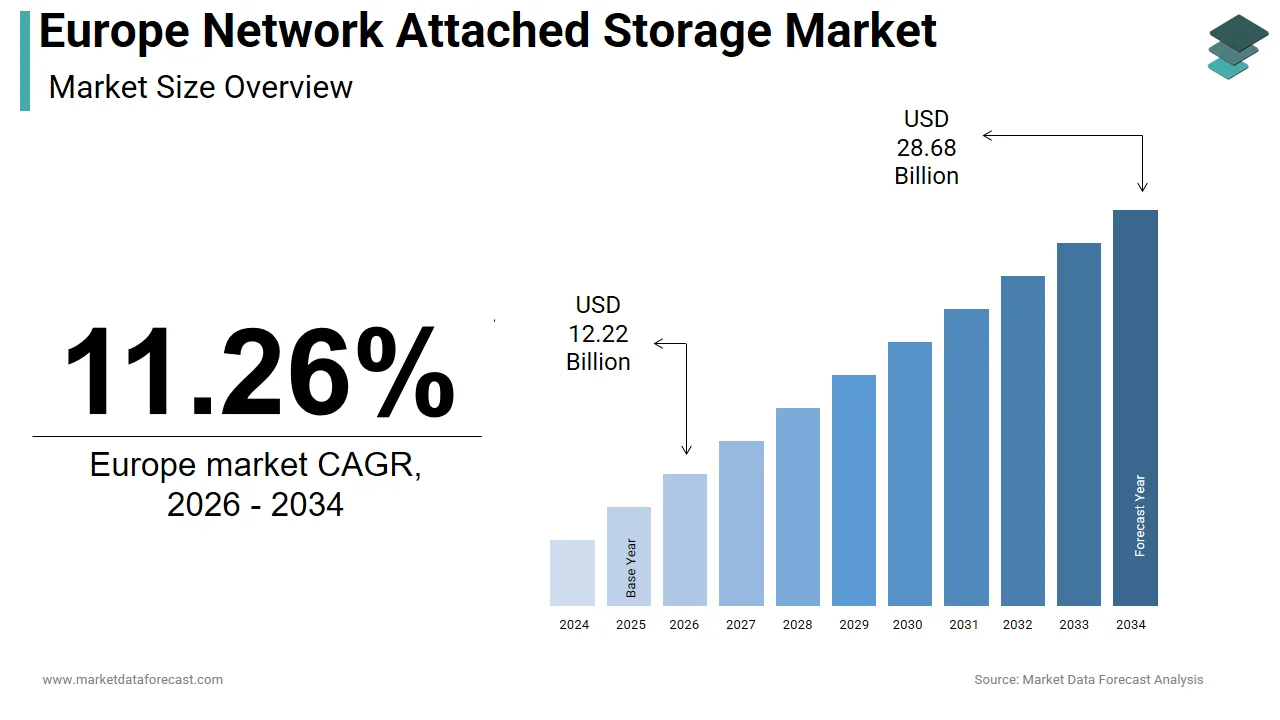
The Europe network attached storage (NAS) market was valued at USD 10.98 billion in 2025, is anticipated to reach USD 12.22 billion in 2026, and is projected to reach USD 28.68 billion by 2034, growing at a CAGR of 11.26% from 2026 to 2034. Market growth is driven by rising enterprise data volumes, increasing adoption of cloud-integrated storage solutions, and expanding demand for secure, scalable data management systems. NAS solutions are widely used across government, enterprise, and research sectors to enable centralized storage, data backup, and efficient file sharing. Increasing investments in digital infrastructure, edge computing, and hybrid cloud environments are further accelerating market expansion across Europe.
Key Market Trends
- Rising demand for centralized and scalable enterprise storage solutions.
- Increasing integration of NAS with hybrid and multi-cloud environments.
- Growing adoption of NAS for backup, disaster recovery, and data protection.
- Expansion of edge computing and distributed IT infrastructure.
- Strengthening focus on data sovereignty and regulatory compliance.
Segmental Insights
- Based on design, the 1–8 bays segment dominated the market in 2025 by capturing 60.5% share, driven by strong adoption among small and medium-sized enterprises requiring cost-effective storage solutions.
- Based on product, the midmarket NAS solutions segment led the market by accounting for 68.8% share in 2025, supported by increasing demand from mid-sized enterprises for scalable and efficient storage infrastructure.
- Based on end-user industry, the government segment held the largest share of 23.7% in 2025, driven by growing digitalization, secure data storage requirements, and regulatory compliance needs.
Regional Insights
The Europe network attached storage market is witnessing strong growth across major economies, supported by enterprise digital transformation, expanding cloud adoption, and increasing data generation.
- Germany led the regional market in 2025 with 20.6% share, driven by its strong industrial base, digital infrastructure investments, and enterprise data management requirements.
- The United Kingdom holds a significant share, supported by its strong presence in financial services, creative industries, and academic research institutions.
- France is expected to grow at a healthy CAGR over the forecast period, supported by state-led digital sovereignty initiatives and increasing investment in secure data storage infrastructure.
Competitive Landscape
The Europe NAS market is characterized by strong competition among global storage technology providers and enterprise IT infrastructure vendors. Market players are focusing on improving storage performance, enhancing cybersecurity features, and integrating NAS with cloud and edge computing platforms. Strategic product innovation, partnerships, and expansion of hybrid storage solutions are shaping competitive dynamics across the region.
Prominent companies operating in the Europe network attached storage market include Dell Technologies Inc., NetApp, Inc., Hewlett Packard Enterprise, Hitachi, Ltd., Western Digital Corporation, Seagate Technology, NETGEAR, Inc., Synology Inc., Buffalo Americas, Inc., Pure Storage, Inc., and QNAP Systems, Inc..
Europe Network Attached Storage Market Size
The Europe network attached storage market was valued at USD 10.98 billion in 2025. The regional market is projected to grow from USD 12.22 billion in 2026 to reach USD 28.68 billion by 2034, exhibiting a compound annual growth rate (CAGR) of 11.26% from 2026 to 2034.
Network-attached storage comprises specialized data storage devices connected to local area networks that provide centralized file-level data access to multiple users and heterogeneous client systems. Unlike direct attached or cloud-only solutions, NAS devices offer on-premises control, low-latency retrieval, and scalable capacity for small to medium enterprises, creative professionals, and public sector institutions across the continent. In 2025, this market is defined by its role as a hybrid bridge between legacy infrastructure and modern data governance needs. Europe’s digital transformation agenda has intensified data generation. According to Eurostat, enterprises in the EU are increasingly adopting cloud computing services, yet many continue to retain on-site NAS for sensitive or frequently accessed files. The region also faces stringent data residency requirements under the General Data Protection Regulation, making localized storage essential. As per the European Commission, small and medium enterprises operate widely across the EU, many of which rely on cost-effective NAS for backup, media libraries, and collaborative workflows. This ecosystem thrives not on raw scale but on reliability, compliance, and integration within Europe’s diverse and regulation-conscious digital landscape.
MARKET DRIVERS
Escalating Data Generation from Small and Medium Enterprises
Small and medium enterprises are a primary engine of demand for network-attached storage across Europe due to their growing digital operations and limited IT resources, which is one of the major factors driving the growth of the European network-attached storage market. As per the European Commission, SMEs represent the overwhelming majority of businesses in the EU and collectively employ millions of people, which is generating vast volumes of operational, customer, and multimedia data. Unlike large corporations with dedicated data centers, most SMEs require affordable, easy-to-deploy, and maintenance-light storage solutions, which is precisely the value proposition of modern NAS systems. According to the European DIGITAL SME Alliance, SMEs have reported significant growth in unstructured data in recent years, primarily from email archives, design files, surveillance footage, and customer databases. Many operate in sectors like architecture, healthcare, and retail, where rapid file sharing and version control are critical. With only a minority employing full-time IT staff, these businesses favor plug-and-play NAS devices that integrate seamlessly with existing Windows or macOS environments. Vendors have responded with simplified management interfaces, automated backup to cloud tiers, and built-in ransomware protection. This grassroots data explosion among Europe’s economic backbone ensures sustained and organic demand for scalable on-premises storage that balances autonomy with affordability.
Stringent Data Sovereignty and Privacy Regulations
Europe’s rigorous data protection framework fundamentally shapes storage architecture preferences, which is driving adoption of on premises network attached storage over purely cloud-based alternatives and further fuelling the expansion of the regional market. The General Data Protection Regulation mandates strict controls over personal data processing, including requirements for data minimization, purpose limitation, and data localization in certain contexts. According to the European Data Protection Board, many EU member states have enacted supplementary national laws that restrict cross-border transfers of sensitive categories such as health, financial, or biometric data. Public institutions, including schools, municipalities, and healthcare providers, are particularly constrained, with national laws such as Germany’s Federal Data Protection Act and France’s Cloud Souverain initiative reinforcing localized storage. These legal imperatives make NAS an attractive compromise, offering centralized management and network accessibility while keeping data physically within organizational or national boundaries. Moreover, the EU’s Data Governance Act promotes trusted data sharing but emphasizes user control, which NAS facilitates through granular permission settings. Consequently, organizations choose NAS not merely for performance but as a compliance instrument that aligns technical infrastructure with Europe’s foundational privacy ethos.
MARKET RESTRAINTS
Fragmented Legacy IT Infrastructure Across Member States
The Europe network attached storage market faces significant headwinds from the continent’s highly heterogeneous and aging IT environments, which complicate seamless NAS integration and management. Many organizations, especially in Southern and Eastern Europe, operate on legacy operating systems, outdated network protocols, and mixed vendor hardware that lack standardization. According to the European Environment Agency, public sector computers in EU member states continue to run unsupported software versions, creating compatibility gaps with modern NAS firmware that requires updated protocols. Small businesses often rely on consumer-grade routers with limited Quality of Service capabilities, leading to network congestion when multiple users access large media files simultaneously. Additionally, language and technical literacy disparities impede adoption. As per the European Training Foundation, SMEs in certain regions lack staff capable of configuring RAID arrays or setting up remote replication. This fragmentation increases deployment time, support costs, and failure rates, discouraging potential buyers who perceive NAS as overly complex. While vendors offer simplified models, the absence of pan-European IT modernization initiatives means that infrastructure readiness remains uneven, constraining market penetration despite clear functional demand.
Intensifying Cybersecurity Threats Targeting On-Premises Storage
The rising sophistication of cyberattacks poses a critical restraint on network-attached storage adoption, as many devices remain vulnerable to ransomware and unauthorized access due to misconfiguration or outdated firmware. According to Europol, ransomware incidents targeting SMEs in Europe have increased significantly, with attackers increasingly focusing on accessible network shares as entry points. NAS devices, often deployed without enterprise-grade firewalls or intrusion detection, are particularly exposed. As per ENISA and cybersecurity firm Kaspersky, European SMEs have experienced NAS-related security breaches in recent years. Contributing factors include default admin credentials left unchanged, unpatched vulnerabilities in web management interfaces, and a lack of multi-factor authentication. Although newer models incorporate snapshot rollback and immutable backup features, awareness remains low. The European Union Agency for Cybersecurity notes that only a minority of SMEs conduct regular vulnerability scans on peripheral devices like NAS. This risk perception deters cautious organizations from expanding on-premises storage, pushing them toward managed cloud services perceived as more secure, even when data residency laws complicate such choices. Until security hardening becomes both automatic and transparent, this threat will continue to suppress full market potential.
MARKET OPPORTUNITIES
Integration with Hybrid Cloud and Edge Computing Architectures
A significant opportunity for the Europe network attached storage market lies in its evolution into intelligent edge nodes within hybrid cloud ecosystems. Rather than serving as isolated silos, modern NAS devices now function as active data gateways that cache frequently accessed files locally while tiering cold data to compliant European cloud regions. This architecture reduces bandwidth costs and latency for distributed teams. As per Eurofound, many EU enterprises operated hybrid work models in 2024, which makes such integration crucial. Vendors have introduced native integrations with Microsoft 365 and Google Workspace, enabling real-time synchronization of collaborative documents while maintaining on-premises version control. In media and surveillance sectors, NAS units increasingly perform edge analytics before transmitting metadata to central servers, aligning with GDPR’s data minimization principle. The European Commission’s upcoming Data Act further incentivizes such architectures by mandating interoperability and user data portability. By transforming from passive repositories into smart data orchestrators, NAS devices address both performance and regulatory needs, opening new use cases in telemedicine, smart manufacturing, and decentralized research collaborations across the continent.
Expansion into Creative and Media Production Workflows
The surge in high-resolution content creation across Europe presents a compelling growth avenue for the European network-attached storage market. Driven by the proliferation of 4K and 8K video production, podcasting, and digital art, creative studios require shared storage that supports simultaneous multi-user editing without frame drops. According to the European Audiovisual Observatory, Europe continues to produce large volumes of feature films and television drama, generating petabytes of raw footage demanding fast, reliable access. Traditional external drives cannot support collaborative workflows, while cloud storage introduces unacceptable latency for real-time editing. High-performance NAS systems equipped with advanced networking and caching deliver consistent throughput. Companies now offer rack-mounted NAS units certified for professional editing software, enabling seamless project sharing. Educational institutions are also adopting these systems, with film schools across the EU integrating shared NAS labs. This niche yet high-value segment values performance, durability, and workflow integration over cost, allowing vendors to differentiate through specialized software bundles and professional support, turning NAS into an indispensable tool in Europe’s thriving creative economy.
MARKET CHALLENGES
Persistent Skills Gap in Storage Management and Cyber Hygiene
A critical challenge confronting the Europe network attached storage market is the widespread shortage of personnel skilled in both storage administration and cybersecurity best practices, particularly among small organizations. Despite the availability of user-friendly interfaces, optimal NAS deployment requires an understanding of networking fundamentals, RAID configurations, backup scheduling, and access control policies. As per the European Centre for the Development of Vocational Training, only a minority of IT technicians in SMEs across Southern Europe received formal training in data storage systems in 2024. This gap leads to common errors such as disabling encryption for convenience, failing to update firmware, or granting excessive user permissions. The problem is exacerbated by language barriers, as technical documentation for many NAS models remains English-dominant. Even when breaches occur, incident response is often inadequate. According to Europol, many affected SMEs could not isolate compromised NAS units during ransomware attacks due to poor network segmentation. Without accessible training programs or AI-driven automation that simplifies complex tasks, this human factor will continue to undermine the reliability and security of on-premises storage deployments, eroding trust in the technology despite its functional merits.
Supply Chain Volatility and Component Shortages
Ongoing instability in global semiconductor and hard drive supply chains presents a structural challenge to the timely delivery and pricing of network-attached storage systems across Europe, which is further challenging the expansion of the European network-attached storage market. Although the acute shortages of 2021–2022 have eased, geopolitical tensions and export controls continue to disrupt component flows. As per the European Semiconductor Industry Association, lead times for NAND flash memory and network interface controllers remain above historical averages. Hard disk drive availability is similarly constrained, with manufacturers reporting reduced yields from European distribution centers due to logistics bottlenecks. These delays force resellers to maintain higher inventory buffers, increasing costs that are passed to end users. More critically, they disrupt project timelines for public sector tenders and enterprise rollouts that depend on predictable hardware procurement. Currency fluctuations add another layer of risk, as the euro’s volatility against the US dollar impacts import costs for components sourced from Asia and North America. While some vendors have begun localizing assembly in Poland and the Czech Republic, full supply chain resilience remains distant. This uncertainty complicates budgeting and planning, causing some organizations to defer NAS investments or opt for less capable alternatives, thereby dampening market momentum even amid strong underlying demand.
REPORT COVERAGE
| REPORT METRIC | DETAILS |
| Market Size Available | 2025 to 2034 |
| Base Year | 2025 |
| Forecast Period | 2026 to 2034 |
| Segments Covered | |
| Various Analyses Covered | Global, Regional, and Country-Level Analysis, Segment-Level Analysis, Drivers, Restraints, Opportunities, Challenges; PESTLE Analysis; Porter’s Five Forces Analysis, Competitive Landscape, Analyst Overview of Investment Opportunities |
| Countries Covered | UK, France, Spain, Germany, Italy, Russia, Sweden, Denmark, Switzerland, Netherlands, Turkey, Czech Republic, and the Rest of Europe. |
| Market Leaders Profiled | Dell Technologies Inc., NetApp, Inc., Hewlett-Packard Enterprise Company, Hitachi, Ltd., Western Digital Corporation, Seagate Technology Holdings Public Limited Company, NETGEAR, Inc., Synology Inc., Buffalo Americas, Inc., Pure Storage, Inc., QNAP Systems, Inc., and Others. |
SEGMENTAL ANALYSIS
By Design Insights
The 1–8 bay design segment dominated the market by holding 60.5% of the regional market share in 2025. The growth of the 1-8 bays segment in the European market is primarily driven by widespread adoption among small and medium enterprises, creative professionals, and public institutions that require affordable, compact, and low-maintenance storage solutions. As per the European Commission, SMEs constitute the majority of businesses in the EU and often operate with limited IT staff, making simplicity a critical purchase criterion. Devices in this category typically support two to four drive bays, offering capacities sufficient for email archives, surveillance footage, media libraries, and collaborative document sharing. Vendors such as Synology and QNAP have optimized these models with intuitive web-based interfaces, automated backup to cloud tiers, and built-in security features like snapshot rollback, reducing the need for specialized technical knowledge. According to European education authorities, schools and municipal offices widely deploy 1–8 bay NAS units for localized data management due to their quiet operation and desktop form factor. The segment’s appeal lies not in raw scalability but in its alignment with the operational realities of Europe’s decentralized economic fabric, where cost efficiency, ease of use, and regulatory compliance outweigh enterprise-grade performance.
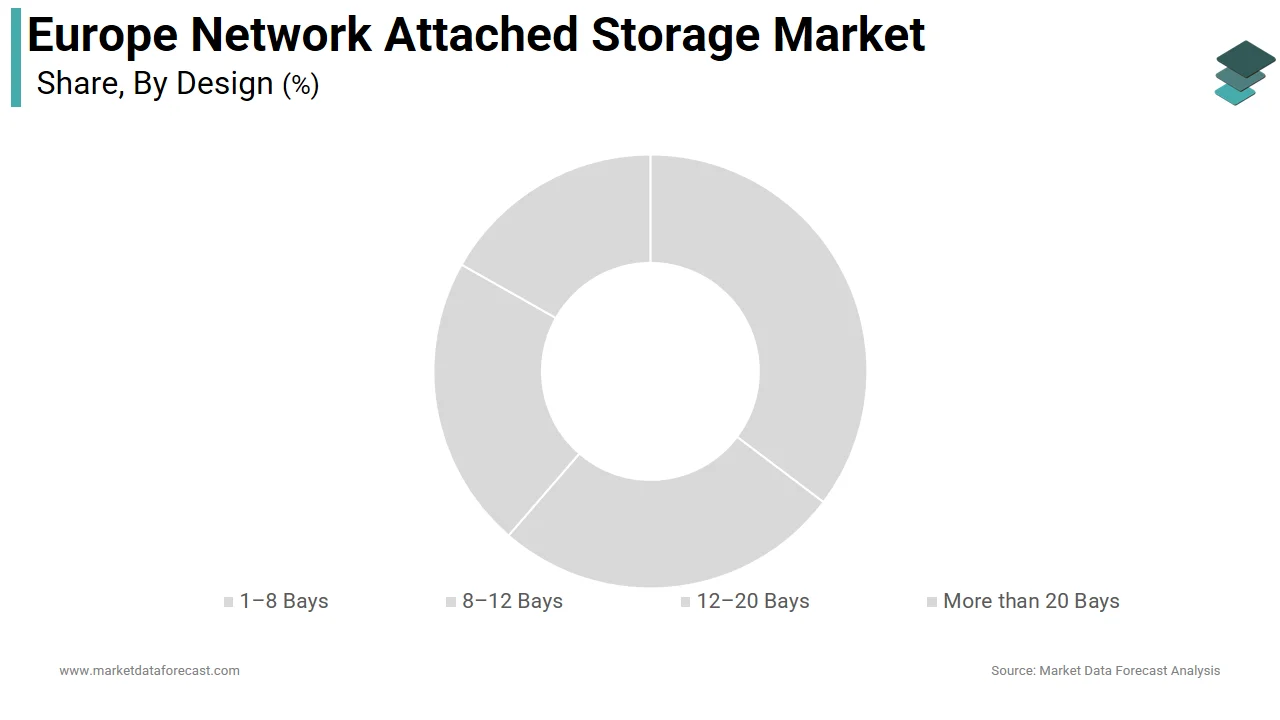
The more than 20 bays segment is anticipated to witness a CAGR of 13.3% over the forecast period. The rising data intensity of research institutions, broadcast media companies, and large enterprises adopting on-premises private cloud architectures is majorly driving the growth of the more than 20 bays segment in the European market. As per CERN and other European research institutions, experimental data volumes have necessitated high-density storage with redundant power and cooling, capabilities inherent in 24+ bay chassis. Similarly, national broadcasters are transitioning to 4K and 8K production workflows, where raw footage demands scalable shared storage for multi-editor access. According to the European Media Production Association, major post-production houses in Germany and France have upgraded to 20+ bay NAS systems to support real-time collaboration. These units often integrate with object storage and Kubernetes environments, enabling hybrid data pipelines that comply with GDPR while supporting AI training workloads. As European data sovereignty policies discourage reliance on US-based hyperscalers, organizations are investing in high-capacity on-site infrastructure, positioning the more than 20 bays segment as the backbone of sovereign data ecosystems.
By Product Insights
The midmarket NAS solutions segment led the market by accounting for 68.8% of the regional market share in 2025. The leading position of midmarket NAS solutions segment in the European market is driven by their optimal balance of performance, manageability, and cost for organizations that outgrow consumer-grade devices but lack the budget or complexity requirements of full enterprise stacks. Midmarket systems typically support advanced features such as virtualization integration, snapshot replication, and multi-protocol access without requiring dedicated storage administrators. As per the European DIGITAL SME Alliance, businesses with 50 to 250 employees widely deployed midmarket NAS in 2024 to consolidate file servers, host private clouds, and back up Microsoft 365 data. Public sector adoption is equally strong, with secondary schools across the EU using these systems for student records and e learning content, benefiting from pre-validated security configurations aligned with national data protection guidelines. Vendors differentiate through software ecosystems that extend utility beyond basic storage. This segment thrives because it addresses the “missing middle” of Europe’s digital landscape, which is making midmarket NAS the pragmatic engine of decentralized data resilience.
The enterprise NAS solutions segment is the fastest-growing product segment in the Europe network attached storage market and is predicted to grow at a CAGR of 11.5% over the forecast period, owing to the stringent data residency mandates, rising ransomware threats, and the need for high availability in mission-critical operations. Large financial institutions, healthcare networks, and government agencies increasingly deploy enterprise NAS as part of sovereign cloud strategies that keep sensitive data within national borders. As per Deutsche Bank and the UK’s National Health Service, enterprise NAS rollouts have centralized compliance documentation and ensured zero data loss during clinical record access. According to ENISA, European enterprises with over 1,000 employees now mandate immutable snapshots and air gapped backups, features standard in enterprise NAS platforms. Integration with identity providers and support for advanced encryption further align these systems with regulatory expectations. As the EU’s Data Act enforces stricter interoperability and portability rules, enterprise NAS evolves from storage to governance infrastructure, justifying premium investment for risk mitigation and operational continuity.
By End-user Industry Insights
The government segment commanded the highest share of 23.7% of the regional market in 2025. The growth of the government segment in the European market is attributed to Europe’s strong emphasis on data sovereignty, public service digitization, and long-term archival requirements. National and local administrations generate vast volumes of citizen records, land registries, judicial documents, and surveillance data that must remain under sovereign control. As per the European Data Protection Supervisor, EU member states prohibit storing core public data on non-EU cloud infrastructure without explicit legal safeguards. Ministries and municipalities favor on-premises NAS for secure, auditable, and cost-effective retention. In France and Germany, government agencies have deployed NAS units to manage biometric applications, school administration, and social welfare case files, leveraging tamper-resistant functionality to prevent data manipulation. The sector’s procurement cycles prioritize reliability over innovation, but strict adherence to certification and GDPR drives consistent demand. This institutional reliance on localized, tamper-resistant storage ensures the government remains the anchor tenant of Europe’s NAS ecosystem.
The healthcare segment is estimated to register a CAGR of 14.5% over the forecast period, owing to the digitization of medical imaging, electronic health records, and genomic research, all of which produce massive, high-fidelity data sets requiring rapid, secure, and compliant access. As per the European Health Agency, hospitals across the EU have implemented Picture Archiving and Communication Systems that rely on high-performance NAS for image caching and radiologist collaboration. GDPR classifies health data as “special category,” mandating strict access controls and audit logs, features native to modern NAS platforms. In Sweden, Karolinska University Hospital integrated NAS clusters to support real-time AI diagnostics on pathology slides. Additionally, cross-border health initiatives like the European Reference Networks depend on federated storage nodes that synchronize patient data while preserving national jurisdiction. As precision medicine and telehealth expand, healthcare’s demand for resilient, on-site storage will continue to outpace other sectors.
COUNTRY LEVEL ANALYSIS
Germany Network Attached Storage Market Analysis
Germany dominated the network-attached storage market in Europe in 2025 by holding 20.6% of the regional market share. The dominance of Germany in the European market is driven by its industrial strength, data protection rigor, and advanced digital infrastructure. The country’s market status is defined by high demand from manufacturing, automotive, and public administration sectors that prioritize data sovereignty under the Federal Data Protection Act. As per the German Federal Office for Information Security, public agencies mandated on-premises storage for citizen data in 2024, driving procurement of certified NAS units with hardware encryption. Frankfurt’s role as a European data hub further stimulates demand, with colocation facilities using high-density NAS for edge caching. The nation’s engineering culture favors reliability over novelty, leading to longer device lifecycles and a preference for vendors with local support centers. This combination of regulatory discipline, industrial depth, and technical literacy solidifies Germany’s position as the continent’s most sophisticated and volume-driven NAS market.
United Kingdom Network Attached Storage Market Analysis
The United Kingdom occupied a promising share of the European network-attached storage market in 2025 due to its dynamic mix of financial services, creative industries, and academic research. The country’s market status is shaped by post-Brexit data localization pressures and the National Cyber Security Centre’s stringent guidelines for critical infrastructure. London-based banks and insurance firms use enterprise NAS to archive transaction records in compliance with Financial Conduct Authority mandates, while universities deploy petabyte-scale systems for particle physics and genomics. As per Jisc, higher education institutions in the UK upgraded their research storage in 2024 to support AI workloads. The creative sector also contributes significantly, with post-production studios in Soho relying on high-throughput NAS for 8K film editing. Despite cloud adoption, the UK’s emphasis on auditability and low latency ensures sustained investment in on-premises solutions, particularly in sectors where milliseconds matter, or data cannot leave sovereign jurisdiction.
France Network Attached Storage Market Analysis
France is predicted to grow at a healthy CAGR in the European NAS market during the forecast period, owing to the strong state involvement in digital sovereignty and cultural preservation. The country’s market status is anchored in the Cloud Souverain initiative, which directs public agencies to use locally hosted infrastructure for sensitive operations. Ministries, hospitals, and universities procure NAS systems that comply with ANSSI’s security certification, often featuring French language management interfaces and domestic technical support. As per the French National Institute of Statistics, public schools across France use centralized NAS for student records and digital textbooks, ensuring offline access during connectivity outages. The aerospace and defense sectors also rely on high assurance NAS for classified project data, with custom firmware hardened against side channel attacks. Cultural institutions digitize millions of artifacts annually, requiring scalable, metadata-rich storage. This blend of national strategy, public sector scale, and industrial secrecy makes France a high-value, regulation-led market where compliance is as critical as capacity.
Italy Network Attached Storage Market Analysis
Italy is expected to account for a notable share of the European network-attached storage market over the forecast period. The Italian market is fragmented, but there is growing demand from small businesses, healthcare, and local governments. The country’s market status reflects a transition from informal IT practices toward structured data governance, spurred by GDPR enforcement and national digitalization funds. As per Italy’s National Digital Agency, SMEs received subsidies in 2024 to adopt secure storage solutions, many choosing 4–8 bay NAS for accounting, design, and customer databases. Regional health authorities are upgrading hospital PACS systems, with Lombardy installing NAS units in 2024 to handle radiology workloads. Municipalities use NAS for civil registry and urban planning, benefiting from low power consumption and silent operation in historic town halls. While enterprise adoption lags behind Northern Europe, the push for digital resilience, especially after ransomware attacks on local councils, has accelerated procurement. Italy’s market is thus defined by grassroots modernization, where affordability and ease of use drive volume across thousands of decentralized buyers.
Netherlands Network Attached Storage Market Analysis
The Netherlands is projected to exhibit a healthy CAGR in the European network attached storage market during the forecast period. The Netherlands is notable for its concentration of data-intensive industries and advanced logistics networks. The country’s market status is shaped by its role as a European digital gateway, hosting major internet exchanges and cloud on ramps in Amsterdam. Multinational corporations use Dutch NAS deployments as regional data hubs that comply with both EU and global privacy standards. As per the Dutch Data Protection Authority, logistics firms implemented NAS in 2024 to manage IoT sensor data from smart warehouses and autonomous vehicles. The agritech sector relies on NAS for genomic crop data and climate modeling. Academic medical centers in Rotterdam and Utrecht use high-availability clusters for real-time patient analytics. The Netherlands’ culture of pragmatic innovation, combined with English fluency and robust fiber infrastructure, fosters early adoption of next-generation features like containerized apps and S3 object gateways. This positions the country as a testbed for scalable, future-proof storage architectures that balance openness with control.
COMPETITIVE LANDSCAPE
Competition in the Europe network attached storage market is defined by a delicate balance between global technology leadership and deep regional adaptation. While international vendors dominate innovation, success hinges on understanding Europe’s fragmented regulatory environment, language diversity, and cultural preferences for data autonomy. The market features intense rivalry among established players who differentiate through software ecosystems, security certifications, and localized service networks rather than price alone. Small and medium enterprises drive volume, yet they demand enterprise-grade reliability without complexity, pushing vendors to simplify management while hardening defences. Public sector procurement adds another layer, requiring compliance with national cybersecurity standards and sustainability criteria. Unlike other regions, Europe’s competition is less about raw performance and more about trust, as trust in data residency, resilience against cyber threats, and long-term vendor accountability. New entrants face high barriers due to certification timelines and entrenched relationships, making organic growth through channel partners and demonstrable compliance the primary path to relevance in this mature yet evolving market.
KEY MARKET PLAYERS
The leading companies operating in the Europe network attached storage market include:
- Dell Technologies Inc.
- NetApp, Inc.
- Hewlett-Packard Enterprise Company
- Hitachi, Ltd.
- Western Digital Corporation
- Seagate Technology Holdings Public Limited Company
- NETGEAR, Inc.
- Synology Inc.
- Buffalo Americas, Inc.
- Pure Storage, Inc.
- QNAP Systems, Inc.
TOP PLAYERS IN THE MARKET
- Synology Inc is a leading innovator in the Europe network attached storage market, renowned for its user-centric DiskStation Manager operating system that combines enterprise-grade features with a consumer-friendly design. The company serves a diverse clientele across small businesses, educational institutions, and creative studios throughout Europe. Synology has strengthened its position by localizing technical support in Germany, France, and the Netherlands and offering GDPR compliant data management tools such as immutable snapshots and encrypted remote replication. In recent years, it introduced AI-powered photo indexing and containerized application hosting to extend NAS utility beyond file storage. These enhancements cater to European users seeking on-premises solutions that balance functionality, privacy, and ease of maintenance without reliance on external cloud providers.
- QNAP Systems Inc maintains a strong footprint in the Europe network attached storage market through its versatile product portfolio spanning entry-level to high-performance models tailored for surveillance, virtualization, and media workflows. The company actively collaborates with European system integrators and value-added resellers to deliver customized storage solutions for healthcare, manufacturing, and public sector clients. QNAP recently enhanced its QuTS hero operating system with real-time ransomware detection and automated recovery features aligned with ENISA cybersecurity guidelines. It also expanded its European logistics hubs in the Czech Republic and Spain to ensure faster delivery and firmware update distribution. These initiatives reinforce QNAP’s commitment to security, responsiveness, and regional partnership in a regulation-conscious market.
- Western Digital Corporation plays a pivotal role in the Europe network attached storage market, not only as a storage hardware manufacturer but as an integrated solutions provider through its WD Red and My Cloud Pro Series. The company leverages its vertical integration to deliver optimized reliability and performance for European SMEs and home offices. Western Digital has reinforced its presence by certifying its devices with major European cybersecurity agencies and enabling seamless backup to EU-based cloud regions via partnerships with OVHcloud and Deutsche Telekom. In 2024, it launched energy-efficient NAS models featuring low-power HelioSeal drives, which address Europe’s growing emphasis on sustainable IT infrastructure. These actions underscore its strategy of embedding compliance, efficiency, and interoperability into every layer of its storage ecosystem.
TOP STRATEGIES USED BY THE KEY MARKET PARTICIPANTS
Key players in the Europe network attached storage market emphasize localized technical support and multilingual user interfaces to enhance accessibility across diverse linguistic regions. They integrate advanced cybersecurity features such as immutable snapshots, ransomware rollback, and hardware-based encryption to comply with GDPR and national data protection laws. Companies invest in energy-efficient hardware designs to align with the European Green Deal and corporate sustainability mandates. Strategic partnerships with regional cloud providers enable hybrid backup solutions that respect data sovereignty requirements. Additionally, vendors continuously enrich their operating systems with containerized applications, AI-driven media indexing, and virtualization support to expand use cases beyond basic file sharing, thereby increasing customer retention and solution stickiness in a competitive landscape.
MARKET SEGMENTATION
This research report on the Europe network attached storage market has been segmented and sub-segmented into the following categories.
By Design
- 1–8 Bays
- 8–12 Bays
- 12–20 Bays
- More than 20 Bays
By Product
- Enterprise NAS Solutions
- Midmarket NAS Solutions
By Storage Solution
- Scale-up NAS
- Scale-out NAS
By Deployment Type
- On-premises
- Remote/Cloud
- Hybrid
By End-user Industry
- Banking, Financial Services, and Insurance (BFSI)
- Consumer Goods & Retail
- Telecommunications & ITES
- Healthcare
- Energy
- Government
- Education & Research
- Media & Entertainment
- Manufacturing
- Business & Consulting
- Others (Aerospace & Defense, Automotive, Food Processing, and Logistics)
By Country
- United Kingdom
- France
- Spain
- Germany
- Italy
- Russia
- Sweden
- Denmark
- Switzerland
- Netherlands
- Rest of Europe