- Product Description Description
- Table of Contents TOC
- List of Table & Figure LOT
- Get Free Sample PDF Sample PDF
Market Size, 2025
$6.94 BnMarket Estimate, 2026
$7.24 BnMarket Forecast, 2034
$10.22 BnCAGR, 2026–2034
4.39%Europe Storage Area Network (SAN) Market Report Summary
The European storage area network (SAN) market was valued at USD 6.94 billion in 2025, is estimated to reach USD 7.24 billion in 2026, and is projected to reach USD 10.22 billion by 2034, growing at a CAGR of 4.39% from 2026 to 2034. The growth of the European SAN market is driven by the rising adoption of enterprise data storage solutions, increasing data volumes from digital transformation initiatives, and the expansion of cloud computing, virtualization, and big data analytics. Businesses across Europe are increasingly implementing advanced SAN systems to ensure high-speed, reliable, and scalable storage performance that supports mission-critical applications and large-scale workloads.
Key Market Trends
- Increasing adoption of hybrid SAN solutions combining on-premises and cloud storage for enhanced flexibility and security.
- Rising demand for NVMe-over-Fabric (NVMe-oF) technology for faster data transfer and reduced latency.
- Growing preference for software-defined storage (SDS) to achieve cost-effective scalability and improved automation.
- Expanding use of SAN in AI, machine learning, and IoT-driven data environments.
- Strategic collaborations between hardware manufacturers and cloud service providers to deliver integrated storage infrastructure solutions.
Segmental Insights
- Based on component, the hardware segment dominated the European storage area network market in 2024, accounting for 57.9% of the total market share. The segment’s dominance is attributed to the continuous demand for high-performance switches, host bus adapters (HBAs), and storage arrays required for enterprise-level data management systems.
- Based on SAN type, the enterprise server SAN segment led the European market in 2024 by capturing a substantial share. This leadership position is driven by the rapid digitalization of European enterprises, the deployment of high-capacity data centers, and the integration of storage networks to support enterprise-grade applications.
Regional Insights
The Europe SAN market demonstrates steady growth across key regional economies, with adoption largely influenced by enterprise IT investments and digital infrastructure maturity.
- Germany outperformed other regions in the Europe storage area network market, accounting for 26.7% of the regional share in 2024, due to strong enterprise data storage demand across manufacturing, finance, and automotive sectors.
- The United Kingdom followed, driven by significant investment in cloud data centers and hybrid storage deployments by financial services and IT firms.
- France and the Netherlands are witnessing consistent growth supported by the increasing number of smart city and digital transformation projects.
- The Nordic countries are emerging as high-potential markets due to rapid adoption of energy-efficient and sustainable data infrastructure solutions.
Competitive Landscape
The Europe storage area network market is moderately consolidated, with leading companies focusing on innovation in high-speed connectivity, automation, and data center optimization. Vendors are investing in AI-driven storage management tools, advanced data protection solutions, and hybrid SAN platforms to meet evolving enterprise requirements. Prominent companies dominating the Europe SAN market include Dell Technologies, Hewlett Packard Enterprise (HPE), IBM Corporation, Cisco Systems, Inc., Broadcom Inc. (Brocade), NetApp, Inc., Hitachi Vantara (Hitachi Ltd.), Fujitsu Limited, Huawei Technologies Co., Ltd., Lenovo Group Limited, Pure Storage, Inc., DataCore Software Corporation, StarWind Software Inc., Nutanix, Inc., and NEC Corporation.
Europe Storage Area Network Market Size
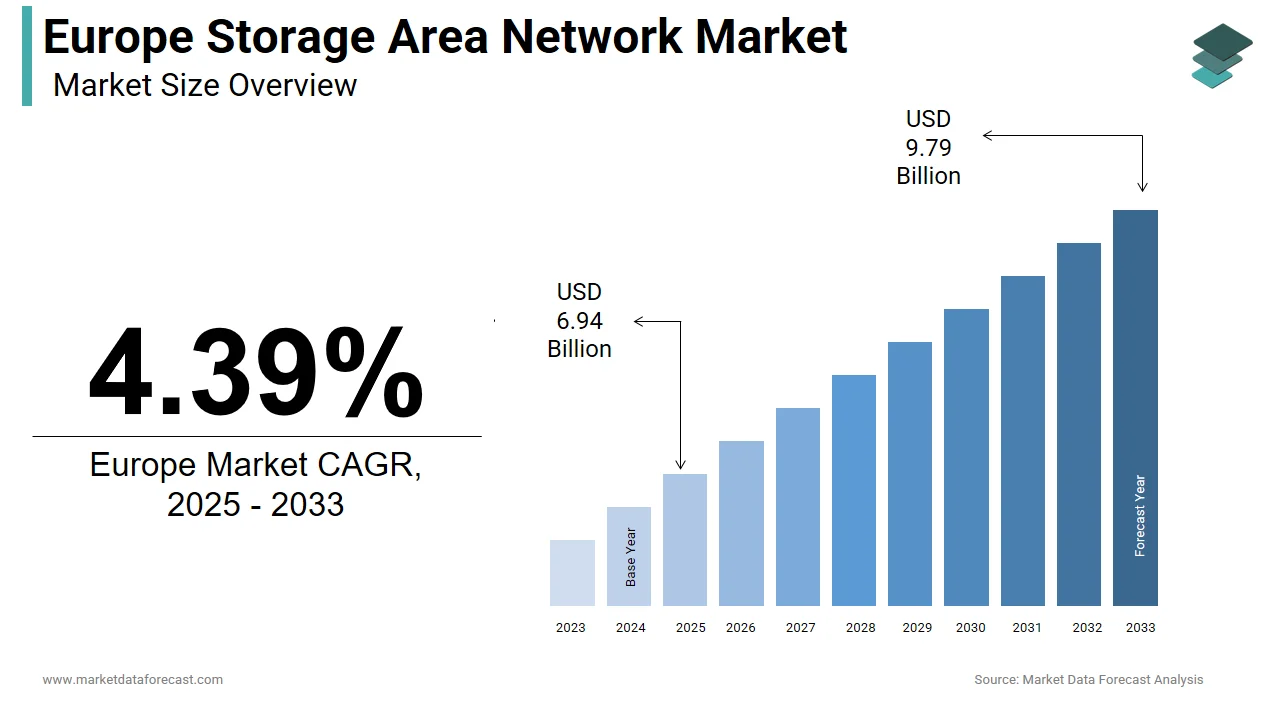
The size of the Europe storage area network market was worth USD 6.94 billion in 2025. The Europe market is anticipated to grow at a CAGR of 4.39% from 2026 to 2034 and be worth USD 10.22 billion by 2034 from USD 7.24 billion in 2026.
A storage area network is a high-speed, dedicated data storage infrastructure that connects servers to consolidated storage devices using block-level protocols. Unlike direct-attached or network-attached storage, SANs enable centralized management, high availability, and low-latency access to mission-critical data across enterprise and public sector environments. In Europe, this technology emphasizes digital operations in banking, healthcare, telecommunications, and government, where data integrity and uptime are non-negotiable. As per Eurostat, 92 percent of large enterprises in the European Union had at least a basic level of digital intensity in 2023, and large enterprises commonly use data centers. Furthermore, the European Commission’s Digital Decade initiative sets a target for at least 75 percent of EU enterprises to adopt cloud computing services, big data, and/or artificial intelligence by 2030, which inherently drives demand for robust back-end storage fabrics. National cybersecurity strategies in Germany, France, and the Netherlands, in line with EU directives like NIS2, prioritize enhancing cyber resilience and protecting critical infrastructure. This regulatory and operational context positions SANs not as legacy infrastructure but as essential enablers of Europe’s secure and sovereign digital transformation.
MARKET DRIVERS
Regulatory Mandates for Data Resilience and Sovereignty Drive SAN Adoption
Stringent European data governance frameworks compel organizations to implement resilient and geographically contained storage solutions, which directly surges the growth rate of the Europe storage area network market. The General Data Protection Regulation requires that personal data be protected against loss and unauthorized access, while sector-specific directives, such as the Network and Information Systems Directive, impose strict uptime and recovery obligations on operators of essential services. According to sources, the NIS2 Directive, which took effect in 2023, requires covered entities to implement robust cybersecurity risk management measures, including backup and redundancy strategies. And, many critical infrastructure operators likely upgraded their storage infrastructure in preparation for NIS2 compliance. These regulatory imperatives transform SANs from optional IT investments into mandatory components of legal and operational compliance.
Explosion of Mission-Critical Enterprise Applications Demands Low Latency Storage
The proliferation of latency-sensitive enterprise workloads across regions also drives the expansion of the Europe storage area network market. This necessitates the high throughput and deterministic performance that only storage area networks can deliver. Modern applications, such as real-time fraud detection in banking, electronic health records in hospitals, and industrial IoT analytics in manufacturing, generate and consume vast volumes of data that cannot tolerate the variable response times of file-based or cloud native storage. Moreover, automotive manufacturers rely on SAN-connected simulation clusters to run crash test modeling with sub-millisecond data access requirements. This performance dependency ensures sustained enterprise reliance on SANs despite the rise of alternative architectures.
MARKET RESTRAINTS
High Capital and Operational Expenditure Deters Widespread Deployment
The significant upfront and ongoing costs continue to be a major barrier to the rise of the Europe storage area network market. A typical enterprise-grade Fibre Channel SAN deployment requires investment in specialized host bus adapters, Fibre Channel switches, redundant storage arrays, and dedicated management software. Operational expenses further accumulate through licensing fees, skilled personnel requirements, and power consumption. Even large organizations are reevaluating investments as cloud storage offers pay-as-you-go models that better align with cost optimization mandates. SAN penetration is constrained to latency-sensitive and compliance-driven applications because of the high financial burden and a lack of vendor financing and public subsidies.
Complex Integration and Skills Shortage Impede Implementation
Shortage of skills and complex integration further constrain the expansion of the Europe storage area network market. Deploying and managing SANs demands specialized expertise in storage networking protocols, zoning, and performance tuning, a skill set in critically short supply across the European labor market. The shortage leads to extended deployment timelines, with the average SAN implementation in Europe taking several weeks compared to that for software-defined alternatives. Integration challenges are further compounded by heterogeneous IT environments where legacy servers must interoperate with modern storage arrays, often requiring custom middleware or protocol gateways. As organizations accelerate cloud migration, many are opting for simpler converged or hyperconverged infrastructures that reduce dependency on niche storage networking knowledge. Until training programs and automation tools bridge this expertise gap, SAN adoption will remain confined to organizations with mature IT departments.
MARKET OPPORTUNITIES
Modernization of Public Sector Data Infrastructure Creates New Demand
European governments are undertaking large-scale digital transformation initiatives that require high-performance, resilient storage backbones, creating significant opportunities for growth of the Europe storage area network market. The German government has funded various digitalization projects, including a €239 million investment for data labs across federal ministries announced in March 2022. These state-led investments are further amplified by EU cohesion funds, which support digital upgrades in Eastern member states such as Poland and Romania, where legacy systems are being replaced with modern data fabrics. This public sector momentum provides a stable and ethically aligned growth vector for SAN technology.
Convergence of SAN with AI and High Performance Computing Workloads
The rise of artificial intelligence and high-performance computing in European research and industry is setting up new prospects for the expansion of the Europe storage area network market. The integration is generating unprecedented demand for ultra-low latency storage that only next-generation SANs can fulfill. AI training workloads require simultaneous access to petabytes of data with microsecond-level consistency conditions that overwhelm traditional file systems. High-performance computing facilities across Europe are increasingly adopting advanced storage area network technologies to support powerful GPU-based data processing, according to sources. Across major scientific institutions such as CERN, custom network architectures are being used to efficiently manage massive experimental datasets, according to sources. At the European level, funding for AI and computing infrastructure projects continues to grow, with storage speed and reliability remaining key to performance success, as per research. This convergence positions SANs as indispensable enablers of Europe’s scientific and industrial AI ambitions.
MARKET CHALLENGES
Rapid Evolution of Alternative Storage Architectures Threatens Relevance
The accelerating adoption of hyperconverged infrastructure, software-defined storage, and cloud native data platforms impedes the growth of the Europe storage area network market. These modern alternatives offer greater scalability, simplified management, and lower total cost of ownership, which appeal strongly to organizations pursuing agile IT strategies. Major cloud providers such as AWS and Microsoft Azure now offer block storage services with sub-millisecond latency that rival on-premises SAN performance while eliminating capital expenditure. Even in the regulated sector, financial institutions are adopting private cloud stacks with distributed storage layers that mimic SAN functionality without proprietary hardware. SAN vendors must adopt cloud interoperability and consumption-based pricing to stay relevant in an IT landscape increasingly dominated by the cloud.
Energy Efficiency and Sustainability Compliance Burdens Mount
European data centers face intensifying regulatory and societal burden to reduce energy consumption and carbon emissions, which challenges the power-intensive nature and expansion of the Europe storage area network market. In addition, Germany’s Green IT initiative offers tax incentives only for storage systems meeting stringent energy per terabyte thresholds, which many SANs fail to satisfy. Vendors that fail to innovate in areas like flash optimization fabric efficiency, and intelligent power gating may be excluded from the European digital infrastructure market, as sustainability is now a critical procurement standard.
REPORT COVERAGE
| REPORT METRIC | DETAILS |
| Market Size Available | 2054 to 2034 |
| Base Year | 2025 |
| Forecast Period | 2026 to 2034 |
| Segments Covered | By Component, SAN Type, Technology, Organization Size, End-use, and Region. |
| Various Analyses Covered | Global, Regional, and Country-Level Analysis, Segment-Level Analysis, Drivers, Restraints, Opportunities, Challenges; PESTLE Analysis; Porter’s Five Forces Analysis, Competitive Landscape, Analyst Overview of Investment Opportunities |
| Countries Covered | UK, France, Spain, Germany, Italy, Russia, Sweden, Denmark, Switzerland, Netherlands, Turkey, Czech Republic, and the Rest of Europe. |
| Market Leaders Profiled | Dell Technologies, Hewlett Packard Enterprise (HPE), IBM Corporation, Cisco Systems, Inc., Broadcom Inc. (Brocade), NetApp, Inc., Hitachi Vantara (Hitachi Ltd.), Fujitsu Limited, Huawei Technologies Co., Ltd., Lenovo Group Limited, Pure Storage, Inc., DataCore Software Corporation, StarWind Software Inc., Nutanix, Inc., NEC Corporation |
SEGMENTAL ANALYSIS
By Component Insights
The hardware segment dominated the Europe storage area network market in 2024 and accounted for 57.9% share in 2024. The foundational role of physical infrastructure in delivering high performance and reliability is among the key reasons behind the dominance of the hardware segment. Storage arrays, host bus adapters, Fibre Channel switches, and cabling form the backbone of SAN deployments, particularly in latency-sensitive sectors such as finance and healthcare. Across Europe, advanced storage solutions like all-flash arrays with NVMe interfaces are increasingly deployed in high-performance computing (HPC) environments to meet escalating data throughput demands. This trend is driven by data-intensive workloads. Separately, regulatory bodies like the German Federal Office for Information Security (BSI) publish guidelines and enforce standards for critical infrastructure, influencing data security practices and emphasizing resilience. The irreplaceable nature of this physical layer in ensuring deterministic performance and regulatory compliance ensures hardware remains the dominant expenditure category.

The services segment is expected to exhibit a noteworthy CAGR of 14.2% from 2025 to 2033 due to the increasing complexity of hybrid SAN environments and acute shortages of in-house storage expertise. Organizations are outsourcing design, integration, monitoring, and managed support to ensure optimal performance and compliance. According to reports from the European Commission, a persistent digital skills gap continues to affect the European Union, requiring significant upskilling and the hiring of specialists to manage complex IT infrastructure. Across the continent, governments and large enterprises rely on external integrators for a range of critical IT functions. In early 2024, the French Ministry of Defense awarded multiple major contracts to modernize military capabilities and support infrastructure, though details for every component are not publicly announced. The rise of consumption-based models such as Storage as a Service further accelerates this trend. This shift from capital to operational expenditure aligns with broader IT modernization strategies and fuels sustained service growth.
By SAN Type Insights
The enterprise Server SAN segment led the Europe storage area network market by capturing a substantial share in 2024. The growth of the enterprise Server SAN segment is attributed to its widespread adoption across banking, manufacturing, healthcare, and public administration, where data sovereignty, low latency, and high availability are non-negotiable. These systems are purpose-built for structured workloads such as ERP databases, transaction processing, and electronic health records that require block-level access and sub-millisecond response times. In healthcare, the European initiative has accelerated SAN deployment. Industrial firms also depend on this architecture. This entrenched presence in regulated and performance essential sectors supports its market dominance.
The hyperscale server SAN segment is predicted to witness the highest CAGR of 18.7 from 2025 to 2033. Factors such as the expansion of large-scale cloud providers and AI-driven data centers across Europe are boosting the expansion of the hyperscale server SAN segment. Unlike traditional Enterprise SANs, Hyperscale SANs are software optimized for massive parallelism and petabyte-scale workloads, supporting cloud storage databases and AI training clusters. Large-scale cloud operators across Europe continue to expand their data center capacity, with most adopting advanced storage network architectures to enhance performance, according to sources. The region’s high-performance computing initiatives are also encouraging the use of hyperscale storage systems to meet the growing demands of scientific and research applications, as per research. These deployments, driven by cloud and AI expansion, ensure exponential growth for this segment.
COUNTRY LEVEL ANALYSIS
Germany Storage Area Network Market Analysis
Germany outperformed other regions in the Europe storage area network market and accounted for 26.7% of the regional market in 2024. Its advanced industrial base, stringent data regulations, and prominence in vital infrastructure digitization fuel the domination of Germany. The country’s Industrie 4.0 strategy mandates real-time data exchange across production systems, necessitating high-performance SAN backbones in manufacturing. According to sources, several industrial facilities upgraded their storage infrastructure, with a portion selecting Fibre Channel SANs for production line analytics. Apart from these, the Federal Office for Information Security enforces strict data localization rules compelling public sector entities to use on-premises SANs with hardware-level encryption. The presence of global technology firms such as SAP and Siemens further anchors demand as they operate some of Europe’s most complex SAN environments. This convergence of regulatory rigor, industrial sophistication, and technological prowess cements Germany’s dominance.
United Kingdom Storage Area Network Market Analysis
The United Kingdom is the next prominent region in the Europe storage area network market and occupied a 19.6% share in 2024. Its concentration of financial institutions, cloud data centers, and research universities mainly propels the growth of the United Kingdom. London remains Europe’s financial capital with banks and insurers operating mission-critical SANs to support high-frequency trading and risk modeling. The country also hosts hyperscale data centers with AWS, Google, and Microsoft expanding their UK cloud regions using Hyperscale SAN architectures. In academia, the Alan Turing Institute’s AI research clusters rely on NVMe over Fabrics SANs to process large-scale datasets. The National Health Service is modernizing its digital records system with regional trusts deploying encrypted SANs to comply with GDPR and the Data Protection Act. Despite Brexit, the UK maintains deep integration with European data flows and continues to attract storage infrastructure investment due to its skilled workforce and robust digital policy framework.
France Storage Area Network Market Analysis
France is projected to be the fastest-growing in the Europe storage area network market, which is propelled by strong state-led digital initiatives and defense sector modernization. The French government’s Cloud Souverain strategy mandates that public data reside on nationally controlled infrastructure, driving SAN deployment across ministries and state-owned enterprises. According to the French State Digital Agency, over 45 government data centers were consolidated onto secure Enterprise SAN platforms in 2023 as part of the Interministerial Digital Transformation Plan. In defense, the Ministry of Armed Forces upgraded its command and control systems with air-gapped SANs featuring hardware encryption following the 2023 National Cybersecurity Strategy. France also hosts major cloud regions with OVHcloud expanding its Gravelines campus using custom Hyperscale SANs to support European AI startups. The country’s nuclear energy operator EDF relies on SANs for real-time reactor monitoring with zero tolerance for data latency, as confirmed in its 2023 operational safety review. This blend of sovereign cloud ambitions, vital infrastructure needs, and industrial digitization sustains France’s influential role.
Netherlands Storage Area Network Market Analysis
The Netherlands is moderately growing in the Europe storage area network market due to its strategic position as a European data hub and leader in sustainable digital infrastructure. Amsterdam is recognized as one of the leading internet exchange hubs globally, housing a large network of data centers that cater to cloud and enterprise clients across Europe. As per research, most new data storage systems in the Netherlands are now being designed with energy-efficient architectures in line with national sustainability initiatives. According to sources, the country’s financial sector operates under strict regulations that require mirrored data storage between key regional sites. This combination of connectivity, regulatory clarity, and industrial innovation makes the Netherlands a pivotal node in Europe’s storage ecosystem.
Sweden Storage Area Network Market Analysis
Sweden is likely to expand in the Europe storage area network market over the forecast period, owing to its prominence in green data centers, AI research, and public sector digitization. The country’s abundant renewable energy and cool climate attract hyperscalers, with Microsoft and Facebook operating large facilities in Luleå that utilize Hyperscale SANs optimized for AI workloads. Academic institutions deploy NVMe over Fibre Channel SANs for climate modeling and genomics research under the EuroHPC framework. Besides, Sweden’s strict data protection laws, aligned with GDP,R compel healthcare providers to use on-premises SANs with hardware-level audit trails. This alignment of sustainability policy, scientific ambition, and regulatory compliance positions Sweden as a forward-looking storage market in Northern Europe.
COMPETITIVE LANDSCAPE
The Europe storage area network market features intense competition among global infrastructure vendors, regional specialists, and emerging software-defined storage providers. Dell Technologies, Hewlett Packard Enterprise, and NetApp lead through integrated hardware, software, and services portfolios that cater to regulated industries such as finance, healthcare, and government. They compete not only on performance and reliability but also on compliance with GDPR, NIS2, and national data localization laws. At the same time, the cloud hyperscalers exert downward pressure by offering block storage services that mimic SAN capabilities without dedicated hardware. Regional players like Fujitsu and Lenovo gain traction through localized support and public sector contracts, particularly in Southern and Eastern Europe. Differentiation increasingly hinges on sustainability credentials, AI readiness, and the ability to deliver hybrid SAN models that span on-premises and sovereign cloud environments. As European organizations balance performance sovereignty and cost, the competitive landscape rewards vendors who combine technical excellence with regulatory fluency and flexible consumption options.
KEY MARKET PLAYERS
Some of the companies that are playing a dominating role in the Europe storage area network market include
- Dell Technologies
- Hewlett Packard Enterprise (HPE)
- IBM Corporation
- Cisco Systems, Inc.
- Broadcom Inc. (Brocade)
- NetApp, Inc.
- Hitachi Vantara (Hitachi Ltd.)
- Fujitsu Limited
- Huawei Technologies Co., Ltd.
- Lenovo Group Limited
- Pure Storage, Inc.
- DataCore Software Corporation
- StarWind Software Inc.
- Nutanix, Inc.
- NEC Corporation
Top Players in the Market
- Dell Technologies maintains a strong presence in the Europe storage area network market through its PowerStore and PowerMax SAN platforms, which are widely deployed across financial, healthcare, and industrial sectors. The company actively supports European data sovereignty initiatives by offering on-premises and air-gapped SAN configurations compliant with GDPR and NIS2 directives. It also deepened partnerships with European system integrators to deliver managed SAN services for public sector clients. These efforts support Dell’s global dominance in enterprise storage while addressing Europe’s unique regulatory and performance requirements.
- Hewlett Packard Enterprise is a key contributor to the Europe storage area network market via its Primera and Alletra storage systems designed for mission-critical workloads. HPE emphasizes sustainability by integrating intelligent power management into its SAN hardware, aligning with EU energy efficiency mandates. The company also collaborates with EuroHPC on exascale storage architectures supporting scientific research in Germany and Finland. These initiatives strengthen HPE’s position as an innovator in both performance and operational flexibility within the European landscape.
- NetApp plays a pivotal role in the Europe storage area network market through its unified SAN and NAS solutions that support hybrid cloud and AI workloads. The company’s ONTAP software provides consistent data services across on-premises and cloud environments, which appeals to European enterprises pursuing digital sovereignty. It also partnered with leading European telecom providers to deliver edge SAN solutions for industrial IoT. These actions demonstrate NetApp’s strategic focus on data mobility security and edge computing in alignment with Europe’s evolving infrastructure needs.
Top Strategies Used by the Key Market Participants
Key players in the Europe storage area network market prioritize compliance with European data sovereignty and cybersecurity regulations by offering on-premises air-gapped and encrypted storage solutions. They are shifting toward consumption-based as-a-Service models to align with enterprise preferences for operational expenditure over capital investment. Strategic partnerships with local system integrators, cloud providers, and telecom operators enable tailored deployment and support across diverse national markets. Continuous innovation in NVMe over Fabrics and all-flash architectures addresses the performance demands of AI and real-time analytics. Furthermore, vendors invest in sustainability features such as intelligent power scaling and high-density designs to meet stringent EU energy efficiency standards for data centers.
MARKET SEGMENTATION
This research report on the Europe storage area network market has been segmented and sub-segmented into the following categories.
By Component
- Hardware
- Software
- Services
By SAN Type
- Hyperscale Server SAN
- Enterprise Server SAN
By Technology
- Fibre Channel (FC) SAN
- Fibre Channel over Ethernet (FCoE) SAN
- InfiniBand SAN
- Internet Small Computer Systems Interface (iSCSI) SAN
By Organization Size
- Large Enterprises
- Small and Medium-Sized Enterprises
By End Use
- BFSI
- IT & Telecom
- Government & Public Sector
- Healthcare
- Retail & E-commerce
- Manufacturing
- Others
By Country
- United Kingdom
- France
- Spain
- Germany
- Italy
- Russia
- Sweden
- Denmark
- Switzerland
- Netherlands
- Rest of Europe