- Product Description Description
- Table of Contents TOC
- List of Table & Figure LOT
- Get Free Sample PDF Sample PDF
Market Size, 2025
$36.23 BnMarket Estimate, 2026
$40.62 BnMarket Forecast, 2034
$101.44 BnCAGR, 2026–2034
12.12%Global Network Attached Storage Market Summary
The global network attached storage (NAS) market was valued at USD 36.23 billion in 2025, is projected to reach USD 40.62 billion in 2026, and is expected to expand to USD 101.44 billion by 2034, growing at a CAGR of 12.12% from 2026 to 2034. The growth of the global network-attached storage market is driven by the surging demand for data storage, rising cloud adoption, expansion of enterprise IT infrastructure, and increasing use of NAS systems for big data analytics and multimedia content management. The growing adoption of hybrid and remote work models has further accelerated the need for scalable, secure, and cost-efficient NAS solutions.
Key Market Trends
- Increasing adoption of cloud-integrated NAS solutions for hybrid storage models.
- Rising demand for enterprise-scale NAS systems to manage massive unstructured data.
- Growing use of NAS in surveillance, media & entertainment, and big data analytics.
- Transition from scale-up to scale-out NAS for higher scalability and performance.
- Expansion of SME adoption due to the affordability of entry-level NAS devices.
Segmental Insights
- By design, the 1–8 bays NAS segment dominated in 2024 with a 48.2% share, reflecting its popularity among small and medium enterprises for cost-effective storage needs.
- By product, the enterprise segment led with 58.5% share in 2024, driven by large-scale data storage requirements across IT, telecom, and BFSI sectors.
- By storage architecture, the scale-up NAS segment accounted for a 54.4% share in 2024, offering centralized expansion capabilities for enterprises.
Regional Insights
- North America was the leading region, capturing a 37.1% share in 2024, supported by advanced IT infrastructure, cloud adoption, and strong enterprise demand.
- Europe shows steady growth, driven by strict data regulations and rising enterprise digitalization.
- Asia-Pacific is expected to record the fastest CAGR, fueled by rapid digital transformation, expanding data centers, and SME adoption.
- Latin America and the Middle East & Africa are emerging regions, with growth supported by increasing IT investments and modernization of storage infrastructure.
Competitive Landscape
Key players in the global NAS market include Dell Technologies Inc. (US), NetApp Inc. (US), Hewlett-Packard Enterprise Company (US), Hitachi Ltd. (Japan), Western Digital Corporation (US), Seagate Technology Holdings PLC (US), NETGEAR Inc. (US), Synology Inc. (Taiwan), Buffalo Americas Inc. (US), Pure Storage Inc. (US), and QNAP Systems Inc. (Taiwan). These companies are focusing on next-gen NAS architectures, cloud integration, high-performance storage solutions, and strategic partnerships to strengthen their market presence.
Global Network Attached Storage Market Size
The global network attached storage market was valued at USD 36.23 billion in 2025, is estimated to reach USD 40.62 billion in 2026, and is projected to reach USD 101.44 billion by 2034, growing at a CAGR of 12.12% from 2026 to 2034.
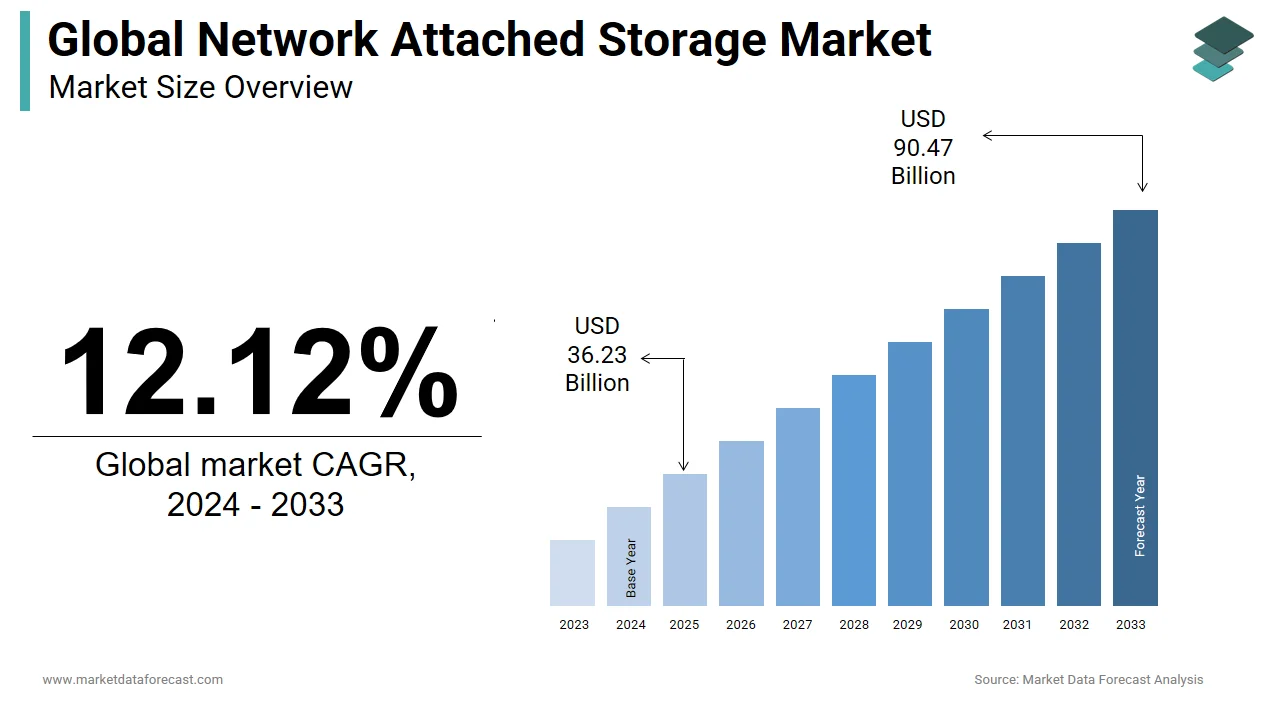
Network Attached Storage (NAS) is a dedicated file-level data storage architecture that enables centralized, scalable, and remotely accessible storage over a standard IP network. Unlike direct-attached storage, NAS systems allow multiple users and heterogeneous devices to retrieve data simultaneously, making them integral in enterprise, small-to-medium business (SMB), and personal computing environments. The proliferation of digital content, expansion of edge computing, and growing demand for real-time data access have elevated NAS deployment across sectors. As per the study, global data creation is projected to reach notable zettabytes, driven by IoT, surveillance, and multimedia applications, which necessitate robust storage infrastructures. NAS solutions are increasingly embedded with AI-driven management tools and integrated cloud gateways, enhancing their utility in hybrid environments.
MARKET DRIVERS
Surge in Unstructured Data Generation from Enterprise and Consumer Applications
The exponential rise in unstructured data has intensified the demand for efficient and scalable storage solutions, which drives the growth of the attached storage market. This positions NAS as an important infrastructure component. Enterprises across healthcare, media, and financial services are generating vast volumes of unstructured content, with Gartner estimating that 80% of all enterprise data will be unstructured by 2025. NAS systems provide the flexibility to store, manage, and back up such data without disrupting operational workflows. Furthermore, consumer-generated content from smart homes and surveillance cameras contributes significantly; a single 4K security camera can produce a notable amount of footage annually, as per the study. This sustained data influx compels organizations to adopt NAS solutions that offer seamless integration, remote access, and automated tiering.
Expansion of Remote Work and Decentralized Collaboration Models
The structural shift toward remote and hybrid work environments has fundamentally altered data access and collaboration requirements, which accelerates the growth of the attacked storage market. The necessity for secure, centralized, and always-available file repositories has intensified as employees operate outside traditional office networks. This transition necessitates storage systems that support concurrent access, version control, and secure external connectivity, capabilities inherently offered by modern NAS platforms. Small and medium businesses, in particular, leverage NAS for cost-effective deployment of virtual private networks (VPNs) and secure file-sharing portals.
MARKET RESTRAINTS
Vulnerability to Cybersecurity Threats and Ransomware Attacks
The NAS devices are increasingly targeted by cybercriminals due to their role as centralized data repositories, which hampers the growth of the network-attached storage market. The ransomware attacks on networked storage systems rose, with NAS units from major vendors being exploited through zero-day vulnerabilities and weak authentication protocols. In addition, according to a study, a portion of NAS devices in enterprise environments had at least one important vulnerability, often due to outdated firmware or misconfigured remote access settings. These vulnerabilities deter organizations from fully migrating sensitive data to NAS, especially in regulated industries like finance and healthcare, where compliance with HIPAA and GDPR is mandatory.
High Total Cost of Ownership for Scalable Enterprise-Grade Deployments
The total cost of ownership (TCO) for high-capacity as well as enterprise-grade deployments remains prohibitive for many organizations, which hinders the growth of the attached storage market. Beyond initial hardware procurement, costs accumulate through redundancy configurations, power consumption, cooling infrastructure, and ongoing maintenance. According to the study, energy costs account for a portion of total data center operating expenses, and NAS arrays contribute to this burden due to their continuous operational demands. A fully loaded enterprise NAS system with petabyte-scale capacity and enterprise SSDs can be an upfront investment, as per the study. Apart from these, integrating NAS with existing IT ecosystems often requires specialized personnel, which further escalates labor costs. For mid-tier organizations, this financial burden limits deployment to basic configurations by constraining performance and scalability, and prompting consideration of cloud alternatives despite latency and egress cost concerns.
MARKET OPPORTUNITIES
Integration with Artificial Intelligence and Predictive Analytics in Storage Management
The integration of NAS with artificial intelligence (AI) provides new opportunities for the network attached storage market. Modern NAS platforms are increasingly incorporating AI-driven analytics to optimize data tiering, predict hardware failures, and automate backup schedules. As per research, AI-powered storage systems can reduce data retrieval latency and extend hardware lifespan by anticipating component degradation. For instance, predictive maintenance algorithms can detect disk anomalies up to days in advance with a portion accuracy, as per the study. Enterprises in manufacturing and logistics are deploying AI-enhanced NAS to analyze sensor data from IoT devices in real time, enabling proactive decision-making. Also, AI adoption in IT infrastructure is growing annually, as per a study.
Rising Adoption in Edge Computing and Distributed Data Environments
The decentralization of data processing through edge computing is creating new demand for localized, high-performance NAS solutions, which is setting up new opportunities for the growth of the network attached storage market. NAS serves as an important edge storage nod,e which enables low-latency access and local data aggregation before cloud synchronization. For example, a single autonomous vehicle generates approximately 4TB of data daily, necessitating robust edge NAS units for temporary storage and preprocessing. Similarly, retail chains deploy NAS at branch locations to support real-time inventory analytics and video surveillance.
MARKET CHALLENGES
Interoperability Issues in Heterogeneous IT Ecosystems
Ensuring seamless interoperability across diverse operating systems, cloud platforms, and legacy infrastructure is hindering the growth of network attached storage market. Enterprises often operate hybrid environments combining Windows, Linux, macOS, and cloud services, each with distinct file-sharing protocols such as SMB, NFS, and AFP. As per the study, a portion of NAS deployment failures in mid-sized organizations stems from protocol incompatibility or misconfigured network permissions. Apart from these, integrating NAS with public cloud providers like AWS or Azure requires adherence to specific API standards, which are not uniformly supported across NAS vendors.
Environmental and Energy Efficiency Constraints in Dense Deployments
Growing environmental and operational constraints are challenging the growth of network attached storage market. High-density NAS arrays for those using enterprise HDDs and SSDs generate substantial heat, which necessitates advanced cooling solutions that increase facility costs and carbon footprint. A single 12-bay NAS unit can consume notable watts under load, and in large deployments, this scales rapidly. Regulatory burden is mounting. In 2023, the EU updated its Energy Efficiency Directive (EED), setting a new binding target to reduce final energy consumption by at least 11.7% by 2030 compared to 2020 projections.
REPORT COVERAGE
| REPORT METRIC | DETAILS |
| Market Size Available | 2025 to 2034 |
| Base Year | 2025 |
| Forecast Period | 2026 to 2034 |
| Segments Covered | By Design, Product, Storage Solution, and Region. |
| Various Analyses Covered | Global, Regional and Country-Level Analysis, Segment-Level Analysis, Drivers, Restraints, Opportunities, Challenges; PESTLE Analysis; Porter’s Five Forces Analysis, Competitive Landscape, Analyst Overview of Investment Opportunities |
| Regions Covered | North America, Europe, Asia-Pacific, Latin America, Middle East and Africa |
| Market Leaders Profiled | Dell Technologies Inc. (US), NetApp, Inc. (US), Hewlett Packard Enterprise Company (US), Hitachi, Ltd. (Japan), Western Digital Corporation (US), Seagate Technology Holdings Public Limited Company (US), NETGEAR, Inc. (US), Synology Inc. (Taiwan), Buffalo Americas, Inc. (US), Pure Storage, Inc. (US), and QNAP Systems, Inc. (Taiwan), and Others. |
SEGMENTAL ANALYSIS
By Design Insights
The 1–8 bays NAS segment dominated the network attached storage market by capturing a 48.2% share in 2024. The growth of the 1–8 bays NAS segment is primarily driven by its alignment with small and medium businesses (SMBs), remote offices, and professional creative workflows that demand compact, cost-efficient, and energy-conscious storage. According to the research, millions of SMBs operate in the United States alone, with a portion adopting NAS for local data backup and file sharing. The affordability of 1–8 bay systems makes them accessible without requiring extensive IT infrastructure. Apart from these, as per research, a portion of SMBs prefer NAS units with under eight bays due to ease of deployment and compatibility with existing network environments.
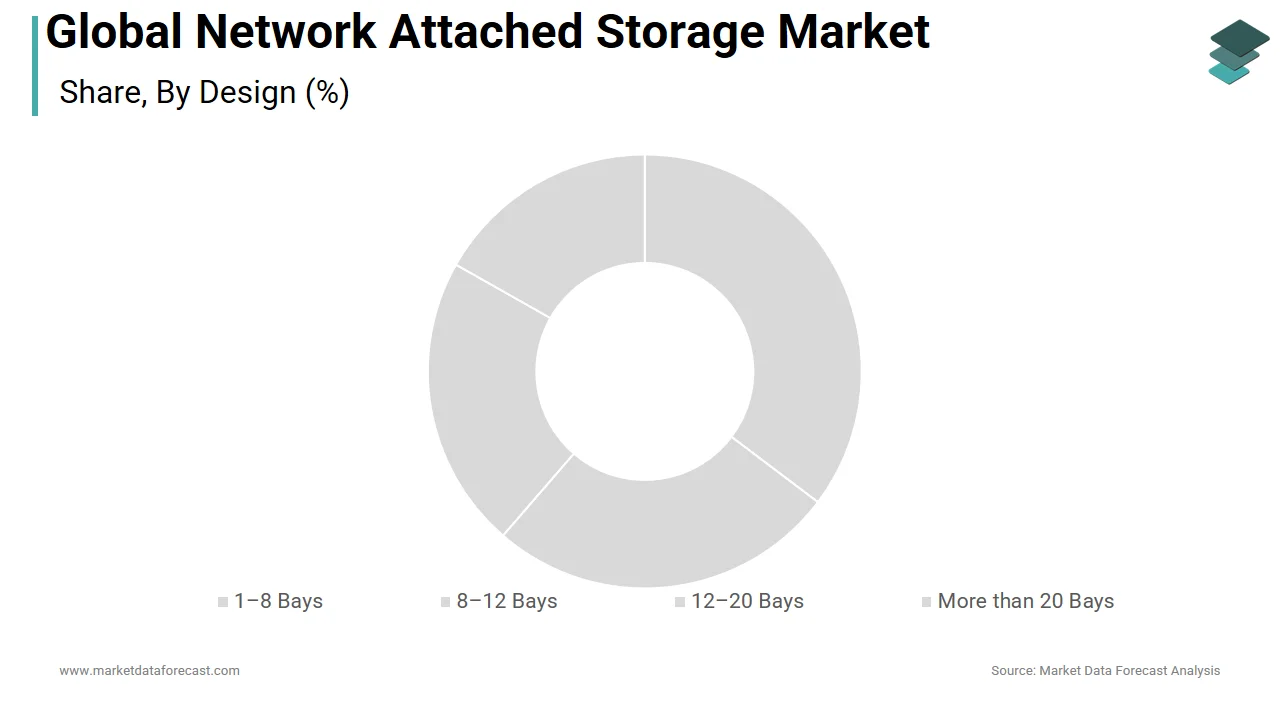
The more than 20 bays NAS segment is predicted to witness the highest CAGR of 14.7% from 2026 to 2034 due to the escalating need for high-density storage in hyperscale data centers, media production houses, and research institutions generating exabyte-scale datasets. These large-bay systems support petabyte-level capacities with redundant configurations, which enable seamless integration into high-performance computing (HPC) environments. Vendors are increasingly embedding NVMe-oF and RDMA support into these systems, which enhances I/O performance and strengthens their role in next-generation data infrastructure.
By Product Insights
The enterprise segment led the network attached storage market by capturing 58.5% of the share in 2024, with the escalating data governance mandates, digital transformation initiatives, and compliance requirements across regulated industries such as finance, healthcare, and government. Moreover, the integration of NAS with enterprise content management (ECM) platforms, used by a portion of Fortune 500 companies, according to a study, further entrenches its role in structured data workflows. These systems often feature multi-protocol support, automated tiering to cloud storage, and disaster recovery capabilities, which make them indispensable for mission-critical operations.
The midmarket segment is estimated to register the fastest CAGR of 13.2% during the forecast period, owing to the digital adoption among mid-sized firms seeking enterprise-like capabilities without the complexity and cost of full-scale data centers. According to the research, mid-sized companies (100–1,000 employees) represent a portion of the U.S. workforce and are increasingly investing in hybrid IT models. These organizations leverage NAS for secure remote access, ransomware-resistant backups, and collaboration tools, especially in professional services and manufacturing. As per the study, a portion of midmarket firms deploy NAS as part of their cybersecurity strategy by citing the ability to isolate backups from primary networks.
By Storage Solution Insights
The scale-up NAS segment dominated the network attached storage market by capturing 54.4% of the global market share in 2024. The growth of the scale-up NAS segment is driven by its simplicity, predictable performance, and lower management overhead qualities, which are highly valued in environments with stable growth patterns. Educational institutions, for example, frequently adopt scale-up NAS for centralized student records and digital learning repositories.
The scale-out NAS segment is estimated to register a CAGR of 16.3% from 2024 to 2033 due to the need for horizontal scalability and performance elasticity in data-intensive applications such as artificial intelligence, video surveillance, and scientific computing. Unlike scale-up systems, scale-out NAS allows organizations to add nodes seamlessly, increasing both capacity and throughput in parallel. In media and entertainment, where 8K video editing workflows require sustained bandwidth exceeding 5 GB/s, studios like Industrial Light & Magic rely on scale-out NAS to manage multi-petabyte rendering pipelines.
REGIONAL ANALYSIS
North America Network Attached Storage Market Insights
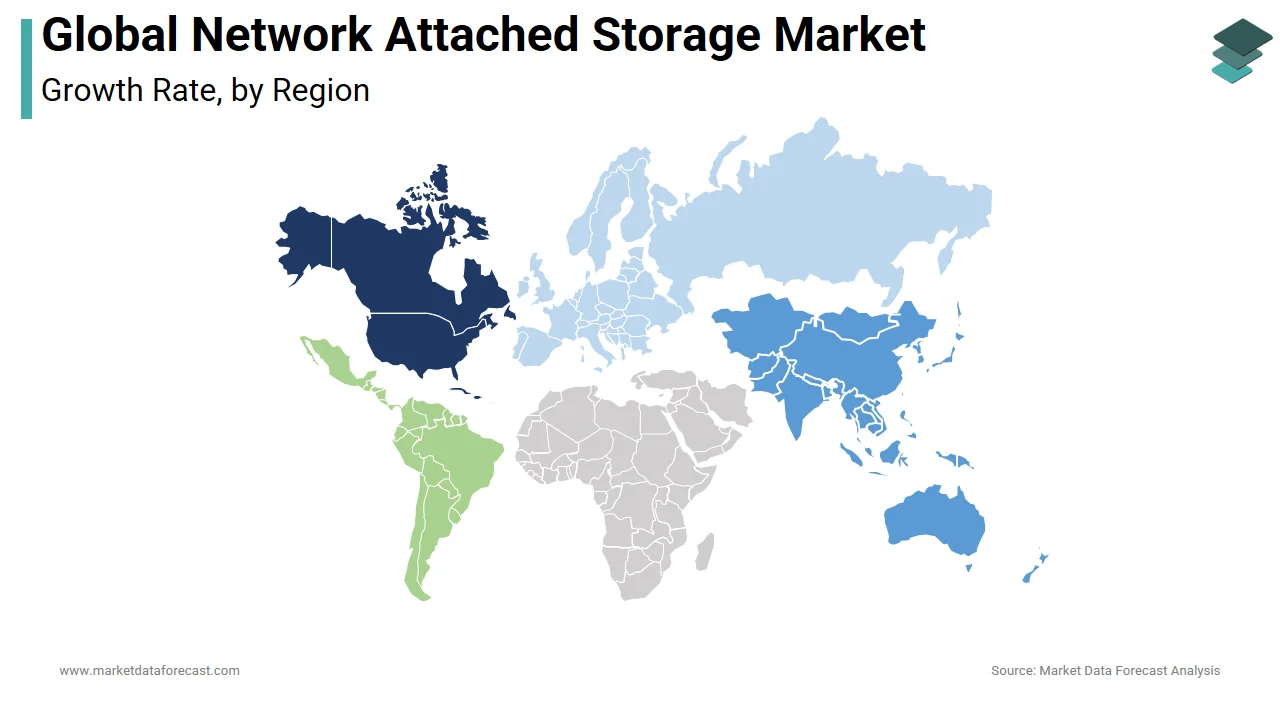
North America was the top performer in the global NAS market in 2024 and accounted for 37.1% of the global market share in 2024. The domination of North America in the global market is primarily driven by a mature IT infrastructure, widespread digital transformation across enterprises, and aggressive adoption of hybrid cloud models. The United States hosts the largest number of data centers in the world, with over 5,400 facilities as of March 2025. This extensive infrastructure, including major hyperscale facilities from companies like Amazon, Microsoft, and Google, creates a robust ecosystem for Network Attached Storage (NAS) deployment in both on-premise and edge environments. Federal mandates such as the Cybersecurity Executive Order 14028 have prompted government agencies to modernize legacy storage with secure, auditable NAS solutions. Apart from these, the proliferation of AI startups drives demand for high-performance NAS capable of supporting large-scale model training. Hence, NAS systems serving as cloud gateways are witnessing unprecedented integration which strengthens North America’s technological and market dominance.
Europe Network Attached Storage Market Insights
Europe was positioned second by occupying network attached storage market with 28.2% of share in 2024, with stringent data sovereignty laws and a strong emphasis on digital privacy. "The General Data Protection Regulation (GDPR), enforced since 2018, compels organizations to protect the personal data of EU residents, regardless of where that data is stored or processed. A portion of SMEs in the EU have implemented NAS for secure document management, reflecting a broader trend toward decentralized data control. Countries like Sweden and Finland are leveraging their cold climates to host low-power NAS clusters.
Asia Pacific Network Attached Storage Market Insights
Asia Pacific is expected to be the most lucrative region in the network attached storage market, with China and India spearheading growth. The region’s expansion is fueled by digital government initiatives and the explosive rise of internet-enabled services. As per the study, internet penetration in the Asia Pacific surged in 2023, generating unprecedented volumes of consumer and transactional data. India’s Digital India program has enabled millions of citizens to access e-governance services, necessitating a secure, scalable NAS for municipal and healthcare data.
Latin America Network Attached Storage Market Insights
Latin America grew steadily in the network attached storage market but is witnessing steady growth in Brazil and Mexico, where digitalization in public and private sectors is gaining momentum. According to the study, a portion of federal agencies have migrated to digital document management systems. Apart from these, the rise of fintech startups is driving demand for compliant, scalable storage solutions. Cybersecurity concerns are also influencing adoption; according to study, a portion of organizations experienced ransomware attacks targeting network storage, prompting investment in NAS with immutable backup features.
Middle East and Africa Network Attached Storage Market Insights
The Middle East and Africa is likely to grow in the network attached storage market during the forecast period. The UAE’s Smart Dubai initiative, aiming for 100% paperless government by 2021, has spurred the deployment of NAS in municipal services and healthcare institutions. As per the study, government data volume has grown annually, necessitating robust storage frameworks. Saudi Arabia’s Vision 2030 includes a substantial investment in digital infrastructure, including the development of NEOM’s cognitive city, which will generate exabytes of sensor and AI data requiring high-capacity NAS. In Africa, Kenya and South Africa are emerging as digital hubs, with Nairobi hosting many tech startups, according to a study.
COMPETITIVE LANDSCAPE
The network attached storage market features intense competition driven by technological differentiation, regional expansion, and evolving customer demands for hybrid and edge-ready solutions. Established vendors like NetApp, Dell, and Hitachi compete with specialized firms such as QNAP and Synology by offering scalable, secure, and intelligent storage platforms. Innovation in file systems, support for high-speed protocols like NVMe over Fabrics, and integration with AI workloads are key battlegrounds. Companies are increasingly shifting from hardware-centric models to software-defined storage and subscription-based services to improve customer retention. Price competition is pronounced in the SMB segment, where affordability and ease of use determine adoption. Meanwhile, in enterprise spaces, differentiation arises through performance, compliance capabilities, and cloud interoperability. The rise of local data sovereignty laws in Asia Pacific and Europe further intensifies the need for region-specific solutions, which is prompting vendors to localize offerings and support structures.
KEY MARKET PLAYERS
Some of the companies that are playing a dominating role in the global network attached storage market include
- Dell Technologies Inc. (US)
- NetApp, Inc. (US)
- Hewlett-Packard Enterprise Company (US)
- Hitachi, Ltd. (Japan)
- Western Digital Corporation (US)
- Seagate Technology Holdings Public Limited Company (US)
- NETGEAR, Inc. (US)
- Synology Inc. (Taiwan)
- Buffalo Americas, Inc. (US)
- Pure Storage, Inc. (US)
- QNAP Systems, Inc. (Taiwan)
Top Strategies Used By Key Market Participants
Key players in the network attached storage market primarily adopt product innovation, strategic partnerships, geographic expansion, mergers and acquisitions, and ecosystem integration to strengthen their competitive stance. Companies are increasingly embedding AI and machine learning into NAS firmware to enable predictive maintenance, automated tiering, and ransomware detection. Strategic collaborations with cloud providers allow seamless hybrid storage workflows, which enhance data mobility and compliance. Vendors are also expanding into emerging markets in the Asia Pacific and Latin America through localized support and channel alliances. Acquisition of software firms specializing in data security or management enables holistic solution offerings. Furthermore, integration with enterprise applications such as ERP, VDI, and surveillance platforms increases NAS utility.
Top Players in the Market
NetApp
NetApp maintains a strong footprint in the Asia Pacific NAS market by delivering unified data storage solutions that integrate seamlessly with hybrid cloud environments. The company has intensified its focus on AI-driven data management, launching ONTAP 9.14 with enhanced predictive analytics for storage optimization. In Japan and South Korea, NetApp collaborates with local telecom providers to deploy NAS solutions for 5G-enabled edge computing. It also partnered with AWS and Microsoft Azure to offer cloud-integrated NAS systems, enabling enterprises in Singapore and Australia to leverage cloud tiering without compromising data sovereignty. Its commitment to ESG goals is reflected in NAS systems designed to reduce power consumption, aligning with regional sustainability mandates.
Dell Technologies
Dell Technologies has strengthened its presence in the Asia Pacific NAS landscape through its PowerScale scale-out storage platform, widely adopted in media, research, and financial services. The company has expanded its direct sales and channel partnerships across India, Japan, and ASEAN nations to accelerate NAS deployment in both enterprise and public sectors. It also strengthened its edge computing portfolio by integrating PowerScale with VMware’s edge OS, enabling real-time data processing in remote locations. Collaborations with local cloud providers such as Alibaba Cloud and NTT Communications allow Dell to offer hybrid NAS-cloud workflows compliant with regional data regulations by enhancing trust and adoption across regulated industries.
QNAP Systems
QNAP Systems has emerged as a pivotal player in the Asia Pacific NAS market by targeting SMBs, creative professionals, and surveillance-intensive sectors with cost-effective, feature-rich solutions. Headquartered in Taiwan, QNAP leverages its regional proximity to manufacturing hubs and tech-savvy markets to drive rapid product iteration and deployment. The company has also enhanced its QES operating system with AI-powered metadata tagging, improving searchability for unstructured data. QNAP actively participates in regional trade shows like CES Asia and partners with local ISPs in Vietnam and the Philippines to bundle NAS with business broadband services.
MARKET SEGMENTATION
This global network attached storage market research report is segmented and sub-segmented into the following categories.
By Design
- 1–8 Bays
- 8–12 Bays
- 12–20 Bays
- More than 20 Bays
By Product
- Enterprise NAS Solutions
- Midmarket NAS Solutions
By Storage Solution
- Scale-up NAS
- Scale-out NAS
By Deployment Type
- On-premises
- Remote/Cloud
- Hybrid
By End-user Industry
- Banking, Financial Services, and Insurance (BFSI)
- Consumer Goods & Retail
- Telecommunications & ITES
- Healthcare
- Energy
- Government
- Education & Research
- Media & Entertainment
- Manufacturing
- Business & Consulting
- Others (Aerospace & Defense, Automotive, Food Processing, and Logistics)
By Region
- North America
- Europe
- Asia-Pacific
- Middle East Africa
- Latin America