- Product Description Description
- Table of Contents TOC
- List of Table & Figure LOT
- Get Free Sample PDF Sample PDF
Market Size, 2025
$20.02 BnMarket Estimate, 2026
$22.82 BnMarket Forecast, 2034
$65.10 BnCAGR, 2026–2034
14%Executive Summary: Global IP Camera Market Analysis & Growth Forecast (2026-2034)
- Market Scope: Comprehensive sector analysis encompassing components (hardware, services, software), product types (fixed, PTZ, infrared, dome), connection types (centralized and decentralized), end-use applications (residential, commercial, public, and government), and global regional footprints.
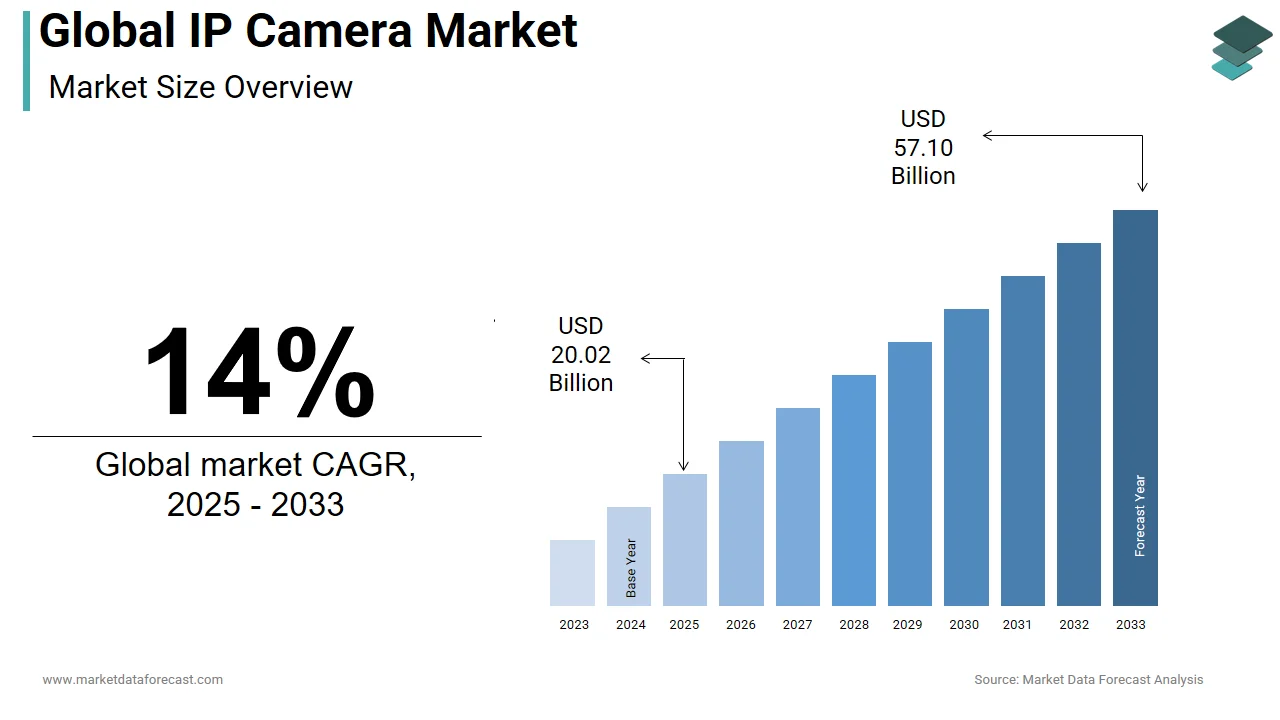
- Market Valuation: Valued at USD 120.02 billion in 2025, estimated at USD 22.82 billion in 2026, and projected to reach USD 65.10 billion by 2034, registering a compound annual growth rate (CAGR) of 14% from 2026 to 2034.
- Primary Growth Drivers: Escalating demand for smart housing systems, rising crime rates driving security investments across corporate and public sectors, and government-led infrastructure initiatives for traffic monitoring and public safety.
Key Global IP Camera Market Segment Metrics (2026-2034)
| Category | Leading Segment (Position) | Fastest-Growing / High-Impact Segment |
|---|---|---|
| By Product Type | Infrared Cameras (expected to hold a leading 30% market share due to critical low-light/night capabilities in defense and traffic applications) | Pan-Tilt-Zoom (PTZ) Cameras (experiencing surging adoption for dynamic, wide-area tracking in stadiums and city surveillance) |
| By Connection Type | Decentralized Systems (projected to record the most substantial share due to inbuilt storage like SD cards, HDDs, and NAS, offering cost efficiency) | Centralized Systems (maintaining strong enterprise deployment for master-control room security and heavy database integration) |
| By Application & Region | Government & Public Sector / North America (North America historically led with 35% share; government sectors dominate public safety and transit) | Asia-Pacific (APAC) (fastest-growing regional market projected at a 13% CAGR, propelled by massive investments in India and Japan) |
Major Global IP Camera Market Players & Industry Structure
Market Structure: Highly competitive global ecosystem featuring prominent multinational security corporations and specialized hardware manufacturers investing heavily in AI-driven video analytics, edge computing, and strategic technological partnerships.
Key Companies: Bosch Security Systems, Hangzhou Hikvision Digital Technology Co. Ltd., Zhejiang Dahua Technology Co. Ltd., Axis Communications, Honeywell International Inc., Sony Corporation, Panasonic i-PRO Sensing Solutions Co. Ltd., and Samsung Electronics Co. Ltd.
Global IP Camera Market Size
The global IP camera market was worth USD 120.02 billion in 2025. The global market is projected to hold a market share of USD 22.82 billion in 2026 and USD 65.10 billion by 2034, growing at a CAGR of 14% during the forecast period.
IP camera stands for Internet Protocol Camera. It is a digital video camera mainly used for surveillance in many enterprises such as government facilities, military and defense, corporate workplaces, public sites, and residents. IP cameras provide 24 hours of security, and their ability to work under harsh environmental conditions boosts the market. The increased rate of crime in the world is helping the growth of the market as nowadays many citizens are willing to invest in an IP camera for advanced all day around protection for their homes.
MARKET DRIVERS
The major driver for the IP camera market is the increased demand for smart housing systems. The increased risk of crimes such as burglary and theft in both the corporate and public sectors attracts customers to invest in IP cameras. Both developed and developing countries governments are investing in the market to provide maximum safety and security to their citizens and try to curb crime. IP camera’s advanced features, such as its adaption to dark and light environments, drive the market. The manufacturers' interest in inventing specifically for traffic monitoring and banks is helping drive the market.
MARKET RESTRAINTS
The main restraint on the global IP camera market is its high installation and maintenance costs. IP cameras have a difficult configuration system, which makes them difficult for customers to use. The increased number of low-cost and inferior-quality IP cameras from local players is setting back the market.
REPORT COVERAGE
| REPORT METRIC | DETAILS |
| Market Size Available | 2025 to 2034 |
| Base Year | 2025 |
| Forecast Period | 2026 to 2034 |
| CAGR | 14% |
| Segments Covered | By Component, Product Type, Connection Type, End-Use/Application, and Region |
|
Various Analyses Covered | Global, Regional & Country Level Analysis, Segment-Level Analysis, DROC, PESTLE Analysis, Porter’s Five Forces Analysis, Competitive Landscape, Analyst Overview on Investment Opportunities |
| Regions Covered | North America, Europe, APAC, Latin America, Middle East & Africa |
|
Market Leaders Profiled | Arecont Vision Costar LLC., Avigilon Corporation, Canon Inc. (Japan), Belkin International Inc. (United States), Bosch Security Systems (United States), Zhejiang Dahua Technology Co. Ltd. (China), D-Link Corporation (Japan), GeoVision Inc. (Japan), Hangzhou Hikvision Digital Technology Co. Ltd. (China), Honeywell International Inc. (United States), Guangzhou Juan Intelligent Joint Stock Co. Ltd (China), March Networks Corporation (Canada), MOBOTIX AG (Germany), Netgear Inc. (United States), Pelco by Schneider Electric (United States), Samsung Electronics Co. Ltd. (South Korea), Shenzhen Apexis Electronic Co. Ltd. (China), Shenzhen Wanscam Technology Co. Ltd (China), Sony Corporation (Japan), Vivotek Inc. (China), Axis Communications (Sweden), Panasonic i-PRO Sensing Solutions Co. Ltd. (United States), Techwin (South Korea), Z3 Technology LLC (United States), VideoIQ Inc. (United States), and Toshiba (Japan) and Others. |
SEGMENTAL ANALYSIS
By Product Type Insights
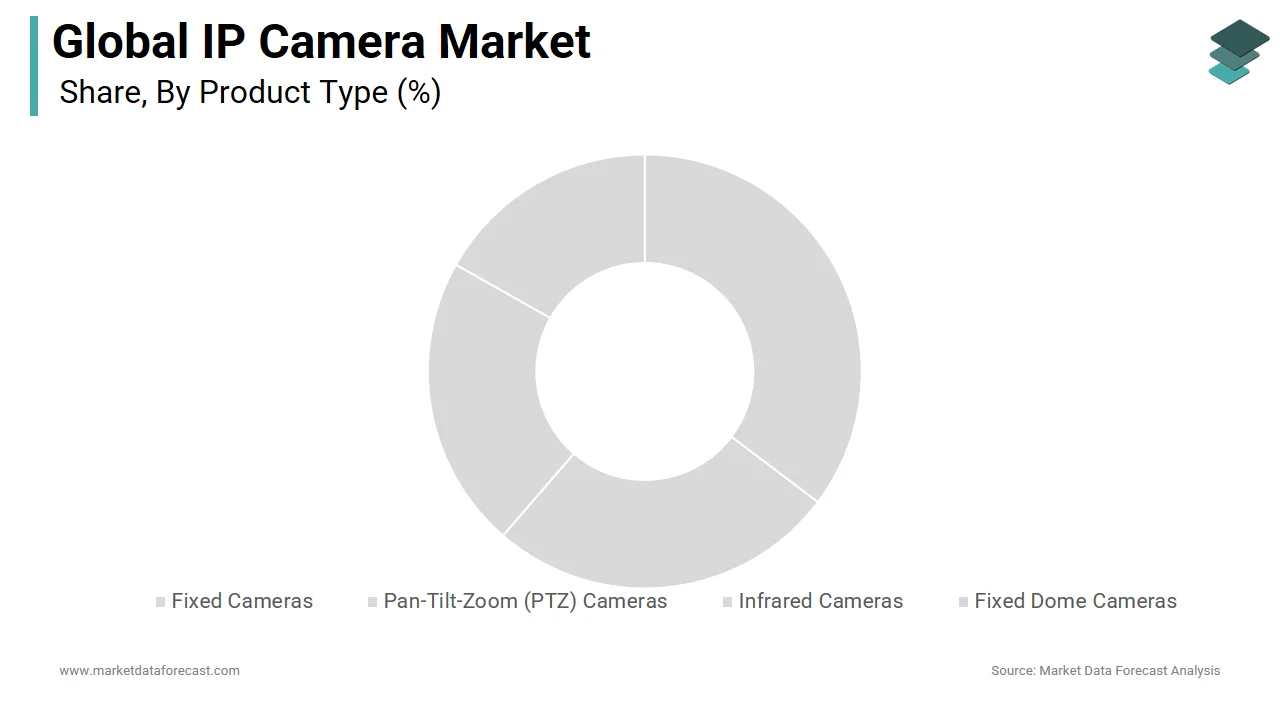
The infrared camera is expected to have the largest market share of 30% by product type during the forecast period. This is due to the increased demand of for safety and security of employees, business and other government and public facilities. These cameras are mainly used in the military and defense to alert the army if there has been an unauthorized action or entry. The manufacturers of the IP camera industry are working on prototypes for traffic monitoring and surveillance; this helps the government monitor road safety and security both during the day and at night time. The Indian government has introduced infrared sensor cameras to enhance traffic security and monitor traffic volume on roads in its capital state, New Delhi, with the help of the Delhi Traffic Police Department.
By ConnectionType Insights
IP camera market by connection is segmented into centralized and decentralized. Decentralized connection systems are likely to record the most substantial share over the anticipated years due to the rising call for video surveillance in corporate and public places. Decentralized connection systems contain inbuilt storage features such as SD card, Hard Disk Drive (HDD), Flash Drives, and Network Attached Storage (NAS); this not only is size-friendly but is also cost-efficient; the consumer does not have to buy an additional video recorder for the purpose. Decentralized IP cameras are flexible and can work in extreme and multi-server environments. Many enterprises are propelling towards shifting to the decentralized IP camera for cost-efficient video surveillance solutions.
By End-Use/Application Insights
IP camera market by application is segmented into residential, commercial, public, and government. The public and government sectors are expected to hold the largest market share by application. The public and government sector is further segmented into transportation, BFSI (banking, financial services, and insurance), education, and government facilities. Among these, the banking, financial services, and insurance sector is foreseen to develop at a CAGR of 15% and record the largest share over the envisioned period. The increased risk of bank robberies is demanding banking officials invest in modern and innovative security service systems that not only provide recorded video footage to help identify the suspect but also alert security if there has been unauthorized access to bank lockers. The manufacturing companies of IP cameras are working on inventing new and advanced IP cameras, especially for banks, to improve security and safety.
In addition to this, not only in banking services, but the government is taking the initiative to implement IP cameras in other residential and commercial places to ensure the safety and security of citizens and other monumental properties such as museums.
Next in line is the military and defense segment; due to increased global terrorism and attacks, the government is investing in IP cameras attached to drones to protect both the army and citizens.
REGIONAL ANALYSIS
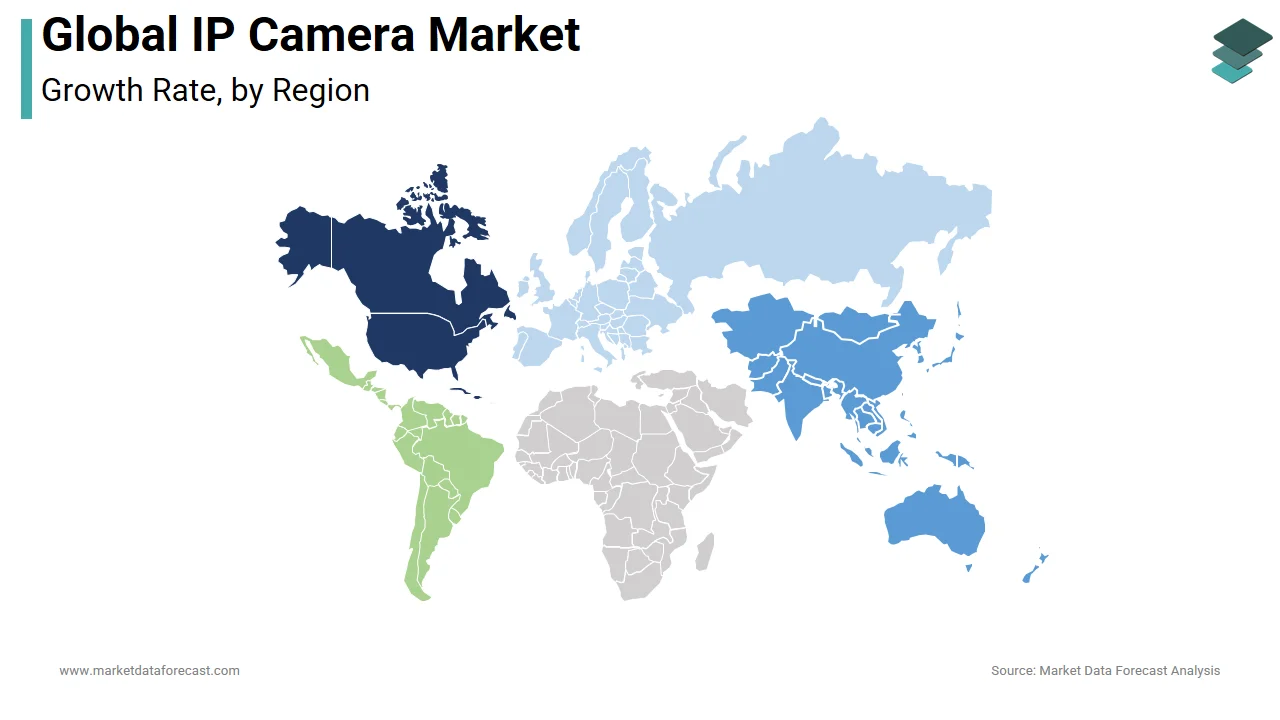
North America had the largest market share of 35%, but due to the increased demand for adopting modern security solutions, Asia Pacific is expected to project and expand at a CAGR of 13% during the forecast period. Countries such as India and Japan are major investors in IP surveillance cameras to reduce crime in the areas. These cameras have the ability to identify an individual with the help of their movement and body shape within 50-meter ranges; this encourages other industries in the region to invest more in the IP camera market, which creates a hike in the Asia Pacific IP camera market in the future.
KEY MARKET PLAYERS
Bosch Security Systems, located in the United States, is expected to be the market leader of the IP camera market during the forecast period because the company has observed a drastic growth in its IP camera and expanded accordingly in 2017.
Arecont Vision Costar LLC., Avigilon Corporation, Canon Inc. (Japan), Belkin International Inc. (United States), Bosch Security Systems (United States), Zhejiang Dahua Technology Co. Ltd. (China), D-Link Corporation (Japan), GeoVision Inc. (Japan), Hangzhou Hikvision Digital Technology Co. Ltd. (China), Honeywell International Inc. (United States), Guangzhou Juan Intelligent Joint Stock Co. Ltd (China), March Networks Corporation (Canada), MOBOTIX AG (Germany), Netgear Inc. (United States), Pelco by Schneider Electric (United States), Samsung Electronics Co. Ltd. (South Korea), Shenzhen Apexis Electronic Co. Ltd. (China), Shenzhen Wanscam Technology Co. Ltd (China), Sony Corporation (Japan), Vivotek Inc. (China), Axis Communications (Sweden), Panasonic i-PRO Sensing Solutions Co. Ltd. (United States), Techwin (South Korea), Z3 Technology LLC (United States), VideoIQ Inc. (United States), and Toshiba (Japan).
RECENT MARKET HAPPENINGS
-
Bosch Security Systems, in February of 2017, has partnered with Sony Corporation to develop advanced security solutions with the help of Sony Corporation’s unquestionable skills in modern camera technology.
-
NTT East, a leading Japanese telecom company, partnered with Earth Eyes Corporation to build an AI security system that will bring a new level of revolutionary change to the IP camera market.
MARKET SEGMENTATION
This research report on the global ip camera market has been segmented and sub-segmented based on the product type, connection, application, and region.
By Component
-
Hardware
-
Camera lenses
-
Mountings
-
Network connectivity devices
-
-
Services
-
Installation
-
Maintenance
-
Software customization
-
Operational training
-
By Product Type
- Fixed Cameras
- Pan-Tilt-Zoom (PTZ) Cameras
- Infrared Cameras
- Fixed Dome Cameras
By Connection Type
-
Centralized Systems
-
Central control server with master database
-
-
Distributed Systems
-
Built-in storage capabilities (e.g., NAS, SD cards)
-
By End-Use/Application
-
Residential
-
Smart homes
-
Home security systems
-
-
Commercial
-
Retail
-
Banking, Financial Services, and Insurance (BFSI)
-
Healthcare
-
Education
-
Industrial
-
Real estate
-
Transportation & logistics
-
-
Government and Public Sector
-
Public facilities
-
Transportation hubs
-
City surveillance
-
By Region
- North America
- Europe
- Asia-Pacific
- Latin America
- The Middle East and Africa