- Product Description Description
- Table of Contents TOC
- List of Table & Figure LOT
- Get Free Sample PDF Sample PDF
Market Size, 2025
$1.87 BnMarket Estimate, 2026
$1.99 BnMarket Forecast, 2034
$3.24 BnCAGR, 2026–2034
6.28%Executive Summary: Europe Peer-to-Peer Lending Market
- Market Scope: Comprehensive regional analysis of the European peer-to-peer (P2P) lending market covering consumer and business lending segments, alternative finance trends, regulatory harmonization under ECSPR, and digital lending infrastructure.
- Market Valuation: Valued at USD 9.68 billion (2025), estimated at USD 10.82 billion (2026), and projected to reach USD 30.57 billion by 2034, registering a strong CAGR of 12.5% (2026–2034).
- Primary Growth Drivers: Increasing consumer demand for alternative financing solutions, tightening credit standards from traditional banking institutions, and strong digital infrastructure. Key opportunities are boosted by AI credit scoring, green P2P lending, and EU sustainability alignment.
Key Market Segment Metrics (2026–2034)
| Category | Leading Segment (2025 Position) | Fastest-Growing Segment |
|---|---|---|
| By Lending Type | Consumer Lending (dominated the market with a 62.4% share in 2025) | Business / SME Lending (projected to be the fastest-growing segment at a CAGR of 14.2%) |
| By Technology & Regulation | Standard Alternative Finance Platforms & Traditional P2P Models | AI Credit Scoring, Green P2P Lending & ECSPR-Authorized Platforms |
| By Region / Country | United Kingdom (held largest regional share at 38.7% in 2025) & Germany (18.9% share) | Southern Europe & Eastern Europe (anticipated to witness fastest regional growth at 15.8% CAGR) |
Major Market Players & Market Structure
Market Structure: Highly competitive European alternative finance landscape featuring digital lending platforms competing intensely on regulatory compliance (ECSPR authorization), cross-border capabilities, and ESG integration to attract institutional capital.
Key Companies: Mintos, Bondora, PeerBerry, October, Robocash, Debitum, EstateGuru, Crowd2Fund, Funding Circle, and Zopa Bank Limited.
Europe Peer-to-Peer Lending Market Size
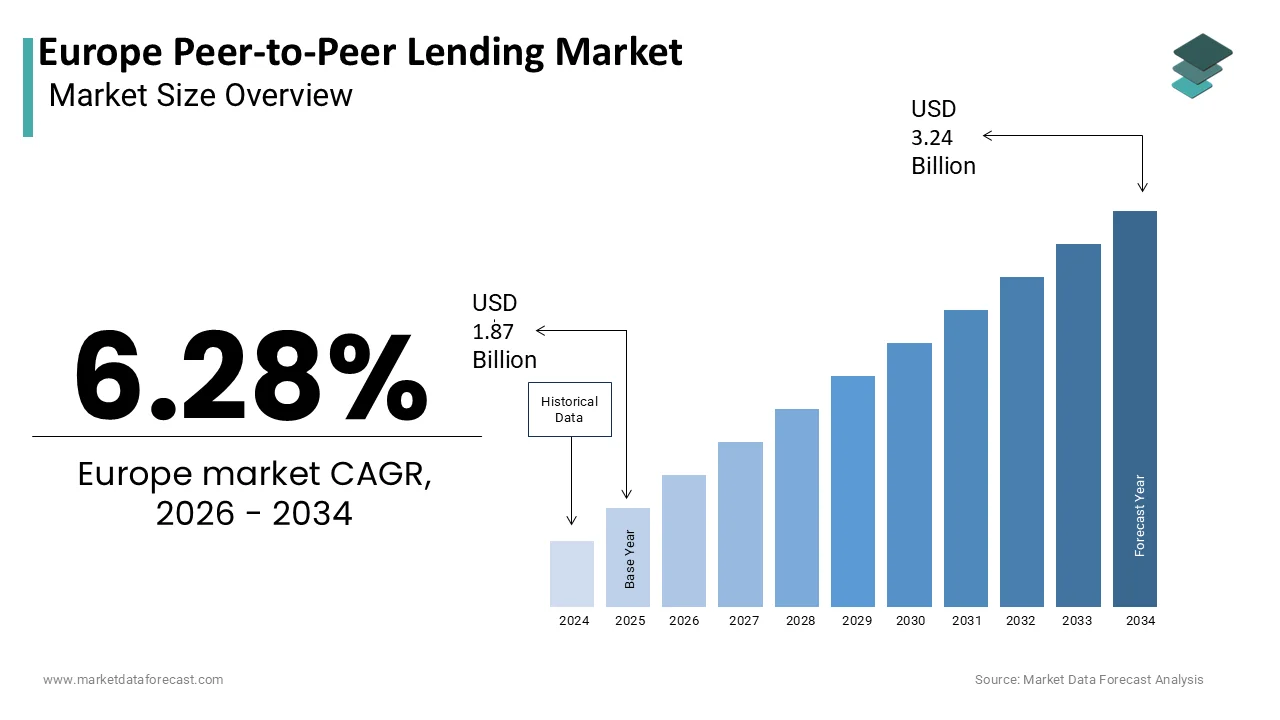
The Europe Peer-to-Peer Lending Market is projected to grow from USD 1.87 billion in 2025 to USD 1.99 billion in 2026 and reach USD 3.24 billion by 2034, registering a CAGR of 6.28% from 2026 to 2034.
Peer-to-peer lending refers to the digital intermediation of unsecured or asset-backed loans between individual or institutional lenders and borrowers, facilitated by regulated online platforms that perform credit assessment, loan servicing, and risk pricing. Unlike traditional banking, this model bypasses balance sheet intermediation by offering alternative financing for consumers and small enterprises often underserved by mainstream institutions. The European market operates under a fragmented yet evolving regulatory framework, with national regulators such as the UK Financial Conduct Authority, France’s Autorité de Contrôle Prudentiel et de Résolution, and Germany’s Federal Financial Supervisory Authority overseeing platform licensing and investor protection. According to the source, over 1.8 million European households accessed non-bank digital credit in 2023, with peer-to-peer platforms accounting for a significant share of small-ticket unsecured lending. As per the European Commission’s Digital Finance Outreach Survey, 34% of small and medium enterprises in Southern and Eastern Europe cited difficulty in obtaining bank loans as a primary barrier to growth, creating structural demand for alternative finance.
MARKET DRIVERS
Persistent Credit Gaps for Small and Medium Enterprises in Southern and Eastern Europe
Small and medium enterprises in several EU regions continue to face systemic barriers in accessing bank financing, driving demand for peer-to-peer lending platforms. The persistent credit gaps for small and medium enterprises in Southern and Eastern Europe are driving the growth of Europe peer to peer lending market. Peer-to-peer platforms fill this void by leveraging alternative data, such as transaction history, utility payments, and e-commerce cash flow, to assess creditworthiness beyond traditional financial statements. The credit standards for SMEs remained tightest in Italy, Spain, and Portugal, due to perceived risk and collateral shortages. This persistent financing gap for micro businesses and service sector firmssustains robust demand for agile digital lending channels that offer faster decisions and flexible terms without requiring real estate collateral.
Growing Retail Investor Appetite for Alternative Fixed Income Assets in a Low-Yield Environment
Retail investors are increasingly allocating capital to peer-to-peer lending as a source of yield in an environment of historically low interest rates on traditional savings. The growing retail investor for alternative fixed income assets in a low-yield environment is additionally fuelling the growth of Europe peer to peer lending market. In Germany, a survey by the Deutsche Bundesbank found that 22% of retail investors with more than EUR 10,000 in liquid assets held alternative income instruments, including peer-to-peer loans, up from 13% in 2020. Platforms like Mintos and Bondora have attracted over 300 000 active European investors by offering fractional lending, secondary market liquidity, and automated portfolio builders. The European Insurance and Occupational Pensions Authority noted in its 2023 Retail Investment Trends report that yield-seeking behavior intensified among post-retirement savers in Nordic and Benelux countries, where inflation eroded real returns on government bonds. Although regulatory caps limit exposure, for example,e the UK’s FCA restricts retail investors to 10% of investable assets in high-risk products, its demand remains strong among financially literate individuals seeking portfolio diversification beyond equities and fixed deposits.
MARKET RESTRAINTS
Divergent National Regulatory Frameworks Increasing Compliance Complexity
The absence of a harmonizEU-wideide regulatory regime for peer-to-peer lending imposes significant compliance burdens on cross-border platforms. The divergent national regulatory frameworks and increasing compliance complexity are hampering the growth of Europe peer to peer lending market. According to the European Banking Authority, peer-to-peer platforms must obtain separate licenses in each member state, where they operate as lenders or brokers, with requirements varying widely on capital adequacy, loan origination rules, and investor disclosure. In Germany, platforms must comply with the Banking Act and hold a BaFin license if they assess credit risk, while in France, they fall under crowdfunding regulations administered by ACPR with different capital thresholds. A 2023 study by the Centre for European Policy Studies found that a single platform operating in five major EU markets incurs average annual compliance costs of EUR 1.4 million, excluding legal advisory fees. Furthermore, the UK’s post Brexit exclusion from EU passporting means platforms like Zopa must maintain separate legal entities for UK and EU operations. This fragmentation deters new entrants, limits economies of scale, and prevents the emergence of truly pan-European players, thereby constraining market depth and investor liquidity across borders.
Limited Recourse and Recovery Mechanisms in Case of Platform or Borrower Default
Investor protection due to weak recovery mechanisms, when loans default, or platforms fail, is restraining the growth of Europe peer to peer ending market. According to the European Consumer Organisation, over 60% of peer-to-peer platforms in Europe do not hold client funds in segregated accounts, exposing lenders to platform insolvency risk. In 2022, the collapse of the Estonian platform Kuetzal, more than 2,000 European investors lost EUR 27 million because funds were not ring-fenced, as confirmed by the Estonian Financial Supervision Authority. National legal systems further complicate enforcement, where cross-border debt collection in the EU averages 14 months and costs 25% of the claim value, as per the European Commission’s Justice Scoreboard. These structural vulnerabilities deter risk-averse investors and contradict the European Commission’s Capital Markets Union objective of fostering retail participation in alternative finance.
MARKET OPPORTUNITIES
Integration with Embedded Finance and E-Commerce Workflows
Peer-to-peer lending platforms are increasingly embedding loan origination into third-party digital ecosystems by creating seamless point-of-sale financing for consumers and merchants. The integration with embedded finance and e-commerce workflows is substantially to create new opportunities for the growth of Europe peer to peer lending market. According to the European Commission’s Digital Finance Initiative, over 40% of new peer-to-peer consumer loans in 2023 were originated through partnerships with online retailers, marketplaces,s and service platforms. In Sweden, Klarna’s integration with peer-to-peer capital providers enables instant underwriting for buy-now-pay-later transactions without balance sheet risk. Similarly, platforms like October partner with accounting software firms such as Sage to offer working capital advances directly within SME financial dashboards. As open banking regulations expand under PSD2 and the upcoming PSD3, platforms can access real-time cash flow data to refine risk models. This shift from destination lending to contextual finance unlocks scalable distribution and deeper borrower engagement, particularly among digital native micro businesses.
Expansion into Green and Social Impact Lending Aligned with EU Taxonomy
Peer-to-peer platforms are developing specialized loan products that finance activities compliant with the EU Sustainable Finance Disclosure Regulation and Taxonomy by attracting institutional and ESG-focused retail capital. The expansion into green and social impact lending aligned with the EU taxonomy is likely to leverage the growth of Europe peer to peer lending market. According to the European Banking Authority, European platforms launched green lending categories in 2023, targeting energy efficiency retrofit,s electric vehicle purchases, es and circular economy startups. The Dutch platform Lendahand partners with local microfinance institutions to fund solar home systems in emerging markets, with all projects mapped to EU Taxonomy environmental objectives. In France, tAutoritéite des Marchés Financiers granted the first “green crowdfunding” label to a peer-to-peer platform in 2023 by enabling preferential marketing to retail investors. As the EU mandates climate-related disclosures for financial products under SFDR, platforms offering verifiable green or social outcomes gain a competitive edge in attracting capital from sustainability-driven lenders by creating a new high-integrity segment within the market.
MARKET Challenges
Platform Concentration Risk and Overexposure to Cyclical Sectors
Many European peer-to-peer platforms exhibit high concentration in specific borrower segmentsy increasing systemic vulnerability during economic downturn, andis a challenge for the growth of Europe peer to peer lending market. According to the European Systemic Risk Board, many SME loan portfolios on major platforms are concentrated in retail hospitality and personal services sectors highly sensitive to inflation and consumer spending shifts. In the UK, the Financial Conduct Authority’s 2023 stress test revealed that a 20% rise in unemployment could trigger default rates exceeding 15% on consumer unsecured loans, far above the 5 to 7% base case. Platforms like Bondora and Mintos derive more than 40% of their loan volume from a single country by amplifying macroeconomic exposure. Additionally, the lack of standardized risk rating methodologies across platforms obscures true portfolio risk, where a 2023 review by the European Securities and Markets Authority found that identical borrower profiles received risk scores varying by up to three grades across different platforms. This opacity and concentration undermine portfolio diversification benefits and heighten contagion risk in a synchronized recession, threatening both investor returns and platform solvency.
Inadequate Standardization of Credit Risk Assessment and Data Sharing
The absence of a unified credit data infrastructure limits the accuracy and consistency of borrower risk evaluation on peer-to-peer platforms. This factor is additionally hampering the growth of Europe peer to peer lending market. According to the European Central Bank, only 12 EU member states have comprehensive national credit registers that include alternative finance data, and none share peer-to-peer loan performance information in real time. As a result, platforms rely on fragmented data sources, bank statements,s open banking APIs, and self-reported income, some leading to inconsistent underwriting. Furthermore, the General Data Protection Regulation restricts the sharing of negative credit information across borders by preventing platforms from accessing full borrower historiesmulti-countryntry applications.
REPORT COVERAGE
| REPORT METRIC | DETAILS |
| Market Size Available | 2025 to 2034 |
| Base Year | 2025 |
| Forecast Period | 2026 to 2034 |
| Segments Covered | By Type, Loan Type, Purpose, and Region. |
| Various Analyses Covered | Global, Regional, and Country-Level Analysis, Segment-Level Analysis, Drivers, Restraints, Opportunities, Challenges; PESTLE Analysis; Porter’s Five Forces Analysis, Competitive Landscape, Analyst Overview of Investment Opportunities |
| Countries Covered | UK, France, Spain, Germany, Italy, Russia, Sweden, Denmark, Switzerland, Netherlands, Turkey, Czech Republic, Rest of Europe |
| Market Leaders Profiled | Zopa Limited, Funding Circle Ltd., Mintos Marketplace, RateSetter (Metro Bank Group), Twino, PeerBerry, Bondora, October (formerly Lendix), LendInvest, Assetz Capital, Auxmoney GmbH, Younited Credit, Bitbond, Revolut (P2P lending features), Railsbank (lending ecosystem provider), Kolo (by NatWest Group), Upstart Network, Inc., Societe Generale (through P2P partnerships), ING Group (P2P collaboration initiatives) |
SEGMENTAL ANALYSIS
By Type Insights
The consumer lending segment held 63.3% of the Europe peer to peer lending market share in 2025. Consumer lending leads due to persistent pressure on household finances across Europe, where real wages have failed to keep pace with inflation. According to Eurostat, real disposable income per capita in the EU declined by 2.1% in 2023, marking the third consecutive annual drop, forcing households to seek unsecured credit for essential expenditures. Platforms like Zopa and Bondora report that their consumer loans are used for debt consolidation or daily expenses, not discretionary spending. This structural reliance on alternative credit for basic financial resilience ensures sustained consumer lending volume among younger and middle-income demographics excluded from premium banking services. The ease of access and streamlined digital journey significantly favor consumer lending over more documentation-intensive business loans. Peer-to-peer platforms capitalize on this by offering loan approvals in under 24 hours with minimal paperwork, contrasting sharply with banks that average 14 days for unsecured personal loans, as per the European Banking Authority. In Sweden and the Netherlands, over 80% of new consumer loan applications are submitted via mobile apps, with platforms like Lendo and CrossLend integratinge-identificationn and open banking APIs to auto-verify income and expenses. The European Securities and Markets Authority confirmed in 2023 that platforms with fully digital onboarding achieve 3.2 times higher conversion rates than those requiring manual document uploads. This frictionless experience, combined with personalized rate offers based on real-time cash flow data, makes consumer lending the default entry point for retail participation in alternative finance.
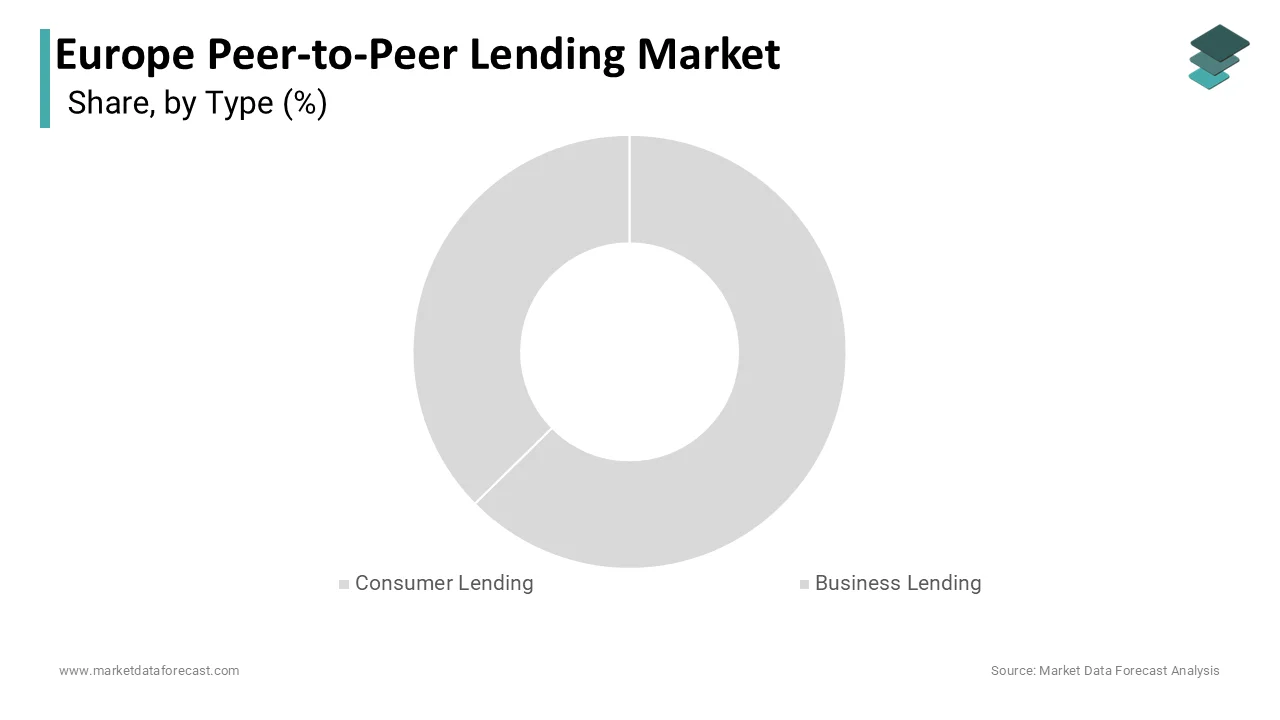
The business lending segment is projected to expand at a CAGR of 18.4% from 2025 to 2033. Business lending growth is accelerated by deep integration into operational software ecosystems used by small enterprises. According to the European Central Bank’s Fintech Monitoring Report 2023, new SME loans on peer-to-peer platforms originated through direct partnerships with accounting software like Sage and QuickBooks or e-commerce marketplaces like Shopify. The French platform October reports that 60% of its loan applications are triggered automatically, when a merchant’s cash flow dips below a threshold, with funds deposited within 48 hours. In Germany, the integration of lending APIs into invoicing platforms like Billbee has enabled micro businesses to access working capital against unpaid invoices without balance sheet dilution.
By Loan Type Insights
The unsecured loans segment was the largest by accounting for a significant share of the Europe peer to peer lending market. Unsecured lending dominates because it aligns with the digital, low-touch ethos of peer-to-peer platforms. According to the European Alternative Finance Network, processing a secured loan requires, on average,e 3.7 times more operational steps than an unsecured one, including asset appraisal, al insurance verification, ion and legal documentation for collateral registration. Platforms like Bondora and Zopa deliberately avoid secured products to maintain automated underwriting and rapid disbursement, with 92% of their loans funded within 24 hours. Additionally, consumer demand favors unsecured credit for personal use, where Eurostat data shows that European households own vehicles or equipment valuable enough to collateralize meaningful loans without risking essential assets. This combination of operational efficiency and borrower preference ensures unsecured lending remains the market’s backbone. Secured lending is further constrained by fragmented national laws governing collateral enforcemeCross-borderrder enforcement is even more complex, where a 2023 study by the Centre for European Policy Studies found that only 4 of 27 member states fully recognize foreign security interests without re-registration. This legal uncertainty deters platforms from offering pan-European secured products. Moreover, the General Data Protection Regulation restricts access to asset ownership registries by making it difficult to verify collateral without borrower consent. In Germany, platforms must comply with the Civil Code’s strict chattel mortgage rules, requiring notarized agreements for movable assets, adding cost and delay. These structural and legal frictions render secured lending economically unviable for most digital lenders, reinforcing the dominance of unsecured models.
The secured segment is projected to expand at a CAGR of 22.7% from 2025 to 2033. Secured lending growth is fueled by tailored products for self-employed individuals in the platform economy, who ownincome-generatingg assets. According to Eurofound, 14.6% of EU workers participated in platform work in 2023, with over 5 million using personal vehicles or tools as primary income sources. Platforms like Auxmoney in Germany and Lendo in Sweden now offer auto equity loans where the vehicle serves as collateral, with loan-to-value ratios capped at 60% to mitigate depreciation risk. In the Netherlands, the platform Geldvoorelkaar partners with Uber and Bolt to offer vehicle refinance loans at 5.8% interest, well below the unsecured rate,s using telematics data to monitor asset location and usage. Secured lending is expanding through green finance initiatives that tie loans to the purchase of qualifying assets like electric vehicles or solar panels. In France, the platform PretUp offers home solar panel loans secured by the installation itself, with default rates under 3% due to the asset’s resale value and utility bill offset. The European Commission’s Sustainable Finance Disclosure Regulation now requires platforms to classify such loans as “taxonomy aligned,” attracting ESG-mandated capital.
By Purpose Type Insights
The repaying bank debt segment held 38.3% of the Europe peer to peer lending machine market share in 2025. Borrowers increasingly refinance expensive bank obligations through peer-to-peer platforms offering substantially lower rates. In the UK, where bank overdraft rates exceeded 30% APR in 2023, as per the Financial Conduct Authority, Zopa reported that 64% of its loans were used to repay bank debt or overdrafts. The European Banking Authority confirmed that refinancing via alternative finance reduced borrower annual interest costs by an average of EUR 1 200. Platforms like Bondora in Estonia and Auxmoney in Germany explicitly market “debt optimization” calculators that show savings from consolidation, driving conversion. Credit card recycling is the second largest segment due to the behavioral trap of revolving high-interest debt and the ease of balance consolidation. Platforms like Lendo in Sweden and CrossLend in Germany offer “credit card payoff” products with fixed monthly payments and no hidden fees, contrasting with variable credit card terms. Additionally, open banking integrations allow platforms to auto-detect credit card liabilities and pre-fill loan amounts, removing friction.
The home renovation segment is projected to expand at a CAGR of 19.3% from 2025 to 2033. Home renovation lending is surging due to binding EU and national requirements for building energy upgrades. According to the European Commission’s Energy Performance of Buildings Directive, all residential buildings must achieve at least energy class E by 2030, triggering mandatory retrofits for over 35 million EU homes. In Germany, the Federal Office of Economics and Export Control reported that 1.2 million homeowners applied for renovation grants in 2023, with 68% also seeking complementary private financing. Platforms like Smava and Check24 now offer green renovation loans with terms up to 15 years, interest rates as low as 3.9%, and instant subsidy eligibility checks. The European Investment Bank’s 2023 Energy Efficiency Finance Report confirmed that peer-to-peer lenders accounted for 24% of all private renovation financing in France and Italy—up from 9% in 2021. As national building codes tighten and fossil fuel heating bans expand, renovation loans transition from discretionary to compliance-driven, ensuring structural growth.
Platforms are embedding lending directly into the home improvement purchase journey, capturing demand at the decision point. According to the European Construction Federation, over 40% of renovation loan applications in 2023 originated through partnerships with certified contractors who offer financing at the quote stage. In the Netherlands, the platform Geldvoorelkaar integrates with 1 200 insulation and heat pump installers, providing instant pre-approval during site visits. This model increases conversion by 3.5 times compared to post decision applications, as verified by the Dutch Authority for the Financial Markets. Similarly, France’s PretUp partners with energy audit firms to bundle loan offers with renovation plans, reducing borrower research burden.
COUNTRY LEVEL ANALYSIS
United Kingdom Peer-to-Peer Lending Market Analysis
The United Kingdom was the top performer of the Europe peer to peer lending market by capturing 28.3% of the share in 2025, with the region’s most mature and regulated alternative finance ecosystem. Its leadership stems from early regulatory clarity under the Financial Conduct Authority, which introduced the Innovative Finance ISA in 2016, allowing tax-free returns on peer-to-peer investments. The country hosts global platforms like Zopa and Funding Circle, which have set industry standards for risk modeling and investor protection. Post Brexit, the UK maintained its sandbox approach, enabling controlled innovation in credit scoring and open banking integrations. With over 1.1 million active retail lenders and strong institutional participation, the UK market remains the benchmark for scalability and regulatory balance in European peer-to-peer lending.
Germany Peer-to-Peer Lending Market Analysis
Germany peer to peer lending market ranked second by capturing 21.3% of the market share in 2025, with its conservative yet high-volume consumer lending driven by strong financial literacy and digital adoption. The Federal Financial Supervisory Authority enforces strict risk disclosure rules, which require platforms to provide standardized risk classifications that have increased investor trust. Platforms like Smava and Auxmoney dominate by integrating with Schufa credit data and offering real-time rate comparisons against bank offers. The country’s high savings rate of over 10% of disposable income fuels retail investor participation, with over 800 000 Germans holding peer-to-peer loans as part of diversified portfolios. Germany’s emphasis on transparency, data privacy, and consumer protection has created a stable and deep market that prioritizes sustainability over rapid growth.
France Peer-to-Peer Lending Market Analysis
France peer to peer lending market is likely to grow with the strong policy support for SME and green lending through public-private partnerships. According to the Autorité de Contrôle Prudentiel et de Résolution, French platforms facilitated EUR 1.9 billion in loans in 2023, with business lending growing at 24% year on year. The government’s “Finance Innovation” label certifies compliant platforms, enabling access to state guarantee schemes like the Bpifrance guarantee that covers 70% of SME loan losses. Platforms like October and PretUp have leveraged these guarantees to attract institutional capital, with pension funds now accounting for 35% of business loan funding. Additionally, France’s Loi PACTE encourages employee savings plans to allocate up to 10% to alternative finance, which is creating a steady retail investor base.
Sweden Peer-to-Peer Lending Market Analysis
Sweden peer to peer lending market growth is likely to grow, withthe emergenceg as a leader in digital innovation and open banking integration. The country’s near-universal adoption of e-identification and real-time payment infrastructure enables loan disbursement in under two hours. Platforms like Lendo and Toborrow dominate by embedding lending into e-commerce and service marketplaces, with 45% of loans originating outside traditional financial apps. Sweden’s high financial literacy ranked first in the OECD’s 2023 financial competence index, which ensures informed participation, while strict consumer protection laws limit overindebtedness. This combination of technological readingsr regulatoryalance, and consumer sophistication creates a scalable model that other Nordic countries are emulating.
Netherlands Peer-to-Peer Lending Market Analysis
The Netherlands' peer-to-peer lending market growth is likely to be propelled by its focus on sustainable lending and cooperative finance models. The platform Geldvoorelkaar operates as a cooperative, returning 100% of interest to lenders and focusing on social impact metrics. The Dutch Authority for the Financial Markets enforces stringent ESG disclosure rules by requiring platforms to classify all loans under the EU Taxonomy.
COMPETITIVE LANDSCAPE
The Europe peer to peer lending market features a dynamic, competitive landscape shaped by regulatory fragmentation, technological innovation, and investor sophistication. Competition is not primarily based on interest rate arbitrage but on risk transparency platform reliability and portfolio diversification. Incumbents like Zopa and October focus on branded direct lending with prudent underwriting, ing while aggregators like Mintos compete on the breadth of originator networks and secondary market liquidity. The entry of digital banks and neobrokers has intensified pressure on user experience and distribution. Regulatory compliance costs create high barriers to entry, yet also foster trust among retail investors. Institutional participation is growing but remains cautious due to concerns over platform solvency and loan recovery mechanisms.
KEY MARKET PLAYERS
Some of the companies that are playing a dominating role in the europe peer-to-peer lending market include
- Zopa Limited
- Funding Circle Ltd.
- Mintos Marketplace
- RateSetter (Metro Bank Group)
- Twino
- PeerBerry
- Bondora
- October (formerly Lendix)
- LendInvest
- Assetz Capital
- Auxmoney GmbH
- Younited Credit
- Bitbond
- Revolut (P2P lending features)
- Railsbank (lending ecosystem provider)
- Kolo (by NatWest Group)
- Upstart Network, Inc.
- Societe Generale (through P2P partnerships)
- ING Group (P2P collaboration initiatives)
TOP LEADING PLAYERS IN THE MARKET
- Zopa Limited is a pioneering UUK-based peer-to-peerlending platform that has evolved into a fully licensed digital bank while retaining its core marketplace lending model. The company facilitates consumer loans across Europe with a strong emphasis on credit risk analytics and investor protection. Zopa has strengthened its market position by integrating open banking data to refine real-time affordability assessments and by launching its Innovative Finance ISA to attract tax-advantaged retail investment. In recent years, the company expanded its investor base to include institutional capital through securitization partnerships while maintaining transparent risk grading for all loan listings in the European peer-to-peer lending market.
- Mintos Marketplace AS is a Latvia headquartered pan European peer to peer lending platform that aggregates loan originators from over 20 countries to offer diversified investment opportunities. The company serves both retail and institutional investors with a secondary market for loan liquidity and automated portfolio strategies. Mintos has reinforced its presence by achieving full compliance with the European Crowdfunding Service Providers regulation and by implementing stringent originator due diligence protocols. The platform also introduced buyback guarantees and real-time performance dashboards to enhance investor confidence and transparency in the Europe peer to peer lending market.
- October SAS is a French peer-to-peer lending platform specializing in SME financing across Europe, with operations in France, Germany,ny Spain, Italy,taly and the Netherlands. The company connects small businesses with retail and institutional lenders through a digital platform that emphasizes environmental and social impact metrics alongside credit risk. October has strengthened its market position by securing partnerships with national guarantee schemes such as Bpifrance and by classifying all loans under the EU Taxonomy for sustainable activities. The platform also launched institutional note programs to facilitate larger capital allocations from pension funds and asset managers in the Europe peer to peer lending market.
TOP STRATEGIES USED BY THE KEY MARKET PARTICIPANTS
Key players in the Europe peer to peer lending market pursue regulatory harmonization by aligning with the European Crowdfunding Service Providers regulation to enable cross-border operations. They integrate open banking and alternative data sources to enhance credit risk modeling and reduce default rates through real-time cash flow analysis. Platforms develop secondary markets and automated investment tools to improve retail investor liquidity and engagement. Strategic partnerships with national guarantee schemes and development banks de-risk SME lending and attract institutional capital. Additionally, they emphasize ESG compliance by mapping loans to the EU Taxonomy and offering green lending categories to meet rising demand for sustainable finance from both borrowers and investors.
MARKET SEGMENTATION
This research report on the europe peer-to-peer lending market is segmented and sub-segmented into the following categories.
By Type
- Consumer Lending
- Business Lending
By Loan Type
- Unsecured Loans
- Secured Loans
By Purpose
- Repaying Bank Debt
- Credit Card Refinancing
- Home Renovation
- Others
By Country
- United Kingdom
- Germany
- France
- Sweden
- Netherlands
- Rest of Europe