Europe Perfume Market Size, Share, Trends And Growth Forecasts Research Report, Segmented By Type, Product, End User, Distribution Channel and Country - Industry Analysis (2026 to 2034)
Market Size, 2025
$16.03 BnMarket Estimate, 2026
$16.79 BnMarket Forecast, 2034
$24.38 BnCAGR, 2026–2034
4.77%Europe Perfume Market Report Summary
The European perfume market was valued at USD 16.03 billion in 2025, is estimated to reach USD 16.79 billion in 2026, and is projected to reach USD 24.38 billion by 2033, growing at a CAGR of 4.77% during the forecast period. The growth of the European perfume market is driven by increasing consumer preference for luxury and personalized fragrances, rising disposable incomes, and the growing influence of fashion and celebrity-endorsed scents. Additionally, the expansion of travel retail, the resurgence of artisanal perfume brands, and sustainable production practices are reshaping the regional fragrance landscape.
Key Market Trends
- The rising popularity of premium and niche perfumes driven by demand for exclusivity and craftsmanship.
- Increasing shift toward eco-friendly and cruelty-free formulations as sustainability becomes a key purchasing factor.
- Growing influence of digital marketing and e-commerce platforms in promoting and distributing luxury fragrances.
- Emergence of personalized fragrance experiences using AI-driven scent customization.
- Strong growth in unisex fragrances, reflecting evolving consumer preferences for gender-neutral products.
Segmental Insights
- Based on type, the eau de perfume segment held the largest share of 42.6% of the European perfume market in 2024. This dominance is attributed to its longer-lasting fragrance concentration, preferred by consumers seeking premium-quality scents that provide both intensity and longevity.
- Based on product, the premium segment was the largest, capturing 58.5% share of the European perfume market in 2024. The segment’s growth is supported by rising consumer spending on high-end luxury brands and growing demand for limited-edition perfumes crafted with rare natural ingredients.
- Based on distribution channel, the offline segment captured a dominant share of 63.1% of the European perfume market in 2024, driven by consumer preference for in-store testing, personalized consultations, and luxury retail experiences in boutique and department stores.
Regional Insights
The European perfume market demonstrates robust regional diversity, driven by strong cultural associations with fragrance and the presence of globally renowned luxury houses.
- France was the top performer in the European perfume market, accounting for 23.5% share in 2024, owing to its status as the global hub for perfumery and home to iconic fragrance brands such as Dior, Chanel, and Guerlain.
- Italy is witnessing a growing demand for artisanal and natural perfumes, supported by a strong local tradition of craftsmanship and design innovation.
- Germany continues to expand as a key market for both mass and premium fragrances, with an emphasis on sustainable and dermatologically safe products.
- The United Kingdom remains a strong market, with increasing demand for gender-neutral and vegan fragrances driven by shifting consumer trends.
- Spain and Scandinavia are emerging markets, showing rising adoption of niche and eco-conscious perfume brands.
Competitive Landscape
The European perfume market is highly competitive and brand-driven, with global luxury conglomerates dominating alongside a growing base of independent niche brands. Companies are focusing on premiumization, sustainable packaging, and digital storytelling to enhance customer engagement and brand loyalty. Major companies operating in the Europe perfume market include LVMH Moët Hennessy Louis Vuitton SE, Kering SA, L’Oréal S.A. (France), Unilever Plc (U.K.), Coty Inc., Natura & Co. (Brazil), Puig SA (Spain), Chanel Limited (France), and Beiersdorf AG (Germany).
Europe Perfume Market Size
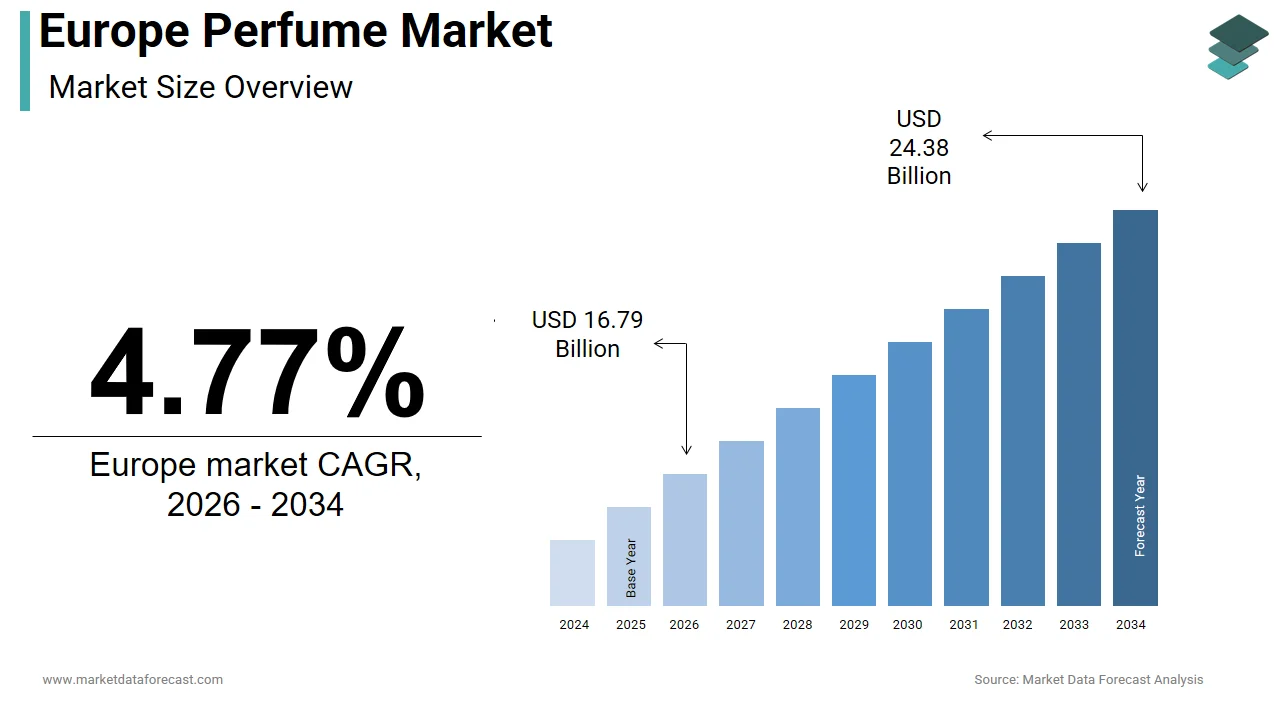
The size of the Europe perfume market was worth USD 16.03 billion in 2025. The regional market is anticipated to grow at a CAGR of 4.77% from 2026 to 2034 and be worth USD 24.38 billion by 2034 from USD 16.79 billion in 2026.
Perfume is defined as a liquid mixture of fragrant essential oils or aroma compounds, fixatives, and solvents, used to create a pleasant, lasting scent for personal use, objects, and spaces. Europe remains the historical birthplace of modern perfumery, with France alone accounting for a portion of global fine fragrance exports, as per sources. Consumer behavior across the region reflects a sophisticated preference for heritage brands alongside a growing openness to niche and artisanal scents. Germany, Italy, and the United Kingdom serve as key consumption hubs, with urban populations demonstrating heightened sensitivity to scent composition and brand storytelling. According to research, a portion of European households reported purchasing at least one fragrance product annually, underscoring consistent baseline demand. This intricate interplay of tradition, regulatory scrutiny, and shifting aesthetic sensibilities defines the contemporary European perfume landscape, which sets it apart from other global regions through its emphasis on craftsmanship, authenticity, and sensory legacy.
MARKET DRIVERS
Rising Demand for Niche and Artisanal Fragrances
Consumer gravitation toward niche and artisanal perfumes has emerged as a key driver of the Europe perfume market. This is fueled by a desire for individuality and experiential luxury. Unlike mass-market fragrances, niche scents emphasize unique compositions, limited distribution, and narrative depth, aligning with the values of discerning European buyers. A post-pandemic shift in consumer patterns prompted a return to in-store shopping for many retailers, particularly those in the luxury and niche sectors, after lockdown measures were relaxed. Additionally, the number of independent perfumers registered with the Union des Parfumeurs Créateurs rose, which reflects entrepreneurial momentum in this segment. Social media platforms, particularly Instagram and TikTok, have amplified discovery, with the use of social media and hashtags significantly influencing the fragrance industry, especially for niche perfumery, by increasing brand visibility and driving trends. This cultural shift away from homogenized scents toward personalized olfactory identities continues to reshape product development and retail strategies across the continent.
Growing Influence of Sustainability and Clean Beauty Standards
Environmental consciousness and clean beauty expectations are encouraging the expansion of the Europe perfume market. This compels brands to reformulate and reposition. European consumers increasingly scrutinize ingredient sourcing, packaging recyclability, and carbon footprints, driven by stringent regional regulations and heightened ecological awareness. As per research, most European consumers express a clear preference for cosmetics and fragrances that exclude certain synthetic ingredients commonly limited under regional safety regulations. According to sources, this growing awareness is directly influencing purchasing choices, with many buyers in countries such as France and Germany favoring brands that hold credible eco-certifications. As per research, ongoing policy initiatives across Europe are also driving wider use of sustainable packaging solutions, with major luxury brands increasingly embracing refillable formats in their perfume collections. These evolving expectations are not merely trend-driven but embedded in Europe’s regulatory and cultural fabric, making sustainability a non-negotiable pillar of market relevance.
MARKET RESTRAINTS
Stringent Regulatory Compliance and Ingredient Restrictions
The European perfume market operates under one of the world’s most rigorous regulatory frameworks, which constrains formulation flexibility and increases compliance costs, and thereby restricts the growth of the Europe perfume market. The European Union maintains comprehensive safety requirements for cosmetic formulations under its regulatory framework. As per research, fragrance ingredients used in cosmetic products must be carefully monitored and clearly indicated when present beyond specified limits. According to sources, the list of restricted or controlled cosmetic substances continues to expand as new safety evaluations are completed. As per research, updating or reformulating a popular fragrance to conform to newly introduced standards often requires substantial investment and additional development time. According to sources, chemical safety regulations in Europe also mandate detailed documentation and data reporting for all listed substances. Smaller brands often lack the resources to navigate this labyrinthine system, which leads to market consolidation. These regulatory hurdles, while essential for consumer safety, create significant entry barriers and stifle innovation, particularly for independent and emerging perfumers seeking to establish a foothold in the European market.
Volatility in Raw Material Sourcing and Geopolitical Disruptions
Persistent supply chain vulnerabilities due to its dependence on natural raw materials sourced from politically unstable or climate-sensitive regions slow down the expansion of the Europe perfume market. Key ingredients such as jasmine from Egypt, rose from Bulgaria, and sandalwood from India are subject to harvest fluctuations, trade restrictions, and export controls. According to sources, Bulgarian rose oil prices have fluctuated, influenced by droughts and labor costs, which have driven prices up. Similarly, Geopolitical conflicts, such as the war in Ukraine, have certainly impacted supply chains and led to price instability for many commodities, including chemicals. The fragrance industry is known to face challenges like raw material price fluctuations and supply shortages, particularly with restrictions on certain chemicals and volatility in natural ingredient supply. Climate change exacerbates these risks. This fragility in the upstream supply chain not only inflates costs but also threatens the consistency and authenticity of iconic scents, posing a structural challenge to the market’s long-term stability.
MARKET OPPORTUNITIES
Expansion of Direct-to-Consumer and Digital Personalization Platforms
The proliferation of direct-to-consumer channels and AI-driven personalization tools creates a potential opportunity for the growth of the Europe perfume market. This helps the brands to deepen engagement and capture latent demand. Unlike traditional retail, which relies on passive discovery, digital platforms enable hyper-tailored scent recommendations based on consumer preferences, lifestyle data, and even genetic olfactory profiles. Brands such as Olfactive Studio and Scentbird have leveraged machine learning algorithms to curate bespoke scent journeys, resulting in customer retention rates exceeding, as per a study. Moreover, virtual try-on technologies using scent simulation via smartphone peripherals are gaining traction, with programs reporting an increase in conversion rates compared to standard e-commerce interfaces, according to sources. This shift not only democratizes access to niche offerings but also generates rich behavioral data that informs future creations. The future of Europe's personalized scent experiences could be reshaped by advancements in digital infrastructure, along with growing consumer acceptance of virtual environments and the fusion of biometric feedback with real-time scent technology.
Revival of Heritage Craftsmanship and Regional Identity
A renewed appreciation for regional perfumery traditions and artisanal craftsmanship is generating fresh prospects for the expansion of the Europe perfume market. Consumers are increasingly drawn to scents that embody local terroir, historical narratives, and time-honored distillation methods, creating fertile ground for geographically rooted brands. This trend is further amplified by cultural tourism, with fragrance workshops and distillery visits in regions like Andalusia and the Peloponnese contributing over two hundred million euros annually to local economies, as estimated by the European Travel Commission. Preserving intangible cultural assets is made possible when European perfumers create authentic, place-based scents, which also allows them to earn higher margins.
MARKET CHALLENGES
Counterfeit Products and Brand Integrity Erosion
The proliferation of counterfeit perfumes poses a severe and escalating threat to brand equity, consumer safety, and revenue integrity across Europe, which in turn inhibits the growth of the Europe perfume market. Illicit replicas often contain unregulated or hazardous substances yet mimic packaging so closely that even seasoned consumers struggle to differentiate them. These fakes predominantly originate from unregulated manufacturing hubs in Eastern Europe and Southeast Asia and infiltrate markets through online marketplaces and informal retail channels. More alarmingly, as per research, a portion of seized counterfeit perfumes contained methanol or industrial solvents exceeding safe exposure limits. This not only endangers public health but also dilutes brand perception when consumers associate adverse reactions with legitimate products. The persistence of counterfeiters, even with advanced holographic and blockchain technology, requires constant and robust investment in forensic tracking and consumer education.
Shifting Gender Norms and Fragmentation of Traditional Categories
The erosion of binary gender constructs in fragrance marketing is disrupting long-established product segmentation and forcing brands to rethink formulation, positioning, and retail display strategies, and as a result, the expansion of the Europe perfume market is being held back. European consumers, particularly among younger demographics, increasingly reject gendered labeling in favor of fluid scent identities. According to research, a portion of respondents aged sixteen to twenty-nine stated they choose perfumes based on personal resonance rather than gendered marketing cues. This cultural shift has rendered traditional men’s and women’s fragrance aisles obsolete in progressive retailers, with chains reporting that unisex or gender-neutral fragrances constitute a share of their fine fragrance sales. However, legacy brands face significant challenges in reformulating decades-old signatures originally designed for specific gender archetypes without alienating loyal customers. Apart from these, regulatory frameworks still classify certain ingredients as restricted based on historical usage patterns tied to gendered products, creating formulation ambiguities. This identity flux demands agile brand storytelling and inclusive product architecture, yet missteps risk commercial irrelevance in a market where authenticity and social alignment are paramount.
REPORT COVERAGE
| REPORT METRIC | DETAILS |
| Market Size Available | 2025 to 2034 |
| Base Year | 2025 |
| Forecast Period | 2026 to 2034 |
| Segments Covered | By Type, Product, End-user, Distribution Channel, and Region. |
| Various Analyses Covered | Global, Regional and Country-Level Analysis, Segment-Level Analysis, Drivers, Restraints, Opportunities, Challenges; PESTLE Analysis; Porter’s Five Forces Analysis, Competitive Landscape, Analyst Overview of Investment Opportunities |
| Countries Covered | UK, France, Spain, Germany, Italy, Russia, Sweden, Denmark, Switzerland, Netherlands, Turkey, Czech Republic, and the Rest of Europe. |
| Market Leaders Profiled | LVMH Moët Hennessy Louis Vuitton SE, Kering SA, L’Oréal S.A. (France), Unilever Plc (U.K.), Coty Inc., Natura & Co. (Brazil), Puig SA (Spain), Chanel Limited (France), and Beiersdorf AG (Germany). |
SEGMENTAL ANALYSIS
By Type Insights
The eau de perfume segment held the largest share of 42.6% of the Europe perfume market in 2024. The growth of the eau de Parfum segment is driven by its optimal balance of scent concentration, longevity, and price positioning, which appeals to both premium and mid-tier consumers. European shoppers increasingly favor fragrances that offer all-day wear without the intensity or cost of pure perfume. According to sources, a share of regular fragrance users in Germany, France, and Italy identified Eau de Parfum as their preferred concentration due to its versatility across professional and social settings. Besides, luxury houses have strategically expanded their Eau de Parfum offerings with exclusive flankers and limited editions, driving repeat purchases. The segment also benefits from higher perceived value, enabling brands to maintain healthier margins compared to lighter concentrations while remaining accessible to a broad demographic.
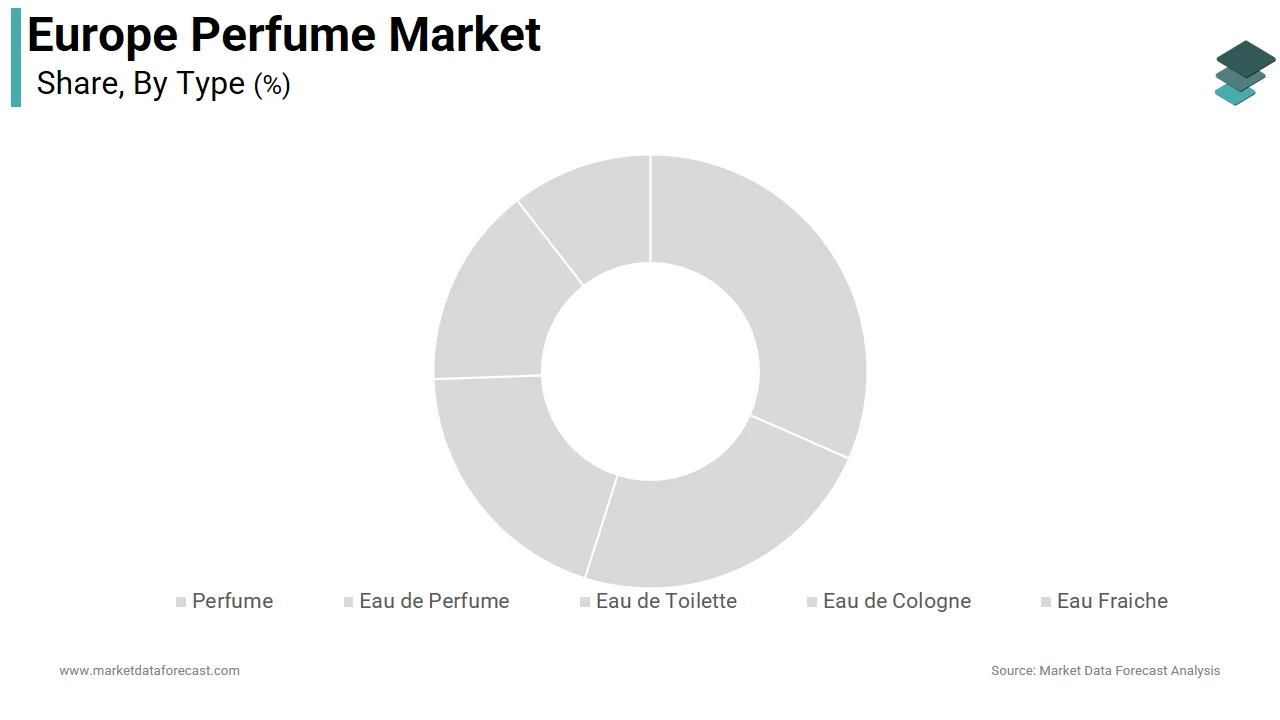
The perfume segment is estimated to register the fastest CAGR of 9.3% from 2025 to 2033. The expansion of the perfume segment is driven by the rising demand for ultra-premium and collectible scents among affluent consumers seeking exclusivity and olfactory sophistication. Pure perfume typically contains a portion of aromatic compounds offering unmatched longevity and depth, which resonates with connoisseurs in markets like France and Switzerland. Furthermore, the gifting culture around milestone occasions has elevated perfume as a symbol of prestige. This convergence of wealth expansion, artisanal storytelling, and emotional gifting fuels the segment’s rapid ascent.
By Product Insights
The premium segment was the largest segment of the Europe perfume market and captured 58.5% share in 2024. The prominence of the premium segment is attributed to Europe’s historical affinity for luxury craftsmanship, brand heritage, and sensory refinement. Consumers across mature markets consistently associate fine fragrance with self-expression status and emotional resonance rather than mere functional use. Luxury conglomerates such as LVMH and Kering have supported this dominance by integrating perfume into broader brand ecosystems, including fashion and hospitality, thereby enhancing cross-category loyalty. Moreover, the regulatory environment in Europe, which mandates ingredient transparency, has elevated trust in established premium brands that invest in traceable sourcing and sustainable extraction.
The mass segment is anticipated to witness the fastest CAGR of 6.8% during the forecast period, owing to value-conscious consumers, particularly in Southern and Eastern Europe, who seek affordable yet trend-aligned scents. Economic pressures, including inflation and cost-of-living adjustments, have prompted a shift toward accessible luxury with mass fragrances offering designer-inspired olfactory profiles at a fraction of the price. Retailers have amplified this trend by dedicating prominent shelf space to curated mass offerings, often co-branded with influencers or entertainment franchises. Apart from these, private label development by supermarket chains such as Carrefour and Edeka has introduced high-quality alternatives that mimic premium notes using compliant synthetic molecules.
By Distribution Channel Insights
The offline segment captured a dominant share of 63.1% of the European perfume market in 2024. The experiential nature of fragrance discovery, where tactile interaction, sampling, and in-person consultation remain irreplaceable for many consumers, has significantly propelled the growth of the offline segment. Department stores, specialty perfumeries, and brand boutiques offer immersive environments that facilitate emotional connection and informed decision-making. Apart from these, trained beauty advisors in stores such as Marionnaud and Douglas drive conversion through personalized recommendations. Seasonal promotions, gift events, and in-store exclusives further anchor offline relevance. The essential, multisensory nature of choosing a fragrance means that, despite advances in the digital world, physical stores remain the top choice for both discovery and building customer loyalty.
The online distribution segment is likely to experience the fastest CAGR of 12.1% from 2025 to 2033. The rapid growth of the online distribution segment is fueled by digital native consumers who prioritize convenience, discovery, and personalized curation. The proliferation of scent sampling kits, virtual try-on tools, and AI-driven recommendation engines has significantly mitigated the historical barrier of not smelling before buying. According to sources, a share of online fragrance shoppers aged eighteen to thirty used digital scent profiling tools before making a purchase. Subscription models have also gained traction with platforms reporting subscriber bases growing year on year. Moreover, cross-border e-commerce within the EU has streamlined access to niche brands previously unavailable in local markets. These innovations collectively transform online from a transactional channel into an experiential and exploratory space.
COUNTRY LEVEL ANALYSIS
France Perfume Market Analysis
France was the top performer in the European perfume market and accounted for a 23.5% share in 2024. As the historic epicenter of perfumery, the country benefits from unparalleled brand equity, infrastructure, and consumer literacy. Grasse alone produces a portion of the world’s raw materials for luxury fragrances, as per sources. Domestic consumption remains robust. The nation’s cultural reverence for scent as an extension of identity sustains premium demand even amid economic uncertainty. Moreover, France hosts the majority of global fragrance houses, including L’Oréal Luxe and Chanel Perfume, whose R and D investments exceed a significant amount annually, according to sources. Regulatory leadership through stringent allergen labeling and sustainable sourcing standards further cements its role as both market and moral compass for the European industry.
United Kingdom Perfume Market Analysis
The United Kingdom followed closely in the Europe perfume market and captured 18.4% share in 2024. London functions as a pan-European hub for fragrance innovation, trend-setting, and multicultural consumer testing. The British market exhibits strong openness to gender fluid and niche offerings, with a share of UK fragrance sales attributed to unisex or indie brands, according to research. High disposable income in urban centers fuels consistent demand for limited editions and celebrity collaborations. Apart from these, the UK’s post-Brexit regulatory autonomy has enabled faster approval of novel ingredients, giving domestic brands a competitive edge in product differentiation. The nation’s cosmopolitan consumer base and agile retail landscape position it as a critical barometer for emerging scent preferences across Northern Europe.
Germany Perfume Market Analysis
Germany remains a major region in the European perfume market. The growth of Germany is driven by rational yet quality-driven purchasing behavior with a pronounced emphasis on ingredient transparency and environmental impact. A portion of German fragrance buyers check INCI lists before purchase, according to studies, which reflects deep regulatory awareness. This has propelled demand for certified natural and refillable formats, with brands reporting double-digit growth in eco-conscious lines. Germany also leads in offline retail density. Stable economic conditions and high per capita spending on personal care sustain Germany’s position as a volume and value anchor in Central Europe.
Italy Perfume Market Analysis
Italy grew consistently in the Europe perfume market and remains a vital center for olfactory artistry and design-led fragrance. Italian consumers exhibit strong loyalty to domestic luxury houses such as Acqua di Parma and Xerjoff, whose heritage blends craftsmanship with Mediterranean botanicals. The country’s fashion industry acts as a powerful co-driver, with over sixty-five percent of top Italian fashion brands maintaining in-house fragrance divisions, as per studies. Domestic production of key raw materials, including Calabrian bergamot and Tuscan iris, supports vertical integration and authenticity. Moreover, Italy’s tourism sector amplifies global exposure with duty-free fragrance sales at airports. Urban centers such as Milan and Florence serve as trend incubators where scent is intertwined with lifestyle aesthetics, reinforcing Italy’s role as a cultural tastemaker in Southern Europe.
Spain Perfume Market Analysis
Spain is anticipated to grow in the Europe perfume market due to youth engagement and value-oriented premiumization. Spanish consumers, particularly those under thirty five show high receptivity to influencer-endorsed and social media-driven launches, with TikTok fragrance hauls increasing, according to research. The mass premium segment is thriving with local retailers like El Corte Inglés introducing private label scents that mimic luxury accords at accessible price points. Climate also plays a role, as warmer temperatures encourage frequent fragrance use. Apart from these, Spain’s strategic location as a gateway to Latin America enables dual market testing for global brands. Rising disposable income and a rebound in tourism post-pandemic have further revitalized both domestic consumption and duty-free sales, solidifying Spain’s ascent as a key growth engine in Western Europe.
COMPETITIVE LANDSCAPE
The Europe perfume market features intense competition characterized by a blend of legacy luxury conglomerates, agile niche creators, and global beauty giants. Established players leverage heritage brand equity, extensive distribution networks, and integrated fashion ecosystems to dominate premium segments. Simultaneously, independent perfumers gain traction through authentic storytelling and hyper-personalized offerings that resonate with conscious consumers. The market is further fragmented by mass market players offering designer licensed scents at accessible price points, creating a multi-tiered competitive landscape. Regulatory complexity, ingredient restrictions, and sustainability mandates raise barriers to entry yet also drive innovation among incumbents. Digital disruption has leveled discovery opportunities, allowing smaller brands to compete through social commerce and direct engagement. This dynamic environment fosters constant reinvention, with competitors balancing tradition with technological and cultural responsiveness to retain relevance across diverse European consumer bases.
KEY MARKET PLAYERS
Some of the companies that are playing a dominating role in the Europe perfume market include
- LVMH Moët Hennessy Louis Vuitton SE
- Kering SA
- L’Oréal S.A.( France)
- Unilever Plc (U.K.)
- Coty Inc.
- Natura & Co. (Brazil)
- Puig SA (Spain)
- Chanel Limited (France)
- Beiersdorf AG (Germany)
TOP PLAYERS IN THE MARKET
- LVMH Moët Hennessy Louis Vuitton SE is a pivotal force in the European perfume market through its portfolio of luxury fragrance houses, including Parfums Christian Dior, Guerlain, and Givenchy. The group leverages its integrated fashion and beauty ecosystem to drive cross-category appeal and global distribution. In recent years, LVMH has intensified its focus on sustainable sourcing and refillable packaging across its perfume lines. These initiatives enhance brand prestige while aligning with European regulatory and consumer expectations for environmental accountability.
- Kering SA exerts significant influence in the European fragrance landscape primarily through its ownership of Bottega Veneta and Alexander McQueen perfume lines. Although smaller in fragrance scale than LVMH, Kering emphasizes artistic direction and limited edition releases to cultivate exclusivity. The company has recently invested in digital scent storytelling and immersive retail experiences in key European capitals. This strategic pivot toward creative differentiation strengthens its positioning in the premium segment without competing on volume.
- Coty Inc maintains a robust presence in Europe through a dual strategy encompassing mass market licenses such as Gucci and Burberry, and its direct-owned brands like Chloé and Hugo Boss fragrances. Coty accelerated its digital transformation by integrating AI-driven personalization into its European e-commerce platforms. These actions reinforce its agility in serving both accessible luxury and prestige consumers across diverse channels.
TOP STRATEGIES USED BY THE KEY MARKET PARTICIPANTS
Key players in the Europe perfume market deploy a range of strategic initiatives to sustain competitiveness and capture evolving consumer demand. Product innovation remains central, with brands frequently launching limited editions and flankers to maintain novelty. Sustainability integration is now standard as companies adopt refillable systems, ethically sourced ingredients, and transparent labeling to meet EU regulatory and ethical expectations. Digital acceleration is another core strategy encompassing AI-powered scent recommendation tools, virtual try-on features, and direct-to-consumer subscription models. Strategic brand collaborations with designers, artists, and influencers amplify cultural relevance, particularly among younger demographics. Finally, selective distribution through curated retail partnerships and flagship boutiques preserves brand exclusivity while enhancing experiential engagement in physical spaces.
MARKET SEGMENTATION
This research report on the Europe perfume market has been segmented and sub-segmented into the following categories.
By Type
- Perfume
- Eau de Perfume
- Eau de Toilette
- Eau de Cologne
- Eau Fraiche
By Product
- Mass
- Premium
By End User
- Men
- Women
By Distribution Channel
- Online
- Offline
By Region
- United Kingdom
- France
- Spain
- Germany
- Italy
- Russia
- Sweden
- Denmark
- Switzerland
- Netherlands
- Rest of Europe
Frequently Asked Questions
1. What is the current growth rate of the Europe Perfume Market?
The Europe Perfume Market is currently experiencing steady annual growth supported by consumer demand for both premium and mass fragrances.
2. Which countries dominate the Europe Perfume Market?
France, Germany, Italy, Spain, and the UK are leading contributors within the Europe Perfume Market due to strong consumer culture and established brands.
3. What are the major segments in the Europe Perfume Market?
The Europe Perfume Market is segmented by product type (parfum, EDP, EDT, EDC), end-user (men, women, unisex), and distribution channel (online, offline stores).
4. How are consumer trends evolving in the Europe Perfume Market?
Consumers in the Europe Perfume Market increasingly prefer premiumization, sustainability, and personalized fragrances
5. What drives growth in the Europe Perfume Market?
Key drivers of the Europe Perfume Market include rising disposable income, digital marketing, e-commerce expansion, and innovative product launches.
6. How is e-commerce impacting the Europe Perfume Market?
E-commerce is boosting the Europe Perfume Market by offering wider product selection, convenience, and access to niche and premium perfumes.
7. What are the leading product types in the Europe Perfume Market?
Eau de Parfum, Eau de Toilette, and Parfum are top-selling products in the Europe Perfume Market
8. Who are the main consumers in the Europe Perfume Market?
The Europe Perfume Market serves women (with the largest share), men, and an expanding unisex fragrance segment.
9. Which brands are major players in the Europe Perfume Market?
LVMH, Coty, L'Oréal, Estée Lauder, and Puig are key competitors in the Europe Perfume Market.
10. How important is sustainability in the Europe Perfume Market?
Sustainability and ethical sourcing are significant trends shaping product development in the Europe Perfume Market.
Related Reports
Access the study in MULTIPLE FORMATS
Purchase options starting from
$ 2000
Didn’t find what you’re looking for?
TALK TO OUR ANALYST TEAM
Need something within your budget?
NO WORRIES! WE GOT YOU COVERED!
Call us on: +1 888 702 9696 (U.S Toll Free)
Write to us: sales@marketdataforecast.com