- Product Description Description
- Table of Contents TOC
- List of Table & Figure LOT
- Get Free Sample PDF Sample PDF
Market Size, 2025
$179.53 BnMarket Estimate, 2026
$189.12 BnMarket Forecast, 2034
$286.74 BnCAGR, 2026–2034
5.34%Europe Pharmacy Benefit Management Market Size, Growth, Trends & Forecast (2026–2034)
The Europe pharmacy benefit management (PBM) market size was calculated at USD 179.53 billion in 2025, is estimated to reach USD 189.12 billion in 2026, and is anticipated to be worth USD 286.74 billion by the end of 2034, registering a compound annual growth rate (CAGR) of 5.34% during the forecast period from 2026 to 2034. Driven by the rising prevalence of chronic diseases, accelerated digital health and e-prescription integration, and expanded cross-border healthcare initiatives, the European PBM ecosystem is undergoing steady transformation.
Key Executive Metrics (At-a-Glance)
- 2025 Base Valuation: USD 179.53 Billion
- 2026 Current Valuation: USD 189.12 Billion
- 2034 Forecast Valuation: USD 286.74 Billion
- Compound Annual Growth Rate (CAGR): 5.34% (2026–2034)
- Largest Service Segment: Formulary Management (36.4% share in 2025)
- Fastest-Growing Service Segment: Specialty Pharmacy Services (14.8% CAGR)
- Largest Service Provider Segment: Insurance Companies (58.3% share in 2025)
- Fastest-Growing Service Provider Segment: Standalone PBMs (16.3% CAGR)
- Largest Regional Market: Germany (26.3% share in 2025)
- Fastest-Growing Country Markets: Italy / United Kingdom / Spain
Core Market Drivers
- Rising Prevalence of Chronic Diseases: Long-term pharmacotherapy requirements for diabetes, cardiovascular, and respiratory conditions intensifying cost-containment and utilization management.
- Digital Health Integration: Interoperable electronic records and e-prescription backbones enabling real-time formulary enforcement and adherence tracking.
Primary Market Restraints & Challenges
- Fragmented Regulatory Landscapes: Sovereign national drug pricing, 27 distinct formularies, and diverse reimbursement criteria across EU member states increasing administrative friction.
- Data Privacy Restrictions (GDPR): Stringent compliance barriers limiting the large-scale secondary use of real-world evidence for optimization and formulary design.
Europe Pharmacy Benefit Management Market Segmentation Breakdown
| Segment Category | Largest / Dominant Segment | Fastest-Growing Segment |
|---|---|---|
| By Service | Formulary Management (36.4%) | Specialty Pharmacy Services (14.8% CAGR) |
| By Service Provider | Insurance Companies (58.3%) | Standalone PBMs (16.3% CAGR) |
| By Region | Germany (26.3%) | Italy / UK / Spain |
Major Industry Players Profiled
Key enterprises shaping the European PBM ecosystem include AXA Health, Allianz Care, Alcura Health, Optum (UnitedHealth), CVS Health Caremark, Express Scripts (Evernorth / Cigna), Cegedim, and Alliance Healthcare.
Europe Pharmacy Benefit Management Market Size
The Europe pharmacy benefit management market size was calculated to be USD 179.53 billion in 2025 and is anticipated to be worth USD 286.74 billion by 2034, from USD 189.12 billion in 2026, growing at a CAGR of 5.34% during the forecast period.
The pharmacy benefit management in Europe is the administrative and clinical oversight of prescription drug programs within publicly funded or private health insurance schemes, which aim at optimizing medication access, cost efficiency, and therapeutic outcomes. Europe’s approach is decentralized, embedded within national health systems, and increasingly influenced by digital health integration and cross-border pharmaceutical regulations. The function encompasses formulary design, drug utilization review, rebate negotiation with manufacturers, and real-time claims adjudication that is often executed by government agencies, sickness funds, or contracted third parties. Around 23 EU member states utilize some form of centralized pharmaceutical reimbursement assessment, with health technology assessment bodies playing a pivotal role in coverage decisions. The pharmaceutical expenditure accounted for 18.4% of total outpatient healthcare spending across the EU in 2023, with the fiscal significance of efficient benefit management.
MARKET DRIVERS
Rising Prevalence of Chronic Diseases Driving Medication Utilization and Cost Containment Needs
The escalating burden of chronic non-communicable diseases for the expansion and refinement of pharmacy benefit management functions is propelling the growth of the Europe Pharmacy Benefit Management Market. The cardiovascular disorders, diabetes, and respiratory illnesses now account for over 80 % of deaths in the WHO European region, with long-term pharmacotherapy for millions. According to the European Center for Disease Prevention and Control, many people in the EU live with type 2 diabetes or hypertension, each requiring multiple daily medications. Pharmacy benefit managers respond by implementing therapeutic substitution protocols, prior authorization requirements, and step therapy pathways to ensure cost-effective prescribing without compromising clinical outcomes. For instance, France’s Assurance Maladie uses a centralized electronic prescribing platform that flags non-preferred drugs in real time by reducing off-formulary dispensing by 27 % between 2020 and 2023.
Integration of Digital Health Technologies Enabling Real-Time Formulary Enforcement and Adherence Monitoring
The rapid digitization of European healthcare systems has created a fertile environment for advanced pharmacy benefit management through interoperable electronic health records and e-prescription infrastructures is an additional factor prompting the growth of the Europe pharmacy benefit management market. This digital backbone allows pharmacy benefit managers to embed clinical decision support directly into the prescribing workflow, ensuring real-time adherence to preferred drug lists and cost-sharing rules. Similarly, the centralized medication reconciliation platform that cross-checks dispensed drugs against insurer formularies and flags potential duplications or interactions will also promote the growth of the market in Europe.
MARKET RESTRAINTS
Fragmented Regulatory and Reimbursement Landscapes Across Member States
The scalability and standardization of pharmacy benefit management from the profound heterogeneity in national drug pricing, reimbursement criteria, and health system governance are hindering the growth of the Europe pharmacy benefit management market. Each EU member state maintains sovereign authority over pharmaceutical policy, which is resulting in 27 distinct formularies, pricing mechanisms, and coverage rules. As per the Organization for Economic Co-operation and Development, this fragmentation increases administrative costs for multinational payers by an estimated 18 to 25 % compared to more centralized systems. This regulatory patchwork impedes the development of unified benefit management platforms and discourages investment in cross-border PBM services, which limits economies of scale and innovation diffusion.
Limited Adoption of Risk Sharing and Value Based Pharmaceutical Contracts
The implementation of sophisticated risk-sharing agreements between payers and pharmaceutical manufacturers remains nascent, which is limiting the growth of the Europe pharmacy benefit management market. Traditional volume-based discounts dominate negotiations, with only a handful of nations routinely employing performance-linked contracts. According to the European Commission’s Pharmaceutical Strategy for Europe, fewer than 15 % of new oncology or rare disease medicines launched between 2020 and 2023 were tied to measurable health outcomes in EU reimbursement deals. As per the Office of Health Economics, data infrastructure gaps, particularly the lack of standardized real-world evidence collection, prevent robust evaluation of drug performance post-launch.
MARKET OPPORTUNITIES
Expansion of Cross-Border Healthcare and EU Pharmaceutical Procurement Initiatives
The European Union’s advancing framework for cross-border health services and joint procurement presents a strategic opportunity to harmonize and scale pharmacy benefit management functions across member states. This factor is also expected to decline the growth of the Europe pharmacy benefit management market. Directive 2011/24/EU guarantees EU citizens the right to seek planned care, including pharmaceuticals in other member countries, and be reimbursed under home country rules, necessitating interoperable benefit verification systems. More significantly, the Joint Procurement Agreement for medical countermeasures, activated during the pandemic, has evolved into a permanent mechanism for bulk purchasing of high-cost medicines. This model is now being extended to oncology and gene therapies. Pharmacy benefit managers can leverage these centralized negotiations to enforce standardized formularies and utilization criteria across participating nations.
Growing Emphasis on Medication Adherence and Deprescribing in Aging Populations
The shift toward older age structures to expand beyond cost containment into proactive therapeutic optimization is likely to fuel the growth of the Europe pharmacy benefit management market. This increases the risks of adverse drug events, non-adherence, and hospitalization. Pharmacy benefit management systems are uniquely positioned to deploy predictive analytics and pharmacist-led interventions to address these challenges. Similarly, Austria’s social insurance funds reimburse pharmacists for structured medication reviews under the “Gut beraten” program, which is improving adherence by 22% among elderly beneficiaries. As per the European Innovation Partnership on Active and Healthy Aging, integrating adherence support and deprescribing protocols into benefit management not only enhances patient safety but also generates long-term savings by preventing avoidable hospitalizations, thereby redefining the PBM role as a guardian of therapeutic integrity.
MARKET CHALLENGES
Data Privacy Regulations Limiting Real World Evidence Utilization for Benefit Design
The stringent data protection laws under the General Data Protection Regulation significantly with the ability of pharmacy benefit managers to harness real-world health data for formulary optimization and outcomes monitoring. While GDPR permits health data processing for public interest purposes, its requirements for explicit consent, data minimization, and purpose limitation create operational barriers to linking prescription records with hospital outcomes or mortality registries. According to the European Data Protection Board, fewer than 12 EU member states have established legal frameworks that explicitly authorize secondary use of health data for pharmaceutical policy without individual consent. For example, Germany’s strict interpretation of GDPR delayed the launch of its national health data research platform by over two years, which is limiting the timely evaluation of new medicines. As per the European Federation of Pharmaceutical Industries and Associations, the absence of harmonized data governance reduces the feasibility of pan-European comparative effectiveness studies by forcing benefit managers to rely on clinical trial data that often lacks real-world generalizability.
Workforce Shortages in Community Pharmacy Undermining Clinical PBM Services
The acute shortage of pharmacists and pharmacy technicians, particularly in rural and underserved regions, limits the delivery of advanced clinical services integral to modern PBM models. According to the Pharmaceutical Group of the European Union, 14 member states reported pharmacist density below the WHO-recommended threshold of 1 per 2000 population in 2023, with Romania and Bulgaria falling below 1 per 5000. This scarcity is exacerbated by aging workforces, like in Italy, where 38% of community pharmacists are over 55 years old, as per the Italian National Institute of Statistics. Consequently, pharmacies struggle to transition from dispensing to cognitive services such as medication therapy management, adherence counseling, and therapeutic interchange functions increasingly expected under value-based PBM frameworks.
REPORT COVERAGE
| REPORT METRIC | DETAILS |
| Market Size Available | 2025 to 2034 |
| Base Year | 2025 |
| Forecast Period | 2026 to 2034 |
| CAGR | 5.34% |
| Segments Covered | By Service, Service Provider, and Region |
| Various Analyses Covered | Global, Regional & Country Level Analysis; Segment-Level Analysis; DROC, PESTLE Analysis; Porter’s Five Forces Analysis; Competitive Landscape; Analyst Overview of Investment Opportunities |
| Regions Covered | UK, France, Spain, Germany, Italy, Russia, Sweden, Denmark, Switzerland, Netherlands, Turkey, and the Czech Republic |
| Market Leaders Profiled | Optum (UnitedHealth), CVS Health Caremark, Express Scripts (Evernorth / Cigna), Prime Therapeutics, Humana Pharmacy Solutions, MedImpact Healthcare, CarelonRx (Elevance Health), Change Healthcare / Optum services, Cegedim (healthcare IT/databases), Alliance Healthcare (distribution & services), Vidalink, Sea Rainbow, Cachet. |
SEGMENTAL ANALYSIS
By Service Insights
The formulary management segment accounted in holding 36.4% of the Europe pharmacy benefit management market share in 2025, with its central role in controlling pharmaceutical expenditure while ensuring therapeutic appropriateness across publicly funded health systems. National health authorities rely on formularies to define reimbursable medicines, establish therapeutic hierarchies, and enforce substitution policies. Similarly, France’s Transparency Commission assigns clinical benefit scores that directly determine reimbursement levels, influencing prescribing behavior at scale. As per the Organization for Economic Co-operation and Development, countries with centralized formulary systems are achieving lower per capita pharmaceutical spending compared to those without. The integration of health technology assessment outcomes into formulary decisions is mandatory in 21 EU member states, which further promotes this function as the cornerstone of rational drug use.
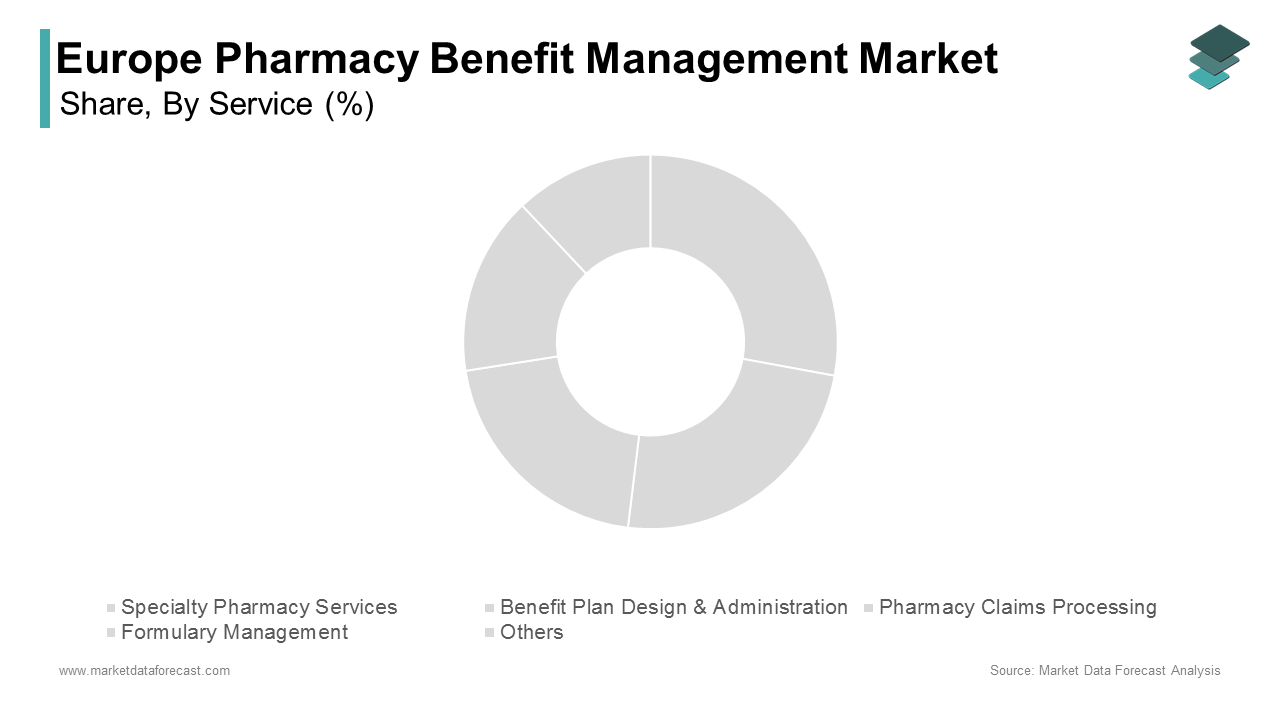
The specialty pharmacy segment is likely to grow with an expected CAGR of 14.8% from 2026 to 2034, with the rapid uptake of biologics, cell and gene therapies, and orphan drugs that require complex handling, patient monitoring, and reimbursement navigation. Countries like the Netherlands have established dedicated hospital-based specialty pharmacies that coordinate cold chain logistics, nurse training, and adherence support for therapies such as CAR T cell treatments. The demand for specialized PBM infrastructure to manage access, safety, and cost effectiveness will continue to drive this segment’s exceptional growth trajectory.
By Service Provider Insights
The insurance companies segment was the largest by accounting for the Europe pharmacy benefit management market with 58.3% of share in 2025 due to its dual role as risk bearers and benefit administrators in both statutory and private health schemes. In countries with social health insurance models, such as Germany and France, sickness funds directly manage drug formularies, negotiate manufacturer rebates, and operate electronic claims adjudication systems. Germany’s statutory health insurers collectively process over 1.2 billion outpatient prescriptions annually, as per the National Association of Statutory Health Insurance Funds. Even in tax-funded systems like Sweden, private insurers offering supplementary coverage increasingly incorporate pharmacy benefit tools to control costs. As per the European Commission’s Social Protection Committee, 73 % of EU health insurers now use real-time electronic prescribing interfaces that enforce formulary compliance at the point of care. This institutional integration allows insurers to align pharmaceutical spending with broader risk management and preventive care strategies by making them the natural stewards of PBM activities across most European health ecosystems.
The standalone segment is expected to register the fastest CAGR of 16.3% throughout the forecast period with a surge reflecting the increasing complexity of pharmaceutical benefits and the need for specialized third-party expertise beyond traditional insurer capabilities. While historically rare in Europe due to public system dominance, standalone PBMs are emerging to serve multinational employers, private health insurers, and cross-border health schemes requiring pan-European coordination. Companies like Alcura in the UK and Pharmera in Germany now offer end-to-end PBM platforms that integrate claims processing, specialty drug distribution, and adherence analytics for corporate clients. Additionally, the European Commission’s Cross-Border Healthcare Directive has created demand for neutral PBM entities that can adjudicate prescriptions across jurisdictions while complying with diverse national rules.
REGIONAL ANALYSIS
Germany Pharmacy Benefit Management Market Analysis
Germany was the top performer in the Europe pharmacy benefit management market with 26.3% of the share in 2025, with its decentralized yet highly structured social health insurance system, where over 100 sickness funds independently manage pharmaceutical benefits under federal oversight. The introduction of the E-prescription mandate in 2023 requires all statutory prescriptions to be issued electronically by 2026. As per the National Association of Statutory Health Insurance Physicians, more than 80 % of general practitioners now use integrated prescribing platforms that auto-apply formulary rules and rebate eligibility. The AMNOG law further empowers benefit managers by linking drug reimbursement to proven added therapeutic benefit.
France Pharmacy Benefit Management Market Analysis
France was positioned second in the European pharmacy benefit management market with a 21.3% share in 2025. The nation’s centralized system grants the state unparalleled control over drug pricing, reimbursement, and prescribing behavior through its “Tarif de Responsabilité” and “Liste en Sus” mechanisms. As per the French Ministry of Solidarity and Health, this system reduced out-of-pocket drug spending by 23 % between 2019 and 2023. France also mandates generic substitution unless explicitly prohibited by the prescriber by achieving a 72 % generic dispensing rate in 2023 according to the National Agency for Medicines and Health Products Safety.
United Kingdom Pharmacy Benefit Management Market Analysis
The United Kingdom pharmacy benefit management market growth is likely to have steady growth opportunities throughout the forecast period. The UK has developed sophisticated PBM functions through regional Clinical Commissioning Groups and the national Drug Tariff system. As per the National Institute for Health and Care Excellence, its technology appraisals result in managed access agreements that include usage criteria and data collection requirements. The recent rollout of the Electronic Prescription Service now covers English pharmacies by enabling real-time checks for high-cost drugs and controlled substances.
Italy Pharmacy Benefit Management Market Analysis
The Italian pharmacy benefit management market growth is likely to grow with a prominent CAGR in next coming years. The regional health authorities further refine national formularies based on local epidemiology and budgets by resulting in a hybrid centralized-decentralized model. Italy has also pioneered managed entry agreements. The national e-prescription system, operational in all 20 regions since 2022 that enables the real-time application of therapeutic alternatives and co-payment rules.
Spain Pharmacy Benefit Management Market Analysis
Spain's pharmacy benefit management market growth is likely to be driven by its autonomous community model, where 17 regional governments manage pharmaceutical benefits within a national pricing and reference framework. Nationally, Spain employs external reference pricing against nine EU countries, ensuring competitive drug costs, while its “Vademécum Electrónico” provides real-time formulary and pricing data to prescribers.
COMPETITION OVERVIEW
Competition in the Europe pharmacy benefit management market is shaped by a hybrid ecosystem where public health authorities, private insurers, and specialized service providers coexist with distinct yet overlapping roles. Unlike the consolidated US PBM model, Europe lacks dominant standalone players, resulting in a fragmented but highly contextual competitive landscape. Statutory sickness funds in Germany and France inherently perform core PBM functions, limiting commercial opportunities, whereas in the UK and the Netherlands, private insurers and third-party administrators fill gaps in supplementary and employer-sponsored coverage. Competition centers not on scale but on integration depth. Firms differentiate through interoperability with national digital health infrastructures, clinical credibility with prescribers, and agility in managing specialty pharmaceuticals. Regulatory alignment is a key battleground, as players must navigate 27 distinct reimbursement regimes while pursuing pan-European service models. Innovation focuses on real-world data utilization, adherence enhancement, and value-based contracting, with success hinging on public-private collaboration rather than market dominance.
KEY MARKET PLAYERS
A few dominating players in the Europe pharmacy benefit management market include
- Optum (UnitedHealth)
- CVS Health Caremark
- Express Scripts (Evernorth / Cigna)
- Prime Therapeutics
- Humana Pharmacy Solutions
- MedImpact Healthcare
- CarelonRx (Elevance Health)
- Change Healthcare / Optum services
- Cegedim (healthcare IT/databases)
- Alliance Healthcare (distribution & services)
- Vidalink
- Sea Rainbow
- Cachet
Top Strategies Used by the Key Market Participants
Key players in the Europe pharmacy benefit management market prioritize deep integration with national e-prescription and electronic health record systems to enforce formulary compliance at the point of care. They actively collaborate with public health technology assessment bodies to align private benefit designs with national therapeutic guidelines. Companies invest in specialty pharmacy infrastructure to manage high-cost biologics and gene therapies requiring complex logistics and patient support. They deploy AI-driven analytics to identify prescribing outliers and promote generic or biosimilar substitution where clinically appropriate. Firms also develop cross-border PBM platforms to serve multinational employers and expatriate populations under unified benefit rules. Additionally, they embed real-time co-payment calculators and prior authorization workflows into clinician portals to reduce administrative friction. Strategic partnerships with community and hospital pharmacies further extend their operational reach and clinical credibility across diverse healthcare settings.
Leading Players in The Europe Pharmacy Benefit Management Market
AXA Health
AXA Health, a subsidiary of the global insurance giant AXA Group, plays a pivotal role in Europe’s pharmacy benefit management landscape through its integrated private health plans and digital health platforms. Operating primarily in the UK, France, and Germany, the company embeds PBM functionalities such as formulary compliance, prior authorization, and specialty drug coordination directly into its insurance workflows. In 2025, AXA Health launched a European digital pharmacy hub that connects prescribers, pharmacists, and patients across its network by enabling real-time benefit verification and adherence support. The platform also integrates with national e-prescription systems to ensure regulatory alignment. AXA Health enhances medication access while controlling costs by extending its PBM influence beyond Europe through knowledge transfer to emerging markets in Asia and Latin America.
Allianz Care
Allianz Care, the international health insurance arm of Allianz SE, delivers pharmacy benefit management services to multinational corporations, expatriates, and high-net-worth individuals across more than 190 countries, with a strong operational base in France, Switzerland, and the Netherlands. The company utilizes a centralized global formulary informed by European health technology assessments to standardize drug coverage while accommodating local reimbursement rules. This company also partnered with European specialty pharmacies to streamline access to orphan drugs for its clients.
Alcura Health
Alcura Health, headquartered in the United Kingdom, is a specialized provider of home-based pharmacy and PBM services focused on complex and long-term medication regimens. The company manages end-to-end pharmaceutical care for patients with conditions such as multiple sclerosis, cystic fibrosis, and oncology, integrating benefit verification, delivery logistics, and clinical monitoring. It also launched a dedicated PBM analytics unit to support employer-sponsored health schemes in optimizing drug spend. Alcura’s deep integration with the UK’s National Health Service and its scalable care model have attracted interest from European health systems seeking to outsource specialty pharmacy management, which is positioning it as a niche but influential player with growing international advisory engagements.
MARKET SEGMENTATION
This research report on the Europe pharmacy benefit management market has been segmented and sub-segmented based on service, service provider, and region.
By Service
- Specialty Pharmacy Services
- Benefit Plan Design & Administration
- Pharmacy Claims Processing
- Formulary Management
- Others
By Service Provider
- Insurance Companies
- Retail Pharmacies
- Standalone PBMs
By Region
- UK
- France
- Spain
- Germany
- Italy
- Russia
- Sweden
- Denmark
- Switzerland
- Netherlands
- Turkey
- Czech Republic