- Product Description Description
- Table of Contents TOC
- List of Table & Figure LOT
- Get Free Sample PDF Sample PDF
Market Size, 2025
$2.57 BnMarket Estimate, 2026
$2.83 BnMarket Forecast, 2034
$6.08 BnCAGR, 2026–2034
10.03%Europe Plastic Pallets Market Size, Growth, Trends & Forecast (2026–2034)
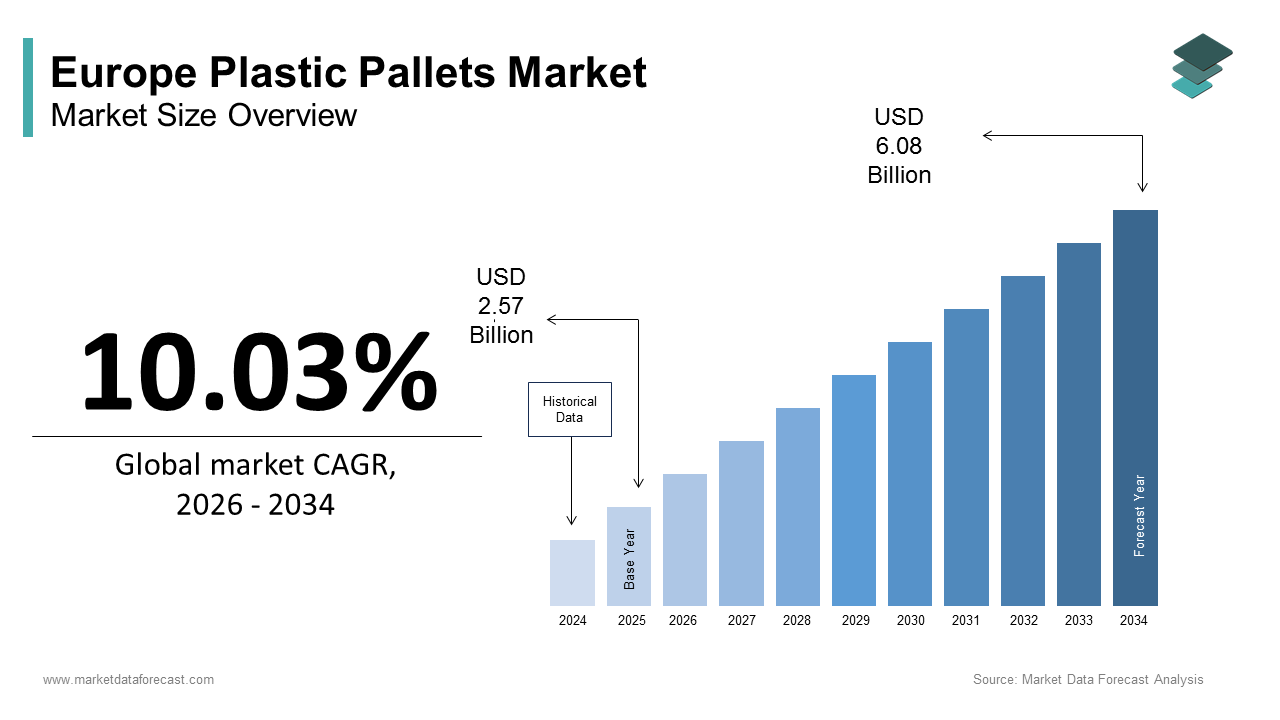
The Europe plastic pallets market size was calculated to be USD 2.57 billion in 2025, is anticipated to reach USD 2.83 billion in 2026, and is projected to be worth USD 6.08 billion by 2034, growing at a robust CAGR of 10.03% during the forecast period from 2026 to 2034. Driven by circular economy mandates, exponential e-commerce expansion, and the rising demand for hygienic, automated-ready cold chain logistics, the market continues to exhibit accelerated growth across Europe.
Key Executive Metrics (At-a-Glance)
- 2025 Base Valuation: USD 2.57 Billion
- 2026 Current Valuation: USD 2.83 Billion
- 2034 Forecast Valuation: USD 6.08 Billion
- Compound Annual Growth Rate (CAGR): 10.03% (2026–2034)
- Dominant Material Type Segment: High-Density Polyethylene (HDPE)
- Fastest-Growing Material Type Segment: Recycled Polypropylene (rPP) (CAGR of 9.4%)
- Dominant Pallet Type Segment: Rackable Pallets (42.3% share in 2024)
- Fastest-Growing Pallet Type Segment: Nestable Pallets (CAGR of 11.2%)
- Dominant End User Segment: Food and Beverage (54.3% share in 2024)
- Fastest-Growing End User Segment: Pharmaceuticals (CAGR of 13.1%)
- Dominant Regional Market: Germany (22.3% share in 2024)
Core Market Drivers
- Circular Economy Mandates: EU regulations requiring reusable and recyclable packaging by 2030 are accelerating corporate transitions to closed-loop plastic pallet systems.
- E-Commerce & Cold Chain Growth: High-velocity distribution and temperature-sensitive biopharmaceutical logistics require dimensional stability and IoT-compatible plastic assets.
Primary Market Restraints & Challenges
- High Initial Capital Outlay: Substantial upfront cost differentials between plastic and wooden pallets deter small and medium-sized enterprises (SMEs).
- Fragmented Waste Management: Inconsistent municipal recycling infrastructure across different European states creates challenges for end-of-life recovery and compliance.
Europe Plastic Pallets Market Classification Breakdown
| Segment Category | Largest Segment | Fastest-Growing Segment |
|---|---|---|
| By Material Type | High-Density Polyethylene (HDPE) | Recycled Polypropylene (rPP) (CAGR of 9.4%) |
| By Pallet Type | Rackable Pallets (42.3% share) | Nestable Pallets (CAGR of 11.2%) |
| By End User | Food and Beverage (54.3% share) | Pharmaceuticals (CAGR of 13.1%) |
| By Region | Germany (22.3% share) | United Kingdom & Netherlands (Logistics hubs & strict tax/recycling frameworks) |
Major Industry Players Profiled
Key market participants include Schoeller Allibert, Craemer Group, ORBIS Corporation, CABKA Group, CHEP (Brambles Limited), Greystone Logistics, Rehrig Pacific Company, and Faber Halbertsma Group.
Europe Plastic Pallets Market Size
The Europe plastic pallets market size was calculated to be US 2.57 billion in 2025 and is anticipated to be worth USD 6.08 billion by 2034, growing from USD 2.83 billion in 2026 at a CAGR of 10.03% during the forecast period.
Plastic pallets serve as integral components of modern logistics infrastructure, engineered from high-density polyethylene or polypropylene to support efficient material handling across sectors such as food and beverage, pharmaceuticals, automotive, and e-commerce. Unlike traditional wooden alternatives, plastic pallets offer enhanced durability, resistance to moisture and microbial contamination, and compliance with international shipping standards, including ISPM 15. Their closed-loop design facilitates hygiene-critical applications, particularly in regulated industries where product safety is non-negotiable. According to Eurostat, the European Union generated approximately 50 million tonnes of plastic waste in 2023, underscoring growing scrutiny on plastic usage despite the recyclability of industrial products like pallets. The European Environment Agency noted that over 75% of logistics operations within the EU now prioritize reusable packaging solutions as part of circular economy mandates. This regulatory and operational shift positions plastic pallets not merely as transport tools but as strategic assets aligned with sustainability frameworks and digital supply chain integration across the continent.
MARKET DRIVERS
Regulatory Alignment with Circular Economy Principles Drives Adoption
The European Union’s Circular Economy Action Plan has profoundly influenced packaging and logistics standards by creating a structural tailwind that is propelling the growth of Europe's plastic pallets market. Under this framework, the European Commission mandated that by 2030, all plastic packaging placed on the EU market must be reusable or recyclable in an economically viable manner. Plastic pallets, often manufactured with up to 100% recycled content and designed for hundreds of reuse cycles, directly align with this objective. According to the European Plastics Converters association, reusable plastic packaging systems reduce single-use waste by as much as 85% over a five year lifecycle compared to disposable alternatives. In the food and pharmaceutical sectors, where hygiene and traceability are paramount, the European Food Safety Authority has endorsed closed-loop plastic pallet systems for minimizing cross-contamination risks. Germany alone reported that over 60% of its cold chain logistics operators transitioned to food-grade recyclable plastic pallets between 2020 and 2024 as part of national sustainability compliance protocols. This emergence of regulatory pressure, corporate environmental targets, and operational efficiency has institutionalized plastic pallet adoption across continental supply networks, transforming them from passive logistics tools into active enablers of circularity.
Expansion of E-Commerce and Cold Chain Logistics Elevates Demand
The exponential growth of e-commerce and temperature-sensitive logistics has intensified demand for standardized, durable, and hygienic plastic pallets. The expansion of e-commerce and cold chain logistics is escalating the growth of Europe plastic pallet market. Eurostat data indicates that online retail sales in the EU reached 145 billion euros in 2024, representing a compound annual growth rate of 9.2% since 2020. This surge necessitates high-velocity distribution systems where plastic pallets outperform wood in dimensional stability, weight consistency, and compatibility with automated sortation and robotic handling. Simultaneously, the cold chain logistics sector has expanded rapidly, with the European Cold Chain Federation reporting that refrigerated transport volumes grew by 12% annually between 2021 and 2024, driven by demand for perishable foods and biopharmaceuticals. Plastic pallets are inherently suited for these environments due to their resistance to condensation, corrosion, and microbial ingress. In the Netherlands, a hub for European pharma distribution, over 80% of vaccine and insulin shipments now rely exclusively on ISO compliant plastic pallets to meet GDP Good Distribution Practice standards. This dual acceleration in e-commerce velocity and cold chain complexity has rendered plastic pallets indispensable to supply chain reliability, safety, and scalability across Western and Central Europe.
MARKET RESTRAINTS
High Initial Capital Investment Deters Small and Medium Enterprises
The elevated upfront cost for small and medium-sized enterprises is degrading the growth of Europe plastic pallet market. A standard new plastic pallet typically costs between 40 and 80 euros, compared to 8 to 15 euros for a wooden counterpart, representing a 4 to 6 fold initial outlay. According to the European Commission’s SME Observatory, over 93% of logistics and warehousing firms in the EU are classified as SMEs, with limited access to capital for asset-intensive sustainability upgrades. In countries like Romania and Greece, where SMEs constitute more than 98% of total businesses, budget constraints often override lifecycle cost considerations. Consequently, many continue using wooden pallets despite higher replacement frequency and sanitation risks. This financial asymmetry not only slows market penetration but also fragments supply chain standardization, as mixed pallet fleets complicate automation and data tracking.
Fragmented Waste Management Infrastructure Limits End-of-Life Recycling
Although plastic pallets are technically recyclable, inconsistent municipal and industrial waste management systems undermine their circular potential and deter environmentally conscious adopters, which is also inhibiting the growth of Europe plastic pallet market. Germany and the Netherlands achieve collection and reprocessing rates above 65% for rigid industrial plastics, whereas countries like Bulgaria and Latvia report rates below 15% due to underdeveloped sorting facilities and limited regional reprocessing capacity. Moreover, contamination from mixed polymer streams or embedded metal fasteners in damaged pallets further reduces recyclability. Without harmonized EU-wide collection schemes for industrial plastic assets, end-of-life management remains ad hoc, eroding the environmental credibility of plastic pallets in sustainability audits. This systemic gap contradicts the EU’s Packaging and Packaging Waste Regulation objectives and represents a critical restraint on market growth in regions where circularity claims must be demonstrably verified.
MARKET OPPORTUNITIES
Integration of Smart Logistics Technologies Unlocks New Value Streams
The emergence of plastic pallets with embedded digital technologies across Europe’s evolving supply chains is expected to create new opportunities for the growth of Europe's plastic pallet market. Unlike wood, plastic pallets can seamlessly integrate RFID tags, QR codes, and lightweight IoT sensors without compromising structural integrity. According to the European Logistics Association, over 35% of Tier 1 logistics operators in Western Europe are piloting smart pallet programs to enable real-time tracking, load condition monitoring, and automated inventory reconciliation. Similarly, the German retail consortium EHI reported that automated warehouses using digitally enabled plastic pallets achieved 22% higher throughput due to precise identification and reduced manual handling errors. The European Commission’s Digital Product Passport framework, set for phased implementation from 2026, further incentivizes such integration by mandating traceability for reusable transport items. As Industry 4.0 accelerates, plastic pallets are evolving from passive carriers to data-rich assets, which is creating value beyond physical utility and opening premium service models for pallet pooling and performance-based leasing.
Growth of Pallet Pooling Services Enhances Accessibility and Sustainability
The pallet pooling systems, where standardized plastic pallets are shared across multiple supply chain participants under managed service contracts, are gaining significant traction in Europe as a capital-light and eco-efficient solution. The growth of pallet pooling services is expected to elevate the growth of Europe plastic pallet market. CHEP and LPR Europe, the continent’s leading pooling operators, reported a combined fleet of over 200 million plastic and composite pallets in circulation by 2024, with plastic variants growing at 11% annually. According to the European Federation of Transport and Logistics Pallet Users, pooled plastic pallets achieve an average of 60 rotations before retirement, far exceeding the typical 5 to 10 uses of single company wooden pallets. In France, a 2023 decree under the Anti-Waste for a Circular Economy Law now requires large retailers to prioritize pooled reusable packaging, directly boosting demand for service-based plastic pallet access. Spain’s Ministry for Ecological Transition further noted that pooled systems reduce CO2 emissions by up to 30% per pallet kilometer compared to single-use alternatives. This model decouples usage from ownership, allowing even small distributors to benefit from high-quality, trackable, and compliant pallets without upfront investment.
MARKET CHALLENGES
Volatility in Polymer Feedstock Prices Impacts Cost Predictability
The fluctuations in virgin and recycled polymer resin prices, which directly affect manufacturing costs and pricing stability is one of the challenges for the growth of Europe plastic pallets market. High-density polyethylene and polypropylene, the primary materials used in plastic pallet production, are derived from fossil fuels and thus subject to crude oil and natural gas. Although recycled content offers some insulation, the supply of food-grade post-consumer recycled polyolefins remains constrained. Plastics Europe reported that only 18% of collected plastic waste in 2023 met the purity and performance standards required for industrial reuse in rigid applications like pallets. This scarcity forces manufacturers to blend virgin resin, exposing them to energy market shocks. For instance, the 2022 energy crisis in Europe caused resin costs to spike by 40% in one quarter alone, compressing margins for pallet producers and triggering price increases that disrupted procurement planning for logistics buyers.
Competition from Advanced Composite and Bio-Based Alternatives Threatens Market Share
Emerging materials, such as bio composites, molded fiber, and hybrid bamboo polymer constructions, are increasingly capturing a niche, which is also limiting the growth of Europe plasric pallets market. Driven by corporate net zero commitments and stricter chemical safety regulations, these alternatives appeal to sustainability-driven procurement departments despite higher costs or performance trade-offs. In 2023, IKEA announced a pilot using wheat straw composite pallets for intra-EU furniture shipments, citing a 50% lower carbon footprint than conventional plastic. Similarly, the Dutch company Ecopal introduced a flax fiber reinforced bio pallet certified for use in organic food logistics under EU Regulation 2018 848. Although these materials currently represent less than 3% of the total pallet market, as per the European Pallet Association, their symbolic appeal in ESG reporting and alignment with the EU Green Deal’s bioeconomy strategy pose a long-term substitution threat. Traditional plastic pallet manufacturers must now contend not only with cost but with evolving definitions of sustainability that may favor rapidly renewable or biodegradable feedstocks, even if their mechanical performance lags.
REPORT COVERAGE
| REPORT METRIC | DETAILS |
| Market Size Available | 2025 to 2034 |
| Base Year | 2025 |
| Forecast Period | 2026 to 2034 |
| CAGR | 10.03% |
| Segments Covered | By Material Type, Pallet Type, End User And Region |
| Various Analyses Covered | Global, Regional & Country Level Analysis; Segment-Level Analysis; DROC, PESTLE Analysis; Porter’s Five Forces Analysis; Competitive Landscape; Analyst Overview of Investment Opportunities |
| Regions Covered | UK, France, Spain, Germany, Italy, Russia, Sweden, Denmark, Switzerland, Netherlands, Turkey, and the Czech Republic |
| Market Leaders Profiled | Schoeller Allibert, Craemer Group, ORBIS Corporation, CABKA Group, CHEP, Greystone Logistics, Rehrig Pacific Company, and Faber Halbertsma Group |
SEGMENTAL ANALYSIS
By Material Type Insights
The high-density polyethylene segment accounted for a prominent share of the Europe plastic pallets market in 2024. The growth of the segment is driven by its optimal balance of mechanical strength, chemical resistance, and recyclability. Unlike alternative polymers, HDPE maintains structural integrity under repeated heavy loads and extreme temperature fluctuations, making it ideal for cold chain and pharmaceutical logistics. According to the European Chemicals Agency, over 70% of reusable industrial containers in the EU food sector are manufactured from HDPE due to its compliance with Regulation EC 1935 2004 on food contact materials. Additionally, HDPE’s compatibility with existing recycling streams enhances its appeal under the EU’s Extended Producer Responsibility schemes. This lifecycle efficiency, coupled with stable melt flow properties during regranulation, ensures HDPE remains the material of choice for both pallet manufacturers and logistics operators seeking circular economy alignment.
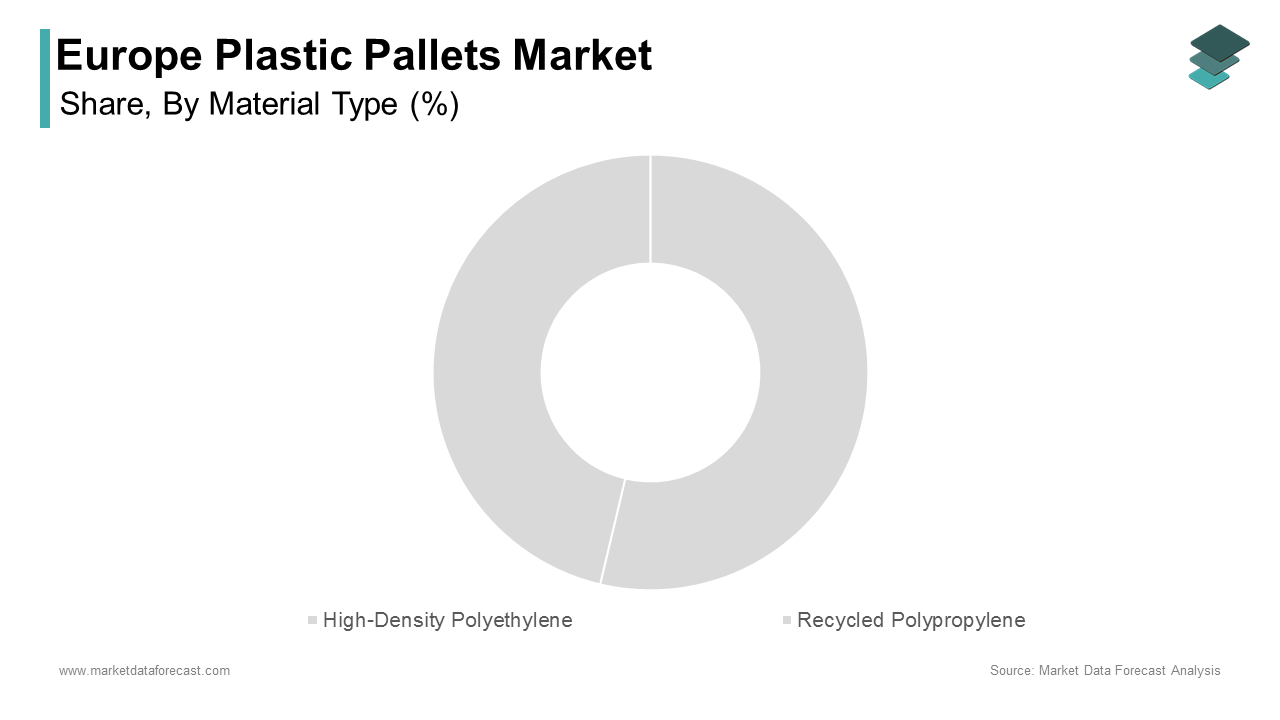
The recycled polypropylene segment is likely to grow with an anticipated CAGR of 9.4% during the forecast period, owing to the tightening EU regulations on virgin plastic use and corporate net-zero procurement mandates. The European Commission’s Packaging and Packaging Waste Regulation requires that all plastic packaging contain at least 30% recycled content by 2030, directly boosting demand for certified rPP. In 2023, the Netherlands launched the Pallet Circularity Initiative, which mandated that all public sector logistics contracts prioritize pallets made with a minimum of 50% post consumer rPP. Furthermore, advancements in sorting and decontamination technologies have improved rPP purity levels to over 98% by enabling food-safe applications, a breakthrough previously limited to virgin resins. Companies like Berry Global and Suez have scaled rPP pellet production in France and Belgium, reducing regional supply gaps. This emergence of regulatory pressure, technological progress, and procurement policy shifts is propelling recycled polypropylene beyond niche status into mainstream industrial adoption.
By Pallet Type Insights
The rackable pallets segment was the largest by capturing 42.3% of the Europe plastic pallets market share in 2024. According to the German Engineering Federation VDMA, over 78% of new logistics centers constructed in Western Europe since 2021 feature automated storage and retrieval systems that require pallets with uniform load-bearing capacity exceeding 1,500 kilograms. Rackable plastic pallets meet this demand with steel reinforced frames or integrated ribbing that prevents deflection under static loads, unlike wood, which can warp or splinter. In Sweden, the Work Environment Authority updated warehouse safety guidelines in 2023 to mandate rack-certified pallets in facilities handling goods above 8 meters, directly increasing adoption. Furthermore, the European Committee for Standardization’s EN 12469 standard for reusable transport items specifies dimensional tolerances that only injection-molded rackable plastic pallets consistently achieve. These regulatory, technical, and operational factors collectively cement rackable pallets as the backbone of Europe’s high-density storage infrastructure.
The nestable pallets segment is anticipated to grow at a CAGR of 11.2% throughout the forecast period, with the need to reduce return logistics costs and optimize trailer space utilization, particularly in e-commerce and retail replenishment networks. When empty, nestable designs collapse vertically, allowing up to 70% more units per return truckload compared to standard stackable variants. France’s Green Freight Program, launched in 2024, offers tax incentives to logistics firms that reduce empty miles by at least 25%, directly benefiting operators using nestable systems. Additionally, the rise of just-in-time delivery models in Southern Europe has increased demand for lightweight pallets that minimize fuel consumption. Nestable HDPE variants weigh between 12 and 18 kilograms, nearly 30% lighter than rackable equivalents.
By End User Insights
The Food and Beverage industry held 54.3% of the Europe plastic pallet market share in 2024, owing to the stringent hygiene regulations, supply chain digitization, and the sector’s reliance on cold chain integrity. Plastic pallets are non-porous, easily sanitized, and resistant to bacterial colonization, attributes mandated under the EU’s Hygiene Package for food contact surfaces. The European Food Safety Authority confirmed in 2023 that wooden pallets were implicated in 12% of cross-contamination incidents in fresh produce supply chains, accelerating the shift to plastic. Moreover, large retailers, including Aldi and Tesco, now require suppliers to use RFID-enabled plastic pallets to comply with traceability protocols under the Digital Product Passport framework. Germany alone processes over 17 million tonnes of perishable food annually through temperature-controlled distribution centers, nearly all of which mandate ISO 18601-compliant plastic pallets. The integration of food safety, automation readiness, and regulatory enforcement has made plastic pallets non-negotiable in this sector, solidifying their position as the anchor end user.
The Pharmaceuticals segment is the fastest-growing end user in the Europe plastic pallets market, projected to expand at a compound annual growth rate of 13.1% from 2024 to 2030 as per the European Medicines Agency. This surge is propelled by Good Distribution Practice requirements, vaccine cold chain expansion, and serialization mandates under the Falsified Medicines Directive. Unlike other industries, pharmaceutical logistics demand pallets that maintain dimensional stability between minus 25 and plus 40 degrees Celsius without off-gassing or absorbing cleaning agents. The European Directorate for the Quality of Medicines reported that 91% of GDP inspected warehouses in 2024 rejected wooden pallets due to splintering and moisture retention risks. Additionally, the rollout of mRNA-based vaccines and biologics, which require continuous temperature monitoring, has increased demand for pallets with embedded IoT sensors. In Switzerland, Novartis and Roche jointly standardized on high-purity HDPE pallets with integrated QR codes for batch-level tracking across their EU distribution network.
REGIONAL ANALYSIS
Germany Plastic Pallets Market Analysis
Germany was the top performer of the Europe plastic pallets market by capturing 22.3% of the market share in 2024 with its advanced manufacturing base, stringent environmental legislation, and dense logistics network. The Circular Economy Act of 2023 further accelerated adoption by mandating reusable packaging for all B2B shipments originating from companies with over 250 employees. Simultaneously, Germany’s dual system for packaging waste is operated by organizations like Interseroh that achieved a 74% collection rate for industrial HDPE in 2024 by enabling closed-loop recycling. Major automotive and food producers, including BMW and Nestle, have deployed over 2 million pooled plastic pallets in national supply chains, thereby reducing pallet-related damage claims by 31%.
France Plastic Pallets Market Analysis
France's plastic pallets market was ranked second by holding 15.8% of the market share in 2024, owing to the aggressive circular economy policies and a concentrated retail sector that enforces strict packaging standards. The Anti-Waste for a Circular Economy Law of 2020 banned single-use wooden pallets in large retail supply chains from 2023 onward, directly shifting demand toward reusable plastic alternatives. Carrefour and Auchan alone mandated the use of pooled HDPE pallets across their 4 200 supplier networks, resulting in a 40% reduction in pallet-related disposal costs. Additionally, France’s logistics carbon tax, introduced in 202,2 penalizes freight operators using non-optimized return systems, incentivizing nestable and stackable plastic designs. According to the French Environment and Energy Management Agency, plastic pallet pooling reduced CO2 emissions by 210 000 tonnes annually in the food distribution sector alone.
United Kingdom Plastic Pallets Market Analysis
The United Kingdom plastic pallets market growth is likely to grow at the fastest CAGR in the coming years. Tesco’s 2023 Packaging Pledge required all tier one suppliers to transition to 100% reusable or recyclable transport packaging by 2025, directly benefiting plastic pallet providers. The UK also hosts Europe’s second-largest pharmaceutical export hub, with over 60% of vaccine shipments from Wockhardt and AstraZeneca relying on GMP-certified plastic pallets. The Department for Environment, Food and Rural Affairs reported that plastic pallet reuse rates in the chilled food sector exceeded 85 cycles per unit in 2024, far surpassing continental averages. Moreover, the UK Plastics Tax, levied at 210 pounds per tonne on packaging with less than 30% recycled content, has accelerated the use of rHDPE pallets.
Italy Plastic Pallets Market Analysis
Italy's plastic pallets market growth is driven by its export-oriented food industry and Mediterranean logistics gateway status. The Italian Ministry of Agricultural, Food, and Forestry Policies mandated in 2023 that all perishable exports to non-EU countries use closed-loop plastic pallets to prevent phytosanitary rejections. Additionally, the expansion of the Gioia Tauro and Trieste ports, handling 22% of EU Mediterranean container traffic, has increased demand for durable pallets resistant to salt air corrosion. A 2024 study by the Politecnico di Milano found that plastic pallet adoption in Lombardy’s dairy sector reduced product recalls by 27% due to improved sanitation.
Netherlands Plastic Pallets Market Analysis
The Netherlands plastic pallets market growth is likely to grow with its role as Europe’s logistics nerve center, home to the Port of Rotterdam, where the continent’s largest and a dense network of pharma and agritech distribution hubs. The Netherlands Enterprise Agency reported that 95% of new warehouse constructions in 2023 included automated guided vehicle systems requiring pallets with millimeter-level dimensional accuracy, exclusively achievable with injection-molded plastic. Furthermore, the Dutch government’s Circular Plastics NL program has funded over 200 million euros in recycling infrastructure since 2021, ensuring a stable supply of food-grade rHDPE. Companies like Jumbo and Albert Heijn now mandate smart plastic pallets with digital twins for real-time inventory tracking across their Benelux networks.
COMPETITION OVERVIEW
Competition in the Europe plastic pallets market is characterized by a mix of global pooling giants, regional manufacturers, and specialized recyclers vying for dominance across diverse end-user sectors. The market features high entry barriers due to capital intensity, regulatory complexity, and the need for extensive service networks, yet it remains dynamic owing to rapid innovation in material science and digital logistics. Players differentiate through lifecycle durability, digital capabilities, sustainability credentials, and sector-specific compliance, such as GDP for pharmaceuticals or HACCP for food. Price competition is moderate as buyers increasingly prioritize the total cost of ownership over the upfront cost. Strategic partnerships, recycling infrastructure, control, and automation readiness now define competitive advantage more than volume scale alone, reinforcing a shift toward integrated value-added offerings rather than commodity supply.
KEY MARKET PLAYERS
A few major players of the Europe plastic pallets market include
- Schoeller Allibert
- Craemer Group
- ORBIS Corporation
- CABKA Group
- CHEP
- Greystone Logistics
- Rehrig Pacific Company
- Faber Halbertsma Group
Top Strategies Used by the Key Market Participants
Key players in the Europe plastic pallets market primarily adopt strategies centered on digital integration, sustainability enhancement, and service model innovation. Companies are embedding RFID and IoT technologies into pallets to enable real-time tracking and condition monitoring, aligning with Industry 4.0 trends. They are increasing the use of certified recycled resins to comply with EU packaging regulations and corporate ESG targets. Pallet pooling and leasing models are being expanded to reduce customer capital expenditure and improve asset utilization. Strategic collaborations with logistics providers, retailers, and waste recyclers are also common to ensure closed-loop systems and strengthen regional supply chain integration across diverse European markets.
Leading Players in the Market
- Brambles Limited operates globally through its CHEP brand and is a dominant force in reusable packaging solutions, including plastic pallets, across Europe. The company manages one of the world’s largest pooling platforms, facilitating circular supply chains for retail food, beverage, and automotive sectors. In recent years, Brambles has intensified its investment in digital pallet tracking, deploying RFID-enabled HDPE pallets across major European logistics corridors. It has also expanded partnerships with pharmaceutical distributors to meet GDP compliance standards and launched closed-loop recycling initiatives in Germany and the Netherlands to enhance feedstock sustainability and align with EU circular economy mandates.
- Meyers Industries Inc supplies engineered plastic pallets tailored for high-performance logistics in Europe with a strong emphasis on automotive and industrial applications. The company leverages injection molding expertise to produce rackable and nestable pallets that meet the stringent dimensional tolerances required by automated warehouses. Recently, Meyers enhanced its European footprint by upgrading production lines in Poland to incorporate food-grade recycled content and launched a smart pallet pilot with a major e-commerce player in France, integrating IoT sensors for real-time condition monitoring and strengthening its value proposition beyond physical durability.
- Rehrig Pacific Company has established a significant presence in the European plastic pallets market through customized reusable packaging solutions for food retail and cold chain logistics. The company emphasizes sustainability by utilizing high percentages of post-consumer recycled resin in its European manufacturing operations. Rehrig introduced a new generation of lightweight nestable pallets designed specifically for EU reverse logistics efficiency and collaborated with waste management firms in Spain and Sweden to create regional take-back programs, ensuring end-of-life recyclability and reinforcing its commitment to circularity and regulatory alignment.
MARKET SEGMENTATION
This research report on the Europe plastic pallets market has been segmented and sub-segmented based on material type, pallet type, end user, and region.
By Material Type
- High-Density Polyethylene
- Recycled Polypropylene
By Pallet Type
- Nestable
- Rackable
- Stackable
- Display/Custom
By End User
- Food and Beverage
- Pharmaceuticals
By Region
- UK
- France
- Spain
- Germany
- Italy
- Russia
- Sweden
- Denmark
- Switzerland
- Netherlands
- Turkey
- Czech Republic
- Rest of Europe