- Product Description Description
- Table of Contents TOC
- List of Table & Figure LOT
- Get Free Sample PDF Sample PDF
Market Size, 2025
$1.19 BnMarket Estimate, 2026
$1.29 BnMarket Forecast, 2034
$2.4 BnCAGR, 2026–2034
8.11%Executive Summary: Europe Preclinical CRO Market
- Market Scope: Comprehensive European preclinical contract research organization (CRO) market analysis covering service categories, end-user segments, national leadership shares, rare disease epidemiological benchmarks, and public research funding frameworks.
- Market Valuation: Valued at USD 1.10 billion (2024), increased to USD 1.19 billion (2025), and forecast to reach USD 2.22 billion by 2033, registering a solid CAGR of 8.11% (2025–2033).
- Primary Growth Drivers: Expanding oncology and rare-disease therapeutic pipelines, rising biopharmaceutical R&D outsourcing trends, and a strong focus on translational research. Key clinical and funding benchmarks include Europe hosting over 6,000 rare diseases affecting ~30 million people (with orphan drug designations growing 12% annually since 2015), Horizon Europe and the European Innovation Council committing over €95 billion (2021–2027) to life sciences innovation, and over 210 new molecular entities entering European preclinical development in 2023 (82% originating from small and mid-sized biotech firms).
Key Market Segment Metrics (2025–2033)
| Category | Leading Segment (2024 Position) | Fastest-Growing Segment |
|---|---|---|
| By Service Type | Toxicology testing (dominated with a 42.3% market share in 2024) | Bioanalysis and drug metabolism/pharmacokinetics / DMPK studies (projected to grow at a 9.4% CAGR) |
| By End User | Biopharmaceutical and pharmaceutical companies (held a significant market share driven by emerging biotech pipelines) | Government and academic research institutes (projected to expand at an 8.1% CAGR) |
| By Therapeutic Area | Oncology and rare-disease preclinical development models | Cell and gene therapy safety and efficacy testing services |
| By Country / Region | Germany (led with 22.3% of the market in 2024, followed by the United Kingdom with 19.2%) | Major European life sciences hubs expanding clinical outsourcing capacity |
Major Market Players & Market Structure
Market Structure: Highly competitive European preclinical CRO landscape featuring multinational clinical research leaders and specialized laboratories competing intensely through strategic corporate acquisitions, expanding Good Laboratory Practice (GLP) compliant facilities, advanced bioanalysis capabilities, implementation of organ-on-a-chip platforms, digital pathology integration, AI-driven toxicology assessment, and specialized safety testing services for cell and gene therapies.
Key Companies: PRA Health Science, Wuxi AppTec, Medpace, Paraxel International Corporation, Laboratory Corporation of America, Envigo, Eurofins Scientific, Charles River Laboratories International, and Pharmaceutical Product Development.
Europe Preclinical CRO Market Size
The Europe Preclinical CRO Market is projected to grow from USD 1.19 billion in 2025 to USD 1.29 billion in 2026 and reach USD 2.40 billion by 2034, registering a CAGR of 8.11% from 2026 to 2034.
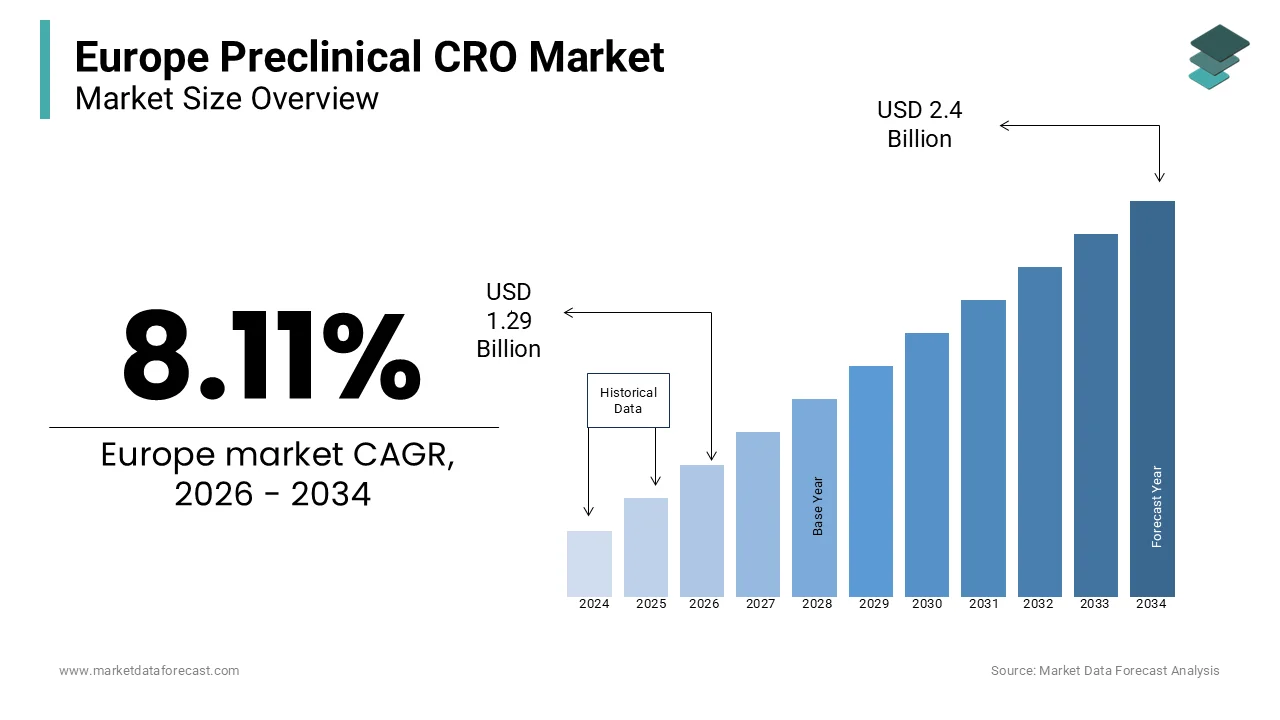
The preclinical contract research organization is a specialized service providers that conduct nonclinical studies, including in vitro and in vivo testing, toxicology, pharmacokinetics, safety pharmacology, and regulatory consulting on behalf of pharmaceutical, biotechnology, and medical device companies. These services are essential for generating data required to support Investigational New Drug applications and first-in-human trials.
MARKET DRIVERS
Rising Investment in Oncology and Rare Disease Therapeutics Drives Demand for Specialized Preclinical Services
The surge in research funding and pipeline expansion for oncology and rare disease therapeutics is majorly propelling the growth of the Europe preclinical contract research organization market. Concurrently, more than 6000 rare diseases affect an estimated 30 million people in the European Union, prompting accelerated regulatory pathways and orphan drug incentives. These incentives have led to a 12 percent annual increase in orphan drug designations since 2015, as documented by the European Medicines Agency. Furthermore, the Innovative Medicines Initiative,e public-private partnership between the European Union and the European Federation of Pharmaceutical Industries and Associations, has allocated over 5 billion euros since 2010 to support translational research in these areas.
Expansion Of Academic And Public-Private Translational Research Networks Creates New Outsourcing Avenues
The proliferation of integrated academic and public-private translational research networks is additionally fuelling the growth of the Europe preclinical contract research organization market. Initiatives such as the European Innovation Council and Horizon Europe have committed over 95 billion euros between 2021 and 2027 to foster innovation in health and life sciences with a strong emphasis on bridging the gap between basic research and clinical application. As per the European Commission, more than 120 translational research centers have been established under these programs, including the German Center for Cardiovascular Research and the UK Dementia Research Institute. These entities often lack in-house capacity for GLP-compliant toxicology or pharmacokinetic studies, yet require rigorous preclinical validation to advance candidates toward first-in-human trials.
MARKET RESTRAINTS
Stringent Regulatory Requirements and Ethical Oversight Increase Operational Complexity
The rigorous regulatory and ethical frameworks, which significantly elevate operational complexity and compliance costs, are restraining the growth of the Europe preclinical contract research organization market. The Directive 2010 63 EU mandates a comprehensive ethical review, project authorization,n and the implementation of the three Rs principles, replacement, reduction, and refinement for all animal-based research. According to the European Commission, 58% of all project authorizations in 2021 underwent full ethical assessment by national committees, reflecting the depth of scrutiny applied. Additionally, the Organisation for Economic Co-operation and Development maintains over 130 Good Laboratory Practice principles that laboratories must adhere to for data to be accepted by regulatory bodies. Compliance with these standards necessitates extensive documentation, staff training, and facility validation. Moreover, the European Chemicals Agency’s implementation of the REACH regulation requires extensive toxicological profiling for industrial chemicals, further expanding the scope of mandated preclinical testing.
Fragmented Regulatory Interpretation Across Member States Increases Compliance Burden
The divergence in the interpretation and implementation of preclinical research regulations across member states imposes a substantial compliance burden on CROs operating regionally. While Directive 2010 63 EU establishes a common framework for the protection of animals used in scientific procedures, each of the 27 member states maintains its own national legislation enforcement mechanisms and ethical review timelines. Similarly, the application of Good Laboratory Practice standards overseen by national GLP compliance monitoring authorities exhibits variability in audit frequency documentation requirements and inspector qualifications as noted in a 2022 assessment by the Organisation for Economic Co-operation and Development. This fragmentation forces multinational CROs to maintain multiple compliance protocols, facility certifications, and legal advisories tailored to each jurisdiction. Harmonization efforts remain hampered by national sovereignty concerns and differing ethical traditions, particularly regarding the use of non-human primates and genetically modified organisms.
MARKET OPPORTUNITIES
Adoption of Advanced In Vitro and In Silico Models Opens High-Value Niche Segments
The accelerating adoption of human-relevant non-animal testing methodologies is creating high-value niche opportunities for technologically advanced preclinical CROs in Europe. As per the Joint Research Centre of the European Commission, over 200 alternative method validation studies have been completed since 2015, with 45 methods formally adopted into OECD test guidelines. These include complex three-dimensional organoid culture,s microphysiological system, and computational toxicology platforms capable of simulating human metabolism and toxicity pathways. CROs that invest in these technologies can command premium pricing along-term contracts from clients seeking to meet regulatory expectations under the European Green Deal’s zero pollution ambition.
Growth in Cell and Gene Therapy Pipelines Demands Specialized Safety Assessment Capabilities
The rapid expansion of cell and gene therapy development in Europe is generating urgent demand for CROs with specialized capabilities in biodistribution, tumorigenicity, immunogenicity, and long-term safety monitoring, which will further fuel the growth of the Europe preclinical contract research organization market. The European Medicines Agency’s Committee for Advanced Therapies has issued specific reflection papers guiding non-clinical development, yet few organizations possess the integrated expertise to execute these complex studies.
MAKET CHALLENGES
Persistent Shortage of Skilled Preclinical Research Personnel Constrains Service Capacity
The lack of qualified professionals with expertise in advanced preclinical methodologies is significantly constraining the growth of the Europe preclinical contract research organization market. This mismatch is particularly acute in emerging domains such as immunotoxicology, gene therapy's safety assessment, and digital pathologywhere hands-on experience is scarce. The situation is exacerbated by the migration of skilled researchers to North America and Asia, where compensation packages and research infrastructure are often more competitive. Moreover, academic curricula across many European countries have been slow to integrate training in Good Laboratory Practice-compliant study design and regulatory documentation, further widening the skills gap. This human capital bottleneck not only delays study initiation and data delivery but also limits the ability of CROs to adopt innovative platforms that require multidisciplinary teams.
High Capital Intensity of Advanced Preclinical Infrastructure Limits Market Entry
The substantial capital investment required to establish and maintain state-of-the-art preclinical research infrastructure presents a formidable barrier to entry and expansion for many CROs, which is also a challenging factor for the growth of the Europe preclinical contract research organization market. Modern preclinical facilities must integrate advanced capabilities such as in vivo imaging systems, telemetry-based cardiovascular monitoring next next-generation sequencing for toxicogenomics, and containment suites for handling advanced therapy medicinal products.
REPORT COVERAGE
| REPORT METRIC | DETAILS |
| Market Size Available | 2025 to 2034 |
| Base Year | 2025 |
| Forecast Period | 2026 to 2034 |
| Segments Covered | By Service Type, End User, and Region. |
| Various Analyses Covered | Global, Regional, and Country-Level Analysis, Segment-Level Analysis, Drivers, Restraints, Opportunities, Challenges; PESTLE Analysis; Porter’s Five Forces Analysis, Competitive Landscape, Analyst Overview of Investment Opportunities |
| Countries Covered | UK, France, Spain, Germany, Italy, Russia, Sweden, Denmark, Switzerland, Netherlands, Turkey, Czech Republic, and the Rest of Europe |
| Market Leaders Profiled | PRA Health Science, Inc., Wuxi AppTec, Medpace, Inc., Paraxel International Corporation, Laboratory Corporation of America, Envigo, Eurofins Scientific, Charles River Laboratories International, Inc., Pharmaceutical Product Development |
SEGMENTAL ANALYSIS
By Service Type Insights
The toxicology testing segment was the largest and held 42.3% of the Europe preclinical CRO market share in 2025. Toxicology Testing remains the largest segment due to its non-negotiable role in regulatory submissions and the increasing complexity of therapeutic modalities requiring comprehensive safety profiling. Furthermore, the rise in biologics and cell and gene therapies has intensified demand for specialized toxicology services such as immunotoxicity and biodistribution assessments.

The bioanalysis and DMPK Studies segment is emerging with a significant CAGR of 9.4% during the forecast period, with the surge in complex modalities such as antibody drug conjugates, bispecific antibodies, nd RNA-based therapeutics, which exhibit non-linear pharmacokinetics and require highly sensitive analytical methods for accurate exposure assessment. Additionally, the European Medicines Agency’s 2022 guideline on bioanalytical method validation has raised the bar for data quality, prompting sponsors to outsource to CROs with ISO 17025-accredited laboratories. The proliferation of microsampling and dried blood spot technologies, which reduce animal use and improve data granularity, has further expanded service scope.
By End User Insights
The biopharmaceutical companies segment held a significant share of the Europe preclinical CRO market in 2025. Biopharmaceutical Companies remain the primary end users due to their extensive pipelines, regulatory obligations, and strategic shift toward asset-light R and D models. In 2023, alone over 210 new molecular entities entered preclinical development in Europe, with 82 percent originating from small and mid-sized biotech firms that lack in-house GLP facilities, as documented by the European Medicines Agency. The rise of venture-backed biotechs, particularly in oncology and rare diseases, has amplified demand for scalable and flexible CRO partnerships.
The government and academic institutes segment is expected to grow with a CAGR of 8.1 over % period with the expansion of publicly funded translational research programs aimed at bridging the valley of death between discovery and clinical validation. Institutions such as the Max Planck Society in Germany and the Francis Crick Institute in the United Kingdom now routinely engage CROs for GLP-compliant toxicology and pharmacokinetic studies to meet regulatory standards for first-in-human trials. A 2023 survey by the League of European Research Universities found that 61 percent of member institutions increased their preclinical outsourcing budget by more than 20 percent year on year.
COUNTRY LEVEL ANALYSIS
Germany Preclinical CRO Market Analysis
Germany was the top performer of the Europe preclinical CRO market by capturing 22.3% of share in 2025. The presence of global pharma headquarters, including Bayer and Merck KG, aA alongside a thriving biotech cluster in Berlin and Munich, generates consistent demand for outsourced preclinical services. Additionally, Germany leads Europe in animal study authorizations with 1.8 million procedures reported in 2022 by the European Commission, reflecting high preclinical activity.
United Kingdom Preclinical CRO Market Analysis
The United Kingdom was positioned second by holding 19.2% of Europe's preclinical CRO market share in 2025. Public investment in life sciences reached 2.1 billion pounds in 2023, according to UK Research and Innovation, supporting translational hubs such as the Cell and Gene Therapy Catapult. The Medicines and Healthcare products Regulatory Agency approved 47 novel therapies in 20,23, the highest in Europe, which correlates with robust preclinical pipeline activity. Academic institutions, including the University of Oxford and Imperial College London, routinely outsource complex safety pharmacology and DMPK studies to specialized CROs.
France Preclinical CRO Market Analysis
France's preclinical CRO market growth is likely to grow with a centralized research ecosystem, strategic national investment, and a growing biotech sector. The France 2030 investment plan allocated 4 billion euros to health innovation, including the creation of ten integrated health research camps, as announced by the Ministry of Higher Education and Research. This initiative has catalyzed partnerships between academic labs and CROs for IND-enabling studies, particularly in oncology and neurodegenerative diseases. France is home to major CROs such as Citoxlab, now part of Charles River,r, and maintains over 60 GLP certified sites, according to data from the French Directorate General for Health.
Italy Preclinical CRO Market Analysis
The Italian preclinical CRO market is substantially to grow substantially in the coming years with the revitalized public investment and regional biotech cluster development. The National Recovery and Resilience Plan allocated 1.2 billion euros to life sciences innovation in 2023, as confirmed by the Ministry of University and Research, focusing on infrastructure modernization and technology transfer. Regions such as Lombardy and Lazio have established biotech parks that integrate startups with CROs for early-stage validation. Italy hosts over 45 GLP-certified laboratories according to the Italian National Institute of Health, with growing expertise in cardiovascular and metabolic disease models. The country’s strong tradition in pharmacology research at institutions like the University of Milan drives demand for outsourced safety pharmacology studies.
COMPETITIVE LANDSCAPE
The Europe preclinical CRO market features intense competition characterized by a mix of global giants and specialized regional players vying for leadership through scientific excellence, operational scale, and technological innovation. Major firms differentiate themselves by offering integrated end-to-end services spanning discovery, toxicology, and regulatory submission support while maintaining strict adherence to Good Laboratory Practice and Directive 2010 63 EU requirements. Competition is further intensified by rising client expectations for human-relevant models, data, transparency, and rapid study turnaround.
KEY MARKET PLAYERS
Companies playing a major role in the Europe preclinical CRO market profiled in this report are
- PRA Health Science, Inc.
- Wuxi AppTec
- Medpace, Inc
- Paraxel International Corporation
- Laboratory Corporation of America
- Envigo, Eurofins Scientific
- Charles River Laboratories International, Inc
- Pharmaceutical Product Development..
TOP LEADING PLAYERS IN THE MARKET
- Charles River Laboratories is a pivotal contributor to the Europe preclinical CRO market, offering comprehensive services spanning discovery, toxicology, and regulatory-compliant safety assessment. The company operates numerous GLP-certified facilities across the United Kingdom, Germany, and France, enabling seamless support for European biopharma clients. In recent years, Charles Riv Charles intensified its focus on integrated drug discovery platforms by acquiring Cognate BioServices to expand capabilities in cell and gene therapy testing. It also launched advanced in vitro safety screening suites in its Edinburgh and Freiburg sites, enhancing throughput for oncology and rare disease programs.
- Evotec SE, headquartered in Hamb,urg Ger, plays a distinctive role by combining edge academic collaboration with industrial-scale preclinical services. The company leverages its proprietary phenotypic screening and organoid platforms to support complex target validation and safety profiling. Evotec has deepened its European footprint through strategic alliances such as the joint venture with Bristol Myers Squibb and the expansion of its Toulouse facility dedicated to DMPK and bioanalysis. It also partnered with the Helmholtz Centre for Infection Research to develop human-relevant infection models.
- Laboratory Corporation of America, through its Covance Preclinical segment, maintains a strong operational presence in Europe with key facilities in Harrogate, United Kingdom, and Munster, Germany. The company provides integrated toxicology, bioanalysis,s, and safety pharmacology services aligned with EMA and FDA requirements. Recently, Labcorp enhanced its European capabilities by investing in digital pathology infrastructure and expanding its gene therapy safety assessment portfolio. It also launched a dedicated rare disease preclinical program in collaboration with European academic consortia.
TOP STRATEGIES USED BY THE KEY MARKET PARTICIPANTS
Key players in the Europe preclinical CRO market employ several core strategies to sustain competitiveness and expand influence. Strategic acquisitions of niche service providers enable rapid capability enhancement, particularly in high-growth areas such as cell and gene therapy safety and advanced bioanalysis. Geographic expansion through new facility construction or upgrades in key hubs like Germany, the United Kingdom,m, and Switzerland ensures proximity to major clients and regulatory bodies. Investment in next-generation technologies, including organ-on-a-chip, digital pathology, and AI-driven toxicology platforms, strengthens scientific differentiation. Long-term partnerships with academic institutions and public research initiatives facilitate early access to novel targets and models.
MARKET SEGMENTATION
This research report on the Europe preclinical CRO market has been segmented and sub-segmented into the following categories.
By Service Type Insights
-
Bioanalysis and DMPK Studies
-
Toxicology Testing
- Other Preclinical Services
By End User Insights
- Biopharmaceutical Companies
- Government and Academic Institutes
- Medical Device Companies
By Country
- UK
- France
- Spain
- Germany
- Italy
- Russia
- Sweden
- Denmark
- Switzerland
- Netherlands
- Turkey
- Czech Republic
- Rest of Europe