- Product Description Description
- Table of Contents TOC
- List of Table & Figure LOT
- Get Free Sample PDF Sample PDF
Market Size, 2025
$4.83 BnMarket Estimate, 2026
$5.23 BnMarket Forecast, 2034
$9.9 BnCAGR, 2026–2034
8.3%Executive Summary: Preclinical CRO Market
- Market Scope: Global preclinical contract research organization (CRO) market analysis covering service types, end-user segments, regional leadership frameworks, and technology adoption metrics.
- Market Valuation: Valued at USD 4.83 billion (2025), estimated at USD 5.23 billion (2026), and projected to reach USD 9.90 billion by 2034, growing at a robust CAGR of 8.30% (2026–2034).
- Primary Growth Drivers: Increasingly complex drug pipelines and high industry outsourcing reliance (>1,500 active global gene and cell therapy clinical trials in 2023 and >90% of investigational new drugs requiring preclinical safety evaluation prior to human trials). Key operational trends include modern technology integration (the U.S. EPA ToxCast program generating toxicity data for >9,000 chemicals and AI models achieving up to 85% accuracy in predicting hepatotoxicity) offset by supply bottlenecks (lead times for specific transgenic rodent models extending to 40 weeks).
Key Market Segment Metrics (2026–2034)
| Category | Leading Segment (2025 Position) | Fastest-Growing Segment |
|---|---|---|
| By Service Type | Toxicology testing (dominated service types with 42.6% market share in 2025) | Bioanalysis and DMPK Studies (projected to grow at a high 12.6% CAGR driven by pharmacokinetic and metabolism profiling needs) |
| By End-User | Biopharmaceutical companies (accounted for 66.3% of market revenue in 2025) | Medical device companies (forecast to expand at an 11.8% CAGR supported by stringent biocompatibility and pre-market testing requirements) |
| By Region | North America (led the global market with 38.2% share in 2025, supported by established GLP infrastructure and robust pipelines, with the FDA approving 55 novel therapeutics in 2023) | Asia-Pacific (identified as the region exhibiting the highest growth momentum driven by expanding research facilities and cost-efficient trial execution) |
Major Market Players & Market Structure
Market Structure: Highly competitive global preclinical CRO landscape featuring 9 prominent market leaders competing on AI-enabled toxicology modeling, advanced bioanalysis, strict GLP compliance, specialized animal and cellular testing models, strategic geographic expansion, cross-border acquisitions, and fully integrated preclinical-to-clinical development capabilities.
Key Companies: Charles River Laboratories International, Laboratory Corporation of America, Envigo, Eurofins Scientific, PRA Health Science, Wuxi AppTec, Medpace, Pharmaceutical Product Development, and Paraxel International.
Global Preclinical CRO Market Size
The Global Preclinical CRO Market is projected to grow from USD 4.83 billion in 2025 to USD 5.23 billion in 2026 and reach USD 9.90 billion by 2034, registering a CAGR of 8.30% from 2026 to 2034.

Preclinical Contract Research Organization (CRO) refers to the specialized entities that support pharmaceutical, biotechnology, and medical device firms in conducting non-clinical studies essential for regulatory submissions and clinical trial initiation. These services span toxicology assessments, pharmacokinetics, safety pharmacology, and exploratory efficacy testing, predominantly in animal models and in vitro systems. As drug development pipelines grow increasingly complex, outsourcing preclinical research has become a strategic imperative to accelerate timelines and ensure regulatory compliance. According to the U.S. Food and Drug Administration, over 90% of investigational new drugs undergo preclinical safety evaluation before entering human trials. Furthermore, approximately 0–50% of drug candidates fail during preclinical phases due to unforeseen toxicity, underscoring the criticality of robust preclinical models. The reliance on specialized expertise and advanced testing platforms has solidified the role of preclinical CROs as integral components of the modern drug development ecosystem.
MARKET DRIVERS
Escalating Complexity of Drug Modalities
The escalating complexity of drug modalities, particularly the rise of biologics, cell and gene therapies, and RNA-based therapeutics, is a pivotal driver of the Preclinical CRO Market. These advanced therapeutic entities require highly specialized preclinical assessment protocols that go beyond conventional small-molecule testing. For instance, gene therapies necessitate long-term biodistribution and tumorigenicity studies, often involving transgenic animal models and advanced molecular imaging. As per the Alliance for Regenerative Medicine, in 2023, over 1,500 gene and cell therapy clinical trials were active globally, indicating a surge in upstream preclinical demand. This complexity compels biopharma firms to outsource to CROs with niche capabilities, as maintaining such infrastructure in-house is cost-prohibitive. Besides, in Europe, novel therapy developers rely on external partners for non-clinical safety testing, reflecting a structural shift toward specialized outsourcing in response to scientific advancement.
Increasing Regulatory Scrutiny and Harmonization
The increasing regulatory scrutiny and harmonization of preclinical testing standards across global jurisdictions is another significant driver. Regulatory bodies such as the U.S. FDA and the International Council for Harmonisation (ICH) have intensified requirements for preclinical data robustness, particularly in genotoxicity, reproductive toxicity, and cardiovascular safety assessments. For example, ICH S7B and E14 guidelines mandate rigorous in vitro and in vivo cardiac safety testing for all new molecular entities, driving demand for CROs equipped with human stem cell-derived cardiomyocytes and automated patch-clamp systems. This regulatory pressure compels sponsors to engage CROs with proven audit histories and GLP (Good Laboratory Practice) certification, ensuring that studies meet international standards and reduce submission risks.
MARKET RESTRAINTS
Ethical and Legislative Pressure on Animal Testing
The growing ethical and legislative pressure surrounding animal testing, particularly in Europe and increasingly in North America, is a major restraint in the Preclinical CRO Market. The European Union’s Directive 2010/63/EU enforces strict adherence to the 3Rs principle, Replacement, Reduction, and Refinement, of animal use in scientific research. As per the European Commission, over 8 million animals were used in scientific procedures across EU in 2020, prompting intensified public and political scrutiny. Countries like Germany and the Netherlands have committed to phasing out animal testing for cosmetics and are advancing legislation to limit its use in pharmaceutical research. This regulatory and societal shift compels CROs to invest heavily in alternative testing models such as organ-on-a-chip and in silico simulations, which are not yet fully validated for regulatory acceptance. The transition delays study timelines and increases operational complexity, constraining traditional preclinical service growth.
Shortage of Skilled Toxicologists and Scientists
The acute global shortage of skilled toxicologists and regulatory scientists capable of designing and interpreting complex preclinical studies is another critical restraint. This scarcity is exacerbated by the increasing demand for specialists in niche areas such as immunotoxicology and nanotoxicology. In parallel, the UK experiences vacancy in senior preclinical research roles within CROs, leading to project backlogs and delayed study initiations. The talent gap directly impacts service delivery, as preclinical studies require scientists with dual expertise in experimental design and regulatory science. Consequently, CROs face rising labor costs and extended recruitment cycles, undermining operational scalability and client retention.
MARKET OPPORTUNITIES
AI and Machine Learning for Predictive Toxicology
The integration of artificial intelligence (AI) and machine learning (ML) for predictive toxicology and study design optimization is a transformative opportunity within the Preclinical CRO Market. AI-driven platforms can analyze vast datasets from historical toxicity studies, genomic profiles, and chemical structures to forecast adverse outcomes with increasing accuracy. For example, the U.S. Environmental Protection Agency’s ToxCast program has generated toxicity data on over 9,000 chemicals using high-throughput screening and computational models, demonstrating the feasibility of non-animal prediction systems. As per a study published in Nature Communications in 2023, AI models achieved up to 85% accuracy in predicting hepatotoxicity, reducing reliance on animal testing. Forward-thinking CROs are incorporating these tools to enhance data interpretation speed and improve study success rates, positioning themselves as innovation leaders in a competitive landscape increasingly focused on efficiency and ethical compliance.
Expansion into Asia-Pacific Biopharmaceutical Hubs
The expansion of preclinical CRO services into emerging biopharmaceutical hubs in Asia-Pacific, particularly South Korea, India, and Singapore, is another emerging opportunity. These regions are witnessing rapid growth in domestic biotech innovation, supported by government funding and favorable regulatory reforms. As per the Singapore Economic Development Board, the country’s biomedical sciences sector attracted over SGD 2.1 billion in investments in 2023, including major expansions in preclinical research infrastructure. Regional CROs are leveraging lower operational costs and proximity to local developers to offer agile, culturally attuned services. Moreover, countries like Japan have relaxed cross-border data sharing regulations for GLP studies, enabling seamless collaboration with global sponsors. This geographic diversification allows preclinical CROs to tap into underserved markets while mitigating geopolitical and supply chain risks.
MARKET CHALLENGES
Lack of Standardization in Data Reporting
The lack of standardization in data reporting and study protocols across global laboratories, which complicates regulatory submissions and cross-study comparisons, is a pressing challenge in the Preclinical CRO Market. Despite ICH guidelines, variations in animal husbandry, dosing regimens, and endpoint measurements persist between CROs, leading to data inconsistencies. This fragmentation undermines data reproducibility, a concern echoed by the U.S. National Academy of Sciences, which found that over 50% of preclinical animal studies suffer from poor experimental design or statistical rigor. Sponsors increasingly demand transparency and auditability, placing pressure on CROs to adopt unified digital platforms and standardized operating procedures, which entail significant investment and cultural change.
Supply Chain Vulnerabilities and Reagent Shortages
The vulnerability of preclinical CRO operations to supply chain disruptions for specialized reagents, laboratory animals, and instrumentation, is another formidable challenge. The global shortage of genetically modified mouse models, such as humanized immune system mice, has delayed studies across major CROs. As per Charles River Laboratories’ 2023 annual report, lead times for certain transgenic rodent models extended to 40 weeks due to breeding bottlenecks and import restrictions. Similarly, the reliance on single-source suppliers for critical reagents like monoclonal antibodies and CRISPR components heightens operational risk. These disruptions not only prolong study timelines but also increase costs, eroding client confidence and threatening long-term contract stability in an industry where precision and timeliness are paramount.
REPORT COVERAGE
| REPORT METRIC | DETAILS |
| Market Size Available | 2025 to 2034 |
| Base Year | 2024 |
| Forecast Period | 2026 to 2034 |
| Segments Analysed | By Service Type, By End User |
| Various Analyses Covered | Global, Regional & Country Level Analysis, Segment-Level Analysis, DROC, PESTLE Analysis, Porter’s Five Forces Analysis, Competitive Landscape, Analyst Overview on Investment Opportunities |
| Regions Analysed | North America, Europe, Asia Pacific, Latin America, Middle East, and Africa |
| Key Market Players | Charles River Laboratories International, Inc., Laboratory Corporation of America, Envigo, Eurofins Scientific, PRA Health Science, Inc., |
SEGMENTAL ANALYSIS
By Service Type Insights
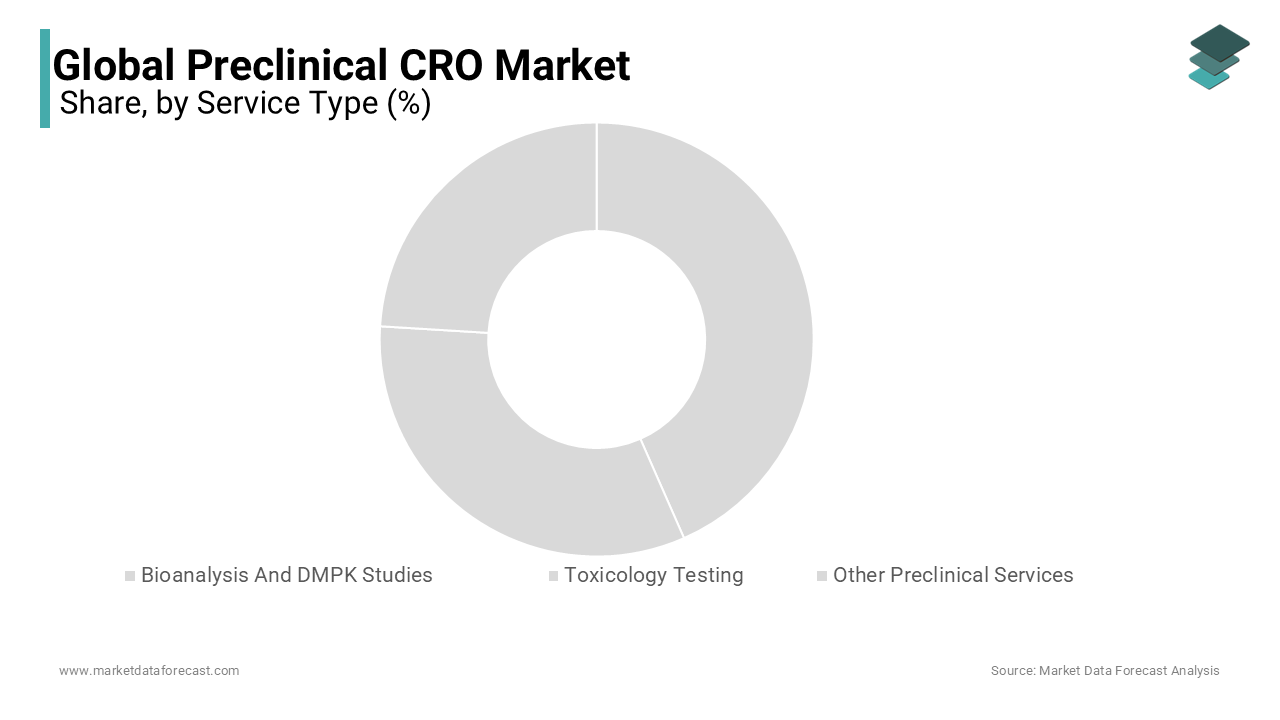
The toxicology testing segment stood as the largest service type by commanding 42.6% of the global market share in 2025. This dominance is primarily rooted in its regulatory indispensability, nearly every drug candidate must undergo a comprehensive safety evaluation before progressing to clinical trials. The U.S. Food and Drug Administration mandates that all Investigational New Drug (IND) applications include detailed toxicology dossiers, encompassing repeat-dose toxicity, genotoxicity, and reproductive safety studies. As per the FDA’s annual drug development pipeline report, over 7,000 active INDs were registered in 2023, each requiring at least one GLP-compliant toxicology study. The complexity of modern therapeutics, particularly antibody-drug conjugates and gene therapies, necessitates extended toxicology protocols, further amplifying demand.
The bioanalysis and DMPK (Drug Metabolism and Pharmacokinetics) studies segment is the fastest-growing within the service spectrum and is projected to expand at a CAGR of 12.6% from 2025 to 2033. This surge is fueled by the rising need for precise pharmacokinetic profiling in early development, especially for biologics and targeted therapies with narrow therapeutic windows. The increasing use of liquid chromatography-tandem mass spectrometry (LC-MS/MS) and hybrid immunoassay platforms, which enable highly sensitive quantification of drugs and metabolites in biological matrices, is a pivotal driver. The shift toward microdosing and human radiolabeled studies further intensifies demand for specialized bioanalytical expertise.
By End-User Insights
The biopharmaceutical companies segment was the prominent end-user by accounting for 66.3% of the preclinical CRO market revenue in 2025. This overwhelming share is driven by the structural shift toward lean, outsourced R&D models within the industry. Major pharmaceutical firms, including Pfizer, Roche, and Merck, have systematically downsized internal preclinical units to reduce fixed costs and increase development agility. As per a 2023 analysis by Deloitte’s Center for Health Solutions, the average R&D productivity of top-20 pharma companies dropped to $0.38 in sales per dollar spent, prompting intensified outsourcing. Concurrently, the rise of virtual biotech startups relies entirely on CROs for preclinical execution due to lack of in-house infrastructure. These entities prioritize speed-to-clinic, leveraging CROs with integrated toxicology and DMPK capabilities to compress development timelines.
The medical device companies segment is the fastest-growing end-user segment and is anticipated to grow at a CAGR of 11.8% through 2033. This acceleration is attributed to the expanding regulatory requirements for biocompatibility and implant safety testing under ISO 10993 and the FDA’s updated guidance on device-tissue interactions. Each of these devices requires rigorous preclinical evaluation, including chronic implantation studies and immunogenicity assessments. Moreover, the European Union’s Medical Device Regulation (EU MDR), implemented in 2021, mandates more extensive preclinical data, compelling even small device firms to engage specialized CROs for compliance.
REGIONAL ANALYSIS
North America Preclinical CRO Market Insights
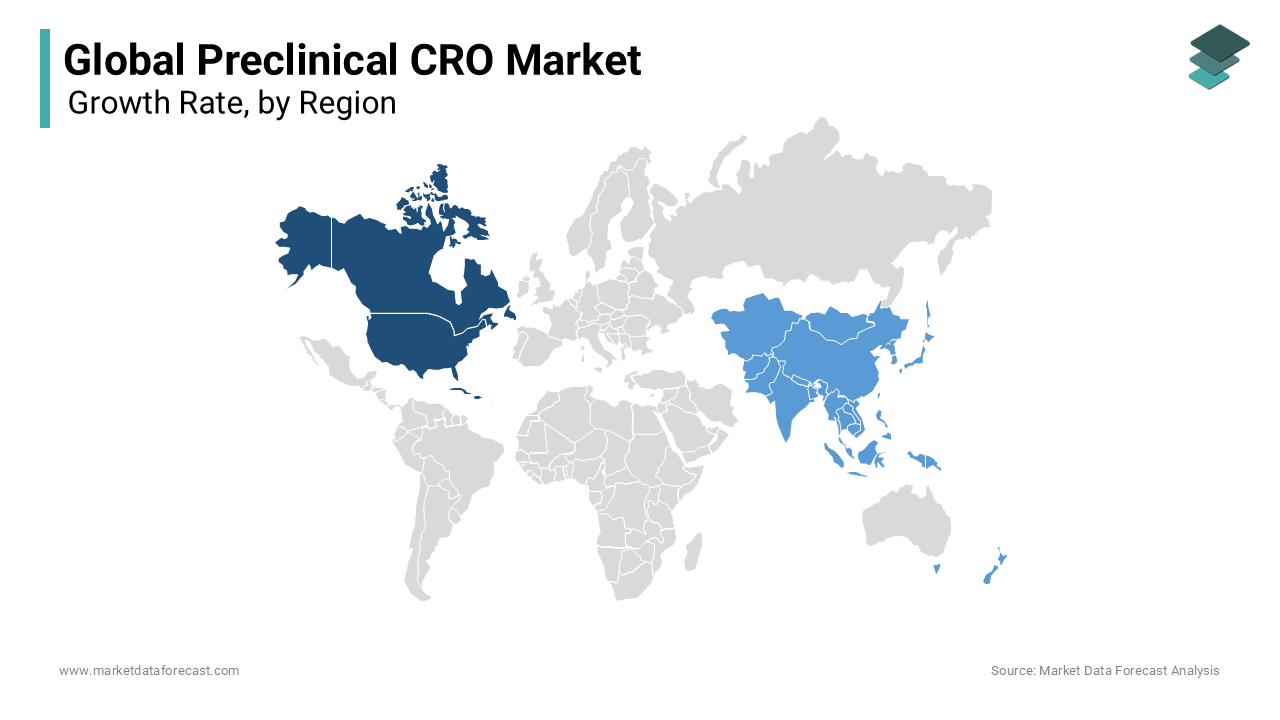
North America held a commanding position in the global preclinical CRO market by securing 38.2% of the total share in 2025. The region’s lead position is anchored in the United States, which hosts the world’s most dynamic biopharmaceutical innovation ecosystem. The U.S. Food and Drug Administration approved 55 novel therapeutics in 2023, the highest annual tally in over two decades, as per the FDA Office of New Drugs. This robust pipeline fuels sustained demand for preclinical services, particularly in oncology, neurology, and rare diseases. The concentration of top-tier CROs such as Charles River Laboratories, Covance, and MPI Research, combined with a well-established GLP infrastructure and regulatory clarity, reinforces North America’s dominance as the epicenter of preclinical outsourcing.
Europe Preclinical CRO Market Insights
Europe maintains a significant regional share. The region benefits from a dense network of research-intensive pharmaceutical companies and a strong tradition of academic-industry collaboration. Germany, the UK, and Switzerland serve as key hubs, hosting major R&D centers for Novartis, Bayer, and GSK. However, the region’s growth is tempered by stringent animal testing regulations under Directive 2010/63/EU, which has led to increased investment in alternative testing models. As per the European Commission, over €1.2 billion has been allocated to the EU-ToxRisk and ONTOX projects since 2020, aimed at developing non-animal safety assessment frameworks. Despite regulatory constraints, Europe remains a critical market due to its high scientific standards and regulatory influence.
Asia-Pacific Preclinical CRO Market Insights
The Asia-Pacific region is emerging as a pivotal force and exhibiting the highest growth momentum. China, Japan, and South Korea lead the regional expansion, supported by aggressive government investment in life sciences. In China, biopharmaceutical R&D funding increased annually, fostering a surge in domestic drug discovery. Japan’s Pharmaceuticals and Medical Devices Agency (PMDA) approved 41 new drugs in 2023, reflecting a revitalized innovation pipeline. The availability of skilled scientific labor, lower operational costs, and improving GLP compliance are attracting global sponsors seeking cost-efficient yet reliable preclinical partners, positioning Asia-Pacific as a strategic growth frontier.
Latin America Preclinical CRO Market Insights
Latin America holds a modest but evolving share in the preclinical CRO market, with Brazil and Mexico emerging as regional focal points. The growth is propelled by increasing investment in biomedical research and the expansion of clinical trial infrastructure, which necessitates parallel preclinical support. However, the region faces challenges in GLP accreditation, with only limited facilities in the entire region certified by the OECD. Despite limitations, growing regional collaboration and regulatory harmonization under PAHO are laying the groundwork for expanded preclinical service adoption.
Middle East and Africa Preclinical CRO Market Insights
The Middle East and Africa collectively account for small share of the market, with Israel and South Africa serving as the primary centers of preclinical research activity. Israel has emerged as a high-tech biomedical hub. The country’s preclinical infrastructure is bolstered by strong academic institutions like the Weizmann Institute and Technion, which collaborate with global CROs on immuno-oncology and neuroscience studies. However, limited GLP facilities and fragmented regulatory frameworks constrain broader market penetration. The African Union’s Africa Medicines Agency, established in 2021, aims to harmonize drug development standards, potentially unlocking future growth in preclinical outsourcing across the continent.
KEY MARKET PLAYERS
Some of the major companies dominating the global preclinical CRO market profiled in the report are Charles River Laboratories International, Inc., Laboratory Corporation of America, Envigo, Eurofins Scientific, PRA Health Science, Inc., Wuxi AppTec, Medpace, Inc., Pharmaceutical Product Development, LLC and Paraxel International Corporation.
TOP LEADING PLAYERS IN THE MARKET
Charles River
Charles River Laboratories is a dominant force in the global preclinical CRO landscape, with a robust footprint across the Asia Pacific region. The company has strategically expanded its capabilities in Japan, China, and Singapore, establishing state-of-the-art facilities for toxicology, bioanalysis, and genetic engineering. The company actively collaborates with academic institutions such as the Shanghai Institute of Materia Medica to advance translational research. Charles River has also invested in digital pathology and AI-driven data analytics to improve study efficiency. Its acquisition of Cognate BioServices in early 2023 strengthened its cell and gene therapy testing services, positioning it as a preferred partner for advanced modality developers across the region.
Covance
Covance by LabCorp maintains a significant presence in the Asia Pacific preclinical market, leveraging its integrated drug development model to serve multinational and regional clients. The company operates GLP-certified laboratories in Singapore and Shanghai, offering end-to-end preclinical services, including DMPK, safety assessment, and biomarker analysis. It has also forged strategic alliances with Japanese pharmaceutical firms to accelerate oncology and metabolic disease pipelines. The company’s adoption of centralized laboratory workflows and cloud-based data management systems enhances transparency and client collaboration. Covance continues to invest in talent development programs with local universities, ensuring a steady pipeline of skilled scientists, while its adherence to global regulatory standards reinforces trust among sponsors navigating complex submission pathways.
Frontage
Frontage Holdings Corporation is a leading Asia-centric preclinical CRO with deep regional roots and growing international recognition. Headquartered in China, Frontage operates integrated facilities in Beijing, Shanghai, and Philadelphia, enabling seamless cross-border support for U.S. and European sponsors. The company specializes in small and large molecule bioanalysis, DMPK, and non-rodent toxicology studies, with a strong focus on regulatory compliance for FDA and NMPA submissions. It has also enhanced its digital infrastructure with electronic lab notebooks and AI-assisted data review systems. By offering competitively priced, high-quality services and rapid turnaround times, Frontage has become a preferred partner for emerging biotechs and mid-sized pharma companies seeking efficient preclinical development pathways in the Asia Pacific region.
TOP STRATEGIES USED BY KEY MARKET PARTICIPANTS
Key players in the Preclinical CRO Market employ strategic expansion, technological integration, and service diversification to consolidate their competitive advantage. Major firms are investing heavily in facility upgrades and geographic expansion, particularly in high-growth regions like Asia Pacific, to capture emerging biopharma demand. Acquisitions and partnerships are frequently leveraged to enhance specialized capabilities in cell and gene therapy testing, digital pathology, and predictive toxicology. Integration of artificial intelligence and machine learning into study design and data interpretation is becoming standard to improve accuracy and reduce timelines. CROs are also focusing on end-to-end solution offerings, combining preclinical services with clinical pharmacology units to provide seamless drug development pathways. Regulatory harmonization expertise and GLP compliance are emphasized to build client trust and ensure global data acceptance.
COMPETITIVE OVERVIEW
The competitive landscape of the Preclinical CRO Market is characterized by a mix of global powerhouses and regionally focused specialists vying for dominance through innovation, scalability, and regulatory agility. Large multinational CROs leverage their extensive infrastructure, global compliance standards, and integrated service portfolios to serve big pharma and biotech firms. At the same time, niche players differentiate themselves by offering specialized testing models, faster turnaround times, and cost-efficient solutions, particularly in emerging markets. Intense rivalry is evident in the rapid adoption of advanced technologies such as organ-on-a-chip, AI-driven toxicity prediction, and automated bioanalytical platforms. Strategic collaborations with academic institutions and biotech clusters are increasingly common to stay at the forefront of scientific advancement. The market is also witnessing consolidation through mergers and acquisitions, as companies seek to broaden their technical capabilities and geographic reach in response to evolving client demands.
RECENT MARKET DEVELOPMENTS
- In January 2022, Charles River Laboratories expanded its preclinical toxicology facility in Yokohama, Japan, enhancing its capacity for cardiovascular and neurotoxicity studies to support Japanese pharmaceutical developers.
- In August 2022, Covance by LabCorp launched a new bioanalytical laboratory in Singapore, equipped with high-resolution mass spectrometry and automated sample processing systems to serve Asia Pacific clients.
- In March 2023, Frontage Holdings Corporation introduced an AI-powered data analytics platform across its preclinical operations in China, improving study accuracy and reducing reporting timelines for global sponsors.
- In June 2023, Charles River acquired Cognate BioServices, strengthening its preclinical testing capabilities for cell and gene therapies, including viral vector safety and biodistribution studies.
- In April 2024, DynaTou Preclinical CRO Marketch, a kiosk solutions provider, acquired KioW are, a kiosk management software company. This Preclinical CRO Marketacquisition is anticipated to allow DynaTouch to offer more comprehensive kiosk solutions and strengthen the Genomics Marketir market presence
MARKET SEGMENTATION
This research report on the global preclinical CRO market has been segmented and sub-segmented based on service type, end-user, and region.
By Service Type
- Bioanalysis And DMPK Studies
- Toxicology Testing
- Other Preclinical Services
By End-user
- Biopharmaceutical Companies
- Government And Academic Institutes
- Medical Device Companies
By Region
- North America
- Europe
- Asia-Pacific
- Latin America
- The Middle East and Africa