- Product Description Description
- Table of Contents TOC
- List of Table & Figure LOT
- Get Free Sample PDF Sample PDF
Market Size, 2025
$30.33 BnMarket Estimate, 2026
$33.09 BnMarket Forecast, 2034
$66.42 BnCAGR, 2026–2034
9.1%Europe Product Lifecycle Management (PLM) Market Summary
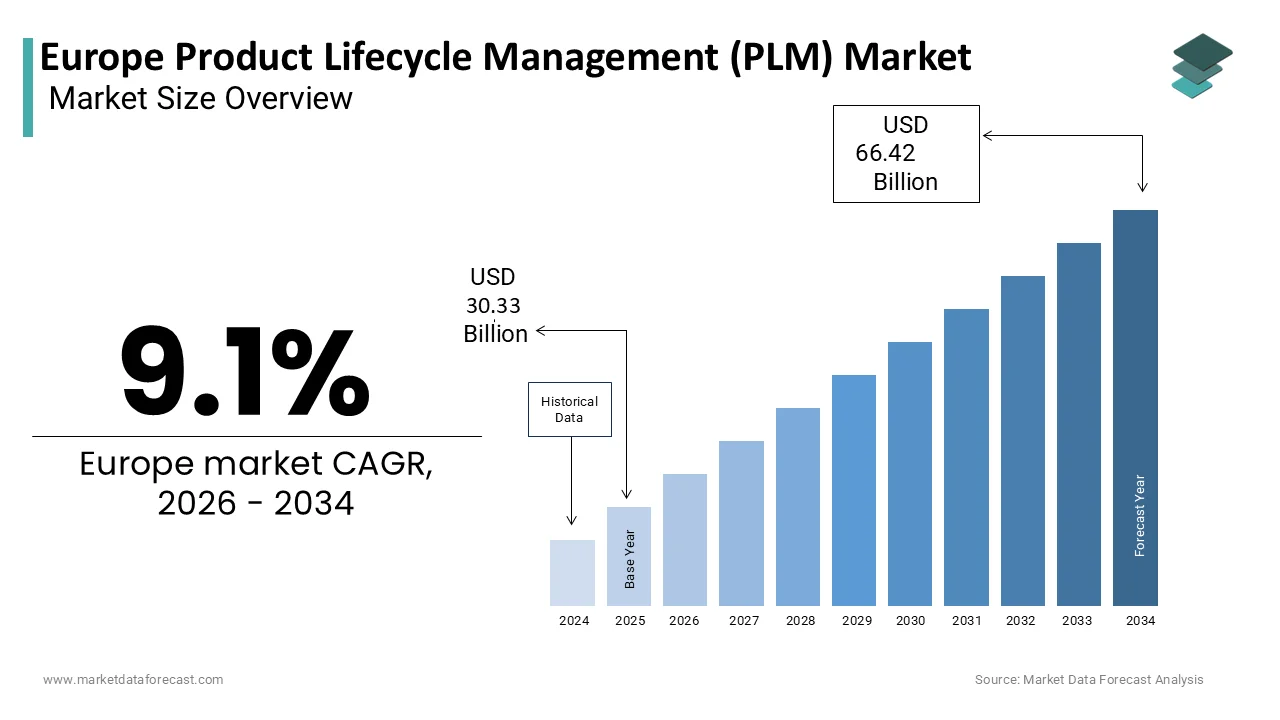
The Europe Product Lifecycle Management (PLM) market was valued at USD 30.33 billion in 2025 and is projected to reach USD 66.42 billion by 2034, growing at a CAGR of 9.10% from 2026 to 2034, driven by EU regulatory harmonization, digital product passport mandates, and accelerated innovation cycles in automotive, aerospace, and high-tech industries.
Market Snapshot
- 2025 Market Size: USD 30.33 Billion
- 2026 Market Size: USD 33.09 Billion
- 2034 Forecast: USD 66.42 Billion
- CAGR (2026–2034): 9.10%
- Base Year: 2025
- Forecast Period: 2026–2034
Quick Growth Drivers
- EU-wide regulatory harmonization under Ecodesign and Digital Product Passport frameworks
- Acceleration of electric vehicle and software-defined product development cycles
- Expansion of digital twin and IoT-enabled lifecycle monitoring
- Increased sustainability reporting obligations under EU Green Deal policies
- Rising integration of engineering, compliance, and supply chain data
Principal Restraints
- High upfront implementation costs for SMEs
- Complex legacy ERP and CAD system integration
- Data sovereignty constraints under GDPR and Data Governance Act
- Cybersecurity compliance overhead under the Cyber Resilience Act
High-Value Opportunities
- Circular economy modules embedded into PLM workflows
- Digital twin integration for predictive maintenance and lifecycle simulation
- AI-driven generative design and automated compliance reporting
- Cloud-native PLM tailored to GAIA-X-compliant infrastructure
- Sustainability intelligence dashboards aligned with EU carbon reduction mandates
Key Market Challenges
- Interoperability gaps between PLM, ERP, and MES systems
- Fragmented data formats across multi-tier supply chains
- Skill shortages in digital engineering and lifecycle data governance
- Underutilization of advanced PLM analytics due to workforce capability gaps
Fastest-Growing Segments
- Quality & Compliance Management – fastest CAGR of 12.4% driven by EU MDR, REACH, and Digital Product Passport mandates
- Cloud Deployment – fastest CAGR of 14.1% fueled by SME adoption and remote collaboration needs
- Healthcare End-User Segment – fastest CAGR of 13.8% due to medical device traceability requirements
Regional Leadership & Dynamics
- Germany (24%) – largest market, anchored by Industrie 4.0 adoption and advanced automotive manufacturing
- France (16%) – aerospace and nuclear engineering-led PLM demand supported by France 2030 investments
- United Kingdom (13%) – dual CE/UKCA compliance tracking and strong life sciences integration
- Italy (9%) – design-driven industries and export-oriented machinery manufacturing
- Sweden (6%) – sustainability-focused engineering and lifecycle-based procurement mandates
What Wins Commercially
- Regulatory-aligned PLM modules supporting Digital Product Passport requirements
- Unified digital thread integration across mechanical, electrical, and software domains
- Seamless ERP–PLM interoperability
- AI-enabled simulation, sustainability analytics, and automated change management
- Secure cloud deployments compliant with EU data residency requirements
Top Strategic Ask for Executives
Invest in interoperable, cloud-enabled PLM platforms that integrate sustainability intelligence, digital twin capabilities, and regulatory compliance automation to future-proof product development under Europe’s increasingly stringent environmental and data governance frameworks.
Leading Players
Some of the companies that are playing a dominating role in the Europe Product Lifecycle Management (PLM) market include
Siemens AG,
Dassault Systèmes,
PTC Inc.,
Autodesk,
IBM,
Oracle Corporation,
SAP SE,
Microsoft Corporation,
Aras Corporation,
and Bentley Systems.
Europe Product Lifecycle Management (PLM) Market Size
The europe product lifecycle management market was valued at USD 30.33 billion in 2025, is estimated to reach USD 33.09 billion in 2026, and is projected to reach USD 66.42 billion by 2034, growing at a CAGR of 9.1% from 2026 to 2034.
The product lifecycle management is the integrated digital framework that enables enterprises to manage the entire lifecycle of a product from initial conception through design, manufacturing, service, and eventual disposal. Rooted in engineering and enterprise data management, PLM systems synchronize cross-functional workflows across research and development, supply chain, compliance, and sustainability domains. According to Eurostat, over 78% of large manufacturing enterprises in the European Union employed some form of digital product data management system by 2023, reflecting a structural shift toward data-driven innovation. As per the European Environment Agency, nearly 60% of industrial material flows in the EU are now subject to extended producer responsibility frameworks, compelling manufacturers to embed end of life considerations into early design phases, which is a process inherently reliant on robust PLM infrastructure. The convergence of stringent environmental legislation, such as the Ecodesign for Sustainable Products Regulation, with accelerating digital transformation in discrete industries has positioned PLM as a critical backbone for compliant and competitive product development across the region.
MARKET DRIVERS
Regulatory Harmonization Across the European Union Drives PLM Adoption
The harmonization of product compliance standards under EU directives compels manufacturers to maintain granular, auditable records throughout a product’s lifecycle. The regulatory harmonization across the European Union is driving the growth of the European product lifecycle management market. The European Commission’s implementation of the Digital Product Passport initiative under the Ecodesign for Sustainable Products Regulation requires companies to digitally track material composition, carbon footprint, and repairability metrics. Such mandates necessitate centralized data repositories capable of integrating inputs from suppliers, designers, and recyclers, precisely the function served by advanced PLM platforms. For instance, the EU Battery Regulation mandates that all electric vehicle batteries sold after 2027 include a digital battery passport detailing the origin of raw materials and carbon intensity. This regulatory architecture transforms PLM from a productivity tool into a legal necessity, compelling firms to invest in interoperable, cloud-enabled systems that ensure real-time compliance visibility across complex value chains.
Accelerated Innovation Cycles in High Tech and Automotive Sectors Fuel PLM Demand
The manufacturers in high-tech and automotive industries operate under intensifying pressure to compress product development timelines while maintaining quality and sustainability benchmarks. The accelerated innovation cycle in high-tech and automotive sectors is additionally fuelling the growth of Europe's product lifecycle management market. According to the European Automobile Manufacturers Association, the average time to market for new vehicle models in Europe has decreased by 22% between 2018 and 2023, driven by competition from electrified and software-defined platforms. Concurrently, the European Semiconductor Industry Association notes that semiconductor design cycles have shortened to under 18 months for advanced nodes, demanding seamless collaboration between geographically dispersed engineering teams. PLM systems address this urgency by unifying mechanical, electrical, and software bill of materials within a single digital thread, reducing iteration errors and version conflicts. A study by the Fraunhofer Institute for Production Systems and Design Technology found that German automotive suppliers using integrated PLM environments reduced prototype validation time by up to 35% compared to peers relying on fragmented tools. The velocity of innovation thus directly correlates with PLM maturity, positioning the technology as a strategic asset for maintaining Europe’s industrial competitiveness.
MARKET RESTRAINTS
High Implementation Costs and Legacy System Integration Hinder PLM Penetration
The adoption of comprehensive PLM solutions requires substantial upfront investment and technical complexity, particularly among small and medium-sized enterprises. The high implementation costs of legacy system integration are limiting the growth of Europe product lifecycle management market. According to the European DIGITAL SME Alliance, only 18% ofEU-basedd manufacturing SMEs have deployed enterprise-grade PLM systems, citing costs exceeding 200,000 euros for mid-tier implementations as a primary barrier. Moreover, many established manufacturers operate on legacy ERP and CAD infrastructures that lack native compatibility with modern PLM architectures. The VDMA, Germany’s mechanical engineering association, reports that its member firms still rely on customized or outdated engineering data management systems by making integration with cloud-based PLM platforms both technically arduous and financially prohibitive. Consequently, even when regulatory or competitive pressures justify PLM adoption, the practical hurdles of cost, compatibility, and capability delay deployment, particularly outside large multinational corporations.
Data Sovereignty and Cross-Border Governance Complicate PLM Deployment
The European Union’s stringent data governance regime, anchored in the General Data Protection Regulation and reinforced by the Data Governance Act, imposes complex constraints on how product data can be stored, processed, and shared across jurisdictions. The data sovereignty and cross-border governance complicate PLM deployment, which is additionally hampering the growth of Europe product lifecycle management market. While these regulations enhance consumer and industrial data rights, they introduce significant operational friction for PLM systems that rely on global collaboration and cloud infrastructure. According to the European Data Protection Board, over 70% of multinational manufacturers operating in the EU have revised their data residency policies since 2022 to ensure compliance with localization requirements. This often necessitates deploying region-specific PLM instances or hybrid architectures that fragment the very data continuity PLM seeks to achieve. Furthermore, the EU’s Cyber Resilience Act, which entered into force in 2024, mandates rigorous cybersecurity certifications for digital products, including enterprise software handling sensitive industrial data. These overlapping regulatory layers increase both the legal risk and technical overhead of PLM deployment, discouraging standardized adoption and encouraging fragmented, siloed approaches that undermine the holistic vision of product lifecycle integration.
MARKET OPPORTUNITIES
Circular Economy Mandates Create New PLM Functional Requirements
The European Union’s aggressive push toward a circular economy is redefining product design paradigms and creating unprecedented demand for PLM capabilities that support material traceability, disassembly planning, and reuse analytics. The circular economy mandates are ascribed to create new opportunities for the growth of Europe product lifecycle management market. Under the Circular Economy Action Plan, the European Commission aims to ensure that all packaging placed on the EU market is reusable or recyclable by 2030, a target that directly impacts product architecture and material selection. PLM systems are uniquely positioned to embed circularity criteria into early-stage development by linking material databases with end of life scenarios. For example, the French Agency for Ecological Transition reports that manufacturers using PLM modules with embedded eco design rules reduced virgin material use by up to 28% in pilot programs. Additionally, the upcoming EU Right to Repair legislation will require detailed serviceability documentation, which PLM can auto-generate from design metadata. These evolving policy instruments transform PLM from a backend engineering tool into a frontline instrument of regulatory and environmental strategy, opening avenues for vendors to develop specialized modules focused on sustainability intelligence and compliance automation.
Digital Twin Integration Unlocks Advanced Simulation and Service Capabilities
The emergence of PLM with digital twin technology enables European manufacturers to extend product lifecycle visibility beyond physical production into operational performance and predictive maintenance. The digital twin integration unlocks advanced simulation and service capabilities is additionally escalates the growth of Europe product lifecycle management market. Unlike static digital models, digital twins continuously assimilate real-world data from IoT sensors embedded in fielded products by enabling dynamic feedback loops that inform design improvements and service strategies. According to the German Engineering Federation VDMA, over 40% of German machinery builders now offer digital twin-enabled services, with PLM serving as the authoritative source for geometric and functional product definitions. In the aerospace sector, Airbus leverages PLM synchronized digital twins to monitor fatigue stress on aircraft components by reducing unscheduled maintenance by 19% as per internal operational reviews published in 2024. Similarly, Siemens Energy uses PLM integrated twins to simulate turbine performance under varying climate conditions, optimizing service intervals and extending asset life.
MARKET CHALLENGES
Interoperability Gaps Between Engineering and Enterprise Systems Impede PLM Value Realization
The persistent disconnects between engineering-centric PLM platforms and broader enterprise systems such as ERP, MES, and SCM continue to limit holistic lifecycle visibility. Many European manufacturers operate in heterogeneous IT landscapes, where data silos prevent the seamless flow of product information from concept to customer. According to a 2024 survey by the European Federation of National Engineering Associations, 68% of engineering managers report that inconsistent data formats between PLM and ERP systems cause delays in production ramp-up and inventory misalignment. For instance, a mismatch in part numbering or revision status can trigger procurement errors that cascade into assembly line stoppages. The problem is compounded in multi-tier supply chains; the European Supply Chain Observatory notes that only 22% of Tier 2 and Tier 3 suppliers in the automotive sector have direct PLM connectivity with OEMs, forcing reliance on manual data exchanges prone to error. Even when APIs exist, semantic differences in how systems interpret attributes like “approved” or “released” create reconciliation overhead. Until industry-wide standards such as ISO 10303 STEP AP242 achieve universal adoption, these interoperability gaps will constrain the ability of PLM to deliver end to end digital continuity, particularly in complex, regulated sectors where traceability is non-negotiable.
Skill Shortages in Digital Engineering Limit PLM Optimization
The full potential of modern PLM systems remains unrealized in many European firms due to a critical deficit in professionals who can bridge domain engineering knowledge with digital data fluency. While PLM platforms offer advanced capabilities in simulation, configuration management, and sustainability analytics, leveraging them requires personnel trained in both product development workflows and data science principles. According to the European Centre for the Development of Vocational Training, there will be a shortfall of over 500,000 digital manufacturing specialists in the EU by 2027, with PLM competency cited as a top-three skill gap by 61% of industrial employers. This shortage is especially acute in Eastern and Southern Europe, where national education systems have been slower to integrate digital engineering curricula. A 2024 study by the Technical University of Denmark found that Danish manufacturers with certified PLM administrators achieved 32% higher user adoption rates and 27% faster change order processing than those without dedicated expertise. Without sufficient human capital to configure, govern, and evolve PLM environments, organizations default to basic document management functions, missing opportunities for AI-driven insights or closed-loop quality improvement. Until workforce development aligns with technological ambition, PLM will remain underutilized as a strategic lever across much of the European industrial base.
REPORT COVERAGE
| REPORT METRIC | DETAILS |
| Market Size Available | 2025 to 2034 |
| Base Year | 2025 |
| Forecast Period | 2026 to 2034 |
| Segments Covered | By Software Type, Deployment Type, End User, and Region. |
| Various Analyses Covered | Global, Regional, and Country-Level Analysis, Segment-Level Analysis, Drivers, Restraints, Opportunities, Challenges; PESTLE Analysis; Porter’s Five Forces Analysis, Competitive Landscape, Analyst Overview of Investment Opportunities |
| Countries Covered | UK, France, Spain, Germany, Italy, Russia, Sweden, Denmark, Switzerland, Netherlands, Turkey, Czech Republic, Rest of Europe |
| Market Leaders Profiled | Siemens AG, Dassault Systèmes SE, PTC Inc., Autodesk, Inc., IBM Corporation, Oracle Corporation, SAP SE, Microsoft Corporation, AE (SAAB Group), Accenture plc, Capgemini SE, Tata Consultancy Services Limited, Infosys Limited, HCL Technologies Limited, Wipro Limited, Atos SE, CGI Inc., Bentley Systems Incorporated, Aras Corporation |
SEGMENTAL ANALYSIS
By Software Type Insights
Design & Engineering Management commands the largest share of the European product lifecycle management market, estimated at approximately 32% as of 2025. This dominance stems from its foundational role in early-stage product development, where digital modeling, collaborative design, and version control are indispensable. European manufacturers, particularly in automotive and industrial machinery, rely heavily on integrated CAD-PLM environments to manage complex assemblies and comply with stringent safety standards. According to the European Commission, over 85% of large engineering firms in Germany and France use PLM systems primarily for design coordination and regulatory documentation. The push toward lightweighting and electrification in mobility sectors has intensified demand for advanced surface modeling and multi-physics simulation tools embedded within design modules. Additionally, the EU’s Horizon Europe program allocated 1.2 billion euros in 2024 specifically to digital design innovation in sustainable manufacturing, further anchoring this segment’s centrality. As per the VDMA, German mechanical engineering companies reduced design rework by 29% after adopting unified design and change management workflows, underscoring operational efficiency gains that reinforce market leadership.
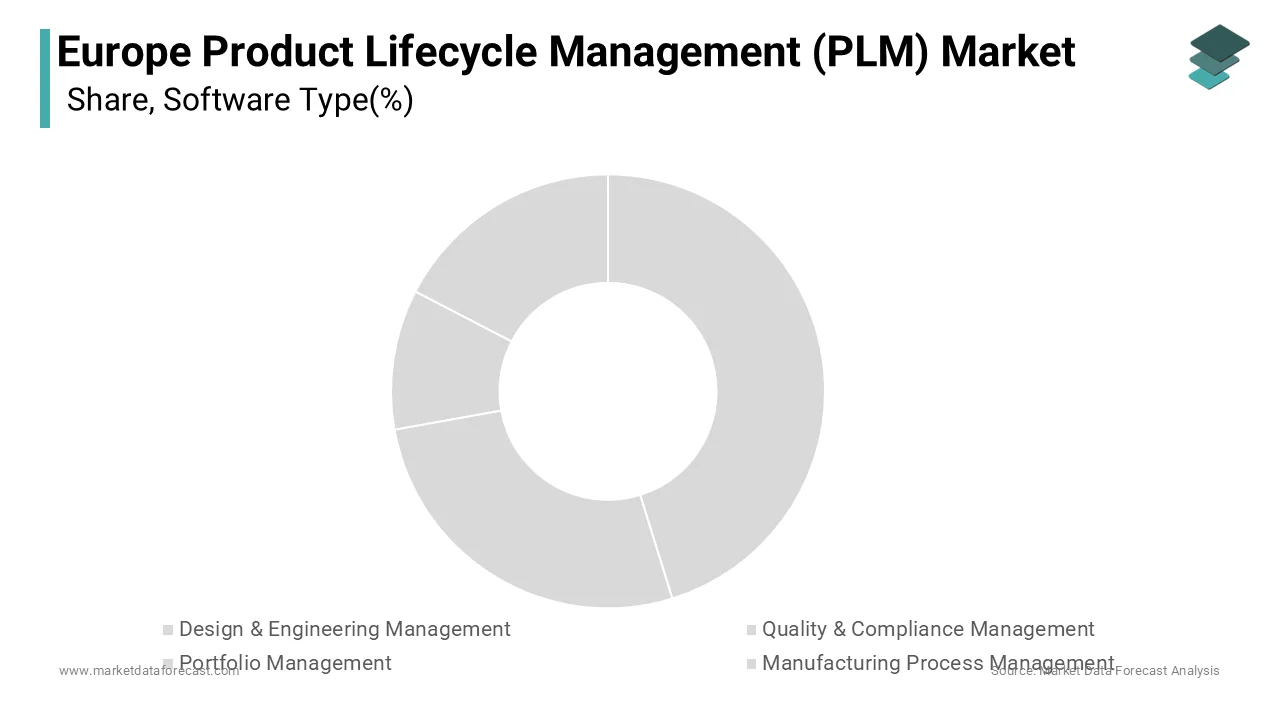
Quality & Compliance Management is the fastest-growing software type in the European PLM market, projected to expand at a compound annual growth rate of 12.4% through 2030. This acceleration is driven by the EU’s tightening regulatory landscape, particularly the Ecodesign for Sustainable Products Regulation and the upcoming Digital Product Passport framework. As per the European Environment Agency, non-compliance with chemical disclosure rules under REACH resulted in fines exceeding 180 million euros across EU member states in 2023 alone, compelling manufacturers to embed real-time compliance checks into their PLM workflows. The medical device sector exemplifies this trend; according to the European Medicines Agency, over 90% of Class III device manufacturers now integrate PLM-based quality management systems to meet the traceability mandates of the EU Medical Device Regulation. Furthermore, the European Standardization Organization reports that ISO 13485-certified firms using automated compliance modules cut audit preparation time by 40%. These converging pressures, legal, reputational, and operational, are transforming quality and compliance from back office functions into core strategic capabilities, fueling rapid adoption across regulated industries.
By Deployment Type Insights
On-premises deployment retains the largest market share in Europe, accounting for roughly 58% of the PLM software installed base as of 2025. This prevalence is especially pronounced in aerospace, defense, and heavy machinery sectors, where data sovereignty, intellectual property protection, and legacy system integration remain paramount. According to the European Defence Agency, over 75% of Tier 1 defense contractors in France, Germany, and Italy operate PLM systems on private servers due to national security protocols that restrict cloud usage for sensitive engineering data. Similarly, the German Federal Office for Information Security notes that 68% of DAX-listed industrial firms classify product geometry files as critical infrastructure assets, mandating on-site storage. The high degree of customization required in complex manufacturing environments also favors on-premises architectures, which allow deeper integration with proprietary ERP and MES platforms. A 2024 benchmark by the Fraunhofer Institute found that on-premises PLM users in industrial equipment reported 30% higher data fidelity in bill of materials synchronization compared to early cloud adopters, reinforcing institutional preference despite rising cloud capabilities.
Cloud deployment is the fastest-growing segment in the European PLM market, advancing at a compound annual growth rate of 14.1% between 2025 and 2030. This surge is propelled by the increasing need for remote collaboration, scalable computing, and cost-efficient access to advanced analytics among small and medium enterprises. According to Eurostat, 63% of EU-based manufacturing SMEs initiated cloud migration strategies in 2024, citing flexibility and reduced IT overhead as primary motivators. The rise of subscription-based PLM offerings from vendors like Dassault Systèmes and Siemens has lowered entry barriers; their cloud native platforms now support real-time co-design across geographies without requiring capital expenditure. Additionally, the European High Performance Computing Joint Undertaking reports that cloud-enabled simulation workloads grew by 85% in 2024, driven by demand for virtual prototyping in electric vehicle and renewable energy sectors. Regulatory acceptance is also shifting; as per the European Data Protection Supervisor, updated certification frameworks for GAIA-X-compliant cloud providers have alleviated prior concerns about cross-border data flows, accelerating adoption in traditionally cautious industries like automotive and electronics.
By End User Insights
The Automotive & Transportation sector holds the largest end-user share in the European PLM market, representing approximately 28% of total adoption as of 2025. This leadership reflects the industry’s extreme complexity in managing millions of parts, global supply chains, and overlapping regulatory regimes. European automakers face unprecedented pressure to accelerate electric vehicle development while maintaining rigorous safety and emissions standards. According to the European Automobile Manufacturers Association, the average new vehicle platform now integrates over 10,000 unique components, necessitating PLM systems capable of synchronizing mechanical, electrical, and software engineering domains. Volkswagen Group, for instance, reported in its 2024 sustainability review that its unified PLM environment reduced variant management errors by 33% across 12 brands. Furthermore, the EU’s Fit for 55 package mandates a 55% reduction in vehicle CO2 emissions by 2030, compelling manufacturers to simulate lightweight materials and battery architectures early in design, a process deeply reliant on PLM. As per the Centre for Automotive Research Europe, 92% ofEU-headquarteredd OEMs now treat PLM as mission-critical infrastructure, cementing the sector’s dominant position.
The Healthcare segment is the fastest-growing end-user vertical in the European PLM market, projected to grow at a compound annual growth rate of 13.8% through 2030. This expansion is fueled by the convergence of personalized medicine, stringent device regulation, and digital health innovation. The EU Medical Device Regulation, fully enforced since 2021, requires comprehensive technical documentation and post-market surveillance for every device, a burden efficiently managed through PLM-based quality and traceability modules. According to the European Commission, over 500,000 medical device certificates were reviewed under the new regime in 2024, with non-compliant products removed from 18 national markets. Companies like Medtronic and Siemens Healthineers now use PLM to link design history files with clinical trial data and service logs, enabling closed-loop feedback for next-generation devices. Additionally, the rise of implantable and connected diagnostics projected by the European Health Telematics Observatory to reach 120 million units annually by 2027 demands robust configuration control to manage firmware updates and cybersecurity patches. These dynamics position healthcare as a high-growth frontier for PLM, driven by regulatory rigor and technological convergence.
COUNTRY LEVEL ANALYSIS
Germany Product Lifecycle Management Market Analysis
Germany stands as the largest national market for product lifecycle management in Europe, holding an estimated 24% share of regional revenue in 2025. The country’s dominance is rooted in its world-leading industrial base, particularly in automotive, machinery, and chemicals, where engineering precision and regulatory compliance are non-negotiable. As per the Federal Ministry for Economic Affairs and Climate Action, over 90% of Germany’s top 500 industrial firms have implemented enterprise-grade PLM systems to manage complex product variants and sustainability reporting. The Industrie 4.0 initiative, which has mobilized more than 20 billion euros in public-private investment since 2011, explicitly identifies PLM as a core enabler of digital thread integration across value chains. German engineering culture further reinforces adoption; the VDMA reports that 78% of mechanical engineering companies use PLM not only for design but also for supplier qualification and carbon footprint tracking. With the nation targeting climate neutrality in manufacturing by 2045, PLM’s role in material transparency and circular design is expanding rapidly, ensuring continued market leadership.
France Product Lifecycle Management Market Analysis
France ranks second in the European PLM landscape with approximately 16% market share, driven by its strong aerospace, nuclear, and luxury goods sectors. The French aerospace industry, anchored by Airbus and Safran, relies on PLM to coordinate multinational engineering teams and ensure compliance with EASA airworthiness directives. According to the French Civil Aviation Authority, over 12,000 design changes per aircraft program are managed annually through PLM systems, highlighting scale and complexity. In parallel, the luxury sector, comprising LVMH and Kerin,g has adopted PLM to authenticate raw materials and enforce ethical sourcing under the EU Corporate Sustainability Reporting Directive. The French government’s France 2030 investment plan has allocated 1.5 billion euros to digitalize industrial SMEs, with PLM cited as a priority technology. As per INSEE, French manufacturers using integrated PLM environments reported a 22% reduction in time to market for new products in 2024, reinforcing national competitiveness and sustaining robust demand.
United Kingdom Product Lifecycle Management Market Analysis
The United Kingdom holds the third-largest PLM market share in Europe at around 13%, characterized by strength in automotive, pharmaceuticals, and defense engineering. Despite Brexit, UK manufacturers remain tightly integrated with EU regulatory frameworks, necessitating PLM systems that support dual compliance tracking for UKCA and CE marking. According to the Society of Motor Manufacturers and Traders, British automotive firms invested over 5 billion pounds in digital engineering tools in 2024, with PLM central to battery electric vehicle platform development. The life sciences sector also contributes significantly; the Medicines and Healthcare products Regulatory Agency notes that 85% of UK-based medtech firms use PLM to manage design controls under the UK MDR. Moreover, the UK’s National Quantum Strategy and Advanced Manufacturing Plan emphasize digital twins and virtual validation, both dependent on PLM data integrity. These cross-sectoral drivers, combined with a mature tech ecosystem, sustain the UK’s prominent position in the regional market.
Italy Product Lifecycle Management Market Analysis
Italy commands the fourth largest share of the European PLM market at approximately 9%, distinguished by its concentration of industrial design, fashion, and specialized machinery. Italian manufacturers, particularly in the Emilia Romagna and Lombardy regions, leverage PLM to protect intellectual property in high-value design assets and manage short production runs with frequent style changes. According to ISTAT, over 60% of Italian machinery exporters use PLM to customize equipment configurations for global clients while maintaining service documentation in multiple languages. The fashion industry’s shift toward traceability, spurred by the EU Strategy for Sustainable and Circular Textiles, has also accelerated PLM adoption among luxury apparel houses. The Italian Ministry of Enterprises and Made in Italy reports that 45% of textile firms participating in the 2024 Green Label Initiative deployed PLM to track fiber origins and chemical treatments. These niche yethigh-marginn applications, coupled with strong export orientation, anchor Italy’s steady presence in the European PLM ecosystem.
Sweden Product Lifecycle Management Market Analysis
Sweden occupies the fifth position in the European PLM market with a share of roughly 6%, driven by its leadership in sustainable engineering, telecommunications, and clean tech. Swedish industrial philosophy emphasizes lifecycle thinking, making PLM a natural fit for companies like Volvo Cars, Ericsson, and Sandvik, which embed environmental impact metrics directly into product definitions. According to Statistics Sweden, 70% of the country’s top 100 manufacturers use PLM systems that integrate with environmental product declarations compliant with ISO 14025. The Swedish Environmental Protection Agency mandates that all publicly procured goods undergo lifecycle assessment, a requirement efficiently fulfilled through PLM-linked databases. Furthermore, Sweden’s commitment to fossil-free steel led by the HYBRIT joint venture relies on PLM to track green hydrogen usage and carbon intensity across pilot production lines. As per the Swedish Agency for Economic and Regional Growth, digital engineering investments grew by 19% in 2024, with PLM cited as a foundational layer for industrial decarbonization, securing the nation’s innovative edge in the regional market.
COMPETITIVE LANDSCAPE
The European product lifecycle management market features intense competition among global technology leaders and specialized regional vendors, each vying for dominance through differentiation in functionality,y compliance readiness, ss and deployment flexibility. Established players leverage deep industry expertise along-standing relationships with major OEMs, while newer entrants focus on modular cloud native solutions targeting small and medium enterprises. The competitive landscape is shaped by rapid technological convergence, where PLM increasingly overlaps with enterprise resource planning,g product data management,nt and quality management systems. Regulatory complexity across EU member states creates both barriers and opportunities as vendors tailor solutions to meet national interpretations of union-wide directives. Innovation in sustainability analytics, interoperability standards, and user experience drives continuous platform evolution, making vendor selection a strategic rather than purely technical decision for European manufacturers.
KEY MARKET PLAYERS
Some of the companies that are playing a dominating role in the global Europe Product Lifecycle Management (PLM) Market include
- Siemens AG
- Dassault Systèmes SE
- PTC Inc.
- Autodesk, Inc.
- IBM Corporation
- Oracle Corporation
- SAP SE
- Microsoft Corporation
- AE (SAAB Group)
- Accenture plc
- Capgemini SE
- Tata Consultancy Services Limited
- Infosys Limited
- HCL Technologies Limited
- Wipro Limited
- Atos SE
- CGI Inc.
- Bentley Systems Incorporated
- Aras Corporation
TOP LEADING PLAYERS IN THE MARKET
- Dassault Systèmes is a pivotal force in the European product lifecycle management market through its 3DEXPERIENCE platform, which unifies design, simulation, manufacturing, and sustainability workflows. The company has deep integration across European automotiv,e aerospa,ce, and life sciences sectors, where regulatory compliance and digital continuity are critical. In recent years,s Dassault Systèmes has expanded its cloud native offerings and embedded artificial intelligence to enhance generative design and circular economy capabilities. Ilaunches industry-specificic solution experiences tailored to EU green deal requirements, reinforcing its strategic alignment with regional industrial policy and accelerating adoptionamong mid-tierr manufacturers seeking scalable digital transformation pathways.
- Siemens Digital Industries Software maintains a strong presence in Europe by offering end-to-end PLM solutions that bridge mechanical, electrical,l and software engineering domains. Its Teamcenter platform serves as the digital backbone for numerous European industrial champions, ns particularly in Germany and France. Siemens has intensified its focus on digital twin integration and sustainability analytics, enabling customers to simulate carbon footprints and material reuse scenarios. Recent initiatives include partnerships with European research institutions advancemodel-basedd systems engineering, and investments in edge computing to support real-time data synchronization across global engineering teams, thereby strengthening its value proposition in complex, highly regulated environments.
- PTC has significantly reinforced its position in the European PLM market through its Windchill platform and strategic emphasis on Internet of Things-enabled product lifecycle intelligence. The company targets discrete manufacturers in industrial equipment and medical devices where traceability and service lifecycle management are paramount. PTC has expanded its cloud delivery model via partnerships with Microsoft Azure, ensuring compliance with EU data sovereignty standards. It has also integrated augmented reality and generative AI into its workflow tool,s allowing European engineers to visualize design changes and automate documentation. These innovations align with Europe’s push for human-centric digitalization and have accelerated PTC’s relevance among agile mid-sized enterprises.
TOP STRATEGIES USED BY THE KEY MARKET PARTICIPANTS
Key players in the European product lifecycle management market prioritize cloud migration to enhance scalability and remote collaboration while ensuring compliance with EU data governance frameworks. They invest heavily in embedding artificial intelligence and machine learning to automate design validation, change management,t and sustainability reporting. Strategic partnerships with hyperscalers and local system integrators facilitate smoother deployment across diverse industrial landscapes. Companies also develop industry-specific solution bundles aligned with European regulatory mandates such as the Ecodesign for Sustainable Products Regulation and Medical Device Regulation. Continuous enhancement of digital twin capabilities enables real-time feedback from products in service, driving closed-loop innovation and predictive maintenance offerings that differentiate their platforms in competitive bids.
EUROPE PRODUCT LIFECYCLE MANAGEMENT MARKET NEWS
- In March 2024, Dassault Systèmes launched a dedicated sustainability innovation center in Paris to acceleratethe development of PLM modules supporting EU digital product passport requirements and circular design workflows.
- In May 2024, Siemens Digital Industries Software partnered with TNO Netherlands Organisation for Applied Scientific Research, toco-develop AI-drivenn PLM tools for carbon footprint tracking in heavy machinery manufacturing.
- In February 2024, PTC expanded its Windchill Cloud offering on Microsoft Azure with GAIA-X-compliant data residency options specifically for German and French industrial ccustomerss
- In June 2024, Dassault Systèmes introduced an industry solution experience for European medtech firms, integrating PLM with clinical trial and post-market surveillance data under EU MDR guidelines.
- In April 2024, Siemens announced the integration of its Teamcenter platform with SAP S4HANA Cloud Public Edition to streamline bill of materials synchronization for European automotive suppliers adopting unified ERP PLM architectures.
MARKET SEGMENTATION
This research report on the europe product lifecycle management (PLM) market is segmented and sub-segmented into the following categories.
By Software Type
- Design & Engineering Management
- Quality & Compliance Management
- Portfolio Management
- Manufacturing Process Management
- Others
By Deployment Type
- On-Premise
- Cloud
By End User
- Automotive & Transportation
- Aerospace & Defense
- Industrial Machinery
- Healthcare
- Electronics & Semiconductor
- Others
By Country
- Germany
- France
- United Kingdom
- Italy
- Sweden
- Rest of Europe