Europe Property Insurance Market Size, Share, Trends & Growth Forecast Report, Segmented By Coverage Type (Fire and Theft, House Damage, Floods and Earthquake, Personal Property, Others), End User, Application, And Country (UK, France, Spain, Germany, Italy, Russia, Sweden, Denmark, Switzerland, Netherlands, Turkey, Czech Republic & Rest of Europe) - Industry Analysis From (2026 To 2034)
Market Size, 2025
$6,796 BnMarket Estimate, 2026
$7,417 BnMarket Forecast, 2034
$14,936 BnCAGR, 2026–2034
9.14%Europe Property Insurance Market Report Summary
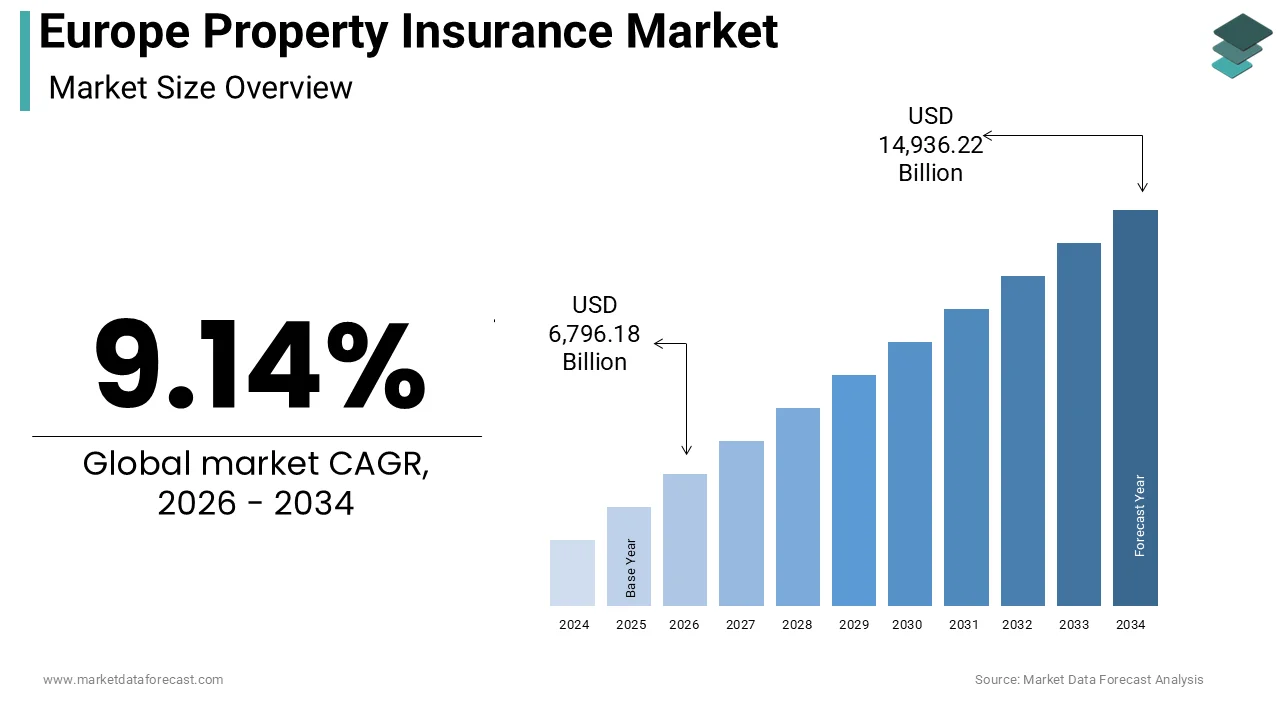
The Europe property insurance market was valued at USD 6,796.18 billion in 2025, is estimated to reach USD 7,417.84 billion in 2026, and is projected to reach USD 14,936.22 billion by 2034, growing at a CAGR of 9.14% during the forecast period. The growth of the Europe property insurance market is driven by increasing awareness of risk protection, rising incidences of natural disasters, and the growing value of residential and commercial properties across the region. The market is further supported by regulatory frameworks mandating certain types of property insurance, along with the increasing adoption of digital insurance platforms that simplify policy management and claims processing. Additionally, climate change-related risks such as floods, storms, and wildfires are encouraging individuals and businesses to secure comprehensive property insurance coverage. The expansion of smart home technologies and risk assessment tools is also enhancing underwriting capabilities and driving market growth.
Key Market Trends
- Rising frequency of natural disasters and climate-related risks, increasing demand for comprehensive property insurance coverage.
- Growing adoption of digital insurance platforms and InsurTech solutions streamlining policy issuance and claims processing.
- Increasing focus on risk-based pricing and advanced analytics, improving underwriting accuracy.
- Expansion of smart home technologies and IoT-based risk monitoring, reducing potential losses and enabling proactive insurance models.
- Strong regulatory support and government initiatives promoting insurance penetration and disaster risk coverage across Europe.
Segmental Insights
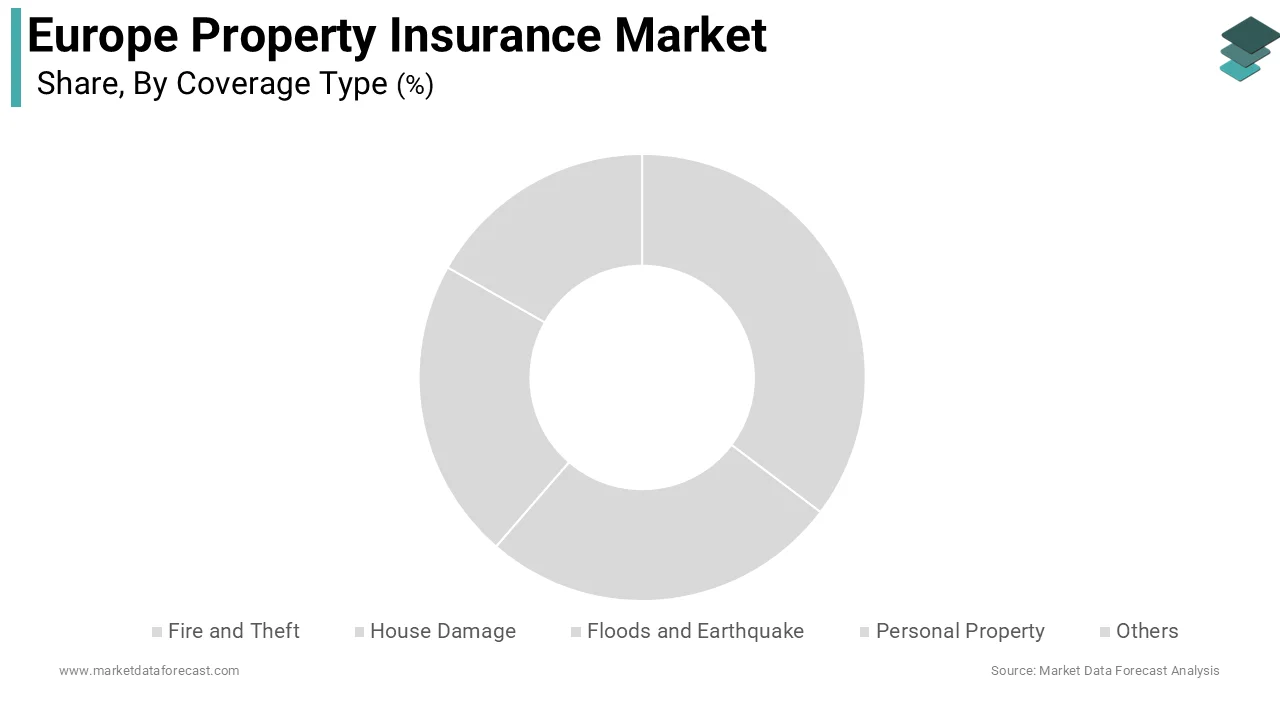
- Based on coverage type, the house damage segment accounted for 38.2% of the Europe property insurance market share in 2025, driven by increasing residential property ownership and rising awareness of protection against structural damage caused by natural disasters and accidents.
- Based on end user, the homeowners segment dominated the market by holding 58.3% of the Europe property insurance market share in 2025, owing to growing homeownership rates and the necessity of safeguarding personal assets.
- Based on application, the personal application segment captured 62.3% of the Europe property insurance market share in 2025, supported by the increasing demand for individual insurance policies covering homes and personal belongings.
Regional Insights
- Germany dominated the Europe property insurance market in 2025, accounting for 22.4% of the regional market share, driven by high insurance penetration, a strong economy, and widespread awareness of property risk management.
- The United Kingdom property insurance market is expected to grow steadily, supported by a mature insurance sector and increasing adoption of digital insurance services.
- France is expected to witness significant growth, fueled by its state-mandated natural catastrophe insurance regime, which enhances coverage against environmental risks.
- Italy’s property insurance market is expanding due to high exposure to seismic and volcanic risks, along with government initiatives such as the Sisma Bonus that encourage insurance adoption through tax incentives.
- Spain’s property insurance market is driven by its reliance on the Consorcio de Compensación de Seguros, which provides coverage for extraordinary risks such as natural disasters.
Competitive Landscape
The Europe property insurance market is highly competitive, with the presence of leading multinational insurance providers offering a wide range of property coverage solutions. Market players are focusing on digital transformation, advanced risk modeling, and customer-centric insurance products to strengthen their market position. Strategic partnerships, product innovations, and expansion into emerging risk coverage areas such as climate-related insurance are key strategies adopted by companies.
Prominent players in the Europe property insurance market include Allianz SE, AXA SA, Zurich Insurance Group, Generali Group, Aviva plc, Munich Re Group, Swiss Re, Aegon N.V, Vienna Insurance Group, Mapfre S.A, Talanx AG, Ageas, RSA Insurance Group, Helvetia Holding AG, and Tryg A/S
Europe Property Insurance Market Size
The Europe property insurance market size was calculated to be USD 6,796.18 billion in 2025 and is anticipated to be worth USD 14,936.22 billion by 2034, from USD 7,417.84 billion in 2026, growing at a CAGR of 9.14% during the forecast period.
The property insurance is designed to indemnify asset owners against physical damage, theft, and liability arising from unforeseen events affecting residential and commercial structures. The coverage includes fire, natural catastrophes, and increasingly, cyber-related physical damages. The urgency for robust coverage has intensified due to the escalating frequency of extreme weather events, with summer 2025 alone generating estimated long-term losses of 126 billion euros across the continent due to heat waves, droughts, and floods. Residential real estate values have also shown resilience and growth, with house prices in the European Union rising by 3.3% over the course of 2024, thereby increasing the total insured value of assets. Furthermore, construction output in the European Union demonstrated positive momentum, recording a 1.3% increase in October 2025 compared to the same period in the previous year, signaling continued asset accumulation.
MARKET DRIVERS
Escalating Frequency and Severity of Climate-Induced Catastrophes
The intensifying frequency and severity of climate-induced catastrophes are greatly influencing the growth of Europe property insurance market. As global temperatures rise, the continent experiences more volatile weather patterns, leading to unprecedented levels of physical damage to buildings and infrastructure. Specific events, such as the Central Europe floods in 2024, resulted in final industry loss estimates of approximately 2.15 billion euros, heavily impacting regions in Austria, the Czech Republic, and Poland. The summer of 2025 further exacerbated this trend, with extreme weather events causing an estimated 43 billion euros in climate-related losses, compelling property owners to seek comprehensive coverage against such systemic risks. Insurers are responding by recalibrating their risk models to account for these heightened exposures, which in turn drives premium adjustments and policy uptake among vulnerable populations. The tangible financial impact of these events forces both residential and commercial entities to prioritize insurance as a non-negotiable element of asset management.
Appreciation of Real Estate Asset Values and Construction Activity
The steady appreciation of real estate asset values, coupled with sustained construction activity, is additionally fuelling the growth of the Europe property insurance market. As the monetary value of properties increases, the cost to rebuild or replace these assets rises proportionally, necessitating higher coverage limits and increased premium contributions. House prices across the European Union demonstrated an annual growth rate of 3.3% in 2024, while rental prices increased by 3.1%, directly inflating the insured value of housing stock. This upward trajectory in asset valuation is complemented by positive trends in construction output, which grew by 1.3% in the European Union in October 2025 compared to the previous year. New construction projects inherently require immediate insurance coverage from the groundbreaking phase, thereby injecting fresh premiums into the market. Additionally, the recovery in capital values for various property sectors, including a 2.7% increase in residential values in late 2024, ensures that existing policies are regularly updated to reflect current replacement costs. The correlation between asset wealth and insurance demand is further reinforced by the fact that mortgage lenders typically mandate comprehensive property coverage as a condition for financing.
MARKET RESTRAINTS
Regulatory Capital Constraints and Solvency II Compliance Burdens
The stringent regulatory capital constraints imposed by the Solvency II framework are impeding the growth of Europe property insurance market, with the limiting underwriting capacity and increasing operational costs. The Solvency II directive requires insurers to hold capital reserves commensurate with the risks they underwrite, which can be particularly onerous for property lines exposed to high volatility from natural catastrophes. Recent amendments to the framework aim to adjust capital charges for long term investments, yet the core requirement for robust solvency margins remains a barrier to aggressive market expansion. Insurers must allocate substantial resources to maintain compliance, which diverts capital away from potential underwriting growth and innovation. The European Commission adopted further amendments in early 2026 to refine technical provisions and risk margin methodologies, indicating a continuously evolving regulatory landscape that demands constant adaptation from participants. These regulatory pressures can lead to a consolidation of the market where smaller players struggle to meet capital requirements, thereby reducing competition and potentially limiting product availability in niche segments. Furthermore, the risk-based nature of Solvency II means that insurers operating in high-risk geographic zones face disproportionately higher capital charges, discouraging them from writing new business in these areas.
Affordability Crisis and Protection Gaps in High Risk Zones
An emerging affordability crisis and the resultant protection gap in high-risk zones are hampering the growth of Europe property insurance market. As the frequency of claims rises due to climate change, insurers are forced to increase premiums to maintain profitability, pushing coverage beyond the financial reach of many property owners. Reports indicate that insurance claims related to hazards jumped by 78% between 2019 and 2023, a trend that inevitably translates into steeper premium hikes for consumers. In certain vulnerable regions, the cost of property insurance has become so prohibitive that owners are opting to self-insure or go entirely uninsured, creating a dangerous protection gap. The European Central Bank has warned that climate change poses an increasing risk to the insurance sector, with potential losses impacting the wider economy if the protection gap continues to widen. Experts project that climate change-related losses in the EU could increase two to threefold by 2050 under a 1.5 degree Celsius warming scenario, further exacerbating the affordability issue. This dynamic is particularly acute in areas prone to recurring flooding or wildfires, where the insurability of assets is being questioned by carriers. A significant portion of the population remains exposed due to cost barriers, which is limiting the total addressable market for insurers. The tension between rising risk costs and consumer purchasing power creates a ceiling on market growth, as insurers cannot indefinitely raise rates without triggering widespread policy lapses and regulatory intervention regarding access to coverage.
MARKET OPPORTUNITIES
Integration of Smart Home Technologies and IoT-Driven Risk Mitigation
The integration of smart home technologies and Internet of Things devices by enabling proactive risk mitigation and personalized pricing models is substantially prompting new opportunities for the growth of Europe property insurance market. Insurers are increasingly leveraging data from connected devices such as smart leak detectors, smoke alarms, and security systems to monitor properties in real time and prevent losses before they escalate. By incentivizing the installation of these devices through premium discounts ranging from 5% to 20%, insurers can reduce the frequency and severity of claims while enhancing customer engagement. This shift allows carriers to move from a reactive claims payment model to a preventive partnership model, fundamentally altering the value proposition of property insurance. The availability of granular data enables more accurate underwriting, allowing insurers to offer tailored policies that reflect the specific risk profile of each home rather than relying on broad demographic averages. Furthermore, the growth of the insurtech sector in Europe supports this transition, with numerous startups developing platforms that seamlessly integrate IoT data into underwriting workflows. As consumer adoption of smart home ecosystems accelerates, insurers who effectively harness this data will gain a competitive advantage through improved loss ratios and enhanced customer retention.
Expansion of Cyber Physical Coverage for Connected Properties
The expansion of cyber-physical coverage for connected properties, as the boundary between digital and physical risks blurs, is ascribed to bolster opportunities for the growth of Europe property insurance market. Modern buildings increasingly rely on interconnected systems for heating, ventilation, security, and access control, making them vulnerable to cyber-attacks that can cause direct physical damage or business interruption. Despite the high risk, penetration of standalone cyber insurance remains low, with surveys indicating that three in four operators of essential services across the EU do not currently possess cyber insurance coverage. This gap represents a substantial opportunity for property insurers to bundle cyber extensions with traditional property policies or develop hybrid products that cover both physical damage and the cyber events that cause it. As smart building technologies become standard in new constructions and retrofits, the potential for cyber-induced property losses grows, necessitating specialized coverage solutions. Insurers can capitalize on this by educating the market on the unique risks of connected properties and offering comprehensive packages that address these emerging perils. The emergence of property and cyber risks creates a new frontier for product innovation, allowing carriers to differentiate themselves and capture market share in a segment that is currently underserved.
MARKET CHALLENGES
Data Scarcity and Modeling Uncertainties for Emerging Climate Risks
The data scarcity and modeling uncertainties regarding emerging climate risks pose a challenge to the growth of the European property insurance market. Traditional actuarial models rely heavily on historical data to predict future losses, but the rapidly changing climate renders past patterns increasingly irrelevant for forecasting future catastrophe frequencies and severities. The European insurance industry faces the difficulty of quantifying risks associated with unprecedented events such as compound extremes, where multiple hazards occur simultaneously or in quick succession. Experts warn that the lack of robust forward-looking data makes it difficult to price policies accurately, leading to potential mispricing that could threaten insurer solvency or market stability. This uncertainty is compounded by the fact that climate science projections often operate on different timescales and spatial resolutions than those required for precise insurance rating. As a result, insurers struggle to determine appropriate exposure limits and reinsurance structures for properties in transitioning risk zones. The inability to confidently model these emerging risks leads to conservative underwriting stances, which can restrict coverage availability and stifle market growth. Furthermore, the divergence between scientific consensus and available insurance data creates a communication gap with regulators and policyholders, complicating efforts to implement adaptive risk management strategies.
Operational Disruptions in Claims Management Due to Systemic Shocks
The operational disruptions in claims management caused by systemic shocks, by testing the resilience of carrier infrastructure and service delivery capabilities is also slowing the growth of Europe property insurance market. When large-scale catastrophes strike, such as the widespread flooding events seen in recent years, insurers face an inundation of claims that can overwhelm their processing systems and stretch adjuster resources to the breaking point. The surge in claims volume following major events often leads to delays in settlement, increased operational costs, and diminished customer satisfaction, which can erode trust in the insurance mechanism. Reports highlight that property claims management is facing major disruptions in 2025 due to the increasing complexity and volume of losses driven by acute weather events. The logistical challenge of deploying adjusters to multiple affected regions simultaneously, often in hazardous conditions, further complicates the efficient handling of claims. Additionally, the rise in litigation and disputes over coverage interpretations in the wake of large losses adds another layer of operational burden. Insurers must invest heavily in digital transformation and automation to enhance their claims handling capacity and ensure business continuity during peak periods. However, the sheer scale of systemic shocks can still outpace even the most advanced technological solutions, leading to bottlenecks that impact the entire value chain.
REPORT COVERAGE
| REPORT METRIC | DETAILS |
| Market Size Available | 2025 to 2034 |
| Base Year | 2025 |
| Forecast Period | 2026 to 2034 |
| CAGR | 9.14% |
| Segments Covered | By Coverage Type, End User, Application, And Region |
| Various Analyses Covered | Global, Regional & Country Level Analysis; Segment-Level Analysis; DROC, PESTLE Analysis; Porter’s Five Forces Analysis; Competitive Landscape; Analyst Overview of Investment Opportunities |
| Regions Covered | UK, France, Spain, Germany, Italy, Russia, Sweden, Denmark, Switzerland, Netherlands, Turkey, and the Czech Republic |
| Market Leaders Profiled | Allianz SE, AXA SA, Zurich Insurance Group, Generali Group, Aviva plc, Munich Re Group, Swiss Re, Aegon N.V., Vienna Insurance Group, Mapfre S.A., Talanx AG, Ageas, RSA Insurance Group, Helvetia Holding AG, Tryg A/S |
SEGMENTAL ANALYSIS
By Coverage Type Insights
The house damage segment was accounted for in holding 38.2% of the Europe property insurance market share in 2025. The growth of the segment is majorly driven by the comprehensive nature of the coverage, which typically serves as the core component of standard homeowners and commercial property policies. Unlike specific peril policies, house damage coverage addresses a wide array of structural risks, including storm damage, vandalism, and accidental destruction, making it indispensable for asset protection. The escalating cost of construction materials and labor, which directly increases the sum insured required to rebuild properties. Furthermore, the aging building stock in Europe necessitates robust structural coverage, with over 60% of residential buildings in the EU constructed before 1990, making them more susceptible to structural failures and weather-related damage. The mandatory requirement for structural coverage by mortgage lenders across major European economies further cements the segment's leading position by ensuring consistent premium inflows regardless of fluctuating specific peril risks. The inherent vulnerability of the aging European building stock serves as a critical demand driver for comprehensive house damage coverage, distinguishing it from narrower peril-specific products. A significant proportion of the continent's real estate assets were constructed decades ago using materials and standards that are less resilient to modern climate stressors and wear. These older structures are particularly prone to issues such as roof failures during heavy snow loads, pipe bursts due to inadequate insulation, and subsidence caused by changing soil moisture levels. In Southern Europe, the degradation of historical masonry due to extreme heat cycles has led to a 15% increase in structural repair claims over the last three years.
The floods and earthquake segment is projected to be the fastest-growing category within the Europe property insurance market, expanding at a Compound Annual Growth Rate of 9.8% from 2025 to 2031. The growth of the segment is likely to grow with the tangible escalation of climate change-induced hydrological events and heightened seismic awareness in specific regions. Unlike traditional perils that see steady growth, this segment is experiencing a step change in demand as previously low-risk areas become exposed to flooding. The increasing frequency of flash floods and riverine flooding events has devastated communities across Central and Western Europe. As per the European Environment Agency, the number of severe flood events in Europe has doubled in the last decade compared to the period between 1980 and 2000, creating an urgent need for specialized coverage. Furthermore, regulatory shifts in countries like France and Spain are mandating broader inclusion of natural catastrophe coverage in standard policies, which is effectively pulling more assets into this segment. The financial impact of these events is staggering, with flood-related insured losses in Europe exceeding 8 billion euros in 2024 alone, prompting a reevaluation of risk retention strategies by both individuals and corporations. Insurers are responding by developing parametric insurance products that offer rapid payouts based on trigger events by making coverage more attractive and accessible. The intensification of hydrological extremes due to climate change stands as the foremost driver propelling the rapid expansion of the flood and Earthquake insurance segment. Changing precipitation patterns have led to more frequent and severe rainfall events that overwhelm existing drainage infrastructure and cause widespread inundation. The summer of 2025 witnessed catastrophic flooding in Central Europe, causing estimated economic losses of 15 billion euros, of which a significant portion was covered under specific flood endorsements or natural catastrophe pools. This reality has shifted consumer perception from viewing floods as rare anomalies to expected annual risks, driving voluntary uptake of coverage in previously complacent regions. Regulatory mandates and the evolution of public-private partnerships are instrumental in accelerating the growth of the Flood and Earthquake segment by institutionalizing coverage requirements. Several European nations are moving away from purely voluntary models toward semi-compulsory schemes to ensure broad risk pooling and financial stability in the face of disasters. In France, the CatNat system continues to evolve, with recent reforms expanding the scope of covered events and adjusting premium calculation methods to reflect current risk realities, effectively bringing more properties under the umbrella of mandatory natural catastrophe coverage.
By End User Insights
The homeowners segment was the largest by accounting 58.3% of the Europe property insurance market share in 2025, with the sheer volume of owner-occupied housing stock across the continent and the legal and financial imperatives tied to property ownership. Unlike renters, who may only insure personal belongings, homeowners are responsible for the entire structure, creating a much higher premium per policy. According to Eurostat, the homeownership rate in the European Union stood at 69.5% in 2024, which translates to hundreds of millions of households requiring comprehensive property coverage. Cultural preferences for property ownership, coupled with government policies promoting home buying, have sustained these rates despite economic fluctuations. This concentration of wealth drives demand for high-limit policies that cover not just the structure but also ancillary structures and extensive liability. Additionally, the trend of second home ownership in vacation destinations like Spain and Italy adds another layer of demand, with over 12 million secondary residences in the EU requiring dedicated insurance coverage. These properties often face unique risks, such as prolonged vacancy, necessitating specialized homeowners' products that command higher premiums.
The renters segment is swiftly growing at the fastest CAGR of 8.4% throughout the forecast period. The growth of the segment is significantly driven by the shifting demographic trends, rising housing affordability challenges, and a cultural shift towards flexible living arrangements. While traditionally underpenetrated compared to homeowners, it is rapidly maturing as awareness of personal property risks grows. The expansion of the private rental sector is driven by young professionals and migrants, who find purchasing property increasingly difficult. Additionally, landlords are increasingly inserting clauses into lease agreements that mandate tenants to hold liability and contents insurance, which is effectively driving adoption from the supply side. Economic factors such as soaring house prices and tighter mortgage lending criteria have forced many individuals to remain in the rental market for longer periods, increasing the duration and stability of tenancies. In major cities like Berlin and Paris, over 60% of the population now rents by creating dense clusters of potential insurance customers, who need to protect their personal belongings against theft and damage. This shift is not limited to young people, where an increasing number of older adults are also choosing to rent for flexibility, diversifying the risk pool. The value of goods held by renters has also escalated, with the proliferation of high-value consumer electronics and smart home devices making contents insurance more relevant.
By Application Insights
The personal application segment was the largest by capturing 62.3% of the Europe property insurance market share in 2025, which is attributed to the fragmented nature of the residential areas. The ubiquity of home ownership and the mandatory nature of building insurance for mortgaged properties create a massive volume base that dwarfs commercial lines. A key driver for this dominance is the broad definition of personal property insurance, which often encompasses not only the primary residence but also secondary homes, holiday lets, and personal liability, aggregating significant premium value. The emotional value attached to one's home also drives higher penetration rates, as individuals prioritize the protection of their most significant asset against all conceivable risks. Additionally, the rise of the gig economy and home-based businesses has blurred the lines, with many personal policies now including extensions for small-scale commercial activities conducted from home, further bolstering the segment's volume. This structural coupling ensures that the Personal segment enjoys a near captive audience, with conversion rates approaching 100% for mortgaged properties. Furthermore, the longevity of these relationships, often spanning 20 to 30 years, provides insurers with a stable and predictable revenue stream. The standardization of these products allows for efficient processing and low acquisition costs, enhancing profitability even in a competitive landscape.
The enterprise application segment is projected to expand at a CAGR of 7.9% from 2026 to 2034, with the increasing complexity of commercial assets, the rise of specialized industries, and the heightened awareness of business interruption risks following recent global disruptions. Unlike the mature personal market, the enterprise sector is undergoing a transformation where traditional property cover is being augmented by complex extensions covering supply chain dependencies and cyber-physical risks. Additionally, the trend towards nearshoring manufacturing to Europe has led to the establishment of new industrial facilities, each requiring comprehensive property and machinery breakdown coverage. The average premium per enterprise policy is also increasing as companies opt for higher limits and broader terms to mitigate the financial impact of downtime. Insurers are responding with tailored solutions for specific verticals such as logistics and pharmaceuticals, driving engagement and premium growth in this dynamic segment. Recent global events have raised the fragility of supply chains and the devastating financial impact of property damage that halts operations. Consequently, businesses are increasingly attaching robust Business Interruption (BI) extensions to their property policies that often match or exceed the cost of the physical damage cover itself. The cost of downtime for modern automated industries can reach millions of euros per day, making comprehensive coverage a strategic imperative rather than a compliance exercise. Insurers are responding by offering more sophisticated BI products that cover contingent business interruption arising from supplier failures, broadening the scope of enterprise policies.
REGIONAL ANALYSIS
Germany Property Insurance Market Analysis
Germany was the largest contributor to the Europe property insurance market by occupying 22.4% of the market share in 2025, with its high penetration of composite policies that bundle property with liability and legal expenses, creating high switching costs for consumers. The robust industrial base and the presence of numerous Mittelstand companies, which drive significant demand for commercial property insurance, alongside a strong residential sector. The "Elementarschaden" or elemental damage debate, where pressure is mounting to make flood insurance mandatory, which is potentially unlocking millions of euros in new premiums. The high value of real estate in cities like Munich and Frankfurt ensures that average sums insured remain elevated, supporting premium growth despite a stable volume of policies. Additionally, the digital transformation of major German insurers is improving operational efficiency, allowing them to offer competitive rates while maintaining profitability in a low-interest-rate environment.
United Kingdom Property Insurance Market Analysis
The United Kingdom property insurance market growth is expected to have a steady pace throughout the forecast period, defined by a sophisticated brokerage channel and a high degree of awareness regarding natural catastrophe risks, particularly flooding. The adoption of parametric insurance products for commercial clients allows for faster claims settlement following weather events. The concentration of high-value commercial real estate in London contributes significantly to the enterprise segment, with office and retail spaces commanding substantial premiums. The ongoing recovery from recent storm seasons has kept claim frequencies high by prompting insurers to refine their pricing models and drive premium adequacy, solidifying the UK's position as a mature and resilient market.
France Property Insurance Market Analysis
France property insurance market is likely to have significant growth opportunities in the coming years with its state-mandated natural catastrophe regime. This regulatory framework acts as a primary driver, guaranteeing a steady flow of premiums into the natural catastrophe pool regardless of individual risk assessment. According to the French Federation of Insurance (France Assureurs), the property insurance sector generated 35 billion euros in premiums in 2024, with a significant portion attributed to the mandatory surcharge for natural risks. The frequency of drought-related subsidence claims has surged in recent years, with 2025 seeing a record number of municipalities recognized as disaster zones, which is driving up the cost of claims and subsequent premium adjustments. The renovation sector, as government incentives for energy efficiency upgrades lead to increased construction activity and associated property risks.
Italy Property Insurance Market Analysis
Italy's property insurance market growth is driven by the high exposure to seismic and volcanic risks, with the government's push to increase insurance penetration through tax incentives, such as the "Sisma Bonus," which offers tax deductions for properties insured against seismic events. The aging building stock in Italy, much of which is historically significant and vulnerable to damage, necessitates specialized and high-value coverage solutions. The tourism sector also plays a crucial role, with hotels and holiday resorts in regions like Tuscany and the Amalfi Coast requiring comprehensive property protection against a range of perils. Insurers are increasingly utilizing advanced seismic modeling to price risks more accurately, encouraging uptake by offering affordable premiums for retrofitted buildings.
Spain Property Insurance Market Analysis
Spain's property insurance market growth is propelled by the heavy reliance on the Consorcio de Compensación de Seguros for extraordinary risks. The vibrant tourism industry and a significant volume of second homes require year-round protection. The exposure to wildfires and droughts, which have become more frequent and severe by prompting property owners to seek broader coverage. The coastal regions, which attract millions of tourists and expatriates, represent a high concentration of insured value, driving demand for comprehensive policies that include liability and contents. The integration of the Consorcio system ensures that even high-risk properties remain insurable, fostering a stable market environment.
COMPETITION OVERVIEW
The competition in the Europe property insurance market is characterized by a high degree of fragmentation alongside the dominance of several large multinational carriers who compete on brand reputation and financial strength. Incumbent insurers face intensifying pressure from agile insurtech entrants that leverage digital channels to offer simplified and cost-effective property coverage to consumers. Market participants are increasingly differentiating themselves through value-added services such as risk prevention tools and rapid claims settlement capabilities rather than competing solely on price. The threat of natural catastrophes has led to a consolidation trend where smaller players struggle to maintain adequate capital reserves while larger firms acquire niche competitors to expand their geographic reach. Regulatory compliance costs associated with Solvency II further create barriers to entry and favor established entities with robust risk management frameworks. Competitive dynamics are also shaped by the ability of insurers to innovate with hybrid products that cover both traditional physical perils and emerging cyber physical risks.
KEY MARKET PLAYERS
A few major players of the Europe property insurance market include
- Allianz SE
- AXA SA
- Zurich Insurance Group
- Generali Group
- Aviva plc
- Munich Re Group
- Swiss Re
- Aegon N.V
- Vienna Insurance Group
- Mapfre S.A
- Talanx AG
- Ageas
- RSA Insurance Group
- Helvetia Holding AG
- Tryg A/S
Top Strategies Used by Key Market Participants
Key players in the Europe property insurance market primarily employ digital transformation strategies to enhance operational efficiency and improve customer engagement through automated platforms. Insurers are increasingly investing in advanced data analytics and artificial intelligence to refine risk assessment models and enable dynamic pricing for property policies. Another major strategy involves the development of parametric insurance products that offer immediate payouts based on predefined triggers such as wind speed or rainfall levels. Companies are also focusing on ecosystem partnerships with insurtech startups to integrate Internet of Things devices for proactive risk mitigation and loss prevention. Furthermore, market participants are expanding their sustainability-linked insurance offerings to incentivize green building practices and align with European Union climate goals.
Leading Players in the Market
- Allianz SE stands as a preeminent force in the Europe property insurance market with a vast global footprint that influences risk standards worldwide. The company leverages its extensive reinsurance capabilities and advanced data analytics to underwrite complex commercial and residential risks across the continent. Recently, Allianz has intensified its focus on sustainable insurance solutions by integrating environmental criteria into its underwriting processes for property assets. The firm launched innovative parametric products designed to provide rapid payouts for climate-related events such as floods and storms. Their commitment to digital transformation is evident through the deployment of artificial intelligence tools that streamline claims processing and enhance customer experience. Allianz continues to strengthen its position by forming strategic partnerships with insurtech firms to develop next-generation risk mitigation services for property owners.
- AXA Group operates as a leading insurer in Europe with a significant contribution to the global property insurance landscape through its diverse portfolio and risk expertise. The company has recently prioritized the expansion of its prevention services by offering clients proactive tools to mitigate property damage before it occurs. AXA has invested heavily in cyber-physical coverage solutions that address the growing intersection of digital threats and physical asset damage in smart buildings. Their strategy involves leveraging big data to refine pricing models and ensure accurate risk assessment for properties in high-hazard zones. The group has also reinforced its capital base to better absorb shocks from large-scale natural catastrophes affecting European regions. AXA actively engages in public-private partnerships to enhance community resilience against climate change impacts while securing its long-term market presence.
- Zurich Insurance Group maintains a robust presence in the Europe property insurance market and plays a critical role in shaping global commercial property risk management practices. The company distinguishes itself through specialized industry solutions tailored for sectors such as manufacturing, logistics, and real estate development. Zurich has recently accelerated its sustainability agenda by offering preferential terms for properties that meet stringent green building certifications and energy efficiency standards. Their adoption of drone technology and satellite imagery for rapid post disaster assessment has significantly improved claims response times across European territories. The firm continues to expand its network of risk engineers who provide on-site guidance to commercial clients to prevent losses. Zurich also focuses on developing flexible insurance products that adapt to the evolving needs of businesses facing supply chain disruptions and physical asset vulnerabilities.
MARKET SEGMENTATION
This research report on the Europe property insurance market has been segmented and sub-segmented based on coverage type, end user, application & region.
By Coverage Type
- Fire and Theft
- House Damage
- Floods and Earthquake
- Personal Property
- Others
By End User
- Landlords
- Homeowners
- Renters
- Others
By Application
- Personal
- Enterprise
By Region
- UK
- France
- Spain
- Germany
- Italy
- Russia
- Sweden
- Denmark
- Switzerland
- Netherlands
- Turkey
- Czech Republic
- Rest of Europe
Frequently Asked Questions
1. What factors are driving the growth of this market?
Rising property values, increased awareness of risk protection, climate-related risks, and regulatory requirements are key drivers.
2. What are the major types of property insurance in Europe?
The main types include residential insurance, commercial property insurance, and industrial property insurance.
3. How does climate change impact the market?
It increases claims related to floods, storms, and wildfires, leading to higher premiums and policy adjustments.
4. What is the role of reinsurance in this market?
Reinsurance helps insurers manage risk exposure by transferring portions of risk to larger reinsurance companies.
5. What are the key challenges faced by insurers?
Rising claims costs, regulatory pressures, fraud, and unpredictable natural disasters are major challenges.
6. How is digital transformation affecting the market?
Insurers are adopting AI, big data, and digital platforms for underwriting, claims processing, and customer experience.
7. What is the impact of inflation on property insurance?
Inflation increases repair and reconstruction costs, leading to higher premiums.
8. What are the common risks covered under property insurance?
Fire, theft, vandalism, natural disasters, and accidental damage are commonly covered risks.
9. What trends are shaping the future of the market?
Usage-based insurance, parametric insurance, and increased adoption of InsurTech solutions.
10. What is the future outlook of the Europe property insurance market?
The market is expected to grow steadily due to urbanization, rising asset values, and increasing risk awareness.
Related Reports
Access the study in MULTIPLE FORMATS
Purchase options starting from
$ 2000
Didn’t find what you’re looking for?
TALK TO OUR ANALYST TEAM
Need something within your budget?
NO WORRIES! WE GOT YOU COVERED!
Call us on: +1 888 702 9696 (U.S Toll Free)
Write to us: sales@marketdataforecast.com