- Product Description Description
- Table of Contents TOC
- List of Table & Figure LOT
- Get Free Sample PDF Sample PDF
Market Size, 2025
$12.16 BnMarket Estimate, 2026
$13.70 BnMarket Forecast, 2034
$35.67 BnCAGR, 2026–2034
12.7%Executive Summary: Europe Public Toilet Market
- Market Scope: Comprehensive regional assessment of the European public toilet sector, mapping application sectors, distribution channels, and country-level infrastructure profiles.
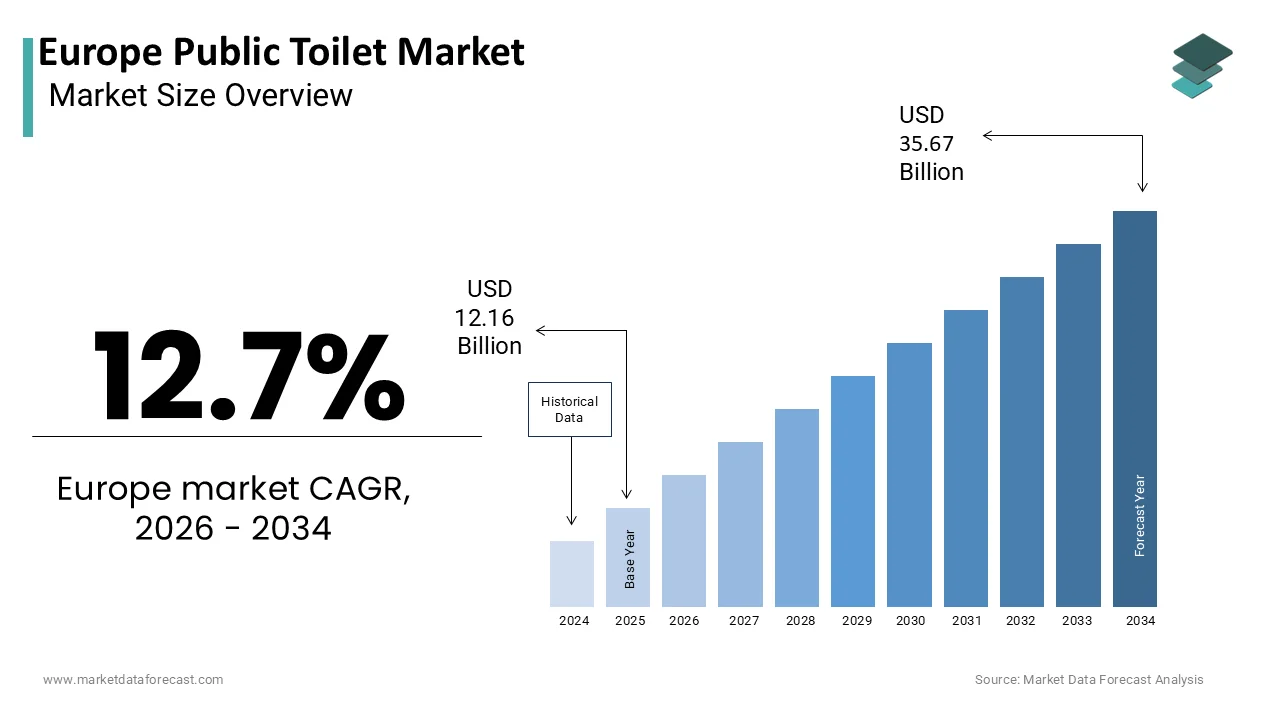
- Market Valuation: Valued at USD 12.16 billion in 2025, reaching USD 13.70 billion in 2026, and projected to expand to USD 35.67 billion by 2034, growing at a rapid CAGR of 12.7% across the forecast period from 2026 to 2034.
- Primary Growth Drivers: Rapid urbanization and increasing population density in major metropolitan areas, surging international tourism, and municipal adoption of smart IoT technologies and sustainable water conservation systems.
Key Market Segment Metrics
| Category | Leading Segment (Base Position) | Fastest-Growing / High-Growth Segment |
|---|---|---|
| By Application | Commercial (held a dominant market share, driven by massive transit passenger flows across airports, rail hubs, and high-traffic tourist destinations) | Residential (projected at a 5.8% CAGR, fueled by urban development projects featuring shared communal amenities and community-led sanitation) |
| By Distribution Channel | Offline (captured a significant share, anchored by complex municipal tendering processes, direct supplier negotiations, and custom engineering projects) | Online (projected at a 7.2% CAGR, propelled by the digital transformation of government procurement and transparent e-bidding platforms) |
| By Country | Germany (leading national market at 22.4% share, supported by heavy infrastructure investments, smart city initiatives, and leading sanitary ware brands) | France & United Kingdom (high-growth markets driven by massive international tourist volumes, accessibility mandates, and municipal reopening campaigns) |
Major Market Players & Industry Landscape
Market Structure: A dynamic infrastructure and urban furniture marketplace featuring major multinational operators utilizing advertising-subsidized models, alongside specialized sanitary manufacturers competing on self-cleaning technologies and water efficiency.
Key Companies: JCDecaux Group (Sanisette), Wall AG, Ströer SE & Co. KGaA, Cintas Corporation, TOI TOI & DIXI Group GmbH, PolyJohn Enterprises Corporation, Satellite Industries, Inc., 2theloo B.V., ONE HUNDRED Restrooms, ADCO International, TOTO Ltd., Geberit AG, and Roca Sanitario S.A.
 Download Free Sample Report
Europe Public Toilet Market Size
The Europe public toilet market was valued at USD 12.16 billion in 2025, is estimated to reach USD 13.70 billion in 2026, and is projected to reach USD 35.67 billion by 2034, growing at a CAGR of 12.7% from 2026 to 2034.
The public toilet is the design, construction, maintenance, and management of sanitary facilities accessible to the general public in urban and rural environments. These infrastructures are components of municipal services, ensuring public health, hygiene, and social inclusion across the continent. As per Eurostat, the urban population in the European Union reached 75% of the total in 2024, driving the need for expanded public amenities in densely populated areas. Furthermore, the European Commission emphasized the importance of inclusive urban planning through its Urban Agenda, which advocates for accessible and hygienic public spaces for all citizens, ns including those with disabilities. According to the World Health Organization, access to adequate sanitation is a fundamental human right, yet disparities remain in certain regions, prompting targeted investments. The rise in tourism also plays a pivotal role as cities strive to maintain high standards of cleanliness to attract visitors. Consequently, municipalities are adopting innovative solutions such as self-cleaning toilets and digital monitoring systems to enhance user experience and operational efficiency. This evolving landscape reflects a broader commitment to improving the quality of life and environmental stewardship in European cities.
MARKET DRIVERS
Rising Urbanization and Population Density in Major Cities
The rapid increase in urbanization and population density across major European cities is a primary factor boosting the growth of Europe public toilet market. As more people migrate to urban centers, the demand for public amenities, including sanitary facilities,s escalates significantly. According to the United Nations Department of Economic and Social Affairs, the urban population in Europe is projected to reach 80% by 20,30 necessitating substantial infrastructure upgrades. High-density areas often suffer from a shortage of public restrooms, leading to hygiene issues and public dissatisfaction. Cities like Lond, on, Pari, Paris, and Berlin are investing heavily in expanding their public toilet networks to accommodate growing populations. The Mayor of London announced a strategy in 2024 to install 500 new public toilets across the capital to address accessibility gaps. Furthermore, the concentration of commercial activities and entertainment venues in city centers creates peak usage times that require robust and durable facilities. This shift thus drives continuous investment in public toilet infrastructure to ensure adequate coverage and maintain public health standards in crowded urban environments.
Growth in Tourism and Hospitality Sector Activities
The robust growth in the tourism and hospitality sector is also boosting the growth of Europe public toilet market. Tourists constitute a large portion of public facility users, particularly in historic city centers and popular attractions. According to the European Travel Commission, international tourist arrivals in Europe reached 700 million in 2024, surpassing previous records and creating immense pressure on existing sanitation infrastructure. Popular destinations, such as Rome, Barcelona, and Amsterdam,m experience seasonal spikes in visitor numbers requiring scalable and efficient restroom solutions. As per the World Travel and Tourism Council, the contribution of travel and tourism to the European economy grew by 8% in 2024, amplifying its economic importance. The Spanish Ministry of Industry, Trade, and Tourism launched an initiative in 2025 to modernize public facilities in top tourist spots, aiming to improve visitor satisfaction scores. Furthermore, the presence of clean and accessible restrooms is a key factor in destination ratings and reviews, influencing traveler choices. The Italian National Institute of Statistics noted that cities with improved public sanitation saw a 12% increase in positive tourist feedback in 2024. This correlation between sanitation quality and tourism performance motivates municipalities and private stakeholders to invest in advanced public toilet technologies and regular maintenance protocols.
MARKET RESTRAINTS
High Operational and Maintenance Costs
The high operational and maintenance costs are limiting the ability of municipalities to expand and upgrade facilities, which is solely attributed to the degrading growth of Europe public toilet market. Public toilets require frequent cleaning, repair, and restocking of supplies, which incur substantial recurring expenses. According to the European Federation of Cleaning Industries, the cost of maintaining public restrooms in major cities averages 50000 euros per unit annually, including labor and materials. This financial burden often strains limited municipal budgets, leading to deferred maintenance and facility closures. The complexity of managing diverse facilities across large urban areas further exacerbates these challenges. The German Association of Cities reported that maintenance backlogs for public amenities increased by 15% in 2024 due to inflation and labor shortages. Additionally, the vandalism and misuse of public facilities result in frequent repairs and replacements, adding to the overall cost. These financial constraints force local authorities to prioritize other essential services over public sanitation, resulting in inadequate coverage and poor facility conditions. The lack of sustainable funding models thus hinders the development and upkeep of a comprehensive public toilet network.
Vandalism and Security Concerns
The vandalism and security concerns are affecting the longevity and usability of public facilities. Public restrooms are often targets for graffiti theft and structural damage,e which deters users and increases maintenance requirements. According to the European Forum for Urban Security, incidents of vandalism in public spaces increased by 10% in 2024, with restrooms being among the most affected areas. This persistent issue leads to higher insurance premiums and repair costs for municipalities. As per the Dutch Ministry of Justice and Security, property damage in public facilities resulted in 100 million euros in losses across the Netherlands in 2024. The fear of crime and unsafe conditions also discourages people from using public toilets,s particularly at night or in isolated locations. Furthermore, the need for enhanced security measures, res such as surveillance cameras and emergency buttons, adds to the initial installation costs. These safety concerns thus limit the willingness of local authorities to invest in new facilities and complicate the management of existing ones. The ongoing struggle to balance accessibility with security remains a critical challenge for the sector.
MARKET OPPORTUNITIES
Integration of Smart Technologies and IoT Solutions
The integration of smart technologies and Internet of Things (IoT) solutions is expected to substantially leverage the growth of Europe public toilet market. Smart toilets equipped with sensors can monitor usage levels, cleanliness, ss, and supply status in real time,ime enabling proactive maintenance. According to the European Commission, the adoption of IoT technologies in urban infrastructure is expected to reduce operational costs by 20% by 2030. These systems allow municipalities to optimize cleaning schedules and resource allocation, improving overall service quality. As per research, pilot projects in Berlin demonstrated a 30% reduction in water consumption through smart flushing systems in 2024. Furthermore, digital interfaces can provide users with information on availability and accessibility features, enhancing convenience. Additionally, data collected from these systems can inform future planning and investment decisions. These technological advancements thus offer a pathway to more sustainable and user-friendly public toilet services. The potential for remote monitoring and automated reporting further supports the modernization of public sanitation infrastructure.
Focus on Sustainability and Water Conservation Initiatives
The growing emphasis on sustainability and water conservation through the adoption of eco-friendly technologies is another attribute to fuel the growth of Europe public toilet market. Traditional flush toilets consume significant amounts of water, prompting a shift towards low-flow and waterless alternatives. According to the European Environment Agency, the average public toilet uses 6 liters of water per flush, contributing to substantial municipal water usage. Innovative solutions, such as vacuum flush systems and composting toilets,s can reduce water consumption by up to 90%. As per the Swedish Environmental Protection Agency, the installation of water-efficient fixtures in public facilities saved 1 million cubic meters of water in 2024. Furthermore, the use of recycled materials in construction and solar power for lighting aligns with broader environmental goals. Additionally, the recovery of nutrients from waste through advanced treatment processes supports circular economy principles. These sustainable practices not only reduce environmental impact but also lower long-term operational costs. The alignment with European Green Deal objectives thus drives the adoption of innovative and eco-conscious public toilet solutions.
MARKET CHALLENGES
Limited Public Funding and Budget Constraints
The limited public funding and budget constraints for the development and maintenance of adequate facilities are a key challenge for the growth of Europe public toilet market. Municipalities often face competing priorities for limited financial resources, making it difficult to allocate sufficient funds for public sanitation. According to the European Court of Auditors, local government budgets for public services decreased by 5% in real terms between 2020 and 2024 due to economic pressures. This reduction forces authorities to cut back on non-essential services, including public toilet provision. As per the UK National Audit Office, the closure of public toilets has saved local councils an average of 100000 pounds annually,y but at the cost of public accessibility. The lack of dedicated funding streams for sanitation infrastructure exacerbates the problem. Furthermore, economic uncertainty and inflation increase the cost of construction and maintenance, further straining finances. These financial limitations thus restrict the ability of local authorities to meet growing demand and maintain existing facilities. The reliance on intermittent grants and subsidies creates instability in long-term planning and investment.
Regulatory Hurdles and Planning Permissions
The regulatory hurdles and complex planning permissions by delaying project implementation and increasing costs are also expected to degrade the growth of Europe public toilet market. Installing public toilets often requires navigating multiple layers of approval from local, regional, and national authorities. According to the European Spatial Planning Observation Network, the average time for obtaining planning permission for public infrastructure projects is 18 months in Europe. This prolonged process delays the deployment of much-needed facilities and increases administrative expenses. As per the German Federal Building Code, strict zoning laws and heritage protection regulations often restrict the location and design of public restrooms in historic city centers. Furthermore, varying standards across different jurisdictions complicate the standardization of designs and operations. The Spanish Ministry of Territorial Policy stated that harmonizing local regulations for public facilities remains a significant challenge for national operators. Additionally, environmental impact assessments and public consultations add further layers of complexity to the approval process. These regulatory barriers thus hinder the timely and efficient expansion of public toilet networks across Europe.
REPORT COVERAGE
| REPORT METRIC | DETAILS |
| Market Size Available | 2025 to 2034 |
| Base Year | 2025 |
| Forecast Period | 2026 to 2034 |
| Segments Covered | By Application, Distribution Channel, and Region. |
| Various Analyses Covered | Global, Regional and Country-Level Analysis, Segment-Level Analysis, Drivers, Restraints, Opportunities, Challenges; PESTLE Analysis; Porter’s Five Forces Analysis, Competitive Landscape, Analyst Overview of Investment Opportunities |
| Countries Covered | UK, France, Spain, Germany, Italy, Russia, Sweden, Denmark, Switzerland, Netherlands, Turkey, Czech Republic, Rest of Europe |
| Market Leaders Profiled | JCDecaux Group, Sanisette, Cintas Corporation, TOI TOI & DIXI Group GmbH, PolyJohn Enterprises Corporation, Satellite Industries, Inc., 2theloo B.V., ONE HUNDRED Restrooms, ADCO International, TOTO Ltd., Geberit AG, Roca Sanitario S.A. |
SEGMENTAL ANALYSIS
By Application Insights
The commercial segment was the largest by holding a dominant share of the Europe public toilet market in 2025. Transportation hubs, such as airports,s railway stations, and bus terminals, along with major tourist attractions, generate immense demand for public toilets due to the constant flow of travelers and visitors. According to the survey, European airports handled over 1.2 billion passengers in 2024, thereby creating a critical need for accessible and hygienic restroom facilities. These high-traffic environments require durable and easy-to-clean fixtures that can withstand heavy usage without frequent breakdowns. Furthermore, the presence of clean and well-maintained toilets is a key factor in customer satisfaction ratings for transport operators and tourist sites. The direct correlation between facility quality and user experience drives continuous investment in commercial public toilets. The need to maintain high standards of cleanliness in these visible and heavily used spaces ensures that the commercial segment remains the primary focus for manufacturers and service providers.
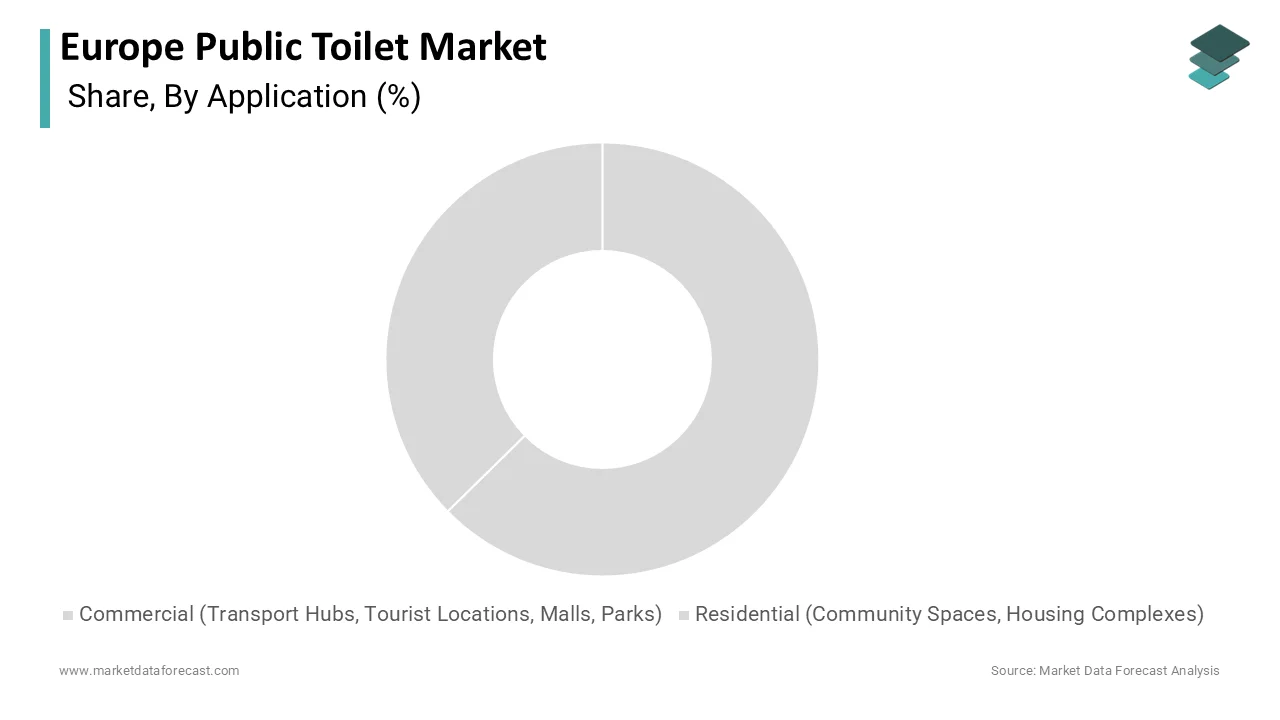
The residential segment is expected to witness the fastest CAGR of 5.8% from 2026 to 2034, with the urban development projects that include shared public amenities and the increasing trend of community-led sanitation initiatives in dense housing complexes. Modern urban development projects in Europe increasingly incorporate shared public amenities, including communal toilets and hygiene facilities, to enhance livability and social interaction. These projects aim to create inclusive communities where residents have access to high-quality public services within their neighborhoods. The developments often feature publicly accessible restrooms in communal gardens, parks, and recreational areas serving both residents and visitors. Furthermore, the integration of smart sanitation solutions in these residential areas enhances convenience and sustainability. This trend towards integrated living spaces drives the demand for aesthetically pleasing and functional public toilet units in residential zones.
By Distribution Channel Insights
The offline distribution channel segment held a significant share of the Europe public toilet market in 2025. The procurement of public toilets for municipal and commercial projects typically involves complex tendering processes and direct negotiations that favor offline channels. Government agencies and large private developers require detailed specifications, custom designs, and compliance certifications that are best handled through direct interactions with manufacturers and suppliers. The processes allow for thorough evaluation of technical proposals, site visits, and face-to-face negotiations, ensuring that the selected solutions meet specific project requirements. Furthermore, the need for customized solutions such as heritage-compatible designs or integrated smart systems requires close collaboration between buyers and suppliers.
The online distribution channel is expected to witness the fastest CAGR of 7.2% from 2026 to 2034. The digitalization of procurement processes is accelerating the growth of the online distribution channel for public toilets. Governments and private entities are increasingly adopting e-procurement platforms to streamline bidding and purchasing activities. These platforms allow buyers to easily compare product prices and supplier credentials, simplifying the decision-making process. Furthermore, the availability of detailed product information, virtual tours,s and customer reviews online helps buyers make informed decisions without extensive physical visits. The shift towards digital efficiency enables faster acquisition of standardized toilet units and accessories. The growing comfort with online transactions among procurement professionals thus supports the rapid expansion of the online channel.
COUNTRY LEVEL ANALYSIS
Germany Public Toilet Market Analysis
Germany was the top performer in the Europe public toilet market by holding 22.4% othe f share in 2025. The public hygiene and advanced infrastructure drive the demand for high-quality sanitation facilities. According to the German Federal Ministry for Digital and Transport, investments in public amenities reached 2 billion euros in 2024, supporting the modernization of restrooms in cities and transport hubs. The presence of leading manufacturers such as Geberit and Duravit fosters innovation and local supply chain strength. As per the German Engineering Federation, exports of sanitary ware from Germany reached 3 billion euros in 202,4 reflecting strong global demand. The country’s focus on smart city initiatives encourages the adoption of sensor-based and self-cleaning toilets. Furthermore, strict environmental regulations promote the use of water-saving technologies.
France Public Toilet Market Analysis
France public toilet market was ranked second, holding 18.4% of the market share in 2025. The tourism industry and historic urban centers drive the need for accessible and aesthetically pleasing public toilets. According to the French Ministry of Europe and Foreign Affairs, international tourist arrivals reached 90 million in 2024, creating significant demand for public sanitation. As per the City of Paris, 100 new eco-friendly toilets were installed in 2025 to enhance cleanliness and sustainability. The presence of major players such as Porcher and Jacob Delafon contributes to local innovation. Furthermore, regulations requiring accessible toilets in all public spaces drive the adoption of compliant fixtures. The strategic investments and regulatory frameworks maintain France’s strong position in the European market.
United Kingdom Public Toilet Market Analysis
The United Kingdom public toilet market growth is likely to grow with the public health and addressing the closure of public facilities. According to the UK Local Government Association, campaigns to reopen and upgrade public toilets gained momentum in 2024 with several councils allocating dedicated budgets. The presence of established manufacturers such as Twyford and Ideal Standard supports local supply. As per the British Toilet Association, over 200 new public toilets were planned or opened in 2025 to address accessibility gaps. The government’s emphasis on inclusive cities encourages the installation of changing places toilets for people with severe disabilities. Furthermore, the adoption of self-cleaning technologies in high-traffic areas improves hygiene standards.
Italy Public Toilet Market Analysis
Italy's public toilet market growth is likely to grow with its rich cultural heritage and high tourist volumes, driving the demand for well-maintained public facilities. According to the Italian National Institute of Statistics, international tourists spent 45 billion euros in 2024, the economic importance of tourism. Cities like Rome, Venice,e and Florence invest heavily in public restrooms to maintain their appeal. As per the Italian Ministry of Cultural Heritage and Activities, 50 million euros were allocated for urban hygiene improvements in 2025. The presence of renowned sanitary ware brands such as Catalano and Pozzi Ginori supports local innovation. Furthermore, regulations requiring historic compatibility in city centers drive the demand for customized designs. The City of Rome stated that heritage-compatible toilets were installed in key tourist areas in 2025. These strategic investments and focus on tourist satisfaction maintain Italy’s competitive position in the regional market.
Spain Public Toilet Market Analysis
Spain's public toilet market growth is likely to be driven by the vibrant tourism sector and urban renewal projects, which fuel the demand for public sanitation facilities. According to the Spanish Ministry of Industry, Trade, and Tourism, international arrivals reached 80 million in 2024, driving the need for adequate public amenities. Cities like Barcelona and Madrid are upgrading their public toilet networks to meet international standards. The presence of major manufacturers such as Roca supports local production and innovation. Furthermore, the adoption of sustainable technologies such as solar-powered lights and water-saving flushes aligns with environmental goals. The Spanish Ministry for Ecological Transition stated that green public toilet projects received 10 million euros in funding in 2025.
COMPETITIVE LANDSCAPE
The competition in the Europe public toilet market is characterized by a mix of large multinational corporations and specialized local providers competing on service quality and technological innovation. Major players such as JCDecuax, Wall AG, and Ströer dominate the landscape through extensive networks and advertising-supported business models. These companies leverage their scale to offer comprehensive maintenance and modernization services that meet stringent hygiene standards. New entrants face barriers due to high initial investment costs and complex regulatory requirements for public infrastructure. Competitive dynamics are influenced by the growing demand for smart and sustainable solutions, which drive continuous innovation in self-cleaning and water-saving technologies. Price competition is moderate as municipalities prioritize reliability and user experience over the lowest cost. Strategic alliances with local governments are crucial for securing contracts and expanding market presence. The focus on environmental sustainability and digital integration differentiates competitors as they strive to align with European Green Deal objectives.
KEY MARKET PLAYERS
Some of the companies that are playing a dominating role in the global Europe Public Toilet Market include
- JCDecux Group
- Sanisette (JCDecaux brand)
- CINTAS Corporation
- TOI TOI & DIXI Group GmbH
- PolyJohn Enterprises Corporation
- Satellite Industries, Inc.
- 2theloo B.V.
- ONE HUNDRED Restrooms
- ADCO International
- TOTO Ltd.
- Geberit AG
- Roca Sanitario S.A.
TOP LEADING PLAYERS IN THE MARKET
- JJCDecuxSA is a global leader in urban furniture and public sanitation solutions with a significant presence in the Europe public toilet market. The company operates thousands of self-cleaning public toilets across major European cities, providing hygienic and accessible facilities for residents and tourists.JCDecuxx contributes to the global market by leveraging its advertising-supported business model, which subsidizes the cost of installation and maintenance. Recent actions include the deployment of next-generation automated toilets equipped with advanced sensors and eco-friendly cleaning systems in Paris and London. These innovations enhance user experience and reduce environmental impact. The firm actively collaborates with municipal authorities to integrate smart city technologies into public infrastructure.
- Wall AG is a prominent provider of public toilet services in Europe, known for its innovative design and commitment to cleanliness. The company manages a vast network of attended and automated facilities in key German cities and other European locations. Wall AG contributes to the global market by setting high benchmarks for hygiene and customer service in public sanitation. Recent efforts to strengthen its market position include the introduction of luxury restroom concepts that offer premium amenities for a small fee. The company has also invested in water-saving technologies and solar-powered units to align with environmental regulations. Wall AG partners with local governments to ensure comprehensive coverage and accessibility. Its focus on combining functionality with aesthetic appeal helps redefine public perceptions of sanitation.
- Ströer SE & Co KGaA is a leading out-of-home media and marketing company that plays a vital role in the Europe public toilet market through its urban furniture division. The company provides and maintains public restrooms as part of its broader cityscape management services. Ströer contributes globally by integrating sanitation facilities into its advertising networks, creating sustainable revenue streams. Recent actions include the rollout of smart toilets with digital interfaces and real-time monitoring capabilities in major metropolitan areas. The firm focuses on enhancing accessibility and hygiene through regular maintenance and technological upgrades. Ströer collaborates with city planners to optimize the location and design of public facilities. Its commitment to innovation and sustainability drives the adoption of energy-efficient solutions.
TOP STRATEGIES USED BY THE KEY MARKET PARTICIPANTS
Key players in the Europe public toilet market primarily focus on technological innovation and sustainability to maintain a competitive advantage. Companies invest heavily in developing self-cleaning and water-efficient systems that reduce operational costs and environmental impact. Strategic partnerships with municipal authorities are common to secure long-term contracts and integrate facilities into urban planning. Expansion of advertising-supported models helps firms subsidize maintenance costs and ensure financial viability. Digitalization strategies, including the use of Internet of Things sensors,n enable real-time monitoring and predictive maintenance, improving service quality. Many participants pursue green certifications and adopt renewable energy sources to align with regulatory requirements. Acquisitions of smaller specialized firms allow larger players to broaden their service portfolios and geographic reach. These approaches enable manufacturers and operators to meet evolving customer demands while improving operational efficiency and enhancing the overall user experience in public sanitation infrastructure.
MARKET SEGMENTATION
This research report on the europe public toilet market is segmented and sub-segmented into the following categories
By Application
- Commercial (Transport Hubs, Tourist Locations, Malls, Parks)
- Residential (Community Spaces, Housing Complexes)
By Distribution Channel
- Offline (Direct Tendering, Contractors, Suppliers)
- Online (E-Procurement Platforms, Digital Marketplaces)
By Country
- Germany
- France
- United Kingdom
- Italy
- Spain
- Rest of Europe