- Product Description Description
- Table of Contents TOC
- List of Table & Figure LOT
- Get Free Sample PDF Sample PDF
Market Size, 2025
$0.47 BnMarket Estimate, 2026
$0.63 BnMarket Forecast, 2034
$7.03 BnCAGR, 2026–2034
35.22%Europe Quantum Cryptography Market Size, Growth, Trends & Forecast (2026–2034)
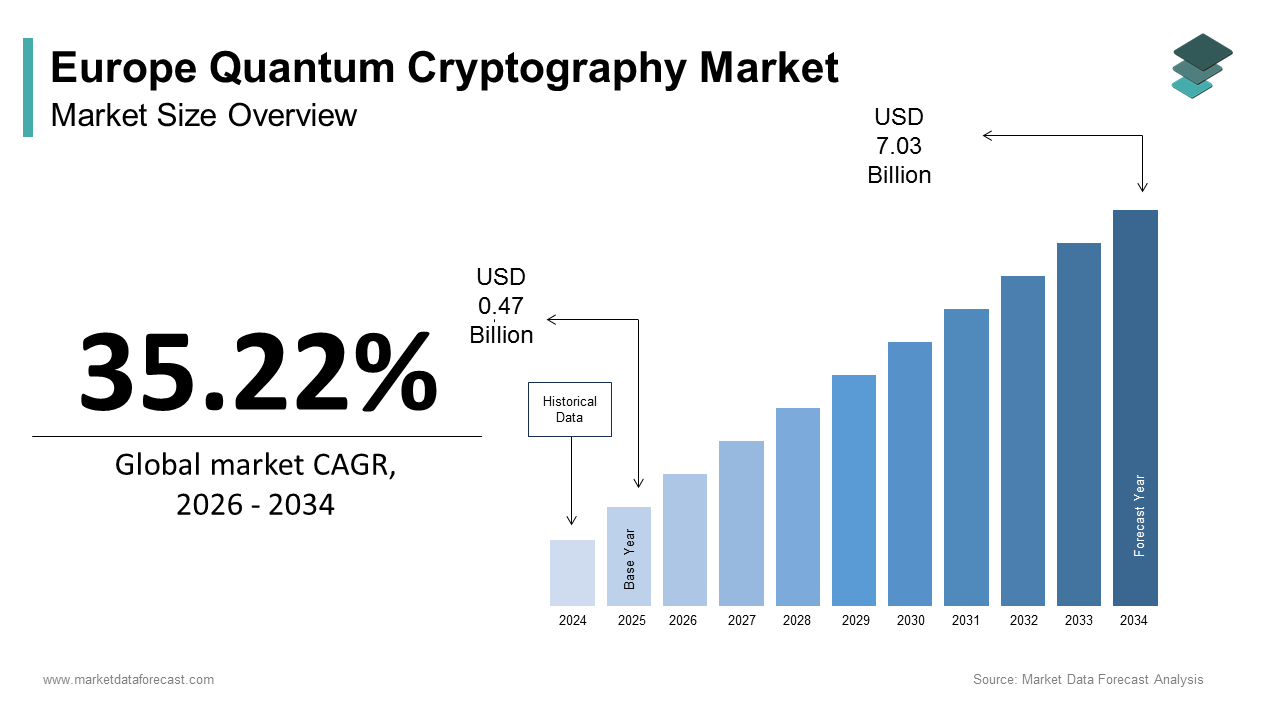
The Europe quantum cryptography market size was calculated to be USD 0.47 billion in 2025, reached USD 0.63 billion in 2026, and is anticipated to be worth USD 7.03 billion by 2034, growing at a compound annual growth rate (CAGR) of 35.22% during the forecast period from 2026 to 2034. Driven by the strategic deployment of the European Quantum Communication Infrastructure (EuroQCI), rising cyber threats targeting critical infrastructure, and government digital sovereignty mandates, the market is experiencing rapid transformation.
Key Executive Metrics (At-a-Glance)
- 2025 Base Valuation: USD 0.47 Billion
- 2026 Current Valuation: USD 0.63 Billion
- 2034 Forecast Valuation: USD 7.03 Billion
- Compound Annual Growth Rate (CAGR): 35.22% (2026–2034)
- Dominant Regional Market: Germany (holding a 25.5% market share in 2025 via national QKD backbones, Fraunhofer leadership, and critical infrastructure protection)
- Key Growth Segments: Government & Defense, BFSI, Network & Application security, Services, and Solution offerings
Core Market Drivers & Growth Triggers
- EuroQCI Deployment: The rollout of the European Union's sovereign quantum communication infrastructure linking terrestrial fiber and satellite links to secure sensitive data flows.
- Cyber Threat Escalation: Growing incidence of ransomware, data exfiltration, and "harvest now, decrypt later" attacks targeting critical national infrastructure and financial systems.
Primary Market Restraints & Challenges
- Transmission & Integration Barriers: Photon loss limits in fiber optics, high infrastructure costs, and complex integration requirements with legacy security architectures.
- Interoperability & Talent Gaps: Absence of standardized cross-vendor QKD protocols and a critical deficit in specialized quantum engineering human capital.
Europe Quantum Cryptography Market Segmentation Breakdown
| Segment Category | Largest Segment / Leader | Fastest-Growing Segment |
|---|---|---|
| By Vertical | Government & Defense (Held 56.5% share in 2025 due to state mandates protecting classified communications and critical infrastructure) | BFSI (Projected at a 35.5% CAGR driven by defense against "harvest now, decrypt later" financial data threats) |
| By Security Type | Network Security (Accounted for 81.5% share in 2025 as the fundamental layer securing data in transit across fiber/space channels) | Application Security (Estimated at a 32.3% CAGR via QRNG and quantum entropy integration into TLS and database encryption) |
| By Offering | Solution (Led with 71.6% share in 2025 via hardware-intensive QKD appliances and QRNG photonics infrastructure) | Services (Predicted at a 38.8% CAGR due to rising demand for quantum integration consulting, managed QKD, and compliance auditing) |
| By Region | Germany (Held 25.5% share in 2025, anchored by national QKD testbeds, Fraunhofer research, and sovereign industrial policy) | UK / France (Expanding rapidly through defense integration, central bank trials, and advanced sovereign cloud corridors) |
Major Industry Players Profiled
Key corporations shaping the Europe quantum cryptography market include Magiq Technologies, Inc, Quintessencelabs, Crypta Labs Ltd, Infineon Technologies AG, ID Quantique, Toshiba, NXP Semiconductors, IDEMIA, Palo Alto Networks, Thales, PQShield Ltd, CryptoNext Inc, Crypto Quantique, ETAS, and LuxQuanta.
Europe Quantum Cryptography Market Size
The Europe quantum cryptography market size was calculated to be USD 0.47 billion in 2025 and is anticipated to be worth USD 7.03 billion by 2034, from USD 0.63 billion in 2026, growing at a CAGR of 35.22% during the forecast period.
Quantum cryptography refers to the application of quantum mechanical principles to secure communication channels against computational and future quantum attacks. Unlike classical encryption, which relies on mathematical complexity, quantum cryptography leverages the laws of physics to detect eavesdropping through quantum state disturbance, which is ensuring information-theoretic security. The European landscape is shaped by strategic initiatives such as the EU’s Quantum Flagship program, national quantum strategies, and critical infrastructure protection mandates. According to the European Commission, the EuroQCI initiative is scheduled for initial deployment by 2026, which is establishing a continent‑wide quantum communication infrastructure that integrates terrestrial fiber networks and satellite links to secure sensitive data flows. As per Eurostat, Europe’s critical infrastructure across energy, finance, and healthcare processes vast volumes of sensitive information daily, underscoring the urgent need for quantum‑resistant security. The European Union Agency for Cybersecurity has classified quantum key distribution as a high‑assurance solution for protecting data with long‑term sensitivity, particularly in defense and public administration. Pilot projects in Germany, France, and Switzerland have already demonstrated operational QKD links between government sites, marking the transition of quantum cryptography from research environments to sovereign security infrastructure. With the EU’s Global Gateway and IRIS² satellite program supporting interoperability, quantum communication is evolving into a strategic pillar of Europe’s cybersecurity framework.
MARKET DRIVERS
Integration of Quantum Cryptography into the European Quantum Communication Infrastructure (EuroQCI)
The integration of quantum cryptography into Europe’s sovereign communication backbone is emerging as the most significant driver of the regional market growth. According to the European Commission, the EuroQCI initiative, endorsed by all 27 EU member states, is scheduled for deployment beginning in 2026, combining terrestrial fiber networks and satellite links to secure sensitive communications. As per the Digital Europe Programme, funding has been allocated to support EuroQCI development, with pilot projects already linking secure sites in several EU capitals. The infrastructure will eventually connect strategic locations such as government institutions, military facilities, and financial centers. According to the European Defence Agency, EuroQCI is expected to play a role in protecting classified communications for EU military operations. National implementations are advancing, with France and Germany already testing QKD backbones for secure government data exchange. This sovereign investment transforms quantum cryptography from a niche technology into a mandatory layer for high assurance communications, creating sustained demand across public sector entities.
Rising Cyber Threats Against Critical National Infrastructure and Financial Systems
The growing sophistication of cyber threats targeting Europe’s critical infrastructure is accelerating the adoption of quantum secure technologies, which is further boosting the quantum cryptography market expansion in Europe. According to the European Union Agency for Cybersecurity, ransomware and data exfiltration remain among the most significant threats to energy, transport, and healthcare operators. As per the European Central Bank, systemic cyber risks to financial infrastructures are a major concern, with attackers increasingly attempting to harvest encrypted data for future decryption using quantum computers. This “harvest now, decrypt later” threat has prompted institutions such as the Bank of France and Deutsche Börse to explore QKD for secure inter‑data center links. The European Banking Authority has issued guidance on strengthening resilience in digital finance, encouraging exploration of quantum‑secure methods. Additionally, the European Health Data Space initiative emphasizes the need for advanced security measures to protect sensitive patient data. These high-consequences use cases validate quantum cryptography as an urgent operational necessity rather than a speculative defense.
MARKET RESTRAINTS
Limited Transmission Distance and High Infrastructure Dependency
The technical limitations of QKD systems remain a major challenge to their widespread adoption across Europe, which is impeding the growth of the European quantum cryptography market. According to the Joint Research Centre, photon loss in optical fiber restricts practical transmission distances, requiring trusted nodes or quantum repeaters to extend coverage. As per the European Commission’s EuroQCI feasibility studies, building a fully connected quantum network across the EU will require extensive infrastructure, including secure nodes and satellite links. Satellite‑based QKD missions such as Eagle‑1 are being developed, but remain limited to intermittent line‑of‑sight passes, making them unsuitable for continuous high‑throughput needs. These constraints confine quantum cryptography to high‑value, short‑distance applications, hindering broad enterprise adoption and increasing costs.
Absence of Standardized Interoperability Protocols Across Vendors and Nations
The lack of harmonized standards across Europe is slowing down the scalability of quantum cryptography solutions, which is further hampering the expansion of the European quantum cryptography market. According to the European Telecommunications Standards Institute, multiple proprietary QKD protocols are currently deployed across EU testbeds, with incompatible specifications that hinder seamless interoperability. France, Germany, and Italy have adopted different vendor solutions, making cross‑border key exchange technically complex. As per the European Committee for Standardization, only preliminary guidelines have been published, with full ETSI QKD standards expected in the coming years. Fraunhofer Institute studies highlight that interoperability challenges increase deployment costs for multinational organizations. Until a single EU‑wide QKD interface standard is mandated, quantum cryptography will remain fragmented, undermining the strategic goal of a unified quantum‑secure Europe and discouraging private sector investment.
MARKET OPPORTUNITIES
Deployment in Secure Cloud and Data Center Interconnects for Sovereign Cloud Initiatives
Europe’s push for digital sovereignty is creating a high-value opportunity for the European quantum cryptography market. The Gaia X framework, supported by Germany, France, and the Netherlands, aims to create a federated European cloud infrastructure compliant with EU data protection and security rules. As per the Gaia X Association, dozens of certified cloud providers are building interconnected data centers that must protect data in transit against both current and future threats. In 2024, Orange and Deutsche Telekom announced a quantum-secured cloud corridor between Frankfurt and Paris using QKD over dedicated fiber, enabling encrypted virtual machine migration with frequently refreshed keys. According to the European Commission, billions of euros have been allocated under the Digital Europe Programme to secure cloud infrastructure, positioning quantum cryptography as a foundational layer for Europe’s trusted digital ecosystem.
Integration with 5G and Future 6G Mobile Network Security Architectures
The evolution of mobile networks toward ultra-secure and ultra-reliable communication is opening a strategic avenue for quantum cryptography in next generation wireless infrastructure. As per the Hexa‑X European 6G Vision published in 2024, quantum key distribution is identified as a candidate technology for securing control plane signalling in 6G networks, particularly for critical services such as autonomous vehicle coordination and remote surgery. While current 5G networks rely on classical key exchange, the EU’s Secure 5G Implementation Framework mandates pilot projects integrating QKD for high-risk slices. In 2024, Vodafone and the University of Bristol demonstrated a hybrid fiber‑wireless QKD system delivering keys to 5G base stations in Bristol with latency suitable for ultra-reliable low-latency communication requirements. According to the European Telecom Market Observatory, millions of 5G base stations are expected to be deployed across Europe by 2030, many serving critical infrastructure. Quantum cryptography’s ability to provide forward secrecy aligns with 3GPP’s security objectives for beyond 5G systems. As Europe leads global 6G standardization through initiatives like Hexa‑X, early integration of quantum keying protocols could establish a technological and regulatory advantage, transforming mobile networks into quantum secure communication fabrics.
MARKET CHALLENGES
Extreme Cost and Complexity of System Integration with Legacy Security Infrastructures
Deploying quantum cryptography in operational European environments remains prohibitively expensive and technically complex due to incompatibility with existing classical encryption ecosystems, which is a notable challenge to the growth of the European quantum cryptography market. As per the European Investment Bank’s 2024 deep tech infrastructure review, QKD links are significantly more costly than classical high-grade key distribution, requiring specialized hardware and fiber leasing. Moreover, integrating QKD with legacy network security architectures such as IPsec or MACsec requires custom gateways and key management interfaces that lack standardized APIs. According to the German Federal Office for Information Security, integration efforts at federal agencies have required extended timelines and dedicated teams of quantum and network engineers. Most enterprise security operations centers lack the expertise to monitor quantum channel health or diagnose photon detector failures, leading to operational fragility. While cloud-managed QKD services are emerging, they introduce latency and trust assumptions that contradict the physics-based security premise. Until quantum key delivery can be abstracted into plug-and-play modules compatible with existing security orchestration platforms, adoption will remain confined to well-funded government and research entities.
Shortage of Specialized Quantum Talent and Fragmented Academic to Industry Pipeline
Europe faces a critical deficit in quantum engineering talent capable of designing, deploying, and maintaining quantum cryptography systems, which is constraining market scalability and challenging the regional market expansion. According to the European Quantum Industry Consortium, fewer than 1,200 professionals in the EU possess hands-on experience in quantum communication hardware as of 2024, while demand from EuroQCI alone is expected to require several thousand specialists by 2027. As per the European Research Council, only a limited number of European institutions currently offer lab-based courses in QKD system integration. The mismatch is acute in Southern and Eastern Europe, where national quantum initiatives lack academic infrastructure. Companies such as ID Quantique and Toshiba Europe report long recruitment times for quantum network engineers. Although the EU’s Quantum Flagship has funded dozens of doctoral programs since 2018, many graduates pursue academic or quantum computing roles rather than applied cryptography. This talent gap inflates labor costs and delays project timelines. Without a coordinated EU-wide upskilling strategy and industry-aligned curricula, the quantum cryptography market will remain bottlenecked by human capital shortages despite abundant funding and political will.
REPORT COVERAGE
| REPORT METRIC | DETAILS |
| Market Size Available | 2025 to 2034 |
| Base Year | 2025 |
| Forecast Period | 2026 to 2034 |
| CAGR | 35.22% |
| Segments Covered | By Vertical, Security Type, Offering, And Region |
| Various Analyses Covered | Global, Regional & Country Level Analysis; Segment-Level Analysis; DROC, PESTLE Analysis; Porter’s Five Forces Analysis; Competitive Landscape; Analyst Overview of Investment Opportunities |
| Regions Covered | UK, France, Spain, Germany, Italy, Russia, Sweden, Denmark, Switzerland, Netherlands, Turkey, and the Czech Republic |
| Market Leaders Profiled | Magiq Technologies, Inc, Quintessencelabs, Crypta Labs Ltd, Infineon Technologies AG, Id Quantique, Toshiba, NXP Semiconductors, IDEMIA, Palo Alto Networks, Thales, PQShield Ltd, CryptoNext Inc, Crypto Quantique, ETAS, LuxQuanta |
SEGMENTAL ANALYSIS
By Vertical Insights
The government & defense segment dominated the market by holding 56.5% of the European market share in 2025. The growth of the government & defense segment in the European market is attributed to the sector’s mandate to protect state secrets, critical infrastructure, and classified communications against emerging quantum threats. According to the European Commission, EuroQCI prioritizes defense and governmental sites for initial deployment. Pilot projects have already demonstrated secure QKD links between EU institutions and national agencies. France’s ANSSI and Germany’s BSI have tested QKD backbones for secure government data exchange. According to the European Union Agency for Cybersecurity, quantum cryptography is classified as a high‑assurance solution for protecting data with long‑term sensitivity, particularly in defense and public administration. With hundreds of high‑assurance sites scheduled for quantum protection under EuroQCI by 2027, this vertical will remain the bedrock of European quantum cryptography adoption.
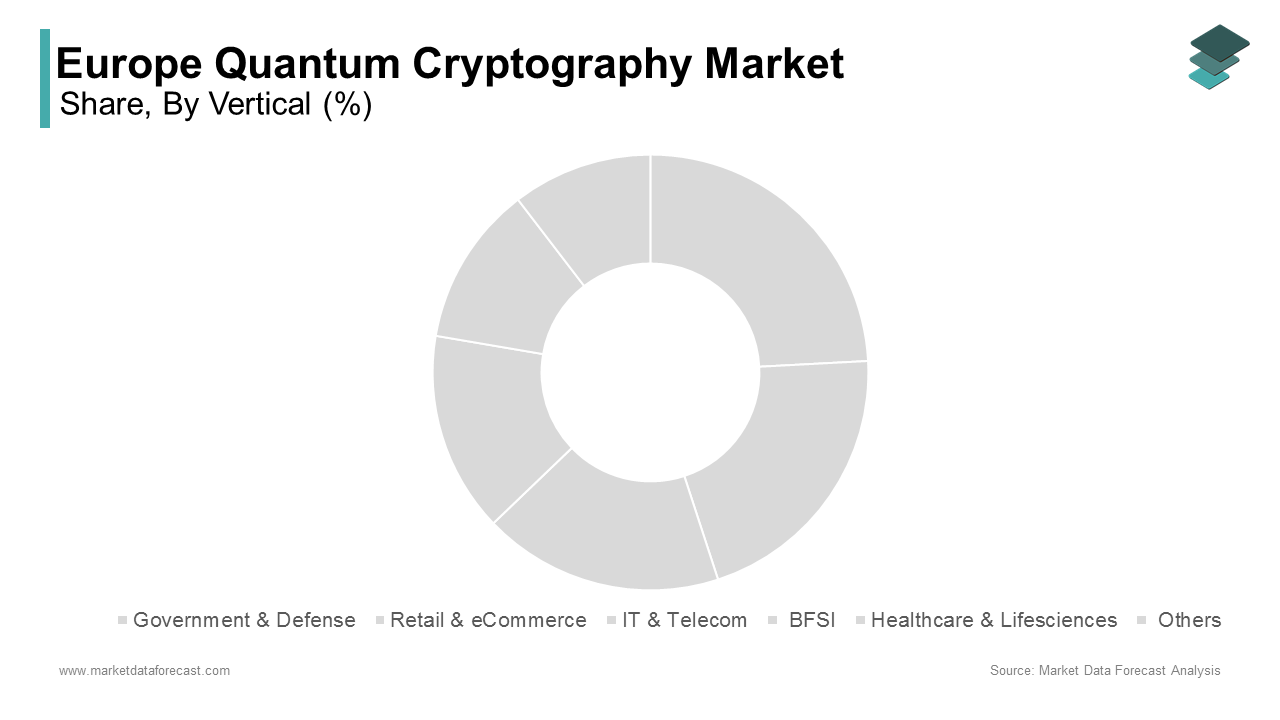
The BFSI vertical is the fastest-growing segment and is estimated to witness a CAGR of 35.5% in the European market over the forecast period. The exposure to “harvest now, decrypt later” attacks, where adversaries collect encrypted financial data today for future decryption using quantum computers, is fuelling the growth of the BFSI segment in the European market. According to the ECB, Eurozone clearing and settlement systems process trillions of euros in daily transactions, requiring long‑term cryptographic assurance. Leading banks such as BNP Paribas, Deutsche Bank, and ING have initiated QKD pilots for secure inter‑data center replication. As per the European Banking Authority, recent cyber resilience guidelines encourage exploration of quantum‑secure key exchange for high‑value transactions. The Eurosystem’s T2 settlement platform is evaluating QKD integration for its next upgrade cycle. With financial data retaining sensitivity for decades and regulatory pressure mounting, BFSI is rapidly transitioning from post‑quantum cryptography trials to physics‑based quantum keying for its most critical operations.
By Security Type Insights
The network security segment accounted for the leading share of 81.5% of the European market in 2025. The growth of the network security segment in the European market is attributed to the fact that e quantum cryptography is fundamentally a network‑layer technology designed to secure data in transit across fiber optic or free‑space channels. Current implementations focus on point‑to‑point or trusted node networks that deliver symmetric keys to encrypt traffic between data centers, government facilities, or financial institutions. According to the European Commission, extensive fiber networks across Germany, France, and Switzerland have been provisioned for QKD, with expansion planned through 2026. National cybersecurity agencies such as Germany’s BSI and France’s ANSSI mandate network‑level quantum protection for communications involving classified or critical infrastructure data. Since quantum cryptography secures the conduit itself rather than the application or endpoint, network security remains the natural and dominant application domain for this technology across Europe.
The application security segment is the fastest-growing security type segment and is predicted to grow at a CAGR of 32.3% over the forecast period, owing to the integration of quantum random number generators (QRNGs) and quantum‑derived keys into application‑level security protocols such as TLS 1.3, database encryption, and digital signing workflows. According to the Gaia‑X sovereign cloud framework, certified European cloud providers are required to ensure quantum‑resistant key creation for virtual machines and containers. Companies such as Quside and QuintessenceLabs now offer API‑based quantum entropy services, enabling developers to embed true randomness into financial trading algorithms, health data anonymization, and blockchain consensus mechanisms. The European Health Data Space pilot in Estonia has tested quantum‑derived keys to encrypt genomic records at the application level, ensuring long‑term privacy. As zero‑trust architectures demand continuous re‑authentication and ephemeral keys, quantum entropy is becoming embedded in the application security stack, driving this high-growth trajectory.
By Offering Insights
The solution segment led the market by commanding for 71.6% of the European market share in 2025. This dominance arises because quantum cryptography deployment is inherently hardware‑intensive, requiring specialized photon sources, single‑photon detectors, polarization controllers, and dedicated fiber interfaces. A typical QKD system includes on‑premise appliances such as ID Quantique’s Clavis or Toshiba’s QKD transceivers. According to the European Commission, the majority of EuroQCI’s budget is allocated to capital expenditure on physical infrastructure rather than services. Quantum random number generator hardware is also embedded in high‑assurance servers used by central banks and defense agencies. Unlike software‑based security solutions, quantum cryptography cannot be virtualized or delivered purely as code due to its reliance on quantum physical phenomena. This hardware‑anchored nature ensures that the solution segment remains the primary value driver in the market.
The services segment is the fastest-growing offering and is predicted to register a CAGR of 38.8% over the forecast period in this regional market due to the operational complexity of managing quantum‑secure networks, which require specialized integration consulting, managed security operations, and compliance auditing. Most European organizations lack in‑house quantum expertise, prompting reliance on vendors such as Thales, Atos, and Accenture to design, deploy, and maintain QKD networks. In 2024, Deutsche Telekom announced a managed QKD service for financial institutions offering monitoring, key rotation, and incident response. According to ENISA, EuroQCI participants must undergo third‑party validation of quantum system integrity, creating demand for certification and audit services. Additionally, as sovereign cloud platforms like Gaia‑X scale, they outsource quantum key management to specialized service providers who integrate QKD with cloud orchestration layers. With the European Commission allocating significant funding to quantum cybersecurity services under Horizon Europe 2023–2027, this segment is evolving from ancillary support to a strategic enabler of scalable quantum security adoption.
REGIONAL ANALYSIS
Germany Quantum Cryptography Market Analysis
Germany held the leading position in the European quantum cryptography market in 2025, holding 25.5% of the regional market share. The country’s leadership results from its dual role as a technology developer and sovereign adopter. Germany hosts multiple quantum communication testbeds through Fraunhofer and university collaborations. According to BSI, Germany launched its first national QKD backbone pilot connecting Berlin and Bonn, with expansion planned to other federal sites. Germany also contributes significantly to EuroQCI implementation, with national funding allocated to protect critical infrastructure, including energy grids. The Fraunhofer Society operates the Quantum Communication Lab in Berlin, which has validated long‑distance QKD links over standard fiber. With strong industry‑academia collaboration and national competence networks training quantum engineers, Germany remains the continent’s primary engine of quantum cryptography innovation and deployment.
France Quantum Cryptography Market Analysis
France held a promising share of the European quantum cryptography market in 2025. The growth of France in the European market is driven by the country’s strategy, which centers on national sovereignty, with QKD integrated into defense intelligence and nuclear command systems. ANSSI has launched pilot QKD networks in Paris to secure communications between government institutions. The French Armed Forces are preparing for integration with satellite‑based QKD through the Eagle‑1 mission. France co‑leads EuroQCI, contributing to technical standards for trusted node architecture. CNRS operates quantum networking testbeds linking research labs in Paris, Lyon, and Rennes. According to France 2030, hundreds of millions of euros are allocated to quantum communications, with mandatory QKD adoption for classified data planned by 2027. France exemplifies the fusion of civil and military quantum security strategy.
United Kingdom Quantum Cryptography Market Analysis
The United Kingdom is estimated to grow at a prominent share of the European quantum cryptography market during the forecast period. Despite Brexit, the UK remains integrated into European quantum initiatives through Horizon Europe and alignment with EuroQCI standards. The UK’s strength lies in financial and research applications. The Bank of England and London Stock Exchange have initiated pilots to secure market data feeds using QKD. The UK Quantum Network, operated by BT and Toshiba, links Cambridge, Bristol, and London, with expansion planned to Edinburgh and Manchester. The National Quantum Computing Centre in Harwell hosts hybrid test environments combining QKD and post‑quantum cryptography. Innovate UK has allocated funding to quantum secure communications, focusing on SME adoption and interoperability. With London’s role as a global financial hub and strong university ecosystem, the UK maintains a strong influence in shaping practical quantum cryptography deployment models.
Switzerland Quantum Cryptography Market Analysis
Switzerland is expected to grow at a healthy CAGR in the European quantum cryptography market during the forecast period. Though not an EU member, Switzerland plays an outsized role as a neutral testbed and standards contributor. Geneva hosts the SwissQuantum backbone, linking CERN, the University of Geneva, and the cantonal administration. ID Quantique, headquartered in Geneva, supplies QKD systems globally and co‑authored ETSI QKD standards. The Swiss government mandates quantum secure communication for federal data involving sensitive records under its updated Data Protection Act. Swisscom has launched commercial QKD services for banks and pharmaceutical firms. Switzerland’s neutrality allows it to host cross‑border quantum trials between EU and non‑EU entities, making it a trusted intermediary. With a large share of European interoperability tests conducted on Swiss infrastructure, the country functions as Europe’s de facto quantum cryptography laboratory.
Netherlands Quantum Cryptography Market Analysis
The Netherlands is projected to grow at a steady CAGR in the European quantum cryptography market over the forecast period. The country is distinguished by its leadership in quantum networking and cloud integration. QuTech, a collaboration between Delft University of Technology and TNO, operates the Dutch Quantum Internet testbed connecting Delft, The Hague, Amsterdam, and Leiden, with plans to extend to Brussels. SURF, the national research network, has tested QKD links for secure data sharing in the European Open Science Cloud. Dutch cloud providers are integrating quantum random number generators into sovereign cloud offerings. The Dutch National Bank participates in Eurosystem pilots for settlement system protection. According to Quantum Delta NL, hundreds of millions of euros are invested in quantum technology through 2027, with a national goal to achieve a functional quantum internet by 2028. The Netherlands is positioning itself as the backbone of Europe’s quantum communication fabric through academic excellence and pragmatic infrastructure integration.
COMPETITION OVERVIEW
The Europe quantum cryptography market is characterized by a concentrated yet dynamic competitive landscape dominated by specialized quantum hardware firms and large defense technology integrators. Competition is driven by technical excellence in key rate transmission distance and system reliability rather than price, as deployments target high-assurance government and financial use cases. Incumbents like ID Quantique and Toshiba benefit from years of R and D and early involvement in national testbeds, while defense giants like Thales leverage existing government contracts and systems integration capabilities. New entrants face high barriers due to the need for photonics expertise, regulatory certifications, and access to secure fiber networks. The market is further shaped by the European Union’s coordinated EuroQCI initiative, which creates both opportunity and pressure for vendors to align with common architectures. Although still nascent, the competitive environment is intensifying as quantum threats become operational realities, prompting collaboration on standards and differentiation through service enablement and cloud integration. This blend of innovation, cooperation, and strategic alignment defines Europe’s unique quantum security ecosystem.
KEY MARKET PLAYERS
A few major players of the Europe quantum cryptography market include
- Magiq Technologies, Inc
- Quintessencelabs
- Crypta Labs Ltd
- Infineon Technologies AG
- Id Quantique
- Toshiba
- NXP Semiconductors
- IDEMIA
- Palo Alto Networks
- Thales
- PQShield Ltd
- CryptoNext Inc
- Crypto Quantique
- ETAS
- LuxQuanta
Top Strategies Used by the Key Market Participants
Key players in the Europe quantum cryptography market are prioritizing interoperability by actively participating in ETSI and European Commission working groups to establish common QKD protocols and APIs. Companies are developing compact high-key rate QKD appliances compatible with existing fiber infrastructure and sovereign cloud platforms like Gaia X. Strategic partnerships with national telecom operators and cybersecurity agencies enable rapid integration into government and financial critical networks. Investment in quantum random number generators and hybrid key management systems bridges quantum and classical security layers. Additionally, firms are offering managed security services, including monitoring key rotation and compliance auditing to lower operational barriers for enterprise adoption. These strategies collectively address technical standardization, infrastructure readinesss and usability to accelerate real-world deployment across Europe.
Leading Players in the Market
- ID Quantique SA is a Switzerland-based pioneer in quantum cryptography and a global leader in quantum key distribution and quantum random number generation technologies. The company supplies QKD systems and QRNG hardware to governments, financial institutions, and cloud providers across Europe, including the Swiss government, Banque de France, and Deutsche Telekom. In 202,4 ID Quantique launched inext-generationion Clavis7 platform supporting key rates over 10 Mbps at 50 kilometers and full integration with ETSI QKD APIs. The company also co-led the European Commission’s QIA interoperability working group to establish cross-vendor standards. Through continuous R and D investment and deep involvement in EuroQCI testbeds, ID Quantique reinforces its role as a foundational technology provider in Europe’s sovereign quantum security infrastructure.
- Toshiba Europe Ltd is aUK-headquarteredd subsidiary of Toshiba Corporation and a major contributor to quantum cryptography deployment across Europe through its Cambridge-based research laboratory. The company has pioneered high-speed QKD systems using twin field protocols, achieving secure key exchange over 600 kilometers in lab settings and 120 kilometers in field trials with BT and the UK National Quantum Network. In 202,3 Toshiba delivered QKD systems for the Paris Quantum Network and the Bank of England’inter-datata center link. In 2024, the company introduced a compact QKD appliance designed for integration into sovereign cloud data centers compatible with Gaia X architecture. Toshiba’s focus on practical deployment, high key rate,s and European regulatory alignment positions it as a critical enabler of scalable quantum secure communications.
- Thales Group is a French multinational aerospace and defense technology company with a strategic focus on quantum cryptography for government and critical infrastructure protection. Through its cybersecurity division, Thales develops and deploys integrated QKD solutions for NATO, EU institutions, and national defense agencies, including secure satellite ground stations linked to the upcoming Eagle 1 quantum mission. In 2024, Thales partnered with Orange to deliver managed QKD services for French ministries and launched a quantum key management platform that orchestrates keys across hybrid classical quantum networks. The company also contributes to EuroQCI architecture design and leads the European Commission’s QUARTZ project on quantum resilient critical infrastructure. Thales leverages its deep integration into European defense and aerospace ecosystems to embed quantum cryptography into high-assurance sovereign systems.
MARKET SEGMENTATION
This research report on the Europe quantum cryptography market has been segmented and sub-segmented based on vertical, security type, offering, and region.
By Vertical
- Government & Defense
- Retail & eCommerce
- IT & Telecom
- BFSI
- Healthcare & Lifesciences
- Others
By Security Type
- Network Security
- Application Security
By Offering
- Solution
- Quantum Key Distribution
- Quantum Random Number Generation
- Others
- Services
By Region
- UK
- France
- Spain
- Germany
- Italy
- Russia
- Sweden
- Denmark
- Switzerland
- Netherlands
- Turkey
- Czech Republic
- Rest of Europe