Europe Rolling Stock Market Size, Share, Trends & Growth Forecast Report, By Propulsion Type (Diesel , Electric), Product Type, Train Type, And Country (UK, France, Spain, Germany, Italy, Russia, Sweden, Denmark, Switzerland, Netherlands, Turkey, Czech Republic & Rest Of Europe) - Industry Analysis From (2025 To 2033)
Europe Rolling Stock Market Report Summary
The Europe rolling stock market was valued at USD 16.11 billion in 2024, is estimated to reach USD 17.28 billion in 2025, and is projected to reach USD 30.32 billion by 2033, growing at a CAGR of 7.28% during the forecast period from 2025 to 2033. The growth of the Europe rolling stock market is driven by rising investments in rail infrastructure modernisation, increasing adoption of electric rolling stock, and expansion of high-speed and rapid transit networks across the region. Urbanisation, sustainability targets, and fleet renewal programs further contribute to market growth.
Key Market Trends
- Increasing shift toward electric and hybrid rolling stock to achieve EU decarbonisation goals.
- Rising development of high-speed rail networks across major European nations.
- Adoption of digital rail technologies, including automation and predictive maintenance.
- Expansion of metro, tram, and rapid transit systems in urban regions.
- Growing focus on fleet modernisation and passenger comfort improvement.
Segmental Insights
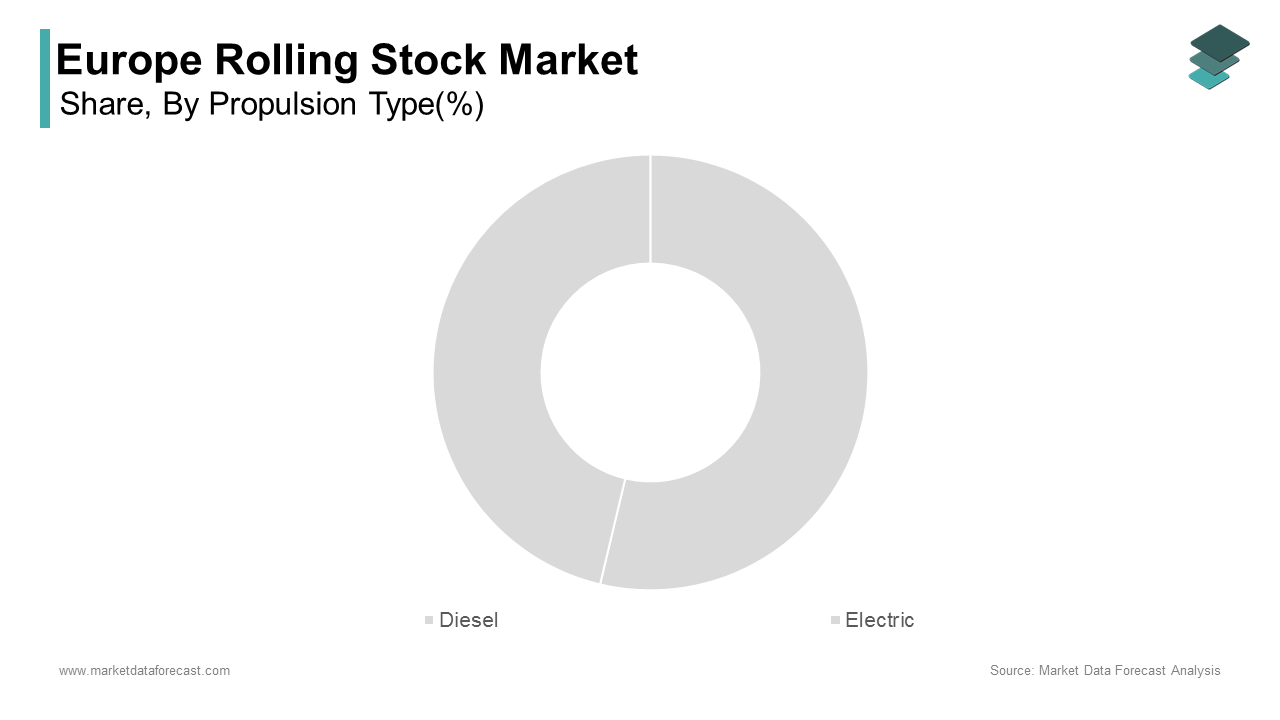
- Based on propulsion type: The electric rolling stock segment occupied 77.5% share of the Europe rolling stock market in 2024.
- Based on product type: The rapid transport segment accounted for 52.5% of the market share in 2024.
- Based on train type: The passenger rail segment held a 65.5% share of the European market in 2024.
Regional Insights
- Germany dominated the Europe rolling stock market with a 22.5% share in 2024 due to strong rail modernisation programs.
- France commanded a significant share in 2024, supported by its world-leading high-speed rail network and electrification initiatives.
- The United Kingdom is anticipated to play a key role during the forecast period owing to large-scale fleet replacement and digital rail upgrades.
- Italy is predicted to register a prominent CAGR during the forecast period, driven by continued upgrades to its high-speed and intercity rail systems.
- Spain is expected to account for a noteworthy share of the Europe rolling stock market, supported by investments in metro, tram, and AVE high-speed networks.
Competitive Landscape
The Europe rolling stock market is moderately consolidated, with manufacturers focusing on electrification, high-speed capabilities, and digital technologies to enhance competitiveness. Prominent players in the market include Alstom, Siemens Mobility, Stadler Rail, CAF, CRRC Corporation Limited, Hitachi Rail, Wabtec Corporation, and Kawasaki Heavy Industries
Europe Rolling Stock Market Size
The Europe rolling stock market size was calculated to be USD 16.11 billion in 2024 and is anticipated to be worth USD 30.32 billion by 2033, from USD 17.28 billion in 2025, growing at a CAGR of 7.28% during the forecast period.

Rolling stock includes locomotives, passenger coaches, freight wagons, and multiple-unit trains operating across the continent’s integrated rail networks. Defined by interoperability mandates under the European Union Agency for Railways and deeply interwoven with decarbonization strategies, this market functions as a critical enabler of sustainable passenger mobility and freight logistics. As per Eurostat, in 2023, the European Union maintained around 200,947 kilometres of railway lines, with nearly 55% electrified, which reflects the bloc’s strong commitment to sustainable infrastructure. As per Eurostat, rail passenger transport reached 429 billion passenger-kilometres in 2023 by accounting for a modest share of inland passenger mobility. As per Eurostat, rail freight transport represented approximately 16.4% of total inland freight tonne-kilometres in 2023, which indicates its role in reducing emissions compared to road transport. As per UITP, urban rail systems in major metropolitan areas such as Paris, Berlin, and Madrid collectively facilitate billions of passenger journeys annually, highlighting their central role in sustainable urban mobility. Unlike other global regions, Europe’s rail evolution is shaped less by market liberalization alone and more by binding environmental imperatives, particularly the European Green Deal’s mandate for climate neutrality by 2050, which positions rail as a cornerstone of the continent’s low-carbon transport architecture.
MARKET DRIVERS
Accelerated Public Investment in Rail Infrastructure
Public capital allocation is serving as a primary catalyst for rolling stock renewal and expansion across Europe, which is majorly driving the European rolling stock market growth. As per the European Commission, the Connecting Europe Facility (CEF) has committed €33.71 billion to transport, energy, and digital infrastructure between 2021 and 2027, with rail modernization forming a significant share of expenditures. As per Germany’s Federal Transport Infrastructure Plan 2030, the government has allocated €269.6 billion overall, with a substantial portion directed toward rail upgrades and modernization projects. As per France’s national rail modernization plan, the country has announced investments of €100 billion by 2040 to overhaul its rail network, including regional and high-speed trains. As per the European Parliament’s TRAN Committee research, rolling stock demand in Western Europe is largely driven by fleet renewal, technological upgrades, and state-backed infrastructure programs, rather than short-term ridership fluctuations. These strategic investments are not merely reactive but prescriptive as they mandate fleet replacement aligned with Technical Specifications for Interoperability, digital signalling readiness, and energy efficiency benchmarks. This institutional anchoring ensures stable, multiyear demand for manufacturers such as Alstom, Siemens Mobility, and Stadler, insulating the sector from short-term economic fluctuations and enabling long-term production planning.
Stringent EU Emissions Regulations Favouring Rail Modal Shift
Europe’s regulatory framework is systematically tilting transport economics toward rail through binding climate legislation, which is further boosting the European rolling stock market expansion. As per the European Union’s Fit for 55 package, the bloc aims to cut net greenhouse gas emissions by at least 55 percent by 2030 compared to 1990 levels, with climate neutrality targeted by 2050. As per the International Energy Agency, rail transport accounts for less than 1 percent of EU transport-related CO₂ emissions, while handling a significant share of passenger and freight movement, which indicates its efficiency. For instance, France has prohibited certain short-haul flights where viable rail alternatives exist, while other EU countries continue to debate similar measures. As per PwC and Dutch government programs, the Netherlands provides tax relief schemes and subsidies to encourage sustainable logistics and transport operations. As per the International Union of Railways (UIC), increasing the modal share of rail in line with EU transport targets could reduce emissions by up to 238 million tonnes of CO₂ annually, which is indicating the potential of modal shift. As per Alstom, Germany has ordered 11 battery-powered Coradia Continental trains for regional service, while hydrogen-powered Coradia iLint trains are already in operation and reflecting the sector’s transition toward zero-emission rolling stock. These regulatory tailwinds are not cyclical but structural, embedding rail into the core of Europe’s climate governance architecture.
MARKET RESTRAINTS
Fragmented Technical Standards Across Legacy Networks
Despite decades of harmonization efforts, persistent technical incompatibilities across European rail systems inflate costs and delay fleet deployment, which is majorly restraining the European rolling stock market growth. Voltage systems vary between 1.5 kV DC, 3 kV DC, 15 kV AC, and 25 kV AC, while signalling protocols range from national systems like PZB in Germany to the emerging European Rail Traffic Management System. As per the European Court of Auditors, interoperability across the Trans-European Transport Network remains limited, with significant gaps in harmonization reported in 2023. These disparities compel operators to custom-order or retrofit vehicles for cross-border operations. A locomotive certified for service in France, Germany, and Poland may require integration of multiple signalling systems, adding considerable cost burdens for operators. Maintenance complexity rises proportionally, with operators maintaining country-specific spare parts inventories and technician training programs. In the Baltics and Finland, the 1520 millimetres track gauge remains incompatible with the continent’s standard 1435 millimetres gauge, which is demanding costly transshipment or bogie exchange. As per the International Union of Railways, fragmentation in standards and infrastructure significantly increases lifecycle costs, which raises raising total cost of ownership and hinders pan-European fleet standardization.
Lengthy Certification and Approval Timelines
Regulatory approval processes continue to hinder timely market entry and fleet renewal, which is further hampering the European rolling stock market expansion. Every new rolling stock design must undergo type approval under the EU Railway Interoperability Directive, followed by national safety validations that often duplicate testing requirements.
According to the European Union Agency for Railways, the average authorization timeline exceeds 30 months, with some projects extending beyond four years due to inconsistent interpretations of safety rules across member states. In 2022, the delivery of 30 Stadler Flirt trains to the Czech Republic was delayed by 19 months solely due to national authority backlogs, despite prior ERTMS compliance. The absence of mutual recognition among notified bodies forces manufacturers to repeat crashworthiness, fire safety, and electromagnetic compatibility tests in each target market. A 2023 study by the Shift2Rail Joint Undertaking found that these inefficiencies add 8 to 12% to upfront capital costs. Innovative designs—such as hydrogen trains or modular commuter units—face even longer scrutiny periods, slowing adoption of breakthrough technologies. This regulatory friction disproportionately impacts smaller operators and reduces ROI certainty, ultimately tempering investment appetite across the supply chain.
MARKET OPPORTUNITIES
Deployment of Digital Rail Technologies Enabling New Fleet Models
The continent-wide rollout of digital infrastructure is redefining rolling stock utilization and ownership paradigms, which is a promising opportunity for the European rolling stock market.
ERTMS Level 2 is now active on over 14,000 kilometres of EU tracks according to the European Commission, enabling precise train control, reduced headways, and dynamic scheduling. This allows operators to replace legacy high-capacity trains with shorter, modular units that adjust formation based on real-time demand. In Denmark, DSB’s digitally enabled Siemens Desiro ML fleet reduced required vehicles by 18% while maintaining service frequency, as reported by the European Rail Freight Association. Onboard sensor networks now facilitate predictive maintenance, extending intervals by up to 35% per Alstom’s 2024 operational data. These efficiencies empower lessors like Alpha Trains to offer performance-based leasing contracts tied to availability and energy consumption metrics. With the EU mandating full ERTMS deployment on the core network by 2030, over 12,000 existing vehicles will require retrofitting or replacement, creating dual revenue streams in new build and modernization. Rolling stock is thus evolving from static hardware to an integrated, data-driven mobility platform.
Expansion of Urban and Peri-Urban Commuter Networks
Secondary and tertiary cities across Europe are investing heavily in regional express and light rail corridors to address congestion and air quality mandates, which is another promising opportunity for the European rolling stock market. As per the European Commission, ERTMS Level 2 is now active on more than 12,000 kilometres of EU tracks, which is enabling precise train control, reduced headways, and dynamic scheduling. This allows operators to replace legacy high-capacity trains with shorter, modular units that adjust formation based on real-time demand. As per DSB, Denmark’s deployment of digitally enabled Siemens Desiro ML and other modern fleets has improved operational efficiency. As per Alstom, onboard sensor networks and predictive maintenance technologies can extend maintenance intervals by up to 30%, which reduces downtime and lifecycle costs. These efficiencies empower lessors like Alpha Trains to offer performance-based leasing contracts tied to availability and energy consumption metrics. As per the European Commission, the EU mandates full ERTMS deployment on the core network by 2030 and requires thousands of existing vehicles to be retrofitted or replaced, which is creating dual revenue streams in new build and modernization. Rolling stock is thus evolving from static hardware to an integrated and data-driven mobility platform.
MARKET CHALLENGES
Supply Chain Volatility for Critical Components
Chronic shortages of semiconductors, power electronics, and rare earth magnets are constraining production capacity and inflating costs, which is primarily challenging the regional market growth. Although rail consumes less than 1% of global industrial semiconductors, it competes for legacy node chips used in traction control and door systems. As per the European Association of Railway Suppliers, supply chain disruptions have significantly extended lead times for semiconductor components, which is delaying rolling stock deliveries across Europe. As per the European Commission’s Raw Materials Scoreboard, Europe imports over 90% of its rare earth elements, including neodymium and dysprosium, from China, which indicates critical supply dependencies. As per Benchmark Mineral Intelligence, prices of dysprosium oxide rose sharply between 2021 and 2023 due to geopolitical tensions, increasing input costs for manufacturers. Rolling stock manufacturers operate under fixed-price, long-term contracts with limited pass-through mechanisms, which is compressing margins and reducing flexibility in innovation. This input dependency not only delays fleet renewal but also discourages innovation in next-generation propulsion systems.
Workforce Shortages in Rail Engineering and Maintenance
A deepening skills gap in rail-specific engineering and maintenance is threatening fleet reliability and scalability, which is further challenging the regional market growth. As per the European Rail Industry Association, the sector faces a significant skills shortage by 2030 due to aging workforces and misaligned vocational training. As per Germany’s rail industry reports, thousands of engineering roles remain unfilled, directly impacting depot throughput and operational efficiency. Modern rolling stock demands advanced technical competencies that traditional apprenticeships do not adequately cover. As per OECD, the automotive and renewable sectors offer notably higher wages for comparable skill sets, which is drawing talent away from rail in Southern Europe. As per SNCF Maintenance, staffing shortages have led to measurable increases in fleet idle days, which are reducing availability and service reliability. Without coordinated upskilling initiatives and wage recalibration, this human capital deficit risks undermining the punctuality, safety, and cost efficiency that underpin public and political confidence in rail expansion.
REPORT COVERAGE
| REPORT METRIC | DETAILS |
| Market Size Available | 2024 to 2033 |
| Base Year | 2024 |
| Forecast Period | 2025 to 2033 |
| CAGR | 7.28% |
| Segments Covered | By Propulsion Type, Product Type, Train Type, and Region |
| Various Analyses Covered | Global, Regional & Country Level Analysis; Segment-Level Analysis; DROC, PESTLE Analysis; Porter’s Five Forces Analysis; Competitive Landscape; Analyst Overview of Investment Opportunities |
| Regions Covered | UK, France, Spain, Germany, Italy, Russia, Sweden, Denmark, Switzerland, Netherlands, Turkey, and the Czech Republic |
| Market Leaders Profiled | Alstom, Siemens Mobility, Stadler Rail, CAF, CRRC Corporation Limited, Hitachi Rail, Wabtec Corporation, Kawasaki Heavy Industries |
SEGMENTAL ANALYSIS
By Propulsion Type Insights
The electric rolling stock segment occupied 77.5% of the European rolling stock market share in 2024. The dominance of the electric segment in the European market is attributed to the continent’s deep electrification legacy and policy alignment with decarbonization imperatives. As per Eurostat, around 55% of the EU’s railway network is electrified, enabling widespread deployment of electric locomotives and multiple units. As per the European Green Deal, the EU aims to cut net greenhouse gas emissions by at least 55% by 2030 compared to 1990 levels, with climate neutrality targeted by 2050, which is further entrenching electric traction as the default choice for new procurements. As per national commitments, rail operators such as Deutsche Bahn, SNCF, and Trenitalia have announced plans to transition toward fully electric or zero-emission regional fleets by the mid-2030s, which is accelerating the retirement of diesel assets. As per the European Commission, all new vehicles operating on the Trans-European Transport Network must support overhead electrification or alternative zero-emission technologies by 2030, which is effectively locking in electric infrastructure as the baseline for future investment. This regulatory and infrastructural synergy ensures electric rolling stock remains the anchor of Europe’s rail modernization agenda.
By Product Type Insights
The rapid transport segment accounted for 52.5% of the Europe rolling stock market share in 2024. The dominance of the rapid transport segment in the European market is attributed to the continent’s urbanization pressure and public investment in high-frequency intra-city mobility. As per the European Environment Agency, over 75% of Europeans reside in urban areas, underscoring the importance of efficient public transport systems. As per UITP and Eurostat data, metro systems in major cities such as Paris, Berlin, and Madrid collectively serve millions of passenger trips daily, which is indicating their central role in urban mobility. Municipal authorities prioritize rapid transport due to its high passenger throughput, low per capita emissions, and compatibility with dense urban fabric. As per the EU’s Urban Mobility Framework, member states are encouraged to allocate significant portions of local transport budgets to rail-based public transit, with many countries meeting or exceeding these targets in recent years. Major fleet renewal programs are underway: London’s Elizabeth Line added 70 new Class 345 trains, while Copenhagen’s City Circle Line introduced 36 driverless metro cars. These procurements emphasize accessibility, digital integration, and energy recovery braking, which is reinforcing the rapid transport segment as the most dynamic and voluminous product segment.
The freight wagons segment is the fastest-growing product segment and is expected to exhibit a CAGR of 8.08% over the forecast period, owing to the EU’s aggressive modal shift policy. The European Commission’s Sustainable and Smart Mobility Strategy mandates that freight corridors achieve minimum rail shares, triggering large-scale wagon procurement for intermodal and bulk transport. As per DB Cargo, the company announced new investments in intermodal flat wagons in 2023 to strengthen its freight capacity. As per PKP Cargo, Poland’s national operator, is committed to expanding its wagon fleet under its National Railway Fund, which is focusing on grain and container transport. Modern wagons now feature automated coupling, real-time GPS tracking, and aerodynamic designs that improve fleet efficiency. As per the European Environment Agency, a single intermodal train can replace dozens of heavy goods vehicles, which is significantly cutting CO₂ emissions each year. As per the European Commission, the Connecting Europe Facility has allocated billions of euros to freight rail terminals and wagon upgrades and positioned this segment for sustained structural growth.
By Train Type Insights
The passenger rail segment had 65.5% of the European market share in 2024. The leading position of the passenger rail segment in the European market is driven by Europe’s dense intercity networks, robust commuter rail culture, and public funding prioritization of human mobility over goods movement. The EU’s TEN-T policy mandates that all core network corridors support high-frequency passenger services, which is compelling national operators to maintain large, modern fleets. As per SNCF, France’s TGV network operates hundreds of high-speed trainsets, which is making it one of the largest fleets globally. As per Germany’s rail industry reports, the regional fleet includes thousands of electric multiple units, which reflects the country’s strong electrification and modernization strategy. As per UITP, urban populations continue to expand, with cities like Barcelona and Vienna investing in automated metro expansions to accommodate rising ridership, which is projected to grow steadily through 2030. As per the European Commission, public subsidies cover a significant share of passenger rail operating costs across the EU and ensure financial viability even on marginally profitable routes. This institutional support, combined with high public acceptance of rail as a daily mobility option, secures the passenger rolling stock’s dominant market position.
The rail freight segment is anticipated to grow at a CAGR of 8.44% over the forecast period, outpacing passenger segments due to urgent climate policy imperatives. As per the European Union’s Fit for 55 package, the bloc has set binding climate targets to reduce emissions by at least 55% by 2030 compared to 1990 levels, with modal shift to rail identified as a key enabler of freight decarbonization. As per the European Commission’s Alternative Fuels Infrastructure Regulation, all core network freight terminals must be rail-connected by 2030, which is accelerating infrastructure and asset co-development. As per Eurostat and corridor monitoring reports, the Rhine-Alpine Corridor handled tens of millions of tonnes of rail freight in 2023, which reflects steady year-on-year growth in volumes. As per DB Schenker, the company has expanded its rail logistics operations in Europe and is aiming to increase the share of land freight moved by rail in the coming years. As per the International Energy Agency, rail freight emits around 75% less CO₂ per tonne-kilometre compared to road transport, which further indicates its environmental advantage. This regulatory and environmental calculus ensures rail freight’s rapid fleet expansion will continue.
REGIONAL ANALYSIS
Germany Rolling Stock Market Analysis
Germany dominated the rolling stock market in Europe in 2024 by holding 22.5% of the regional market share. As per Eurostat, Germany operates over 33,000 kilometres of railway track, which is making it the largest rail network in Europe and the continent’s most intensive rail user. As per Deutsche Bahn, the Digital Rail Germany program launched in 2020 commits €86 billion through 2030 to modernize infrastructure and expand rolling stock, including hundreds of new long-distance and regional trains. As per Germany’s Energiewende policy, the country aims for near-total rail electrification by 2040, driving demand for electric and battery-hybrid multiple units. As per industry reports, Germany hosts major rolling stock factories such as Alstom in Salzgitter, Siemens Mobility in Krefeld, and Stadler in Berlin that collectively employ tens of thousands of engineers and technicians. As per the German Federal Ministry for Digital and Transport, robust vocational training pipelines and federal support for rail R&D include over €1 billion allocated to hydrogen train trials in Lower Saxony, ensuring Germany remains the technological and industrial nucleus of the European rail ecosystem.
France Rolling Stock Market Analysis
France commanded a promising share of the European rolling stock market in 2024 due to its world-leading high-speed rail network and aggressive regional electrification. As per SNCF, France’s TGV system spans over 2,700 kilometres of high-speed lines, which is making it one of the largest networks globally. In 2023, TGV services carried tens of millions of passengers, which demands continuous fleet renewal. As per the Grand Paris Express project, France is undertaking the largest urban rail investment in Europe, which is adding 200 kilometres of automated metro and 68 new stations by 2030 to expand suburban capacity. As per the French government’s France 2030 plan, billions of euros have been allocated to procure next-generation regional trains featuring regenerative braking and modular interiors. As per SNCF Voyageurs, the operator has ordered battery-electric trains to serve non-electrified lines, to phase out diesel traction by the mid-2030s. Coupled with strong domestic manufacturing via Alstom’s Belfort and Reichshoffen plants, France’s dual focus on high-speed prestige and commuter inclusivity solidifies its position as Europe’s second-largest rolling stock market.
United Kingdom Rolling Stock Market Analysis
The United Kingdom is anticipated to play a key role in the Europe rolling stock market during the forecast period, owing to the large-scale fleet replacement following decades of underinvestment. After maintaining the oldest passenger fleet in Western Europe. As per the UK Department for Transport, the Rail Network Enhancements Pipeline outlines multi-billion-pound investments through 2029 to support new intercity and commuter trains. As per Hitachi, the Newton Aycliffe factory has delivered over 120 Class 800 series trains for the Intercity Express Programme, which is strengthening long-distance services. As per CAF, the Newport facility is producing hundreds of metro-style units for operators, including Southeastern and Northern, which is expanding regional capacity. As per Transport for London, the Elizabeth Line represents a £1.5 billion rolling stock investment, with 70 nine-car Class 345 trains introduced to serve the new cross-London route. Although post-Brexit regulatory divergence poses certification complexities, the UK’s legally binding 2050 target and congestion in cities such as Manchester and Birmingham ensure sustained demand for modern, high-capacity electric multiple units over the next decade.
Italy Rolling Stock Market Analysis
Italy is predicted to register a prominent CAGR in the European rolling stock market during the forecast period. As per Italy’s National Recovery and Resilience Plan, over €13 billion has been allocated to rail modernization through 2026, which is supporting the procurement of new regional and high-speed trains. As per Trenitalia, the operator is pursuing a major fleet renewal program to replace a large share of its aging regional trains by the mid-2020s, prioritizing energy-efficient electric multiple units with higher passenger capacity. As per Milan’s M4 metro project, the city is expanding urban rail with new driverless trains, while Naples is upgrading its commuter network with modern low-floor EMUs to enhance accessibility. For instance, the Brenner Corridor between Verona and Innsbruck recorded growth in rail freight volumes in 2023, which reflects rising interest in modal shift. With strong EU cohesion funds support and rising ridership in secondary cities such as Bologna and Turin, Italy’s rolling stock market is positioned for structural expansion.
Spain Rolling Stock Market Analysis
Spain is anticipated to account for a noteworthy share of the Europe rolling stock market during the forecast period. The integrated high-speed and metropolitan rail strategy of Spain is majorly driving the Spanish rolling stock market. As per Spain’s Ministry of Transport, the country operates Europe’s second-largest high-speed rail network, spanning over 3,900 kilometres and serving dozens of cities with AVE services that carried tens of millions of passengers in 2023. As per Renfe, fleet renewal includes the procurement of Talgo Avril trainsets capable of 330–350 km/h, ordered in recent years to expand high-speed capacity. As per Madrid’s Line 11 extension and Barcelona’s L9/L10 project, both cities are expanding metro capacity with new automated trains scheduled for delivery by the mid-2020s. As per Eurostat, Spain’s rail electrification rate exceeds 70%, the highest in Southern Europe, enabling near-universal deployment of electric rolling stock. As per Spain’s Sustainable Mobility Law, all new regional trains must be zero-emission by 2030, which is accelerating orders for battery and hydrogen prototypes. Backed by robust domestic engineering via Talgo and CAF, Spain’s balanced focus on speed, accessibility, and sustainability cements its position among Europe’s top five rail markets.
COMPETITION OVERVIEW
The Europe rolling stock market features intense competition among established manufacturers vying for public sector tenders shaped by stringent environmental and interoperability requirements. Alstom, Siemens Mobility, and Stadler lead through diversified portfolios spanning high-speed speed regional and urban segments, while smaller players like CAF and Pesa capture niche markets with agile, customized solutions. Competition is not solely price-driven but emphasizes lifecycle cost, energy efficiency, digital integration and compliance with national technical standards. The consolidation following Alstom’s acquisition of Bombardier reduced player count but heightened capability concentration. New entrants face high barriers, including certification complexity, supply chain maturity and long development cycles. Operators increasingly demand performance-based contracts tying payments to availability and reliability metrics, which favours incumbents with service ecosystem maturity. These dynamics foster continuous innovation yet constrain market fluidity.
KEY MARKET PLAYERS
A few major players for the Europe rolling stock market include
- Alstom
- Siemens Mobility
- Stadler Rail
- CAF
- CRRC Corporation Limited
- Hitachi Rail
- Wabtec Corporation
- Kawasaki Heavy Industries
Top Strategies Used by the Key Market Participants
Key players in the Europe rolling stock market prioritize technological innovation through investment in zero-emission propulsion systems, including battery and hydrogen trains, aligning with EU decarbonization mandates. They pursue strategic acquisitions and partnerships to broaden geographic reach and enhance product portfolios, os as seen in Alstom’s integration of Bombardier. Companies are expanding manufacturing and maintenance facilities within Europe to shorten supply chains and ensure localized support. Emphasis on digitalization is evident through the deployment of predictive maintenance platforms and automated train control systems that improve asset utilization. Additionally, firms actively engage in public funding programs such as the Connecting Europe Facility to co-develop next-generation rolling stock compliant with evolving interoperability and safety standards, ensuring long-term market relevance.
Leading Players in the Europe Rolling Stock Market
- Alstom is a leading force in the European rolling stock sector with deep integration across high-speed intercity trains, regional multiple units, and urban transit systems. Headquartered in France, the company has delivered landmark solutions, including the TGV and Coradia fleets. In recent years, Alstom has strengthened its position through the acquisition of Bombardier Transportation, which significantly expanded its manufacturing footprint and product portfolio across Germany, Spain and the UK. The company continues to invest in battery and hydrogepropulsion technologies, launching commercial deployments such as the Coradia iLint in Germany and regional battery trains in France. Its innovation centers in France and Poland focus on digital rail and predictive maintenance, enhancing lifecycle value for operators.
- Siemens Mobility, headquartered in Germany, is a pivotal contributor to Europe’s rail modernization through its Velaro high-speed trains, Mireo regional platforms and Desiro commuter units. The company has reinforced its presence by advancing digital rail offerings, including its Railigent X analytics suite and automated train operations for metro systems in Vienna and Budapest. Siemens recently inaugurated a new train assembly line in Krefeld, Germany, dedicated to battery electric multiple units supporting national decarbonization mandates. It also collaborates with infrastructure managers to integrate vehicles with ERsignallingling,, future-proof interoperability. Its commitment to sustainable manufacturing, including carbon-neutral production sites, underscores its strategic alignment with EU Green Deal objectives.
- Stadler Rail, based in Switzerland, has emerged as a dynamic player specializing in customized solutions for regional urban and mountainous rail operations. Known for its FLIRT platform, the company serves over 30 European countries with agile, lightweight trains suited to non-electrified and low-density lines. Stadler has expanded its European capacity through new factories in Belarus, Poland, and Germany and recently began serial production of hydrogen trains in Bussnang, Switzerland. It secured significant contracts for metro cars in Minsk and Berlin, and battery electric units for WalWales and Schleswig-Holstein's design philosophy enables rapid adaptation to national technical standards, reducing delivery timelines and supporting public authorities in meeting urgent fleet renewal targets.
MARKET SEGMENTATION
This research report on the Europe rolling stock market has been segmented and sub-segmented based on propulsion type, product type, train type, and region.
By Propulsion Type
- Diesel
- Electric
By Product Type
- Wagon
- Rapid Transport
- Locomotive
By Train Type
- Rail Freight
- Passenger Rail
By Region
- UK
- France
- Spain
- Germany
- Italy
- Russia
- Sweden
- Denmark
- Switzerland
- Netherlands
- Turkey
- Czech Republic
- Rest of Europe
Frequently Asked Questions
1. What types of rolling stock are witnessing high demand?
Electric locomotives, metro systems, trams, and high-speed trains are witnessing strong demand due to electrification and urban transit needs.
2. What factors are driving growth in the Europe rolling stock market?
Urbanization, government rail investments, electrification, sustainability initiatives, and demand for high-speed rail systems are major growth drivers.
3. What challenges affect market growth?
High production costs, slow approval processes, component supply shortages, and competition from global manufacturers pose challenges.
4. Which companies are key market players in Europe?
Key companies include Alstom, Siemens Mobility, Stadler Rail, CAF, CRRC Corporation, Hitachi Rail, Wabtec, and Kawasaki Heavy Industries.
5. How are sustainability policies impacting market demand?
EU green transport policies encourage low-emission electric and hydrogen-powered trains, increasing demand for cleaner rolling stock.
6. What technologies are trending in Europe’s rolling stock market?
Hydrogen trains, autonomous train control, predictive maintenance, AI-based signaling, and lightweight rail materials are key trends.
7. What is the role of high-speed rail development in Europe?
Expansion of networks such as ICE, TGV, Eurostar, and cross-border corridors boosts demand for advanced high-speed trains.
8. How does urban transportation support market growth?
The growing need for metros, trams, and light rail systems in major cities drives investment in urban rolling stock fleets.
9. How does government funding influence the market?
Government investment for rail modernization, electrification, and passenger capacity upgrades promotes rolling stock procurement.
10. What is the future outlook for the Europe rolling stock market?
The market is expected to grow steadily, driven by smart mobility adoption, hydrogen trains, digital signaling, cross-border rail expansion, and decarbonization targets.
Related Reports
Access the study in MULTIPLE FORMATS
Purchase options starting from
$ 2000
Didn’t find what you’re looking for?
TALK TO OUR ANALYST TEAM
Need something within your budget?
NO WORRIES! WE GOT YOU COVERED!
Call us on: +1 888 702 9696 (U.S Toll Free)
Write to us: sales@marketdataforecast.com