- Product Description Description
- Table of Contents TOC
- List of Table & Figure LOT
- Get Free Sample PDF Sample PDF
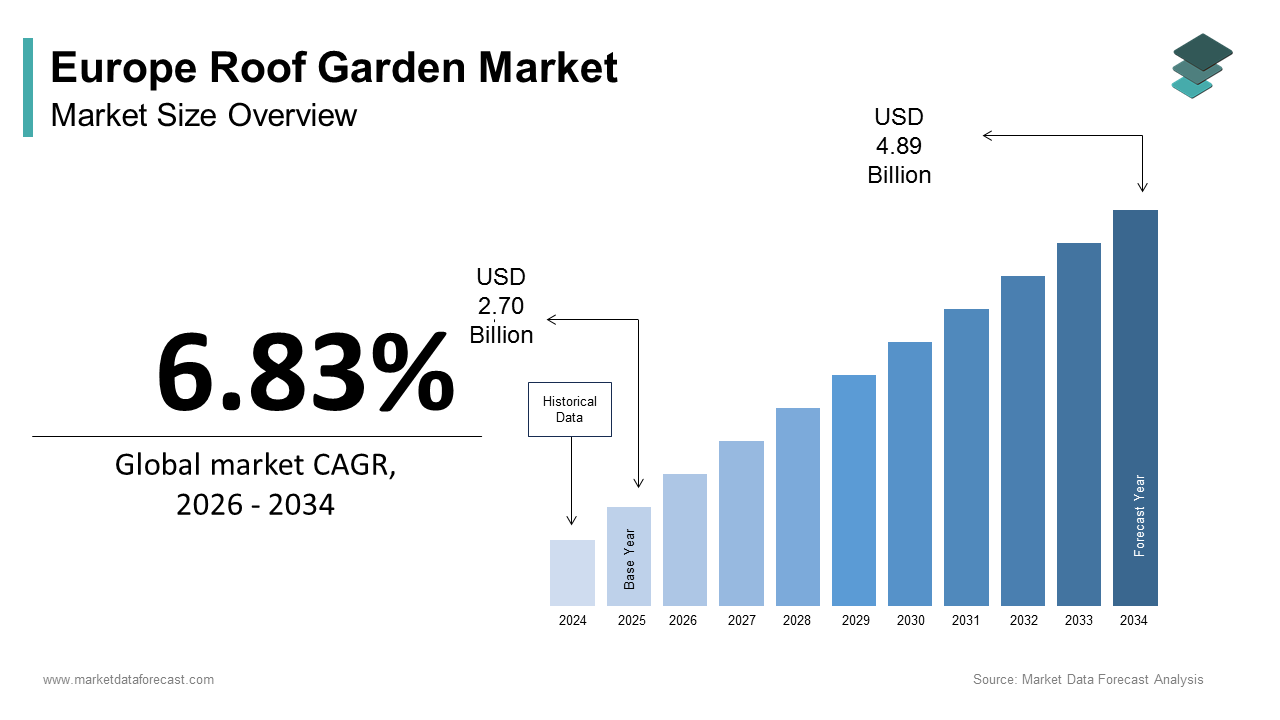
Market Size, 2025
$2.70 BnMarket Estimate, 2026
$2.88 BnMarket Forecast, 2034
$4.89 BnCAGR, 2026–2034
6.83%Europe Roof Garden Market Report Summary
The Europe roof garden market was valued at USD 2.70 billion in 2025 and is projected to reach USD 4.89 billion by 2034, growing from USD 2.88 billion in 2026 at a CAGR of 6.83% during the forecast period. Market growth is driven by increasing urbanization, rising focus on sustainable construction practices, and stringent environmental regulations promoting green infrastructure. Growing awareness of energy-efficient buildings, stormwater management, and urban heat island mitigation is accelerating the adoption of roof gardens across commercial and residential projects. Supportive government policies and green building certifications are further strengthening the Europe roof garden market.
Key Market Trends
- Rising adoption of green roofs to improve building energy efficiency and insulation
- Increasing investment in sustainable urban infrastructure and climate resilience
- Growing retrofit projects in urban commercial properties
- Strong integration of biodiversity and water management systems in roof designs
- Expansion of eco-friendly construction materials and modular green roof systems
Segmental Insights
- Based on type, the extensive roof gardens segment dominated the Europe roof garden market in 2025, supported by lower installation costs, lightweight structures, and minimal maintenance requirements.
- Based on application, the commercial segment led the market in 2025, driven by adoption in office buildings, shopping centers, public infrastructure, and hospitality properties
Regional Insights
- Germany led the Europe roof garden market in 2025 by holding 28.1% of the regional market share, supported by strong environmental policies and widespread green roof incentives.
- France ranked second with a 20.4% share in 2025, driven by regulatory mandates and sustainable urban planning initiatives.
- United Kingdom remains a key market, supported by the retrofitting of existing buildings and property value enhancement strategies.
- Netherlands is witnessing steady growth due to climate adaptation strategies and progressive urban sustainability policies
- Switzerland is expected to expand during the forecast period, supported by green building standards and environmental conservation initiatives.
Competitive Landscape
The Europe roof garden market is moderately competitive, with companies focusing on innovative green roofing systems, lightweight substrates, waterproofing technologies, and integrated drainage solutions. Market participants are strengthening partnerships with construction firms and urban planners while emphasizing sustainability certifications and long-term durability.
Europe Roof Garden Market Size
The Europe roof garden market size was calculated to be USD 2.70 billion in 2025 and is anticipated to be worth USD 4.89 billion by 2034, from USD 2.88 billion in 2026, growing at a CAGR of 6.83% during the forecast period.
A roof garden is a cultivated green space or vegetative layer located on the rooftop of a residential, commercial, or industrial building. Unlike ornamental landscaping, this sector is fundamentally integrated into urban climate resilience, energy efficiency, and biodiversity strategies. According to research, a large majority of Europeans reside in urban environments, where dense, non-porous surfaces worsen heat island effects and aggravate stormwater management challenges. In response, cities like Berlin, Copenhagen, and Zurich have mandated green roofs on new commercial buildings, driving institutional adoption. The market operates under technical standards such as FLL Guidelines and DIN 18195, which govern waterproofing, drainage, and load capacity. Furthermore, the European Union's building sector represents a significant portion of total energy usage, and the implementation of green roofs effectively lowers cooling requirements, mitigating this energy demand. This fusion of environmental policy, architectural innovation, and urban planning defines the European roof garden market as a critical infrastructure component rather than a mere aesthetic feature.
MARKET DRIVERS
Municipal Green Roof Mandates and Urban Climate Policies
The proliferation of binding municipal regulations requires or incentivizes vegetated roofs on new and retrofitted buildings, which is a booster for the Europe roof garden market. Cities across the continent are implementing these measures to combat urban heat islands, manage stormwater, and enhance biodiversity. Green roof policies are being enforced by dozens of major European cities, with Copenhagen pioneering mandatory green roof installation for new construction to increase climate resilience and reduce the urban heat island effect. Similarly, Paris requires green roofs or solar panels on all new commercial buildings, while Berlin offers subsidies covering a notable share of installation costs. These policies are backed by scientific evidence. Scientific analysis of green roofs, particularly in German cities like Stuttgart, indicates that vegetation on rooftops effectively reduces localized summer air temperatures, alleviating the urban heat island effect. Regulatory frameworks now mandate climate adaptation in urban design, fostering sustained demand for professional green roofing solutions in both public and private developments.
Integration of Green Roofs into EU Energy Efficiency and Biodiversity Strategies
The alignment of roof gardens with overarching EU environmental directives serves as a structural driver of the Europe roof garden market. The revised Energy Performance of Buildings Directive explicitly recognizes green roofs as passive cooling measures that contribute to nearly zero-energy building targets. Simultaneously, the EU Biodiversity Strategy for 2030 calls for the creation of urban green spaces to support pollinators and native flora, with green roofs identified as key habitats in dense cities. According to the European Commission’s Urban Agenda, integrating vegetation on roofs reduces stormwater runoff and mitigates pressure on aging municipal drainage systems. Climate monitoring from Copernicus indicates that this measure is increasingly critical, as Europe faces a rising frequency of high-volume precipitation events. Funding mechanisms like the EU’s Recovery and Resilience Facility have allocated billions to urban greening projects, with Italy and Spain dedicating specific envelopes to rooftop ecosystem restoration. This policy convergence transforms roof gardens from optional amenities into certified climate infrastructure, unlocking public investment and mainstreaming their adoption across member states.
MARKET RESTRAINTS
High Installation and Maintenance Costs Deterring Widespread Adoption
The substantial upfront investment and ongoing maintenance required, particularly for intensive systems, limit the growth of the Europe roof garden market. According to various sources, green roof installation costs are highly variable, influenced significantly by the system's depth, irrigation needs, and plant selection, with more intensive or complex systems requiring higher investment. The necessity for structural reinforcement in older buildings to support the added weight of vegetation and substrate creates a significant financial obstacle, frequently increasing the overall project budget for retrofits. Moreover, regular maintenance, including weeding, fertilization, and irrigation management, results in ongoing, recurring costs that can act as a deterrent for property owners focused on minimizing expenses. Despite the presence of subsidies in Hamburg and Vienna, these measures typically cover a small percentage of expenses and entail complex administrative procedures. In Southern Europe, water scarcity further inflates operational costs. Research from the Polytechnic University of Madrid indicated that in hot, dry climates like Seville, green roofs with active irrigation systems require a substantial, consistent supply of water during summer months to sustain vegetation. Economic viability remains a major hurdle for mass market adoption without improved financial mechanisms and standardized low-maintenance designs.
Structural and Technical Limitations of Existing Building Stock
The physical constraints of the region’s aging building inventory pose a major restraint on the Europe roof garden market expansion. A large portion of the European Union's building stock consists of older structures, which, due to their age and design, often lack the necessary structural capacity to support the additional weight of saturated green roof installations. Retrofitting requires structural assessments and reinforcements that are often prohibitively expensive or technically unfeasible in historic districts. Additionally, complex roof geometries, limited access, and inadequate drainage systems complicate installation. In cities like Rome and Prague, heritage preservation laws restrict modifications to rooftops, effectively banning green roofs in culturally protected zones. Even in newer buildings, poor initial waterproofing or insufficient slope can lead to leaks and root penetration, creating liability concerns among developers. These technical barriers fragment the addressable market, limiting deployment primarily to new constructions or publicly funded pilot projects with dedicated engineering budgets.
MARKET OPPORTUNITIES
Expansion of Rooftop Urban Agriculture for Local Food Security
The integration of productive roof gardens, such as hydroponic farms and edible landscapes, into urban food systems is a transformative opportunity for the Europe roof garden market growth. Rooftop farming is rising in cities to build local resilience, aligning with the EU’s Farm to Fork focus on short supply chains. The Milan Urban Food Policy Pact has spurred numerous European cities to include rooftop agriculture in their food plans, with Copenhagen hosting pioneering community-supported rooftop farms that transform industrial concrete spaces into productive, organic, and biodiversity-friendly hubs. These systems not only provide fresh produce but also create green jobs. Research from the University of Sheffield indicates that widespread development of rooftop agriculture in London could create significant new employment opportunities and increase food self-sufficiency, transforming underutilized rooftops into active agricultural sites. Innovations in lightweight substrates and closed-loop irrigation have reduced structural demands, making food-producing roofs viable on more buildings. This trend strengthens municipal support and opens new revenue streams for green roof installers by linking food sovereignty with climate adaptation.
Development of Biodiversity-Focused Green Roofs with Native Species
The EU’s push to halt biodiversity loss by 2030 prioritizes habitat creation in urban environments and paves the way for fresh prospects for the Europe roof garden market. Green roof designers are shifting from generic sedum mats to region-specific plant communities that support local pollinators and endangered species. In Germany, FLL-guided Biodiverse Green Roofs, which include native grasses and wildflowers, significantly increase insect species richness compared to simple, conventional sedum roofs. Similarly, the Netherlands’ “Green Roof for Biodiversity” certification rewards designs that incorporate nesting structures for solitary bees and birds. Municipalities like Utrecht and Basel now offer enhanced subsidies for roofs meeting these ecological criteria. This focus on functional ecology, not just aesthetics, positions green roofs as measurable contributors to national biodiversity targets, attracting conservation funding and differentiating providers in a maturing market.
MARKET CHALLENGES
Lack of Standardized Certification and Performance Metrics
The absence of harmonized EU-wide standards for performance verification leads to inconsistent quality and consumer skepticism, which curbs the growth of the Europe roof garden market. While guidelines like FLL exist, they are voluntary and interpreted differently across countries, resulting in variable outcomes in stormwater retention, thermal performance, and longevity. Significant portions of green roof failures are often linked to improper installation techniques and the utilization of subpar materials, frequently stemming from a lack of qualified, specialized contractors. In the absence of mandatory third-party validation, similar to building energy ratings, clients find it difficult to evaluate competing bids or confirm the accuracy of vendor claims. This opacity discourages institutional investors and insurers, who demand predictable ROI and risk profiles. The market will lack cohesion and rely on anecdotal success rather than consistent reliability until the EU mandates performance standards and installer accreditation.
Water Scarcity and Irrigation Sustainability in Southern Europe
Intensifying drought conditions in Southern Europe present a formidable challenge to the viability of traditional green roof systems, which, in turn, obstruct the expansion of the European roof garden market. These systems often rely on supplemental irrigation during dry periods. The European Drought Observatory documented that extended, severe droughts throughout the Mediterranean region caused critical soil moisture shortages and significantly strained municipal water supplies during 2023. In cities like Barcelona and Athens, water restrictions limit non-essential use, making irrigated green roofs politically and economically untenable. Research from the Agricultural University of Athens indicates that drought-tolerant sedum species can experience high mortality rates when facing intense, combined heat and water scarcity, particularly in shallow green roof environments without irrigation. Despite encouraging research into water-retaining substrates and mycorrhizal fungi, widespread, scalable implementation remains challenging. This climatic reality forces a reevaluation of green roof typologies in the south, demanding ultra-low-input systems that may sacrifice biodiversity or aesthetic appeal. The viability of the roof garden market outside of water-rich northern cities depends on developing innovations that do not rely on local freshwater supplies.
REPORT COVERAGE
| REPORT METRIC | DETAILS |
| Market Size Available | 2025 to 2034 |
| Base Year | 2025 |
| Forecast Period | 2026 to 2034 |
| CAGR | 6.83% |
| Segments Covered | By Type, Application, And Region |
| Various Analyses Covered | Global, Regional & Country Level Analysis; Segment-Level Analysis; DROC, PESTLE Analysis; Porter’s Five Forces Analysis; Competitive Landscape; Analyst Overview of Investment Opportunities |
| Regions Covered | UK, France, Spain, Germany, Italy, Russia, Sweden, Denmark, Switzerland, Netherlands, Turkey, and the Czech Republic |
| Market Leaders Profiled | ZinCo GmbH, Optigreen International AG, Bauder Ltd., Sempergreen Group, Green Roof Technology GmbH, Sika AG, Soprema Group, Knauf Insulation, Saint-Gobain, ACO Group |
SEGMENTAL ANALYSIS
By Type Insights
The extensive roof gardens segment dominated the Europe roof garden market by accounting for a substantial share in 2025. The dominance of the extensive roof gardens segment is driven by its lightweight design, low maintenance requirements, and cost-effectiveness, making them ideal for large-scale implementation on commercial and public buildings. Shallow, sedum-based green roof systems are designed to be lightweight when fully saturated, enabling their installation on most modern flat roofs without requiring significant structural reinforcements. Driven by city-level environmental policies focused on water management and urban cooling, the majority of green roof installations in Germany are lightweight, extensive systems rather than recreational, deep-soil options. These systems require minimal irrigation and no regular mowing, reducing long-term operational costs compared to intensive alternatives. Their simplicity aligns with EU policy goals for scalable climate adaptation, enabling rapid deployment across logistics centers, schools, and housing blocks without structural reinforcement, solidifying their role as the backbone of Europe’s green roof infrastructure.
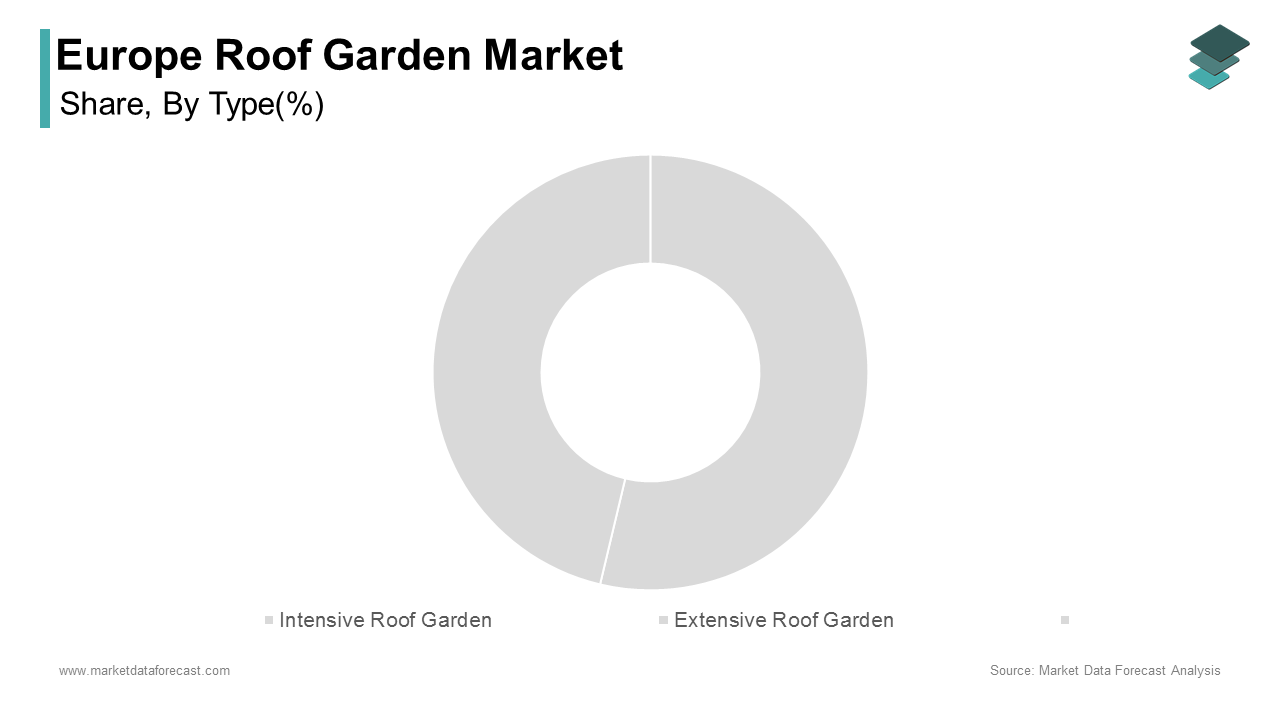
The intensive roof gardens segment is estimated to register the fastest CAGR of 8.7% from 2026 to 2034 due to rising demand for multifunctional urban spaces that combine recreation, food production, and social well-being in dense city centers. Unlike extensive systems, intensive roofs feature deeper substrates (30–150 cm), supporting trees, shrubs, lawns, and even urban farms, transforming rooftops into usable extensions of living space. The Milan Urban Food Policy Pact acts as a long-standing international framework encouraging European cities to adopt sustainable, resilient food systems. Copenhagen’s ØsterGRO serves as an established, community-driven urban farm using repurposed industrial space for organic production. High-end residential and hospitality developments in London, Paris, and Barcelona increasingly incorporate landscaped terraces as premium amenities, with property values rising for units with private green roofs. This convergence of wellness, sustainability, and real estate value drives investment in complex, high-specification systems that blur the line between architecture and landscape.
By Application Insights
The commercial application segment led the Europe roof garden market by capturing a significant share in 2025. The leading position of the commercial application segment is attributed to regulatory mandates, corporate sustainability commitments, and the scale of new commercial construction. European and North American municipalities are increasingly mandating green roofs on new commercial flat-roof structures through planning regulations, tying development permits directly to ecological performance and biodiversity, with some regions experiencing, and later reversing, such requirements. A significant volume of new commercial construction across the European Union, specifically within logistics hubs and office developments, providesa substantial opportunity for the implementation of extensive green roof technology. Corporations such as Unilever and IKEA have integrated green roofs into their ESG strategies, using them to achieve BREEAM or LEED certification and reduce building energy consumption. The centralized ownership and professional facility management of commercial properties also ensure proper installation and maintenance, minimizing failure rates and maximizing return on investment through extended roof membrane life and stormwater fee reductions.
The residential segment is anticipated to witness the fastest CAGR of 9.2% over the forecast period. The swift expansion of the residential segment is propelled by urban densification, rising demand for private outdoor space, and policy incentives for sustainable housing. In cities like Berlin and Vienna, municipal subsidies cover a notable portion of green roof costs for multi-family housing retrofits, while Paris offers density bonuses for developments incorporating vegetated terraces. According to Eurostat, a substantial portion of the European population, particularly in urban areas, resides in flats, where access to private green spaces has emerged as a key differentiator in competitive rental markets. Developers are responding by integrating semi-intensive green roofs into balconies and penthouse levels, with projects in Amsterdam and Stockholm reporting faster sales for units with rooftop gardens. Additionally, the post-pandemic emphasis on mental health and biophilic design has elevated green roofs from luxury features to wellness essentials, particularly in high-end condominiums and co-housing communities seeking to enhance residents' quality of life.
REGIONAL ANALYSIS
Germany Roof Garden Market Analysis
Germany was the top performer in the Europe roof garden market and held a 28.1% share in 2025. The prominence of the German market is credited to its status as the birthplace of modern green roof technology and the first country to implement binding municipal regulations. Cities like Berlin, Stuttgart, and Munich have required green roofs on new commercial buildings since the 1980s, creating a mature ecosystem of certified installers, material suppliers, and research institutions. According to a study, a significant portion of suitable roofs in Germany is now vegetated, with the total accumulated green roof area covering a vast, continuously growing expanse. The country’s FLL Guidelines serve as the de facto technical standard across Europe, ensuring quality and performance. Continuous innovation in lightweight substrates and water retention systems, developed by institutes like the University of Applied Sciences Weihenstephan, further cements Germany’s role as the engineering and regulatory nucleus of the European green roof movement.
France Roof Garden Market Analysis
France was the second largest country in the Europe roof garden market and occupied a 20.4% share in 2025. The demand for roof gardens in France is attributed to its integration of green roofs into national urban planning and biodiversity strategies. The 2015 Energy Transition Law mandates that all new commercial buildings must feature either green roofs or solar panels, driving widespread adoption in logistics hubs and retail centers. Since the mid-2010s, Paris has aggressively expanded its rooftop and facade vegetation through public-private partnerships, surpassing its initial ambitious targets for greening the city’s built environment. Recent renovations at major Parisian transit hubs have prioritised sustainable infrastructure, incorporating renewable energy systems and water management features into their updated architectural designs. French environmental policy increasingly integrates urban vegetation into national biodiversity strategies to bridge gaps between isolated habitats and improve the resilience of city ecosystems. Research centers like CSTB validate native plant mixes that support pollinators, while subsidies from ADEME cover a notable share of installation costs. This fusion of climate policy, urban design, and ecological restoration positions France as a holistic model for multifunctional green infrastructure.
United Kingdom Roof Garden Market Analysis
The United Kingdom remains a noteworthy player in the Europe roof garden market owing to a strong focus on retrofitting existing buildings and enhancing property value. A significant majority of London's commercial building stock pre-dates the turn of the century, creating complex structural retrofitting challenges that drive the adoption of lightweight materials and innovative, low-load green solutions. Major London regeneration projects, such as King's Cross and Battersea Power Station, prominently feature green roofs as a standard component to achieve top-tier sustainability certifications. Residential properties offering accessible green spaces and sustainable amenities command premium rental rates in the London market, driven by tenant demand for high-quality, eco-friendly living environments. Despite limited national mandates, local authorities such as Camden and Islington facilitate expedited planning for green infrastructure projects. This market-driven, real estate-centric approach makes the UK a laboratory for high-value, bespoke roof garden solutions in historic urban contexts.
Netherlands Roof Garden Market Analysis
The Netherlands is moving ahead steadfastly in the Europe rood garden market. It is renowned for its integration of green roofs into integrated water management systems. In a country where a portion of land lies below sea level, managing rainfall is existential; green roofs are a critical component of the “Room for the River” and “Sponge City” strategies. The municipality of Rotterdam is actively incentivizing the installation of green infrastructure to improve water management and mitigate sewage overflows during heavy rainfall. Dutch innovators like Optigroen and Sempergreen have pioneered circular green roof systems using recycled rubber and bio-based drainage layers. Academic studies from Wageningen University indicate that integrating green roofs with blue water storage technologies effectively retains most precipitation, minimizing runoff during intense summer rains. This engineering-led, climate-resilient approach establishes the Netherlands as a global benchmark for water-smart vegetated infrastructure.
Switzerland Roof Garden Market Analysis
Switzerland is likely to grow in the Europe roof garden market during the forecast period. It is notable for its legally binding biodiversity requirements on green roofs. The canton of Basel has long established a pioneering mandate requiring that all new or renovated flat roofs be greened with native, biodiverse species to foster insect habitats, a practice similarly adopted and implemented by other major Swiss cities like Zurich to bolster urban biodiversity. Data from Swiss urban monitoring indicates a significant portion of urban rooftops feature biodiverse greening, with studies confirming that these installations, when properly designed to mimic natural habitats, yield a substantially higher level of pollinator activity compared to traditional roof structures. The Swiss Standards Association (SN 506 720) enforces rigorous performance criteria for substrate depth, plant diversity, and maintenance, ensuring ecological functionality beyond aesthetics. High construction quality and willingness to invest in long-term environmental benefits make Switzerland a leader in scientifically validated, high-performance green roof implementation that prioritizes ecosystem services over visual appeal.
COMPETITION OVERVIEW
The Europe roof garden market features intense competition among specialized system providers, general landscape contractors, and emerging agritech startups. Established players like ZinCo and Sempergreen dominate through certified engineering systems and brand recognition, while smaller regional firms compete on price and local relationships. The market is highly fragmented due to varying national regulations and building codes, which create barriers to pan-European standardization. Competition is increasingly defined by technical performance in stormwater retention, thermal insulation, and biodiversity support rather than aesthetics alone. Success hinges on navigating complex municipal subsidy schemes, demonstrating long-term ROI through energy and maintenance savings, and adapting to climate-specific challenges such as drought in the south and heavy rainfall in the north. Without harmonized EU standards, the market remains localized and relationship-driven.
KEY MARKET PLAYERS
A few market players of the Europe roof garden market include
- ZinCo GmbH
- Optigreen International AG
- Bauder Ltd
- Sempergreen Group
- Green Roof Technology GmbH
- Sika AG
- Soprema Group
- Knauf Insulation
- Saint-Gobain
- ACO Group
Top Strategies Used by the Key Market Participants
Key players in the Europe roof garden market are primarily focused on developing integrated blue-green systems that manage stormwater while supporting biodiversity. Companies are investing in circular material innovation using recycled and biobased components to reduce environmental footprints. Strategic partnerships with municipalities and housing associations streamline subsidy access and large-scale deployment. Digital tools for design planning and maintenance optimization enhance performance verification and client trust. Additionally, firms are aligning product certification with EU taxonomy and biodiversity strategies to qualify for green financing and public procurement preferences in an increasingly policy-driven market.
Leading Players in the Market
- ZinCo GmbH is a German pioneer and global leader in green roof system technology, renowned for its engineered solutions that integrate waterproofing, drainage, and vegetation layers into certified performance systems. The company has significantly shaped European standards through its collaboration with the FLL and DIN, ensuring technical reliability across climates. ZinCo has strengthened its position by launching climate-adaptive systems such as the “Stormwater Management Roof,” which combines water retention and delayed discharge to meet EU urban flood resilience requirements. It also expanded its digital planning tool Green Roof Planner to include biodiversity and carbon sequestration metrics. These innovations reinforce ZinCo’s role as a technical authority whose systems are specified in landmark projects from Berlin to Singapore.
- Optigroen International B.V. is a Dutch innovator specializing in circular and water-smart green roof solutions tailored to Northern European urban challenges. The company contributes to the global market by developing lightweight systems using recycled rubber and bio-based components that reduce structural load and environmental impact. Optigroen has reinforced its market presence by integrating blue-green roof technology that stores rainwater for irrigation and controlled release during dry periods. It also partnered with Dutch municipalities to create subsidy-ready packages that simplify procurement for housing corporations. These actions position Optigroen as a sustainability-driven enabler of climate-resilient urban infrastructure across Europe and beyond.
- Sempergreen Group is a Netherlands-based provider of modular green roof systems known for its pre-vegetated sedum mats and intensive rooftop garden designs. The company plays a key role in scaling green roof adoption through standardized yet customizable solutions that ensure rapid installation and consistent performance. Sempergreen has strengthened its position by launching the “Biodiverse Roof” line featuring native plant mixes certified by Dutch ecological authorities. It also developed a digital maintenance platform that uses sensor data to optimize irrigation and nutrient management. These initiatives enhance ecological value and long-term viability, making Sempergreen a preferred partner for developers seeking certified sustainable building credentials.
MARKET SEGMENTATION
This research report on the Europe roof garden market has been segmented and sub-segmented based on type, application, and region.
By Type
- Intensive Roof Garden
- Extensive Roof Garden
By Application
- Residential
- Commercial
By Region
- UK
- France
- Spain
- Germany
- Italy
- Russia
- Sweden
- Denmark
- Switzerland
- Netherlands
- Turkey
- Czech Republic
- Rest of Europe