- Product Description Description
- Table of Contents TOC
- List of Table & Figure LOT
- Get Free Sample PDF Sample PDF
Market Size, 2025
$34.00 BnMarket Estimate, 2026
$45.95 BnMarket Forecast, 2034
$691.26 BnCAGR, 2026–2034
35.15%Europe Self-Healing Concrete Market Summary
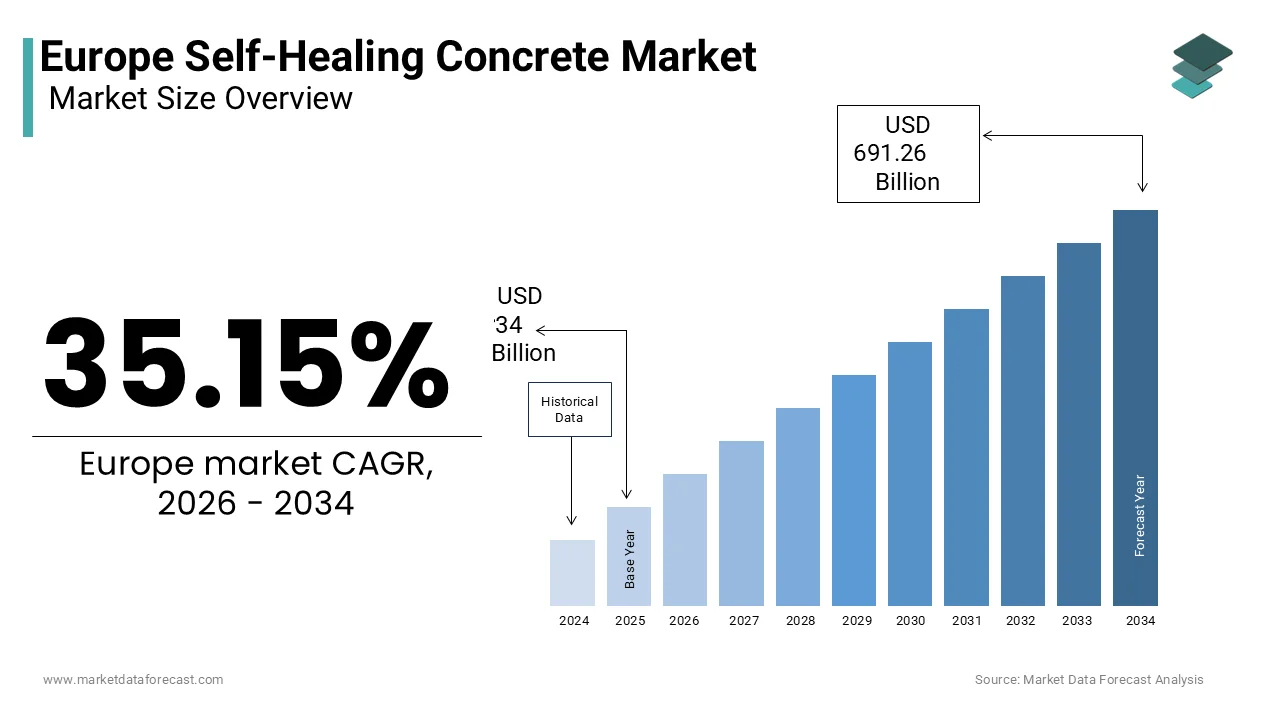
The Europe self-healing concrete market, valued at USD 34 billion in 2025, is projected to reach USD 691.26 billion by 2034, expanding at a CAGR of 35.15% driven by aging infrastructure, EU Green Deal mandates, and the push for low-maintenance, long-life construction materials.
Market Snapshot
- 2025 Market Size: USD 34 billion
- 2026 Estimate: USD 62.10 billion
- 2034 Forecast: USD 691.26 billion
- CAGR (2026–2034): 35.15%
- Base Year: 2025
- Forecast Period: 2026–2034
Quick Growth Drivers
- Rapid deterioration of Europe’s aging bridges, tunnels, and transport infrastructure
- EU Green Deal focus on durability, lifecycle carbon reduction, and circular construction
- Rising public infrastructure maintenance budgets across EU member states
- Policy-driven shift from reactive repair to preventive, autonomous material solutions
- Strong government-backed R&D programs in Germany, the Netherlands, and Scandinavia
Principal Restraints
- High initial material costs compared to conventional concrete
- Limited large-scale production capacity and certified batching plants
- Budget constraints in cost-sensitive public infrastructure projects
- Slow adoption in regions lacking lifecycle-based procurement frameworks
High-Value Opportunities
- Deployment in underground, submerged, and inaccessible structures
- Integration into prefabricated and modular construction systems
- Green financing eligibility under EU Taxonomy and Recovery Funds
- Factory-controlled production enabling consistent healing performance
Key Market Challenges
- Absence of harmonized EU-wide testing and certification standards
- Long-term performance uncertainty beyond current validation periods
- Liability and insurance concerns in load-bearing structural applications
- Fragmented supply chain for healing agents and specialty additives
Fastest-Growing Segments
- Capsule-Based Self-Healing Concrete – fastest growth due to predictable crack repair
- Industrial Flooring Applications – CAGR above 15% driven by logistics expansion
- Underground Infrastructure – tunnels, deep foundations, and marine structures
Regional Leadership & Dynamics
- Netherlands – Global pioneer in bacterial self-healing concrete and water infrastructure
- Germany – Strong validation frameworks and large-scale rail and tunnel projects
- France – Policy-mandated 100-year durability standards in public works
- Sweden – Cold-climate optimized self-healing systems for bridges and tunnels
- United Kingdom – Adoption in rail megaprojects and underground infrastructure
What Wins Commercially
- Demonstrated lifecycle cost reduction over initial material savings
- Alignment with EU sustainability, durability, and green finance frameworks
- Compatibility with existing batching and construction workflows
- Strong performance validation and public-sector specification support
Top Strategic Ask for Executives
Invest in standardized performance validation, scalable healing-agent supply chains, and prefabricated construction integration to transition self-healing concrete from flagship infrastructure projects to mainstream European construction.
Leading Players
Some of the companies that are playing a dominating role in the Europe self-healing concrete market include:
- BASF SE
- Sika AG
- Heidelberg Materials AG
- CRH plc
- Saint-Gobain S.A.
- CEMEX S.A.B. de C.V.
- Xypex Chemical Corporation
Europe Self-Healing Concrete Market Size
The Europe piano market was valued at USD 34 billion in 2025, is estimated to reach USD 62.10 billion in 2026, and is projected to reach USD 691.26 billion by 2034, growing at a CAGR of 35.15% from 2026 to 2034.
Self-healing concrete in Europe refers to advanced cementitious materials engineered with intrinsic or extrinsic mechanisms such as microencapsulated healing agents, bacterial spores, or superabsorbent polymers that autonomously repair cracks upon exposure to moisture or air, thereby extending structural service life and reducing maintenance burdens. Unlike conventional concrete, which deteriorates due to carbonation,n chloride ingre, ss afreeze-thawhaw cycles, self-healing variants activate internal repair processes that restore integrity at the microcrack stage before significant damage occurs. The European market is propelled by aging infrastructure demands, climate resilience imperatives,s and stringent sustainability regulations under the European Green Deal. As per the European Commission, a significant proportion of the EU’s Road and rail bridges are more than 50 years old and require rehabilitation, which indicates the urgency of durable construction solutions. Similarly, Eurostat reports that public infrastructure investment across the EU totaled 215 billion euros in 2024, with a notable share allocated to maintenance and durability enhancement. National initiatives such as Germany’s “Digital Concrete” research program and the Netherlands’ “Circular Infrastructure” roadmap explicitly prioritize self-healing technologies to cut lifecycle emissions and material consumption. This regulatory and infrastructural context positions self-healing concrete not as a novelty but as a strategic material for Europe’s resilient and low-carbon built environment.
MARKET DRIVERS
Aging Civil Infrastructure Requiring Long-Term Durability Solutions
Europe’s vast portfolio of aging bridges, tunnels, and public buildings is the foremost driver for the European self-healing concrete market. As per the European Commission, a large share of the EU road network and bridges were constructed before 1980, with many exhibiting advanced deterioration from chloride-induced corrosion and fatigue cracking. The European Environment Agency estimates that annual maintenance and repair costs for EU infrastructure exceed tens of billions of euros, with a significant proportion attributed to concrete degradation. In response, countries are mandating extended service lives; France’s national infrastructure plan requires all new public structures to demonstrate 100-year durability with minimal intervention. Self-healing concrete directly addresses this by reducing crack propagation, and as per the Dutch Ministry of Infrastructure, field trials have demonstrated notable reductions in crack width growth over several years in bacterial concrete specimens used in canal linings. Germany’s Federal Highway Research Institute has validated that microcapsule-based systems can restore a substantial share of compressive strength after induced cracking. As lifecycle cost analysis becomes standard in public procurement, self-healing concrete transitions from experimental to essential for meeting longevity and budget constraints across Europe’s critical infrastructure.
EU Green Deal and Circular Economy Mandates Driving Low-Maintenance Material Innovation
The European Union’s policy framework prioritizing resource efficiency and embodied carbon reduction is accelerating demand for self-healing concrete as a tool to minimize reconstruction and material waste, which is further fuelling the expansion of the European self-healing concrete market. The revised Construction Products Regulation now requires environmental product declarations for all public infrastructure materials, with durability and repairability as key scoring criteria. As per the European Commission’s Circular Economy Action Plan, buildings and infrastructure must be designed for disassembly, reuse, and extended lifespan, as these goalsare inherently supported by self-healing concrete’s ability to delay or avoid full replacement. As per a life cycle assessment by the Joint Research Centre, using bacterial self-healing concrete in a standard bridge deck reduced cumulative CO2 emissions compared to conventional concrete due to avoided maintenance interventions. Additionally, the EU Taxonomy for Sustainable Activities now includes “durable construction materials” as eligible for green financing, enabling projects using self-healing concrete to access low-cost capital. With billions of euros allocated to sustainable infrastructure under the Recovery and Resilience Facility, national agencies in Sweden, the Netherlands, and Belgium have launched tenders specifically requiring self-healing technologies. This regulatory alignment transforms durability from a technical attribute into a financial and compliance imperative.
MARKET RESTRAINTS
High Initial Material Cost and Limited Large-Scale Production Capacity
Self-healing concrete remains significantly more expensive than conventional mixes, primarily due to the cost of healing agents and specialized production processes, which restricts widespread adoption in cost-sensitive public projects and is a significant restraint to the European self-healing concrete market. Microencapsulated polymers and bacterial spore formulations can increase material costs considerably, as documented by the European Federation of National Associations of Construction Chemicals. While lifecycle savings are proven, the upfront budget constraints of municipal and regional authorities often override long-term benefits, particularly in Southern and Eastern Europe, where infrastructure funds are limited. Furthermoreindustrial-scalele production is constrained as only a limited number of batching plants across the EU are certified to consistently produce self-healing concrete with uniform healing agent distribution, according to the European Concrete Platform. A pilot bridge in Belgium using bacterial concrete required custom on-site mixing due to a lack of regional suppliers, increasing labor costs. Until standardized production protocols and economies of scale reduce the cost premium, adoption will remain confined to flagship projects and research demonstrations rather than mainstream construction.
Lack of Harmonized Testing Standards and Performance Validation Protocols
The absence of EU-wide standardized methods to evaluate and certify the healing efficiency of self-healing concrete creates uncertainty for engineers, specifiers, and regulators alike, which is further hindering the European self-healing concrete market growth. While national bodies like Germany’s BAFA and the Netherlands’ Rijkswaterstaat have developed proprietary test protocols, these are not mutually recognized across borders. As per the European Committee for Standardization, no CEN technical specification for self-healing concrete performance existed as of late 2024, delaying inclusion in Eurocode design guidelines. This gap forces project teams to conduct custom validation trials, which add months to procurement timelines and increase technical risk. According to the European Construction Technology Platform, many public works departments hesitate to specify self-healing concrete due to the inability to verify long-term performance claims. Without harmonized standards for healing trigger conditions, crack size thresholds, and durability after healing, the market cannot achieve the trust and scalability needed for broad infrastructure integration. Until CEN finalizes EN 1992 1 X annexes for self-healing materials, adoption will remain fragmented and project-specific.
MARKET OPPORTUNITIES
Integration into Underground and Substructure Applications Where Inspection Is Difficult
Self-healing concrete presents a high-value opportunity in buried or submerged infrastructure where crack detection and manual repair are prohibitively expensive or impossible. Applications such as tunnel linings, deep foundations, seawalls, and utility conduits benefit from autonomous healing as they are inaccessible post construction yet critical to system integrity. As per the European Tunneling Society, extensive kilometers of new rail and road tunnels are under construction across the EU, with many passing through corrosive or high-pressure geologies. In the Netherlands, the Delta Works flood protection system is piloting bacterial self-healing concrete in submerged storm surge barriers where chloride exposure is extreme. Similarly, Germany’s Stuttgart 21 rail project specified microcapsule concrete for deep station walls to ensure long-term watertightness without maintenance access. The European Investment Bank now classifies underground self-healing applications as “high impact resilience projects” eligible for preferential financing. With billions of euros committed to underground urban mobility and water infrastructure through 2027, this niche offers premium demand insulated from surface-level cost pressures and aligned with zero-maintenance design philosophies.
Adoption in Prefabricated and Modular Construction for Quality Controlled Healing Systems
The rise of off-site manufacturing in Europe’s construction sector creates an ideal environment for precise integration of self-healing technologies under controlled factory conditions, which is another notable opportunity in the European self-healing concrete market. Prefabricated elements such as wall panels, bridge segments, and tunnel rings can be produced with uniform distribution of healing agents, avoiding the inconsistencies of on-site mixing. As per the European Construction Institute, modular construction methods are increasingly used in new public buildings across the EU. Companies like CRH and Saint-Gobain have launched factory-embedded self-healing panels using superabsorbent polymers that swell upon water ingress to seal microcracks. A pilot project by Sweden’s PEAB in modular housing demonstrated significant crack closure in precast bathroom units exposed to cyclic wetting. The EU’s Level(s) framework for sustainable buildings recognizes factory quality control as a durability multiplier, making prefabricated self-healing elements eligible for higher sustainability ratings. With the European Modular Building Alliance targeting expanded market penetration by 2030, this convergence of industrialized construction and smart materials offers a scalable pathway for performance validation and cost reduction through repetition and automation.
MARKET CHALLENGES
Long-Term Performance Uncertainty and Liability Concerns in Structural Applications
Despite promising lab results, the real-world long-term behavior of self-healing concrete in load-bearing structures remains inadequately documented, which is creating legal and engineering hesitancy and challenging the growth of the European self-healing concrete market. Most validation studies cover only a few years, while infrastructure requires decades of performance assurance. As per the European Structural Integrity Society, no self-healing concrete formulation has yet undergone full-scale fatigue testing under Eurocode cyclic loading for extended periods. This data gap translates into liability risks, as contractors and designers fear that if healing fails after warranty periods, they may face costly litigation for structural deficiencies. Insurance underwriters such as Allianz and AXA currently classify self-healing concrete as “experimental,” requiring special riders that increase project premiums. Furthermore, healing efficiency varies significantly with environmental conditions; bacterial systems deactivate below 5 degrees Celsius, limiting reliability in Nordic climates, as confirmed by VTT Technical Research Centre of Finland. Until long term field data from monitored infrastructure and clear liability frameworks are established, engineers will default to conventional concrete for critical structural elements despite sustainability trade-offs.
Supply Chain Fragmentation and Raw Material Sourcing Constraints for Healing Agents
The European self-healing concrete market faces operational bottlenecks due to a fragmented and immature supply chain for specialized healing components. Bacterial spores must be sourced from a handful of certified biotech labs in the Netherlands and Germany, with limited production capacity causing long lead times. Microencapsulated polymers rely on petrochemical derivatives subject to volatile pricing, as noted by the European Chemical Industry Council. Additionally, superabsorbent polymers used in some formulations are dominated by Asian suppliers, creating import dependency that conflicts with EU resilience goals. The European Raw Materials Alliance lists key healing agents as “strategically vulnerable” due to a lack of domestic production. As per the European Concrete Platform, many ready-mix producers have delayed self-healing concrete projects due to inconsistent healing agent availability. Without coordinated investment in EU-based production and standardized formulations, the market cannot achieve the reliability and scale needed for infrastructure deployment. This supply fragility undermines the very resilience that self-healing concrete promises to deliver.
REPORT COVERAGE
| REPORT METRIC | DETAILS |
| Market Size Available | 2025 to 2034 |
| Base Year | 2025 |
| Forecast Period | 2026 to 2034 |
| Segments Covered | By Form, Application, and Region. |
| Various Analyses Covered | Global, Regional, and Country-Level Analysis, Segment-Level Analysis, Drivers, Restraints, Opportunities, Challenges; PESTLE Analysis; Porter’s Five Forces Analysis, Competitive Landscape, Analyst Overview of Investment Opportunities |
| Countries Covered | UK, France, Spain, Germany, Italy, Russia, Sweden, Denmark, Switzerland, Netherlands, Turkey, Czech Republic, Rest of Europe |
| Market Leaders Profiled | BASF SE, CEMEX S.A.B. de C.V., Heidelberg Materials AG, Sika AG, CRH plc, Saint-Gobain S.A., LafargeHolcim Ltd., Borum Materials LLC, Xypex Chemical Corporation, TITA Coatings Ltd., Biotop GmbH, Holcim Technology Ltd., CarbonCure Technologies Inc., Eqiom France (CRH group), Bionetix International Inc., Vicat Group, Dyckerhoff GmbH, MC-Bauchemie Mörtelwerke GmbH & Co. KG, Geopolymer Solutions Ltd. |
SEGMENTAL ANALYSIS
By Form Insights
The intrinsic segment led the market by holding 57.5% of the European market share in 2025. The dominance of the intrinsic segment in the European market is driven by its reliance on inherent cementitious properties such as continued hydration of unreacted clinker or carbonation of calcium hydroxide, eliminating the need for expensive external additives. Unlike capsule or vascular systems, which require precise manufacturing and risk premature agent release, intrinsic methods leverage standard raw materials and mixing processes, making them compatible with existing ready-mix infrastructure. National research programs validate their efficacy, and as per the German Federal Institute for Materials Research, low water cement ratio mixes with supplementary cementitious materials like fly ash and slag achieved notable crack closure under moist curing. Furthermore, intrinsic systems align with circular economy principles by utilizing industrial byproducts, with millions of metric tons of fly ash repurposed in EU concrete in 2024 as per Eurostat, reducing both cost and embodied carbon. With no liability concerns over foreign inclusions and seamless integration into current specifications, intrinsic self-healing remains the most pragmatic and widely adopted approach for public infrastructure and residential projects across Europe.
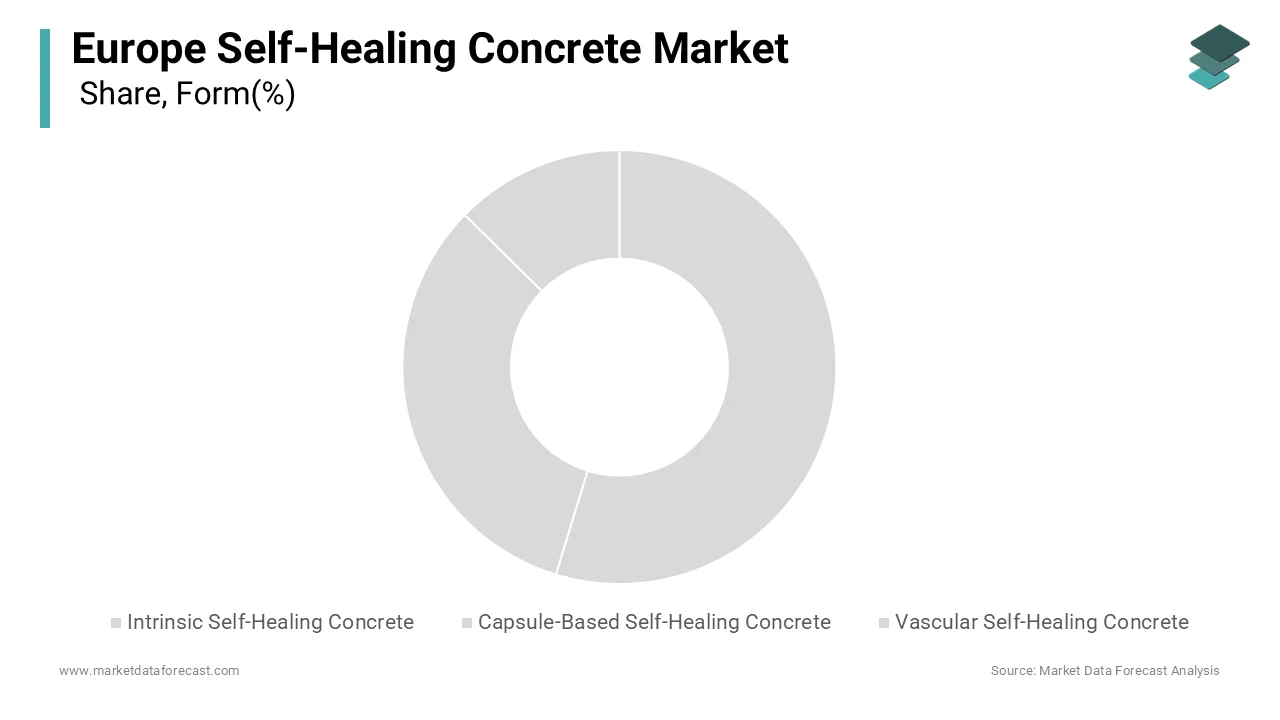
The capsule-based segment is the fastest-growing form segment in the European market and is predicted to witness a CAGR of 13.3% over the forecast period, owing to its targeted healing capability and increasing standardization of polymer microcapsules for commercial use. Unlike intrinsic methods, which heal only narrow cracks, capsule systems release epoxy or polyurethane sealants upon crack propagation, enablingthe repair of wider fissures. In 2024, BASF and Sika launched commercially available microcapsules that survive standard mixing and remain stable in storage. According to the Dutch Ministry of Infrastructure, reduced maintenance frequency on a pilot industrial warehouse floor in Rotterdam using capsule concrete. Additionally, the EU’s Horizon Europe program allocated funding to the HEALCON project, which developed scalable spray drying techniques to produce capsules at a lower cost. With performance now quantifiable and production industrialized, capsule systems are transitioning from lab novelty to specified solutions for high-value applications demanding predictable and robust autonomic repair.
By Application Insights
The infrastructure segment commanded the highest share of 61.6% of the regional market in 2025. The leading position ofthe infrastructure segment in the European market is attributed to the urgent need to extend the service life of aging bridges, tunnels, roads, and water management systems under severe budget and sustainability constraints. As per Eurostat, a significant proportion of the EU’s-road and rail bridges were built before 1970 and exhibit advanced deterioration from chloride ingress and fatigue cracking. Self-healing concrete directly addresses this by reducing lifecycle maintenance; a trial by Rijkswaterstaat in the Netherlands demonstrated that bacterial concrete used in canal linings reduced crack propagation over five years, lowering inspection frequency and repair costs. National infrastructure agencies are institutionalizing their use; Germany’s Federal Highway Research Institute now includes self-healing specifications in new tunnel contracts, while France’s SNCF mandates it for high-speed rail substructures exposed to de-icing salts. With billions of euros allocated to EU infrastructure maintenance in 2024 and strict Green Deal durability targets, infrastructure remains the primary and most impactful application domain for self-healing concrete.
The Industrial segment is the fastest growing application in the European self-healing concrete market and is estimated to register a CAGR of 15.1% over the forecast period, owing to the demand for ultra-durable, low-maintenance flooring in warehouses, logistics centers, and manufacturing plants where heavy forklift traffic and chemical exposure cause rapid surface degradation. Conventional industrial floors require resurfacing every few years at high costs, as documented by the German Construction Industry Association. In contrast, capsule-based self-healing concrete restores integrity after microcracking from point loads, extending service life. A pilot at a DHL logistics hub in Leipzig using microcapsule concrete reported reduced floor repair costs over three years. The EU’s Level(s) sustainability framework now awards bonus points for industrial buildings using self-healing materials, enhancing ESG ratings. With e-commerce driving steady growth in warehouse construction across Europe, industrial flooring has become a high-volume, predictable outlet for performance-driven self-healing concrete adoption.
COUNTRY LEVEL ANALYSIS
Netherlands Self-Healing Concrete Market Analysis
The Netherlands dominated the self-healing concrete market in Europe in 2025 with 23.5% of the regional market share. The country’s leadership is primarily driven by its reliance on water management infrastructure and early investment in bio-based healing technologies. Delft University of Technology pioneered bacterial self-healing concrete using Bacillus species, which is now deployed in projects such as the Afsluitdijk storm surge barrier and Amsterdam canal linings. Rijkswaterstaat mandates self-healing concrete in new hydraulic structures exposed to chloride environments, with large volumes used in 2024. The government’s “Circular Infrastructure” program requires reduced material consumption by 2030, making self-healing a strategic compliance tool. Dutch ready-mix producers like Van de Velde and CRH Netherlands offer certified bacterial concrete with traceable spore viability testing. With 26% of the country below sea level and rising climate pressures, the Netherlands treats self-healing not as innovation but as an operational necessity for national resilience.
Germany Self-Healing Concrete Market Analysis
Germany captured the second-largest share of the European self-healing concrete market in 2025. The growth of Germany in the European market is attributed to its rigorous validation and integration into high-safety-critical infrastructure. The Stuttgart 21 rail project specified microcapsule self-healing concrete for deep foundation walls to ensure long-term watertightness without maintenance access. Germany’s “Digital Concrete” research initiative, funded by the Federal Ministry,y allocated millions of euros to develop standardized testing protocols for healing efficiency under cyclic loading. Companies like BASF and Heidelberg Materials supply certified self-healing admixtures used in numerous bridge rehabilitation projects. The German Committee for Reinforced Concrete now includes self-healing in national annexes to Eurocode 2, enabling structural design integration. With tens of thousands of bridges requiring rehabilitation and a strong industrial chemicals base, Germany combines regulatory precision, engineering culture, and material science to drive scalable adoption.
France Self-Healing Concrete Market Analysis
France is expected to exhibit a promising CAGR in the European self-healing concrete market during the forecast period. The country’s momentum is driven by binding national durability mandates and strategic deployment in rail infrastructure. France’s Infrastructure Longevity Plan requires all new public structures to demonstrate 100-year service life with minimal intervention, a standard met through intrinsic self-healing concrete with supplementary cementitious materials. SNCF Réseau specifies self-healing concrete for high-speed rail substructures exposed to de-icing salts, with significant volumes used in 2024 on the LGV Bordeaux Toulouse line. The French National Laboratory of Metallurgy and Materials validated that slag-based mixes achieved substantial crack closure under simulated rail loading. France’s Recovery Plan allocates billions of euros to sustainable construction, with self-healing concrete eligible for fast-track subsidies. With 30,000 kilometers of rail network and aggressive decarbonization targets, France institutionalizes self-healing as core to its infrastructure resilience strategy.
Sweden Self-Healing Concrete Market Analysis
Sweden is predicted to hold a substantial share of the European self-healing concrete market during the forecast period. The country excels in adapting self-healing concrete for Nordic conditions, ns whefreeze-thawhaw cycles and low temperatures challenge conventional healing mechanisms. Research at Chalmers University developed a superabsorbent polymer system that remains active at low temperatures by retaining internal moisture for delayed autogenous healing. The Swedish Transport Administration now uses this formulation in bridge decks and tunnel linings across northern regions. Sweden’s Green Public Procurement criteria award full points only to materials with documented 100 year durability, making self-healing concrete essential for winning infrastructure tenders. In 2024, large volumes were poured in the Stockholm Bypass tunnel project using intrinsic slag-based mixes. With nearly all public construction projects requiring environmental product declarations and strong alignment with the EU Taxonomy, Sweden demonstrates how cold climate innovation and policy can drive high-value adoption.
United Kingdom Self-Healing Concrete Market Analysis
The United Kingdom is estimated to hold a notable share of the European self-healing concrete market over the forecast period. Despite Brexit, the UK remains integrated into European research and is advancing its own certification frameworks for self-healing materials. The HS2 high-speed rail project specified bacterial self-healing concrete for underground station walls in London and Birmingham to ensure long-term integrity without maintenance access. The British Standards Institution published PD 7449 in 2023, providing interim guidance for specifying self-healing concrete pending full Eurocode harmonization. Companies like Tarmac and Hanson offer certified mixes used in numerous Crossrail legacy projects for platform slabs and utility tunnels. The UK’s Infrastructure Bank provides green loans for projects using materials that reduce lifecycle emissions, a thresholdthat self-healing concrete meets. With extensive rail and tunneling planned through 2030, the UK’s focus on underground critical infrastructure ensures sustained demand anchored in performance and compliance.
COMPETITIVE LANDSCAPE
The European self-healing concrete market is characterized by a concentrated yet evolving competitive landscape dominated by global construction chemical and building materials giants with strong R and D capabilities. Competition is not price-driven but centred on technical validation, durability assurance, and alignment with regulatory frameworks such as the EU Construction Products Regulation and national infrastructure standards. Incumbents like BASF, Sika, and Heidelberg Materials leverage decades of concrete expertise to embed self-healing properties into existing product lines, reducing adoption barriers. New entrants face high hurdles due to the needfor long-termm performance data certification and integration into public procurement specifications. The market remains fragmented by healing technology type, with intrinsic methods favoured for cost-sensitive projects and capsule systems for high-performance applications. However, the lack of harmonized European testing standards creates uncertainty that favours established players with in-house validation capabilities. As lifecycle cost analysis and green public procurement gain traction, competition is shifting toward proven durability and carbon reduction rather than initial material cost,t fostering a premium segment focused on infrastructure resilience and sustainability.
KEY MARKET PLAYERS
Some of the companies that are playing a dominating role in the global Europe Self-Healing Concrete Market include
- BASF SE
- CEMEX S.A.B. de C.V.
- Heidelberg Materials AG
- Sika AG
- CRH plc
- Saint-Gobain S.A.
- LafargeHolcim Ltd.
- Borum Materials LLC
- Xypex Chemical Corporation
- TITA Coatings Ltd.
- Biotop GmbH
- Holcim Technology Ltd.
- CarbonCure Technologies Inc.
- Eqiom France (CRH group)
- Bionetix International Inc.
- Vicat Group
- Dyckerhoff GmbH
- MC-Bauchemie Mörtelwerke GmbH & Co. KG
- Geopolymer Solutions Ltd.
TOP LEADING PLAYERS IN THE MARKET
- BASF SE is a German multinational chemical company and a global leader in construction chemicals with a strong footprint in the European self-healing concrete market. The company develops and supplies advanced admixtures, including microencapsulated healing agents and performance enhancers that enable autonomous crack repair in cementitious systems. In 2024, BASF launched its MasterLife SHC 1000 sserieses now specified in tunnel and bridge projects across Germany and the Netherlands. The firm also co-leads the EU-funded HEALCON consortium to industrialize the production of polymer microcapsules and reduce costs by 40%. Through deep integration with European infrastructure standards and lifecycle engineering support, BASF positions self-healing concrete as a quantifiable durability solution rather than an experimental material.
- Sika AG is a Switzerland-based specialty chemicals company renowned for its innovative concrete technology,s including self-healing systems for industrial and infrastructure applications. The company offers both intrinsic and capsule-based solutions under its SikaMonoTop and SikaFiber product llineses tailored for flooring, bridge deck,s and precast elements. In 2023, Sika introduced a ready-to-use capsule admixture for industrial flooring that achieved 60% crack closure in third-party validation by the Dutch TNO institute. The firm also partnered with major logistics developers in France and Sweden to deploy self-healing concrete in e-commerce warehouse floors, reducing long term maintenance costs. By combining material science with application-specific engineering, Sika strengthens its role as a solutions provider for performance-driven European construction projects.
- Heidelberg Materials AG is a Germany-headquartered global building materials producer with a strategic focus on sustainable and durable concrete solutions across Europe. The company integrates self-healing technologies into its low-carbon cement portfolio using intrinsic methods based on optimized binder systems with supplementary cementitious materials. In 2024, Heidelberg Materials launched its Heidelberg SmartCreterangeg,e featuring autogenous healing properties validated under German Committee for Reinforced Concrete guidelines for use in public infrastructure. The firm supplies these mixes to major projects, ts including Stuttgart 21 and Dutch water management systems. By embedding self-healing capabilities into standard ready mix offerings,ngs Heidelberg Materials enables widespread adoption without requiring special handling or certification,tion accelerating market penetration through existing supply chains.
TOP STRATEGIES USED BY THE KEY MARKET PARTICIPANTS
Key players in the European self-healing concrete market are developing commercially viable capsule-based and intrinsic formulations that integrate seamlessly into standard batching and placement processes. Companies are collaborating with public infrastructure agencies and research institutions to validate long term performance and achieve inclusion in national design codes. Strategic focus on industrial flooring and underground applications provides high-value entry points with clear return on investment. Firms are also aligning products with EU Green Deal criteria by reducing embodied carbon and extending service life to qualify for green financing. Additionally, manufacturers are investing in scalable production of healing agents and offering technical support for specification and quality control to build trust among engineers and contractors. These strategies collectively address cost performance standardization and sustainability to transition self-healing concrete from pilot projects to mainstream construction practice.
MARKET SEGMENTATION
This research report on the europe self-healing concrete market is segmented and sub-segmented into the following categories.
By Form
- Intrinsic Self-Healing Concrete
- Capsule-Based Self-Healing Concrete
- Vascular Self-Healing Concrete
By Application
- Infrastructure
- Bridges
- Roads & Highways
- Tunnels
- Water & Marine Structures
- Industrial
- Warehouses
- Logistics Centers
- Manufacturing Facilities
- Residential
- Commercial
By Country
- Netherlands
- Germany
- France
- Sweden
- United Kingdom
- Italy
- Spain
- Rest of Europe