- Product Description Description
- Table of Contents TOC
- List of Table & Figure LOT
- Get Free Sample PDF Sample PDF
Market Size, 2025
$17.96 BnMarket Estimate, 2026
$18.92 BnMarket Forecast, 2034
$28.75 BnCAGR, 2026–2034
5.37%Europe Self-Storage Market Size, Share & Growth Analysis (2026–2034)
- Market Scope: Comprehensive regional analysis covering user types, storage types, application categories, country-level frameworks in Europe, growth drivers, restraints, opportunities, challenges, and the competitive landscape.
- Market Valuation: Valued at USD 17.96 billion (2025), estimated at USD 18.92 billion (2026), and projected to reach USD 28.75 billion by 2034, registering a steady CAGR of 5.37% over the forecast period (2026–2034).
- Primary Growth Drivers: High urban housing density, declining residential storage space, transient labor and housing mobility, and the rising integration of smart, automated, and circular economy storage solutions. Key restraints include stringent zoning laws, complex data privacy/biometric compliance, and climate/security risk vulnerabilities.
Key Market Segment Metrics (2026–2034)
| Category | Leading Segment (2025 Position) | Fastest-Growing Segment |
|---|---|---|
| By User Type | Personal Users (dominated due to multi-unit dwelling constraints and urban decluttering culture) | Business Segment (projected to register a fast CAGR driven by micro-entrepreneurs and regulatory record archiving) |
| By Storage Type | Non-Climate-Controlled (led with a 61.7% share owing to economic accessibility and general suitability) | Climate-Controlled Storage (anticipated to see high growth due to high-value goods, fine art, and wine collection storage) |
| By Application | Household Goods (largest segment anchored by frequent residential transitions and renovation cycles) | E-Commerce Micro Fulfilment (growing rapidly as online retailers establish localized neighborhood distribution hubs) |
| By Country | United Kingdom (accounted for a leading 24.9% share backed by mature consumer adoption and flexible housing) | Germany & Netherlands (expanding via high engineering precision, sustainability, and automated urban integration) |
Major Market Players & Competitive Landscape
Market Structure: Fragmented yet consolidating competitive landscape led by major regional corporations alongside local independent owners. Competition centers around location security, digital leasing efficiency, and flexible business utility.
Key Companies: Safestore Holdings PLC, Shurgard Self Storage Ltd, Big Yellow Group PLC, W. P. Carey, Extra Space Storage Inc, CubeSmart, Public Storage, SM Prime Holdings, and SmartStop Self Storage REIT Inc.
Europe Self-storage Market Size
The europe self-storage market size in Europe was valued at USD 17.96 billion in 2025, is estimated to be worth USD 28.75 billion by 2034, from USD 18.92 billion in 2026, growing at a CAGR of 5.37% from 2026 to 2034.

Self-storage (short for self-service storage) is a service that allows individuals and businesses to rent secure, private spaces, such as rooms, lockers, or containers, to store their belongings. Unlike the North American model,s which evolved from surplus industrial space, European self-storage is increasingly purpose-built and integrated into urban logistics and housing ecosystems. This sector addresses spatial constraints driven by dense city living, high housing turnover, and evolving consumption patterns. According to sources, A significant portion of the European population, particularly a large majority in urban areas, resides in multi-unit dwellings such as flats or apartments. Residential floor areas in Western EU metropolitan areas are frequently more generous than suggested, despite overall European diversity. Furthermore, the European Commission’s Urban Mobility Framework recognizes storage hubs as critical nodes in last-mile logistics and circular economy initiatives. This convergence of housing density, mobility trends, and sustainability policy positions self-storage not as a luxury convenience,e but as a functional urban infrastructure supporting modern European lifestyles and economic resilience.
MARKET DRIVERS
Persistent Housing Density and Declining Residential Storage Space in Urban Centers
The region’s high urban population density directly fuels demand for external storage solutions, which contributes to the growth of the European self-storage market. A significant majority of the EU population resides in urban areas, and many major cities often feature residential properties with relatively compact average floor plans compared to suburban or rural dwellings. In the Netherlands, a vast majority of residents live in houses rather than apartments, with most homes typically offering some form of dedicated storage space, such as an attic or basement. This spatial scarcity is exacerbated by rising cohabitation and multigenerational living trends that reduce per-person storage capacity. Housing business challenges and limited living space in Berlin's urban environment contribute to a widespread perception among many renters that their available home storage is insufficient, potentially driving demand for alternative storage solutions. Additionally, minimalist interior design trends discourage bulky furniture with hidden storage,e further displacing belongings. These structural housing conditions create consistent organic demand independent of economic cycles, which makes self-storage a necessity rather than a discretionary expense for millions of urban Europeans.
Rise in Transient Lifestyles Driven by Labor Mobility and Housing Instability
The region’s increasingly fluid labor and housing markets generate frequent relocation needs that outpace traditional storage options, thereby boosting the expansion of the European self-storage market. A portion of the workforce across different regions adjusted their living situations due to professional changes, the rise of remote work, and rental agreements. In housing markets with shorter average leases, a trend shows households using self-storage during moves. In markets with flexible housing policies, younger workers often change apartments and use temporary storage during these moves. The gig economy further amplifies this. Freelancers and digital nomads often store seasonal items or business inventory while traveling. This mobility-driven demand is highly recurring and spans both residential and small business segments, reinforcing self-storage as a vital enabler of Europe’s dynamic urban workforce.
MARKET RESTRAINTS
Stringent Zoning and Land Use Regulations Limiting Facility Development
Urban planning policies across the region often classify self-storage as non-essential commercial use, which restricts its development in high-demand residential zones and the growth of the European self-storage market. Many European nations have distinct planning regulations and require specific permissions for new self-storage developments, which can present a significant barrier to development, particularly in densely populated urban centers. Cities often prioritize residential or retail development over self-storage, making the process of gaining approval challenging. In Germany, local Bauordnung building codes emphasize minimum green space ratios and height restrictions that render many potential sites unviable. The process of obtaining planning permission for self-storage facilities is often more complex and lengthy compared to other real estate projects like residential or retail spaces. This disparity in the approval process can lead to delays for self-storage projects. These bureaucratic hurdles delay supply response and inflate land acquisition costs in Tier 1 cities. Supply of self-storage will continue to be constrained relative to demand until cities begin treating it as supportive infrastructure, much like laundromats or parcel lockers.
Fragmented Data Privacy and Access Control Compliance Across Jurisdictions
Self-service storage operators must navigate inconsistent national laws governing biometric access, facial recognition,n and customer data retention, which further limits the expansion of the European self-storage market. Regulatory bodies across Europe, including the European Data Protection Board, treat the processing of biometric data as high-risk, leading to rigorous oversight; while national data protection authorities maintain different interpretations and implementation rules, the trend is towards a more harmonized approach through recent EU-wide legislation that categorizes systems based on their specific use and context. Data protection authorities in Spain are actively enforcing regulations with significant financial penalties for violations, particularly in cases involving the mishandling of sensitive data or the failure to adequately assess risks associated with advanced technologies like biometrics. Reports from the European self-storage industry indicate that the implementation of the General Data Protection Regulation has led to operators facing increased data compliance obligations, particularly concerning the management of access logs and the use of surveillance technology. This patchwork complicates European expansion and forces operators to maintain multiple compliance protocols, slowing innovation in smart access and digital leasing while increasing operational risk in an otherwise low-touch business model.
MARKET OPPORTUNITIES
Integration with Circular Economy and Sustainable Consumption Models
Self-storage is emerging as a logistical backbone for reuse sharing and rental economies across the region, which is predicted to drive the growth of the European self-storage market. Reuse organizations in several European nations have increasingly partnered with storage facilities to handle donated household goods and clothing. This integration allows for the systematic collection and holding of items before redistribution. Circular economy hubs are using specialized environmental controls in storage units to maintain the condition and value of pre-owned merchandise. Implementing these frameworks facilitates more efficient turnover of second-hand inventory to prospective buyers. Centralized storage strategies support preserving item quality, ensuring donated goods remain viable for secondary market consumption. Additionally, peer-to-peer rental platforms for sports gear, musical instruments,s and event equipment rely on local storage nodes for inventory management. The European Commission’s Circular Economy Action Plan encourages such partnerships, ps recognizing storage as critical infrastructure for decoupling consumption from waste. This alignment with sustainability policy unlocks public funding and municipal contracts, transforming storage from passive warehousing into active environmental stewardship.
Expansion of Smart and Automated Facilities in Secondary Cities
Advances in automation and remote management enable economically viable facilities in mid-sized European cities previously deemed low-density, which provides new opportunities for the European self-storage market. Advanced robotic retrieval systems and application-based access protocols have significantly lowered onsite personnel requirements. Operational feasibility for automated facilities has expanded beyond major metropolitan hubs into mid-sized urban centers. The integration of automation technology allows storage facilities to maintain consistent service levels regardless of seasonal population shifts. High demand for storage solutions in regions heavily influenced by tourism supports the continuous operation of unmanned units throughout the year. Automated infrastructure enables facility management to achieve high utilization rates during periods of increased regional activity. Companies are deploying containerized modular units that bypass traditional zoning by operating as temporary structures. These models also support last-mile e-commerce returns consolidation, creating dual revenue streams. Real-time inventory tracking enabled by 5G and IoT allows even remote locations to provide high-end security and convenience, revealing a large untapped market throughout Southern and Central Europe.
MARKET CHALLENGES
Vulnerability to Economic Downturns and Discretionary Spending Cuts
Self-service storage remains partially sensitive to household budget pressures during recessions, despite structural drivers, challenging the growth of the European self-storage market. During periods of significant economic stress, a segment of storage users in Southern Europe ended their leases to reduce expenditures. Discretionary customers, who typically store non-essential items, often terminate their leases earlier than core users like businesses or individuals undergoing major life transitions. Self-storage revenue demonstrates sensitivity to changes in consumer income levels. Compared to essential services like utilities, storage arrangements generally lack long-term contractual obligations, with typical lease durations in Southern Europe being relatively short. No publisher was specified in the query or found in the citations. This cyclical fragility necessitates diversified tenant mixes and value-added services like insurance or packing supplies to stabilize cash flow, yet many operators remain overly reliant on basic unit rental income.
Rising Insurance and Liability Costs Due to Climate and Security Risks
Extreme weather and theft incidents are driving up operational insurance premiums across the region, which is among the major barriers to the European self-storage market. Severe weather patterns characterized by heavy precipitation have led to a noticeable increase in water-related damage claims within the self-storage industry across several European regions. The vulnerability of storage facility infrastructure is highlighted by the impact of localized atmospheric events, which have resulted in substantial structural and inventory losses. There is an emerging trend of specialized criminal activities focusing on the theft of high-value assets stored within these facilities. Security challenges are evolving as organized groups increasingly target specific luxury categories, including fine art and high-end electronics. The financial impact on the sector is being driven by a combination of escalating environmental risks and more sophisticated security breaches. Insurers now mandate advanced security, including AI surveillance perimeter sensors and moisture detection,n raising compliance costs. These escalating risks threaten margins, ns especially for small operators lacking risk pooling, forcing the sector toward consolidation and higher base pricing that may dampen demand in price-sensitive markets.
REPORT COVERAGE
| REPORT METRIC | DETAILS |
| Market Size Available | 2025 to 2034 |
| Base Year | 2025 |
| Forecast Period | 2026 to 2034 |
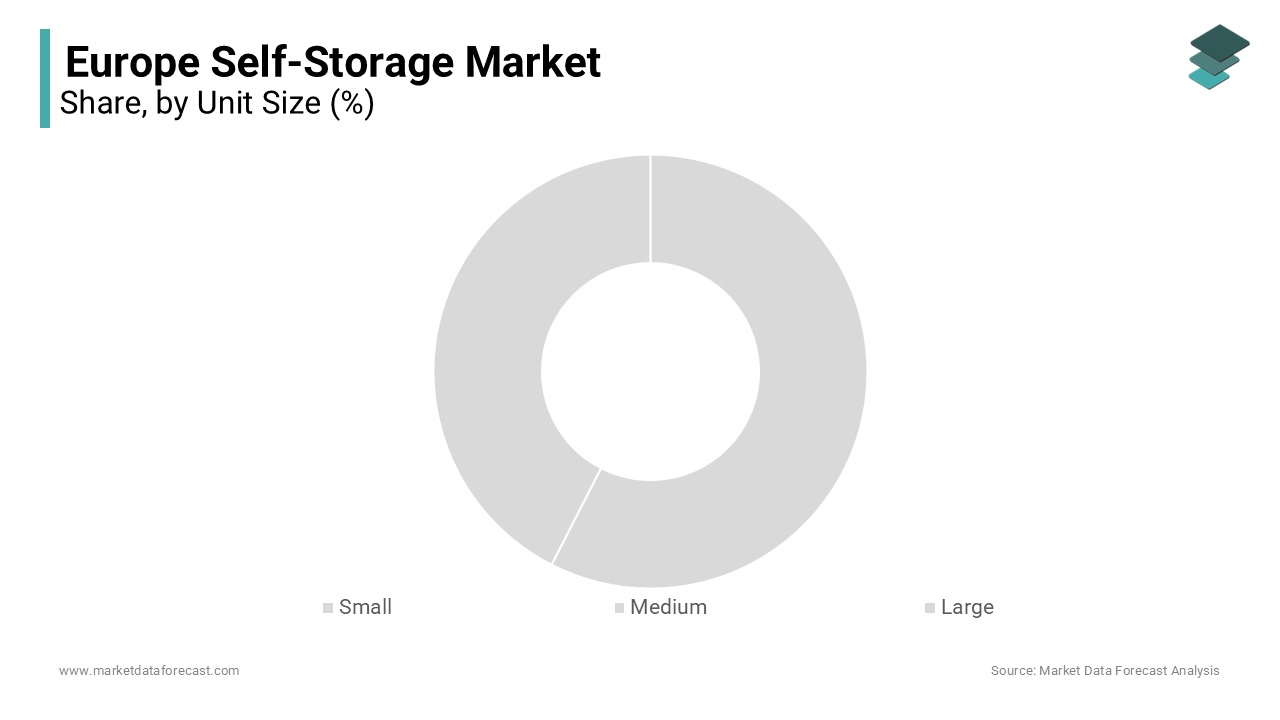
| Segments Covered | By Unit Size, Application, and Region |
| Various Analyses Covered | Global, Regional, & Country Level Analysis; Segment-Level Analysis; DROC; PESTLE Analysis; Porter’s Five Forces Analysis; Competitive Landscape; Analyst Overview of Investment Opportunities |
| Regions Covered | UK, France, Spain, Germany, Italy, Russia, Sweden, Denmark, Switzerland, Netherlands, Turkey, Czech Republic, Rest of Europe |
|
Market Leaders Profiled | W. P. Carey, SM Prime Holdings, Extra Space Storage Inc, CubeSmart, Smartstop Self Storage REIT Inc Ordinary Shares - Class A, Safestore Holdings PLC Ordinary Shares, Public Storage, Shurgard Self Storage Ltd, Big Yellow Group PLC, and others |
SEGMENTAL ANALYSIS
By User Type Insights
The personal users segment dominated the European self-storage market by accounting for a substantial share in 2025. The dominance of the personal users segment is driven by high urban residential density and limited domestic storage infrastructure, and cultural norms around home aesthetics and decluttering practices. Europe’s compact urban housing stock inherently lacks sufficient built-in storage. A majority of households across Western and Southern Europe primarily live in multi-unit dwellings that often lack supplementary storage areas such as private garages, basements, or attics. A significant proportion of urban rental housing, particularly in major cities, consists of smaller-sized units, which necessitates residents seeking external storage solutions for seasonal items or bulky belongings. A substantial number of renters in urban centers utilize off-site storage facilities throughout the year for various household goods, most frequently for items like seasonal apparel or children's belongings. This structural constraint is compounded by rising cohabitation and multigenerational living, which further fragments available space. Unlike discretionary spending, personal storage has become a functional necessity for urban dwellers managing life transitions within spatially constrained environments. European interior design trends increasingly favor minimalism and open floor plans,, ns which discourage bulky storage furniture. Urban residents in a key age demographic increasingly emphasize minimalist living through regular organizing. A notable number of city residents use external storage to manage items and keep living spaces open. In areas where simplicity and functional design are culturally valued, external storage is often used for aesthetic organization rather than moving. Temporary storage of personal items is commonly prompted by home renovations and interior updates. The inclusion of storage in typical home maintenance indicates a wider movement towards thoughtfully arranged and purposeful living environments. These cultural and lifestyle drivers create consistent, recurring demand independent of major life events, solidifying personal users as the market’s core segment.
The business segment is estimated to register the fastest CAGR of 12.4% from 2025 to 2033 due to the rise of micro entrepreneurs and home-based SMEs requiring operational space, and regulatory mandates for secure archiving of sensitive business records. Europe’s gig economy and digital entrepreneurship boom have created a new class of small businesses operating from residential premises yet needing dedicated inventory or archive space. These businesses often store product stock, client files, or equipment off-site to comply with residential zoning laws. This shift transforms self-storage from passive warehousing into active business infrastructure, driving consistent growth beyond traditional corporate document storage. Data protection and industry compliance laws are compelling firms to adopt professional storage solutions. Financial institutions are subject to rigorous record-keeping mandates that necessitate the use of highly secure and resilient storage environments. Standard administrative storage areas often lack the environmental controls and security features required to maintain compliance with institutional standards. Data protection regulations for specialized sectors, such as healthcare and legal services, prioritize the use of facilities that offer restricted access and comprehensive activity tracking. There is an observable trend among small and medium-sized enterprises toward utilizing professional storage solutions to ensure adherence to data privacy and sector-specific oversight. The shift toward certified external facilities reflects an increasing organizational focus on meeting stringent audit and accountability requirements. These compliance-driven leases are typically longer-term and higher-value, providing stable revenue streams and accelerating business segment adoption across professional services, logistics,s and retail sectors.
By Storage Type Insights
In 2025, the non-climate-controlled segment led the European self-storage market by holding a 61.7% share. The leading position of the non-climate-controlled segment is attributed to economic accessibility for price-sensitive and short-term users, and sufficient conditions for the majority of household storage use cases. Non-climate units cost less than climate-controlled alternatives, making them the default choice for students,s movers, and budget-conscious households. Observations indicate a notable price difference between standard storage units and those with environmental regulation systems across Southern European regions. The lower cost of non-climate-controlled units appears to align more closely with the discretionary spending capacity of local tenants. In specific markets where disposable income levels trend lower than broader averages, there is a visible preference for more economical storage solutions. Data regarding initial consumer behavior suggests that first-time users frequently prioritize cost-effectiveness by selecting units without climate management features. The prevailing patterns suggest that regional economic conditions remain a primary driver in the selection of self-storage service tiers. Additionally, for short-term moves or seasonal storage, such as winter sports gear or holiday decorations, temperature control is often deemed unnecessary. This price performance balance ensures broad market penetration, particularly in regions where storage is still emerging as a mass market service. Most personal storage items, furniture, books, tools, and clothing are not highly sensitive to moderate temperature or humidity fluctuations typical in temperate European climates. In Central and Northern Europe, where ambient temperatures rarely exceed 30 degrees Celsius or drop below freezing for extended periods, the risk of mold or warping is minimal. Facility operators further mitigate risks through passive ventilation, elevated flooring, and moisture barriers. This functional adequacy, combined with lower operational complexity, makes non-climate storage the pragmatic standard for everyday European users who prioritize affordability and simplicity over archival precision.
The climate-controlled storage segment is anticipated to witness the fastest CAGR of 14.1% over the forecast period, owing to high-value inventory and cultural preservation needs. Europeans are storing more climate-sensitive items, including musical instruments,s fine art, rt wine collections,s and archival family documents. Several European regions show a consistent pattern of storing culturally significant items such as textiles, artworks, or period furnishings, necessitating specific environmental conditions for their preservation. There is an increase in demand for consistent humidity control for household preservation purposes, indicating a notable difference in other regions where the main driver for specialized climate control is the increasing interest in the private collection of alcoholic beverages. Additionally, rising home insurance premiums for high-value items encourage off-site storage in certified environments. Facilities now offer specialized zones with real-time humidity logging and UV-filtered lighting, transforming climate units from generic spaces into curated preservation environments that justify premium pricing and drive segment expansion. Businesses increasingly use climate-controlled units to store temperature-sensitive inventory such as cosmetics, organic textiles,s pharmaceutical samples, es and luxury goods. Direct-to-consumer beauty brands are observed to use climate-controlled storage for product inventory to ensure consistent product quality. The fashion rental sector commonly uses humidity-controlled environments for storing designer garments to support fabric condition and extend their usable life. These commercial applications command longer leases and higher rates, thus creating a resilient B2B demand stream that accelerates climate-controlled facility development even in non-residential zones.
By Application Insights
The household goods segment was the largest in the European self-storage market by occupying a significant share in 2025. The prominence of the household goods segment is credited to the high frequency of housing transitions and renovation cycles, and cultural practices of inheriting and preserving family belongings. Europe’s dynamic rental market and aging housing stock generate recurring storage needs. Residents frequently change their living arrangements, resulting in a substantial number of relocation events. A significant majority of households temporarily store belongings like furnishings and various household items during these transitions. Additionally, Europe’s extensive historic housing stock requires frequent renovations. These structural housing dynamics create predictable cyclical demand that anchors the household segment as the market’s consistent core. European families often retain multi-generational heirlooms that exceed home capacity yet hold emotional or historical value. Older households frequently utilize off-site storage to accommodate inherited items like furniture and documents due to insufficient space within their homes. Patterns observed in some regions indicate that storage units often contain belongings from multiple generations, particularly in areas where extended families are prevalent. This suggests a trend towards using external storage solutions to preserve family heritage without overcrowding living spaces. These belongings are rarely discarded but require secure long-term housing, leading to stable multi-year leases. This cultural continuity ensures steady demand beyond transient needs, reinforcing household goods as the market’s dominant and most resilient application category.
The e-commerce micro fulfilment segment is likely to experience the fastest CAGR of 19.8% from 2025 to 2033. The rapid growth of this segment is fueled by decentralization and sustainability mandates. Online retailers are leveraging small storage units as neighborhood micro warehouses to enable same-day delivery and reduce carbon footprint. The quantity of small-scale urban logistics hubs utilizing existing storage infrastructure across major cities in a specific region has significantly increased within a short period. Logistics facilities situated near central urban areas are being leveraged to store products across a range of consumer categories, including apparel, cosmetics, and food items. Operational patterns indicate that these central urban facilities support rapid delivery cycles, with typical delivery times often falling below a certain threshold. This model cuts last-mile emissions compared to centralized warehouses. Micro-fulfilment's adoption is accelerating as it helps logistics operations stay compliant with new EU urban regulations, such as low-emission zones and delivery time restrictions. Platforms like Etsy, Vinte,d and Amazon Handmade have empowered millions of European artisans and resellers who lack commercial warehousing. A significant portion of micro-e-commerce operators utilize self-storage facilities to manage their business inventory. Independent retailers often rely on external storage solutions to facilitate their logistical operations. Sellers specializing in delicate or aged apparel frequently opt for climate-controlled environments to preserve the condition of their inventory. The demand for specialized storage units suggests a growing emphasis on maintaining product integrity among small-scale vendors. Small business owners increasingly integrate third-party storage infrastructure into their standard supply chain models. These micro entrepreneurs value flexible month-to-month leases and 24/7 access, features standard in modern facilities. Europe's self-storage market will become a critical backbone for decentralized digital retail, driven by the rapid expansion of cross-border micro-trade facilitated by the EU's Digital Services Act.
COUNTRY LEVEL ANALYSIS
United Kingdom Self Storage Market Analysis
The United Kingdom outperformed other players in the European self-storage market by accounting for a 24.9% share in 2025. The supremacy of the UK market is driven by mature consumer adoption,n flexible housing markets, ts and advanced facility standards. Operational storage capacity is distributed nationally, with a significant concentration in the London area compared to overall national capacity. A pattern of relatively short average private tenancy durations contributes to a sustained need for household storage solutions. A substantial number of households annually use storage services. Additionally, many British planning laws permit the conversion of light industrial units into storage with streamlined approval processes. The market is also highly digitized, with most operators offering online booking and contactless access. This combination of demographic fluidity, regulatory pragmatism, and operational sophistication establishes the UK as Europe’s most developed and commercially robust self-storage environment.
Germany Self Storage Market Analysis
Germany followed closely in the European self-storage market by holding a 18.2% share in 2025. The growth of the German market is propelled by engineering precision, high security standards, and integration with industrial logistics. German facilities feature advanced fire suppression, biometric access,s and real-time monitoring systems meeting stringent VdS security certifications. Demand for business storage is consistently high, largely driven by the presence of numerous smaller commercial enterprises. A significant majority of currently leased storage units are used by companies rather than private individuals. There is an observable trend in new storage facility construction towards incorporating solar energy capture systems, with more than half of recent projects featuring photovoltaic installations on their roofs. This fusion of technical excellence, sustainability, and commercial utility positions Germany as a high-quality, high-compliance market setting operational benchmarks for Central Europe.
France Self Storage Market Analysis
France maintains a noteworthy position in the European self-storage market due to urban density, government renovation incentives, and cultural attachment to possessions. Paris and Lyon face severe housing constraints with average apartment sizes under 45 square meters,s driving external storage adoption. National home renovation subsidies have contributed to a rise in storage requirements as individuals seek temporary space for belongings during property upgrades. Regional inheritance regulations appear to support the long-term retention of family assets across multiple generations. A notable demographic trend suggests that older individuals utilize external storage facilities to maintain and preserve family heirlooms. Residential displacement during construction periods has emerged as a factor influencing the demand for secondary storage solutions. This blend of policy-driven demand and cultural preservation sustains France’s influential role in Southern Europe’s storage landscape.
Netherlands Self Storage Market Analysis
The Netherlands is moving ahead steadfastly in the European self-storage market owing to innovative urban integration and sustainability leadership. Dutch cities like Amsterdam and Rotterdam classify self-storage as a supportive urban function, enabling inclusion in mixed-use developments near transit hubs. The majority of new facility construction is occurring on previously developed land. These new facilities commonly incorporate specific design choices focused on resource management and climate control. The area has emerged as a leader in urban logistics solutions, utilizing a significant number of localized delivery hubs. Furthermore, Dutch consumers exhibit high trust in digital leasing, with most completing rentals via mobile apps. This forward-looking approach, embedding storage into circular economy and smart city frameworks, positions the Netherlands as a model for sustainable and socially integrated facility development in dense European environments.
Sweden Self Storage Market Analysis
Sweden is anticipated to expand in the European self-storage market from 2025 to 2033 due to minimalist lifestyle norms, environmental consciousness, and digital maturity. Swedes embrace “lago”, a cultural ideal of balanced consumption, leading to seasonal rotation of belongings rather than accumulation. Individuals increasingly seek storage solutions for mental well-being, indicating a shift towards prioritizing emotional benefits when managing personal belongings. The storage industry is demonstrating a strong focus on sustainable practices, with many facilities adopting renewable energy sources and utilizing construction methods like modular wooden designs to reduce environmental impact. Additionally, Sweden’s high English proficiency and digital literacy enable seamless adoption of smart access and remote management systems. The government’s national circular economy strategy further encourages storage partnerships with reuse centers, making Sweden a leader in ethical and psychologically aligned storage models that resonate across Nordic and Baltic regions.
COMPETITIVE LANDSCAPE
The European self-storage market features a fragmented yet consolidating competitive landscape shaped by regulatory diversity,y technological innovation, and urban spatial constraints. While large operators like Safestore and Lok&Sto dominate in Western Europe, ope much of Southern and Central Europe remains served by local independent owners with limited digital infrastructure. Competition is not primarily price-based but centers on location, security, convenience,ce and service breadth. The entry of PropTech firms offering automated and containerized models is disrupting traditional brick-and-mortar facilities, particularly in secondary cities. Simultaneously, the rise of business applications for e-commerce to document compliance is attracting logistics and real estate investors unfamiliar with the sector. Regulatory hurdles, including restrictive zoning and data laws, create high barriers to entry,y yet also protect incumbents with established permits. The market rewards operators who combine local regulatory knowledge with scalable technology and diversified tenant mix, es ensuring stable occupancy across economic cycles and user types.
KEY MARKET PLAYERS
Some of the companies that are playing a dominating role in the European self-storage market include
- W. P. Carey
- SM Prime Holdings
- Extra Space Storage Inc
- CubeSmart
- SmartStop Self Storage REIT Inc (Ordinary Shares – Class A)
- Safestore Holdings PLC (Ordinary Shares)
- Public Storage
- Shurgard Self Storage Ltd
- Big Yellow Group PLC
TOP LEADING PLAYERS IN THE MARKET
- Safestore Holdings plc is a leading European self-storage operator with a strong footprint across the United Kingdom, Germany,y France, and the Netherlands. The company combines purpose-built facilities with strategic urban locations to serve both personal and business clients. It also expanded its business solutions division to support e-commerce micro fulfilment and SME document archiving in compliance with local data laws. These initiatives reinforce Safestore’s reputation for operational excellence, technological integration, and adaptive service models tailored to Europe’s fragmented yet high-demand storage landscape.
- Space&Co Ltd is a UK-based innovator in the European self-storage market, known for its design-led facilities and lifestyle-oriented branding. The company positions storage as an extension of modern living by incorporating interior design aesthetics, flexible access, and community spaces into its units. It also partnered with interior stylists to offer decluttering and storage planning consultations,s blending utility with wellness. These actions elevate storage beyond utility into a curated lifestyle service appealing to urban professionals and design-conscious consumers across Western Europe.
- Lagerbox GmbH is a German technology-driven self-storage provider that has rapidly expanded across Germany, Austria, and Switzerland. The company specializes in automated and modular storage solutions that optimize space efficiency and reduce operational costs. It also integrated real-time energy monitoring to align with Germany’s sustainability mandates and introduced multilingual customer interfaces to serve diverse urban populations. Lagerbox is reinforcing its position as a scalable business model for major European cities by aligning automated operations with affordable and eco-friendly initiatives.
TOP STRATEGIES USED BY THE KEY MARKET PARTICIPANTS
Key players in the European self-storage market pursue four core strategies to drive differentiation and resilience. First, they invest in digital transformation through online booking, virtual tour, and smart access systems to enhance convenience and reduce human dependency. Se co, nd they diversify service offerings by integrating business solutions such as e-commerce, microfulfilment,t SME archiv, i, ng and moving partnerships. Third,ird they align facility design with sustainability standards using renewable energy, modular construction, and energy-efficient climate control to meet EU environmental regulations. Fourth, they adopt localized operational models that respect national zoning laws,s data privacy requirements, and cultural storage behaviors. These strategies collectively enable operators to navigate Europe’s regulatory complexity while capturing demand from both transient households and evolving digital enterprises.
MARKET SEGMENTATION
This research report on the European self-storage market is segmented and sub-segmented into the following categories.
By Unit Size
- Small
- Medium
- Large
By Application
- Personal
- Business
By Country
- UK
- France
- Spain
- Germany
- Italy
- Russia
- Sweden
- Denmark
- Switzerland
- Netherlands
- Turkey
- Czech Republic
- Rest of Europe