- Product Description Description
- Table of Contents TOC
- List of Table & Figure LOT
- Get Free Sample PDF Sample PDF
Market Size, 2025
$5.11 BnMarket Estimate, 2026
$5.26 BnMarket Forecast, 2034
$6.67 BnCAGR, 2026–2034
3.02%Europe Set Top Box Market Report Summary
The Europe set-top box market was valued at USD 5.11 billion in 2025, is estimated to reach USD 5.26 billion in 2026, and is projected to reach USD 6.67 billion by 2034, growing at a CAGR of 3.02% during the forecast period from 2026 to 2034. Market growth is driven by the continuous digitalization of television broadcasting, rising adoption of IPTV and OTT services, and the growing demand for high-definition and 4K-enabled set-top boxes across residential and commercial sectors. Additionally, technological advancements such as integrated smart features, cloud-based recording, and hybrid connectivity options are further fueling market expansion across Europe.
Key Market Trends
- Increasing shift toward IPTV and OTT-based set-top boxes due to growing internet penetration and smart TV adoption.
- Rising popularity of hybrid set-top boxes integrating broadcast and broadband capabilities for seamless content access.
- Growing demand for high-definition (HD) and ultra-high-definition (UHD) viewing experiences among consumers.
- Technological innovations, including AI-enabled interfaces, voice controls, and cloud DVR services enhancing user experience.
- Government initiatives promoting digital broadcasting and migration from analog systems in several European countries.
Segmental Insights
- By Type: The Satellite STBs segment dominated the Europe set-top box market in 2025, accounting for 39.8% share, driven by wide satellite coverage and strong subscription-based broadcasting networks.
- By End User: The Residential segment held the major market share of 67.7% in 2025, attributed to the increasing number of households adopting digital TV solutions and smart entertainment systems.
- By Resolution: The HD STBs segment led with 51.4% market share in 2025, supported by the growing consumer preference for high-quality viewing and availability of affordable HD-compatible devices.
Regional Insights
- Germany was the largest market in 2025, capturing 25.5% of the European set-top box market share, driven by strong consumer adoption of digital TV and advanced broadcasting infrastructure.
- The United Kingdom and France are key contributors, supported by the presence of established broadcasters and increasing penetration of IPTV and OTT platforms.
- Eastern Europe is emerging as a fast-growing region, with accelerating digital transition and demand for cost-effective smart STBs in developing economies.
Competitive Landscape
The Europe set-top box market is moderately fragmented, featuring a mix of global and regional players competing through innovation, partnerships, and content integration strategies. Key companies are focusing on developing smart, energy-efficient, and AI-enabled STBs to cater to evolving consumer needs and streaming preferences. Prominent players in the market include Advanced Digital Broadcast, Altech UEC, Commscope Inc., Huawei Technologies Co., Ltd., Humax Holdings, Kaonmedia Co., Ltd., Shenzhen Cozhou Electronics Co., Ltd., Skyworth Group Co., Ltd., Technicolor SA, and Zinwell Corporation.
Europe Set Top Box Market Size
The Europe set-top box market size was valued at USD 5.11 billion in 2025 and is projected to reach USD 6.67 billion by 2034 from USD 5.26 billion in 2026, growing at a CAGR of 3.02%.
Set-top box (STB) has evolved into a cornerstone of the region’s media and entertainment ecosystem due to the advancements in digital broadcasting technologies and consumer demand for high-quality content delivery. According to Eurostat (2023), more than 70% of households in Western Europe access television content via digital platforms, which indicates the essential role of set-top boxes (STBs) in enabling cable, satellite, terrestrial, and internet-based broadcasting. The ongoing transition from analogue to digital broadcasting, which is supported by EU and national government initiatives such as the Digital Switchover Programme, has substantially accelerated the adoption of STBs across the region. For instance, the Digital Economy Act mandates universal access to digital television, which is prompting widespread deployment of advanced HD, SD, and UHD-compatible devices in the UK. Meanwhile, the rapid growth of smart TVs and connected home ecosystems continues to drive demand for IP and OTT STBs that integrate with major streaming platforms, including Netflix, Amazon Prime Video, and Disney+.
MARKET DRIVERS
Government Mandates for Digital Broadcasting Transition
The widespread implementation of government mandates aimed at transitioning from analogue to digital broadcasting is one of the key drivers of the European set-top box market. According to the European Commission, Member States aimed to complete the switchover from analogue to digital television by the end of 2012, which required the deployment of advanced STBs. For instance, Italy’s Piano Nazionale di Transizione al Digitale initiative has allocated funding to facilitate the switch to digital terrestrial television (DTT), which is driving demand for DTT STBs. Similarly, the UK’s Digital Economy Act mandates universal access to digital television services, which is further propelling STB adoption. As per the reports, German households have already transitioned to digital broadcasting, which confirms the effectiveness of these mandates. Additionally, the integration of value-added features such as HD and UHD resolution support enhances the appeal of modern STBs. With Europe’s digital broadcasting penetration rate projected to remain very high, government mandates remain a critical growth driver, ensuring sustained demand for STBs across the region.
Rising Demand for Streaming Services and Smart TV Integration
The growing popularity of streaming services and the integration of smart TV functionalities are also propelling the expansion of the European set-top box market. According to the European Audiovisual Observatory, streaming services have become a key part of Europe’s audiovisual market, with major platforms such as Netflix, Amazon Prime Video, and Disney+ leading the sector. This surge in demand has fueled the adoption of IP and OTT STBs, which enable seamless access to these services. According to reports, a majority of French households now use OTT STBs to stream content, which reflects their widespread acceptance. Furthermore, the convergence of traditional broadcasting and internet-based services has created hybrid STBs, which offer users the flexibility to access both live TV and on-demand content. Surveys in several European countries show that many consumers prefer STBs with built-in smart TV capabilities, and this factor confirms the importance of integration. As streaming services continue to dominate the media landscape, the demand for advanced STBs equipped with cutting-edge features is expected to grow exponentially.
MARKET RESTRAINTS
High Costs Associated with Advanced STBs
One of the primary restraints impeding the growth of the European set-top box market is the high cost associated with advanced models, particularly those supporting UHD resolution and hybrid functionalities. According to the European Consumer Organisation (BEUC), premium STBs often remain expensive, which is making them less accessible to budget-conscious consumers, especially in Eastern and Southern Europe. As per the reports, many households in the Czech Republic and similar markets own only basic STBs due to affordability concerns. Moreover, the rapid pace of technological advancements requires frequent upgrades, which further strains consumer budgets. High costs also deter small businesses and educational institutions from adopting STBs on a large scale. While basic models remain affordable, they lack the advanced features required for modern applications, limiting their appeal. According to the International Data Corporation (IDC), the average selling price of consumer electronics, including set-top boxes, rose by around 12% in 2022, which reflects the growing emphasis on premium products. This pricing dynamic poses a significant challenge to market expansion, particularly among price-sensitive demographics.
Compatibility Issues with Diverse Broadcasting Standards
The compatibility issues faced by STBs with various broadcasting standards that hinder seamless integration into users' ecosystems are further hampering the expansion of the European set-top box market. According to the European Telecommunications Standards Institute (ETSI), Europe operates under several digital broadcasting standards, including DVB-T2 for terrestrial, DVB-S2 for satellite, and IPTV protocols for internet-based services. This diversity creates challenges for manufacturers to develop universally compatible STBs. For example, an STB designed for DVB-T2 may not function optimally with IPTV services, which is frustrating users who seek multi-platform access. As per the reports from various European consumer surveys, many STB users have encountered compatibility problems, and this is leading to dissatisfaction and reduced product loyalty. Furthermore, proprietary technologies and regional variations exacerbate the issue, which is also fragmenting the market. These compatibility barriers not only discourage potential buyers but also complicate the purchasing decision-making process. As broadcasting ecosystems continue to diversify, addressing these compatibility challenges remains crucial for fostering broader adoption of STBs across Europe.
MARKET OPPORTUNITIES
Expansion into Emerging Markets within Europe
The expansion into emerging markets, particularly in Eastern and Southern Europe, is a significant opportunity in the European set-top box market. According to the European Investment Bank, countries like Romania, Bulgaria, and Greece are witnessing rapid digitalisation due to government initiatives and EU funding programs. According to Romania’s National Recovery and Resilience Plan, significant investments have been allocated toward enhancing digital infrastructure, including expanding digital television services in rural areas. This investment creates fertile ground for STB manufacturers to tap into untapped consumer bases. Furthermore, according to the World Bank, internet penetration in Romania’s rural regions is growing rapidly, which indicates increasing access to digital tools. In particular, residential users present a lucrative opportunity as families seek affordable yet effective solutions for accessing digital content. By offering cost-effective STB options tailored to these markets, companies can establish a strong foothold. Additionally, partnerships with local distributors and broadcasters can enhance market penetration, ensuring accessibility and awareness among end-users.
Integration with Smart Home Ecosystems and IoT Technologies
The integration of set-top boxes with smart home ecosystems and Internet of Things (IoT) technologies provides promising opportunities in the European set-top box market. For instance, the global smart home market is projected to grow at a CAGR of 9.9% over the next few years and reach USD 257.54 billion by 2034. In this global market, Europe is expected to account for a significant share, which indicates the region’s growing adoption of connected devices. STBs, when combined with smart home devices, enable users to control lighting, security systems, and appliances through a single interface. This enhances convenience and energy efficiency. According to reports, many smart home users prefer STBs with integrated IoT capabilities. Similarly, according to the European Gaming and Interactive Software Federation (ISFE), the European gaming industry was valued at approximately €25 billion in 2022, which is benefiting from greater interactivity and immersive experiences driven by device integration. As smart home adoption accelerates, STB manufacturers have the opportunity to innovate and cater to these specialised applications. By aligning with tech giants developing IoT ecosystems, companies can position themselves at the forefront of this transformative trend.
MARKET CHALLENGES
Intense Competition Among Established Players
The intense competition among established players that often leads to price wars and margin erosion is one of the potential challenges to the growth of the European set-top box market. According to Statista, the leading set-top box (STB) manufacturers in Europe collectively account for a significant majority of the market share, which is indicating a highly concentrated competitive landscape. This dominance forces smaller companies to either innovate aggressively or risk being marginalised. For instance, Samsung and LG, with their proprietary STB offerings, command premium pricing and strong brand loyalty, leaving little room for new entrants. According to sources, many startups in the European electronics sector struggle to survive beyond their initial years due to competitive pressures. Furthermore, the rapid pace of technological advancements requires continuous R&D investments, which can be financially burdensome for smaller firms. Price undercutting and aggressive marketing strategies further exacerbate the situation, which is making it difficult for emerging brands to gain traction. This hyper-competitive environment poses a substantial challenge to sustainable growth and profitability within the market.
Environmental Concerns and Sustainability Pressures
The growing scrutiny over the environmental impact of set-top boxes due to the stringent sustainability regulations and consumer awareness is also challenging the expansion of the European set-top box market. According to the European Environment Agency (EEA), electronic waste generation in Europe totalled around 12 million metric tons in 2022, with discarded consumer electronics, including set-top boxes (STBs) by contributing notably to this figure. The use of non-biodegradable materials, such as plastics and lithium-ion batteries, has drawn criticism from environmental advocacy groups. For example, Greenpeace Europe has called for stricter regulations on electronic product lifecycles, which is urging manufacturers to adopt eco-friendly alternatives. Additionally, the European Union’s Circular Economy Action Plan mandates that companies reduce resource consumption and improve product recyclability by 2030. Compliance with these regulations requires significant investment in sustainable design and manufacturing processes, which can strain operational budgets. According to the Swedish Environmental Protection Agency, about 65% of European consumers prioritise eco-friendly products, which is further pressuring companies to align with sustainability goals. Balancing profitability with environmental responsibility remains a formidable challenge for the STB market.
REPORT COVERAGE
| REPORT METRIC | DETAILS |
| Market Size Available | 2025 to 2034 |
| Base Year | 2025 |
| Forecast Period | 2026 to 2034 |
| CAGR | 3.02% |
| Segments Covered | By Type, End User, Resolution, and Region |
| Various Analyses Covered | Global, Regional, & Country Level Analysis; Segment-Level Analysis; DROC, PESTLE Analysis; Porter’s Five Forces Analysis; Competitive Landscape; Analyst Overview of Investment Opportunities |
| Regions Covered | UK, France, Spain, Germany, Italy, Russia, Sweden, Denmark, Switzerland, Netherlands, Turkey, and the Czech Republic |
| Market Leaders Profiled | Advanced Digital Broadcast, Altech UEC, Commscope Inc., Huawei Technologies Co., Ltd., Humax Holdings, Kaonmedia Co., Ltd., Shenzhen Cozhou Electronics Co., Ltd, Skyworth Group Co., Ltd, Technicolour SA, Zinwell Corporation |
SEGMENTAL ANALYSIS
By Type Insights
The satellite STBs segment held 39.8% of the European set-top box market share in 2025. The dominance of the satellite STBs segment in the European market is attributed to their ability to deliver high-quality content to remote and rural areas where terrestrial and cable infrastructure is limited. According to the German Federal Ministry for Economic Affairs and Climate Action, a large share of rural households in Germany rely on satellite television, which is driving demand for satellite STBs. Additionally, the proliferation of Direct-to-Home (DTH) services, such as Sky and Canal+, has bolstered satellite STB adoption. Technological advancements, such as support for HD and UHD resolution, further enhance their appeal. According to Statista, the European satellite TV market is projected to reach a value of around €5 billion by 2026, which indicates that satellite STBs remain indispensable for users seeking reliable and high-performance broadcasting solutions.
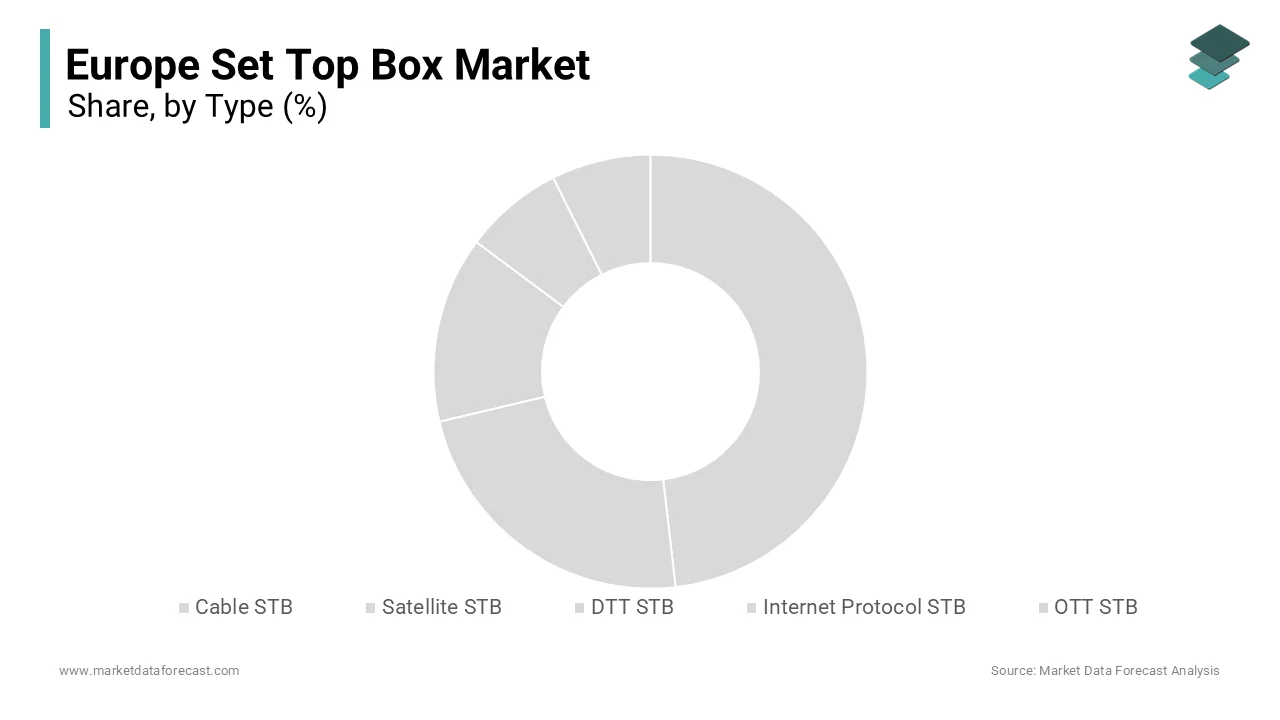
The OTT STBs segment is on the rise and is predicted to exhibit a CAGR of 23.2% over the forecast period in the European set-top box market. The affordability and compatibility of OTT set-top boxes with internet-based services make them ideal for urban consumers, which is one of the major factors propelling the growth of the OTT STBs segment in the European market. According to the Italian National Institute of Statistics (ISTAT), a growing number of households in Italy use OTT set-top boxes (STBs) to access streaming platforms such as Netflix and Amazon Prime Video. The rise of affordable broadband and fibre-optic networks has further fueled this growth, particularly in Northern Europe. According to Statista, Sweden’s OTT and IPTV devices account for roughly half of the country’s total set-top box sales, which reflects strong consumer preference for internet-based viewing. Additionally, the simplicity of OTT STBs appeals to younger users and tech-savvy consumers, which is broadening their demographic reach. As manufacturers focus on improving connectivity and user interfaces, the OTT STBs segment is poised to capture a larger share of the market.
By End User Insights
The residential users segment held the major share of 67.7% of the European market in 202,4, owing to their widespread adoption of digital television services in households across Europe. According to the UK’s Office for National Statistics (ONS), the vast majority of British households own at least one television set equipped with a set-top box (STB), which indicates their importance in residential settings. Additionally, the integration of smart TV functionalities and streaming services has further boosted adoption rates. Collaborations with broadcasters, such as Sky and BT, also drive sales through exclusive promotions and bundled offers. According to Statista, the UK’s pay-TV and digital TV market generates around €8 billion in annual revenue, which confirms that residential users remain a cornerstone of the STB market.
The commercial users segment is projected to witness a CAGR of 17.7% over the forecast period in the European set-top box market. The rise of hospitality, retail, and corporate sectors adopting STBs for digital signage and interactive displays fuels the growth of the commercial user segment in the European market. According to France’s Ministry of Industry, many hotels across France use set-top boxes (STBs) for in-room entertainment, which is enhancing guest experiences. Similarly, businesses leverage STBs for presentations and training sessions, as noted by the Dutch Chamber of Commerce. Enhanced features such as cloud integration and multi-screen support further boost commercial adoption. According to Eurostat, Europe’s service sector continues to expand steadily, indicating that commercial users are set to become a key driver of market growth.
By Resolution Insights
The HD STBs segment occupied 51.4% of the regional market share in 2025. The growth of the HD STBs segment in the European market is driven by their balance of affordability and performance, which is making them ideal for mainstream users. According to the German Federal Ministry of Education and Research, digital learning technologies have become increasingly integrated into classrooms across Germany, which is fueling demand for devices such as HD set-top boxes (STBs). Additionally, HD STBs are widely adopted in residential settings due to their compatibility with existing televisions. The versatility of HD STBs that support activities from live TV to on-demand streaming makes them indispensable tools. According to Statista, HD set-top box shipments in Europe are projected to approach 20 million units by 2026, and this indicates the growing demand for these devices, which is further strengthening their position as the leading resolution segment.
The UHD STBs segment is anticipated to record a CAGR of 25.5% over the forecast period, owing to their ability to deliver ultra-high-definition content. According to Italy’s Ministry of Economic Development, Italy has encouraged the transition to Ultra High Definition (UHD) broadcasting across public channels, which is creating a surge in UHD set-top box (STB) adoption. Similarly, the Spanish Chamber of Commerce notes that many businesses use these STBs for high-resolution digital signage applications. The ability of UHD STBs to enhance visual clarity and detail enhances their appeal. According to the European Broadcasting Union (EBU), Europe’s broadcasting sector is investing heavily in UHD infrastructure, which indicates that UHD STBs are poised to revolutionise the market.
Regional Analysis
Germany Market Analysis
Germany led the market by accounting for 25.5% of the European market share in 2025. The dominance of Germany in the European market is driven by the country’s robust digital infrastructure and high disposable incomes. According to Germany’s Federal Ministry for Digital and Transport, the government’s Digital Agenda 2026 initiative includes multi-billion-euro investments to modernise broadcasting and digital infrastructure, which is fueling STB adoption. Additionally, Germany’s strong manufacturing base supports OEM partnerships, which are further boosting STB adoption.
United Kingdom Market Analysis
The UK occupied a substantial share of the European set-top box market in 2025. The emphasis of the UK on digital transformation, particularly in education and healthcare, is propelling the UK market growth. For example, the NHS has adopted STBs for patient entertainment systems, necessitating their use. Furthermore, the UK’s thriving media industry contributes significantly to market growth. With STB sales exceeding €2 billion annually, the UK plays a vital role in the European market.
France Market Analysis
France is a promising market for STB in Europe and is anticipated to account for a prominent share of the European market over the forecast period,d owing to the focus of France on e-learning and corporatdigitisationon fuels STB adoption. For instance, French schools have integrated digital classrooms, which is driving the demand for STB in France.
Italy Market Analysis
Italy is predicted to showcase a notable CAGR in the European STB during the forecast period. Government initiatives to modernise education and businesses support STB adoption. For example, Italian schools have embraced digital learning tools, driving demand. The country’s artistic heritage also fosters demand for high-resolution STBs. With a notable CAGR, Italy presents significant growth opportunities.
Spain Market Analysis
Spain is anticipated to account for a considerable share of the European market during the forecast period, owing to the country’s growing tech-savvy population and affordable STB options drive adoption. For instance, Spanish retailers offer budget-friendly models, appealing to students and casual users.
COMPETITIVE LANDSCAPE
KEY MARKET PLAYERS
Some of the notable key players in the European set-top box market are
- Advanced Digital Broadcast
- Altech UEC
- Commscope Inc.
- Huawei Technologies Co., Ltd.
- Humax Holdings
- Kaonmedia Co., Ltd.
- Shenzhen Cozhou Electronics Co., Ltd.
- Skyworth Group Co., Ltd.
- Technicolor SA
- Zinwell Corporation
MARKET SEGMENTATION
This research report on the European set-top box market has been segmented and sub-segmented based on categories.
By Type
- Cable STB
- Satellite STB
- DTT STB
- Internet Protocol STB
- OTT STB
By End User
- Residential
- Commercial
- Others
By Resolution
- HD
- SD
- UHD
By Country
- UK
- France
- Spain
- Germany
- Italy
- Russia
- Sweden
- Denmark
- Switzerland
- Netherlands
- Turkey
- Czech Republic
- Rest of Europe