Europe Smart TV Market Size, Share, Trends & Growth Forecast Report By Screen Type, Distribution Channel, Resolution, and By Country (France, Germany, Italy, Spain, United Kingdom & Rest of Europe) – Industry Analysis and Forecast, 2026 to 2034
Market Size, 2025
$76.68M unitsMarket Estimate, 2026
$88.12M unitsMarket Forecast, 2034
$143.36M unitsCAGR, 2026–2034
7.2%Europe Smart TV Market Size
The Europe Smart TV Market is projected to grow from 76,679.17 thousand units in 2025 to 88,118.48 thousand units in 2026 and reach 143,360.83 thousand units by 2034, registering a CAGR of 7.20% from 2026 to 2034.
Smart TV is an internet-connected television set that enables access to streaming platforms, web browsing, and integrated applications, which is fundamentally reshaping home entertainment consumption across the region. As of early 2025, smart TVs have become the default choice for most European households, replacing conventional broadcast-only televisions. According to Eurostat, over 86% of households in the European Union possessed a television set in 2023, with a significant majority opting for smart-enabled models due to enhanced digital connectivity and content accessibility. According to the European Audiovisual Observatory, 74% of television viewing time in Western Europe during 2024 was spent on non-linear content, primarily through smart TV interfaces. This behavioural shift aligns with broader digitalization policies under the European Digital Decade framework, which aims for universal gigabit connectivity by 2030, which is further accelerating smart TV adoption. Additionally, the European Commission’s revised Audiovisual Media Services Directive has encouraged platform interoperability and user-centric design, which indirectly promotes advanced television hardware capable of supporting diverse over-the-top services. These infrastructural and regulatory dynamics, combined with rising digital literacy among older demographics, have created a robust foundation for sustained evolution in the European smart TV ecosystem beyond pure hardware sales.
MARKET DRIVERS
Proliferation of High-Speed Broadband Infrastructure Fuels Smart TV Integration
The escalating expansion of high-speed broadband networks across Europe is propelling the growth of the European smart TV market. According to the European Commission’s Broadband Coverage in Europe 2024 report, 89% of households in the EU now have access to fixed very high-capacity networks capable of delivering speeds above 100 Mbps. This infrastructure leap has reduced buffering and latency, thereby enhancing the streaming experience on smart TVs. In Germany, the Federal Network Agency confirmed that fiber-to-the-home connections surpassed 18 million by mid-2024, marking a 37% year-on-year increase. Similarly, France’s ARCEP reported that nationwide fiber coverage reached 92% of premises by March 2025, up from 61% in 2022. These improvements have coincided with a surge in 4K and UHD content availability from broadcasters and global platforms. As per Netflix’s 2024 European engagement report, households with download speeds above 75 Mbps spent significantly more time daily on smart TV apps compared to those with slower connections.
Rising Consumer Preference for Integrated Entertainment Ecosystems Drives Demand
The rapidly growing consumer preference for integrated entertainment ecosystems is supporting the expansion of the European smart TV market. According to GfK’s Consumer Technology Outlook 2024, smart TV owners increasingly use voice assistants such as Google Assistant or Amazon Alexa, with adoption rising from 52% in 2021 to 68% in 2024. This reflects the broader trend toward unified smart home environments where TVs act as central hubs. In the UK, Ofcom’s Media Nations 2024 report revealed that 71% of adults aged 25–54 used at least three digital platforms regularly, with smart TVs serving as the primary aggregation point. Meanwhile, the European Commission’s DESI analysis showed that 63% of EU internet users accessed video-on-demand services weekly, with 82% of these accesses occurring via smart TVs. Manufacturers have responded by embedding cross-platform compatibility, such as Apple AirPlay 2 and Google Cast, into mid-range models. Samsung’s European market data from 2024 indicated that models featuring smart home integration sold 29% faster than non-integrated counterparts in Italy and Spain.
MARKET RESTRAINTS
Persistent Concerns Over Data Privacy and Surveillance Limit Consumer Trust
The growing consumer apprehension over data privacy and surveillance is significantly hampering the regional market growth. According to a 2024 survey by BEUC (European Consumer Organisation), 61% of respondents expressed discomfort with the extent of personal data collected by smart TV operating systems. The European Data Protection Supervisor’s 2024 Annual Report highlighted that tracking technologies often operate without explicit consent, violating GDPR principles. In Germany, the Federal Office for Information Security (BSI) documented vulnerabilities in smart TV models, including microphone activation logs and app usage chronologies transmitted to third-party servers. A YouGov poll found that 44% of French and Dutch households delayed smart TV purchases in 2024 due to privacy concerns. Additionally, the Norwegian Consumer Council’s investigations revealed that certain brands shared user identifiers with multiple advertising networks without clear disclosure.
Economic Volatility and Declining Disposable Income Suppress Replacement Cycles
The stringent economic volatility across Europe is hampering smart TV market growth. According to Eurostat’s 2025 household consumption data, real disposable income in the EU declined by 1.8% year-on-year, marking the third consecutive annual drop. In the UK, ONS reported that household spending on audiovisual equipment fell to its lowest level since 2012, with smart TV purchases down 22% in 2024 compared to 2022. Germany’s Federal Statistical Office noted a 17% reduction in consumer electronics expenditure among middle-income households between 2022 and 2024. Spain’s National Statistics Institute highlighted that only 28% of households purchased a new television in 2024, compared to 41% in 2021INE. Instituto Nacional de Estadística. As per the ECB’s Consumer Expectations Survey (2025), 53% of respondents anticipated further spending cuts on non-essential durable goods over the next six months.
MARKET CHALLENGES
Fragmentation of Operating Systems Hinders Seamless User Experience
The absence of harmonized operating systems is primarily challenging the European smart TV market. According to Fraunhofer ISI’s 2024 Annual Report, usability studies highlight interoperability barriers across fragmented platforms. As per Eurostat’s Housing in Europe 2024, multi-device households account for the majority of EU residences, amplifying interoperability issues. In Italy, AGCOM introduced new obligations in 2024 requiring smart TV manufacturers to adjust remote controls and home screens to prioritize public service content, sparking industry complaints. Developers also face elevated costs in optimizing applications for multiple environments. Roku’s 2024 Developer Summit confirmed that resource constraints lead many app providers to prioritize only two operating systems.
Rapid Obsolescence of Software and Security Support Erodes Long-Term Value
The growing instability due to the rapid obsolescence of software and security support is also challenging the European smart TV market. According to Stiftung Warentest’s 2024 TV report, many models released between 2019 and 2022 lacked consistent long-term update support. In France, the DGCCRF has issued sanctions against companies for misleading practices, including failure to disclose product longevity. ENISA’s Threat Landscape 2024 highlighted IoT devices, including smart TVs, as vulnerable entry points with outdated firmware contributing to cybersecurity risks. Privacy International’s 2024 research found that consumers are dissatisfied with short update cycles, reinforcing the need for enforceable minimum standards.
REPORT COVERAGE
| REPORT METRIC | DETAILS |
| Market Size Available | 2025 to 2034 |
| Base Year | 2024 |
| Forecast Period | 2026 to 2034 |
| Segments Covered | By Screen Type, Distribution Channel, Resolution, and Region. |
| Various Analyses Covered | Global, Regional, and Country-Level Analysis, Segment-Level Analysis, Drivers, Restraints, Opportunities, Challenges; PESTLE Analysis; Porter’s Five Forces Analysis, Competitive Landscape, Analyst Overview of Investment Opportunities |
| Countries Covered | UK, France, Spain, Germany, Italy, Russia, Sweden, Denmark, Switzerland, Netherlands, Turkey, Czech Republic, Rest of Europe |
| Market Leaders Profiled | Samsung Electronics Co., Ltd., LG Electronics Inc., Sony Corporation, Panasonic Corporation, Philips (TP Vision), TCL Technology Group Corporation, Hisense Group, Sharp Corporation, Vizio Inc., Toshiba Corporation, Grundig (Arçelik A.Ş.), JVC (JVCKENWOOD Corporation), Metz Consumer Electronics GmbH, Thomson (Technicolor SA Licensing), Vestel Electronics A.Ş. |
SEGMENTAL ANALYSIS
By Screen Type Insights
The flat screen smart TVs segment was the largest segment and held the most dominating share of the European smart TV market in 2025. The dominance of the flat screen smart TV segment in the European market is primarily from consumer preference for minimalist design, superior wall mounting compatibility, and lower manufacturing costs that translate into accessible retail pricing. As per a 2024 consumer preference survey by GfK across major European markets, a large majority of respondents cited aesthetic integration with modern interior decor as a decisive factor in choosing flat screen models over curved alternatives. Additionally, flat panels deliver consistent viewing angles across wider audiences, a critical consideration in multi-viewer European households where seating arrangements are rarely optimized for immersive curvature. Retailers further reinforce this trend; MediaMarkt’s 2024 product mix analysis indicated that flat screen models made up the overwhelming share of its smart TV inventory due to higher turnover rates and broader demographic appeal. The absence of significant performance advantages in curved displays, particularly in screen sizes below 65 inches, accounts for most European sales. Consequently, leading manufacturers, including Samsung and LG, have significantly scaled back curved TV production in Europe, redirecting R&D investment toward flat screen innovations such as anti-glare coatings and borderless bezels that align with urban living demands.
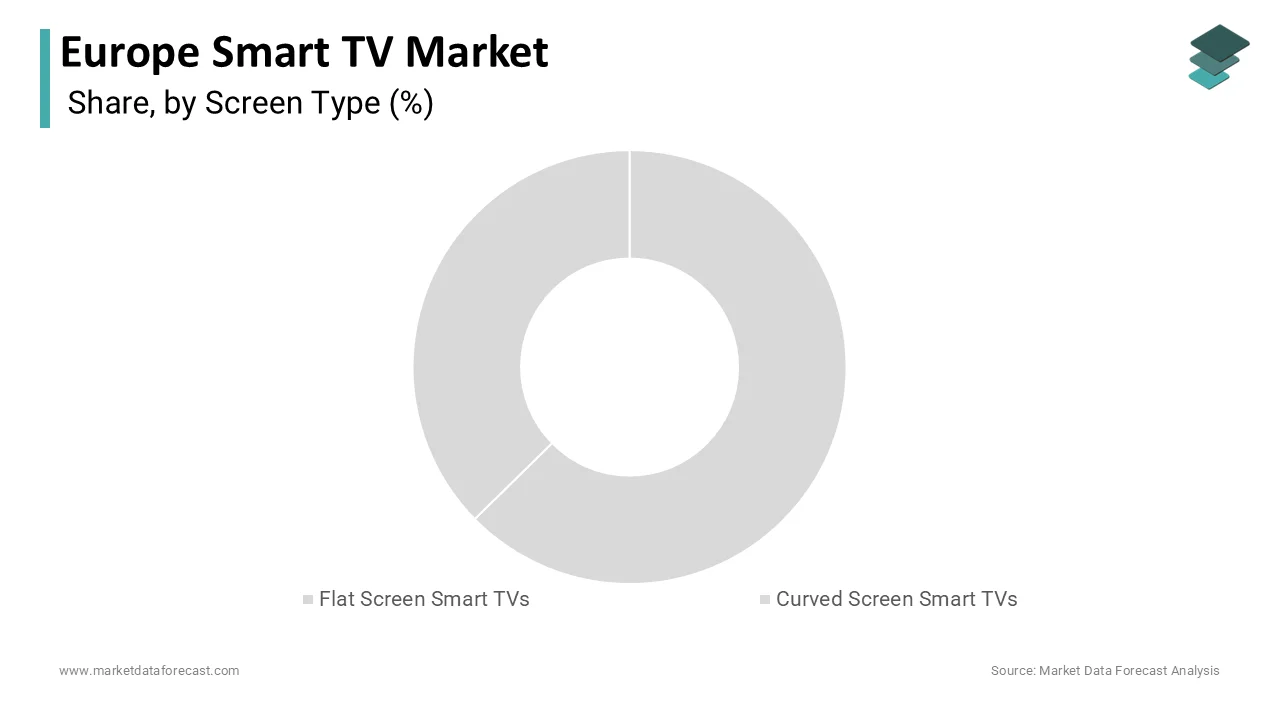
The curved screen smart TV segment is predicted to expand at a CAGR of 4.04% over the forecast period in the European smart TV market. This modest but notable acceleration is driven by a resurgence of premium home theatre adoption among high-income consumers in urban centers such as Munich, Stockholm, and Zurich. As per Germany’s Federal Statistical Office, households with higher incomes have increased their spending on immersive entertainment systems, with curved displays preferred for their perceived depth enhancement in cinematic content. A key innovation propelling this niche growth is the integration of adaptive curvature technology, as LG’s 2024 OLED Flex model, available in select European markets, allows users to toggle between flat and curved modes based on content type, addressing previous rigidity complaints. Furthermore, dedicated home theatre installations have continued to grow with larger screen formats, often specifying curved displays for enhanced viewing experiences. While mass market appeal remains limited, this segment benefits from strategic brand positioning as a luxury lifestyle product rather than a mainstream entertainment device, enabling sustained growth within affluent consumer enclaves despite overall market saturation.
By Distribution Channel Insights
The offline retail segment dominated the market by holding 57.5% of the regional market share in 2025. The leading position of the offline retail segment in the European market is attributed to the high consumer reliance on in-person product evaluation, particularly for premium screen technologies where image quality, sound output, and build finish cannot be adequately assessed online. In France, for instance, industry reports indicate that a majority of smart TV purchases above 800 euros occurred in physical stores during 2024, which is driven by demand for live demonstrations of HDR performance and smart interface responsiveness. Germany’s MediaMarkt and Saturn chains reported that their interactive TV zones helped increase average transaction values compared to online equivalents. Additionally, post-purchase services such as wall mounting, calibration, and extended warranties are more seamlessly bundled in offline environments, enhancing perceived value. According to the European Consumer Organisation’s 2024 trust index, consumers trusted physical retailers more than e-commerce platforms for high-value electronics due to clearer return policies and immediate technical support. Though online channels are growing, the tactile and experiential nature of television purchasing ensures offline retail remains the cornerstone of European smart TV distribution.
By Resolution Insights
The 4K UHD resolution segment held 46.5% of the European smart TV market share in 2025, owing to the convergence of affordable panel pricing, widespread 4K content availability, and regulatory support for high-definition broadcasting standards. According to the European Broadcasting Union’s 2024 infrastructure report, a growing majority of public service broadcasters across Western and Northern Europe now transmit primary channels in 4K with terrestrial coverage reaching most households in countries such as Germany, the Netherlands, and Sweden. Streaming platforms have also accelerated 4K adoption; Netflix confirmed that most of its original European series released in 2024 were natively produced in 4K, while Amazon Prime Video enabled automatic 4K streaming for eligible subscribers across multiple EU countries. Panel costs have declined significantly as well Display Supply Chain Consultants reported that the average manufacturing cost of a 55‑inch 4K panel fell sharply between 2021 and 2025, enabling entry‑level models to reach sub‑400-euro retail pricing. This balance of affordability and performance has rendered Full HD increasingly obsolete for new purchases, particularly as consumers prioritize future‑proofing for emerging 4K gaming and sports content.
COUNTRY LEVEL ANALYSIS
France Smart TV Market Analysis
France held the leading place in the European smart TV market by contributing 21.3% of the regional market share in 2025. France’s status is expansionary and demand driven by large screen 4K and increasingly 8K adoption. Product mix is tilting toward Smart LED with strong uptake of UHD formats, supported by competitive pricing and widespread streaming service penetration. Consumers are consolidating home entertainment around connected ecosystems, which raises average selling prices and accelerates replacement cycles. Retail distribution remains robust across online and offline channels, while platform diversity spanning Android, Tizen, and WebOS supports differentiated features and price points. In the near term, upgrades in panel technology, including OLED and QLED, are improving energy efficiency and picture quality, reinforcing value perception. The market’s growth outlook benefits from broader European momentum and income stability, while content localization and sports broadcasting in UHD will keep engagement high. Based on Europe's total of 44.576 billion USD in 2024, France’s revenue implies a clear first-tier position among national markets.
Germany Smart TV Market Analysis
Germany maintains a strong position in the European smart TV market due to the healthy upgrade cycle anchored in 4K and emerging 8K sets. Germany’s market status is resilient, supported by high household connectivity, premium panel adoption, and intense competition among brands across Android, Tizen, and WebOS ecosystems. Retail dynamics favour larger screen sizes, with sizes above 55 inches gaining share, aided by declining price per inch and improved energy ratings. Streaming engagement and smart home integration encourage the purchase of televisions with advanced processors and voice assistants, thereby increasing average selling prices. Germany’s consumer profile is receptive to AI-enabled features and HDMI 2.1 gaming capabilities, which drive performance-oriented segments. Germany sits among the core demand centers and remains a bellwether for premium technologies like OLED and QLED. On the 2024 Europe baseline of 44.576 billion USD, Germany’s revenue translates to a substantial mid-teens share.
Italy Smart TV Market Analysis
Italy stands in the next tier of European smart TV markets. The robust adoption of 4K sets and rising interest in 8K among early technology adopters are propelling the Italian smart TV market. Italy’s status is growth-oriented with replacement demand fueled by connected entertainment, streaming subscriptions, and improved availability of large-screen models at accessible prices. Product strategy emphasizes Smart LED and UHD panels, supported by platform variety, including Android, Tizen, and WebOS, to meet diverse user needs. Retail performance remains balanced across online and physical channels, and promotions tied to sports content continue to catalyze upgrades. Energy efficiency and design aesthetics matter to Italian consumers, encouraging transitions from older LCD sets to slimmer and more efficient OLED and QLED models. With Europe’s total smart TV revenue at 44.576 billion USD in 2024 and technology advances lifting value per unit, Italy’s contribution places it among the top national markets. The trajectory suggests steady gains as bandwidth improves and households integrate TVs into broader smart home ecosystems.
Spain Smart TV Market Analysis
Spain is a significant player in the European smart TV market. The growth of the Spanish smart TV market is driven by the strong demand for 4K UHD and the rapid adoption of Smart LED. Spain’s status is expansionary with upgrades driven by streaming entertainment and affordable large screens in the 55-to-65-inch range. Platform diversity across Android, Tizen, and WebOS fuels competition, while value segments remain vibrant thanks to aggressive pricing and bundled service promotions. Consumers are increasingly prioritizing connectivity and voice control, lifting attach rates for higher spec models that command better margins. Retail patterns indicate growing online penetration for electronics, aided by faster fulfillment networks. Broader device ecosystems, including smart soundbars and consoles, also stimulate TV upgrades, enhancing overall household entertainment experiences and sustaining unit and revenue growth across the next cycle.
COMPETITIVE LANDSCAPE
The European smart TV market features intense competition driven by technological differentiation, brand legacy, and regional adaptability. Leading players compete not only on hardware specifications but also on software ecosystems, content partnerships, and sustainability credentials. The absence of a unified operating system creates fragmentation yet allows brands to establish unique user experiences. Premium segments are dominated by OLED and QLED technologies, where innovation in picture quality and energy efficiency defines leadersMid-rangerange and entry-level categories witness aggressive pricing and feature parity, particularly among Asian and European brands. Regulatory compliance with EU directives on energy labeling, data privacy, and e-waste shapes product development cycles. Consumer trust is increasingly tied to transparency in software update policies and repairability. Retail presence, both online and offline, remains a critical battleground with experiential marketing influencing purchase decisions across urban and rural demographics.
KEY MARKET PLAYERS
Some of the companies that are playing a dominating role in the global europe smart TV market include
- Samsung Electronics Co., Ltd.
- LG Electronics Inc.
- Sony Corporation
- Panasonic Corporation
- Philips (TP Vision)
- TCL Technology Group Corporation
- Hisense Group
- Sharp Corporation
- Vizio Inc.
- Toshiba Corporation
- Grundig (Arçelik A.Ş.)
- JVC (JVCKENWOOD Corporation)
- Metz Consumer Electronics GmbH
- Thomson (Technicolor SA Licensing)
- Vestel Electronics A.Ş.
TOP LEADING PLAYERS IN THE MARKET
- Samsung Electronics maintains a formidable presence in the European smart TV market through its continuous innovation in display technology and smart platform integration. The company has focused on enhancing user experience via its Tizen operating system, which offers seamless access to streaming appsvoice control l and smart home connectivity. In 20,24, Samsung expanded its Neo QLED lineup with AI-powered upscaling and energy-efficient panels tailored to European environmental standards. It also deepened partnerships with regional broadcasters and streaming services to offer localized content bundles. These initiatives reinforce its reputation for premium quality and technological leadership while aligning with Europe’s evolving digital entertainment and sustainability priorities.
- LG Electronics is a key contributor to the European smart TV landscape with its emphasis on OLED technology and webOS ecosystem. The company has consistently introduced models featuring self-luminous pixels, high dynamic range, and low power consumption, which resonate strongly with European consumers. In 202, LG launched its OLED Flex series in select European markets, allowing users to switch between flat and curved modes. It also enhanced the web with multi-lingual voice recognition and improved accessibility features. LG’s collaboration with European sports leagues and cultural institutions further strengthens content relevance and brand loyalty across diverse national markets.
- Philips remains a distinctive player in the European smart TV market by leveraging its heritage as a European brand and integrating health-centric display innovations. The company emphasizes Ambilight technology, which projects colored light from the screen edges to enhance viewing immersion a feature particularly popular in gaming and cinematic applications. In 202, Philips introduced P5 Perfect Picture Engine upgrades across its mid-range lineup and expanded its partnership with European streaming platforms for curated content channels. It also aligned its product portfolio with EU energy efficiency directives, ensuring compliance and consumer appeal. These localized strategies sustain its strong retail and consumer presence, particularly in Western and Southern Europe.
TOP STRATEGIES USED BY THE KEY MARKET PARTICIPANTS
Key players in the European smart TV market prioritize platform differentiation through proprietary operating systems to enhance user retention. They invest heavily in energy-efficient display technologies to comply with stringent EU ecodesign regulations. Strategic partnerships with regional broadcasters and streaming services enable localized content delivery. Companies focus on AI-driven picture and sound optimization to justify premium pricing. Retail experience enhancement through in-store demonstrations and bundled after-sales services strengthens offline channel performance. Continuous firmware updates and extended software support address consumer concerns about product longevity. Voice assistant integration and smart home interoperability deepen ecosystem lock-in. Product portfolios are segmented by price and feature sets to cater to diverse income groups across Northern, Southern, and Eastern Europe.
MARKET SEGMENTATION
This research report on the europe smart TV market is segmented and sub-segmented into the following categories.
By Screen Type
- Flat Screen Smart TVs
- Curved Screen Smart TVs
By Distribution Channel
- Offline Retail
- Online Retail
By Resolution
- 4K UHD
- Full HD
- 8K & Others
By Country
- France
- Germany
- Italy
- Spain
- United Kingdom
- Rest of Europe
Frequently Asked Questions
1. Who are the top brands in the Europe Smart TV Market?
Leading players in the Europe Smart TV Market include Samsung, LG Electronics, Sony, Philips, and Panasonic, holding significant shares through innovations like OLED TVs and Tizen/WebOS platforms
2. What screen types dominate the Europe Smart TV Market?
Flat screens command over 85-95% of the Europe Smart TV Market share, preferred for affordability, ease of installation, and integration into modern living spaces over curved variants.
3. What resolutions drive the Europe Smart TV Market?
Full HD and 4K UHD resolutions lead the Europe Smart TV Market, with Full HDTV at 38% share; rising 8K adoption boosts growth amid OTT content demand
4. Which operating systems are popular in the Europe Smart TV Market?
Tizen (Samsung), Android TV, webOS (LG), and Roku prevail in the Europe Smart TV Market, with Tizen at 12.8% share, enabling seamless streaming and app ecosystems.
5. What trends shape the Europe Smart TV Market in 2025?
Key trends in the Europe Smart TV Market include AI voice control, 8K displays, 5G integration, and smart home compatibility, alongside energy-efficient models per EU regulations.
6. What challenges face the Europe Smart TV Market?
High competition, data privacy issues, and premium pricing hinder the Europe Smart TV Market, though affordability gains and local manufacturing mitigate these.
7. How does screen size segmentation work in the Europe Smart TV Market?
The Europe Smart TV Market segments into 32-45 inches, 46-55 inches, 56-65 inches, below 32, and above 65 inches, with mid-sizes leading due to household versatility
8. What role does online sales play in the Europe Smart TV Market?
Online channels grow rapidly in the Europe Smart TV Market via e-commerce AR demos, complementing offline retail amid urbanization and digital shifts.
9. How significant is OLED in the Europe Smart TV Market?
OLED TVs, led by LG with 56% share and 10 million units sold, define premium segments in the Europe Smart TV Market for superior visuals.
10. What is the impact of streaming on the Europe Smart TV Market?
OTT platforms drive 70% of Europe Smart TV Market demand, shifting consumers to internet-enabled TVs for on-demand content over traditional broadcasting.
Related Reports
Access the study in MULTIPLE FORMATS
Purchase options starting from
$ 2000
Didn’t find what you’re looking for?
TALK TO OUR ANALYST TEAM
Need something within your budget?
NO WORRIES! WE GOT YOU COVERED!
Call us on: +1 888 702 9696 (U.S Toll Free)
Write to us: sales@marketdataforecast.com