- Product Description Description
- Table of Contents TOC
- List of Table & Figure LOT
- Get Free Sample PDF Sample PDF
Market Size, 2025
$68.82 MnMarket Estimate, 2026
$93.59 MnMarket Forecast, 2034
$1095.32 MnCAGR, 2026–2034
36%Executive Summary: Europe Sodium Ion Battery Market
- Market Scope: Regional European sodium-ion battery market analysis covering technology segments, end-user applications, country leadership frameworks, and raw material independence adoption metrics.
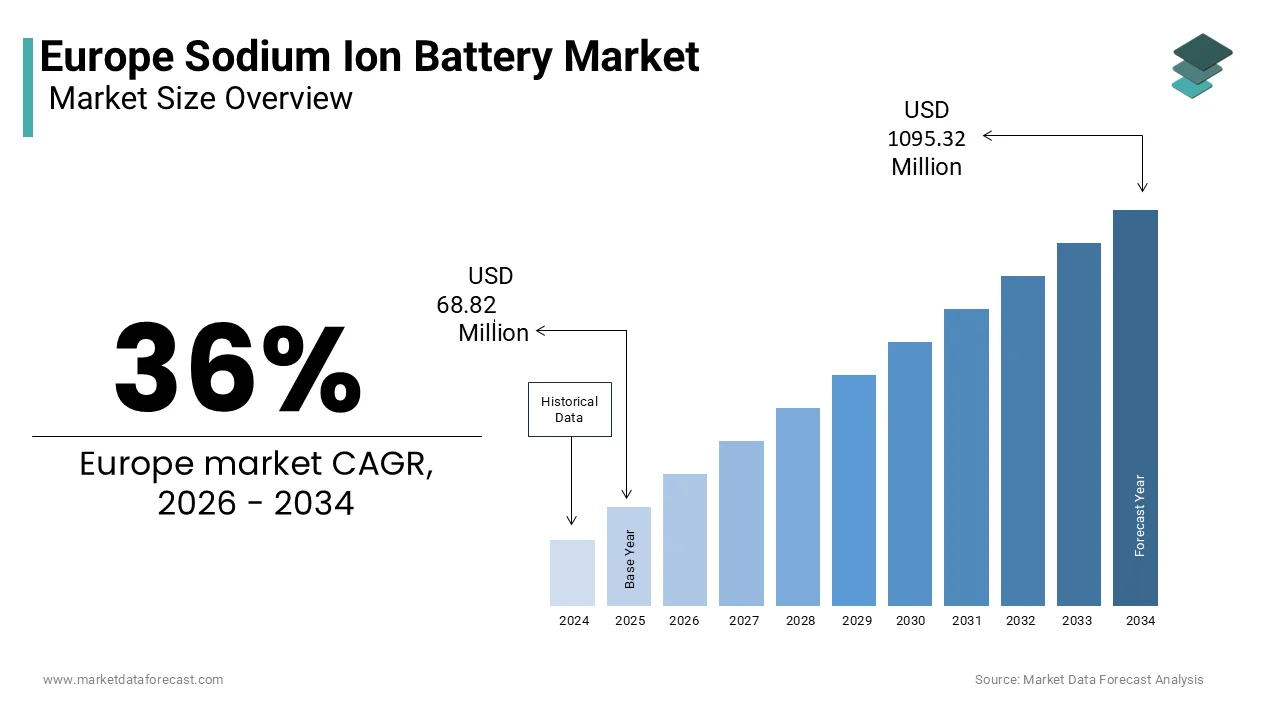
- Market Valuation: Valued at USD 68.82 million in 2025, estimated at USD 93.59 million in 2026, and projected to reach USD 1,095.32 million by 2034, registering a CAGR of 36% from 2026 to 2034.
- Primary Growth Drivers: Europe's strategic push for battery raw material independence, increasing renewable energy deployment requiring cost-effective stationary energy storage, and supportive government policies under the European Green Deal and Critical Raw Materials Act.
Key Market Segment Metrics (2026–2034)
| Category | Leading Segment (2025 Position) | Fastest-Growing Segment |
|---|---|---|
| By Technology | Sodium Salt Batteries (dominated with a 58.7% share in 2025 due to proven reliability and safety) | Room Temperature Sodium-Ion Batteries (projected to register the fastest growth with a 64.2% CAGR) |
| By End User | Utility segment (accounted for largest share of 49.2% in 2025 for renewable integration and grid stability) | Light Electric Vehicles (expected to witness the fastest growth with a 58.7% CAGR) |
| By Policy & Regulatory Framework | European Green Deal and Critical Raw Materials Act initiatives | Net Zero Industry Act, EU Battery Passport, and grid-scale storage funding initiatives |
| By Region / Country | Germany (led European market with a 26.2% share in 2025, followed by France with 20.2%) | Expanding manufacturing and R&D hubs across key European nations |
Major Market Players & Market Structure
Market Structure: Highly competitive European battery technology landscape characterized by vertical integration of raw material sourcing, utility/EV collaborations, pilot-scale manufacturing expansion, recycling infrastructure investments, and EU regulatory participation.
Key Companies: Faradion Limited (Reliance Industries), Tiamat SAS, Natron Energy Inc., Altris AB, HiNa Battery Technology Co., Ltd., CATL, AMTE Power plc, NGK Insulators Ltd., Aquion Energy, Clarios Global LP, Northvolt AB, LiNa Energy Ltd., Alteo Group, Ionetic Ltd., BroadBit Batteries Oy, Cerenergy (Fraunhofer IKTS), Natrion Inc., NEI Corporation, and NatPower Group.
Europe Sodium Ion Battery Market Size
The europe sodium-ion battery market was valued at USD 68.82 million in 2025, is expected to reach USD 93.59 million in 2026, and is growing at a CAGR of 36% from 2026 to 2034, and is projected to reach USD 1095.32 million by 2034.
A sodium-ion battery is an energy storage system that uses sodium ions as the charge carrier, functioning similarly to a lithium-ion battery but with sodium instead of lithium. Positioned as a complementary or alternative technology to lithium-ion batteries, sodium-ion systems offer advantages in raw material abundance, cost stability, and safety due to the usealuminiuminum current collectors and non-flammable electrolytes. As of,, 2025 Europe’s strategic push for battery sovereignty under the European Battery Alliance has accelerated interest in this emerging ch, chemistry, particularly for stationary energy storage and low-speed electric mobility. According to the European Commission, over 70 per cent of the EU’s lithium and 90 per cent of its graphite are imported primarily from outside the continent, creating supply chain vulnerabilities. In contrast, sodium is the sixth most abundant element in the Earth’s crust and can be sourced domestically from salt lakes and seawater. This technology, although only recently commercialised, is a critical component of Europe's effort to create a robust and sustainable battery supply chain consistent with the Green Deal and Net-Zero Industry Act.
MARKET DRIVERS
Strategic Imperative for Battery Raw Material Independence from Critical Third Countries
The region’s urgent quest to reduce dependency on geopolitically concentrated critical minerals is a primary driver for the European sodium-ion battery market. According to sources, the European Union heavily depends on imports for key battery minerals like lithium, cobalt, and graphite, sourcing nearly all of these from a small number of countries, including China, Chile, and the Democratic Republic of Congo. This high concentration of import sources creates substantial supply chain vulnerabilities and risks. These risks were clearly demonstrated during recent raw material price instability. Sodium, in contrast, is widely available across Europewith major salt deposits in Ge, Germany, France, and Spain and seawater desalination byproducts offering additional feedstock. As per research, domestically producing sodium-ion battery cells could significantly decrease the EU's reliance on external sources for battery materials. Furthermore, the European Critical Raw Materials Act designates sodium-based chemistries as strategic alternatives eligible for streamlined permitting and state aid. National initiatives prioritise sodium ion development as part of their industrial sovereignty strategy. This policy-driven push transforms sodium ion technology from a niche alternative into a cornerstone of Europe’s resource security framework.
Growing Demand for Safe and Cost-Effective Stationary Energy Storage in Grid and Commercial Applications
The expansion of renewable energy capacity across Europe is creating urgent demand for affordable and inherently safe stationary storage solutions, which boosts the expansion of the European sodium-ion battery market. According to studies, wind and solar accounted for a portion of total EU electricity generation, which requires large-scale storage to manage intermittency. Unlike lithium-ion systems, which rely on scarce nickel and cobalt and pose thermal runaway risk, sodium-ion batteries use abundant iron, on mangan, and so, dium, enabling lower cost and enhanced energy, particularly in densely populated urban or industrial settings. Sodium ion technology, with its flat discharge curve, long cycle life, and tolerance to full state of charge storage, is well-suited for daily cycling applications. Sodium-ion batteries are gaining traction as a pragmatic and resilient solution for the energy transition, especially as utilities and commercial operators begin prioritising the total cost of ownership over energy density.
MARKET RESTRAINTS
Immature Supply Chain and Limited Domestic Manufacturing Capacity for Key Components
Significant headwinds from an underdeveloped and fragmented supply chain for cathode materials, electrolytes, and cell assembly equipment hinder the growth of the European sodium-ion battery market. Unlike lithium iron phosphate, which benefits from decades of process optimisation, sodium layered oxides and Prussian white analogues require precise humidity-controlled environments and novel binder systems that are not yet standardised. Apart from these, specialised coating and drying equipment adapted for sodium chemistry is not yet available from European machinery vendors, forcing reliance on Asian imports. This infrastructure gap delays commercial scaling and increases capital expenditure. The cost and performance benefits of sodium-ion technology will remain hypothetical until Europe establishes its own complete material-to-cell value chains.
Performance Limitations in Energy Density and Low Temperature Operation
Technical constraints limit their applicability in high-performance mobility and cold climate energy storage scenarios, which in turn slows down the expansion of the European sodium-ion battery market. According to sources, independent testing indicates that commercial sodium-ion cells have lower gravimetric energy density than typical lithium iron phosphate cells. This gap restricts their use in electric vehicles, where range remains a key consumer concern. Moreover, sodium-ion systems also show a greater reduction in capacity than advanced lithium chemistries when used in sub-zero temperatures, as per sources. In Nordic and Eastern European countries, where winter temperatures regularly fall below 15 degrees, this limitation hampers adoption in both grid and residential storage. Commercial deployment is still limited, even though researchers are actively exploring solutions like electrolyte additives and nanostructured anodes. Improved energy density and cold-weather performance are necessary for sodium-ion technology to move beyond applications where safety, cost, and sustainability are the primary drivers.
MARKET OPPORTUNITIES
Integration into EU Funded Grid-Scale and Industrial Storage Demonstration Projects
The region is leveraging public funding mechanisms to de-risk and validate sodium ion battery deployment in real-world energy systems, which creates an opportunity for the European sodium ion battery market. In addition, major European countries like the Netherlands and France are increasingly adopting sodium-ion battery technology for grid-scale energy storage. Similarly, driven by public funding and EU initiatives, these projects aim to stabilise local energy grids and support key industrial facilities such as data centres and aluminium smelters. These projects serve as living laboratories to validate lifetime performance and grid integration protocols under EU regulatory standards. European grid operators are increasingly recognising sodium-ion technology in their technical standards for its efficient performance, which further integrates it into the continent's power management strategies. By embedding sodium ion technology in flagship infrastructure initiatives, Europe is not only accelerating commercialisation but also building the operational data needed to attract private capital and scale manufacturing.
Policy Tailwinds from the Net Zero Industry Act and Battery Passport Requirements
The European Union’s regulatory architecture is creating a uniquely favourable environment for these batteries through targeted industrial policy and circular economy mandates, which provide fresh prospects for the expansion of the European sodium-ion battery market. The Net-Zero Industry Act, adopted in May 2025, establishes a goal for the EU to domestically produce at least 40% of its annual clean technology needs by 2030. The legislation names batteries as a strategic technology, making them eligible for faster permitting and other support measures. Furthermore, the upcoming EU Battery Passport will be mandatory from February 2027 for large electric vehicles and industrial batteries. This digital record will require full disclosure of a battery's carbon footprint, material traceability, and recyclability information throughout its life cycle. According to research, Sodium-ion batteries are seen as a potential alternative to lithium iron phosphate due to more abundant and globally distributed raw materials, which may reduce supply chain risks. These policy levers transform regulatory compliance into competitive advantage, positioning sodium ion not as a fallback but as a forward-looking solution aligned with Europe’s industrial and environmental sovereignty goals.
MARKET CHALLENGES
Lack of Standardised Testing Protocols and Performance Benchmarking Frameworks
The absence of harmonised testing standards and independent validation protocols affects investor confidence and procurement decisions, and thereby impedes the growth of the European sodium-ion battery market. Most manufacturers rely on adapted lithium-ion test methods that do not account for sodium’s distinct degradation mechanisms, such as cathode phase transitions and anode solid electrolyte interface instability. The ambiguity complicates comparisons for utilities and system integrators seeking reliable long-term assets. Large-scale adoption will be hindered by market fragmentation and a lack of credibility until Europe establishes rigorous, technology-specific certification frameworks.
Limited Recycling Infrastructure and Uncertainty Around Second Life Applications
The nascent state of battery recycling infrastructure in the region poses a systemic challenge for sodium ion technology, despite its theoretical recyclability. This holds back the expansion of the European sodium-ion battery market. Most existing plants are optimised for high-value cobalt and nickel recovery, making sodium iron manganese streams economically unattractive under current models. Furthermore, the second life potential for sodium-ion batteries in less demanding applications, such as backup power, remains unproven due to limited field data on long-term degradation. The full sustainability potential of sodium-ion batteries remains out of reach until the technical and economic viability of circular economy pathways can be guaranteed, which potentially misaligns them with Europe's zero-waste goals.
REPORT COVERAGE
| REPORT METRIC | DETAILS |
| Market Size Available | 2025 to 2033 |
| Base Year | 2025 |
| Forecast Period | 2026 to 2033 |
| Segments Covered | By Technology, End User, and Region. |
| Various Analyses Covered | Global, Regional, and Country-Level Analysis, Segment-Level Analysis, Drivers, Restraints, Opportunities, Challenges; PESTLE Analysis; Porter’s Five Forces Analysis, Competitive Landscape, Analyst Overview of Investment Opportunities |
| Countries Covered | UK, France, Spain, Germany, Italy, Russia, Sweden, Denmark, Switzerland, Netherlands, Turkey, Czech Republic, Rest of Europe |
| Market Leaders Profiled | Faradion Limited (a subsidiary of Reliance Industries Ltd.), Tiamat SAS, Natron Energy, Inc., Altris AB, HiNa Battery Technology Co., Ltd., CATL (Contemporary Amperex Technology Co. Limited), AMTE Power plc, NGK Insulators, Ltd., Aquion Energy, Clarios Global LP, Northvolt AB, LiNa Energy Ltd., Alteo Group, Ionetic Ltd., BroadBit Batteries Oy, Cerenergy (Fraunhofer IKTS), Natrion Inc., NEI Corporation, NatPower Group, Acculon Energy. |
SEGMENTAL ANALYSIS
By Technology Insights
The sodium salt batteries segment held the leading share of 58.7% of the European sodium ion battery market in 2025. The dominance of the sodium salt batteries segment is propelled by decades of operational validation in high-temperature stationary applications and inherent safety due to non-flammable molten salt electrolytes. The European Network of Transmission System Operators for Electricity recognises this technology for frequency regulation due to its rapid response capability. Apart from these, unlike emerging room-temperature sodium-ion cells, sodium salt systems benefit from established manufacturing by companies with European service and maintenance networks. This combination of reliability,y safe, ty and grid compatibility ensures continued leadership despite energy density limitations.

The room temperature sodium ion batteries segment is predicted to witness the highest CAGR of 64.2% between 2025 and 2033 due to breakthroughs in cathode materials such as layered oxides and Prussian white analogues that enable operation at ambient temperatures while retaining cost and safety advantages. In addition, Industry collaboration initiated commercial production of a specific type of energy storage in Europe. This technology is primarily aimed at stationary storage and light electric transport. Public investment is supporting new green technology initiatives. According to research, the new cells provide an extended operational life cycle suitable for frequent use. The new technology is being integrated into grid-scale and smaller electric mobility projects. EU policy, through grants and fast-track permitting, is actively "de-risking" this emerging chemistry, allowing the segment to transition from a lab curiosity to an industrial reality with unprecedented speed.
By End User Insights
The utility segment led the European sodium-ion battery market and accounted for a 49.2% share in 2025. The prominence of the utility segment is fuelled by the urgent need for large-scale scale safe, and cost-effective energy storage to manage the variability of renewable generation. The share of electricity from wind and solar in the EU is consistently increasing, driving a need for more energy storage to maintain grid stability. Sodium-ion batteries, particularly high-temperature sodium salt and emerging room-temperature variants, are favoured for their non-flammability, long duration capability and tolerance to full state of charge, vital for daily cycling in substations and renewable parks. Furthermore, EU bodies and national governments are increasingly providing significant financial support and policy incentives for large-scale energy storage projects, including advanced battery technologies like sodium-based systems. Sodium-ion technology aligns precisely with the operational and regulatory risk profiles of utilities because they prioritise lifetime safety and total cost of ownership more than energy density.
The light electric vehicles segment is estimated to register the fastest CAGR of 58.7% from 2025 to 203, owing to urban mobility mandates and the need for affordable, le sustainable batteries for e-bikes,e e-scooters and last-mile delivery vans. Sodium ion batteries offer a compelling alternative to lithium for these applications due to lower cost, enhanced safety, and reduced fire risk in dense urban environments. In addition, companies rolled out e-scooters and urban delivery vehicles equipped with sodium-ion packs. National incentives in France and Italy now include bonuses for vehicles using EU-made batteries, further boosting sodium ion uptake. The focus of cities on safety, cost-effectiveness, and local supply means this segment offers a strong, immediate opportunity for large-scale commercialisation.
COUNTRY LEVEL ANALYSIS
Germany Sodium Ion Battery Market Analysis
Germany was the top performer in the European sodium-ion battery market and accounted for a 26.2% share in 2025. The dominance of the German market is driven by its industrial energy demands, strong research ecosystem, and proactive grid modernisation policies. The country hosts Europe’s first commercial sodium ion gigafactory in Skellefteå through Northvolt’s European expansion and serves as the testing ground for high-temperature sodium salt systems in industrial parks. The Fraunhofer Institute for Systems and Innovation Research leads EU-funded projects on sodium battery recycling and performance validation. Germany is at the heart of Europe’s sodium-ion industrial strategy, leveraging strong cooperation between public and private sectors, clear regulation, and large-scale manufacturing.
France Sodium Ion Battery Market Analysis
France was the second-largest player in the European sodium-ion battery market and captured a 20.2% share in 2025. The growth of France in the regional market is fuelled by its state-led industrial policy and nuclear, renewable, and hybrid grid. The French government is prioritising sodium-ion technology as a strategic alternative to lithium, allocating substantial funding for material innovation and pilot lines. Following this, Tiamat, a company, launched Europe's first high-power sodium-ion cells for e-mobility, with production scaling up in the Hauts-de-France region. France’s nuclear baseload requires flexible storage for daily load shifting, and sodium-ion systems are being integrated into smart grid demonstrators in Brittany and Provence. France is a key driver for commercialising and standardising sodium-ion technology in Europe, fueled by its strong academic institutions, centralised energy planning, and dedication to technological sovereignty.
Sweden Sodium Ion Battery Market Analysis
Sweden is moving ahead steadfastly in the European sodium-ion battery market, with its renewable-powered manufacturing and advanced materials research. The country hosts Northvolt’s first sodium-ion production line in Skelleftea, powered entirely by hydropower, ensuring an ultra-low carbon footprint. This clean production aligns with EU Battery Passport requirements, giving Swedish-made cells a competitive edge. Uppsala University and KTH Royal Institute of Technology lead in cathode innovation with breakthroughs in Prussian white analogues that enhance cycle life. Sweden exemplifies how green industrial policy can speed up the adoption of next-generation batteries, due to its abundant iron and salt resources, minimal geopolitical risk, and focus on a circular economy.
Netherlands Sodium Ion Battery Market Analysis
The Netherlands grew moderately in the European sodium-ion battery market by leveraging its port infrastructure, grid innovation, and circular economy leadership. Rotterdam’s industrial cluster is home to Europe’s largest sodium salt battery installation. Also, sodium-ion technology is prioritised in the National Battery Strategy for its fire safety in densely populated delta regions. The Netherlands also leads in battery recycling, with companies like Solvay developing direct recycling processes for sodium cathodes. The Netherlands serves as a vital testbed for real-world sodium-ion deployment, leveraging advanced grid integration expertise, strong access to EU funding, and a focus on industrial decarbonization.
United Kingdom Sodium Ion Battery Market Analysis
The United Kingdom is predicted to expand in the European sodium-ion battery market between 2025 and 2033 due to its grid balancing needs, academic excellence, and post-Brexit industrial strategy. The UK’s electricity system has a notable share of variable renewables in Europe, which necessitates rapid response storage. Sodium salt batteries from NGK Insulators have operated reliably in UK substations. The Faraday Institution leads EU collaborative research on sodium anode stability and lifecycle analysis. Despite Brexit, the UK remains deeply integrated into European battery innovation through Horizon Europe associate status. The UK's mature storage market, strong engineering base, and focus on safety create a stable and valuable environment for the commercial rollout of sodium-ion technology.
COMPETITIVE LANDSCAPE
Competition in the European sodium ion battery market is characterised by a dynamic interplay between established industrial players, emerging deep tech startups and global battery leaders repositioning their portfolios. Unlike the mature lithium market, its competition here is less about price and more about technological validation, policy alignment, and supply chain resilience. Northvolt and Tiamat lead in room temperature cell innovation, while NGK dominates high temperature stationary applications with decades of operational data. The market is pre-commercial with most players focused on pilot deployments, securing public funding and building recycling pathways rather than mass sales. Differentiation hinges on chemistry choice, application focus, and carbon footprint. The strong backing from the European Commission means the challenge has shifted from merely scaling up to demonstrating that sodium-ion batteries can deliver on Europe's commitments to energy independence and environmental responsibility. As a result, collaboration often outweighs rivalry in this nascent yet strategically vital sector.
KEY MARKET PLAYERS
Some of the companies that are playing a dominating role in the global Europe Sodium-Ion Battery Market include
- Faradion Limited (a subsidiary of Reliance Industries Ltd.)
- Tiamat SAS
- Natron Energy, Inc.
- Altris AB
- HiNa Battery Technology Co., Ltd.
- CATL (Contemporary Amperex Technology Co. Limited)
- AMTE Power plc
- NGK Insulators, Ltd.
- Aquion Energy
- Clarios Global LP
- Northvolt AB
- LiNa Energy Ltd.
- Alteo Group
- Ionetic Ltd.
- BroadBit Batteries Oy
- Cerenergy (Fraunhofer IKTS)
- Natrion Inc.
- NEI Corporation
- NatPower Group
- Acculon Energy
TOP LEADING PLAYERS IN THE MARKET
- Northvolt AB is a leading European battery developer headquartered in Sweden with a strong strategic focus on sustainable and secure battery technologies, including sodium-ion. The company contributes globally by pioneering low-carbon battery production powered entirely by renewable energy and advocating for resource-diversified chemistries. In Europe, Northvolt has established the continent’s first commercial room-temperature sodium-ion cell production line in Skellefteå in partnership with Altris. Northvolt also leads EU-funded research consortia on sodium ion cathode recycling and performance validation, reinforcing its role as both an industrial producer and innovation anchor in the emerging sodium ion ecosystem.
- Tiamat Energy is a French deep tech company specialising in high-power sodium-ion battery cells derived from two decades of research at the French National Centre for Scientific Research. The company plays a pivotal role in advancing sodium ion performance by developing proprietary layered oxide cathodes that enable fast charging and long cycle life suitable for urban mobility and grid applications. Globally, Tiamat influences materials science through its open collaboration with academic and industrial partners. Tiamat's focus on power density over energy density has created a specific market niche that aligns well with Europe's immediate commercialisation goals for light transport and frequency regulation.
- NGK Insulators, through its European operation, is a key enabler of high-temperature sodium-sulfur sodium nickel chloride battery deployment across the continent. Although headquartered in Japan, the company has maintained a significant presence in Europe for over two decades, supplying utility-scale sodium salt battery systems for grid stabilisation and industrial backup. In Europe, the company has systems deployed in the UK, Germany and Italy, totalling more than 200 megawatt hours. NGK is providing crucial stability during the initial commercialisation of sodium-ion technology by offering a safe and durable solution.
TOP STRATEGIES USED BY THE KEY MARKET PARTICIPANTS
Key players in the European sodium-ion battery market employ several strategic approaches to accelerate commercialisation and secure a competitive advantage. Vertical integration is prioritised with companies securing access to raw materials such as iron, manganese, and sodium salts through partnerships with European chemical producers. Strategic alliances with utilities, as light vehicle manufacturers, and grid operators ensure off-the-shelf agreements and real-world validation. Policy engagement is central as firms actively participate in shaping EU battery regulations, standards, and funding programs to favour resource-diverse chemistries. Technology specialisation allows differentiation, with some focusing on high-power applications and others on stationary storage longevity. Finally, investment in pilot-scale manufacturing and recycling infrastructure reduces risks for scale-up and aligns with EU circular economy mandates, ensuring long-term sustainability and compliance.
MARKET SEGMENTATION
This research report on the europe sodium ion battery market is segmented and sub-segmented into the following categories.
By Technology
- Sodium Salt Batteries
- Room Temperature Sodium-Ion Batteries
By End User
- Utility
- Light Electric Vehicles
- Industrial & Commercial Storage
- Residential Storage
- Others
By Country
- Germany
- France
- Sweden
- Netherlands
- United Kingdom
- Rest of Europe