- Product Description Description
- Table of Contents TOC
- List of Table & Figure LOT
- Get Free Sample PDF Sample PDF
Market Size, 2025
$18.14 BnMarket Estimate, 2026
$19.88 BnMarket Forecast, 2034
$41.39 BnCAGR, 2026–2034
9.6%Executive Summary: Europe Electric Vehicle Battery Market
- Market Scope: Comprehensive Europe electric vehicle battery market analysis covering vehicle types, material compositions, country-level frameworks, gigafactory expansion metrics, and regulatory challenges.
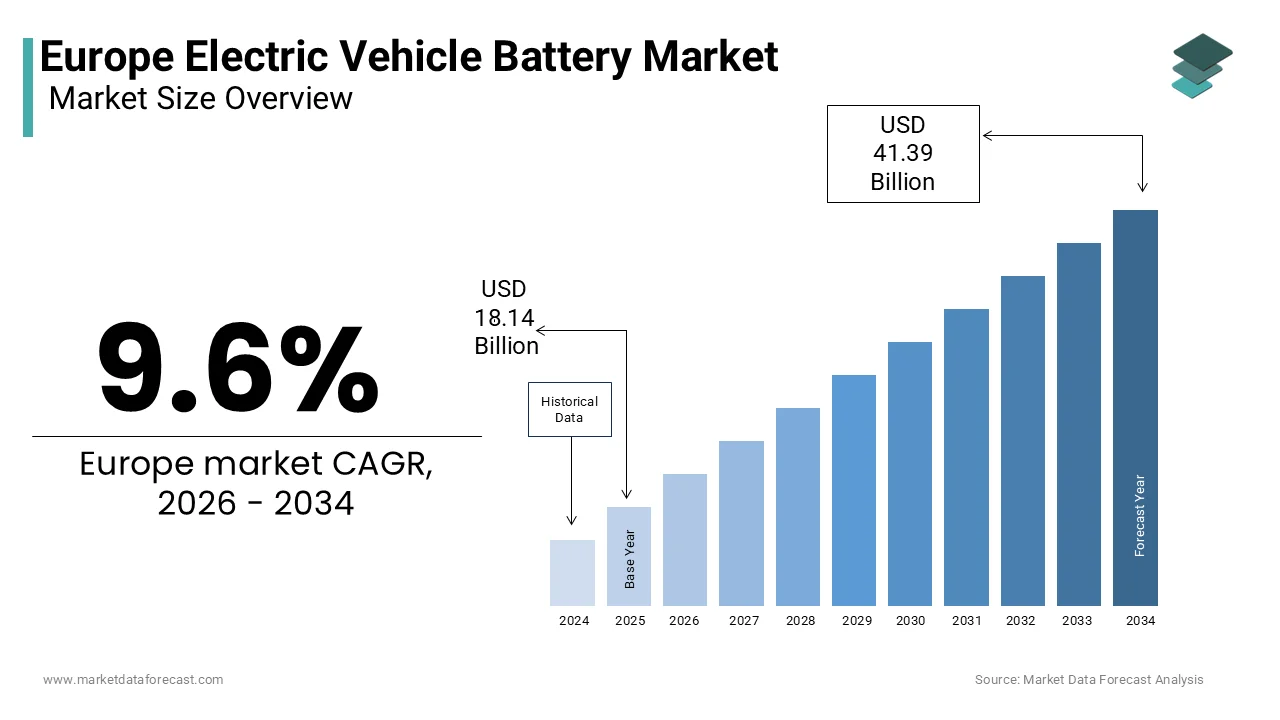
- Market Valuation: Valued at USD 18.14 billion (2025), estimated at USD 19.88 billion (2026), and projected to reach USD 41.39 billion by 2034, registering a robust CAGR of 9.6% (2026–2034).
- Primary Growth Drivers: Stringent European decarbonization policies, rapid adoption of electric vehicles, expansion of localized battery manufacturing, increasing investments in gigafactories, and the development of charging infrastructure. Key restraints include dependence on imported raw materials and high manufacturing costs.
Key Market Segment Metrics (2026–2034)
| Category | Leading Segment (2025 Position) | Fastest-Growing Segment |
|---|---|---|
| By Vehicle Type | Passenger Cars (accounted for the largest battery demand share backed by high regional EV adoption rates) | Commercial Vehicles (accelerating due to fleet electrification mandates and logistics decarbonization) |
| By Material | Steel and Aluminum components (led structural battery pack materials based on traditional manufacturing integration) | Carbon Fiber and advanced composite materials (driven by lightweighting needs for extended range) |
| By Country | Germany (maintained a dominant position due to a strong automotive base and gigafactory investments) | Sweden, France, and the United Kingdom (expanding rapidly as strategic sustainable battery production hubs) |
Major Market Players & Market Structure
Market Structure: Highly competitive battery manufacturing and automotive supply chain landscape characterized by heavy investments in localized supply chains, recycling technologies, EU Battery Regulation compliance, and next-generation cell chemistries.
Key Companies: Northvolt AB, Automotive Cells Company (ACC), LG Energy Solution, CATL, Samsung SDI, SK On, Panasonic Energy, BYD, and major European automotive manufacturers with integrated battery production initiatives.
 Download Free Sample Report
Europe Electric Vehicle Battery Market Size
The europe electric vehicle battery market was valued at USD 18.14 billion in 2025, is estimated to reach USD 19.88 billion in 2026, and is projected to reach USD 41.39 billion by 2034, growing at a CAGR of 9.6% from 2026 to 2034.
An electric vehicle battery is a rechargeable electrochemical energy storage system, which is primarily lithium-ion based is designed to power battery electric and plug-in hybrid vehicles across passenger, commercial, and light-duty segments. These batteries are engineered for high energy density, rapid charging, thermal stability, and extended cycle life while adhering to stringent European safety and environmental standards. According to the European Environment Agency, transport accounted for 22% of the European Union’s total greenhouse gas emissions in 2023, with road vehicles representing nearly 72% of that figure. According to the European Commission, the Fit for 55 package mandates a 55% reduction in CO2 emissions from new cars by 2030 and a complete phase-out of internal combustion engine vehicle sales by 2035. This regulatory trajectory has catalyzed unprecedented investment in localized battery production. According to Eurostat, over 18% of new car registrations in the European Union in 2023 were fully electric vehicles, which reflects a structural shift in consumer and fleet behavior. Simultaneously, the EU Battery Regulation introduced in 2023 imposes strict requirements on carbon footprint declaration, recycled content minimums, and end-of-life collection rates, which are reshaping the entire battery value chain from mining to recycling.
MARKET DRIVERS
EU Regulatory Framework Mandates Rapid Electrification and Localized Battery Production
The comprehensive legislative ecosystem of the European Union is a primary catalyst for the European electric vehicle battery market growth. According to the European Commission, the 2035 ban on new internal combustion engine vehicle sales creates a hard deadline for automakers to transition entirely to electric drivetrains. According to the European Commission, this policy is expected to require approximately 30 million electric vehicles on European roads by 2030, which requires over 1,500 gigawatt hours of annual battery capacity. According to the European Commission, the Net Zero Industry Act designates batteries as a strategic net zero technology and sets a target for the European Union to produce at least 90% of its annual battery demand domestically by 2030. The EU Battery Regulation further mandates that starting in 2027, all traction batteries sold in the bloc must disclose their embedded carbon footprint, with thresholds becoming binding by 2028. According to the International Energy Agency, the average carbon intensity of battery production in Europe is currently 65 kilograms of CO2 equivalent per kilowatt hour, which is significantly lower than global averages due to cleaner grid electricity. These interlocking policies not only drive volume but also actively shape battery design, sourcing, and manufacturing standards across the continent.
Expansion of Charging Infrastructure Reduces Range Anxiety and Boosts Consumer Adoption
The deployment of high-power charging networks across Europe is directly enhancing the practicality and appeal of electric vehicles, thereby increasing battery demand, which is further boosting the expansion of the European market. According to the European Automobile Manufacturers Association (ACEA), Europe had around 630,000 public charging points by the end of 2023, with fast chargers representing nearly 15% of that total. The revised Alternative Fuels Infrastructure Regulation requires member states to install charging stations every 60 kilometers along the Trans-European Transport Network by 2025 and every 300 kilometers for heavy-duty vehicles. According to the Bundesnetzagentur, Germany had surpassed 120,000 public charging points by the end of 2023. This infrastructure density enables longer trips and reduces psychological barriers to electric vehicle ownership. According to ACEA’s 2025 survey, around 68% of European consumers cited charging availability as a decisive factor in their electric vehicle purchase decision. Consequently, automakers are responding with vehicles featuring larger battery packs averaging 77 kilowatt-hours in 2023, which is an up from 60 kilowatt-hours in 2020 and reflects growing consumer demand for extended driving range. This trend directly amplifies demand for high-capacity battery cells across the European market.
MARKET RESTRAINTS
Dependence on Imported Critical Raw Materials Creates Supply Chain Vulnerability
Europe remains heavily reliant on third countries for essential battery raw materials, undermining supply security and price stability, which is a major restraint for the European electric vehicle battery market. According to the European Commission and Eurostat, the EU produces less than 0.1% of global lithium mine production and extracts less than 0.1% of its graphite needs, while Chile accounted for about 23% of the EU’s lithium oxide and hydroxide imports in 2023, and China supplied roughly 38% of the EU’s natural graphite imports in 2023. The bloc has very limited domestic lithium production and lacks significant nickel refining capacity despite these materials being central to lithium-ion battery cathode and anode chemistry. This dependency exposes European battery manufacturers to geopolitical disruptions and export restrictions. According to Reuters, in 2023, China implemented controls on gallium and germanium exports, which demonstrates its willingness to use critical mineral policy as a strategic tool. According to the International Energy Agency, lithium demand could grow over 40 times by 2040 in the Sustainable Development Scenario, while demand for other battery minerals such as cobalt is also expected to rise substantially by 2040. Although the Critical Raw Materials Act aims to increase domestic extraction and recycling, a few of the assessments indicate that Europe will continue to depend heavily on imports for battery raw materials through 2030–2035, which is constraining cost competitiveness and delaying localization ambitions.
High Production Costs Due to Energy Intensity and Compliance Burdens
Battery cell manufacturing in Europe faces significant cost disadvantages compared to Asian counterparts, primarily due to elevated energy prices and stringent regulatory compliance, which further hinders the growth of the European EV battery market. According to BloombergNEF, the average cost to produce a kilowatt-hour of lithium-ion battery capacity globally was around $139 (€128) in 2023, with China maintaining the lowest production costs due to scale and lower energy prices. A major contributor to Europe’s higher costs is the energy intensity of electrode drying and formation cycling, which consumes roughly 30–40 megawatt-hours per gigawatt-hour of battery output. According to Eurostat, industrial electricity prices in Germany averaged about €0.18 per kilowatt-hour (€180 per megawatt-hour) in 2023, which is significantly higher than in China. Additionally, the EU Battery Regulation mandates extensive digital battery passports, traceability systems, and third-party verification starting in 2026, which is adding administrative and IT costs for manufacturers, as noted by Roland Berger’s 2025 analysis. These combined factors reduce margins for European cell makers and deter investment, particularly as global battery pack prices declined by 14% in 2023, according to BloombergNEF, which is reflecting oversupply and increasing competition. Without sustained subsidies or energy cost relief, European battery production struggles to achieve economic viability at scale.
MARKET OPPORTUNITIES
Second Life Battery Applications Unlock New Revenue Streams and Circular Economy Value
Retired electric vehicle batteries retaining a significant amount of their original capacity are increasingly repurposed for stationary energy storage, creating a robust secondary market, which is one of the notable opportunities in the European electric vehicle battery market. According to the European Environment Agency, Europe is projected to see around 1 million electric vehicle batteries reaching their end of life by 2030, which is generating several hundred thousand metric tons of battery packs eligible for reuse or recycling. Projects such as Nissan’s collaboration with Eaton to deploy second-life Leaf batteries in commercial backup systems and BMW’s use of retired i3 batteries for grid balancing in Hamburg demonstrate commercial viability. The EU Battery Regulation mandates that by 2028, all new traction batteries must be designed for easy disassembly and state-of-health monitoring, facilitating reuse. According to the European Environment Agency, second-life applications can extend battery service life by 5 to 10 years, which reduces lifecycle carbon emissions by up to 30%. Moreover, the European Investment Bank has allocated €2.3 billion under its Circular Economy Finance Support Platform specifically for battery repurposing ventures. This emerging ecosystem not only enhances resource efficiency but also provides low-cost storage solutions for renewable integration and grid resilience.
Gigafactory Localization Supported by Strategic Public-Private Partnerships
The coordinated rollout of battery gigafactories across Europe is a promising opportunity to build a sovereign and resilient supply chain. According to the European Commission, over 50 battery cell and module manufacturing projects are under development across Europe, which represents a potential annual capacity of more than 2,000 gigawatt hours by 2030. Key initiatives include Northvolt’s Ett facility in Sweden, which produced Europe’s first homegrown lithium-ion cell in 2023, and ACC’s gigafactories in France, Germany, and Italy backed by Stellantis, Mercedes-Benz, and TotalEnergies. The European Battery Alliance has mobilized over €180 billion in public and private capital since 2017 to support this ecosystem. These projects integrate vertically from cathode production to recycling, with Northvolt achieving 50% recycled nickel content in its cells by 2025. According to the International Energy Agency, localized production could reduce battery supply chain emissions by up to 40% compared to import-dependent models. This strategic mobilization positions Europe not merely as an assembly hub but as a full-cycle innovation leader in sustainable electrochemical storage.
MARKET CHALLENGES
Lack of Standardized Recycling Infrastructure Limits Material Recovery Efficiency
According to the EU Battery Regulation, ambitious targets are set requiring 95% recovery of cobalt, copper, lead, and nickel by 31 December 2031 and 80% recovery of lithium by the same date. The existing recycling infrastructure remains fragmented and underdeveloped. According to the European Environment Agency, less than 5% of lithium from end-of-life traction batteries is currently recovered in Europe due to a lack of hydrometallurgical or direct recycling facilities on a commercial scale. Most European recyclers still rely on pyrometallurgy, which recovers only nickel, cobalt, and copper while discarding lithium and aluminum in slag. Umicore SA in Belgium operates one of the continent’s most advanced recycling facilities, but its annual capacity of 35,000 metric tons meets less than 10% of projected needs by 2030. According to the Fraunhofer Institute for Material Flow and Logistics, building a full-scale lithium recovery plant requires around €300 million in capital and five to seven years for permitting and construction. Moreover, inconsistent national collection schemes result in significant battery leakage, with Eurostat estimating that about 30% of end-of-life traction batteries are not traceably collected. Without harmonised reverse logistics and investment in next-generation recycling technologies, Europe will fall short of its circularity goals and remain dependent on virgin material imports.
Technical and Safety Risks Associated with Next Generation Battery Chemistries
The transition to advanced chemistries such as lithium iron phosphate and solid-state batteries introduces new engineering and regulatory complexities, which further challenge the expansion of the European electric vehicle battery market. While lithium iron phosphate offers cost and safety advantages, its lower energy density requires larger packs for equivalent range, impacting vehicle design. According to the European Transport Safety Council, vehicles using these cells must undergo additional crash testing due to altered weight distribution and thermal propagation characteristics. Solid-state batteries, although promising 500-mile ranges and faster charging, remain in pre-commercial stages with significant hurdles in electrolyte stability and interfacial resistance. According to the German Aerospace Center (DLR), only a few European solid-state battery pilot lines were operational as of 2023, with mass production expected closer to 2028. Moreover, the EU’s upcoming General Safety Regulation mandates real-time battery health monitoring and thermal runaway detection for all new electric vehicles from 2025, which is increasing system complexity. According to a 2025 report by the European Chemicals Agency (ECHA), over 20 new substances in emerging battery formulations lack full toxicity assessments, potentially triggering REACH registration delays. These scientific and compliance uncertainties slow innovation cycles and increase time to market for next-generation solutions.
REPORT COVERAGE
| REPORT METRIC | DETAILS |
| Market Size Available | 2025 to 2034 |
| Base Year | 2025 |
| Forecast Period | 2026 to 2034 |
| Segments Covered | By Vehicle Type, Material, and Region. |
| Various Analyses Covered | Global, Regional, and Country-Level Analysis, Segment-Level Analysis, Drivers, Restraints, Opportunities, Challenges; PESTLE Analysis; Porter’s Five Forces Analysis, Competitive Landscape, Analyst Overview of Investment Opportunities |
| Countries Covered | UK, France, Spain, Germany, Italy, Russia, Sweden, Denmark, Switzerland, Netherlands, Turkey, Czech Republic, Rest of Europe |
| Market Leaders Profiled | LG Energy Solution Ltd., Samsung SDI Co., Ltd., SK Innovation Co., Ltd., Panasonic Holdings Corporation, CATL (Contemporary Amperex Technology Co. Limited), Northvolt AB, Saft Groupe S.A. (a subsidiary of TotalEnergies), A123 Systems LLC, BYD Company Limited, GS Yuasa Corporation, Hitachi Chemical Co., Ltd., Johnson Matthey PLC, VARTA AG, EAS Batteries GmbH, InoBat Auto, Verkor SAS, Britishvolt Ltd., ACC (Automotive Cells Company), Freyr Battery, Envision AESC Group Ltd. |
SEGMENTAL ANALYSIS
By Vehicle Type Insights
The passenger cars segment held the most significant share of the European electric vehicle battery market in 2025 due to strong consumer adoption and supportive national incentive schemes. According to Germany’s Federal Office for Economic Affairs and Export Control (BAFA), the environmental bonus program of Germany provided up to €4,500 for fully electric vehicle purchases until 2023, which significantly accelerated private electrification. According to the European Automobile Manufacturers Association (ACEA), over 1.6 million battery electric passenger cars were registered in the European Union in 2023, which accounts for 18.2% of total car sales. Urban air quality mandates further drive demand as cities like Paris, Berlin, and Madrid enforce low-emission zones that restrict internal combustion engines. According to the European Environment Agency, 132 European cities exceeded WHO particulate matter limits in 2023, which is prompting stricter local vehicle restrictions. Additionally, automakers are prioritizing passenger segments with over 90% of new electric models launched in Europe in 2023 targeting private consumers. Volkswagen’s ID series, Renault’s Megane E-Tech, and BMW’s i4 exemplify this focus. According to JATO Dynamics, the average battery capacity in new European electric passenger cars reached 78 kilowatt-hours in 2023, which is an up from 64 in 2021 and reflects a trend toward longer-range vehicles that inherently consume more battery material per unit.
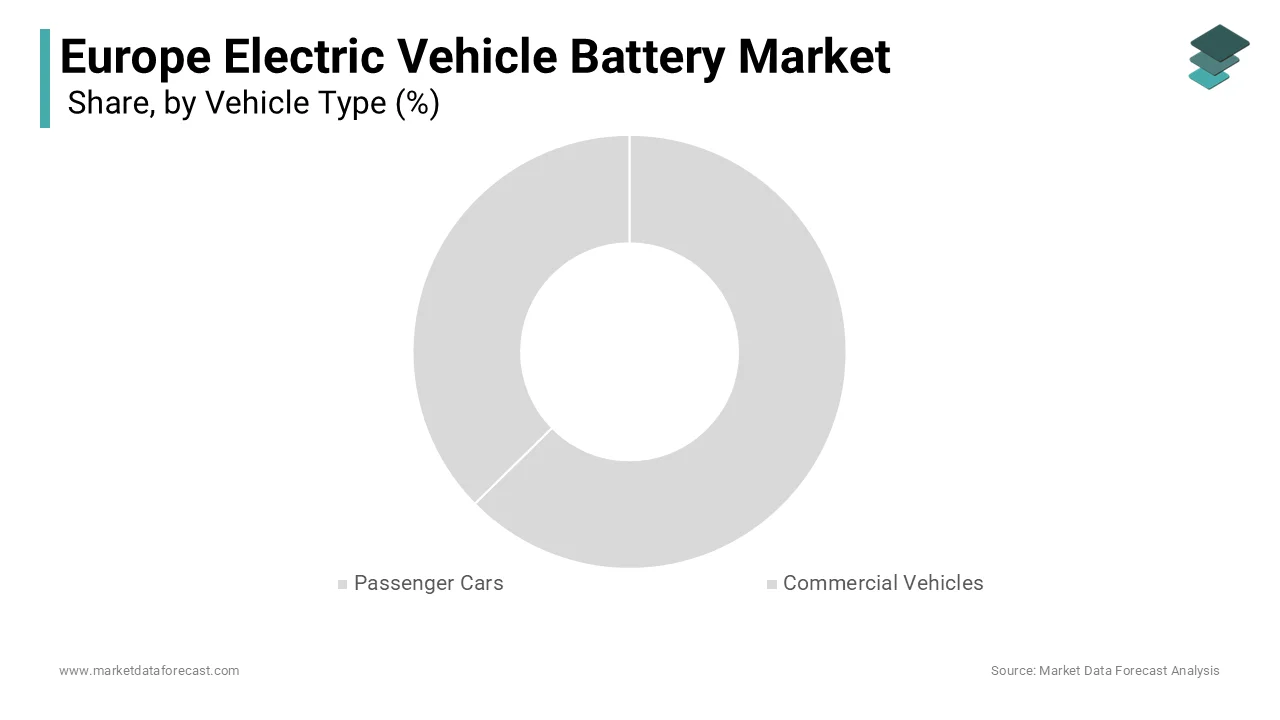
The commercial vehicle segment is expected to expand at the highest CAGR over the forecast period, owing to the urban logistics decarbonization mandates and corporate sustainability targets. According to the European Commission, the European Union’s revised CO₂ standards for heavy-duty vehicles require a 45% emissions reduction by 2030 and 90% by 2040 compared to 2019 levels, compelling fleet electrification. According to the International Council on Clean Transportation (ICCT), urban delivery vans accounted for about 27% of last-mile emissions in Europe in 2023, which is making them a regulatory priority. Major logistics firms are responding aggressively, with Amazon ordering 3,500 electric delivery vans from Rivian for European operations and DHL committing to 60,000 electric vehicles globally by 2030. According to the Alternative Fuels Infrastructure Regulation (AFIR), EU member states must install heavy-duty vehicle charging points every 300 kilometers along the core TEN-T corridors by 2028, enabling regional electric freight. According to the European Federation for Transport and Environment (T&E), over 42,000 electric light commercial vehicles were registered in the European Union in 2023, marking a 48% year-on-year increase. With average battery packs in these vehicles ranging from 60 to 120 kilowatt-hours, this rapid adoption is reflecting a surge in battery demand at a pace exceeding passenger car growth and propelling the growth of the commercial vehicle segment in the European market.
By Material Insights
The aluminum segment had the major share of 59.5% of the European market in 2025. The dominance of the aluminum segment in the European market is attributed to its optimal balance of light weight, high thermal conductivity, and recyclability. According to the European Battery Regulation, emphasis on design for recyclability and mandates for minimum recycled content align with aluminum’s well-established circular infrastructure. According to the European Aluminium Association, over 95% of aluminum from end-of-life vehicles is currently recovered iEuropop,, with recycling requiring only 5% of the energy needed for primary production. Automakers favor aluminum for battery trays because it reduces vehicle mass by up to 40% compared to steel, which enhances range efficiency. According to a 2023 study by the Technical University of Munich, replacing steel with aluminum in a 75-kilowatt-hour battery pack reduces total vehicle weight by around 35 kilograms, which extends range by 4–6%. Furthermore, aluminum’s superior heat dissipation properties improve thermal management in high-performance cells. According to Hydro, the Norwegian materials giant, European electric vehicle production consumed over 180,000 metric tons of battery-grade aluminum in 2023, with demand expected to triple by 2027. This synergy of regulatory alignment, performance benefits, and circular economy readiness is significantly contributing to the dominance of the aluminum segment in the European market.
The carbon fiber and carbon glass composites segment is anticipated to register the fastest CAGR over the forecast period due to the premium and performance-oriented electric vehicle platforms seeking extreme weight reduction. Although currently used in limited high-end applications, these materials offer specific strength up to five times greater than steel and twice that of aluminum. According to the Fraunhofer Institute for Chemical Technology, a carbon fiber–reinforced polymer battery housing can reduce mass by up to 50% compared to aluminum while maintaining crash integrity. BMW’s iNEXT and Porsche’s Mission E platforms already incorporate carbon fiber battery structures to offset the weight of large 100-kilowatt-hour packs. According to the European Commission, its Horizon Europe program allocated €120 million in 2023 to develop low-cost recyclable carbon composites for automotive use, addressing historical cost and sustainability barriers. According to the European Composites Industry Association (EuCIA), production of automotive-grade carbon fiber in Europe grew by about 30% in 2023, which is primarily for battery and chassis integration. With new resin systems enabling closed-loop recycling and automated layup, reducing manufacturing costs, these advanced composites are transitioning from niche to scalable solutions for next-generation battery systems and are boosting the expansion of the carbon fiber and carbon glass segment in the regional market.
COUNTRY LEVEL ANALYSIS
Germany Electric Vehicle Battery Market Analysis
Germany occupied the leading share of 26.7% of the European market in 2025. The leading position of Germany in the European electric vehicle battery market is driven by its position as the continent’s automotive engineering heartland and policy leadership in industrial electrification. According to the Kraftfahrt-Bundesamt (KBA), Germany registered over 690,000 battery electric vehicles in 2023, which is making it Europe’s largest electric vehicle market. According to the Bundesnetzagentur, this demand is supported by a dense charging network with more than 100,000 public charging points across the country. Germany also hosts Europe’s first vertically integrated battery ecosystem, including Northvolt Six in Heide and CATL’s 100-gigawatt-hour plant in Arnstadt, which began production in early 2025. According to the Federal Ministry for Economic Affairs and Climate Action (BMWK), the federal government’s Battery Innovation Fund has committed €6.3 billion to support cell manufacturing, material processing, and recycling. According to the Fraunhofer Institute for Systems and Innovation Research (ISI), German automakers sourced around 42% of their battery cells from European plants in 2023, up from 15% in 2021. The convergence of manufacturing scale, policy support, and OEM demand is significantly boosting the dominating role of Germany in the European market.
France Electric Vehicle Battery Market Analysis
France captured the second-largest share of the European market in 2025. The growth of the electric vehicle battery market in France is driven by a strong state-led industrial strategy and domestic automotive champions committed to electrification. According to the French government’s France 2030 investment plan, €5.7 billion has been allocated specifically to battery innovation, including gigafactories and recycling infrastructure. ACC’s gigafactory in Douvrin, backed by Stellantis, TotalEnergies, and Mercedes-Benz, is expected to reach 24 gigawatt-hours of annual capacity by 2025. According to the French Ministry of Ecological Transition, over 420,000 electric vehicles were registered in 2023, with battery-electric models accounting for 21% of new car sales. According to RTE, France benefits from one of Europe’s cleanest electricity grids, with nuclear and hydro supplying over 90% of generation, enabling low-carbon battery production. The carbon intensity of French electricity averaged 48 grams of CO₂ per kilowatt-hour in 2025, compared to the EU average of 230. This advantage is leveraged by Verkor, which uses hydroelectric power to produce low-carbon cells in its upcoming gigafactory in Dunkirk. State procurement policies further boost demand, with public fleets required to be 100% electric by 2027.
United Kingdom Electric Vehicle Battery Market Analysis
The United Kingdom is a notable market for electric vehicle batteries and is likely to account for a prominent share of the European market during the forecast period. Despite Brexit-related trade complexities, due to robust consumer demand and strategic investments in battery innovation. According to the Society of Motor Manufacturers and Traders (SMMT), over 320,000 electric vehicles were registered in the United Kingdom in 2023, with battery-electric models capturing 23% of the new car market. According to the UK Government’s Department for Business and Trade, the Automotive Transformation Fund has committed £2 billion to build a complete battery supply chain, including Britishvolt’s restarted facility in Blyth and Envision AESC’s Sunderland plant, which supplies Nissan’s LEAF and upcoming EV36Zero models. According to National Grid ESO, renewable sources provided 48% of the UK’s electricity in 2023, reducing the embedded emissions of battery production. The Office for Zero Emission Vehicles mandates that all new cars and vans must be zero-emission by 2035, aligning with EU timelines. Additionally, the UK’s Faraday Institution coordinates national battery research through a £330 million program focused on solid-state and sustainable chemistries. These coordinated public-private efforts are enhancing the UK’s position as a core node in Europe’s evolving battery landscape.
Sweden Electric Vehicle Battery Market Analysis
Sweden is anticipated to account for a prominent share of the European electric vehicle battery market over the forecast period, owing to its near carbon-free energy mix and pioneering role in sustainable battery production. According to the Swedish Energy Agency, 96% of Sweden’s electricity came from renewable and nuclear sources in 2023, enabling some of the world’s lowest-carbon battery manufacturing. According to Northvolt, its Ett gigafactory in Skellefteå produced Europe’s first homegrown lithium-ion cell in 2023 and now supplies BMW and Volvo with cells containing 50% recycled nickel. According to the Swedish Transport Administration, 62% of new car sales in 2023 were plug-in electric, with battery-electric models alone accounting for 45%. This high adoption is supported by a comprehensive incentive system, including exemption from vehicle tax and access to bus lanes. According to the Swedish Environmental Protection Agency, the government has allocated 15 billion kronor to expand charging infrastructure and battery recycling. Sweden’s combination of clean power, circular design, and consumer readiness reflects its position as a model for green battery industrialization.
Italy Electric Vehicle Battery Market Analysis
Italy is projected to grow at a notable CAGR in the European electric vehicle battery market during thforecastdo,, owing to the accelerating consumer uptake and strategic gigafactory development in the Mediterranean corridor. According to the Italian Ministry of Infrastructure and Transport, electric vehicle registrations reached 210,000 in 2023, with market share rising to 15% of new car sales. The government’s Ecobonus scheme provides up to €7,500 for electric vehicle purchases, with additional incentives for scrapping older internal combustion models. Italy is emerging as a southern European battery hub, with ACC building a 24-gigawatt-hour gigafactory in Termoli and Italgas partnering on battery-grade lithium refining using geothermal brines in Tuscany. According to Terna, the national grid operator, renewable sources supplied 43% of Italy’s electricity in 2023, with solar alone contributing 22%. This abundant solar resource supports daytime charging and battery manufacturing with lower grid strain. According to the European Investment Bank, €800 million in financing has been approved for Italian battery projects under the Important Project of Common European Interest (IPCEI) framework. These developments are reflecting Italy’s transition from a late adopter to a key manufacturing and consumption center in the European battery ecosystem.
COMPETITIVE LANDSCAPE
The competition in the European electric vehicle battery market is characterized by a dynamic interplay between homegrown innovators, global Asian giants, and automotive OEM-backed ventures, all navigating a stringent regulatory and sustainability framework. European startups like Northvolt emphasize green production and circularity to differentiate from lower-cost Asian imports, while Chinese leaders such as CATL and EVE Energy leverage scale and technological maturity to capture volume. Meanwhile, ventures like ACC and Verkor align closely with automakers to ensure demand security and platform integration. The EU Battery Regulation acts as a great equalizer by imposing strict environmental and traceability standards that raise entry barriers and reward transparency. Competition is intensifying not only on price and energy density but also on carbon intensity, recycled ccontentand end-of-life management. Incumbents are responding with massive capital expenditures in gigafactories, advanced recycling, and material innovation. As the 2030 localization targets loom, companies that master the integration of clean energy supply chain sovereignty and digital compliance will likely emerge as long-term leaders in this strategically vital sector.
KEY MARKET PLAYERS
Some of the companies that are playing a dominating role in the global Europe Electric Vehicle Battery Market include
- LG Energy Solution Ltd.
- Samsung SDI Co., Ltd.
- SK Innovation Co., Ltd.
- Panasonic Holdings Corporation
- CATL (Contemporary Amperex Technology Co. Limited)
- Northvolt AB
- Saft Groupe S.A. (a subsidiary of TotalEnergies)
- A123 Systems LLC
- BYD Company Limited
- GS Yuasa Corporation
- Hitachi Chemical Co., Ltd.
- Johnson Matthey PLC
- VARTA AG
- EAS Batteries GmbH
- InoBat Auto
- Verkor SAS
- Britishvolt Ltd.
- ACC (Automotive Cells Company)
- Freyr Battery
- Envision AESC Group Ltd.
TOP LEADING PLAYERS IN THE MARKET
- Northvolt is a European battery innovator headquartered in Sweden with a mission to build the world’s greenest lithium-ion batteries. The company operates Europe’s first homegrown gigafactory in Skellefteå and supplies cells to global automakers including BMW, Volkswagen, and Volvo. Northvolt has pioneered vertically integrated production using 100 percent renewable energy and achieved 50 percent recycled nickel content in its cells by 2025. It recently broke ground on its Northvolt Six facility in Germany and expanded its recycling plant Revolt in Västerås to recover 95 percent of battery metals. Through strategic partnerships with raw material suppliers and automakers, Northvolt is establishing a closed-loop battery ecosystem aligned with EU sustainability mandates and reinforcing Europe’s supply chain sovereignty.
- Contemporary Amperex Technology Co Limited is a global battery leader with a rapidly expanding footprint in Europe. The company began mass production at its 100 gigawatt hour plant in Arnstadt, Germany, in early 202, supplying BMW and Stellantis with advanced lithium iron phosphate and sodium ion cells. CATL leverages its scale and R&D capabilities to offer cell-to-pack and cell-to-chassis technologies that enhance energy density and reduce costs. It has signed long-term supply agreements with multiple European OEMs and established a European R&D center in Germany to localize innovation. By combining Chinese manufacturing efficiency with European regulatory compliance, CATL is positioning itself as a key enabler of the continent’s mass market electrification while maintaining a strong global presence.
- Automotive Cells Company is a joint venture between Stellantis, Mercedes-Benz, Mercedes Benz and TotalEnergies created to secure European battery supply for major automotive brands. ACC operates gigafactories in France, Germany, and Italy with a combined planned capacity exceeding 120 gigawatt hours by 2026. The company focuses on high-performanganeseeckel, manganesee,e cob, a,,,lt and lithium iron phosphate cells tailored to diverse vehicle platforms. ACC recently finalized a strategic partnership with Umicore for sustainable cathode production in Poland ensuring traceable and low carbon material sourcing. It also integrates AI-driven quality control and digital battery passports from production inception to meet EU Battery Regulation requirements. Through OEM integration and vertical collaboration, ACC is building a resilient and competitive European battery value chain.
TOP STRATEGIES USED BY THE KEY MARKET PARTICIPANTS
Key players in the European electric vehicle battery market pursue a multifaceted strategic approach centered on sustainability, vertical integration, and regulatory alignment. They prioritize securing access to critical raw materials through long-term offtake agreements and investments in European refining and recycling infrastructure. Companies are increasingly adopting 100 percent renewable electricity for cell manufacturing to comply with the EU Battery Regulation’s carbon footprint thresholds. Strategic joint ventures between automakers and battery specialists ensure stable demand and co-development of next-generation chemistries. Investment in gigafactories across multiple European countries mitigates geopolitical and logistical risks while creating local jobs. Advanced digitalization, including battery passports and blockchain-based traceability systems, is being implemented to meet upcoming 2026 compliance deadlines. Additionally, firms are diversifying chemistries by scaling lithium iron phosphate for cost sensitive models and developing solid state prototypes for premium segments. Partnerships with utilities and grid operators enable smart charging and second-life applications, enhancing circularity and market differentiation in a highly competitive landscape.
MARKET SEGMENTATION
This research report on the europe electric vehicle battery market is segmented and sub-segmented into the following categories:
By Vehicle Type
- Passenger Cars
- Commercial Vehicles
- Others
By Material
- Aluminum
- Carbon Fiber and Carbon Glass Composites
- Steel
- Others
By Country
- Germany
- France
- United Kingdom
- Sweden
- Italy
- Rest of Europe