- Product Description Description
- Table of Contents TOC
- List of Table & Figure LOT
- Get Free Sample PDF Sample PDF
Europe Spinal Cord Stimulation Market Summary
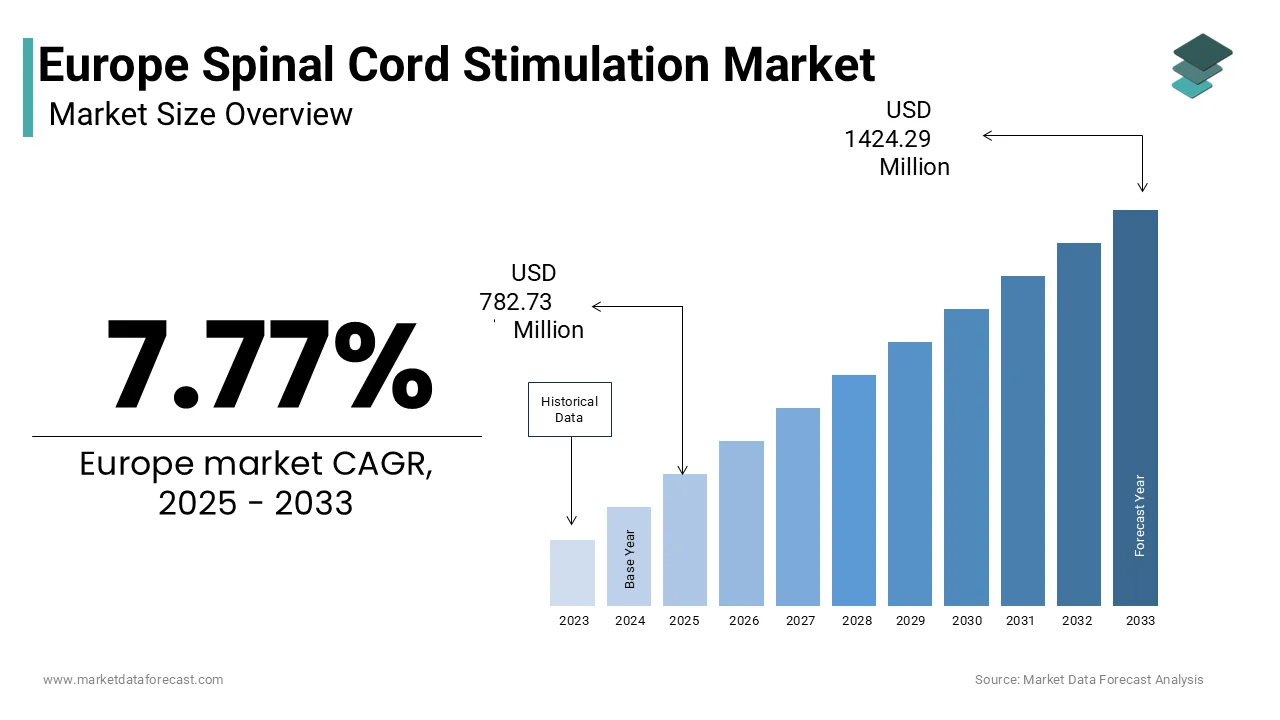
Europe spinal cord stimulation market was valued at USD 726.30 million in 2024, is estimated at USD 782.73 million in 2025, and is projected to reach USD 1,424.29 million by 2033, growing at a CAGR of 7.77% from 2025 to 2033, driven by rising chronic pain prevalence, opioid-sparing pain policies, and adoption of advanced neuromodulation technologies.
Key Market Insights
- 2024 value: USD 726.30 million
- 2025 (est): USD 782.73 million
- 2033 (forecast): USD 1,424.29 million
- CAGR (2025–2033): 7.77%
Quick Growth Drivers
- Rising burden of chronic refractory pain (FBSS, CRPS, neuropathic pain).
- Policy shift toward non-opioid pain management across Europe.
- Growing clinical acceptance of high-frequency, burst, and closed-loop SCS.
- Expansion of reimbursement pathways in Western Europe.
- Increasing spinal surgeries leading to higher FBSS incidence.
Principal Restraints
- Lengthy and fragmented health technology assessment (HTA) timelines.
- Limited availability of trained SCS implanting specialists.
- Uneven reimbursement and payer coverage across EU member states.
- High upfront device costs for advanced waveform systems.
High-Value Opportunities
- Integration of digital health, remote programming, and closed-loop feedback systems.
- Expansion of SCS into non-traditional indications (refractory angina, diabetic neuropathy).
- Growth of outpatient and ambulatory surgery center (ASC) implantation models.
- Real-world evidence generation supporting value-based reimbursement.
Key Market Challenges
- Inconsistent payer coverage limiting equitable patient access.
- Battery longevity and replacement surgery concerns impacting patient acceptance.
- Workforce shortages constraining procedural volumes in Southern and Eastern Europe.
- Slow uptake of premium devices due to conservative public procurement policies.
Fastest-Growing Segments
- Rechargeable SCS systems: fastest growth due to longer lifespan and digital features.
- CRPS indication: rapid growth driven by earlier referral and updated guidelines.
- Ambulatory surgery centers: accelerating adoption with outpatient policy support.
Regional Leadership & Dynamics
- Germany (lead, 20.8%) — strong reimbursement, high spinal surgery volume, advanced waveform adoption.
- United Kingdom — centralized guidelines, growing private sector penetration.
- France — standardized national pain networks and full reimbursement.
- Nordics (Sweden, Netherlands) — early technology adoption, registry-driven value assessment.
- Southern & Eastern Europe — underpenetrated but high latent demand.
What Wins Commercially
- Strong real-world evidence demonstrating opioid reduction and functional improvement.
- Devices with advanced waveforms, longer battery life, and remote management.
- Alignment with multidisciplinary pain pathways and national guidelines.
- Support for physician training and workflow integration.
Top Strategic Ask for Executives
- Invest in clinical evidence and registry participation to accelerate HTA approvals.
- Expand training programs to address implanter shortages.
- Align product strategy with value-based reimbursement models.
- Scale digital and remote-care capabilities to reduce long-term healthcare burden.
Leading Players
Some of the companies that are playing a dominating role in the Europe spinal cord stimulation market include:
- Medtronic
- Boston Scientific
- Nevro
- Abbott (St. Jude Medical)
- Stimwave
- Greatbatch
Europe Spinal Cord Stimulation Market Size
The europe SCS market was valued at USD 726.3 million in 2024, is expected to have 7.77 % CAGR from 2025 to 2033, and be worth USD 1424.29 million by 2033 from USD 782.73 million in 2025.
Spinal cord stimulation (SCS) includes implantable neuromodulation devices designed to manage chronic intractable pain by deliveringlow-voltagee and electrical impulses to the dorsal column of the spinal cord, thereby disrupting pain signal transmission to the brain. SCS therapy is primarily indicated for conditions such as failed back surgery syndrome, complex regional pain syndrome, and peripheral neuropathic pain that do not respond adequately to conventional pharmacological or interventional approaches. The market includes both traditional tonic stimulation systems and advanced waveform technologies such as high-frequency, burst, and closed-loop SCS platforms. According to the European Federation of Neurological Societies, chronic pain affects a large share of adults across the European Union, with a notable proportion classified as refractory to standard treatments. As per the European Pain Federation, hundreds of thousands of patients in Western Europe meet clinical criteria for spinal cord stimulation (SCS) eligibility, yet fewer than 1 in 5 receive the therapy due to access and awareness barriers. Regulatory oversight falls under the European Union Medical Devices Regulation, requiring rigorous clinical evidence for CE certification. Unlike temporary analgesics, SCS offers a reversible, non‑opioid alternative aligned with Europe’s strategy to combat long‑term analgesic dependency and improve quality of life in pain patients.
MARKET DRIVERS
Rising Prevalence of Chronic Refractory Pain Conditions Fuels Clinical Need
The escalating burden of chronic neuropathic and post-surgical pain across Europe is driving the European spinal cord stimulation market growth. According to the European Pain Federation, chronic pain affects around one‑third of adults, with prevalence rising sharply in those aged 50 and above in Germany, France, and the United Kingdom. Failed back surgery syndrome is a major contributor, with hundreds of thousands of new cases annually across Europe. Complex regional pain syndrome, though less common, carries a lifetime prevalence of approximately 26 per 100,000 as reported by the European Reference Network for Rare Neurological Diseases, and is notoriously resistant to medical management. These conditions often lead to long term disability, with the European Agency for Safety and Health at Work estimating that chronic pain accounts for over 20% of all work-related disability claims in the EU. In response, national pain societies have updated treatment algorithms to position SCS as a second-line intervention after six months of failed conservative therapy. A 2024 consensus statement from the European Society of Regional Anaesthesia now recommends early SCS referral for select neuropathic pain syndromes to prevent central sensitization. This clinical validation, combined with a growing pool of eligible patients due to aging demographics and increased spinal surgeries, sustains steady demand for neuromodulation solutions across tertiary pain centers.
Policy Shift Toward Non-Opioid Pain Management Accelerates Reimbursement Support
European health systems are actively de-escalating long-term opioid prescribing in favor of interventional and device-based alternatives, which is creating a favorable environment for SCS and fuelling the regional market expansion. According to the European Monitoring Centre for Drugs and Drug Addiction, long-term opioid use for non-cancer pain declined significantly across Western Europe between 2020 and 2024 following national restrictions in the United Kingdom, Germany, and Sweden. Concurrently, reimbursement pathways for SCS have expanded. As per the French National Authority for Health (HAS), SCS implantation is now fully covered under the national health insurance for patients with documented failed conservative therapy, with hundreds of procedures reimbursed monthly. In the Netherlands, the Health Care Institute (ZIN) includes SCS in its value-based care bundles for chronic pain, linking payment to functional improvement metrics at six months. Similarly, the National Health Service England’s 2023 Integrated Pain Management Framework mandates multidisciplinary assessment pathways that include SCS evaluation for refractory cases. These policy levers not only reduce financial barriers but also institutionalize SCS within formal care protocols, transforming it from a last resort to a recognized component of comprehensive pain management.
MARKET RESTRAINTS
Stringent Health Technology Assessment Requirements Delay Market Access
The adoption of novel SCS technologies in Europe is significantly hindered by rigorous and heterogeneous health technology assessment processes that demand extensive long-term clinical and economic data, which is primarily impeding the spinal cord stimulation market growth in Europe. According to the European Network for Health Technology Assessment (EUnetHTA), the average time to secure reimbursement for a new SCS system exceeds 18 months after CE marking, with countries like Germany and Italy requiring local randomized trials or registry data beyond manufacturer submissions. For example, the German Institute for Quality and Efficiency in Health Care (IQWiG) rejected a 2023 application for a closed-loop SCS system due to insufficient comparative effectiveness data against traditional open-loop devices. Similarly, the UK’s National Institute for Health and Care Excellence (NICE) has not issued a technology appraisal for burst or high-frequency SCS, leaving commissioning decisions to individual integrated care boards. This fragmented evaluation landscape forces manufacturers to conduct multiple post market studies, increasing development costs and delaying patient access. As a result, many advanced waveform systems remain available only in private clinics or academic centers, which limits widespread clinical integration despite regulatory approval.
Limited Availability of Trained Implanting Physicians Constricts Procedure Volume
The successful deployment of SCS therapy depends on a narrow cadre of pain specialists and functional neurosurgeons proficient in both trial lead placement and permanent implantation, which is a workforce that remains insufficient across much of Europe, and this factor further restrains the growth of the European SCS market. According to the European Pain Federation, fewer than 1,000 physicians in the European Union are certified to perform SCS procedures, with significant geographic disparities; while Sweden and the Netherlands have over ten implanters per million population, countries like Spain, Portugal, and Greece have fewer than two. As per a 2024 survey by the European Society of Regional Anaesthesia, waiting times for SCS evaluation exceed six months in 42% of public hospitals, primarily due to human resource constraints. Training programs remain limited, with only five European institutions offering formal neuromodulation fellowships recognized by the European Board of Pain Medicine. This shortage is exacerbated by the technical complexity of newer systems that require specialized programming skills. Without expanded education initiatives and cross-specialty credentialing, the existing clinical capacity will continue to bottleneck SCS utilization, regardless of device availability or reimbursement status.
MARKET OPPORTUNITIES
Integration of SCS into Digital and Remote Patient Management Ecosystems
The convergence of SCS therapy with digital health platforms is a transformative opportunity for the European SCS market. According to the European Connected Health Alliance, over 65% of chronic pain patients in Germany, the United Kingdom, and the Nordic countries now use mobile health apps to track symptoms and medication use. Leading SCS manufacturers have responded by developing Bluetooth-enabled implantable pulse generators that allow patients to adjust stimulation parameters via smartphone applications under clinician supervision. In 2024, the French National Health Insurance began reimbursing remote follow-up consultations for SCS patients, which is reducing the need for in-person visits. Furthermore, closed-loop SCS systems that auto-adjust stimulation based on real-time neural feedback are being integrated with electronic health records in pilot programs at Karolinska University Hospital and University Hospital Zurich. As per the European Commission’s Digital Health Action Plan, such innovations align with broader goals of decentralized care and data-driven therapy optimization. This digital integration not only improves convenience and adherence but also generates real-world evidence on long term outcomes, supporting future reimbursement and guideline inclusion.
Expansion of Indications into Non-Traditional Pain Syndromes
Emerging clinical evidence is broadening the therapeutic scope of SCS beyond classical neuropathic pain into conditions such as refractory angina, painful diabetic neuropathy, and even certain movement disorders, which are unlocking new patient pools and a prominent opportunity in the European SCS market. According to a 2024 multicenter trial published in the European Heart Journal, SCS reduced weekly angina episodes by 58 % in patients with inoperable coronary disease who failed maximal medical therapy. Similarly, the European Association for the Study of Diabetes now recognizes SCS as a viable option for severe diabetic foot pain unresponsive to pharmacotherapy, affecting an estimated three hundred thousand patients across the EU. In neurology, early studies from the University of Copenhagen suggest that dorsal column stimulation may improve gait and reduce tremor in select Parkinson’s disease patients. Regulatory bodies are beginning to acknowledge these applications: the Swedish Medical Products Agency granted a national indication extension for SCS in refractory angina in 2023. As clinical guidelines evolve and physician awareness grows, SCS is transitioning from a niche pain device to a versatile neuromodulation platform, creating substantial growth potential in non-traditional therapeutic domains.
MARKET CHALLENGES
Inconsistent Coverage Policies Across European Payers Limit Equitable Access
Despite clinical efficacy, SCS therapy faces highly variable reimbursement landscapes across European countries, resulting in significant disparities in patient access, which is challenging the expansion of the European SCS market. According to the European Observatory on Health Systems and Policies, SCS is fully reimbursed in only 9 of 27 European Union member states, with partial or conditional coverage in eight others and no formal pathway in the remainder. In Italy, for instance, SCS is reimbursed only in designated regional pain centers, creatingmulti-monthh waiting lists in the south where such facilities are scarce. In Poland and Romania, national health insurers classify SCS as experimental, which is forcing patients to seek costly private care or forego treatment entirely. Even in countries with coverage, prior authorization requirements are stringent. The German statutory health insurance mandates documentation of at least two failed pharmacological regimens and a successful percutaneous trial before approving implantation. This patchwork of policies contradicts the European Union’s principle of health equity and fragments the market, discouraging investment in awareness campaigns and training in underserved regions. Until harmonized coverage criteria are established, SCS will remain inaccessible to a majority of eligible patients despite clinical need.
Device Longevity and Battery Replacement Burden Impact Patient Acceptance
The finite battery life of conventional SCS systems creates a significant burden of repeated surgical interventions that deter patient acceptance, which further challenges the expansion of the European SCS market. According to a 2024 patient survey by the European Pain Patient Alliance, 32% of individuals declined SCS implantation due to concerns about future replacement surgeries, while 28% reported anxiety over daily recharging routines. In elderly patients, who constitute a large proportion of the SCS eligible population, the risks of repeated anaesthesia and wound complications are particularly pronounced. As per the data from the Swedish National Quality Registry for Pain Treatment, 12% of SCS explantations between 2021 and 2023 were due to patient intolerance of replacement procedures. Although newer systems offer extended battery life or wireless charging, adoption is slow due to higher upfront costs and limited reimbursement for premium devices. Moreover, the European Society of Anaesthesiology notes that many public hospitals lack the infrastructure to support complex device replacements, especially for directional or multi-channel systems. Until next-generation platforms achieve truly long-term or battery-free operation, this surgical and psychological burden will remain a critical barrier to broader SCS adoption.
REPORT COVERAGE
| REPORT METRIC | DETAILS |
| Market Size Available | 2024 to 2033 |
| Base Year | 2024 |
| Forecast Period | 2025 to 2033 |
| Segments Covered | By Product Type, Application, End Users, and Region. |
| Various Analyses Covered | Global, Regional, and Country-Level Analysis, Segment-Level Analysis, Drivers, Restraints, Opportunities, Challenges; PESTLE Analysis; Porter’s Five Forces Analysis, Competitive Landscape, Analyst Overview of Investment Opportunities |
| Countries Covered | UK, France, Spain, Germany, Italy, Russia, Sweden, Denmark, Switzerland, Netherlands, Turkey, Czech Republic, Rest of Europe |
| Market Leaders Profiled | Boston.n, Medtronic, Nevro, St. Jude Medical, Greatbatch, Stimwave |
SEGMENTAL ANALYSIS
By Product Type Insights
The non‑rechargeable SCS systems segment captured 60.4% in the European SCS market in 2024. The dominance of the segment in this regional market is primarily due to lower procedural complexity, reduced patient burden, and established reimbursement pathways for shorter lifespan devices. According to the European Pain Federation, more than 68 % of chronic pain patients eligible for SCS are aged 65 or older, many with comorbidities that complicate device management. As per a 2024 study in the European Journal of Pain, non‑rechargeable systems had a 31 % higher adherence rate in patients over 70 compared to rechargeable counterparts, due to the elimination of charging responsibilities. National health systems in Germany, Italy, and Spain favor non‑rechargeable implants in public hospital formularies, which cite lower explantation rates and fewer support calls. Non‑rechargeable systems are expected to remain dominant as clinical pragmatism, elderly demographics, and reimbursement structures sustain their preference despite long‑term cost advantages of rechargeable models.

The rechargeable SCS systems segment is the fastest-growing product type and is projected to grow at a CAGR of 12.8% over the forecast period. According to the European Society of Regional Anaesthesia, newer rechargeable systems now offer battery lives of up to 15 years with wireless charging requiring only weekly sessions. A 2024 usability trial at University Hospital Zurich reported that 82 % of patients found the new charging protocols easy to integrate into daily routines. Smartphone apps now provide adaptive charging alerts, reducing patient anxiety and improving adherence. Rechargeable systems are expected to grow rapidly as battery innovations, wireless charging, and patient‑reported outcome priorities accelerate adoption across Northern and Western Europe.
By Application Insights
The failed back surgery syndrome segment remains the largest clinical indication for SCS in Europe, reflecting the high volume of spinal interventions and persistent post‑operative pain. According to Eurostat, Europe performs more than 800,000 lumbar spine surgeries annually. The European Federation of Neurosurgical Societies reports that 10–40 % of patients develop FBS after lumbar discectomy or fusion, translating to more than 150,000 new cases each year. National pain guidelines, including those from the British Pain Society and German Pain League, list SCS as a first‑tier option for FBS after six months of failed conservative care. FBS is expected to remain dominant as surgical volumes, clear diagnostic criteria, and guideline endorsement sustain its role as the cornerstone indication for SCS.
The CRPS segment is the fastest-growing application segment and is estimated to register a promising CAGR in the European market during the forecast period. According to the European Reference Network for Rare Neurological Diseases, updated 2023 consensus guidelines now advise SCS evaluation after three months of failed pharmacotherapy in CRPS Type I. A landmark 2022 randomized trial published in Pain demonstrated that early SCS reduced pain intensity by 52 % and prevented central sensitization in 76 % of patients. Specialized CRPS centers in Amsterdam and Gothenburg reported a 58 % increase in SCS trials since 2022. CRPS is expected to grow rapidly as earlier referral, guideline shifts, and specialized centers expand the treatable patient pool.
By End User Insights
The hospitals segment accounted for the vast majority of SCS procedures in Europe and stood as the major end-user segment in the regional market. The growth of the hospitals segment in the European market is driven by implantation complexity, multidisciplinary support, and reimbursement structures tied to inpatient care. According to the European Pain Federation, more than 90 % of certified SCS implanters operate within university or tertiary hospitals. National guidelines in Germany, France, and the UK require multidisciplinary team approval before permanent implantation. Public reimbursement in most EU countries covers SCS only when performed in accredited hospital facilities. Hospitals are expected to remain dominant as institutional embedding, multidisciplinary integration, and reimbursement frameworks sustain their role as the primary venue for SCS delivery.
The ASCs segment is the fastest-growing end‑user segment and is predicted to grow at a CAGR of 15.5% over the forecast period. According to the Dutch Ministry of Health, six high‑volume ASCs in the Netherlands received national certification in 2024 to perform permanent SCS implantation under strict outpatient protocols. Switzerland’s Federal Office of Public Health approved outpatient SCS for low‑risk patients in 2023, with clinics in Zurich and Geneva reporting 30 % shorter wait times compared to hospitals. These initiatives align with the EU’s Health Systems Performance Assessment framework, which promotes shifting low‑acuity procedures out of acute care. ASCs are expected to grow rapidly as policy reforms, outpatient safety evidence, and efficiency goals expand neuromodulation beyond hospital settings.
COUNTRY LEVEL ANALYSIS
Germany SCS Market Analysis
Germany dominated the European SCS market and held 20.8% of the regional market share in 2024. The country’s leadership stems from its high volume of spinal surgeries, robust pain‑specialty infrastructure, and comprehensive reimbursement for neuromodulation therapies. Germany performs more than 180,000 lumbar spine procedures annually, as per the German Federal Statistical Office, generating a large pool of Failed Back Surgery Syndrome patients. The nation hosts more than 120 certified SCS implanters, concentrated in university hospitals in Berlin, Munich, and Heidelberg, where multidisciplinary pain centers are well established. The German Joint Federal Committee provides full coverage for SCS after documented trial success, with average approval times under eight weeks. Additionally, German pain societies have pioneered the use of advanced waveform technologies, with more than 60 % of new implants in 2024 featuring burst or high‑frequency stimulation. This combination of procedural volume, clinical expertise, and supportive policy makes Germany the most mature and highest‑value SCS market in Europe, and continued innovation in waveform and closed‑loop systems will reinforce its leadership.
United Kingdom SCS Market Analysis
The United Kingdom occupied the second leading share of the European market in 2024. Its position is anchored in centralized pain guidelines, specialized neuromodulation centers, and a growing private healthcare sector that supplements public access. According to the British Pain Society, more than 50 specialized pain clinics across England, Scotland, and Wales offer NICE‑aligned SCS pathways, with 15 designated as national neuromodulation hubs. The National Health Service fully reimburses SCS for Failed Back Surgery Syndrome and Complex Regional Pain Syndrome, though waiting times average 9–14 months in the public system. This delay has spurred growth in private ambulatory surgery centers, where more than 30 clinics now perform SCS with self‑pay or insurance coverage. A 2024 audit by the Royal College of Anaesthetists found that private SCS volumes grew by 33 % year over year, driven by demand for timely care. Furthermore, the UK’s Medicines and Healthcare products Regulatory Agency has fast‑tracked approvals for closed‑loop systems, positioning the country as an early adopter of next‑generation platforms. These dual public‑private dynamics sustain the United Kingdom’s strong market position, and ongoing investment in advanced neuromodulation will keep it competitive.
France SCS Market Analysis
France accounts for a notable share of the European SCS market owing to its national pain network, standardized reimbursement, and emphasis on equitable access across regions. According to the French Ministry of Health, the country operates 42 designated pain treatment centers that follow a uniform SCS protocol endorsed by the National Authority for Health. SCS is fully reimbursed for eligible indications, with more than 1,000 procedures funded annually through the national insurance system. France’s approach prioritizes multidisciplinary evaluation, requiring psychological and physiotherapy clearance before implantation, which is a model shown to improve long‑term outcomes. A 2024 registry study published by the French Society for the Study of Pain found that SCS patients reported a 54 % reduction in opioid use at one year, aligning with national de‑escalation goals. Additionally, French researchers at INSERM have contributed significantly to CRPS and burst stimulation research, influencing both clinical practice and device development. This blend of centralized policy, outcome focus, and scientific contribution solidifies France’s role as a stable and guideline‑driven SCS market. With its emphasis on equitable access and outcome measurement, France is expected to remain a strong and consistent contributor to the European neuromodulation landscape.
Sweden SCS Market Analysis
Sweden is expected to hold a healthy share of the regional market over the forecast period due to the early technology adoption, national registry oversight, and a strong focus on long‑term patient outcomes. Despite its small population, Sweden performs more than 800 SCS procedures annually, as per the Swedish National Quality Registry for Pain Treatment, one of the highest per‑capita rates in Europe. The registry mandates reporting of pain scores, functional status, and device performance at 6, 12, and 24 months, generating robust real‑world evidence that informs both clinical practice and reimbursement. Sweden’s public healthcare system fully covers SCS, including advanced rechargeable and closed‑loop systems, based on demonstrated value rather than upfront cost. Karolinska University Hospital in Stockholm is a European leader in SCS innovation, having conducted pivotal trials on directional leads and remote programming. Furthermore, Sweden’s digital health infrastructure enables seamless integration of SCS data into national electronic health records, supporting longitudinal care. This data‑driven, patient‑centered model makes Sweden a highly influential and highly performing market disproportionate to its size, and its emphasis on evidence‑based adoption will continue to shape European best practices.
Netherlands SCS Market Analysis
The Netherlands is predicted to witness a healthy CAGR in theEuropeane SCS market during the forecast period, owing to the integrated care pathways, value‑based reimbursement, and pioneering outpatient SCS initiatives. According to the Dutch Association for the Treatment of Pain, the country operates a coordinated network of eight regional pain centers that follow a standardized SCS algorithm endorsed by the Health Care Institute. Reimbursement is bundled into five‑year outcome‑based contracts that reward functional improvement and opioid reduction, not just device implantation. In 2024, the Netherlands became the first EU country to certify select ambulatory surgery centers for permanent SCS implantation in low‑risk patients, reducing wait times by 50 %. Amsterdam’s University Medical Center is a hub for CRPS and burst waveform research, collaborating closely with device manufacturers on next‑generation platforms. Additionally, the Netherlands mandates patient‑reported outcome tracking via digital diaries, which feed into national quality dashboards. This combination of policy innovation, digital integration, and clinical excellence positions the Netherlands as a forward‑looking and highly efficient SCS market. With its emphasis on value‑based care and outpatient innovation, the Netherlands is expected to remain a model for efficiency and patient‑centered neuromodulation.
COMPETITIVE LANDSCAPE
Competition in the European SCS market is characterized by a concentrated landscape of three to four global medical technology companies that differentiate through waveform innovation, lead design, and digital patient management capabilities. Unlike volume-driven markets, competition centers on clinical evidence, health economic value, and seamless integration into multidisciplinary pain pathways. The implementation of the European Union Medical Devices Regulation has raised conformity assessment barriers, favoring incumbents with established quality management systems and post market surveil lance infrastructure. Reimbursement remains fragmented, with Nordic and Benelux countries leading in coverage for advanced platforms while Southern and Eastern Europe lag. Companies compete less on price and more on the total cost of care, demonstrated through opioid reduction, functional recovery, and avoidance of repeat surgeries. Innovation is increasingly focused on closed-loop systems, directional stimulation, and battery longevity to address unmet needs in patient comfort and therapy personalization. As European health systems prioritize non opioid alternatives and long-term disability prevention, the market rewards players that combine technological sophistication with robust real-world outcomes data and deep clinical engagement.
KEY MARKET PLAYERS
Some of the key companies operating in the europe spinal cord stimulation market are
- Boston.n
- Medtronic
- Nevro
- St. Jude Medical
- Greatbatch
- Stimwave
TOP LEADING PLAYERS IN THE MARKET
- Medtronic plc is a global leader in neuromodulation and maintains a strong presence in the European SCS market through its comprehensive portfolio, including traditional tonic, BurstDR, and adaptive closed-loop spinal cord stimulation systems. The company collaborates closely with European pain societies to support clinical education and guideline development, particularly in Germany, the United Kingdom, and Sweden. Recently, Medtronic expanded remote programming capabilities for its SureScan MRI-compatible devices across EU markets, enabling seamless post-implant care via its CareLink digital platform. The company also initiated a multicenter European registry in 2024 to collect real-world evidence on long term outcomes in Complex Regional Pain Syndrome patients, reinforcing its commitment to data-driven adoption and reimbursement support.
- Boston Scientific Corporation has established itself as a key innovator in the European SCS market with its differentiated waveform technologies, including high-frequency ten-kilohertz therapy and directional lead systems under the WaveWriter Alpha platform. The company focuses on physician training and workflow integration, operating dedicated SCS demonstration centers in Paris, Amsterdam, and Munich. In 2024, Boston Scientific launched a pan-European telehealth support program that provides real-time technical assistance during implantation and programming, reducing procedural variability. It also partnered with national pain registries in the Netherlands and Sweden to correlate stimulation parameters with functional outcomes, strengthening the clinical and economic case for its advanced platforms in value-based healthcare environments.
- Nevro Corp is recognized in Europe for pioneering high-frequency SCS therapy through its Senza system, which offers an alternative to traditional tonic stimulation without paresthesia. The company has built a focused presence in countries with progressive reimbursement policies, including the United Kingdom, France, and Switzerland. Nevro has prioritized health economics research, publishing European cost-utility analyses demonstrating reduced long-term opioid use and hospitalizations. In early 2024, the company enhanced its Senza platform with extended battery life and Bluetooth-enabled patient control, aligning with patient demand for autonomy. It also expanded its clinical specialist team across Southern Europe to support hospital adoption and multidisciplinary team engagement, reinforcing its niche as a science-led, outcomes-oriented neuromodulation provider.
TOP STRATEGIES USED BY THE KEY MARKET PARTICIPANTS
Key players in the European SCS market focus on generating robust real-world evidence through national registries and multicenter studies to support health technology assessments and reimbursement. They invest in physician training programs and digital support tools to ensure consistent implantation and programming quality across diverse clinical settings. Companies prioritize the integration of remote monitoring and patient-controlled features to enhance adherence and reduce clinic burden. Strategic collaboration with European pain societies guides guideline alignment and clinical advocacy. Additionally, they tailor device offerings to country-specific reimbursement landscapes by emphasizing long term cost efficiency, opioid reduction, and functional improvement metrics that resonate with value-based healthcare frameworks.
MARKET SEGMENTATION
This research report on the europe spinal cord stimulation market has been segmented & sub-segmented into the following categories.
By Product Type
- Rechargeable
- Non-rechargeable
By Application
- Degenerative Disk Disease (DDD)
- Failed Back Syndrome (FBS)
- Unsuccessful Disk Surgery
- Complex Regional Pain Syndrome (CRPS)
- Multiple Back Operations
- Lumbar Adhesive Arachnoiditis
By End Users
- Hospitals
- Ambulatory Surgery Centers (ASCs)
By Country
- UK
- France
- Spain
- Germany
- Italy
- Russia
- Sweden
- Denmark
- Switzerland
- Netherlands
- Turkey
- Czech Republic
- Rest of Europe