Europe SVOD Market Size, Share, Trends & Growth Forecast Report, Segmented By Content Type (Movies, Tv Shows, Documentaries, Kids Content, Sports), Subscription Model, And Country (Uk, France, Spain, Germany, Italy, Russia, Sweden, Denmark, Switzerland, Netherlands, Turkey, Czech Republic & Rest Of Europe) - Industry Analysis From (2026 To 2034)
Market Size, 2025
$36.16 BnMarket Estimate, 2026
$44.50 BnMarket Forecast, 2034
$233.73 BnCAGR, 2026–2034
23.04%Europe SVOD Market Report Summary
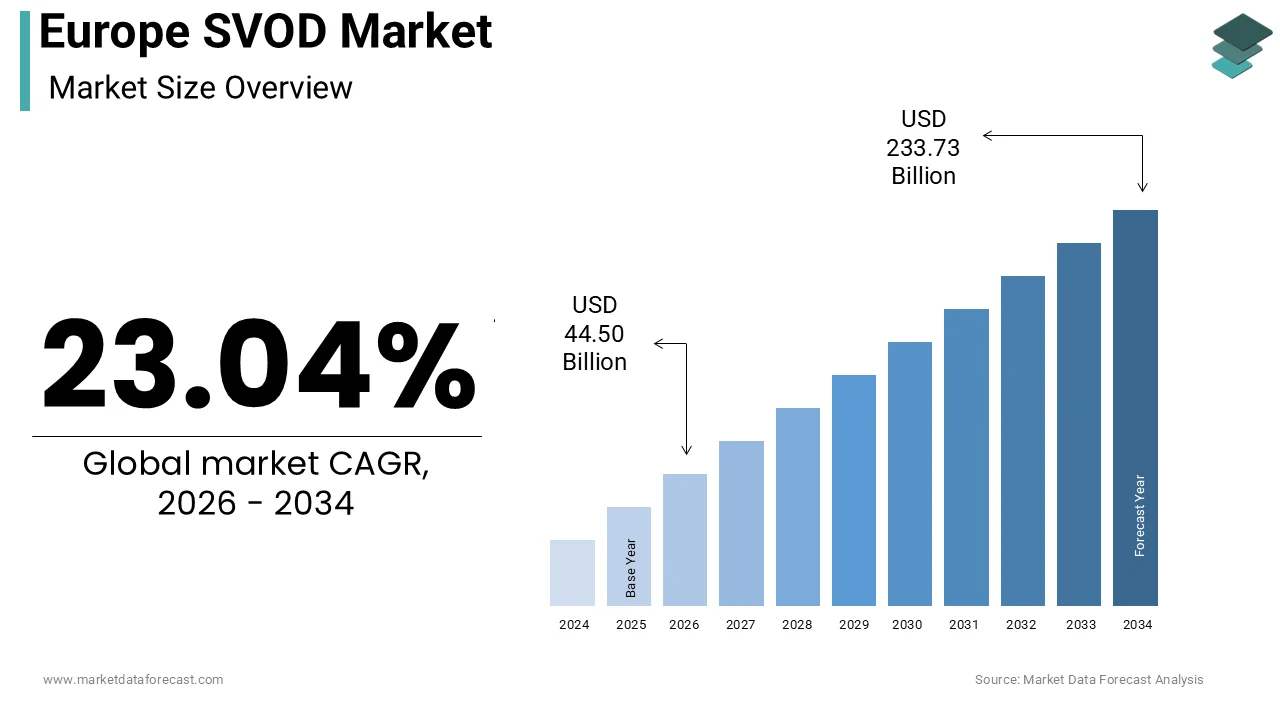
The Europe SVOD (Subscription Video on Demand) market was valued at USD 36.16 billion in 2025, is estimated to reach USD 44.50 billion in 2026, and is projected to reach USD 233.73 billion by 2034, growing at a CAGR of 23.04% during the forecast period. The growth of the Europe SVOD market is driven by the rapid shift from traditional television to digital streaming platforms, increasing internet penetration, and rising adoption of smart devices such as smartphones, smart TVs, and tablets. The growing demand for on-demand, personalized, and ad-free entertainment experiences is significantly boosting market expansion. Additionally, the surge in original content production, multilingual programming, and exclusive releases is attracting a broader audience base across Europe. The expansion of high-speed broadband infrastructure and 5G networks is further enhancing streaming quality and accessibility, thereby accelerating market growth.
Key Market Trends
- Increasing shift from linear TV to on-demand streaming platforms, driven by changing consumer viewing habits.
- Rising investment in original and exclusive content production, including regional and multilingual programming.
- Growing preference for ad-free subscription models, offering uninterrupted viewing experiences.
- Expansion of OTT platforms across multiple devices, including smart TVs, smartphones, and tablets.
- Increasing adoption of AI-driven content recommendations and personalization, enhancing user engagement and retention.
Segmental Insights
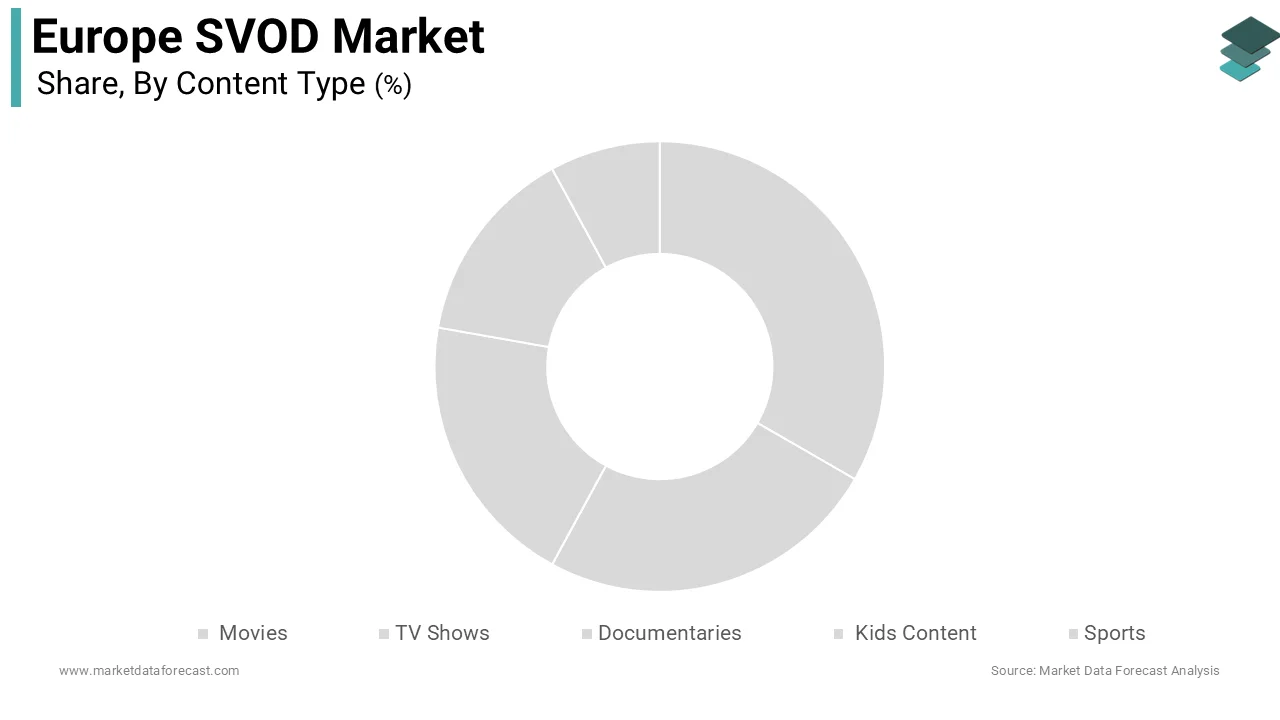
- Based on content type, the TV shows segment dominated the Europe SVOD market by accounting for 46.4% of the market share in 2025, driven by binge-watching trends, availability of long-form content, and increasing production of original series.
- Based on the subscription model, the ad-free subscription segment led the market by capturing 60.6% of the Europe SVOD market share in 2025, supported by growing consumer preference for uninterrupted and premium viewing experiences.
Regional Insights
- The United Kingdom dominated the Europe SVOD market in 2025, accounting for 24.1% of the regional market share, driven by its advanced digital ecosystem, high streaming adoption, and strong media production industry.
- Germany held the second-largest share, supported by its large population and the rapid transition toward digital media consumption.
- France is expected to witness a promising CAGR, fueled by strong cultural policies and a state-supported film industry that encourages local content production and SVOD adoption.
- Italy is projected to capture a notable share, driven by increasing demand for both domestic drama content and international sports streaming.
- Spain is emerging as a fast-growing market, supported by its role as a key production hub for both European and Latin American content.
Competitive Landscape
- The Europe SVOD market is highly competitive, with the presence of global streaming giants and regional media companies. Market players are focusing on expanding their content libraries, investing heavily in original productions, and enhancing user experience through advanced streaming technologies. Strategic partnerships, mergers, and content licensing agreements are key strategies adopted to strengthen market positioning and attract subscribers across diverse demographics.
- Prominent players in the Europe SVOD market include Netflix Inc, Amazon.com Inc, The Walt Disney Company, Warner Bros Discovery Inc, Apple Inc, Comcast Corporation (Sky Group), Paramount Global, RTL Group S.A, Vivendi SE (Canal+ Group), and ProSiebenSat.1 Media SE, ITV plc, BBC Studios, Rakuten Group Inc, DAZN Group Limited, and Viaplay Group.
Europe SVOD Market Size
The Europe SVOD market size was calculated to be USD 36.16 billion in 2025 and is anticipated to be worth USD 233.73 billion by 2034, from USD 44.50 billion in 2026, growing at a CAGR of 23.04% during the forecast period.
Subscription Video on Demand (SVOD) represents a mature yet evolving digital ecosystem where consumers pay recurring fees for unlimited access to curated libraries of film, television, and original programming delivered via high-speed internet protocols. This sector has fundamentally altered media consumption habits across the continent, shifting power from traditional linear broadcasters to agile digital platforms that leverage data analytics for content personalization. The landscape is uniquely characterized by a tension between global hyperscalers and robust local incumbents who leverage cultural proximity to retain audiences. According to Eurostat, households in the European Union generally have broadband access, which serves as the critical infrastructure backbone for seamless streaming experiences. According to the European Audiovisual Observatory, Europe hosts a large number of active SVOD services, which reflects a highly fragmented but vibrant competitive environment. Unlike other regions, the European market operates under strict regulatory frameworks such as the Audiovisual Media Services Directive, which mandates that platforms invest a portion of their revenue into local content production. As per the International Telecommunication Union, fiber optic coverage in Western Europe is now widespread, enabling ultra-high-definition and 4K streaming without buffering. This definition extends beyond mere content delivery to encompass sophisticated recommendation engines and multi-device synchronization that define the modern viewer experience. The market continues to evolve from a growth-at-all-costs model to one focused on profitability and sustainable subscriber retention amidst economic headwinds.
MARKET DRIVERS
Proliferation of High-Speed Broadband and 5G Networks
The ubiquitous availability of high-speed fixed and mobile internet infrastructure is primarily driving the growth of the European SVOD market. Streaming high-definition and ultra-high-definition content requires consistent bandwidth that was previously unavailable in many rural and semi-urban areas but has now become standard. According to the European Commission, gigabit connectivity coverage has expanded significantly across EU households, driven by aggressive public investment and private sector rollout of fiber optics. The deployment of fifth-generation mobile networks further enhances accessibility by enabling high-quality viewing on smartphones and tablets while commuting or traveling. As per the Body of European Regulators for Electronic Communications, mobile data traffic in Europe has been rising sharply, with video accounting for the majority of this volume. The reduction in latency provided by these advanced networks facilitates live sports streaming and interactive content features that were previously technically unfeasible. Rural connectivity initiatives funded by national governments have also closed the digital divide, ensuring that SVOD services can penetrate previously underserved markets. This robust technical foundation removes the primary barrier to entry for potential subscribers and enables platforms to offer higher bitrate content that enhances user satisfaction.
Shift in Consumer Preferences Toward On-Demand Viewing
A fundamental transformation in consumer behavior regarding media consumption habits is further boosting the expansion of the European SVOD market. Modern viewers increasingly reject the rigid scheduling of linear television in favor of the flexibility to watch what they want, when they want, and on the device of their choice. According to the European Audiovisual Observatory, time-shifted viewing now accounts for a substantial portion of total television consumption in major European markets, indicating a decisive shift away from appointment viewing. This demand for control is particularly pronounced among younger generations who have grown up with digital-native expectations of instant gratification and personalized content curation. SVOD platforms cater to this desire by offering entire seasons of shows for binge-watching and utilizing algorithms to recommend content tailored to individual tastes. As per Ofcom, subscription video services in the United Kingdom have surpassed traditional broadcast television in average viewing time, marking a historic turning point. The ability to pause, resume, and switch devices seamlessly fits perfectly into the busy and fragmented lifestyles of contemporary European consumers. Furthermore, the decline of traditional cable subscriptions as users cut the cord to avoid expensive bundles drives migration toward standalone SVOD options.
MARKET RESTRAINTS
Market Saturation and Subscription Fatigue Among Consumers
The excessive proliferation of streaming services has led to a state of market saturation where consumers are overwhelmed by the number of choices and the cumulative cost of multiple subscriptions, which is impeding the European SVOD market growth. As major media companies pull their content from aggregators to launch proprietary platforms, viewers find themselves needing to subscribe to numerous services to access their favorite shows. According to the European Consumer Organisation, the average monthly cost of subscribing to multiple SVOD platforms in Europe has become comparable to traditional cable packages. This financial burden leads to subscription fatigue, where households frequently rotate services, subscribing for a month to watch a specific show and then cancelling, known as churning. As per Deloitte, research indicates that many European consumers plan to reduce the number of streaming subscriptions due to economic pressure and content fragmentation. The sheer volume of available content also creates a paradox of choice where users spend more time browsing than watching, leading to frustration and disengagement. Smaller niche platforms struggle to gain traction as consumers consolidate their spending on a few primary services.
Stringent Content Quotas and Regulatory Compliance Costs
Rigid regulatory frameworks imposed by the European Union and individual member states create significant operational and financial burdens for SVOD platforms operating in the region, which is further hampering the regional market expansion. The Audiovisual Media Services Directive mandates that streaming services must allocate a portion of their catalog to European works and contribute financially to local production funds. The European Commission enforces these rules to protect cultural diversity, but compliance requires substantial investment in content acquisition and original production that may not always yield immediate commercial returns. Platforms must navigate a complex patchwork of national regulations regarding taxation, content classification, and advertising restrictions, which vary significantly from country to country. As per the European Audiovisual Observatory, compliance with these local content obligations has increased operational expenses for global streamers. The requirement to promote European content prominently on user interfaces can sometimes conflict with algorithmic recommendations based on viewer preference, potentially impacting engagement metrics. Smaller international players may find the regulatory hurdle too high to justify entering certain markets, leading to reduced competition and choice for consumers. The administrative burden of reporting and verifying compliance diverts resources away from innovation and platform improvement. These regulatory constraints, while culturally beneficial, act as a restraint on the unrestricted scalability and profit margins of SVOD businesses operating within the European jurisdiction.
MARKET OPPORTUNITIES
Expansion of Advertising-Based Video on Demand Tiers
The introduction and rapid adoption of advertising-supported subscription tiers present a promising opportunity for the European SVOD market. As economic inflation impacts household budgets, many viewers are reluctant to pay premium prices for ad-free experiences, creating a vast addressable market for lower-cost alternatives. According to the European Advertising Standards Alliance, new SVOD sign-ups are increasingly choosing ad-supported plans, indicating strong consumer willingness to trade attention for affordability. As per Magna Global, advertising revenue from streaming services in Europe is expected to grow significantly as brands shift budgets from linear television to digital video. The hybrid model also provides valuable first-party data on viewing habits that enhances targeting capabilities and attracts premium advertisers. Platforms can utilize this dual revenue stream to subsidize high-budget original productions that drive subscriber acquisition. The flexibility to offer multiple pricing tiers allows operators to customize offerings for different demographic groups and economic conditions.
Growth of Localized and Regional Content Production
The surging demand for authentic local stories and regional language content offers a lucrative opportunity for the European SVOD market. Global blockbusters often fail to resonate with local cultural nuances, creating an opening for services that invest heavily in domestic productions. According to the European Film Academy, locally produced series and films consistently achieve stronger engagement compared to imported content. As per the European Audiovisual Observatory, investment in European original productions by SVOD services has been rising, reflecting this strategic shift. Local content also helps platforms meet regulatory quotas more effectively while generating positive public relations and government support. Successful local hits often have the potential to cross borders and become international phenomena, adding value to the global catalog. This focus on localization allows smaller regional players to compete effectively against global giants by leveraging their deep understanding of local tastes.
MARKET CHALLENGES
Escalating Content Acquisition and Production Costs
The intensifying competition for premium content rights and the rising costs of producing high-quality original programming pose a severe threat to the profitability of SVOD platforms, which is a significant challenge to the growth of the European SVOD market. As every major studio launches its own service, the licensing window for third-party content has narrowed, forcing platforms to spend heavily on creating exclusive originals to attract and retain subscribers. According to the European Producers Club, production costs for high-end drama in Europe have been increasing due to talent shortages and inflation in production services. As per PwC, many European SVOD operators are still years away from breaking even due to these massive upfront investments. The risk of a high-budget flop can have devastating financial consequences and damage brand reputation. Furthermore, the fragmentation of rights means platforms must negotiate separately in each territory, increasing legal and administrative overhead. Managing these escalating costs while maintaining a compelling content slate remains the most significant financial challenge facing the industry today.
Prevalence of Account Sharing and Password Piracy
The widespread practice of account sharing among friends and families outside the household significantly erodes potential revenue and distorts viewer metrics for SVOD providers across Europe, which is further challenging the expansion of the European SVOD market. For years, platforms tolerated this behavior as a form of viral marketing, but it has now reached a scale where it materially impacts financial performance. According to the Alliance for Creativity and Entertainment, password sharing costs the European streaming industry substantial amounts in lost subscription revenue. As per YouGov, surveys indicate that a large proportion of Europeans admit to using someone else’s login credentials for streaming services, highlighting the cultural normalization of the practice. The technical measures to detect and restrict sharing risk alienate customers and trigger churn. The prevalence of piracy sites offering free access to premium content further exacerbates the issue. Addressing this revenue leakage without damaging customer relationships is a critical hurdle that defines the current strategic landscape for SVOD operators.
REPORT COVERAGE
| REPORT METRIC | DETAILS |
| Market Size Available | 2025 to 2034 |
| Base Year | 2025 |
| Forecast Period | 2026 to 2034 |
| CAGR | 23.04% |
| Segments Covered | By Content Type, Subscription Model, And Region |
| Various Analyses Covered | Global, Regional & Country Level Analysis; Segment-Level Analysis; DROC, PESTLE Analysis; Porter’s Five Forces Analysis; Competitive Landscape; Analyst Overview of Investment Opportunities |
| Regions Covered | UK, France, Spain, Germany, Italy, Russia, Sweden, Denmark, Switzerland, Netherlands, Turkey, and the Czech Republic |
| Market Leaders Profiled | Netflix Inc., Amazon.com Inc., The Walt Disney Company, Warner Bros. Discovery Inc., Apple Inc., Comcast Corporation (Sky Group), Paramount Global, RTL Group S.A., Vivendi SE (Canal+ Group), ProSiebenSat.1 Media SE, ITV plc, BBC Studios, Rakuten Group Inc., DAZN Group Limited, Viaplay Group |
SEGMENTAL ANALYSIS
By Content Type Insights
The TV shows segment dominated the market by accounting for 46.4% of the European market share in 2025. The dominance of the TV shows segment in the European market can be attributed to the addictive nature of serialized storytelling and the strategic shift toward exclusive original series that define platform identities. The aggressive investment by platforms in high-budget original series that serve as key differentiators in a crowded marketplace is further contributing to the expansion of the TV shows segment in the European market. Unlike movies, which often have licensing windows shared across multiple services, original TV series remain exclusive to their host platform, which is creating a powerful lock-in effect for subscribers. According to the European Audiovisual Observatory, spending on European original series by SVOD providers has been rising as companies race to secure unique intellectual property. As per Deloitte, many European consumers cite specific TV series as the main reason for maintaining their subscriptions rather than film libraries. The episodic format encourages habitual viewing patterns where users return daily or weekly, fostering deeper engagement compared to standalone films. The ability to release entire seasons at once also fuels binge-watching culture, which has become a defining characteristic of modern European media consumption.
However, the sports segment is anticipated to register a CAGR of 19.5% over the forecast period in the European market, owing to the migration of live sporting events from traditional broadcast television to digital streaming platforms and the strategic acquisition of exclusive live broadcasting rights by SVOD providers. Traditional broadcasters are increasingly priced out of auctions for top-tier leagues, leading to a shift where streaming services become the primary home for major tournaments. According to the European League of Football Institutes, digital rights deals for major soccer and basketball leagues have been increasing in value as platforms bid aggressively for exclusivity. As per Nielsen Sports, younger European audiences now show a strong preference for watching live sports on streaming apps rather than linear TV channels. The urgency of live action creates appointment viewing that drives immediate subscription spikes and reduces cancellation risks during active seasons. Platforms are leveraging these rights to bundle sports with entertainment offerings, creating comprehensive super apps.
By Subscription Model Insights
The ad-free subscription model segment led the market by capturing 60.6% of the European market share in 2025. The growth of the ad-free subscription model segment in the European market is attributed to the strong consumer preference for uninterrupted viewing experiences and the historical positioning of SVOD as a premium alternative to advertising-laden linear television. The deeply ingrained consumer expectation that paying for a subscription service guarantees a seamless and interruption-free viewing experience is also aiding the growth of the ad-free subscription model segment in the regional market. According to the European Consumer Organisation, surveys show that subscribers consider the absence of advertisements as the primary benefit of their SVOD membership. As per YouGov, willingness to tolerate advertisements drops sharply when users are already paying a monthly fee. High-net-worth individuals and early adopters prioritize convenience and quality over cost savings, reinforcing the dominance of ad-free tiers.
On the other hand, the ad-supported segment is anticipated to witness the fastest CAGR of 23.3% over the forecast period, owing to the economic pressures on households and the strategic pivot of major platforms to capture price-sensitive demographics. The ongoing economic inflation and cost-of-living crisis across Europe, which forces consumers to seek more affordable entertainment alternatives are further propelling the expansion of the ad-supported segment in the European market. According to the European Central Bank, inflation impacting discretionary spending has prompted rising inquiries about budget streaming options. As per Magna Global, new subscribers in Southern and Eastern Europe are increasingly opting for ad-supported plans, citing cost as the decisive factor. The availability of a lower price point expands the total addressable market to include millions of previously excluded consumers. The psychological acceptance of ads as a fair trade-off for affordability is gaining traction rapidly, which is ensuring that the ad-supported segment will grow faster than any other model.
REGIONAL ANALYSIS
United Kingdom SVOD Market Analysis
The United Kingdom stood as the dominant player in the European SVOD market in 2025 with24.1% of the regional market due to its mature digital infrastructure and vibrant production sector. The nation serves as a primary testing ground for global streaming services launching new features and content strategies before wider European rollouts. The UK government's Creative Sector Vision aims to double the size of the creative industries by 2030, driving massive investment in local original productions. As per Ofcom, SVOD penetration in UK households is among the highest in Europe, with subscribers often holding multiple platforms simultaneously. The presence of global giants alongside strong local players creates a competitive environment that fosters innovation. British content enjoys immense global popularity, enhancing the export value of UK-based SVOD libraries. High broadband speeds and widespread 5G coverage facilitate seamless streaming across all devices.
Germany SVOD Market Analysis
Germany had the second major share of the European SVOD market in 2025 due to its large population and rapid modernization of media consumption habits. Historically slower to adopt streaming, Germany has surged as local broadcasters launched robust digital platforms to compete with international entrants. The Federal Ministry for Economic Affairs and Climate Action supports digital infrastructure projects, ensuring rural areas gain access to high-speed internet. As per Statista, SVOD subscriptions in Germany have been growing rapidly, marking one of the fastest adoption rates in Western Europe. German audiences show strong preferences for local language content and dubbed versions of international hits, prompting heavy investment in localization. Strict data protection laws influence platform operations but also build trust among privacy-conscious consumers.
France SVOD Market Analysis
France is expected to exhibit a promising CAGR in the European SVOD market during the forecast period, owing to the strong cultural policies and a state-supported film industry to drive SVOD adoption. The French regulatory framework mandates significant investment in local content, resulting in a high-quality catalog of exclusive French series and films. According to the Centre National du Cinéma et de l’Image Animée, French SVOD platforms have been investing heavily in local production. As per Médiamétrie, French viewers spend more time watching local content on SVOD than any other European nationality. The government promotes digital sovereignty, encouraging homegrown platforms to compete effectively against US giants. Broadband expansion in rural regions is opening new markets outside Paris, while cultural pride ensures resilience in the French SVOD ecosystem.
Italy SVOD Market Analysis
Italy is estimated to capture a notable share of the European SVOD market during the forecast period due to the strong demand for both local drama and international sports content. The Italian SVOD market has transformed rapidly with the entry of global players and the consolidation of local broadcasters. The Italian Communications Authority notes that mobile viewing is particularly popular due to high smartphone penetration and a culture of on-the-go media consumption. As per Audiweb, streaming time in Italy has been rising, surpassing traditional TV viewing among younger demographics. Football and motorsports drive significant subscriptions to sports-focused bundles. Infrastructure improvements in southern Italy are expanding the addressable market, while telecom bundles accelerate adoption among cost-conscious consumers.
Spain SVOD Market Analysis
Spain emerges as a rapidly growing market in the European market, owing to its role as a major production hub for Latin American and European content. Spanish SVOD platforms have successfully exported locally produced series to global audiences, boosting domestic pride and subscriptions. According to the Institute of Cinematography and Audiovisual Arts, Spain attracted record foreign investment for film and series production in 2024. As per ComScore, Spain has one of the highest rates of multi-screen usage in Europe, with users frequently switching between TVs, tablets, and phones. Competitive pricing strategies by local telecom operators have democratized access for lower-income households. The youthful demographic profile aligns perfectly with digital-native preferences, ensuring Spain remains a vital and expanding market in the European SVOD landscape.
COMPETITION OVERVIEW
The competition in the Europe SVOD market is fiercely intense and characterized by a complex battle between global hyperscalers and strong regional broadcasters vying for limited consumer attention and wallet share. Incumbent players leverage their extensive libraries of iconic franchises and massive production budgets to secure exclusive content that drives subscriber acquisition and retention. Meanwhile, local champions differentiate themselves by offering deeply localized content and understanding specific cultural preferences that global giants often miss. The rivalry intensifies as firms engage in price wars and introduce varied subscription models, including ad-supported tiers to appeal to economically strained households. Strategic partnerships with telecommunications providers have become essential for distribution and bundling to reduce customer acquisition costs. Competitors constantly monitor viewer data to refine recommendation algorithms and personalize user experiences to prevent churn. The pressure to comply with European Union content quotas forces all players to invest heavily in local production, which raises overall industry costs. Companies that can balance global scale with local relevance while managing profitability amidst rising content costs gain a distinct advantage. This dynamic landscape drives continuous innovation in content creation and delivery technologies, ensuring European viewers benefit from high-quality, diverse streaming options.
KEY MARKET PLAYERS
A few major players of the Europe SVOD Market include
- Netflix Inc
- Amazon.com Inc
- The Walt Disney Company
- Warner Bros
- Discovery Inc
- Apple Inc
- Comcast Corporation (Sky Group)
- Paramount Global
- RTL Group S.A
- Vivendi SE (Canal+ Group)
- ProSiebenSat.1 Media SE
- ITV plc
- BBC Studios
- Rakuten Group Inc
- DAZN Group Limited
- Viaplay Group
Top Strategies Used by Key Market Participants
Key players in the Europe SVOD market primarily employ aggressive content localization strategies to produce original series and films that resonate with specific cultural nuances and languages across the continent. Companies frequently invest billions in commissioning local productions to satisfy regulatory quotas and build deep emotional connections with regional audiences. Another prevalent strategy involves the introduction of advertising-supported subscription tiers to capture price-sensitive consumers who are reluctant to pay premium fees during periods of economic inflation. Market participants also focus on bundling their streaming services with telecommunications packages or other digital subscriptions to reduce churn and increase perceived value. Expanding into live sports broadcasting rights allows firms to differentiate their offerings and drive real-time engagement that recorded content cannot match. Furthermore, companies are implementing stricter password-sharing controls to convert casual viewers into paying subscribers and maximize revenue per user. These diversified approaches enable stakeholders to navigate saturation and maintain growth in a highly competitive environment.
Leading Players in the Europe SVOD Market
- Netflix Inc stands as a pioneering force in the Europe SVOD market by delivering a vast library of original and licensed content tailored to diverse European tastes. The company revolutionized global viewing habits by introducing the binge-watching model and sophisticated recommendation algorithms that drive user engagement worldwide. Recently, Netflix significantly increased its investment in local European productions across countries like Spain, France, and Poland to create culturally relevant hits that resonate globally. This strategy strengthens its position by fostering deep loyalty among regional audiences while complying with local content quotas. The platform also introduced an advertising-supported tier in several European markets to capture price-sensitive consumers amidst economic inflation. Netflix continues to refine its password-sharing policies to convert unauthorized users into paying subscribers, thereby boosting revenue. Its commitment to high-quality storytelling and technological innovation ensures it remains a dominant player shaping the future of streaming entertainment across the continent and beyond.
- Amazon Prime Video plays a critical role in the Europe SVOD market by leveraging its integration with the broader Amazon ecosystem to offer compelling value through bundled subscriptions. The company differentiates itself by combining extensive video libraries with benefits like free shipping and music streaming, which drives high retention rates across the region. Globally, Amazon contributes by investing heavily in premium sports rights and exclusive original series that attract millions of viewers. Recent actions include securing exclusive broadcasting deals for major European football leagues, which significantly boost subscriber acquisition in key markets like the United Kingdom and Germany. The platform also expanded its ad-supported tier options to provide flexible pricing for cost-conscious consumers. Amazon utilizes advanced data analytics from its retail operations to personalize content recommendations and optimize marketing strategies. This holistic approach creates a sticky ecosystem that makes cancellation less likely for users. By focusing on live events and high-production-value originals, Amazon solidifies its status as a formidable competitor in the European streaming landscape.
- The Walt Disney Company exerts significant influence in the Europe SVOD market through its Disney Plus platform, which offers unparalleled access to iconic franchises, including Marvel, Star Wars, and Pixar. The company capitalized on its vast intellectual property portfolio to rapidly gain millions of subscribers across Europe shortly after launch. Globally, Disney sets benchmarks for family-friendly content and brand loyalty that few competitors can match. Recent strategies involve the integration of general entertainment content via the Star hub within Disney+ to appeal to adult audiences and reduce churn rates. The company also partnered with local telecommunications providers in countries like France and Italy to bundle services and expand reach efficiently. Disney has begun introducing advertising-supported subscription tiers in European markets to diversify revenue streams and lower entry barriers. The studio continues to produce high-budget local language originals to strengthen its connection with regional viewers. This combination of beloved global brands and localized content strategies ensures Disney remains a central pillar of the European SVOD ecosystem.
MARKET SEGMENTATION
This research report on the Europe SVOD market has been segmented and sub-segmented based on Content Type, Subscription Model & region.
By Content Type
- Movies
- TV Shows
- Documentaries
- Kids Content
- Sports
By Subscription Model
- Ad-free
- Ad-supported
- Hybrid
By Region
- UK
- France
- Spain
- Germany
- Italy
- Russia
- Sweden
- Denmark
- Switzerland
- Netherlands
- Turkey
- Czech Republic
- Rest of Europe
Frequently Asked Questions
1. What are the key drivers of the market?
Increasing internet penetration, rising demand for digital entertainment, and growth in smart devices.
2. Who are the major consumers of SVOD services?
Young adults, urban populations, and tech-savvy users are the primary consumers.
3. What types of content are offered on SVOD platforms?
Movies, TV series, documentaries, live content, and original programming.
4. What are the key trends in the market?
Growth of original content, regional content production, and bundling services.
5. What are the challenges in the SVOD market?
High competition, content licensing costs, and subscriber churn.
6. What role does original content play?
Original content helps platforms attract and retain subscribers.
7. What is the impact of 5G on SVOD services?
5G improves streaming quality, reduces buffering, and enhances user experience.
8. How do SVOD platforms compete in Europe?
Through exclusive content, partnerships, localized offerings, and competitive pricing.
9. What is the role of AI in SVOD platforms?
AI is used for content recommendations and personalized user experiences.
10. What is the future outlook of the Europe SVOD market?
The market is expected to grow significantly due to increasing digital consumption and content investments.
Related Reports
Access the study in MULTIPLE FORMATS
Purchase options starting from
$ 2000
Didn’t find what you’re looking for?
TALK TO OUR ANALYST TEAM
Need something within your budget?
NO WORRIES! WE GOT YOU COVERED!
Call us on: +1 888 702 9696 (U.S Toll Free)
Write to us: sales@marketdataforecast.com