- Product Description Description
- Table of Contents TOC
- List of Table & Figure LOT
- Get Free Sample PDF Sample PDF
Market Size, 2025
$82.45 MnMarket Estimate, 2026
$111.72 MnMarket Forecast, 2034
$1,269.56 MnCAGR, 2026–2034
35.5%Executive Summary: Europe Synthetic Data Generation Market
- Market Scope: Comprehensive regional synthetic data generation market analysis covering application segments, offering types, data format categories, end-use verticals, and country-level leadership frameworks.
- Market Valuation: Valued at USD 82.45 million (2025), estimated at USD 111.72 million (2026), and projected to reach USD 1,269.56 million by 2034, registering a robust CAGR of 35.50% (2026–2034).
- Primary Growth Drivers: Stringent GDPR compliance requirements limiting access to real personal data and accelerated development of AI models requiring scalable, diverse training sets that real-world data cannot provide due to scarcity or imbalance. Key industry trends include the integration of synthetic data within EU AI regulatory sandboxes for controlled innovation, increasing public sector adoption for ethical policy simulation, and the use of hybrid datasets to balance statistical fidelity with privacy preservation. Growth remains constrained by the lack of standardized validation frameworks, high computational costs limiting SME accessibility, risks of algorithmic bias amplification, and legal ambiguities under the EU AI Act and GDPR.
Key Market Segment Metrics (2026–2034)
| Category | Leading Segment (2025 Position) | Fastest-Growing Segment |
|---|---|---|
| By Application / Component | Data protection application segment (led the market in 2025 due to legal necessities for minimizing real personal data usage) | Computer vision algorithms (projected to grow at a CAGR of 32.7%) |
| By Offering | Partially synthetic data (held the majority share by offering in 2025) | Hybrid synthetic data (expected to witness the fastest CAGR of 36.4%) |
| By Data Type | Tabular data (dominated by data type in 2025) | Image and video data (anticipated to exhibit a CAGR of 38.1%) |
| By End Use | Healthcare and life sciences (largest end-use segment in 2025) | BFSI (predicted to witness the highest CAGR of 34.9%) |
| By Region / Country | Germany (led regionally with a 22.6% share in 2025, followed by the United Kingdom at 18.4%) | Sweden (positioned for notable expansion through 2033) |
Major Market Players & Market Structure
Market Structure: Highly competitive European synthetic data generation landscape featuring specialized technology providers competing on privacy preservation, automated bias detection, cloud deployment integration, and responsible AI ecosystem partnerships.
Key Companies: Mostly AI, Hazy, DataGen, Tonic.ai, Gretel.ai, Synthesis AI, Trafi, Zyte, AI.Reverie, Datagen Technologies Ltd., YData Labs, Kinetica, Datomize, Statice GmbH, Gurobi Optimization, Parallel Domain, Physics.ai, and Synthesized.io.
Europe Synthetic Data Generation Market Size
The Europe Synthetic Data Generation Market is projected to grow from USD 82.45 million in 2025 to USD 111.72 million in 2026 and reach USD 1,269.56 million by 2034, registering a CAGR of 35.50% from 2026 to 2034.
Synthetic data generation refers to the technologies and services that create artificial datasets mimicking real-world statistical properties without containing actual personal or sensitive information. These datasets are engineered using generative modeling, differential privacy, and AI-driven simulation techniques to enable safe testing, training, and validation of algorithms in highly regulated environments. The European context is uniquely defined by stringent data protection laws, ethical AI governance frameworks, and a growing demand for innovation that respects fundamental rights. According to multiple sources, organizations developing AI systems in the EU frequently encounter significant legal and practical challenges in obtaining and using real personal data due to the strict requirements and interpretations of the General Data Protection Regulation (GDPR). Further, as per research, the use of synthetic data is an emerging and growing practice across research and industry sectors like healthcare and finance to overcome challenges related to data privacy, data silos, and the difficulties of obtaining individual consent for large-scale AI training. The EU AI Act imposes strict obligations on high-risk AI systems, including requirements for data governance, quality, and robust cybersecurity measures; while synthetic data may be a useful tool, official EU guidance emphasizes high-quality, representative datasets for testing to ensure compliance and mitigate risks. These regulatory and operational realities, not commercial metrics, establish synthetic data as a foundational enabler of responsible digital transformation in Europe.
MARKET DRIVERS
Stringent Data Privacy Regulations Limit Access to Real Personal Data
The region’s robust data protection regime, particularly the General Data Protection Regulation, creates acute demand for synthetic alternatives, which in turn contributes to the growth of the European synthetic data generation market. This is because the regime restricts the use, sharing, and processing of real personal information. Initiatives involving the use of artificial intelligence within public sector healthcare and social services experienced operational delays. Frameworks that govern the use of health data require strict measures to protect individuals' privacy when data is used for secondary purposes. Many existing datasets do not meet the standards for anonymization or pseudonymization required by these frameworks. Using synthetic data provides a path forward that is legally viable for development purposes. A majority of emerging digital health companies now train diagnostic algorithms on synthetic patient records exclusively. Similarly, financial institutions under the European Banking Authority’s guidelines use synthetic transaction logs to test fraud detection models without exposing customer data. This regulatory pressure transforms synthetic data from an optional tool into a compliance necessity, especially for cross-border data collaborations where national interpretations of GDPR further complicate data pooling.
Accelerated AI Model Development Requires Scalable and Diverse Training Sets
The proliferation of artificial intelligence applications across European industries has intensified the need for large, varied, and bias-mitigated datasets that real-world data often cannot provide due to scarcity or imbalance, and thereby contributes to the expansion of the European synthetic data generation market. According to sources, European AI developers often face significant challenges regarding the scarcity of data for training models on edge cases, such as rare medical conditions or uncommon fraud patterns, which can be a primary bottleneck in achieving robust and reliable AI systems. Synthetic data generation addresses this by creating statistically representative yet augmented datasets that include underrepresented scenarios. For instance, the German Aerospace Center and other research organizations utilize synthetic mobility data within simulations to model complex pedestrian behaviors and generate numerous rare crossing scenarios for autonomous vehicle testing that would require extensive time to gather from real-world observations. Besides, the aviation community, including entities like Eurocontrol, is increasingly focused on leveraging artificial intelligence and advanced data processing techniques to better predict and manage the significant and growing impact of extreme weather events on air traffic flow and safety, aiming to improve system resilience and decision-making for all stakeholders. Synthetic data accelerates AI deployment by providing a controlled, scalable, and ethical means of expanding datasets, which in turn enhances fairness and the model's ability to generalize.
MARKET RESTRAINTS
Lack of Standardized Validation Frameworks Undermines Trust in Synthetic Outputs
Skepticism remains a key hurdle for the burgeoning European synthetic data generation market. This is due to the absence of universally accepted metrics to validate the fidelity, utility, and privacy guarantees of synthetic datasets. According to research, organizations are increasingly using synthetic data to comply with regulations like the EU AI Act, but there is a persistent challenge in ensuring rigorous validation processes are consistently applied to prevent issues like model drift and biased outcomes. The need for validation against real-world data is a known critical step that often lacks universal standards. The European Statistical System has not yet endorsed standardized benchmarks for synthetic data quality, leaving developers to rely on ad hoc measures like propensity scoring or machine learning efficacy tests. This uncertainty is particularly acute in regulated sectors. Regulatory bodies like the EMA and FDA are developing guidelines and frameworks for the use of synthetic data in clinical trials, emphasizing the need for robust, auditable validation protocols as a prerequisite for potential regulatory acceptance. The acceptance of synthetic data for primary endpoints in submissions remains an evolving area, requiring rigorous testing and clear documentation of data quality and provenance. The absence of harmonized European standards, such as ISO or EN norms, creates difficulty for purchasers in comparing different vendor assertions, while simultaneously making regulators reluctant to approve synthetic data as admissible proof. This trust deficit slows enterprise adoption even when technical capability exists.
High Computational Costs and Specialized Expertise Limit Accessibility for SMEs
The generation of high-quality synthetic data demands significant computational resources and advanced expertise in machine learning, statistics, and domain knowledge, which inhibits the expansion of the European synthetic data generation market. These barriers disproportionately affect small and medium enterprises across the region. Only a minority of European small and medium-sized enterprises (SMEs) maintain internal teams capable of implementing advanced AI mechanisms like generative adversarial networks or differential privacy. Cloud-based synthetic data platforms are available, yet many SMEs view the associated pricing as unclear and the per-record fees as a barrier to large-scale adoption. Moreover, training realistic synthetic models often requires access to seed real data, which SMEs may lack due to limited customer bases or siloed operations. The use of synthetic data will stay concentrated among entities with substantial resources until we see the rise of simple, inexpensive, and readily deployable solutions.
MARKET OPPORTUNITIES
Integration with AI Regulatory Sandboxes Creates Controlled Innovation Pathways
The region's network of AI regulatory sandboxes offers a structured environment for testing synthetic data applications under supervisory oversight, which paves the way for new opportunities for the European synthetic data generation market. This accelerates real-world validation and policy alignment. Multiple national AI sandboxes are operational within the EU. Synthetic data is a frequent component of approved experiments within these sandboxes. In one specific national sandbox, a banking consortium used synthetic transaction data to develop models aimed at preventing money laundering. The results from this anti-money laundering project were subsequently validated by a national financial supervisory body. In another national sandbox, a synthetic identity dataset was approved for testing facial recognition systems. These sandboxes provide legal certainty, technical feedback, and stakeholder trust that de-risk innovation. This institutional bridge between regulation and innovation positions synthetic data as a cornerstone of Europe’s “test before scale” AI governance model.
Public Sector Adoption Drives Demand for Ethical and Representative Synthetic Datasets
European governments are increasingly commissioning synthetic data to modernize public services while upholding transparency and inclusivity mandates, which provides fresh prospects for the European synthetic data generation market. A system for providing researchers with substitutes for sensitive information has been established to support privacy preservation. Several national statistical offices now release synthetic information regarding topics such as income, education, and housing, which allows for general analysis while mitigating identification risks. In one specific country, a government ministry employs simulated citizen records to evaluate potential policy impacts across various demographic groups. Elsewhere, a transport administration is using generated mobility patterns as a tool for planning sustainable infrastructure projects. These uses align with a broader initiative that supports the development of relevant data infrastructure within the public sector. Institutionalizing secure and ethical data access creates a foundational government demand that establishes essential quality and integrity standards for the general market.
MARKET CHALLENGES
Risk of Algorithmic Bias Amplification in Poorly Designed Synthetic Models
The potential for synthetic datasets to unintentionally amplify or embed biases present in source data or modeling assumptions affects fairness objectives central to EU AI policy, which challenges the growth of the European synthetic data generation market. Synthetic data trained on historical datasets, such as those for loan approvals or hiring, can reproduce and potentially intensify existing demographic disparities. This occurs because generative models learn and scale existing patterns within the training data. A recent review observed that commercially available synthetic credit datasets showed some demographics were consistently represented more often than others. The European Commission’s Guidance on Assessing Bias in AI Systems explicitly warns that synthetic data is not inherently neutral and requires continuous fairness testing. Synthetic data must undergo rigorous bias detection and validation with diverse cohorts to meet the AI Act’s transparency and non-discrimination requirements, and thereby mitigate legal and reputational risks for users.
Ambiguity in Legal Status Under the EU AI Act and GDPR Creates Compliance Uncertainty
Legal ambiguities between the EU AI Act and GDPR leave developers and deployers unsure of their compliance obligations, which hinders the expansion of the EEuropeansynthetic data generation market. Despite its promise, synthetic data occupies a gray zone in the region’s legal framework, with unresolved questions about whether it constitutes personal data under the General Data Protection Regulation or falls within the scope of high-risk systems under the AI Act. Guidance suggests that synthetic data might retain its classification as personal information if there remains a theoretical potential for re-identification through specific attacks. This ambiguity forces organizations to apply full GDPR compliance even to synthetic outputs, negating intended efficiency gains. Simultaneously, the AI Act’s requirements for data governance documentation do not clearly specify whether synthetic training data satisfies the mandate for “relevant, representative, and error-free” datasets. It has been observed that different legal perspectives exist across various states regarding whether synthetic data used within medical AI is classified as clinical evidence. Lack of clear EU rules makes companies hesitant to invest and deploy, stalling progress even with readiness.
REPORT COVERAGE
| REPORT METRIC | DETAILS |
| Market Size Available | 2025 to 2034 |
| Base Year | 2025 |
| Forecast Period | 2026 to 2034 |
| Segments Covered | By Application, Offering, Data Type, End-use Industry, and Region. |
| Various Analyses Covered | Global, Regional, and Country-Level Analysis, Segment-Level Analysis, Drivers, Restraints, Opportunities, Challenges; PESTLE Analysis; Porter’s Five Forces Analysis, Competitive Landscape, Analyst Overview of Investment Opportunities |
| Countries Covered | UK, France, Spain, Germany, Italy, Russia, Sweden, Denmark, Switzerland, Netherlands, Turkey, Czech Republic, Rest of Europe |
| Market Leaders Profiled | Mostly AI, Hazy, DataGen (A Merantix Company), Tonic.ai, Mostly Data (European-focused), Gretel.ai, Synthesis AI, Trafi (AI-driven data generation solutions), Zyte (formerly Scrapinghub — synthetic augmentation services), AI.Reverie (a Samsung NEXT company), Datagen Technologies Ltd., YData Labs, Kinetica (synthetic data modules), Datomize, Statice GmbH, Gurobi Optimization (data simulation workflows), Parallel Domain, Physics.ai, Synthesized.io |
SEGMENTAL ANALYSIS
By Application Insights
The data protection segment led the European synthetic data generation market in 2025. The legal necessity to minimize real personal data usage in development and testing environments is a primary driver of the data protection segment. Organizations are prioritizing compliance with the General Data Protection Regulation and the EU AI Act. A notable observation is that a significant majority of data exposures are found to occur within non-production environments, such as those used for analytics and quality assurance activities. Financial institutions under the European Banking Authority’s guidelines now mandate synthetic datasets for internal model validation to avoid exposing customer transaction histories. A further growth factor is public sector adoption. It is now a general requirement within publicly funded artificial intelligence initiatives that synthetic information should be used as a primary alternative when projects involve individual citizen data. There has been a substantial shift within some national statistical organizations toward using synthetic substitutes, with a large percentage of real records being replaced for broader research access. This institutional alignment transforms synthetic data from a technical workaround into a regulatory cornerstone for data minimization and privacy by design across Europe.
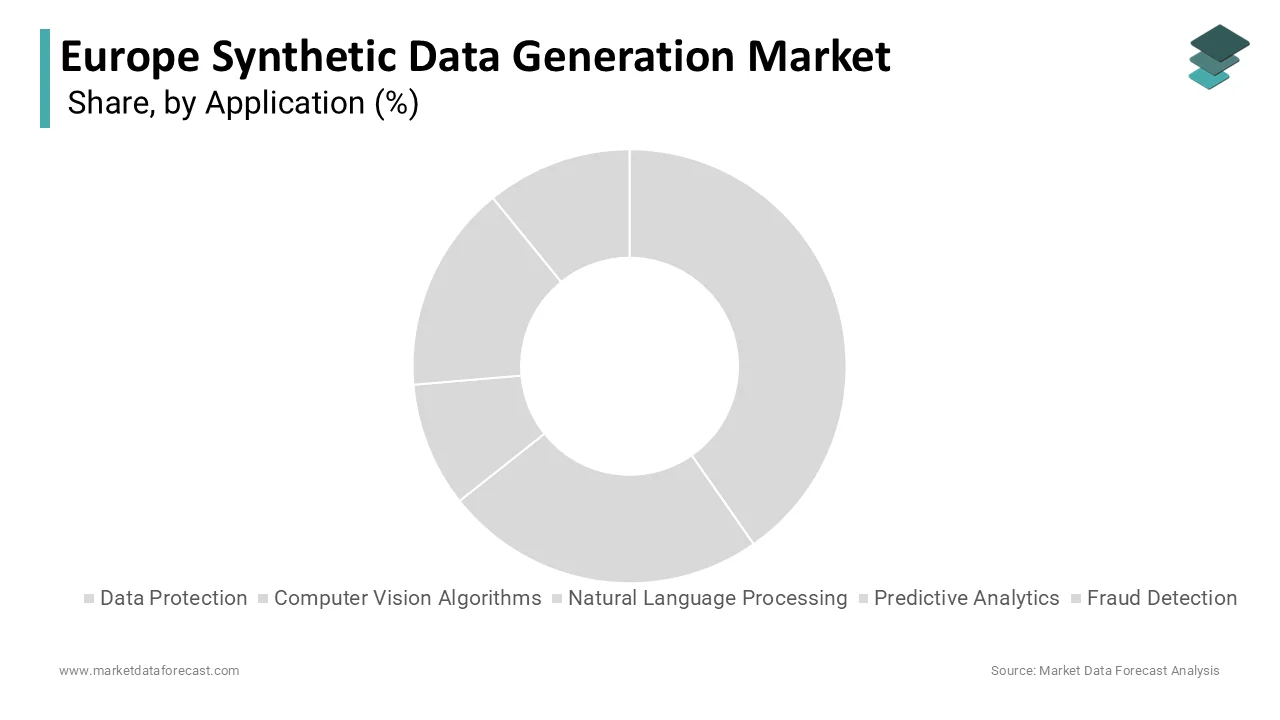
The computer vision algorithms segment is likely to experience the fastest CAGR of 32.7% from 2025 to 2033 due to the high cost and ethical constraints of collecting real-world visual data, especially in sensitive contexts. Autonomous vehicle developers like Germany’s Mercedes-Benz and Sweden’s Volvo use synthetic driving scenarios to simulate rare but critical events, such as jaywalking pedestrians or icy road conditions, without endangering lives. A different driver is regulatory alignment. The EU AI Act classifies biometric identification as high risk, requiring extensive validation under controlled conditions, precisely where synthetic face and gait datasets enable compliant testing. These dual imperatives of safety and legality make synthetic visual data indispensable for next-generation perception systems.
By Offering Insights
The partially synthetic data segment held the majority share of the European synthetic data generation market in 2025. Regulatory acceptance is a key accelerator of the supremacy of the partially synthetic data segment. It strikes a pragmatic balance between statistical fidelity and privacy preservation by selectively replacing only sensitive or sparse attributes while retaining real structural features. Partially synthetic datasets are often favored in official statistics as they help preserve crucial data relationships necessary for analysis while protecting individual privacy. A recent microdata release in Europe modified certain personal identification and location details, yet kept key demographic and employment information intact. This approach allows for meaningful socioeconomic study while reducing the risk of re-identifying individuals. An additional factor is model performance. Predictive models used for analysis that were trained on this type of partially generated data achieved a significant percentage of the accuracy of models trained on completely real information, all while adhering to data protection guidelines. This approach is especially valued in finance and insurance, where rare events like fraud or claims must retain realistic frequency distributions. The method’s empirical reliability and regulatory compatibility ensure its dominance over fully synthetic alternatives in high-stakes domains.
The hybrid synthetic data segment is on the rise and is expected to be the fastest-growing segment in the market by witnessing a CAGR of 36.4% from 2025 to 2033. This model combines real non-sensitive data with synthetically generated sensitive or imbalanced components to optimize both utility and compliance. In healthcare, projects under the European Health Data Space use hybrid data to train diagnostic AI, real anonymized imaging paired with synthetic patient histories to enrich demographic representation. Hybrid datasets have shown effectiveness in improving the identification of rare diseases when compared to alternatives that rely entirely on single types of data. A further driver icross-borderer collaboration. Current international research collaborations increasingly incorporate hybrid data structures to better navigate diverse data privacy regulations across different regions. Europe's diverse data governance needs are best met by hybrid synthesis, a model that flexibly combines reliable data points with nuanced, sensitive data layers.
By Data Type Insights
The tabular data segment dominated theEuropeane synthetic data generation market in 2025. The dominance of the tabular data segment is credited to the maturity of generation techniques. Moreover, its prevalence in enterprise systems, public administration,n and regulated analytics, cs where structured records contain high concentrations of sensitive attributes, also drives the growth of this segment. A significant majority of synthetic data tools are designed to process information in tabular formats. The primary function of these tools is to maintain the underlying statistical relationships between various data columns. These systems utilize specific methodologies, such as marginal distribution fitting and generative adversarial networks, to ensure data consistency. There is a clear pattern of prioritizing structured data types over other formats within the current development of these technologies. Financial institutions rely heavily on synthetic transactions, logs credit s, credit scores, and customer profiles for anti-money laundering and risk modeling without accessing real accounts. A different factor is regulatory focus. Guidelines suggest using synthetic tabular data to assist with internal model validation. This approach is noted for its capacity to simulate infrequent credit events. The use of such data helps maintain privacy by protecting sensitive information. Synthetic datasets provide a method for replicating complex financial patterns without exposing original data. Similarly, national tax agencies in Sweden and the Netherlands use synthetic income datasets for policy simulation. The combination of technical readiness, regulatory endorsement, and high business value ensures tabular data remains the foundational data type in synthetic generation.
The image and video data segment is expected to exhibit a noteworthy CAGR of 38.1% during the forecast period. The rapid expansion of the image and video data segment is fueled by the expansion of computer vision applications in autonomous systems, industrial inspection, and smart infrastructure, re where real visual data collection faces ethical, logistical, tical and scalability barriers. German automotive suppliers like Bosch generate millions of synthetic driving scenarios to train perception systems for level four autonomy under varied weather and lighting conditions, impossible to capture consistently in real life. Besides, the EU AI Act’s restrictions on biometric data have accelerated demand for synthetic faces and body poses for retail analytics and access control testing. These use cases, where realism must coexist with privacy, drive disproportionate investment in generative adversarial networks and diffusion models for visual synthesis.
By End-use Insights
The healthcare and life sciences segment was the largest segment in theEuropeane synthetic data generation market in 2025. The prominence of the healthcare and life sciences segment is attributed to the sector’s acute data sensitivity, regulatory density, innovation urgency, and the European Health Data Space framework,rk which permits secondary use of health data only under strict anonymization conditions that real datasets often fail to meet. A notable increase has been observed in the use of virtual comparison groups within recent studies, particularly to support research in areas with limited patient availability. A further factor is research ethics. Current guidelines for certain research projects involving patient information now suggest the inclusion of virtual alternatives unless specific reasons prevent their use. Institutions routinely generate synthetic electronic health records to train diagnostic algorithms for sepsis or diabetic retinopathy without compromising patient confidentiality. The sector’s combination of high data value,ue stringent privacy rules, and public funding dependency makes it the most consistent and demanding adopter of synthetic data in Europe.
The BFSI segment is predicted to witness the highest CAGR of 34.9% over the forecast period. The swift expansion of the BFSI segment is fuelled by tightening regulatory mandates and the need for robust AI validatiohigh-risk risk financial operations. ING and BNP Paribas now use synthetic transaction streams to simulate economic shocks like recessions or interest rate spikes for stress testing without exposing real customer behavior. An additional driver is cross-border data pooling. Synthetic data is essential for financial institutions aiming to achieve regulatory compliance and drive innovation while navigating the stringent requirements of the Digital Operational Resilience Act (DORA) and the AI Act.
COUNTRY LEVEL ANALYSIS
Germany Synthetic Data Generation Market Analysis
Germany outperformed other countries in the European synthetic data generation market and accounted for a share of 22.6% in 2025. The dominance of the German market is driven by its strong industrial AI adoption, robust data protection culture, and public research investment. The country’s Industry 4.0 initiatives drive demand for synthetic data in manufacturing robotics and autonomous systems. Numerous initiatives within the national platform for artificial intelligence utilize artificial datasets to enhance quality assurance and foresight-based maintenance. Public funding supports the development of technical frameworks for generating artificial data specifically for the transportation and medical sectors. Large-scale research institutions maintain specialized facilities to verify that artificial data maintains high levels of accuracy and data protection for industrial applications. Germany’s strict interpretation of the General Data Protection Regulation further incentivizes enterprises to adopt synthetic alternatives early. This blend of industrial pragmatism, regulatory rigor, and scientific validation cements Germany’s position as the market’s technological and ethical benchmark.
United Kingdom Synthetic Data Generation Market Analysis
The United Kingdom followed closely in theEuropeane synthetic data generation market and captured a 18.4% share in 2025. The growth of the UK market is propelled by its advanced fintech ecosystem, agile regulatory sandbox, and academic leadership in generative modeling. Several financial services firms participated in a program using generated data for various applications, such as simulating fraudulent activities and assessing credit risk. Across the UK, numerous university research centers focus on advanced data techniques, including those at major institutions known for developing new generation methods. The UK’s post Brexit data strategy explicitly endorses synthetic data as a tool for international data adequacy compliance, enabling collaboration with non-EU partners. Additionally, the national health system introduced a system using data that helps speed up the development of artificial intelligence for medical diagnostic tools. This convergence of finance, health,h and research innovation sustains the UK’s dynamic leadership.
France Synthetic Data Generation Market Analysis
France holds a noteworthy position in the European synthetic data generation market because of state led AI strategy, strong public sector digitalization, and leadership in ethical AI governance. The national AI plan in France allocated funding for synthetic data infrastructure, including the establishment of a resource hub for public research. Across various public AI projects, synthetic datasets have been employed to help adhere to the country’s data privacy regulations regarding sensitive information. The national statistics institute has also incorporated synthetic data into its processes, replacing a portion of real census microdata to facilitate broader academic access. France also hosts the European AI Office’s validation unit,t which tests synthetic data quality for AI Act compliance. French institutions are prioritizing synthetic data as a democratic tool for accountable innovation, balancing progress with fundamental rights, as Paris emerges as a key center for AI ethics and regulation.
Netherlands Synthetic Data Generation Market Analysis
The Netherlands grew steadily in the European synthetic data generation market due to its open data culture, advanced digital infrastructure, re and leadership in cross-border data spaces. The Dutch Central Bureau of Statistics released fully synthetic microdata on income and housing, which is now utilized by hundreds of research institutions. The use of synthetic data is required for all publicly funded AI initiatives that involve personal information. The country also hosts the European Digital Innovation Hub for Synthetic Data, which provides SMEs with free generation and validation services. Additionally, Dutch port authorities in Rotterdam use synthetic vessel traffic and cargo data to train AI for logistics optimization without revealing commercial shipping patterns. This commitment to transparency,t responsible data access, supported by high English proficiency and cloud readiness, makes the Netherlands a pivotal enabler opan-Europeanan synthetic data collaboration.
Sweden Synthetic Data Generation Market Analysis
Sweden is predicted to expand in the European synthetic data generation market from 2025 to 2033 due to its progressive data ethics framework, strong public trus,t and leadership in health and mobility AI. The Swedish Ethical Review Authority mandates synthetic alternatives for any research involving identifiable health or biometric data unless exceptional justification is provided. Companies generate synthetic networks and drive data to train 5G and self-driving systems under strict privacy by design principles. Furthermore, Sweden’s national AI initiative AI for Humanity prioritizes synthetic data as a tool for inclusive innovation that avoids bias and exclusion. This combination of ethical foresight, public investment,t and industrial application ensures Sweden punches above its weight in shaping Europe’s responsible data future.
COMPETITIVE LANDSCAPE
Competition in the European synthetic data generation market is defined by a race to establish technical credibility, regulatory alignment, and ethical differentiation in a nascent yet high-stakes environment. The market features a mix of European startups like Hazy and Mostly AI, alongside global entrants such as Gretel AI, each vying to become the trusted standard for privacy-preserving data. Unlike mature software sectors, competition centers less on price and more on verifiable privacy guarantees, auditability ty and domain-specific validation. Regulatory bodies, including national data protection authorities and the European AOfficeic,e actively shape vendor requirements through sandboxes and guidance documents. Success depends on scientific rigor, demonstrable bias mitigation, and seamless integration with existing data science toolchains. While large cloud providers offer basic tools,s specialized vendors lead in high-risk sectors like healthcare and finance, where fidelity and compliaare non-negotiableblee. The market remains fragmented, but consolidation is anticipated as enterprises seek end-to-end responsible AI solutions anchored in trustworthy synthetic data.
KEY MARKET PLAYERS
Some of the companies that are playing a dominating role in the global europe synthetic data generation market include
- Mostly AI
- Hazy
- Mostly AI (Duplicate — see top)
- DataGen (A Merantix Company)
- Tonic.ai
- Mostly Data (European-focused)
- Gretel.ai
- Synthesis AI
- Trafi (AI-driven data generation solutions)
- Zyte (formerly Scrapinghub — synthetic augmentation services)
- AI.Reverie (a Samsung NEXT company)
- Datagen Technologies Ltd.
- YData Labs
- Kinetica (synthetic data modules)
- Datomize
- Statice GmbH
- Gurobi Optimization (data simulation workflows)
- Parallel Domain
- Physics.ai
- Synthesized.io
TOP LEADING PLAYERS IN THE MARKET
- Hazy is a UK-based pioneer in privacy-preserving synthetic data generation that enables enterprises to share and use data without compromising individual confidentiality. The company contributes globally by offering a platform that combines differential privacy, generative modeling, and automated data utility validation tailored for regulated industries. It also integrated its solution with major cloud providers to support seamless deployment in hybrid environments. By prioritizing regulatory alalignment technical transparency,cy and measurable privacy guarantees, Hazy has positioned itself as a trusted partner for organizations seeking compliant data innovation in Europe and beyond.
- Mostly AI is an Austrian headquartered leader in high-fidelity synthetic data solutions with a strong footprint in European healthcare finance and telecommunications. The company contributes to the global market by advancing responsible AI through statistically accurate yet fully anonymous datasets that preserve complex correlations. It also launched an automated bias detection module that flags representation gaps in source and synthetic data. Through deep regulatory engagement and scientific rigor, Mostly AI reinforces synthetic data as a cornerstone of ethical AI development in highly sensitive domains across Europe and internationally.
- Gretel A, I aalthoughhas established a significant European presence through its developer-first approach to synthetic data generation, with strong adoption in research and tech-driven enterprises. The company contributes globally by offeringopen-sourcee and enterprise-grade tools that enable synthetic data creation with built-in privacy metrics and model validation. It also partnered with European Digital Innovation Hubs to provide synthetic data training for SMEs and public sector agencies. By democratizing access through transparent open standards and cloud native deployment, Gretel AI accelerates responsible AI adoption across Europe’s diverse innovation ecosystem.
TOP STRATEGIES USED BY THE KEY MARKET PARTICIPANTS
Key players in the European synthetic data generation market embed regulatory compliance directly into their platforms by integrating GDPR, AI Ac, and sector-specific guidelines into generation workflows. They offer automated validation dashboards that measure statistical fidelity, privacy guarantee,s and bias metrics to build user trust. Companies prioritize data residency by establishing European cloud infrastructure to meet sovereignty requirements. Strategic collaborations with public research bodiese-regulatoryyy sandboxes, and Digital Innovation Hubs enhance credibility and market access. Additionally,y they provide hybrid and partially synthetic data options to balance realism with privacy, allowing customization based on use case sensitivity and legal constraints.
MARKET SEGMENTATION
This research report on the europe synthetic data generation market is segmented and sub-segmented into the following categories.
By Application
- Data Protection
- Computer Vision Algorithms
- Natural Language Processing
- Predictive Analytics
- Fraud Detection
- Others
By Offering
- Partially Synthetic Data
- Fully Synthetic Data
- Hybrid Synthetic Data
By Data Type
- Tabular Data
- Image Data
- Video Data
- Text Data
- Others
By End-use Industry
- Healthcare & Life Sciences
- BFSI
- Automotive
- IT & Telecommunications
- Government & Public Sector
- Retail & E-commerce
- Others
By Country
- Germany
- United Kingdom
- France
- Netherlands
- Sweden
- Rest of Europe