- Product Description Description
- Table of Contents TOC
- List of Table & Figure LOT
- Get Free Sample PDF Sample PDF
Market Size, 2025
$0.53 BnMarket Estimate, 2026
$0.63 BnMarket Forecast, 2034
$2.48 BnCAGR, 2026–2034
18.7%Europe Teleradiology Market Size, Growth, Trends & Forecast (2025–2034)
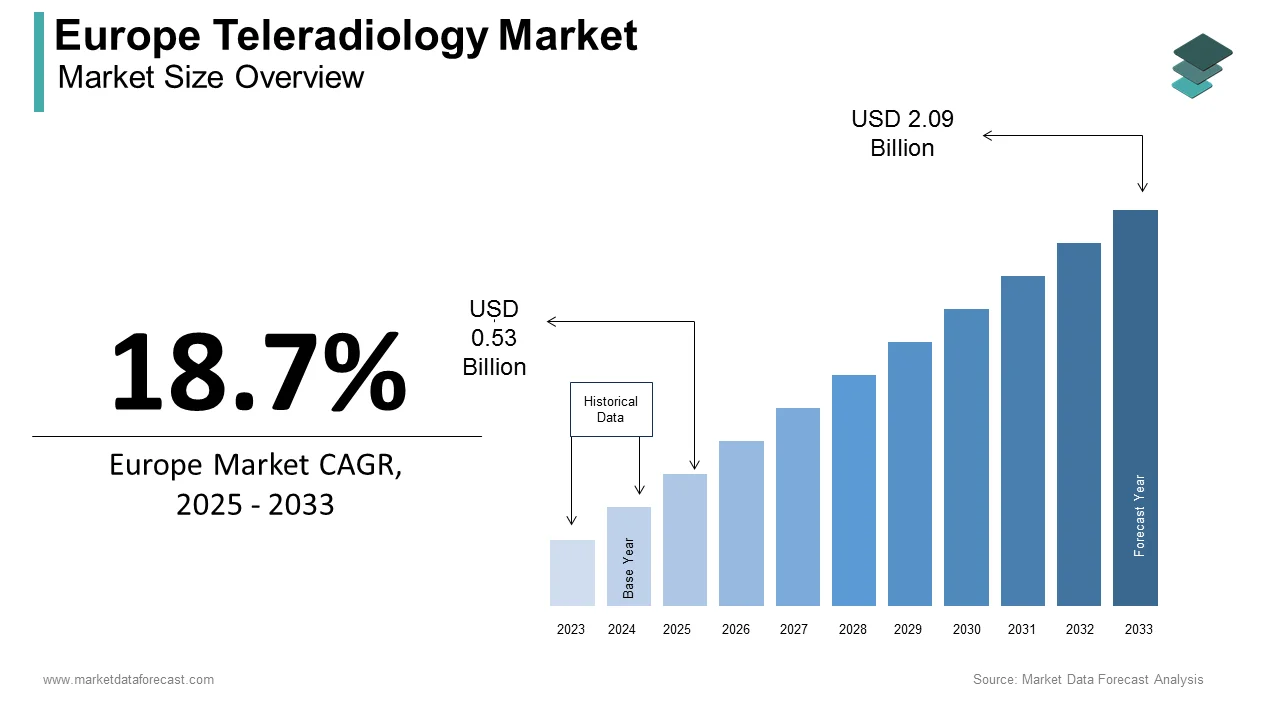
The teleradiology market in Europe was valued at USD 0.53 billion in 2025, is estimated to reach USD 0.63 billion in 2026, and is projected to expand up to USD 2.48 billion by 2034, registering a compound annual growth rate (CAGR) of 18.7% from 2026 to 2034. Driven by a chronic shortage of radiologists, aging populations accelerating diagnostic imaging volumes, and progressive digital health frameworks like the European Health Data Space, the regional market continues to experience rapid integration across hospital networks and emergency care systems.
Key Executive Metrics (At-a-Glance)
- 2025 Base Valuation: USD 0.53 Billion
- 2026 Current Valuation: USD 0.63 Billion
- 2034 Forecast Valuation: USD 2.48 Billion
- Compound Annual Growth Rate (CAGR): 18.7% (2026–2034)
- Dominant Application Segment: Picture Archiving and Communication System (PACS) (holding the largest share in 2024 as the foundational repository and distribution core)
- Fastest-Growing Application Segment: Radiology Information System (RIS) (projected to register the fastest CAGR of 12.4% driven by administrative and clinical workflow automation)
- Dominant Modality Segment: Computed Tomography (capturing a 34.7% share in 2024 due to high volume, emergency, and oncology diagnostic demands)
- Fastest-Growing Modality Segment: Magnetic Resonance Imaging (anticipating a leading CAGR of 13.8% from 2025 to 2033 propelled by advanced soft tissue contrast and compressed sensing)
- Dominant Technology Solutions Segment: Cloud-Based Teleradiology Solutions (accounting for a 61.5% share in 2024 by ensuring scalable, secure access without heavy on-premises overhead)
- Fastest-Growing Technology Solutions Segment: Web-Based Teleradiology Solutions (expanding at a leading CAGR of 15.2% due to zero-install demands in resource-limited and mobile settings)
- Dominant Country: Germany (capturing a 24.6% market share in 2024 supported by mature after-hours networks and reimbursement equity)
Core Market Drivers
- Radiologist Workforce Shortages: Persistent staffing deficits across European healthcare systems necessitating remote interpretation and 24/7 emergency coverage models.
- Surging Imaging Volumes: Aging demographic patterns and expanded cancer screening initiatives driving heavy diagnostic workloads that overwhelm in-house hospital capacities.
Primary Market Restraints & Challenges
- Cross-Border Regulatory Friction: Fragmented data protection interpretations under GDPR and strict compliance burdens that hinder seamless multi-country service deployments.
- Legacy System Incompatibilities: Outdated hospital PACS and limited system interoperability causing manual processing delays and workflow bottlenecks.
Europe Teleradiology Market Segmentation Breakdown
| Segment Category | Leading Sub-Segment | Fastest-Growing Sub-Segment |
|---|---|---|
| By Application | Picture Archiving and Communication System (PACS) (core repository and integration backbone) | Radiology Information System (RIS) (12.4% CAGR driven by automated workflow orchestration) |
| By Modality | Computed Tomography (34.7% share in 2024; vital for trauma, stroke, and emergency diagnostics) | Magnetic Resonance Imaging (13.8% CAGR from 2025 to 2033 powered by accelerated scan methods) |
| By Technology Solutions | Cloud-Based Teleradiology Solutions (61.5% share in 2024 offering scalable infrastructure) | Web-Based Teleradiology Solutions (15.2% CAGR driven by lightweight, mobile care access) |
| By Country | Germany (24.6% share in 2024 anchored by mature networks and parity reimbursement) | France (fastest-growing due to national digital health strategies and Ségur du numérique upgrades) |
Major Industry Players Profiled
Key enterprises shaping the competitive Europe teleradiology market include 4ways Healthcare Limited, RamSoft, Inc., Virtual Radiologic (vRAD), Agfa-Gevaert N.V., ONARD, Europe Diagnostics, Everlight Radiology, Sectra AB, Health Watch Tele Diagnostics Pvt. Ltd., TeleDiagnos, Medica Reporting, and Teleradiology Solutions Europe.
Europe Teleradiology Market Size
The teleradiology market in Europe was valued at USD 0.53 billion in 2025. The European market is further anticipated to grow at a CAGR of 18.7% from 2026 to 2034 and be worth USD 2.48 billion by 2034 from USD 0.63 billion in 2026.
Teleradiology refers to the digital diagnostic imaging services wherein radiological data, such as X-rays, CT scans, and MRIs, are transmitted securely across geographic locations for interpretation by specialized radiologists. This model addresses important gaps in radiology workforce availability and enables 24/7 diagnostic coverage, particularly in rural and underserved regions. The European Society of Radiology (ESR) drew attention to radiologist shortages, notably through the EU-REST project, showing that many nations function below safe manpower thresholds. As per Eurostat, delays and disparities in healthcare access exist between urban and rural areas in the EU. The Digital Europe Programme is providing funding for health data infrastructure, including for the European Health Data Space (EHDS). Furthermore, the EU Medical Devices Regulation mandates stringent cybersecurity and data integrity protocols for all digital health services, including teleradiology workflows. These regulatory and demographic dynamics position teleradiology not merely as a technological convenience but as a structural necessity for equitable and timely diagnostic care across the continent.
MARKET DRIVERS
Chronic Shortage of Radiologists Across European Healthcare Systems
A deepening deficit in radiology professionals that directly fuels demand for teleradiology services as a compensatory mechanism, and this influences the growth of the Europe teleradiology market. As per research, the availability of radiologists across the European Union varies significantly, with some nations facing considerable shortages compared to others. According to sources, the expected retirement trend among radiology professionals may exceed the rate of new entrants in the coming years if no corrective measures are taken. As per research, several hospitals in Germany are experiencing staffing challenges that impact service coverage in diagnostic departments. According to sources, France has increasingly adopted teleradiology solutions to manage nighttime diagnostic workloads and shorten report turnaround times. Hospitals in Sweden have also integrated remote radiology services into their national emergency systems, ensuring timely evaluation of critical scans regardless of hospital capacity, as per research. This workforce crisis is not transient but structural, making teleradiology an indispensable operational layer in modern diagnostic pathways.
Rising Volume of Medical Imaging Procedures Driven by Aging Populations
The exponential increase in diagnostic imaging demand is mainly propelled by demographic aging and the associated rise in chronic conditions requiring radiological monitoring, which in turn accelerates the expansion of the Europe teleradiology market. As per Eurostat, 21.3 percent of the EU population was aged 65 or older in 2023, a figure projected to increase by 2050. Older adults undergo imaging at significantly higher rates. Similarly, cancer screening programs have expanded. This surge overwhelms in-house radiology capacit,y particularly in district hospita,ls prompting reliance on external teleradiology providers for timely interpretation. The effectiveness of early intervention across multiple disease domains is severely compromised by diagnostic backlogs when scalable remote reading solutions are unavailable.
MARKET RESTRAINTS
Fragmented Data Protection and Cross-Border Regulatory Compliance
Significant national variations in implementation create operational friction for teleradiology providers, which restricts the growth of the Europe teleradiology market. The European Court of Justice ruling in 2023 clarified that medical imaging constitutes “special category data” under GDPR Article 9, heightening compliance burdens. These regulatory complexities delay service deployment and deter smaller providers from entering multi-country markets, thereby limiting competition and innovation in cross-border diagnostic networks.
Limited Interoperability of Legacy Hospital Imaging Systems
Many European healthcare institutions continue to operate on outdated Picture Archiving and Communication Systems, and this restricts the expansion of the Europe teleradiology market. It lacks standardized interfaces and hinders seamless integration with modern teleradiology platforms. Many hospitals across Southern and Eastern Europe continue to rely on older imaging systems that lack compatibility with modern data-sharing standards, according to sources. Even in advanced systems like the UK’s NHS Digital infrastructure, regional trusts use incompatible vendor ecosystems, causing workflow barriers. Research from a European university highlighted that limited interoperability among hospital systems often leads to delays in teleradiology reporting due to additional manual processing requirements, as per research. Legacy system modernization will continue to hinder efficient teleradiology adoption in the EU until the Integrating the Healthcare Enterprise (IHE) framework is more widely adopted.
MARKET OPPORTUNITIES
Integration of Artificial Intelligence for Preliminary Image Triage
The incorporation of artificial intelligence algorithms stands as a potential opportunity for the growth of the Europe teleradiology market. This is likely to enhance diagnostic throughput and prioritization accuracy. According to studies, many AI-based imaging software tools received CE marking between 2021–2023 through the standard European regulatory process, which involves manufacturers and independent Notified Bodies. These algorithms do not replace radiologists but act as force multipliers, enabling human experts to focus on complex cases. The EU AI Act has created a clear regulatory path for scaled adoption by classifying these tools as high-risk while still allowing clinical use under strict oversight. This synergy between human expertise and machine efficiency can significantly alleviate diagnostic delay, especially in emergency and stroke imaging.
Expansion of Cross-Border Diagnostic Networks Under the EHDS Framework
The European Health Data Space initiative creates a structured legal and technical foundation for the secure exchange of medical imaging data across nations. This will unlock new models of collaborative diagnostics and give the European teleradiology market new opportunities for expansion. The EHDS also allocates funding for common data dictionaries and imaging metadata standards, ensuring semantic consistency. For rare disease diagnosis, this is particularly impactful as specialists in one country can access cases from across the bloc, increasing diagnostic yield. This policy-driven interoperability transforms teleradiology from a national contingency into a pan-European diagnostic utility.
MARKET CHALLENGES
Persistent Reimbursement Inconsistencies Across National Health Systems
Uncertain and fragmented reimbursement mechanisms across European countries are affecting financial sustainability, which restricts the growth of the Europe teleradiology market. Several European countries have introduced dedicated billing frameworks for remote radiology services, while others continue to include them under broader medical consultation categories, according to sources. Across Europe, many teleradiology companies view inconsistent reimbursement policies as a major obstacle to expanding into new markets, as per research. The economic model for remote diagnostics is unstable and at risk until the labor involved is valued consistently. This fiscal fragmentation contradicts the EU’s goal of equitable access and stalls investment in scalable diagnostic infrastructure.
Cybersecurity Vulnerabilities in Cloud-Based Imaging Platforms
Cybersecurity risks threaten patient privacy and diagnostic integrity, which further affects the expansion of the Europe teleradiology market. The EU’s NIS2 Directive requires teleradiology operators to implement zero trust architectures and conduct biannual penetration testing, but compliance costs annually for mid-sized firms. Furthermore, the integration of third-party AI tools expands the attack surface, as the German Federal Office for Information Security (BSI) published a Practical AI-Security Guide in March 2023, which focuses on the security of AI systems. The digital transformation of radiology will remain susceptible to damaging security breaches, which would erode both clinician and patient trust, as long as robust and standardized cybersecurity protocols are not universally enforced.
REPORT COVERAGE
| REPORT METRIC | DETAILS |
| Market Size Available | 2025 to 2034 |
| Base Year | 2025 |
| Forecast Period | 2026 to 2034 |
| Segments Covered | By Application, Modality, Technology Solutions, and country. |
| Various Analyses Covered | Global, Regional, and Country-Level Analysis, Segment-Level Analysis, Drivers, Restraints, Opportunities, Challenges; PESTLE Analysis; Porter’s Five Forces Analysis, Competitive Landscape, Analyst Overview of Investment Opportunities |
| Countries Covered | UK, France, Spain, Germany, Italy, Russia, Sweden, Denmark, Switzerland, Netherlands, Turkey, Czech Republic, and the Rest of Europe. |
| Market Leaders Profiled | 4ways Healthcare Limited, RamSoft, Inc., Virtual Radiologic (vRAD), Agfa-Gevaert N.V., ONARD, Europe Diagnostics, Everlight Radiology, Sectra AB, and Health Watch Tele Diagnostics Pvt. Ltd. |
SEGMENT ANALYSIS
By Application Insights
The PACS segment held the largest share of the Europe Teleradiology Market in 2024. The dominance of the Picture Archiving and Communication System (PACS) is attributed to its foundational role as the digital repository and distribution backbone for all medical imaging workflows. The system’s integration with hospital electronic health records ensures that clinical context accompanies imaging studies, enhancing diagnostic accuracy. Furthermore, PACS supports advanced functionalities such as hanging protocols and AI algorithm integration, which are important for high-volume teleradiology operations. These operational efficiencies and regulatory tailwinds strengthen PACS as the indispensable core of modern teleradiology infrastructure.
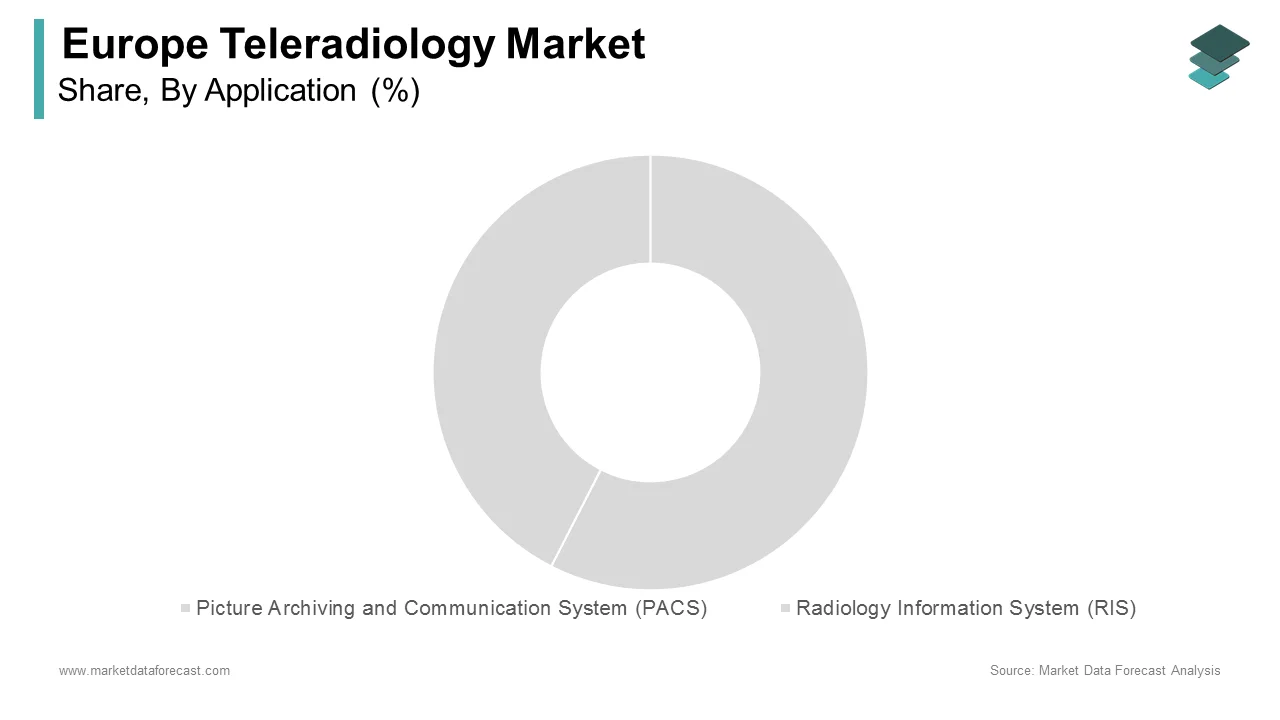
The Radiology Information System segment is estimated to register the fastest CAGR of 12.4% during the forecast period. The rapid expansion of the Radiology Information System segment is driven by the urgent need to automate administrative and clinical coordination in imaging departments overwhelmed by rising case volumes. The challenges in managing scheduling, reporting, and billing that result from high volumes of imaging studies are real and correctly described. RIS platforms address this by digitizing the workflow from referral to final report with integrated decision support. Besides, RIS incorporates AI-driven prioritization engines that flag urgent cases for immediate interpretation, reducing time to diagnosis in stroke and trauma. The market is transitioning from back office utility to strategic clinical orchestrator.
By Modality Insights
In 2024, the computed tomography segment was the top performer in the Europe Teleradiology Market and captured a 34.7% share in 2024. The prominence of the computed tomography segment is because of CT’s important role in emergency diagnostics, oncology, and cardiovascular assessment where rapid interpretation directly impacts survival outcomes. A large number of CT scans are performed across the European Union each year, with many taking place outside of regular working hours when onsite radiologists are limited, as per research. In several countries, national guidelines for stroke management require immediate interpretation of CT images, a goal increasingly supported by remote diagnostic networks, according to sources. Most major trauma centers in Europe now depend on teleradiology services for emergency imaging review during nights and weekends, as per research. The ongoing expansion of preventive screening programs such as those for lung cancer is expected to substantially increase imaging volumes in the coming years, according to sources. CT’s high information density and time sensitivity make it the most teleradiology-dependent modality in clinical practice.
The magnetic resonance imaging segment is anticipated to witness the fastest CAGR of 13.8% from 2025 to 2033, owing to the rising use of MRI in neurological, oncological, and musculoskeletal diagnostics, where superior soft tissue contrast is irreplaceable. Furthermore, AI-powered acceleration techniques such as compressed sensing have reduced scan times, which makes MRI more accessible and increases study throughput. The European Reference Networks for rare diseases rely heavily on centralized MRI interpretation, with a number of cross-border cases processed, as per sources. These clinical and technological advances position MRI as the highest growth imaging modality in remote diagnostics.
By Technology Solutions Insights
The cloud-based teleradiology solutions segment led the cloud-based teleradiology solutions segment by accounting for 61.5% share in 2024. The growth of the cloud-based teleradiology solutions segment is propelled by the cloud’s ability to deliver scalable, secure, and cost-efficient access to imaging data without requiring hospitals to maintain on-premises infrastructure. Cloud solutions also enable seamless integration of AI tools. Furthermore, the pay-as-you-go model reduces capital expenditure for small and medium hospitals, particularly in Southern Europe, where public health budgets remain constrained. These economic and regulatory advantages have made the cloud the default deployment model for modern teleradiology.
The Web-Based Teleradiology Solutions segment is likely to experience the fastest CAGR of 15.2% during the forecast period due to the urgent need for lightweight, zero-install access to imaging studies in resource-limited and mobile care settings. According to findings in WHO Europe reports, many primary care clinics in rural regions lack a full PACS but still require occasional specialist imaging input to support diagnosis. In Sweden, telemedicine programs have implemented web-based teleradiology modules to serve rural health centers, which have been shown to reduce referral delays. This accessibility makes web-based solutions the fastest-growing segment for decentralized care.
COUNTRY LEVEL ANALYSIS
Germany Teleradiology Market Analysis
Germany dominated the Europe Teleradiology Market by accounted for 24.6% share in 2024. Advanced digital health infrastructure and stringent diagnostic quality standards have significantly contributed to the domination of Germany in the regional market. The country operates one of Europe’s most mature after-hours teleradiology networks, with a portion of district hospitals outsourcing night coverage to certified providers, as per sources. Statutory health insurance reimburses remote reads at parity with in-house interpretation, creating a sustainable economic model. Furthermore, Germany leads in AI integration. The combination of regulatory foresight, reimbursement equity, and technological adoption ensures Germany’s continued dominance in diagnostic innovation.
United Kingdom Teleradiology Market Analysis
The United Kingdom is closely following in the Europe Teleradiology Market. The region captured 18.3% of the regional market share in 2024 due to systemic radiologist shortages and centralized digital transformation. The UK also pioneered the use of teleradiology in mobile stroke units with real-time CT interpretation, enabling thrombolysis within minutes of symptom onset. Despite Brexit, the country maintains alignment with EU data standards through the UK GDPR, ensuring cross-border data flow continuity. These structural and operational factors sustain the UK’s robust market position.
France Teleradiology Market Analysis
France is anticipated to be the fastest-growing region in the Europe Teleradiology Market owing to strong government-led digital health initiatives and regional coordination. As per France's national digital health strategy, the Dossier Médical Partagé (DMP) has seen increased adoption in recent years after being integrated into the "Mon espace santé" digital space in 2022. The Ma Santé 2022 strategy included efforts to modernize healthcare IT, but a later component of the national digital health strategy, the Ségur du numérique en santé, allocated significant funding to upgrade medical imaging software, including RIS and PACS, with a focus on interoperability. France operates a unique cooperative model where university hospital radiologists provide remote reads for peripheral clinics. Apart from these, the country leads in pediatric teleradiology. The combination of top-down policy and bottom-up collaboration creates a resilient and equitable diagnostic ecosystem.
Italy Teleradiology Market Analysis
Italy is moving ahead steadfastly in the Europe Teleradiology Market. The growth of Italy is because to stark North-South healthcare disparities and innovative public-private partnerships. In Italy, a shortage of radiologists in the southern regions continues to create significant gaps in imaging interpretation services, according to sources. To help balance access, the national health authorities have introduced a country-wide teleradiology initiative linking regional hospitals with larger academic centers, as per research. In Lombardy, private providers are increasingly supporting emergency imaging operations through contractual partnerships with hospitals, according to sources. Italy also pioneered the use of teleradiology in disaster response, deploying mobile units with real-time image transmission to trauma centers. These adaptive models demonstrate how teleradiology can bridge geographic inequities in complex health systems.
Sweden Teleradiology Market Analysis
Sweden is likely to grow in the Europe Teleradiology Market due to its prominence in integrated digital health and equitable care delivery. The country operates a fully centralized emergency teleradiology service where all after-hours CT and MRI studies from rural hospitals are interpreted by specialists in Stockholm, Gothenburg, or Malmö within minutes, as per statutes. Sweden also leads in sustainability with its cloud teleradiology platform powered entirely by renewable energy, reducing carbon emissions annually. Sweden’s combination of standardization, innovation, and environmental responsibility sets a benchmark for the continent.
COMPETITIVE LANDSCAPE
The competition in the Europe Teleradiology Market is defined by a mix of specialized regional providers and global players vying for contracts with public health systems and private imaging networks. Differentiation occurs not through pricing but through clinical quality, cybersecurity compliance, subspecialty depth, and integration capabilities with national digital health infrastructures. Regulatory alignment with the EU Medical Devices Regulation, NIS2 Directive, and GDPR creates high entry barriers, favoring established entities with robust compliance frameworks. The market lacks price-based competition as reimbursement is often fixed by national health authorities, emphasizing service reliability and turnaround time. Innovation in AI integration workflow automation and cross-border data exchange under the European Health Data Space further intensifies rivalry among top-tier providers. Smaller firms compete through niche expertise, such as pediatric or cardiac imaging, while larger players leverage scale and multilingual reporting. Despite moderate consolidation, the market remains dynamic due to continuous technological evolution and policy-driven demand for equitable diagnostic access across urban and rural settings.
KEY MARKET PLAYERS
Some of the companies that are playing a dominating role in the Europe teleradiology market include
- 4ways Healthcare Limited
- RamSoft, Inc.
- Virtual Radiologic (vRAD)
- Agfa-Gevaert N.V.
- ONARD
- Europe Diagnostics
- Everlight Radiology
- Sectra AB
- Health Watch Tele Diagnostics Pvt. Ltd.
Top Players in the Europe Teleradiology Market
- TeleDiagnos is a leading European teleradiology provider headquartered in the Netherlands and offers diagnostic services across multiple imaging modalities. The company serves hospitals and imaging centers in many European countries with a network of board-certified radiologists specializing in emergency neuroradiology and musculoskeletal imaging. TeleDiagnos contributes to the global market by setting clinical quality benchmarks and participating in international AI validation studies. Recently, the company launched a GDPR compliant cloud platform with integrated AI triage tools for stroke and pulmonary embolism detection, enhancing turnaround times for critical cases.
- Medica Reporting is a UK-based teleradiology specialist with a strong presence across Western and Northern Europe, providing subspecialty reads in oncology, neurology, and pediatric imaging. The company plays a significant role globally by partnering with national health systems to address radiologist shortages through scalable remote interpretation models. These initiatives support its reputation as a trusted partner for public healthcare institutions seeking secure and reliable diagnostic support.
- Teleradiology Solutions Europe is the European arm of a global teleradiology enterprise with operational hubs in Germany and Spain. It delivers high-volume reporting services with a focus on emergency and trauma imaging for public hospitals and private clinics. The company contributes to the global market by harmonizing diagnostic protocols across continents and facilitating knowledge exchange between radiologists in Europe, Asia, and North America.
Top Strategies Used by the Key Market Participants
Key players in the Europe Teleradiology Market pursue several strategic imperatives to strengthen their operational resilience and clinical credibility. These include investing in cloud native and web-based platforms that ensure seamless integration with hospital PACS and compliance with GDPR and NIS2 cybersecurity mandates. Companies actively incorporate CE-marked AI algorithms for preliminary triage to enhance diagnostic speed without compromising accuracy. Strategic partnerships with national health authorities enable participation in public tenders and emergency response frameworks. Workforce development through continuous medical education and subspecialty certification maintains high interpretation quality across distributed radiologist networks. Besides, firms prioritize interoperability by adopting HL7 FHIR and DICOMweb standards to support the European Health Data Space vision. These strategies collectively address the dual demands of regulatory rigor and clinical scalability in a fragmented yet evolving healthcare landscape.
MARKET SEGMENTATION
This research report on the Europe teleradiology market has been segmented and sub-segmented into the following categories.
By Application
- Picture Archiving and Communication System (PACS)
- Radiology Information System (RIS)
By Modality
- X-Ray
- Magnetic Resonance Imaging
- Computed Tomography
- Ultrasound Systems
- Nuclear Imaging
By Technology Solutions
- Web-Based Teleradiology Solutions
- Cloud-Based Teleradiology Solutions
By Country
- UK
- France
- Spain
- Germany
- Italy
- Russia
- Sweden
- Denmark
- Switzerland
- Netherlands
- Turkey
- Czech Republic
- Rest of Europe