- Product Description Description
- Table of Contents TOC
- List of Table & Figure LOT
- Get Free Sample PDF Sample PDF
Market Size, 2025
$0.72 BnMarket Estimate, 2026
$0.75 BnMarket Forecast, 2034
$1.06 BnCAGR, 2026–2034
4.41%Europe Testosterone Replacement Therapy Market Report Summary
The Europe Testosterone Replacement Therapy Market was valued at USD 0.69 billion in 2024, is estimated to reach USD 0.72 billion in 2025, and is projected to reach USD 1.02 billion by 2033, growing at a CAGR of 4.41% during the forecast period (2025–2033).Market growth is fueled by I ncreasing incidences of testosterone deficiency, growing acceptance of hormone replacement therapy among men, and the introduction of novel, patient-friendly testosterone formulations. The rising geriatric male population and advancements in sustained-release delivery systems are further boosting market expansion across Europe.
Moreover, strong clinical awareness programs, evolving prescribing practices, and expanding access to endocrinology and urology care are promoting early diagnosis and long-term management of hypogonadism.
Key Market Trends
- Rising Prevalence of Hypogonadism: Growing recognition of testosterone deficiency in aging and younger males is expanding therapeutic demand.
- Advancements in Drug Delivery Systems: The introduction of long-acting injectables and transdermal systems enhances compliance and reduces side effects.
- Increased Use of AI in Diagnosis: AI and digital biomarkers are improving early detection and treatment personalization in testosterone therapy.
- Awareness and Screening Programs: Public health campaigns and men’s wellness programs are raising awareness of testosterone-related health conditions.
- Emergence of Biosimilar Hormone Therapies: Pharmaceutical innovation and patent expirations are encouraging the entry of cost-effective biosimilar formulations.
- Regulatory Support: European health authorities continue to strengthen clinical guidelines for safe hormone therapy monitoring and dosage optimization.
Segmental Analysis
By Product Type Insights
- The injections segment dominated the European TRT market in 2024, holding a 42.3% share.
- Injectable formulations are preferred for their fast onset of action, predictable absorption, and longer dosing intervals, which reduce patient non-compliance.
- Ongoing innovation in sustained-release and extended-acting injectables is expected to reinforce this segment’s dominance through 2033.
By Active Ingredient Insights
- The active ingredient segment accounted for 38.3% of the market in 2024, driven by the growing use of testosterone enanthate, undecanoate, and cypionate.
- These formulations remain the standard for TRT due to their clinically proven efficacy, bioavailability, and favorable safety profiles.
- Increasing investments in bioidentical hormone therapies and precision dosing technologies are expanding treatment options for endocrinologists.
Regional Analysis
- Germany led the European testosterone replacement therapy market in 2024, accounting for 2% of total share, driven by high diagnosis rates, strong clinical research infrastructure, and widespread access to endocrinology services.
- France followed, holding a 3% share, supported by well-established healthcare systems, reimbursement structures, and early adoption of transdermal and injectable therapies.
- The United Kingdom market is expected to grow steadily, supported by integrated care pathways, robust epidemiological surveillance, and rising awareness about men’s hormonal health.
- Italy presents significant growth potential due to the high prevalence of late-onset hypogonadism and an expanding network of specialized tertiary care centers focusing on hormone-related disorders.
- Spain is likely to experience strong market expansion throughout the forecast period, driven by rising patient education, updated clinical guidelines, and greater accessibility to TRT medications through public health channels.
Competitive Landscape
The Europe Testosterone Replacement Therapy Market is moderately consolidated, with major multinational pharmaceutical companies leading innovation in hormone delivery and bioavailability enhancement. Companies are focusing on long-acting formulations, patient-centric therapies, and strategic partnerships with endocrinology clinics to enhance regional access. Additionally, clinical research in testosterone undecanoate microsphere formulations and AI-assisted dosage monitoring is accelerating therapeutic advancement. Some of the companies that are playing a dominating role in the global Europe Testosterone Replacement Therapy Market include:
Pfizer Inc., Allergan Plc., AbbVie Inc., Bayer AG, Eli Lilly and Company, Endo Pharmaceuticals, Kyowa Kirin International Plc., Novartis AG, and Mylan N.V
Europe Testosterone Replacement Therapy Market Size
The europe testosterone replacement therapy market was valued at USD 0.72 billion in 2025. is expected to have a 4.41 % CAGR from 2026 to 2034 and be worth USD 1.06 billion by 2034 from USD 0.75 billion in 2026.

Testosterone Replacement Therapy refers to medical interventions designed to restore physiological testosterone levels in men diagnosed with hypogonadism or age-related testosterone deficiency. In Europe, this therapeutic approach encompasses a range of formulations, including gels, injections, patches, and pellets, administered under clinical supervision. The growing recognition of late-onset hypogonadism as a clinically significant condition has intensified diagnostic and treatment efforts across European healthcare systems. As per the World Health Organization, in Europe, the proportion of men over 65 is projected to reach 27% of the total male population by 2030, which promotes the demographic impetus behind rising clinical demand. Endocrinological societies across Germany, France, and the United Kingdom have increasingly integrated testosterone assessment into routine men’s health screening,,s which reflects a paradigm shift toward proactive hormonal health management.
MARKET DRIVERS
Increasing Prevalence of Hypogonadism Linked to Aging and Chronic Disease Burden
The rising incidence of testosterone deficiency driven by Europe’s aging male population and the expanding burden of metabolic and cardiovascular comorbidities is the primary factor boosting the growth of Europe's testosterone replacement therapy market. Furthermore, chronic conditions such as type 2 diabetes and obesity, which impair the hypothalamic pituitary gonadal axis function, are highly prevalent across the region. Similarly, as per the World Health Organization Europe, 59% of adult males in the region are overweight or obese,se a condition strongly correlated with reduced total and free testosterone concentrations.
Heightened Awareness and Improved Diagnostic Protocols for Male Hormonal Health
The growing emphasis on men’s health initiatives and the standardization of testosterone deficiency diagnostics across European clinical guidelines is also propelling the growth of the European testosterone replacement therapy market. National endocrine societies, including the French Society of Endocrinology and the British Society for Paediatric and Adolescent Endocrinology and Diabetes, have updated diagnostic criteria to incorporate both symptomatic evaluation and repeated serum testosterone measurements. Patient advocacy campaigns by organizations such as the European Men’s Health Forum have further destigmatized hormonal disorders, leading to a 22% increase in voluntary testosterone testing among men aged 40 to 65 between 2020 and 2025, as per data from the European Health Interview Survey. Additionally, the integration of electronic health records in primary care settings has facilitated systematic identification of at-risk patients through automated alerts for low-energy mood disturbances or osteopenia, which are recognized clinical indicators of androgen deficiency. This institutionalized approach to hormonal assessment not only enhances case detection rates but also creates sustained referral pathways to endocrinologists and urologists, thereby reinforcing therapeutic uptake across the continent.
MARKET RESTRAINTS
Stringent Regulatory Requirements and Safety Concerns Limiting Product Approvals
Regulatory scrutiny surrounding the cardiovascular and prostatic safety profile is degrading the growth European testosterone replacement therapy market. The European Medicines Agency maintains a cautious stance requiring extensive post-marketing surveillance for all androgen formulations, particularly regarding thromboembolic events and prostate cancer risk. Clinical studies cited by the European Society of Cardiology indicate that men with pre-existing heart disease who receive exogenous testosterone may face a 26% higher relative risk of major adverse cardiac events within the first six months of treatment. This has prompted national regulators such as Germany’s Federal Institute for Drugs and Medical Devices to mandate black box warnings and restrict prescriptions to confirmed hypogonadism cases verified through repeated laboratory testing. Moreover, the lack of harmonized reimbursement criteria across member states complicates market access, with countries like France imposing strict prior authorization protocols that delay patient initiation.
Persistent Stigma and Misconceptions Surrounding Hormonal Therapy in Male Populations
Cultural perceptions and lingering misconceptions about testosterone therapy as a performance-enhancing or vanity-driven intervention continue to impede widespread acceptance among both patients and primary care providers. This factor is also hampering the growth of the European testosterone replacement therapy market. This misperception discourages help-seeking behavior, with only 31% of symptomatic men in Poland, nd Romania, and Greece consulting a physician about low energy or reduced libido. Additionally, primary care physicians in these regions often lack specialized training in endocrinology, leading to underdiagnosis or inappropriate referral patterns.
MARKET OPPORTUNITIES
Expansion of Telemedicine and Digital Health Platforms for Hormonal Management
The integration of telehealth services and digital monitoring tools presents a compelling opportunity to broaden access to testosterone replacement therapy across diverse European geographies, which is creating new opportunities for the growth European testosterone replacement therapy market. Startups such as Germany’s Homed and Spain’s SaludOnce now offer endocrinologist-led remote evaluations and t-home testosterone testing kits with CLIA-certified lab partnerships, enabling diagnosis without in-person visits. These platforms also incorporate AI-driven symptom trackers and medication adherence modules, which enhance treatment continuity and reduce dropout rates. In countries with sparse endocrinology resources, such as Bulgaria and Latvia, via such digital solutions, bridge critical care gaps while complying with EU data privacy standards under the General Data Protection Regulation. Furthermore, reimbursement codes for remote hormonal monitoring have been adopted in France and the Netherlands, creating sustainable business models for digital health providers.
Development of Novel Transdermal and Long-Acting Delivery Systems
Innovation in drug delivery technologies, particularly non-invasive transdermal and extended release parenteral formulations, offers significant untapped potential for market differentiation and patient adherence improvement. This is likely to further fuel the growth of the European testosterone replacement therapy market. Traditional testosterone gels face limitations due to skin irritation and transfer risk, yet next-generation microneedle patches and lipid nanoparticle-based sprays are demonstrating enhanced bioavailability and user satisfaction in European clinical trials. Notably, a quarterly subcutaneous implant developed by a Swiss biotech firm achieved 92% patient retention over 12 months in a multicenter study across Germany, BelgiuAustriaustriaa, as published in the journal Andrology. Moreover, long-acting formulations align with European healthcare priorities of reducing frequent clinic visits and minimizing treatment burden for aging populations.
MARKET CHALLENGES
Diagnostic Ambiguity and Lack of Standardized Testosterone Thresholds
The absence of universally accepted diagnostic thresholds for testosterone deficiency, which leads to inconsistent clinical identification and treatment eligibility, is a challenging factor for the growth of Europe and the testosterone replacement therapy market. Although the European Academy of Andrology recommends a total testosterone cutoff of 12 nmol/L for diagnosing hypogonadism, significant variation persists across national guidelines, with thresholds ranging from 8 to 15nmol/Lin countries such as Italy, Spain, and Sweden. This methodological inconsistency results in both false negatives and inappropriate exclusions from therapy. Furthermore, symptoms of low testosterone, such as fatigue and mood changes, overlap extensively with depression, chronic fatigue syndrome, and thyroid disorders, complicating differential diagnosis.
Reimbursement Heterogeneity and Economic Pressures on Public Health Systems
Substantial disparities in reimbursement policies and budgetary constraints within national healthcare systems are one of the challenges for the European Testosterone Replacement Therapy Market growth. While Germany and the Netherlands provide broad coverage for medically indicated testosterone therapy, countries such as Greece,e, Portugal, and Croatia restrict reimbursement to severe primary hypogonadism confirmed by pituitary imaging and repeated hormone assays. The economic burden of aging populations further intensifies fiscal caution, with the European Commission projecting that public health expenditure as a share of GDP will rise from 8.8% in 2023 to 11.2% by 2035. The hormonal therapies for non-life-threatening conditions often undergo rigorous health technology assessments that delay or deny coverage. For instance, Italy’s National Medicines Agency recently downgraded testosterone undecanoate from Class A to Class C reimbursement, citing uinsufficientevidenceevidenceng-termuality of long-term life improvement.
REPORT COVERAGE
| REPORT METRIC | DETAILS |
| Market Size Available | 2025 to 2034 |
| Base Year | 2025 |
| Forecast Period | 2026 to 2034 |
| Segments Covered | By Product Type, Active Ingredient, and Region. |
| Various Analyses Covered | Global, Regional, and Country-Level Analysis, Segment-Level Analysis, Drivers, Restraints, Opportunities, Challenges; PESTLE Analysis; Porter’s Five Forces Analysis, Competitive Landscape, Analyst Overview of Investment Opportunities |
| Countries Covered | UK, France, Spain, Germany, Italy, Russia, Sweden, Denmark, Switzerland, Netherlands, Turkey, Czech Republic, Rest of Europe |
| Market Leaders Profiled | Pfizer Inc., Allergan Plc., AbbVie Inc., Bayer AG, Eli Lilly and Company, Endo Pharmaceuticals, Kyowa Kirin International Plc., Novartis AG, Mylan N.V. |
SEGMENTAL ANALYSIS
By Product Type Insights
The injections segment was the largest and held 42.3% of the European testosterone replacement therapy market share in 2025. Injectable testosterone preparations, particularly testosterone enanthate and cypionate, are deeply entrenched in European clinical practice due to their proven pharmacokinetic reliability and cost-effectiveness. Moreover, the European Medicines Agency has approved multiple generic long-acting injectables, which have driven formulary inclusion in public healthcare systems. The rising use of testosterone undecanoate, which permits dosing every 10 to 14 weeks, is also leveraging the growth of the segment.
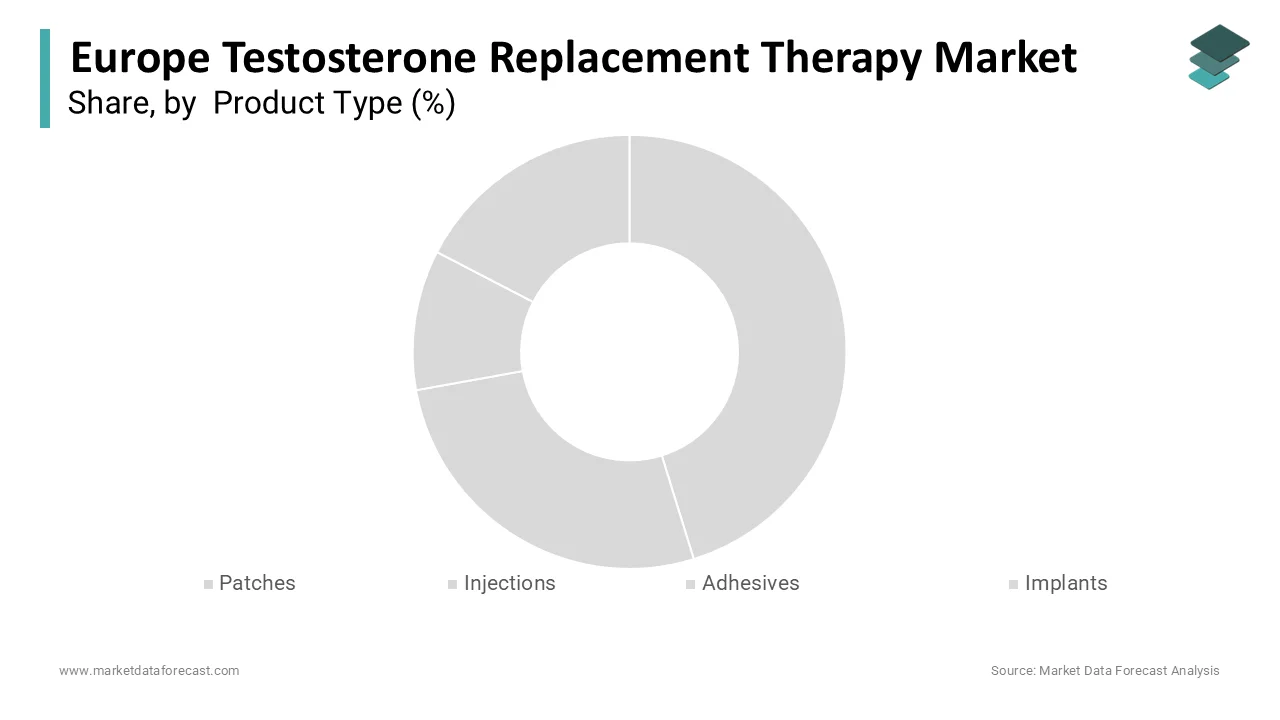
The testosterone patch segment is projected to grow at the fastest CAGR of 7.8% from 2025 and 2033. Recent European-developed matrix-type patches have overcome historical limitations of skin irritation and inconsistent absorption that plagued first-generation reservoir systems. These patches utilize micro-reservoir arrays that modulate release kinetics matching natural diurnal variation, which is increasingly valued in endocrinology practice. Furthermore, the European Directorate for the Quality of Medicines certified next-generation patch products in 2023, enabling centralized marketing authorization across all EU states. This combination of clinical refinement and behavioral alignment positions patches as the most dynamically expanding delivery modality in the European market.
By Active Ingredient Insights
The active ingredient segment accounted in holding 38.3% of the European testosterone replacement therapy market share in 2025. Testosterone undecanoate has demonstrated a more benign cardiovascular safety signal relative to shorter-acting esters, which has significantly influenced prescriber behavior in a risk-averse regulatory environment. The European Society of Cardiology cited this data in its 2025 consensus statement, recommending undecanoate as the preferred injectable for patients with metabolic syndrome or prior cardiovascular events. Furthermore, pharmacovigilance reports from Germany’s Federal Institute for Drugs and Medical Devices showed only 0.7 adverse event reports per per1,0000 patient years for undecanoate versus 2.3 for cypionate. This safety advantage aligns with Europe’s emphasis on long-term risk mitigation in chronic hormonal therapy and has driven formulary preference in public hospitals across Scandinavia and Benelux nations.
The testosterone enanthate segment is projected to register the fastest CAGR of 6.9% from 2025 to 2033. The expiration of key patents and the proliferation of high-quality generics have made testosterone enanthate the most economically accessible injectable option across Europe’s public health systems. National formularies in Portugal, Greece, and Poland exclusively list enanthate for hypogonadism treatment due to its favorable cost per therapeutic unit. Additionally, the European Directorate for the Quality of Medicines confirmed bioequivalence for 19 enanthate generics through its certification program, enhancing clinician confidence. The emerging clinical protocols that combine testosterone enanthate with human chorionic gonadotropin are gaining traction in European reproductive endocrinology centers to maintain virilization, while preserving spermatogenesis.
COUNTRY LEVEL ANALYSIS
Germany Testosterone Replacement Therapy Market Analysis
Germany was the top performer in the Europe Testosterone Replacement Therapy Market with 22.2% of share in 2025, owing to its advanced endocrinology infrastructure, high diagnosis rate,,s and early adoption of novel delivery systems. Germany operates over 450 certified andrology centers accredited by the German Society for Endocrinology, which diagnose more than 150,000 new cases of hypogonadism annually. The national early benefit assessment system has approved reimbursement for both testosterone undecanoate and next-generation patches, ensuring broad therapeutic access. Furthermore, Germany’s robust pharmaceutical manufacturing base includes three of the top five European testosterone API producers, which supports domestic supply chain resilience and competitive pricing.
France Testosterone Replacement Therapy Market Analysis
France was positioned next by capturing 16.3% of the European testosterone therapy market share in 2025, owing to the comprehensive men’s health policies and centralized diagnostic protocols. According to data from the National Institute of Health and Medical Research, 68% of diagnosed patients initiate therapy within 30 days due to streamlined referral pathways to hospital endocrinology units. The country also hosts Europe’s largest public biobank dedicated to male aging, which has contributed critical data to the European Male Aging Study, refining diagnostic thresholds.
United Kingdom Testosterone Replacement Therapy Market Analysis
The United Kingdom testosterone replacement therapy market growth is likely to be driven by the integrated care pathways and robust epidemiological surveillance. The National Institute for Health and Care Excellence updated its 2023 guidance to endorse testosterone undecanoate as first line for primary hypogonadism based on real-world evidence from the UK Biobank cohort linking therapy to reduced fracture risk. Additionally, the UK’s Medicines and Healthcare products Regulatory Agency maintains one of Europe’s most responsive pharmacovigilance systems, which has accelerated approval of novel patches.
Italy Testosterone Replacement Therapy Market Analysis
Italy's testosterone replacement therapy market growth is likely to be driven by the high prevalence of late-onset hypogonadism and specialized tertiary care networks. However, Italy’s network of 87 university-affiliated endocrinology departments provides advanced diagnostic capabilities, particularly in Lombardy and Emilia-Romagna, where diagnosis rates exceed the EU average. The Ministry of Health recently included testosterone undecanoate in its essential medicines list for men with comorbid diabetes or cardiovascular disease based on outcomes from the multicenter TETRA study.
Spain Testosterone Replacement Therapy Market Analysis
Spain's testosterone replacement therapy market growth is likely to be driven by the rising patient awareness and evolving clinical guidelines. According to the National Health Survey 2023, 24% of Spanish men aged 50 to 70 now recognize symptoms of low testosterone compared to just 12% in 2018.
COMPETITIVE LANDSCAPE
The European Testosterone Replacement Therapy Market features a competitive landscape characterized by a mix of multinational pharmaceutical companies and specialized biotech firms. Competition is primarily driven by clinical differentiation, delivery ininnovationand regulatory compliance rather than price alone. Major players invest in generating real-world data to satisfy stringent national health technology assessments and secure reimbursement. The market sees active competition in formulation science with companies racing to develop longer-acting acting safer, and more convenient administration methods. Regulatory harmonization efforts by the European Medicines Agency have elevated evidence requirements, intensifying the focus on post-marketing surveillaAllerganrganr firms often compete through niche delivery platforms or regional partnerships, while larger corporations leverage integrated care models and digital health ecosystems to reinforce brand loyalty and treatment continuity across diverse healthcare settings.
KEY MARKET PLAYERS
Companies playing a notable role in the europe testosterone replacement therapy market analyzed in this report are
- Pfizer Inc.,
- Allergan Plc.,
- AbbVie Inc.,
- Bayer AG.,
- Eli Lilly and Company,
- Endo Pharmaceuticals,
- Kyowa Kirin International Plc.,
- Novartis AG.
- Mylan N.V.
TOP LEADING PLAYERS IN THE MARKET
- Pfizer Inc. maintains a significant presence in the European Testosterone Replacement Therapy Market through its portfolio of branded and generic hormonal therapies. The company leverages its extensive European distribution infrastructure and long-standing relationships with national health systems to ensure broad access to its formulations. In recent years, Pfizer has intensified its focus on patient support programs and digital adherence tools to enhance treatment continuity. The company also collaborates with academic institutions across Germany and the UK on real-world evidence studies to refine clinical protocols for testosterone therapy and address safety concerns within European regulatory frameworks.
- AbbVie Inc. contributes to the market through its advanced transdermal delivery platforms and strong engagement with endocrinology societies across the continent. The company has invested in next-generation gel formulations designed to minimize skin irritation and transfer risk, which aligns with European patient safety priorities. AbbVie recently launched a telehealth integration pilot in France and the Netherlands, enabling remote prescription renewal and home delivery. This initiative supports adherence while complying with EU data privacy standards and reflects the company’s strategy to embed its therapies within digital health ecosystems.
- Bayer AG plays a pivotal role in the European testosterone therapy landscape through its legacy in men’s health and robust primary care outreach. The company promotes comprehensive hormonal screening in collaboration with general practitioner networks in Italy, Spain, and Eastern Europe. Bayer has recently expanded its medical education initiatives to include testosterone deficiency in chronic disease management curricula certified by national medical boards. Additionally, the company supports regional patient advocacy groups to reduce stigma and improve early diagnosis rates, thereby promoting its commitment to sustainable market development beyond product sales.
TOP STRATEGIES USED BY THE KEY MARKET PARTICIPANTS
Key players in the European Testosterone Replacement Therapy Market focus on strategic collaborations with healthcare providers to enhance diagnosis and treatment pathways. They invest heavily in real-world evidence generation to address regulatory and reimbursement concerns across diverse national systems. Companies prioritize the development of patient-centric delivery technologies, such as long-acting injectables and advanced transdermal systems, to improve adherence. Digital health integration through telemedicine platforms and adherence apps is increasingly adopted to align with Europe’s digital transformation in healthcare. Additionally, firms engage in continuous medical education and awareness campaigns targeting both physicians and the public to reduce diagnostic delays and combat misconceptions about hormonal therapy.
MARKET SEGMENTATION
This research report on the European market has been segmented & sub-segmented into the following categories.
By Product Type
- Patches
- Injections
- Adhesives
- Implants
- Oral
By Active Ingredient
- Testosterone Undecanoate
- Testosterone Enanthate
- Testosterone Cypionate
- Methyl Testosterone
By Country
- United Kingdom
- France
- Spain
- Germany
- Italy
- Russia
- Sweden
- Denmark
- Switzerland
- Netherlands
- Rest of Europe