Europe Thermal Interface Materials Market Size, Share, Trends & Growth Forecast Report By Type, Application, and By Country (Germany, United Kingdom, France, Italy, Netherlands & Rest of Europe) – Industry Analysis and Forecast, 2025 to 2033
Europe Thermal Interface Materials Market Summary
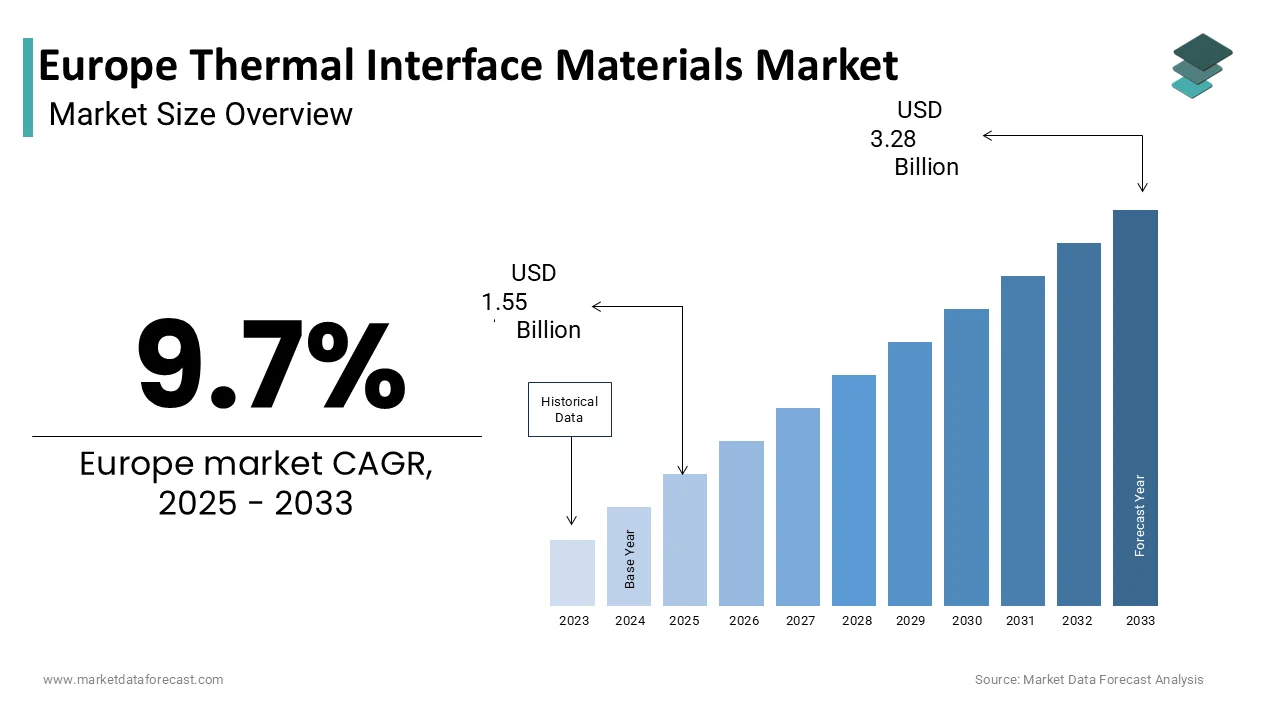
Europe thermal interface materials market was valued at USD 1.42 billion in 2024, estimated to reach USD 1.55 billion in 2025, and is projected to reach USD 3.28 billion by 2033, growing at a CAGR of 9.7% from 2025 to 2033, driven by electric vehicle electrification, high-performance computing expansion, and rising demand for energy-efficient thermal management solutions across digital and industrial infrastructure.
Market snapshot
- 2024 (actual): USD 1.42 billion
- 2025 (est): USD 1.55 billion
- 2033 (forecast): USD 3.28 billion
- CAGR (2025–2033): 9.7%
Quick growth drivers
- Rapid electrification of the automotive sector, increasing thermal loads in EV power electronics, and battery systems.
- Expansion of high-performance computing (HPC) and hyperscale data centers across Western and Northern Europe.
- Rising adoption of wide-bandgap semiconductors (SiC, GaN) requires advanced thermal interfaces.
- EU Green Deal and energy-efficiency mandates are accelerating thermally optimized electronics adoption.
- Growth in industrial automation and smart manufacturing under Industry 4.0 initiatives.
Principal restraints
- Volatility in raw material availability and pricing, particularly silicone resins and ceramic fillers.
- Supply chain exposure to geopolitical disruptions and specialty chemical import dependencies.
- Stringent EU chemical regulations (REACH) limit the use of legacy additives and formulations.
- High reformulation and compliance costs are slowing time-to-market for advanced products.
High-value opportunities
- Bio-based and sustainable thermal interface materials aligned with EU Circular Economy objectives.
- Next-generation renewable energy systems, including solar inverters and offshore wind electronics.
- Thermal solutions for SiC-based power electronics operating at higher temperatures.
- Integration into liquid-cooled data centers and AI computing infrastructure.
Key operational challenges
- Scaling ultra-low thermal resistance performance from lab to mass production.
- Maintaining consistent bond-line thickness and void-free interfaces at industrial volumes.
- Lack of harmonized thermal performance testing standards across EU markets.
- Qualification complexity for aerospace, medical, and mission-critical electronics.
Fastest-growing segments
- Phase change materials: 9.4% CAGR — driven by data centers and 5G infrastructure.
- Medical electronics: 8.7% CAGR — imaging systems, wearables, implantable devices.
- Automotive electronics: largest share (28.2% in 2024) with sustained EV demand.
- Renewable energy power electronics: rising adoption in harsh operating environments.
Regional leadership & dynamics
Germany (lead, 22.4%)
- Automotive electrification leadership and Industry 4.0 deployment.
- Strong domestic materials science and chemical manufacturing base.
United Kingdom
- High-performance computing, aerospace, and liquid-cooled data center expansion.
- Advanced academic–industrial collaboration for thermal innovation.
France
- Nuclear control system modernization and electric vehicle manufacturing growth.
- Strong demand for thermally stable, long-life interface materials.
Netherlands
- Hyperscale data center hub and semiconductor equipment ecosystem.
- Precision manufacturing is driving ultra-clean thermal interface adoption.
What wins commercially
- High-reliability, low-volatility formulations compliant with EU chemical regulations.
- Application-specific co-engineering with OEMs in EVs, HPC, and industrial electronics.
- Proven long-term thermal stability under high power density and cycling conditions.
- Localized EU manufacturing and technical support for supply chain resilience.
Top strategic ask for executives
- Accelerate sustainable and bio-based TIM development.
- Invest in advanced validation, testing, and standardization capabilities.
- Strengthen OEM co-development partnerships in EVs and data centers.
- Expand EU-based production and R&D footprints to mitigate supply risks.
Leading players
Henkel (Bergquist) · 3M · Dow · DuPont · Shin-Etsu · Parker Chomerics · Laird Performance Materials · Indium Corporation · Panasonic · Thermal Grizzly
Europe Thermal Interface Materials Market Size
The europe thermal interface materials market was valued at USD 1.42 billion in 2024, is estimated to reach USD 1.55 billion in 2025, and is projected to reach USD 3.28 billion by 2033, growing at a CAGR of 9.7% from 2025 to 2033.
Thermal interface materials are engineered substances designed to enhance heat transfer efficiency between heat-generating components and heat dissipation systems in electronic and electromechanical assemblies. In Europe, these materials play a pivotal role in supporting advanced thermal management solutions across high-performance computing, electric vehicles, renewable energy infrastructure, and industrial automation. The European region has witnessed a marked shift toward energy-efficient and thermally optimized electronics, driven by stringent environmental regulations and the growing deployment of power-dense systems. As per sources, data centers' electricity consumption is a growing trend, with projections indicating a significant increase in energy demand in the coming years due to the expansion of the digital economy. The European Commission’s Green Deal Industrial Plan further emphasizes energy performance improvements in digital infrastructure, reinforcing demand for innovative thermal interface solutions that support both operational reliability and sustainability targets.
MARKET DRIVERS
Rising Deployment of Electric Vehicles Demands Efficient Thermal Management
The rapid electrification of the regional automotive sector is among the key growth factors of the European thermal interface materials market. Electric vehicle power electronics, such as inverters, battery management systems, and onboard chargers, generate significant localized heat that must be effectively dissipated to maintain performance and safety. According to research, the number of battery electric vehicles registered across the European Union has risen notably. As per various studies, average power densities in electric vehicle inverters have increased, which leads to greater thermal load considerations. Regulatory efforts focused on reducing carbon dioxide emissions from new cars are encouraging automakers to develop more efficient electric drivetrains that require precise thermal regulation. Consequently, thermal interface materials are now essential enablers of both performance reliability and regulatory compliance in inext-generationon electric mobility.
Expansion of High-Performance Computing and Data Center Infrastructure
The region’s accelerating digital transformation has led to a proliferation of high-performance computing systems and hyperscale data centers, which further contribute to the European thermal interface materials market expansion. This generates substantial thermal loads requiring advanced management strategies. Thermal interface materials are critical in maintaining optimal junction temperatures for CPUs, GPUs, and server motherboards to prevent performance throttling and hardware failure. Data center physical infrastructure is expanding across Western Europe, with key markets experiencing notable development. Newly constructed facilities are being designed with improved operational efficiency in mind, incorporating various optimization techniques. There has been a significant increase in high-performance computing capabilities across member states, driven by a need for advanced processing power. These advanced computing systems generate substantial heat during operation, requiring effective cooling mechanisms and materials that remain stable over time. Regional policy initiatives encourage the development of sustainable and climate-conscious data centers, which influence the selection of materials for thermal management in new infrastructure projects.
MARKET RESTRAINTS
Volatility in Raw Material Availability and Pricing
There is persistent pressure from fluctuating access to and costs of critical base materials such as silicone resins, boron nitride, and aluminum oxide fillers, which ultimately hampers the growth of the European thermal interface materials market. Geopolitical disruptions and supply chain recalibrations have intensified input cost instability, directly affecting product affordability and formulation consistency. Imports of specialty chemical precursors from outside the EU saw a decline, which was influenced by changes to customs procedures and environmental compliance reviews. The prices for high-purity aluminum oxide, a material used in thermally conductive composites, increased significantly due to factors such as energy constraints affecting production and limitations on exports from major supplier nations. These dynamics hinder manufacturers’ ability to maintain uniform thermal performance specifications while meeting cost targets for high-volume applications such as consumer electronics and automotive modules. Apart from these, the EU’s Critical Raw Materials Act, while aiming to secure long-term supply, has not yet fully mitigated short-term procurement risks for advanced ceramics and polymer additives. The resulting uncertainty discourages investment in new material formulations and complicates efforts to scale production for emerging thermal management applications across the region.
Stringent Environmental and Chemical Regulatory Frameworks
The continent’s comprehensive regulatory landscape, particularly under the Registration, Evaluation, Authorisation and Restriction of Chemicals regulation, imposes significant compliance burdens on thermal interface material developers. As a result, this hinders the expansion of the European thermal interface materials market. Certain historically effective additives, such as specific brominated flame retardants and volatile silicone compounds, are increasingly restricted due to environmental persistence or toxicity concerns. A notable number of substances of potential concern have been identified for regulatory review over recent years. Many of these substances were previously common components found in material formulations, including thermal compounds. A significant portion of materials used for thermal interface applications has recently been updated by manufacturers to meet evolving safety standards and regulatory timelines. The chemical industry is generally seeing an increase in the reformulation of products in response to new data requirements. These regulatory shifts compel manufacturers to invest heavily in alternative chemistries that may offer lower thermal conductivity or reduced long-term stability. The administrative and testing costs associated with compliance can account for a portion of total product development expenditures. These sustainability initiatives, while beneficial for the environment, present challenges by slowing down the commercial availability of advanced materials and restricting options for uses requiring extreme heat resistance in compact designs.
MARKET OPPORTUNITIES
Emergence of Sustainable and Bio-Based Thermal Interface Solutions
Development and commercialization of environmentally sustainable formulations derived from bio-based or recyclable precursors offer fresh growth possibilities for the European thermal interface materials market. Driven by the EU Circular Economy Action Plan, material suppliers are increasingly investing in alternatives that reduce reliance on fossil-derived polymers and non-renewable fillers. Bio-based polymer production capacity is increasing, indicating a growing focus within the industry. Some research and development efforts are currently dedicated to developing thermally conductive composite materials. Funding is being directed toward research projects that explore the use of cellulose nanofiber and lignin as thermal fillers. These exploration efforts are focused on achieving high conductivity in these new materials. These innovations align with the European Green Public Procurement criteria, which now prioritize electronics incorporating components with verified environmental footprints. This shift not only addresses carbon reduction imperatives but also opens new supply chain partnerships with bio refineries and agricultural waste valorization initiatives across the continent.
Integration into Next Generation Renewable Energy Systems
These materials are gaining strategic relevance in the region’s expanding renewable energy infrastructure, particularly in power conversion units for solar inverters and offshore wind turbine control systems, which ultimately provide new opportunities for the expansion of the European thermal interface materials market. These applications operate in harsh environmental conditions and demand materials that combine high thermal conductivity with long-term resistance to humidity, salt spray, and thermal cycling. The European Clean Energy Package further mandates minimum efficiency thresholds for grid-connected inverters, accelerating the adoption of wide-bandgap semiconductors such as silicon carbide that operate at higher temperatures and require superior interface materials. This convergence of energy policy, technological advancement, and durability requirements positions thermal interface materials as indispensable enablers of Europe’s decarbonization roadmap.
MARKET CHALLENGES
Technical Limitations in Achieving Ultra-Low Thermal Resistance at Scale
The difficulty of consistently delivering ultra-low thermal resistance below 5 millimeter square kelvin per watt across mass production environments remains a major challenge to the European thermal interface materials market. Translating promising lab results into reliable industrial-scale processes is difficult, largely due to persistent issues such as interfacial voids, filler settling, and inconsistent substrate adhesion. Moreover, only a segment of commercially available thermal greases fulfills the thermal impedance stability requirements for specific types of inverters over extended periods of operation. These shortcomings are exacerbated by the trend toward thinner bond lines, which magnify the impact of surface roughness and application tolerances. Furthermore, standardized in situ measurement techniques for thermal performance remain fragmented across EU member states, complicating validation and comparison. Widespread adoption in mission-critical applications is currently limited because robust process controls and standardized testing protocols are not yet in place to bridge the performance gap between theoretical material capabilities and real-world thermal management efficacy.
Lack of Standardized Performance Evaluation and Certification Frameworks
The absence of harmonized testing standards for these materials across the region hinders accurate performance benchmarking and customer confidence in material selection, which constrains the expansion of the European thermal interface materials market. Unlike mechanical or electrical properties, thermal conductivity and interfacial resistance measurements are highly sensitive to test conditions such as pressure, surface finish, and cure profile, leading to significant data variability. The lack of uniformity complicates procurement decisions for sectors such as aerospace and medical electronics, where regulatory validation requires reproducible thermal performance data. Besides, European OEMs often develop proprietary test rigs that are not transferable across supply chains, increasing qualification costs and time to market. Presently, the market for material suppliers remains highly fragmented by bespoke customer requirements, which stifles the ability to scale innovations or apply formulations universally across various industries.
REPORT COVERAGE
| REPORT METRIC | DETAILS |
| Market Size Available | 2024 to 2033 |
| Base Year | 2024 |
| Forecast Period | 2025 to 2033 |
| Segments Covered | By Type, Application, and Region. |
| Various Analyses Covered | Global, Regional, and Country-Level Analysis, Segment-Level Analysis, Drivers, Restraints, Opportunities, Challenges; PESTLE Analysis; Porter’s Five Forces Analysis, Competitive Landscape, Analyst Overview of Investment Opportunities |
| Countries Covered | UK, France, Spain, Germany, Italy, Russia, Sweden, Denmark, Switzerland, Netherlands, Turkey, Czech Republic, Rest of Europe |
| Market Leaders Profiled | Henkel AG & Co. KGaA, 3M Company, Dow Inc., DuPont de Nemours, Inc., Shin-Etsu Chemical Co., Ltd., Momentive Performance Materials Inc., Laird Performance Materials (Laird Connectivity), Panasonic Corporation, Fujipoly Ltd., Thermagon Corporation, Arctic Silver, Inc., Parker Chomerics (a division of Parker Hannifin), Indium Corporation, Thermal Grizzly GmbH, Coolermaster Technology Co., Ltd., Hitachi Chemical Company, Ltd., Chemtronics (Chemtronics Division), Tokuyama Corporation, Bergquist (part of Henkel) |
SEGMENTAL ANALYSIS
By Type Insight
The greases and adhesives segments captured the majority share of 32.5% of the European thermal interface materials market in 2024. The dominance of the greases and adhesives segments is primarily driven by their versatility, ease of application, proven reliability in high-performance thermal pathways across diverse sectors, and widespread use in power electronics for electric vehicles, where consistent thermal contact under mechanical stress is critical. Their adaptability to uneven surfaces and compatibility with automated dispensing systems further solidify adoption in mass production environments. An additional growth factor is its entrenched role in industrial automation systems, which are undergoing rapid digitalization. Greases and adhesives provide the necessary conformability and long-term adhesion in these compact, high-duty-cycle applications. Their cost-effectiveness compared to solid alternatives also supports scalability in cost-sensitive segments such as consumer appliances and mid-tier computing hardware.
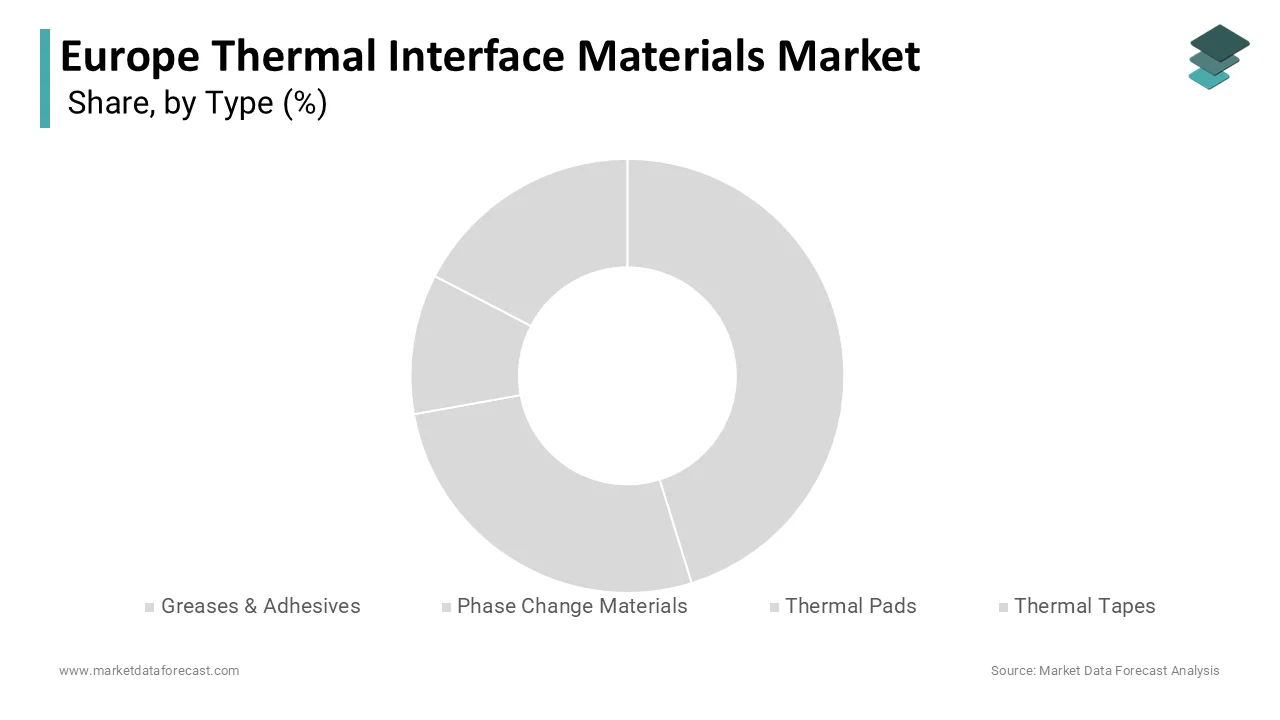
The phase change materials segment is estimated to register the fastest CAGR of 9.4% between 2025 and 2033. The rapid growth of the phase change materials segment is fuelled by its unique ability to combine the pump-out resistance of solid pads with the low interfacial resistance of greases, which makes them ideal for next-generation computing and telecommunications infrastructure. The rollout of 5G base stations across Europe, which operate at significantly higher power densities than 4G counterparts, has intensified demand for materials that maintain performance under thermal cycling. A further growth enabler is their adoption in artificial intelligence servers and edge computing nodes, where thermal excursions are frequent and unpredictable. These materials activate at precise temperatures, typically between 45 and 60 degrees Celsius, transitioning to a compliant state that fills microvoids during operation while remaining solid during shutdown. The European Green Deal’s emphasis on data center energy efficiency further favors phase change materials, as they reduce thermal resistance without active cooling overhead, contributing to power usage effectiveness improvements.
By Application Insights
In 2024, the automotive electronics segment led the European thermal interface materials market by capturing a 28.2% share. The supremacy of the automotive electronics segment is attributed to the continent’s aggressive shift toward electric mobility and advanced driver assistance systems, both of which rely heavily on thermally sensitive semiconductor components. The integration of silicon carbide and gallium nitride power devices in electric vehicle inverters has heightened the need for materials that sustain thermal performance under high-frequency switching and wide temperature swings. The segment's growth is additionally propelled by the proliferation of zonal electronic architectures in premium European car brands, which consolidate multiple electronic control units into fewer high-power domains. These modules, including onboard chargers and DC-DC converters, operate in confined engine bay spaces with limited airflow, necessitating high-performance thermal pathways. Regulatory mandates under the EU’s General Safety Regulation, which requires mandatory installation of advanced emergency braking and lane keeping systems from 2025, further expand the electronics footprint and associated thermal management requirements across all vehicle classes.
The medical devices segment is anticipated to witness the fastest CAGR of 8.7% during the forecast period, owing to the increasing use of high-power imaging systems and portable diagnostic equipment that generate localized heat yet must comply with stringent patient safety and device reliability standards. Magnetic resonance imaging and computed tomography scanners, for instance, now incorporate high-performance computing units for real-time image reconstruction, producing thermal loads that require efficient dissipation without electromagnetic interference. An additional driver of this segment is the rapid deployment of wearable and implantable monitoring devices, which demand ultra-thin, biocompatible thermal solutions. Thermal interface materials in these applications must not only manage heat but also meet ISO 10993 biocompatibility standards and remain stable under long-term skin contact. Innovations in thermally conductive hydrogels and non-leaching elastomers are enabling safer and more efficient thermal transfer in these sensitive contexts. Apart from these, the EU Medical Devices Regulation’s emphasis on post-market surveillance and device longevity has elevated thermal reliability as a critical design parameter, which accelerates material qualification cycles and supplier partnerships across the healthcare technology ecosystem.
COUNTRY LEVEL ANALYSIS
Germany Thermal Interface Materials Market Analysis
Germany dominated the European thermal interface materials market by accounting for a 22.4% share in 2024. The prominence of the German market is credited to its dual strength as a global leader in automotive engineering and industrial automation. German original equipment manufacturers continue to drive innovation in electric vehicle platforms, with each new model integrating more power electronics requiring advanced thermal interfaces. According to research, a significant number of battery electric vehicles were registered domestically in 2024, reinforcing demand for high-performance thermal materials in drivetrain and battery systems. Simultaneously, the nation’s Industry 4.0 initiative has accelerated the deployment of smart factories, where thermal management is essential in robotics, motor drives, and edge computing gateways. Strong domestic chemical and materials science capabilities, anchored by companies in the Rhine Ruhr region, further support localized formulation development and rapid prototyping aligned with automotive and machinery sector requirements.
United Kingdom Thermal Interface Materials Market Analysis
The United Kingdom followed closely in the European thermal interface materials market by capturing a 14.5% share in 2024 by maintaining a distinct leadership in high-performance computing and aerospace electronics. The country’s thermal interface material consumption is heavily influenced by data center expansion and defense-related electronics, both of which demand extreme reliability under thermal stress. Data center capacity within the nation has exceeded a significant threshold. Facilities in specific regions are increasingly adopting liquid-cooled architectures. These advanced systems rely on materials such as gap fillers and phase change materials for effective operation. There has been an increase in deployments of airborne electronic warfare systems. Within these systems, achieving thermal stability is a critical factor impacting their success. The UK’s strong academic-industrial collaboration, particularly through the High Value Manufacturing Catapult network, enables rapid material validation for aerospace and defense applications. This ecosystem supports the adoption of metal-based and nanocomposite thermal interfaces that meet MIL-SPEC standards while offering superior conductivity over traditional polymers.
France Thermal Interface Materials Market Analysis
France continues to be a significant country in the European thermal interface materials market due to its strategic focus on nuclear energy, digitalization, and electric mobility. The nation’s extensive nuclear power infrastructure, which supplies a notable share of its electricity, ty as per sources, is undergoing a major control system modernization program that requires thermally robust electronics for reactor monitoring and grid integration. Simultaneously, France’s automotive sector, led by Stellantis and Renault, is scaling production of affordable electric vehicles, with domestic EV registrations ng a substantial number of units in 2024 according to research. These vehicles incorporate regionalized power electronics that operate in high ambient temperatures, necessitating thermally conductive adhesives and pads with long-term oxidative stability. This dual track of energy and mobility transformation underpins sustained demand for advanced thermal interface solutions.
Italy Thermal Interface Materials Market Analysis
Italy experienced a consistent growth in the European market owing to strong growth in consumer durables and industrial robotics. The country’s domestic appliance manufacturers, including global players like Whirlpool Europe and Electrolux Italia, have intensified integration of inverter compressors and smart control boards in washing machines, refrigerators, and cooking systems, all of which generate localized heat in compact enclosures. There is a noticeable increase in the adoption of energy-efficient home appliances. Businesses across different regions in Italy are increasingly integrating industrial robots into their operations. These industrial robots often require specific thermal management solutions for components like servo drives and vision systems. The national focus on reshoring manufacturing and upgrading legacy production lines is accelerating electronics content per machine, thereby expanding the thermal interface material base. Local material compounders are responding with cost-optimized grease and pad formulations tailored to the thermal and regulatory requirements of Mediterranean climate operation.
Netherlands Thermal Interface Materials Market Analysis
The Netherlands is anticipated to grow in the European thermal interface materials market from 2025 to 2033 by serving as the region’s data center and semiconductor logistics hub. The country’s strategic location and abundant renewable energy supply have attracted hyperscale cloud providers, with notable data center capacity in the Amsterdam metropolitan region. These facilities house dense server racks running artificial intelligence and cloud workloads that necessitate phase change materials and liquid-cooled cold plates with integrated thermal interfaces. Apart from these, the presence of ASML and its extensive supplier network in the Eindhoven high-tech campus drives demand for ultra-clean, particle-free thermal compounds used in photolithography equipment, where even minor thermal drift can compromise nanometer-scale precision. This unique confluence of digital infrastructure and precision manufacturing positions the Netherlands as a critical node for high-end thermal interface material adoption, particularly in applications where reliability and contamination control are non-negotiable.
COMPETITIVE LANDSCAPE
Competition in the European thermal interface materials market is characterized by a mix of global material science leaders and specialized regional formulators vying for dominance across high-growth application segments. The landscape is marked by intense technological differentiation as companies strive to meet the exacting thermal reliability and environmental compliance standards set by European regulators and original equipment manufacturers. Innovation cycles have accelerated with players rapidly commercializing formulations that address emerging needs in electric vehicles, data centers, and medical electronics. Strategic positioning hinges on the ability to offer integrated thermal management solutions rather than standalone materials. Technical service dep, the material certification, ion pedi, gree, and responsiveness to regulatory shifts serve as key competitive differentiators. Global corporations leverage their massive scale and R&D facilities, while smaller European suppliers thrive by specializing in specific chemistries and applications, resulting in a fragmented yet dynamic competitive landscape.
KEY MARKET PLAYERS
Some of the companies that are playing a dominating role in the global europe thermal interface materials market include
- Henkel AG & Co. KGaA
- 3M Company
- Dow Inc.
- DuPont de Nemours, Inc.
- Shin-Etsu Chemical Co., Ltd.
- Momentive Performance Materials Inc.
- Laird Performance Materials (Laird Connectivity)
- Panasonic Corporation
- Fujipoly Ltd.
- Thermagon Corporation
- Arctic Silver, Inc.
- Parker Chomerics (a division of Parker Hannifin)
- Indium Corporation
- Thermal Grizzly GmbH
- Coolermaster Technology Co., Ltd.
- Hitachi Chemical Company, Ltd.
- Chemtronics (Chemtronics Division)
- Tokuyama Corporation
- Bergquist (part of Henkel)
TOP LEADING PLAYERS IN THE MARKET
- Henkel AG and Co KGaA is a leading German chemical and consumer goods company with a strong footprint in the thermal interface materials segment through its Bergquist brand. The company supplies a wide portfolio, including gap fillers,s phase change material, ls, and thermally conductive adhesives to automotive electronics and data center clients across Europe. In recent years, ars Henkel has expanded its R&D capabilities in Düsseldorf to develop volatility formulations aligned with EU chemical regulations.
- Parker Hannifin Corporation maintains a significant presence in Europe through its Chomerics division, which specializes in engineered thermal and electromagnetic solutions. The company serves high-reliability sectors such as aerospace, defense, and medical devices, where thermal stability under extreme conditions is critical. Parker has recently invested in clean room production facilities in the Netherlands to support semiconductor equipment manufacturers.
- 3M Company leverages its advanced materials science expertise to deliver thermal interface solutions across computing, automotive, and industrial sectors in Europe. The company’s portfolio includes thermally conductive tapes, pads, and phase change films that integrate seamlessly into automated assembly lines. It also strengthened partnerships with European electric vehicle OEMco-engineeringering custom thermal stacks that meet both thermal and mechanical design constraints in next-generation platforms.
TOP STRATEGIES USED BY THE KEY MARKET PARTICIPANTS
Key players in the European thermal interface materials market primarily focus on strategic product innovation through dedicated research and development centers aligned with regional sustainability mandates. They actively pursue vertical integration by collaborating with original equipment manufacturers to co-design application-specific thermal solutions. Companies are increasingly investing in localized production facilities to ensure supply chain resilience and compliance with EU chemical regulations. Partnerships with academic institutions and national research bodies support the development of next-generation materials such as bio-based polymers and nanofiller composites. Additionally, firms are expanding their technical service capabilities to provide on-site thermal simulation and validation support, enhancing customer retention and solution adoption across high-performance sectors.
MARKET SEGMENTATION
This research report on the europe thermal interface materials market is segmented and sub-segmented into the following categories.
By Type
- Greases & Adhesives
- Phase Change Materials
- Thermal Pads
- Thermal Tapes
- Others
By Application
- Automotive Electronics
- Consumer Electronics
- Telecommunications
- Industrial Equipment
- Medical Devices
- Others
By Country
- Germany
- United Kingdom
- France
- Italy
- Netherlands
- Rest of Europe
Frequently Asked Questions
1. What drives growth in Europe Thermal Interface Materials Market?
Europe Thermal Interface Materials Market grows due to electric vehicle production, renewable energy systems, and
data center expansion requiring efficient heat dissipation. Automotive giants in Germany and France boost demand
for advanced TIM in batteries and power electronics.
2. What is market size of Europe Thermal Interface Materials Market?
Europe Thermal Interface Materials Market reached around USD 1.5 billion recently, with projections for steady
expansion driven by electronics and EV sectors. Germany leads with high CAGR from automotive innovation
3. Who are key players in Europe Thermal Interface Materials Market?
Key players in Europe Thermal Interface Materials Market include 3M, Henkel, Dow, Honeywell, and Shin-Etsu,
focusing on innovative greases and pads for automotive and telecom uses. They invest in eco-friendly formulations
4. .What are main types in Europe Thermal Interface Materials Market?
Europe Thermal Interface Materials Market segments into greases & adhesives, pads & films, gap fillers, phase
change materials, and metals, with greases holding largest share for electronics cooling applications.
5. How does EV impact Europe Thermal Interface Materials Market?
Electric vehicles drive Europe Thermal Interface Materials Market through needs for battery thermal management
and power electronics cooling in manufacturers like Volkswagen and BMW across Germany and beyond
6. What role of Germany in Europe Thermal Interface Materials Market?
Germany dominates Europe Thermal Interface Materials Market with automotive leadership, Industry 4.0, and EV
focus, demanding high-performance TIM for precision engineering and energy efficiency.
7. What trends shape Europe Thermal Interface Materials Market?
Europe Thermal Interface Materials Market sees trends like sustainable bio-based TIM, advanced phase change
materials, and liquid metals for next-gen electronics and 5G base stations.
8. What challenges face Europe Thermal Interface Materials Market?
Europe Thermal Interface Materials Market faces challenges from high costs of advanced materials, environmental
regulations, and supply chain issues, pushing innovation in recyclable TIM solutions.
9. How does 5G affect Europe Thermal Interface Materials Market?
5G infrastructure boosts Europe Thermal Interface Materials Market by requiring TIM for heat-intensive base
stations and telecom gear in UK and France amid network expansions.
10. What applications dominate Europe Thermal Interface Materials Market?
Europe Thermal Interface Materials Market serves electronics, automotive, telecom, and renewables, with EVs
and data centers as top users for reliable thermal conductivity.
Related Reports
Access the study in MULTIPLE FORMATS
Purchase options starting from
$ 2000
Didn’t find what you’re looking for?
TALK TO OUR ANALYST TEAM
Need something within your budget?
NO WORRIES! WE GOT YOU COVERED!
Call us on: +1 888 702 9696 (U.S Toll Free)
Write to us: sales@marketdataforecast.com