- Product Description Description
- Table of Contents TOC
- List of Table & Figure LOT
- Get Free Sample PDF Sample PDF
Market Size, 2025
$3,699.36 MnMarket Estimate, 2026
$3,854.73 MnMarket Forecast, 2034
$5,357.18 MnCAGR, 2026–2034
4.2%Executive Summary: Europe Thermoformed Plastics Market
- Market Scope: Comprehensive European thermoformed plastics industry analysis covering process segments, application fields, polymer types, country leadership frameworks, strategic corporate developments, and competitive landscapes.
- Market Valuation: Valued at USD 3,699.36 million (2025), estimated at USD 3,854.73 million (2026), and projected to reach USD 5,357.18 million by 2034, registering a steady CAGR of 4.2% (2026–2034).
- Primary Growth Drivers: Fresh food e-commerce expansion, retail-ready packaging requirements, medical device/diagnostic adoption, EU Packaging and Packaging Waste Regulation mandates, and mono-material recyclable solution trends. Restraints include stringent EU single-use plastic regulations and volatile raw material prices.
Key Market Segment Metrics (2026–2034)
| Category | Leading Segment (2025 Position) | Fastest-Growing Segment |
|---|---|---|
| By Process | Thin gauge thermoforming (largest process segment, capturing 61.3% of market share in 2025) | Thick gauge thermoforming (projected to expand at a CAGR of 6.8%) |
| By Application | Food packaging (led applications with 52.3% share in 2025) | Healthcare and medical applications (witnessing fastest CAGR of 7.4%) |
| By Product / Polymer Type | Polypropylene (held 28.3% of product share in 2025) | Biodegradable polymers (anticipated to grow at a CAGR of 12.3%) |
| By Region / Country | Germany (dominated with 22.2% share in 2024 due to advanced packaging industry) | France (16.3% share) and the Netherlands (emerging as a circular recycling model) |
Major Market Players & Market Structure
Market Structure: Highly competitive European packaging and polymer processing ecosystem prioritizing closed-loop systems, 100% recycled post-consumer content certification, and chemical recycling collaborations.
Key Companies: Borealis AG, Plastipak Holdings, Inc., Amcor plc, Berry Global, Inc., Sealed Air Corporation, LINPAC Group, Transcontinental Inc., Coveris Holdings S.A., PACCOR GmbH, Placon Corporation, Inteplast Group, Tekni-Pak, Inc., Winpak Ltd., Clondalkin Group (GIP Europe), Alpha Packaging, Mondi plc, Dinoplast AG, ProAmpac Holdings, Inc., KP Plastics Ltd., Faerch A/S, DS Smith Plc, and Greiner AG.
Europe Thermoformed Plastics Market Size
The Europe Thermoformed Plastics Market is projected to grow from USD 3,699.36 million in 2025 to USD 3,854.73 million in 2026 and reach USD 5,357.18 million by 2034, registering a CAGR of 4.20% from 2026 to 2034.
Thermoformed plastics in Europe refer to polymer sheets, primarily polystyrene, polypropylene, polyethylene terephthalate, and bioplastics that are heated and molded into precise shapes for packaging, consumer goods, medical devices, and automotive interiors. According to Eurostat, the European Union generated 52 million metric tons of plastic waste in 2023, with packaging accounting for over 40%, underscoring the scale of material throughput in which thermoformed items play a central role. The European Environment Agency notes that more than 280000 tonnes of thermoformed trays and containers enter the food supply chain annually, primarily for fresh produce, meat, and ready meals. Regulatory shifts under the EU Packaging and Packaging Waste Regulation now mandate that all plastic packaging be reusable or recyclable by 2030, accelerating innovation in mono-material and bio-based thermoforms.
MARKET DRIVERS
Expansion of Fresh Food E-Commerce and Retail Ready Packaging
Retail-ready packaging designed for direct shelf display and logistical efficiency, where Europe’s fresh food supply chain is significantly boosting demand for thermoformed trays, clamshells, and lidding films. The expansion of fresh food e-commerce and retail-ready packaging is boosting the growth of Europe thermoformed plastics market. According to the European Food and Drink Association, over 75% of fresh meat, poultry, and bakery goods sold in EU supermarkets are now presented in thermoformed containers to ensure visual appeal, portion control, and extended shelf life. The rise of online grocery shopping has intensified this trend, with thermoformed packaging essential for protecting perishables during transit. Retailers like Carrefour and Tesco have adopted standardized thermoformed trays across their private label ranges, enabling automated replenishment and reducing handling time by up to 30%, as documented by the European Retail Round Table. Additionally, the EU’s Farm to Fork Strategy encourages reduced food waste, and thermoformed packaging with modified atmosphere technology has been shown to extend the shelf life of fresh produce by 3 to 5 days, according to the European Commission’s Joint Research Centre.
Growing Adoption in Medical Device and Diagnostic Applications
Thermoformed plastics are increasing in Europe’s healthcare sector due to their sterility, precision, and compatibility with regulatory standards for single-use medical components. The growing adoption of medical devices and diagnostic applications is additionally fuelling the growth of Europe thermoformed plastics market. According to the European Medical Devices Association, over 60% of Class I and II medical devices, including sample collection kits, surgical trays, and diagnostic device housings, are manufactured via thermoforming to ensure dimensional accuracy and cleanroom compatibility. The European Centre for Disease Prevention and Control reported that during 2023, U member states procured more than 2.1 billion thermoformed diagnostic cartridges for point-of-care testing, many of which required transparent PETG or cyclic olefin copolymer materials to facilitate optical reading. Germany’s Federal Institute for Drugs and Medical Devices documented a 19% annual increase in approvals for thermoformed medical components between 2021 and 2023, reflecting rising reliance on disposable formats to prevent cross-contamination. Furthermore, the EU Medical Devices Regulation mandates strict material traceability and biocompatibility requirements that favor established thermoforming resins with documented regulatory dossiers. As Europe’s aging population drives demand for home-based diagnostics and single-use surgical kits, thermoformed plastics remain the preferred manufacturing method for low-cost, high-integrity packaging.
MARKET RESTRAINTS
Stringent EU Regulations on Single-Use Plastics and Recyclability
The European Union’s aggressive stance on plastic waste has introduced significant constraints on traditional thermoformed packaging, particularly those made from polystyrene or multi-layer composites. The stringent EU regulation on single-use plastics and recyclability is impeding the growth of Europe thermoformed plastics market. According to the European Commission, the Single Use Plastics Directive banned expanded polystyrene food containers as of July 2021, and the 2023 revision of the Packaging and Packaging Waste Regulation mandates that all plastic packaging placed on the EU market must be recyclable by 2030. This poses a structural challenge as many thermoformed items, especially those with metallized coatings or mixed polymers, are not readily compatible with existing sorting and reprocessing infrastructure. The European Environment Agency estimates that only 29% of thermoformed packaging is currently collected for recycling due to contamination, shape irregularities, and low density. Producers now face costly reformulations or redesigns to meet mono material requirements, for instance, switching from PET PS laminates to 100% APET increases material costs by 15 to 25% according to Plastics Europe.
Volatility in Fossil Fuel-Derived Resin Prices and Supply Chains
Thermoformed plastics remain heavily dependent on petroleum-based polymers, whose pricing and availability are subject to geopolitical and macroeconomic fluctuations, creating operational instability for European converters. The volatility in fossil fuel-derived resin prices and supply chains is additionally limiting the growth of Europe thermoformed plastics market. According to the International Energy Agency, crude oil prices fluctuated between 72 and 98 dollars per barrel in 2023, directly impacting polypropylene and polystyrene feedstock costs, which rose by an average of 18% year on year as documented by Plastics Europe. The war in Ukraine further disrupted European access to key naphtha feedstock,k with the European Chemicals Agency reporting a 30% reduction in Russian-sourced aromatics in 2022, affecting polystyrene production capacity. Unlike injection molding, which can use regrind more efficiently, thermoforming generates significant edge trim waste up to 30% of sheet input, and reliance on virgin resin amplifies cost exposure. While bio-based alternatives like PLA offer relief, they accounted for less than 4% of total thermoforming material use in 2023, according to European Bioplastics,s due to higher prices and limited thermal performance. This dependency on volatile fossil feedstocks constrains margin predictability and delays investment in new capacity among small and medium-sized converters across Southern and Eastern Europe.
MARKET OPPORTUNITIES
Rise of Mono Material and Recyclable Thermoformed Solutions
The rapid development and adoption of mono-material structures that align with EU circular economy mandates are creating new opportunities for the growth ofEurope'se thermoformed plastics market. According to Plastics Europe, many of Europe's thermoformers have transitioned or are actively piloting 100% polyethylene terephthalate or polypropylene packaging to replace non-recyclable multi-layer alternatives. Retail giants, such as Aldi and Lidl, have committed to sourcing only recyclable thermoformed trays by 202,5 a shift that has spurred innovation in clear high clarity APET grades with enhanced barrier properties. The European Packaging and Sustainability Charter reports that thermoformed containers now achieve collection rates above 45% in countries with deposit return or advanced sorting systems like the Netherlands and Sweden. In 2023, the French Environment and Energy Management Agency certified over 120 new mono-material thermoformed SKUs as “widely recyclable” under its CITEO labeling scheme. Chemical recycling pathways are also emerging, where companies like Loop Industries have partnered with European converters to depolymerize post-consumer APET thermoforms back to virgin-grade resin. These developments transform regulatory pressure into a catalyst for material innovation and long-term market access.
Integration of Thermoformed Bioplastics in Food Service Applications
The expansion of compostable and bio based thermoformed products in the food service and takeaway sector,, rs responding to municipal organic waste collection mandatich is also elevating the growth of Europe thermoformed plastics market. According to European Bioplasticsbio-baseded thermoformed items made from P, PLA, HA, or starch blends grew by 34% in 20,23 driven by urban policies like Paris’s ban on non-compostable takeaway containers and Amsterdam’s circular procurement rules. The European Compost Network verified that 22 EU cities now operate industrial composting facilities accepting certified EN 13432 thermoformed packaging, enabling end-of-life recovery for items like salad bowls and coffee cup lids. Italy’s 2023 National Waste Prevention Program allocated 80 million euros to subsidize compostable packaging in catering, ng with over 15000 food vendors participating. Material performance has also improved, where BASF and TotalEnergies Corbion have introduced heat resistant PLA grades that withstand temperatures up to 95 degrees Cel,sius making them viable for hot food applications.
MARKET CHALLENGES
Limited Sorting Infrastructure for Lightweight Thermoformed Packaging
The inadequate adaptation of municipal and commercial recycling systems to effectively capture and process lightweight thermoformed plastic is one of the major challenges for the growth of Europe thermoformed plastics market. According to the European Recycling Platform, most material recovery facilities across Southern and Eastern Europe are optimized for bottles and rigid containers but struggle with flat trays, clamshells, and thin-gauge sheets, which jam sorting lines or are misidentified as film. The European Environment Agency found that only 12 out of 27 EU member states have sorting facilities capable of reliably separating APET thermoforms from mixed waste streams. In Spain, the National Packaging Waste Consortium reported that less than 20% of collected thermoformed packaging reaches reprocessors due to contamination and shape-related rejection. Even in advanced systems like Germany’s dual collection scheme, thermoformed trays often end up in residual waste because consumers confuse them with non-recyclable foam. This infrastructure gap undermines recyclability claims and exposes brand owners to Extended Producer Responsibility fee penalties.
Technical Limitations in High-Performance Thermoforming for Engineering Applications
Thermoformed plastics face inherent constraints when competing against injection molding or extrusion in demanding industrial and automotive applications due to limitations in wall thickness uniformity, structural strength, and dimensional tolerance. The technical limitations in high-performance thermoforming for engineering applications are additionally hindering the growth of Europe thermoformed plastics market. According to the European Association of Automotive Suppliers, thermoforming is rarely used for load-bearing or high temperature components because typical sheet thicknesses range from 0.5 to 3 millimeters, rs and part geometry is restricted to relatively shallow draws. In the automotive sector, which consumed 2.1 million tonnes of engineering plastics in 20,23 as per the European Plastics Converters association, less than 8% involved thermoforming for interior trim or protective covers. The process also struggles with tight tolerances; a study by the Fraunhofer Institute found that thermoformed parts exhibit up to 2.5% dimensional variation compared to 0.3% for injection molded equivalents. These technical boundaries restrict market expansion into high-value sectors where mechanical performance and precision are non-negotiable. While innovations like twin sheet forming and in-mold decoration have improved functionality, they have not overcome fundamental material distribution challenges during forming. Consequently, thermoforming remains confined largely to packaging and low-stress applications despite ongoing efforts to broaden its engineering relevance.
SEGMENTAL ANALYSIS
By Process Insights
Thin gauge thermoforming segment was the largest by capturing 61.3% of the European thermoformed plastics market share in 2025, with its extensive use high-volumeume disposable packaging for food, od healthc, a, re and consumer go, ods where cost efficiency and rapid production are paramount. The process typically uses sheets under 1.5 millimeters thick and enables output rates exceeding 1000 parts per hour on automated lines. Over 80% of fresh food packaging in EU supermarkets, including meat trays, salad containers,, rs and bakery cases, is produced through thin-gauge thermoforming, as confirmed by the European Food and Drink Association. The European Commission’s Farm to Fork Strategy has further incentivized lightweight yet protective formats that reduce food waste, thermoformed APET trays have been shown to extend shelf life by up to five days, according to the Joint Research Centre. The compatibility of thin gauge lines with recycled and mono material resins also aligns with EU Packaging Regulation targets making this process the industrial backbone of sustainable packaging conversion across Europe.
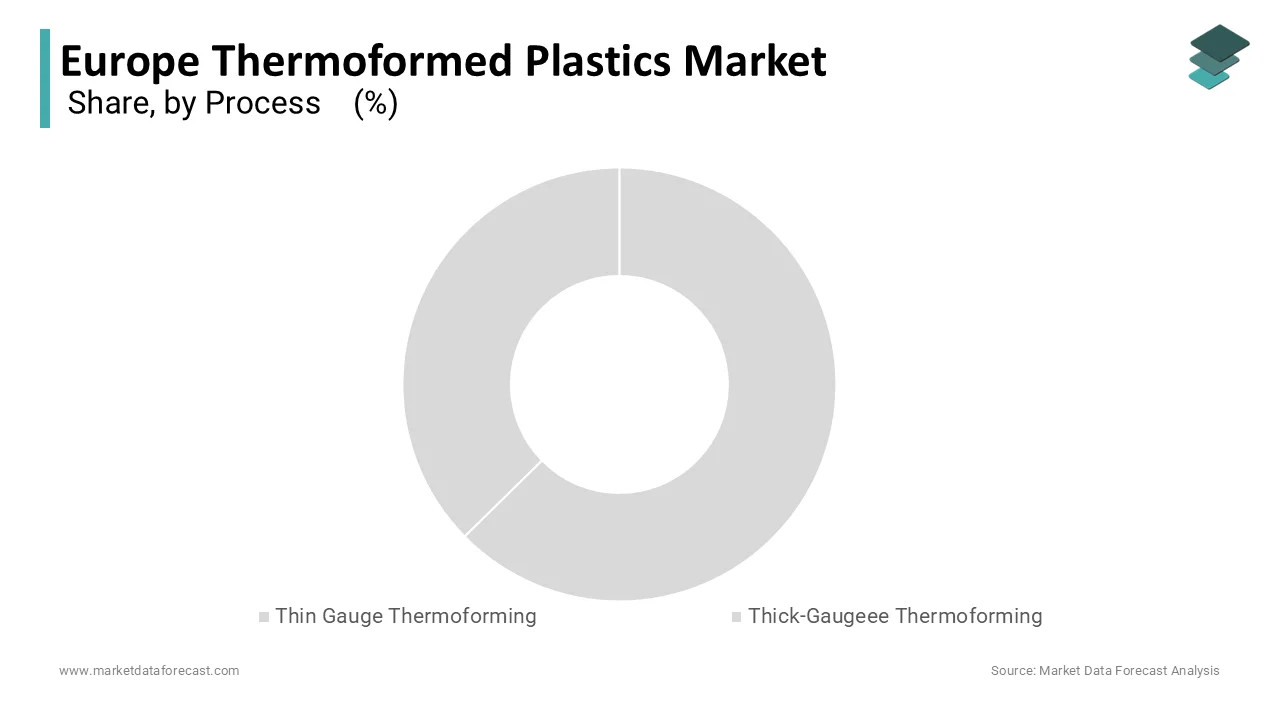
The thick gauge thermoforming segment is projected to expand at a CAGR of 6.8% from 2025 to 20,33 from rising demand for durable semi-structural components in automotive interiors, material handling, ng and point of purchase displays that require thicknesses between 3 and 12 millimeters. Unlike thin gauge applications, thick gauge parts prioritize mechanical robustness, aesthetic finish,, es and design flexibility over mass production speed. The European Association of Automotive Suppliers reported that over 450000 commercial vehicles produced in the EU in 2023 incorporated thermoformed interior panels, instrument bezels, ls,, and battery covers made from ABS and HIPS. In logistics, thick-gauge totes and pallets made from polypropylene have gained traction due to the EU circular economy mandate, es with companies like CHEP and DS Smith deploying more than 1.2 million units across warehouse networks, as documented by the European Logistics Association. Furthermore, the construction sector is adopting thick gauge sheets for interior cladding and lighting diffusers in energy efficient buildin, gs a trend supported by the EU Energy Performance of Buildings Directive. These industrial applications offer higher margins and longer product life cycles driving steady investment in thick gauge capacity despite higher tooling costs.
By Application Insights
The food packaging segment held 52.3% of the Europe thermoformed plastics market share in 2025 owing to the sector’s reliance on thermoformed containers for freshness protec,tion portion contr,,ol and retail efficiency across fresh produ,ce me,, at dai,,ry and ready meals. Over 75% of pre packed fresh meat sold in EU supermarkets uses vacuum skin or modified atmosphere thermoformed trays, as verified by the European Commission’s Directorate General for Health and Food Safety. The European Retail Round Table notes that thermoformed packaging reduces in store labor by enabling direct shelf placement with integrated labeling and barcoding. In 2023, Eurostat recorded a 22% increase in online food delivery which intensified demand for stackable leak resistant thermoformed containers capable of withstanding courier handling. Moreover, the EU’s food waste prevention target, which aims to halve retail and consumer waste by 20,30 has elevated the role of protective packaging. The Joint Research Centre confirmed that properly sealed thermoformed trays reduce spoilage by 15 to 30% compared to bulk alternatives.
The healthcare and medical segment is likely to witness the fastest CAGR of 7.4% throughout the forecast period owing to the stringent hygiene standards,, ds rising demand for single-use diagnostics,, cs and regulatory mandates for sterile containment across hospitals,, cs and laboratories. Over 60% of Class I medical devices, including surgical trays, specimen containers,, rs and diagnostic housings are manufactured via thermoforming due to its ability to produce cleanroom-compatible parts with precise cavity geometries. The European Centre for Disease Prevention and Control reported that in 2023, EU member states distributed more than 2.1 billion thermoformed test cartridges for infectious disease screening, ng many requiring optical clarity and thermal resistance. Additionally, the EU Medical Devices Regulation enforces strict material traceability,ity favoring established resins like PETG and cyclic olefin copolymer with full biocompatibility dossiers.
By Product Insights
The polypropylene segment was accounted in holding 28.3% oEuropeanEurope thermoformed plastics market share in 2025 from an optimal balance of chemical resistance,,ce heat tolerance,ce impact strength,,gth and recyclability,, ty making it suitable for both food and industrial applications. Over 40% of reusable food containers and microwave-safe trays in the EU are made from homopolymer or copolymer PP, as confirmed by the European Food Safety Authority. The material’s compatibility with steam sterilization also makes it a standard for medical specimen cups and pharmaceutical packaging. In the logistics sector,r PP’s durability enables thousands of reuse cycles in thick gauge totes and palle,, ts with CHEP reporting a 35% increase in IPP-based reusable packaging deployments across European distribution centers in 2023. Furthermore, PP is fully compatible with mechanical recycling streams and aligns with the EU’s target of 50% recycled content in plastic packaging by 2030. The European Chemicals Agency verified that PP emits no hazardous substances during thermoforming, reinforcing its safety profile. These functional,l regulatory, and circular economy advantages ensure polypropylene remains the most widely adopted resin in European thermoforming.
Tbiodegradableble polymers segment is anticipated to witness the fastest CAGR of 12.3% during the forecast period, od owing to the municipal organic waste policies, es national bans on conventional plastics,ics and corporate sustainability commitments targeting compostable alternatives. Cities like Paris Amste,rdam and Milan require food service operators to use only EN 13432 certified compostable packaging,g a mandate that has shifted millions of salad bowls, ls coffee cups, and takeaway containers to polylactic acid and starch blends. The European Compost Network confirmed that 22 EU cities operate industrial composting facilities accepting certified thermoformed bioplastics enablend-of-lifelife recovery. Italy’s 2023 National Waste Prevention Program allocated 80 million euros to subsidize compostable packaging adoption with over 15000 food vendors participating. Material performance has also improved, where TotalEnergies Corbion’s heat resistant PLA grades now withstand temperatures up to 95 degrees Celsi, making them viable for hot food applications.
COUNTRY LEVEL ANALYSIS
Germany Thermoformed Plastics Market Analysis
Germany was the largest contributor of the Europe thermoformed plastics market by holding 22.2%the othe f share in 20,24, with its advanced packaging industry, strong, robust automotive sector,ector and strict adherence to circular economy principles. Over 1200 thermoforming companies operate in Germany, many supplying everything from food trays for Aldi and Lidl to interior panels for BMWMercedes-Benz Benz. The Federal Environment Agency reported that Germany collected 2.1 million tonnes of post-consumer plastic packaging in 2023, with thermoformed items increasingly designed formono-materiall recyclability. The Fraunhofer Institute has pioneered digital watermarking trials in collaboration with retailers to improve the sorting of APET trays. Additionally, Germany’s dual system Green Dot imposes high Extended Producer Responsibility fees on non-recyclable formats, incentivizing redesign. Germany’s combination ofindustrial densityt,y regulatory rigor, and recycling infrastructure solidifies its position as Europe’s thermoforming epicenter.
France Thermoformed Plastics Market Analysis
France thermoformed plastics market was positioned second by occupying 16.3% of sharthe e in 2025 in a dynamic food retail sector strong public policy agaisingle-use use plast, cs and leadership in compostable packaging innovation. France banned polystyrene food containers in 2021 and introduced mandatory reuse targets for fresh food packaging by 2025 under itAnti-Wastete for a Circular Economy Law. This has accelerated adoption of PP and APET mono material trays, with over 80000 tonnes deployed in 2023, according to AD, EME, the French Environment and Energy Management Agency. Paris and Lyon now require all takeaway vendors to use certified compostable thermoformed containers as a policy driving PLA demand. The country also hosts major converters like Faerch and DS Sm, with which suppan-Europeanpean retailers. France’s national composting network accepts EN 13432 packaging in 18 metropolitan regions, enabling closed-loop recovery. These regulatory and infrastructural enablers position France as a laboratory for next-generation sustainable thermoforming.
United Kingdom Thermoformed Plastics Market Analysis
The United Kingdom thermoformed plastics market growth is likely to grow with its large grocery sector advanced medical device manufacturing, ng and progressive Extended Producer Responsibility reforms. Tesco Sainsburys, Waitrose collectively source over 500000 tonnes of thermoformed foopackaging annually, with a 2025 target for 100% recyclable or compostable formats. The UK’s Plastic Packaging Tax introduced i,n in2 charges 210 pounds per tonne on packaging with less than 30% recycled, prompting a 28% increase in rAPET usage as reported by the Environment Agency. The National Health Service procures over 1.2 billion thermoformed medical items yearly for diagnostics and surgery. Additionally, the UK hosts leading recyclers like Viridor and Biffa that have upgraded sorting lines to capture APET trays. This blend of retail scale regulatory pressure and healthcare demand sustains the UK’s pivotal role in the European thermoforming landscape.
Italy Thermoformed Plastics Market Analysis
IItaly'sthermoformed plastics market growth is likely to grow with high-quality food packaging for its domestic fresh produce sector and exports of premium ready meals, across the EU. The government’s 2023 National Waste Prevention Program allocated 80 million euros to subsidize compostable packaging adoption, with more than 15000 food service operators switching to PLA thermoforms. Northern Italy hosts a dense cluster of thermoforming machine builders like IMA and SML Group that supply the entire continent. Furthermore, Milan’s urban composting mandate has created a localized recovery loop for certified bioplastics. Italy’s deep integration of agriculture,e food retail, and machinery innovation creates a self-reinforcing ecosystem that drives continuous thermoforming advancement.
Netherlands Thermoformed Plastics Market Analysis
The Netherlands thermoformed market growth is likely to grow with the advanced recycling iinfrastructurere circular economy, and a highly concentrated food logistics hub. The Port of Rotterdam and Schiphol Airport handle over 30% of Europe’s perishable food imports, all requiring thermoformed packaging for distribution. The Netherlands is home to leading recyclers like AVR and Renewi that operate optical sorters capable of recovering clean APET trays at over 90% purity, as verified by the Netherlands Enterprise Agency. Retailers such as Albert Heijn have committed to 100% recyclable packaging by 2025with mono-materialll thermoforms as the default. Additionally, the country’s high urban composting rates support bioplastic thermoforms. This systemic alignment of logistics policy and recycling makes the Netherlands a model for circular thermoforming in Europe.
COMPETITIVE LANDSCAPE
Competition in the European thermoformed plastics market is characterized by a blend of large integrated converters and specialized regional players vying for contracts in food packaging, health care, and industrial applications. Regulatory compliance,,e particularly around recyclability,ity recycled contensingle-usele use plasti, cs has become the primary differentiator, tor more so than price alone. Leading companies compete through material science advancements, their closed-loop system,s and digital traceability rather than volume discounts. At the same time, small andmedium-sizedd enterprises focus on niche applications such as medical device packaging or custom automotive interiors where agility and precision matter more than scale. The push toward circularity has also intensified collaboration among competitors, recyclers, and policymakers, creating a dynamic ecosystem,s where technological leadership,ip regulatorforesightsi,ght and supply chain integration determine long-term viability.
KEY MARKET PLAYERS
Some of the companies that are playing a dominating role in the global europe thermoformed plastics market include
- Borealis AG
- Plastipak Holdings, Inc.
- Amcor plc
- Berry Global, Inc.
- Sealed Air Corporation
- LINPAC Group
- Transcontinental Inc.
- Coveris Holdings S.A.
- PACCOR GmbH
- Placon Corporation
- Inteplast Group
- Tekni-Pak, Inc.
- Winpak Ltd.
- Clondalkin Group (GIP Europe)
- Alpha Packaging
- Mondi plc
- Dinoplast AG
- ProAmpac Holdings, Inc.
- KP Plastics Ltd.
TOP LEADING PLAYERS IN THE MARKET
- Faerch A/S is a leading European thermoformed packaging manufacturer headquartered in Denmark with a strong focus on food and food service applications across the continent. The company specializes in polypropylene and PET trays designed for recyclability and has pioneered mono-material solutions aligned with EU circular economy mandates. Faerch launched its CircuPlast initiative featuring trays made from 100% recycled post-consumer PP certified for food contact by the European Food Safety Authority. It has also partnered with major retailers like Carrefour and Sainsbury’s to implement closed-loop collection schemes. Through investments in advanced washing and decontamination technology, Faerch supplieshigh-qualityy rPP packaging, while contributing to global discussions on scalable circular models for thermoformed plastics.
- DS Smith Plc is a UK-based multinational packaging group with a significant presence in the European thermoformed plastics segment, particularly through its acquisition of Paptic and expansion of its Protect division. The company supplies protectivand food-gradeee thermoformed packaging to automotive, food service ane-commercece sectors across 18 European countries. It also collaborates with chemical recyclers to incorporate advanced recycled resins into food-safe formats. DS Smith’s integration of fiber and plastic solutions positions it as a holistic, sustainable packaging provider in Europe and beyond.
- Greiner AG is an Austrian multinational with a diversified portfolio in thermoformed packaging through its Greiner Packaging division, which operates over 20 production sites across Europe. The company servethe s food,hhealthcarere and consumer electronics sectors with a focus on innovation in material efficiency and recyclability. Greiner launched its “Elevate” APET tray line featuring enhanced barrier properties and compatibility with existing recycling streams. It has also invested in bio-based PLA production lines in Germany athe nd Czech Republic to meet demand for certified compostable food service items. Greiner actively participates in EU initiatives like HolyGrail 2.0 to implement digital watermarks for improved sorting. Its strong R&D capabilities and pan-European footprint enable it to shape both regional standards and global best practices in sustainable thermoforming.
TOP STRATEGIES USED BY THE KEY MARKET PARTICIPANTS
Key players in the European thermoformed plastics market prioritize material innovation by shifting to mono material and recyclable resins such as rAPET and rPP to comply with the h EU Packaging Regulation and Extended Producer Responsibility schemes. They invest in closed-loop collection and recycling partnerships to secure high-quality post-consumer feedstock and validate circular claims. Companies also develop lightweight designs that reduce material use without compromising functionality, addressing both cost and sustainability pressures. Strategic collaborations with retailers and brand owners ensure the development of packaging formats that meet shelf-ready e-commerce logistics requirements.
MARKET SEGMENTATION
This research report on the europe thermoformed plastics market is segmented and sub-segmented into the following categories.
By Process
- Thin Gauge Thermoforming
- Thick-Gauge Thermoforming
By Application
- Food Packaging
- Healthcare & Medical
- Consumer Goods
- Automotive
- Others
By Product
- Polypropylene (PP)
- Polystyrene (PS)
- Polyethylene Terephthalate (PET)
- Polyvinyl Chloride (PVC)
- Biodegradable Polymers
- Others
By Country
- Germany
- France
- United Kingdom
- Italy
- Netherlands
- Rest of Europe