- Product Description Description
- Table of Contents TOC
- List of Table & Figure LOT
- Get Free Sample PDF Sample PDF
Market Size, 2025
$3.84 BnMarket Estimate, 2026
$4.17 BnMarket Forecast, 2034
$8.05 BnCAGR, 2026–2034
8.56%Executive Summary: Europe Trade Credit Insurance Market
- Market Scope: Comprehensive regional trade credit insurance market analysis covering industry sectors, country-level leadership frameworks, risk-sharing mechanisms, and receivables management trends.
- Market Valuation: Valued at USD 3.84 billion (2025), estimated at USD 4.17 billion (2026), and projected to reach USD 8.05 billion by 2034, registering a steady CAGR of 8.56% (2026–2034).
- Primary Growth Drivers: Escalating corporate insolvency rates across Western Europe, geopolitical fragmentation increasing transactional uncertainty, and tightening credit conditions compelling businesses to embed insurance into receivables management. Key industry trends include the integration of embedded insurance into digital trade platforms, public-private credit guarantee schemes creating scalable risk-sharing mechanisms, and rising demand for political risk coverage amid supply chain reconfiguration. Growth remains constrained by limited awareness among SMEs, regulatory divergence, data scarcity impairing underwriting accuracy, and sector concentration risk.
Key Market Segment Metrics (2026–2034)
| Category | Leading Segment (2025 Position) | Fastest-Growing Segment |
|---|---|---|
| By Sector / Industry | Energy segment (accounted for the largest share of the European trade credit insurance market in 2025) | Manufacturing and cross-border export trade sectors |
| By Region / Country | Germany (dominated the European trade credit insurance market in 2025, supported by its strong export-oriented economy) | France and Italy (driven by diversified exports and large SME manufacturing bases) |
Major Market Players & Market Structure
Market Structure: Highly competitive European trade credit insurance landscape featuring dominant global credit insurers and multi-line financial institutions competing on real-time policy verification, sustainability risk modules, and public-private co-insurance partnerships.
Key Companies: Allianz Trade (Euler Hermes), Atradius N.V., Coface S.A., Zurich Insurance Group, AXA Group, Chubb Limited, American International Group, Inc. (AIG), QBE Insurance Group Limited, Tokio Marine HCC, Liberty Mutual Insurance Group, Swiss Re Group, Munich Re Group, Berkshire Hathaway Specialty Insurance, Credendo Group, and Mapfre S.A.
Europe Trade Credit Insurance Market Size
The Europe Trade Credit Insurance Market is projected to grow from USD 3.84 billion in 2025 to USD 4.17 billion in 2026 and reach USD 8.05 billion by 2034, registering a CAGR of 8.56% from 2026 to 2034.
Trade credit insurance (TCI), also known as credit or accounts receivable insurance, is a risk management tool that protects businesses against financial losses when a customer fails to pay for goods or services delivered on credit. This insurance mechanism underpins commercial confidence, particularly incross-borderr transactions where information asymmetry and legal complexity heighten exposure. The market operates within a mature yet dynamically evolving regulatory and macroeconomic landscape shaped by geopolitical volatility and supply chain interdependence. According to sources, trade credit remains a prevalent and central form of payment condition in B2B commerce across Europe. Further, as per the data collected by financial institutions, including the ECB, businesses hold significant capital in extended customer credit, highlighting ongoing challenges with payment periods across different sectors. The European Commission has also recognized trade credit insurance as a key instrument for SME resilience under its SME Strategy for a sustainable and digital Europe. These behavioral and systemic indicators, not market size, emphasize the structural role of credit insurance in sustaining liquidity and enabling growth across the European commercial ecosystem.
MARKET DRIVERS
Escalating Corporate Insolvency Rates Heighten Demand for Risk Mitigation
Corporate insolvencies across the region have surged in the post pandemic high interest rate environment, which mainly contributes to the growth of the European trade credit insurance market. This is creating acute demand for trade credit insurance as a buffer against buyer default. According to the Allianz Trade Global Insolvency Report (formerly Euler Hermes), business insolvencies in the European Union and Western Europe saw a significant rise in 2024, with Western Europe experiencing a +12% increase, marking the fourth consecutive annual rise. The Eurozone saw an even greater acceleration with a +19% increase, and specific countries such as Germany (+23%), France (+17%), and Italy (+45%) experienced major surges in cases. In Germany, the number of corporate bankruptcies increased significantly in 2024, with the rising trend expected to continue toward a multi-year high, as reported by sources including Germany's Federal Statistical Office. This trend compels sellers to reassess counterparty risk, particularly when extending credit to SME,s which constitute a significant share of all European businesses, as per research. Trade credit insurers respond by offering real-time buyer credit assessments and dynamic risk limits that adapt to deteriorating financial indicators. Furthermore, the European Banking Authority noted that banks increasingly require trade credit insurance as collateral for working capital loans, particularly for exporters with exposure to emerging markets. This dual pressure, from rising defaults and tightened credit conditions, drives businesses to embed insurance into their receivables management as anon iscretionaryy element of financial control rather than a discretionary cost.
Geopolitical Fragmentation and Supply Chain Reconfiguration Amplify Transactional Uncertainty
The reconfiguration of European trade flows in response to geopolitical tensions and sanctions has intensified uncertainty in ccross orderommercial relationships, and thereby boosted the expansion of the Euro-European credit insurance market. According to the European Commission, trade among EU member states consistently makes up a majority share of total European exports. The European Union actively pursues a strategy to diversify its trade relationships and build resilient supply chains to mitigate geopolitical risks. The invasion of Ukraine and subsequent sanctions disrupted established payment mechanisms. The challenging geopolitical environment and increased trade distortions resulting from events like the war in Ukraine have generally heightened the risk of payment delays and non-payments in trade with certain non-EU countries, leading to caution among businesses. Simultaneously, the EU’s de-risking strategy has accelerated supply chain diversification with European importers sourcing from alternative markets where legal recourse and credit transparency are limited. European manufacturers are increasingly focused on shoring up the supply of vital components and raw materials by diversifying their supplier bases. This strategic shift is intended to build more resilient supply chains and reduce dependencies, although it requires navigating new commercial and regulatory environments. Trade credit insurers mitigate this complexity by providing country risk analysis, payment monitoring, and political risk coverage fornon-payment due to war sanctions or currency inconvertibility. Consequently, businesses view insurance not merely as protection but as an enabler of strategic sourcing flexibility in an era of fractured globalization.
MARKET RESTRAINTS
Limited Awareness and Perceived Cost Barriers Among SMEs Constrain Market Penetration
Small and medium enterprises in the region remain significantly underinsured due to limited awareness and misperceptions about affordability, despite their vulnerability to buyer default, which restricts the growth of the European trade credit insurance market. According to research, European SMEs have historically exhibited lower adoption rates of trade credit insurance compared to large enterprises, although awareness and usage have been generally increasing, especially in response to heightened economic uncertainty and rising insolvencies. Many owners erroneously equate premiums with high fixed costs, failing to recognize that pricing is proportional to insured turnover and often offset by improved bank financing terms. A challenge in the trade credit insurance market has been a lack of awareness among some SMEs regarding the benefits, with some potentially underestimating the risk of non-payment from long-term buyers; this perception is evolving due to an increase in business insolvencies and a focus on robust risk management strategies. Apart from these, language barriers and complex policy documentation deter uptake, particularly in Southern and Eastern Europe, pe where digital financial literacy lags. Insurers struggle to deliver simplified products at scale because low premium volumes from SMEs do not justify bespoke distribution models. This awareness gap perpetuates a cycle where the businesses most exposed to credit risk remain unprotected, ted thereby limiting the market’s expansion into a vast segment of the European commercial fabric.
Regulatory Divergence in Insurance Supervision Across Member States Increases Operational Complexity
The European Union operates under a harmonized Solvency II framework, yet national supervisory authorities retain significant discretion in interpreting capital requirements, reporting standards, and permissible policy structures for trade credit insurers. As a result, this further impedes the expansion of the European trade credit insurance market. European supervisory authorities, including the European Insurance and Occupational Pensions Authority (EIOPA), continue to observe differences in national supervisory practices regarding risk management, highlighting the ongoing effort to build a common supervisory culture and ensure consistent application of regulations across the Union. Varying national implementation of regulations and specific macroprudential measures, such as those related to single counterparty exposure limits by national authorities like France's ACPR and Sweden's Finansinspektionen, can lead to challenges for pan-European insurers operating across different jurisdictions. This fragmentation forces carriers to maintain multiple policy wordings, data models, and capital buffers across jurisdictions,s undermining economies of scale. Furthermore, European financial stability bodies acknowledge that variations in internal modelling and the scope of some national stress testing approaches for credit portfolios can affect the comprehensive assessment and comparability ocross-borderer risk across the European financial system. These regulatory inconsistencies elevate administrative costs and delay product innovation, particularly for new parametric or index-based credit insurance solutions. Consequently, insurers prioritize large multinational clients where compliance overhead can be amortized,d leaving smaller enterprises underserved. The lack of true regulatory convergence thus acts as a structural restraint on market efficiency and inclusive access across the European Union.
MARKET OPPORTUNITIES
Integration of Embedded Insurance into Digital Trade Platforms Unlocks New Distribution Channels
The emergence of embedded finance within B2B e-commerce and supply chain platforms offers a major opportunity for the growth of Europe trade credit insurance market. Digital marketplaces such as Tradeshift and Taulia now offer insurance as a seamless checkout option during invoice financing or payment term extension processes. Digital trade platforms across Europe are increasingly adopting trade credit insurance APIs, allowing for immediate risk assessment during transactions. This technological shift facilitates integrated risk mitigation solutions for platform users. This shift aligns with the European Commission’s Digital Finance Strategy, which promotes automated risk mitigation in electronic invoicing ecosystems. A regulatory environment in certain European nations, such as the Netherlands, is driving the adoption ofe-invoicingg for public procurement. This mandate fosters natural opportunities for integrating financial services like credit insurance directly within compliant digital platforms. Furthermore, a significant majority of small and medium-sized enterprises (SMEs) operating within European B2B marketplaces have indicated a preference for instant buyer default protection. This preference suggests a market demand for seamlessly embedded insurance options that align with existing digital workflows. This behavioral shift from periodic policy renewal to on-demand coverage enables insurers to reach previously inaccessible segments while improving risk granularity through transaction-level data. The convergence of trade digitization and embedded insurance thus redefines distribution economics in the sector.
Public-Private Credit Guarantee Schemes Create Scalable Risk-Sharing Mechanisms
National and EU-level credit guarantee initiatives are forging structured partnerships with private trade credit insurers to extend protection to underserved enterprises while sharing systemic risk, which paves the way for fresh prospects in the European trade credit insurance market. A European fund supports bank lending for small and medium enterprises, incorporating a specific program for credit insurance. This specific program helps private insurers manage a significant portion of potential losses on commercial receivables, allowing them to take on risks they might otherwise avoid. Across the continent, different public frameworks exist to manage risk, such as state acked reinsurance for political risks in various foreign jurisdictions. Other national programs use government guarantees for export credit insurance, covering a large share of potential losses in areas where sanctions may be a concern. The use of these types of government and private collaborations appears to be connected to a noticeable increase in trade credit insurance access for European small and medium enterprise exporters. These schemes not only expand market access but also stabilize insurer balance sheets during macro shocks by absorbing tail risks. The institutionalization of risk sharing thus transforms trade credit insurance from a purely commercial product into a pillar of European trade resilience policy.
MARKET CHALLENGES
Data Scarcity and Lag in Real-Time Intelligence Impairs Underwriting Accuracy
Trade credit insurers inthe region still face notable gaps in accessing timely and comprehensive financial data on SME buyers, particularly in non-listed or cross-border contexts, despite technological advances, which acts as a major barrier to the European trade credit insurance market. According to multiple sources, a limited number of European small and medium enterprises provide yearly financial statements that have been independently examined, and this practice is less common in the southern parts of the region. This opacity forces underwriters to rely on lagging indicators such as payment delays or news events rather than forward-looking financial health metrics. New data portability legislation in Europe, which became effective recently, is intended to improve data flow. However, it intentionally omits commercial credit information to address privacy issues, which means insurers must continue to rely on various national data systems. As a result, insurers generally experience a significant time lag when trying to identify potential increases in buyer risk for a notable percentage of accounts belonging to small and medium enterprises. This latency results in either over-conservative pricing that excludes viable clients or unexpected losses during sudden insolvencies. Without standardized real-time access to bank payment flows, tax data, or supply chain performance metrics,s underwriting remains partially speculative, ve undermining both affordability and inclusivity in the market.
Concentration Risk in Key Sectors Exposes Insurers to Systemic Shocks
Considerable exposure concentration in cyclical sectors such as construction, automotive, and retail increases vulnerability to synchronized downturns, and thereby negatively impacts the expansion of tEuropeanope trade credit insurance market. Observational shifts indicate that certain sectors are heavily associated with potential financial risk through trade credit insurance. These industries appear sensitive to shifts in the wider economy, including interest rate changes and consumer confidence. Specific data suggests a decline in vehicle registrations across Europe, which could indicate growing pressure on payment structures within the extensive supplier networks for automotive parts. In another area of the economy, there has been a rise in company failures, a trend potentially linked to increased operational expenses and challenges in managing stock levels. Because trade credit insurers often cover entire supply chains, a default by one major buyer can trigger cascading losses across dozens of insured sellers. This interconnectedness limits risk diversification and compels insurers to abruptly tighten coverage or raise premiums during sectoral stress,s thereby disrupting trade liquidity precisely when it is most needed. The absence of effective sectoral hedging instruments further amplifies this systemic fragility within the European credit insurance architecture.
REPORT COVERAGE
| REPORT METRIC | DETAILS |
| Market Size Available | 2025 to 2034 |
| Base Year | 2025 |
| Forecast Period | 2026 to 2034 |
| Segments Covered | By Application and Region. |
| Various Analyses Covered | Global, Regional, and Country-Level Analysis, Segment-Level Analysis, Drivers, Restraints, Opportunities, Challenges; PESTLE Analysis; Porter’s Five Forces Analysis, Competitive Landscape, Analyst Overview of Investment Opportunities |
| Countries Covered | UK, France, Spain, Germany, Italy, Russia, Sweden, Denmark, Switzerland, Netherlands, Turkey, Czech Republic, and the Rest of Europe |
| Market Leaders Profiled | Allianz Trade (Euler Hermes), Atradius N.V., Coface S.A., Zurich Insurance Group, AXA Group, Chubb Limited, American International Group, Inc. (AIG), QBE Insurance Group Limited, Tokio Marine HCC, Liberty Mutual Insurance Group, Swiss Re Group, Munich Re Group, Berkshire Hathaway Specialty Insurance, Credendo Group, Mapfre S.A. |
SEGMENTAL ANALYSIS
By Application Insights
The energy segment accounted for the largest share of the European trade credit insurance market in 2025, reflecting the sector’s elevated exposure to counterparty risk, price volatility, and complex cross-order trade structures. European energy companies operate within long payment cycles and capital-intensive contracts, often involving multiple intermediaries across international markets. Fluctuations in oil, gas, and electricity prices intensified by geopolitical tensions, supply chain disruptions, and energy transition policies have increased the probability of delayed payments and buyer insolvencies.
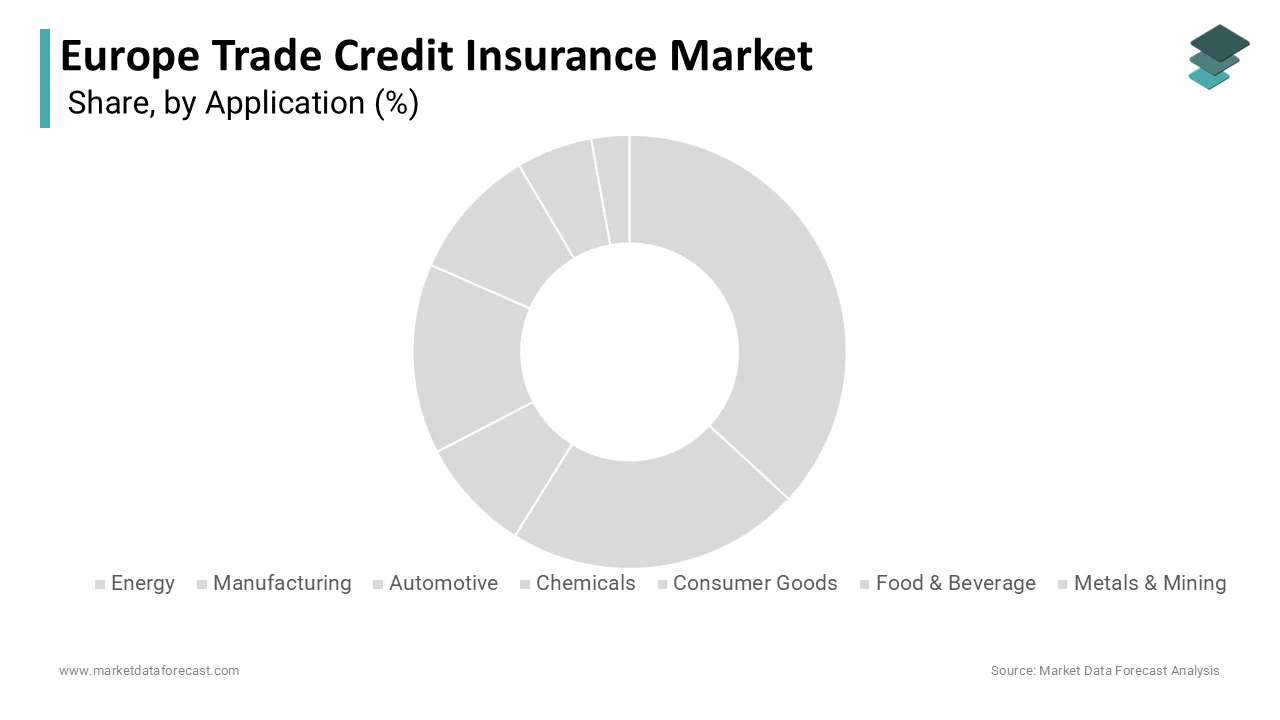
Trade credit insurance plays a critical role in protecting energy suppliers, traders, and distributors against non-payment while enabling them to extend competitive credit terms to customers. The surge in renewable energy investments, coupled with regulatory-driven shifts toward decarbonization, has further expanded the need for risk mitigation tools, particularly for new market entrants and long-term power purchase agreements (PPAs). As a result, insurers have seen strong demand from the energy sector for customized credit risk coverage, making it the dominant application segment in the European market.
COUNTRY LEVEL ANALYSIS
Germany Trade Credit Insurance Market Analysis
Germany dominated the European trade credit insurance market in 2025, supported by its strong export-oriented economy and extensive manufacturing base. German companies, particularly in automotive, machinery, chemicals, and industrial equipment, engage heavily in cross-border trade, which increases exposure to payment default risks. The widespread use of trade credit insurance helps German exporters safeguard receivables, maintain liquidity, and confidently expand into emerging and high-risk markets.
France Trade Credit Insurance Market Analysis
France represents a significant share of the European market, driven by diversified exports across aerospace, luxury goods, agriculture, and chemicals. French firms rely on trade credit insurance to manage buyer risk and economic uncertainty, especially when trading with Southern Europe, Africa, and the Middle East. Government-backed export credit support further reinforces market adoption.
United Kingdom Trade Credit Insurance Market Analysis
The UK trade credit insurance market is shaped by its strong financial services sector and high volume of international trade. Post Brexit trade realignments have increased payment risk awareness among exporters and SMEs, boosting demand for credit insurance to protect against buyer insolvency and delayed payments.
Italy Trade Credit Insurance Market Analysis
Italy’s market growth is supported by its large SME base, particularly in manufacturing, fashion, food processing, and machinery. Italian exporters increasingly use trade credit insurance to mitigate risks associated with longer payment terms and economic volatility in key export destinations.
Russia Trade Credit Insurance Market Analysis
Russia’s trade credit insurance demand is influenced by geopolitical tensions, sanctions, and currency volatility. Insurers operating in or around the Russian market focus heavily on political risk coverage and selective underwriting, making credit insurance essential for managing elevated counterparty risks.
COMPETITIVE LANDSCAPE
Competition in the European trade credit insurance market is defined by a triad of global insurers that blend technological sophistication with deep public sector integration. Allianz Trade, Atradiu,s and Coface dominate through differentiated models, private analytics, cs state partners, hip and hybrid risk pooling, ling yet all prioritize real-time risk intelligence and digital distribution. The market features high barriers to entry due to capital intensity, regulatory licensing,g and the need for proprietary buyer databases spanning millions of entities. Innovation focuses on predictive analytics, cs supply chain mapping, and embedded insurance within trade finance ecosystems. While price competition exists, it is secondary to service reliability, claims, speed,d and coverage breadth,th particularly for political risk. New entrants struggle to match the incumbents’ global monitoring networks and sovereign backing. Consequently, rivalry centers on strategic differentiation through technology partnerships, PSS policy responsiveness, and SME inclusivity rather than aggressive pricing or marketing.
KEY MARKET PLAYERS
Some of the companies that are playing a dominating role in the global europe trade credit insurance market include
- Allianz Trade (Euler Hermes)
- Atradius N.V.
- Coface S.A.
- Zurich Insurance Group
- AXA Group
- Chubb Limited
- American International Group, Inc. (AIG)
- QBE Insurance Group Limited
- Tokio Marine HCC
- Liberty Mutual Insurance Group
- Swiss Re Group
- Munich Re Group
- Berkshire Hathaway Specialty Insurance
- Credendo Group
- Mapfre S.A.
TOP LEADING PLAYERS IN THE MARKET
- Allianz Trade operates as a global leader in trade credit insurance with a deeply entrenched presence across Europe through localized risk analysts and real-time monitoring of over two hundred million companies worldwide. The company integrates proprietary economic forecasting with on-the-ground intelligence to deliver dynamic credit limits that adapt to regional volatility. It also expanded its sustainability risk module to assess how climate transition policies impact buyer solvency in carbon-intensive sectors, thereby reinforcing its role in both financial and strategic risk advisory across global supply chains.
- Atradius, headquartered in Amsterdam,m maintains a robust footprint in the European trade credit insurance market, et supported by its dual capacity as a private insurer and partner to export credit agencies. The company contributes significantly to global trade stability by covericross-borderder transactions in over seventy countries with specialized expertise in emerging market political risk. It also deepened integration with major European banking platforms, allowing real-time policy verification during invoice financing applications. These innovations strengthen its position as a bridge between commercial insurers, public export guarantees,s and corporate treasury functions worldwide.
- Cofa,ce based in Paris, combines commercial insurance operations with a strategic mandate from the French state to support national exporter,s, particularly in high-risk and strategic sectors. The company plays a pivotal role in the global market by offering hybrid policies that blend private underwriting with state reinsurance for transactions in sanctioned or conflict-affected regions. It also partnered with the European Investment Bank to co-insure SME export portfolios under the Pan-European Guarantee Fund. This dual public-private model enables Coface to absorb systemic shocks while expanding access for smaller enterprises across global trade corridors.
TOP STRATEGIES USED BY THE KEY MARKET PARTICIPANTS
Key players in the European trade credit insurance market emphasize real-time data analytics to deliver dynamic credit limits and predictive default alerts. They embed insurance solutions into digital trade finance platforms to enable seamless point of sale coverage for B2B transactions. Strategic partnerships with public export credit agencies and multilateral institutions facilitate risk sharing on high-exposure or politically sensitive deals. Companies invest in AI and machine learning to enhance buyer risk scoring and automate claims processing. Additionally, they localize content and underwriting criteria to reflect national insolvency laws, language preferences,s and sectoral vulnerabilities across diverse European markets.
MARKET SEGMENTATION
This research report othe europe trade credit insurance market is segmented and sub-segmented into the following categories.
By Application
- Energy
- Manufacturing
- Automotive
- Chemicals
- Consumer Goods
- Food & Beverage
- Metals & Mining
- Others
By Country
- Germany
- France
- United Kingdom
- Italy
- Russia
- Rest of Europe