Europe Used Truck Market Size, Share, Trends & Growth Forecast Report By Vehicle Type, By Sales Channel, By End User, and By Country (Germany, France, United Kingdom, Italy, Poland, Spain, Netherlands & Rest of Europe) – Industry Analysis and Forecast, 2026 to 2034
Market Size, 2025
$8.03 BnMarket Estimate, 2026
$8.38 BnMarket Forecast, 2034
$11.79 BnCAGR, 2026–2034
4.35%Europe Used Truck Market Size
The europe used truck market was valued at USD 8.03 billion in 2025, is estimated to reach USD 8.38 billion in 2026, and is projected to reach USD 11.79 billion by 2034, growing at a CAGR of 4.35% from 2026 to 2034.
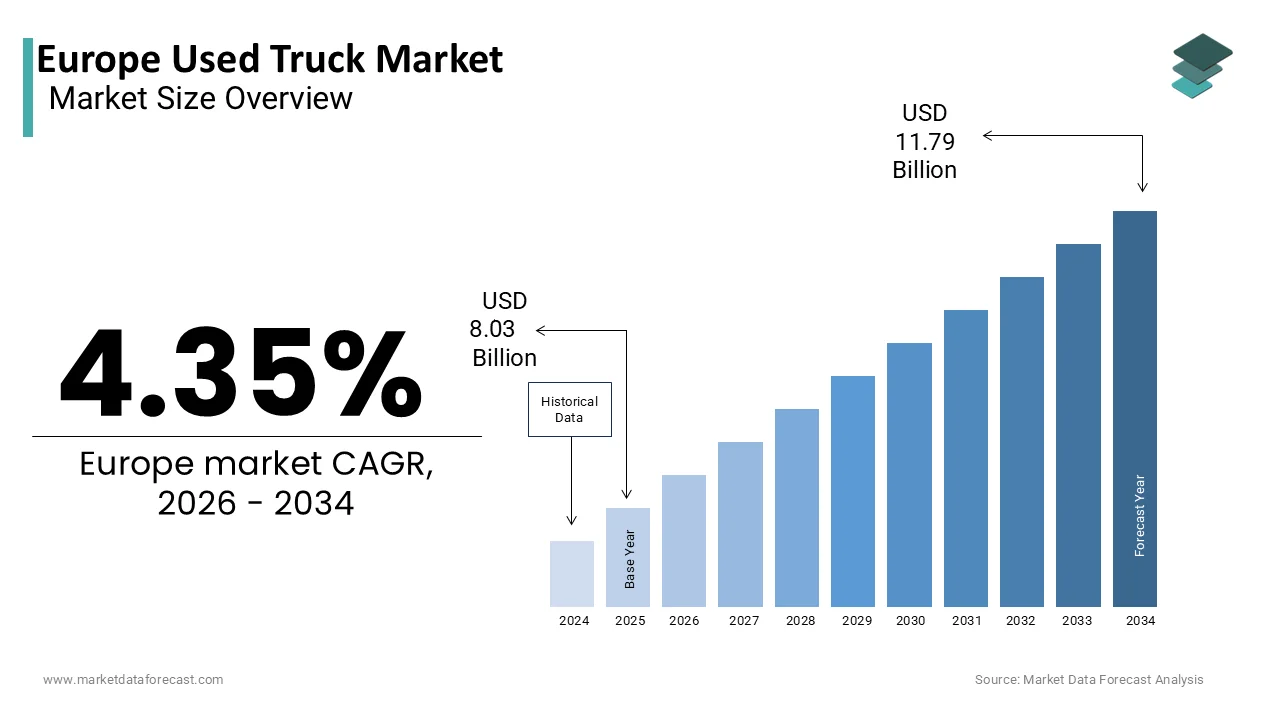
The used truck is a liquidity mechanism within the continental commercial vehicle ecosystem, enabling the redistribution of heavy-duty assets from mature logistics operators to emerging carriers and cross-border buyers. This sector facilitates the extension of asset lifecycles by ensuring that vehicles remain productive long after their initial depreciation curves flatten. According to the European Commission, road freight transport accounts for approximately 76% of all inland freight movement in the European Union, creating a perpetual demand for reliable hauling capacity. Data from the European Automobile Manufacturers Association indicates that the average age of the heavy commercial vehicle fleet in several Eastern European nations exceeds 14 years, with a structural reliance on secondary inventory to maintain operations. The transition toward stricter Euro 6 emission standards has further complicated the landscape, as operators seek compliant used units to avoid urban access restrictions, while managing capital expenditure.
MARKET DRIVERS
High Capital Expenditure for New Vehicles Driving Substitution
The substantial financial barrier associated with purchasing new commercial vehicles, which forces many operators to seek cost-effective alternatives in the secondary sector. The high capital expenditure for new vehicles is substantially propelling the growth of the European used truck market. The list price for a new heavy-duty tractor unit has escalated significantly due to advanced emission control technologies and digital integration features. According to the International Road Transport Union, the average cost of a new Euro 66-compliant truck increased by nearly 20% over the last five years, placing them out of reach for small and medium-sized enterprises. Data from the European Central Bank reveals that borrowing costs for commercial vehicle loans rose sharply in 2023, with interest rates reaching levels not seen in over a decade, thereby dampening appetite for new asset financing. This economic climate compels fleet managers to extend the life of existing assets or purchase slightly older models that offer a better return on investment. As per industry analysis by major leasing companies, the total cost of ownership for a 3-year-old truck can be up to 35% lower than that of a brand-new equivalent when factoring in depreciation and financing charges. Consequently, demand shifts aggressively toward the used market where buyers can acquire capable machinery without the steep initial capital outlay, ensuring business continuity despite tight credit conditions and inflationary pressures on operational budgets.
Robust Cross-Border Demand from Emerging European Markets
The insatiable demand for affordable heavy-duty vehicles is significantly boosting the growth of the European used truck market. Operators in countries with less stringent immediate emission mandates or lower labor cost structures actively seek well-maintained vehicles from countries like Germany, France, and the Netherlands. According to the European Association of Vehicle Traders, over 40% of used heavy commercial vehicles registered in Western Europe are eventually exported to Eastern European nations or non-EU neighbors. Data from national registration authorities shows that Poland and Romania consistently rank among the top destinations for imported used trucks, absorbing thousands of units annually to support their growing logistics sectors. This flow is facilitated by the single market principles that allow relatively frictionless movement of goods and vehicles across borders. As per the Federation of European Motor Vehicle Manufacturers, the average age of trucks entering these Eastern fleets is often between 7 and 10 years, representing the sweet spot for value and reliability.
MARKET RESTRAINTS
Regulatory Uncertainty Regarding Future Emission Zones
The expanding network of Low Emission Zones and Zero Emission Zones in major urban centers, which severely limits the operational utility of older diesel vehicles, is clearly hindering the growth of the European used truck market. Cities across the continent are increasingly banning trucks that do not meet the latest Euro 6 standards, rendering a significant portion of the used inventory obsolete for last-mile and urban distribution tasks. According to the European Environment Agency, over 300 low-emission zones are currently active across Europe, with numbers expected to double by 2025 as municipalities accelerate decarbonization efforts. Data from the City Logistics Forum indicates that non-compliant vehicles face daily fines or complete access bans in key economic hubs like Paris, London, and Berlin, drastically reducing their residual value. This regulatory fragmentation creates uncertainty for buyers who fear that a purchased used truck may become unusable in certain regions within a short timeframe. As per the European Commission’s Urban Access Regulations database, the criteria for entry are becoming stricter, with some cities planning to ban all internal combustion engine trucks by 2030. Consequently, demand for pre-Euro 6 vehicles is contracting rapidly, forcing sellers to discount prices heavily or struggle to find buyers willing to take the risk of stranded assets, thereby stifling liquidity for a large segment of the existing used truck population.
Scarcity of Compliant Used Inventory Due to Extended Retention
The artificial scarcity of high-quality, emission-compliant used vehicles caused by operators retaining their assets for longer periods than historically normal is additionally hampering the growth of the European used truck market. The combination of supply chain disruptions for new trucks and high replacement costs has led fleet owners to postpone retirement schedules. According to the European Leasing Association, the average holding period for heavy commercial vehicles has extended from 4 years to nearly 6 years in recent times as companies strive to maximize the utility of every unit. Data from major OEMs indicates that new truck delivery times remained elevated throughout 2023, with some orders facing delays of up to 12 months, forcing users to hold onto old stock indefinitely. As per analysis by automotive valuation guides, the volume of three to five-year-old trucks available for sale dropped by approximately 25% compared to pre-pandemic levels.
MARKET OPPORTUNITIES
Digitalization of Used Vehicle Trading Platforms
The rapid adoption of sophisticated digital platforms that streamline the buying and selling process through enhanced data transparency and virtual inspection tools is attributed to leveraging the growth of the European used truck market. Traditional methods relying on physical auctions and localized dealerships are giving way to online marketplaces that offer comprehensive vehicle histories, real-time condition reports, and remote viewing capabilities. Data from leading automotive listing portals shows that listings equipped with 360-degree virtual tours and detailed telematics data sell 40% faster than those with standard photographs. This shift allows sellers to reach a pan-European audience instantly, breaking down geographical barriers that previously limited market reach. The integration of blockchain technology for immutable maintenance records is further boosting buyer confidence by eliminating fraud and odometer tampering concerns. These digital ecosystems reduce transaction costs and time-to-sale, enabling a more efficient matching of supply and demand.
Expansion of Certified Pre-Owned Programs by OEMs
The burgeoning trend of Original Equipment Manufacturer-certified pre-owned programs by injecting factory-backed reliability into the secondary sector is giving rise to new opportunities for the growth of the European used truck market. Major truck manufacturers are increasingly entering the used market directly, offering refurbished units with extended warranties, genuine parts, and rigorous multi-point inspections that mimic new vehicle standards. According to the European Association of Automotive Suppliers, certified pre-owned sales volumes for heavy-duty trucks increased by 18% in 2023 as buyers sought assurance against mechanical failures. As per the study, over 60% of respondents stated they would prefer a certified used truck over a generic used unit even at a higher cost, which is citing peace of mind and predictable maintenance expenses.
MARKET CHALLENGES
Complexity of Cross-Border Registration and Compliance
The intricate and often inconsistent administrative procedures required for registering vehicles across different national jurisdictions are one of the challenges for the growth of the European used truck market. Despite the single market framework, each country maintains distinct requirements for technical inspections, taxation, and documentation, creating significant friction for cross-border transactions. According to the International Road Transport Union, operators frequently encounter delays of several weeks when attempting to re-register a used truck in a different member state due to bureaucratic inefficiencies and varying interpretations of EU directives. This administrative labyrinth increases the total cost of acquisition and discourages smaller traders from engaging in international arbitrage. As per the European Commission’s Single Market Enforcement Taskforce, the lack of full digital interoperability between national vehicle registries means that much of the process remains manual and prone to error.
Vulnerability to Economic Cycles and Freight Volume Fluctuations
The high sensitivity to broader economic cycles and fluctuations in freight volumes, which directly dictate the necessity for hauling capacity, is also slowing the growth of the European used truck market. When economic activity slows or manufacturing output declines, the immediate reaction from logistics companies is to halt fleet expansion and reduce demand for both new and used vehicles. Data from the European Road Haulers Association shows that during periods of economic uncertainty, freight rates often collapse, squeezing operator margins and eliminating the capital available for fleet renewal or expansion. This volatility creates a boom-and-bust cycle where used truck values can plummet rapidly if demand evaporates suddenly. As per economic forecasts from the European Central Bank, recurring fears of recession keep buyers on the sidelines, waiting for clearer signals before committing to large asset purchases. Furthermore, the rise of intermodal transport, shifting freight from road to rail in certain corridors, poses a structural threat to long-term truck demand. This inherent cyclicality makes it difficult for market participants to plan inventory levels accurately, leading to periods of oversupply followed by acute shortages, complicating strategic decision-making for dealers and fleet operators alike.
REPORT COVERAGE
| REPORT METRIC | DETAILS |
| Market Size Available | 2025 to 2034 |
| Base Year | 2025 |
| Forecast Period | 2026 to 2034 |
| Segments Covered | By Vehicle Type, Sales Channel, End User, and Region. |
| Various Analyses Covered | Global, Regional, and Country-Level Analysis, Segment-Level Analysis, Drivers, Restraints, Opportunities, Challenges; PESTLE Analysis; Porter’s Five Forces Analysis, Competitive Landscape, Analyst Overview of Investment Opportunities |
| Countries Covered | UK, France, Spain, Germany, Italy, Russia, Sweden, Denmark, Switzerland, Netherlands, Turkey, Czech Republic, Rest of Europe |
| Market Leaders Profiled | Daimler Truck AG, AB Volvo, Scania AB, MAN Truck & Bus, DAF Trucks, Iveco S.p.A., Renault Trucks, PACCAR Inc., Navistar International Corporation, Isuzu Motors Ltd., Penske Automotive Group, Ritchie Bros. Auctioneers, Enterprise Truck Sales, Rush Enterprises, Volvo Used Trucks |
SEGMENTAL ANALYSIS
By Vehicle Type Insights
The Heavy-duty Trucks segment accounted in holding 55.4% of the European used truck market share in 2025. The growth of the segment is majorly driven by the indispensable role these vehicles play in long-haul freight transport, which constitutes the backbone of the European supply chain. Also, the sheer volume of goods moved across borders requires robust and high-capacity vehicles that only heavy-duty units can provide. The operational lifespan of these assets, as heavy-duty trucks are engineered for durability and often remain in service for 10 to 15 years, creates a deep and liquid secondary market. Data from the European Automobile Manufacturers Association indicates that the average age of heavy trucks in operation exceeds 8 years, ensuring a steady flow of units into the used market as fleets refresh to meet emission standards. Furthermore, the high capital cost of new heavy-duty units forces many small operators to rely exclusively on the secondary market for acquisition.
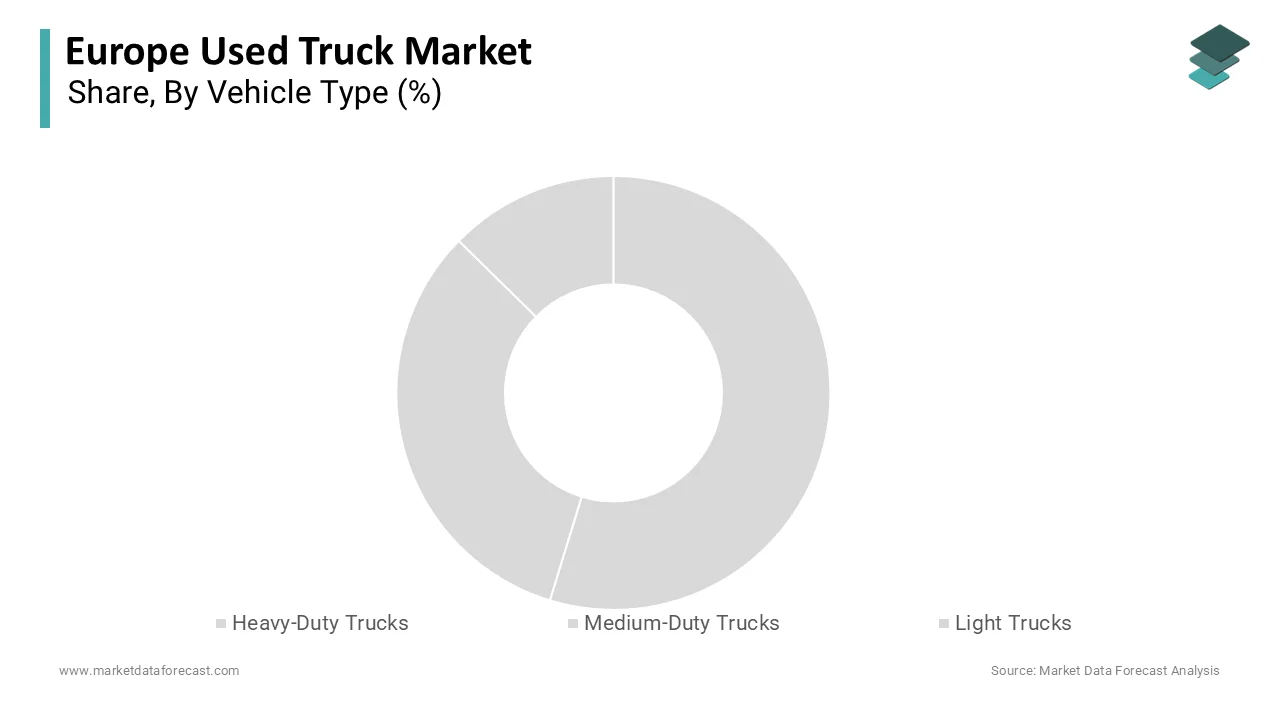
The light trucks segment is projected to register the fastest CAGR of 6.8% during the forecast period, owing to the explosive growth of the e-commerce sector and the corresponding surge in last-mile delivery requirements across urban centers. Also, the shift in consumer behavior toward online shopping, which necessitates a vast fleet of agile vehicles capable of navigating congested city streets efficiently. The rise of gig economy logistics providers, who prefer acquiring affordable used light trucks to minimize startup costs and operational risks, is additionally surging the growth of the segment. Data from the International Road Transport Union shows that the number of registered light commercial vehicles used for courier services increased by 20% over the last 3 years. Additionally, regulatory changes in many cities are pushing for smaller, cleaner vehicles for urban zones by making newer used light trucks highly attractive compared to older heavy units. As per the study, the turnover rate for light trucks is faster than any other class by creating a dynamic and high-volume secondary market that responds quickly to shifting delivery patterns.
By Sales Channel Insights
The franchised dealer segment was the largest with 45.3% of the European used truck market share in 2025, with the high level of trust and assurance that buyers associate with manufacturer-backed dealerships, for high-value heavy-duty assets. The availability of Certified Pre-Owned programs offered by original equipment manufacturers in Europe includes rigorous inspections, extended warranties, and genuine parts coverage that independent sellers cannot match. According to the European Association of Automotive Suppliers, many corporate fleet buyers prefer purchasing from franchised dealers to ensure compliance with maintenance contracts and residual value guarantees. Another key driver is access to proprietary diagnostic tools and software updates that only authorized dealers can provide by ensuring the vehicle meets the latest technical standards. Data from major truck manufacturers reveals that certified used units sold through franchised networks command a price premium of up to 15%, yet sell 30% faster than non-certified equivalents. Furthermore, franchised dealers often offer flexible financing and trade-in options that simplify the acquisition process for business customers.
The Peer-to-Peer segment is anticipated to grow at the fastest CAGR of 9.2% in the coming years, owing to the digital transformation of the used vehicle, which connects individual sellers directly with buyers, bypassing traditional intermediaries and reducing transaction costs. According to the European Digital Freight Alliance, the volume of peer-to-peer commercial vehicle transactions facilitated through digital marketplaces increased by 35% in 2023 alone. Another significant factor is the desire of small owner-operators and private sellers to maximize their returns by avoiding dealer margins and commissions. Additionally, the transparency provided by blockchain-based vehicle history reports is mitigating fears of fraud and odometer tampering, which historically hindered direct sales.
By End User Insights
The construction segment wccounted in holding 40.2% of the European used truck market share in 2025, with the continuous need for specialized heavy-duty vehicles such as dump trucks, concrete mixers, and crane carriers to support infrastructure development and building projects across the continent. The cyclical nature of construction work often favors the acquisition of rugged, cost-effective used equipment rather than expensive new units for temporary or project-specific needs. The harsh operating conditions inherent to construction sites, which accelerate wear and tear, prompt companies to frequently rotate stock and rely on the abundant supply of durable used trucks. Furthermore, the specialized configuration of construction trucks makes them less suitable for general freight, creating a distinct secondary market where these assets are traded among contractors. As per equipment rental association reports, the high utilization rates and strict safety regulations in the sector ensure that used trucks meeting current standards remain in high demand, solidifying construction as the primary end-user vertical.
The Oil and Gas segment is projected to grow at a CAGR of 5.5% during the forecast period with the ongoing maintenance and expansion of energy infrastructure, including pipeline projects and renewable energy installations, which require specialized heavy transport capabilities. The primary driver is the strategic push for energy security in Europe, following recent geopolitical shifts, leading to increased investment in domestic energy projects and LNG terminal construction. The transition toward hydrogen and carbon capture technologies, which utilize similar heavy-duty transport assets as traditional fossil fuel projects, extends the relevance of this sector. Additionally, the remote locations of many energy projects often necessitate the use of robust, pre-owned vehicles that can withstand difficult terrain without the high depreciation concerns of new assets.
COUNTRY LEVEL ANALYSIS
Germany Used Truck Market Analysis
Germany was the largest contributor to the European used truck market by holding 22.3% of the market share in 2025, with its massive automotive manufacturing base and its role as the central logistics hub for the continent, generating constant turnover of commercial vehicles. Also, stringent environmental regulations and Low Emission Zones in German cities, which force fleet operators to frequently upgrade to newer Euro 6-compliant models, are flooding the market with high-quality used units. According to the German Federal Motor Transport Authority, over 400000 heavy commercial vehicles were re-registered in 2023, with a significant portion being used imports or domestic resales. Another critical element is the strong export orientation of the German economy, which sustains a vibrant domestic freight sector requiring reliable transport capacity. Data from the German Truck Association shows that the average fleet renewal cycle in Germany is shorter than the European average, ensuring a steady supply of relatively young used trucks. Furthermore, Germany acts as a primary sourcing ground for exporters targeting Eastern European markets, leveraging its reputation for well-maintained vehicles.
France Used Truck Market Analysis
France's Used truck market growth is likely to grow with the diverse economy spanning agriculture, luxury goods, logistics, and extensive infrastructure projects. The government's aggressive push for modernizing the national freight fleet to meet climate goals by incentivizing the replacement of older polluting trucks with cleaner used alternatives. According to the French Ministry of Ecological Transition, subsidies and scrappage schemes have accelerated the turnover of commercial vehicles, increasing the volume of used trucks available for resale. Another factor prompting the growth of the market in this country is the vast agricultural sector, which relies heavily on medium and heavy-duty trucks for seasonal harvest transport, creating cyclical demand peaks. Additionally, France's strategic location as a gateway to Southern Europe makes it a key transit corridor, sustaining demand for reliable used haulage units.
United Kingdom Used Truck Market Analysis
The United Kingdom's truck market is expected to have significant opportunities throughout the forecast period, with the mature logistics sector and distinct regulatory framework. The intense competition in the UK courier and parcel delivery sector, driven by e-commerce growth, creates an insatiable demand for affordable light and medium-duty used trucks. According to the Road Haulage Association, the UK logistics industry employs over 1.5 million people and operates a fleet of nearly 500000 heavy goods vehicles, with a high turnover rate. Data from the Driver and Vehicle Licensing Agency shows that used truck registrations remained resilient in 2023 despite economic headwinds, reflecting the essential nature of road freight.
Italy Used Truck Market Analysis
Italy's truck market growth is likely to be driven by the strong manufacturing clusters in the north and its vital role in Mediterranean trade routes. The geographical necessity of road transport in Italy, due to limited rail freight capacity for certain goods, has made road transport the dominant mode for moving products across the peninsula and to neighboring countries. The prevalence of specialized transport sectors, such as food and beverage logistics, which require specific vehicle configurations often found in the used market. Additionally, the tourism and hospitality sectors drive demand for light trucks for supplies and services.
Poland Used Truck Market Analysis
Poland's used truck market growth is expected to witness huge opportunities in the coming year, with the major destination for used imports and a growing source of domestic resale activity. The unique as it serves as the primary absorption hub for Western European used trucks, while simultaneously developing its own robust domestic logistics industry. Another key driver is the cost advantage Polish operators enjoy in labor and operations by allowing them to profitably run slightly older trucks that might be phased out in Western Europe. Furthermore, the strategic location of Poland as a transit corridor between Western Europe and the East enhances the utility of every truck in the fleet. Research, the continuous influx of high-quality used trucks from Germany and France sustains a vibrant and high-volume secondary market essential for the continent's freight mobility.
COMPETITIVE LANDSCAPE
The competition within the European used truck market is intense and characterized by the presence of established original equipment manufacturer networks alongside independent dealers and emerging digital platforms. Major automotive brands leverage their factory backing and certified programs to secure premium pricing and long-term customer loyalty, while smaller independent traders often compete through lower prices and flexible negotiation terms. Regulatory complexity regarding emission standards across different European nations adds layers of challenge, requiring participants to maintain diverse inventories compliant with varying local laws. Strategic partnerships between manufacturers and financial institutions are common tactics employed to offer attractive leasing deals and stimulate demand. Furthermore, there is a growing emphasis on sustainability, which has prompted providers to highlight the environmental benefits of extending vehicle lifecycles through resale. This shift towards circular economy principles creates new battlegrounds where certification credibility becomes as crucial as vehicle condition.
KEY MARKET PLAYERS
Some of the companies that are playing a dominating role in the global European used truck market include
- Daimler Truck AG
- AB Volvo
- Scania AB
- MAN Truck & Bus
- DAF Trucks
- Iveco S.p.A.
- Renault Trucks
- PACCAR Inc.
- Navistar International Corporation
- Isuzu Motors Ltd.
- Penske Automotive Group
- Ritchie Bros. Auctioneers
- Enterprise Truck Sales
- Rush Enterprises
- Volvo Used Trucks
TOP LEADING PLAYERS IN THE MARKET
- Mercedes-Benz Truck Value Center operates as a premier network dedicated to the resale and certification of pre-owned commercial vehicles across Europe. The company contributes significantly to the global market by establishing rigorous standards for used truck quality and reliability that influence international trade practices. Their involvement includes managing a vast inventory of certified pre-owned units that undergo extensive multi-point inspections before sale. Recently, they have expanded their digital sales platforms to facilitate cross-border transactions and introduced flexible financing options tailored for small fleet operators. They also launched extended warranty programs specifically designed for high-mileage assets to boost buyer confidence.
- Volvo Trucks Certified Used Programme stands as a leading provider of quality-assured second-hand heavy-duty vehicles with a strong footprint throughout Europe. The company plays a vital role in the global market by offering specialized solutions that extend the lifecycle of commercial transport assets through refurbishment and advanced diagnostics. Their extensive network supports customers in achieving operational efficiency with reliable pre-owned machinery that meets strict safety norms. Recent actions include significant investments in telematics integration for used trucks to provide real-time performance data to new owners. They also enhanced their buyback schemes to ensure a steady flow of high-quality inventory into their certified channels. These efforts demonstrate their commitment to innovation and customer trust, ensuring they remain at the forefront of industry developments in the secondary vehicle sector.
- DAF Used Trucks is a prominent player in the European secondary commercial vehicle market, known for delivering value-driven solutions to diverse transport sectors. The company contributes to the global market by facilitating the efficient redistribution of robust medium and heavy-duty trucks that maintain high performance standards. Their involvement spans comprehensive inspection services and transparent history reporting that simplify the purchasing process for logistics companies. To strengthen its market position, DAF recently upgraded its online marketplace to feature virtual reality tours of available inventory and detailed maintenance records. They also partnered with financial institutions to offer competitive leasing rates for certified pre-owned units. These moves reflect their dedication to delivering high-value services that address the complex challenges of modern fleet management and cost optimization in a dynamic economic environment.
TOP STRATEGIES USED BY THE KEY MARKET PARTICIPANTS
Key players in this sector primarily focus on developing certified pre-owned programs to guarantee vehicle quality and build buyer trust through rigorous inspection protocols. Companies frequently invest in digital transformation initiatives to create seamless online marketplaces that enable virtual inspections and streamline cross-border purchasing processes. Another major strategy involves offering comprehensive after-sales support, including extended warranties and maintenance packages, to reduce ownership risks for customers. Additionally, organizations expand their dealer networks to provide localized services and faster delivery times to clients across different regions.
MARKET SEGMENTATION
This research report on the europe used truck market is segmented and sub-segmented into the following categories.
By Vehicle Type
- Heavy-Duty Trucks
- Medium-Duty Trucks
- Light Trucks
By Sales Channel
- Franchised Dealers
- Independent Dealers
- Peer-to-Peer
- Online Marketplaces / Digital Platforms
By End User
- Construction
- Oil & Gas
- Logistics & Transportation
- Agriculture
- Mining
- Waste Management
- Others
By Country
- Germany
- France
- United Kingdom
- Italy
- Poland
- Spain
- Netherlands
- Rest of Europe
Related Reports
Access the study in MULTIPLE FORMATS
Purchase options starting from
$ 2000
Didn’t find what you’re looking for?
TALK TO OUR ANALYST TEAM
Need something within your budget?
NO WORRIES! WE GOT YOU COVERED!
Call us on: +1 888 702 9696 (U.S Toll Free)
Write to us: sales@marketdataforecast.com