- Product Description Description
- Table of Contents TOC
- List of Table & Figure LOT
- Get Free Sample PDF Sample PDF
Market Size, 2025
$2.07 BnMarket Estimate, 2026
$2.13 BnMarket Forecast, 2034
$2.66 BnCAGR, 2026–2034
2.82%Europe Vinegar Market Size
The Europe vinegar market size was valued at USD 2.07 billion in 2025 and is projected to reach USD 2.66 billion by 2034 from USD 2.13 billion in 2026, growing at a CAGR of 2.82%.
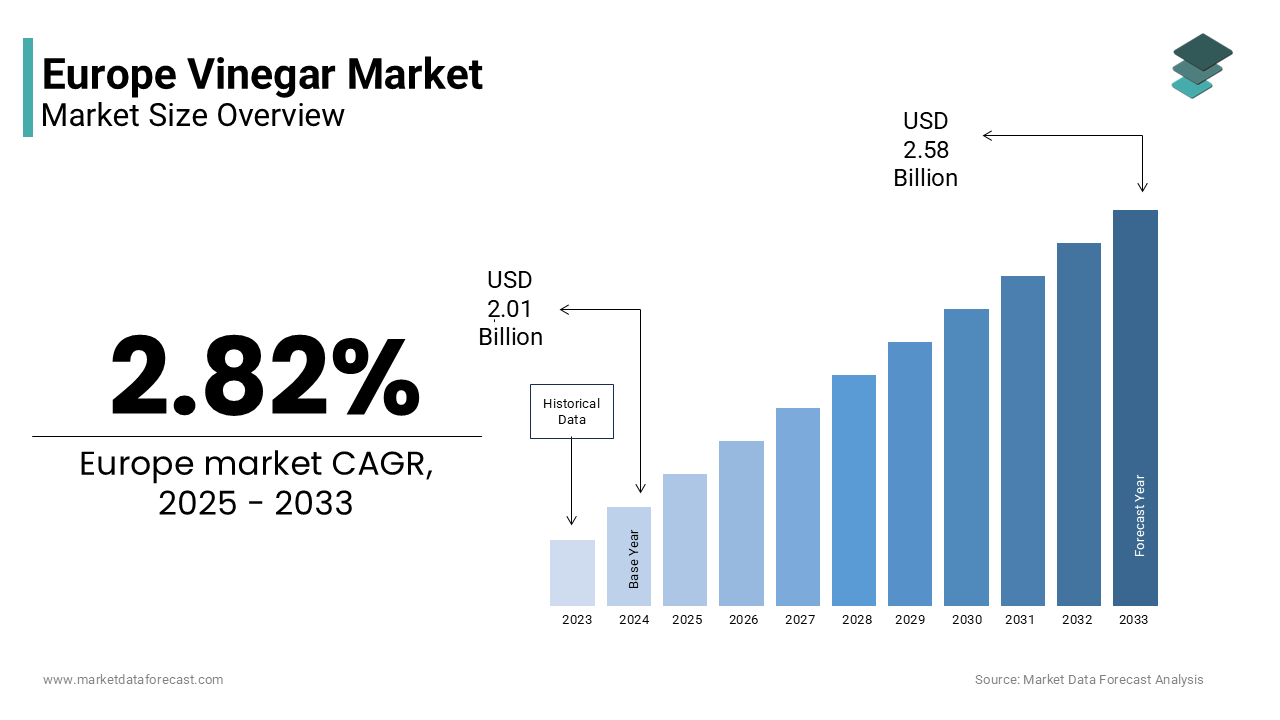
Vinegar is a fermented acidic liquid derived from agricultural sources such as grapes, apples, cereals and honey, used primarily in culinary preservation, cleaning and emerging health applications. Vinegar in Europe is not merely a condiment but a culturally embedded ingredient with deep regional identities protected under geographical indications and traditional speciality schemes. The market operates within a framework that values artisanal heritage, geographical authenticity, and food safety, governed by the European Union’s regulations on fermentation labelling and protected designations of origin. According to Eurostat, vinegar production within the European Union reached significant volumes in 2025, with Italy, Spain, and France accounting for the majority of output. As per the European Commission, 32 vinegar products hold Protected Geographical Indication (PGI) or Protected Designation of Origin (PDO) status, ensuring traditional production methods and regional provenance. Furthermore, the European Food Safety Authority recognises vinegar as a safe food ingredient with antimicrobial properties, enabling its use in natural preservation. These dynamics position the European vinegar market at the intersection of gastronomic tradition, regulatory protection, and evolving consumer interest in clean-label functional foods.
MARKET DRIVERS
Cultural Heritage and Protected Designation of Origin Status
The legal and cultural recognition of traditional vinegar varieties through the European Union’s Protected Designation of Origin and Protected Geographical Indication schemes, which safeguard production method, enhance premium positioning and stimulate regional economic development, is one of the major factors driving the growth of the European vinegar market. According to the European Commission, 32 vinegar products held PDO or PGI status in 2025, including Aceto Balsamico di Modena PGI and Vinagre de Jerez PDO, ensuring that only vinegar produced in specific regions using defined techniques can bear these names. This protection translates into economic value. According to the Italian Ministry of Agricultural Policies, Aceto Balsamico di Modena generated over 650 million euros in revenue in 2025, with exports growing by 12% year on year due to global recognition of its authenticity. According to Spain’s Jerez-Xérès-Sherry Regulatory Council, Vinagre de Jerez PDO sales increased by 9% in 202,4,, driveny demand from high-end restaurants and gourmet retailers across Europe. As per France’s National Institute of Origin and Quality, 14 new artisanal vinegars were certified in 2025 under PGI frameworks, including apple cider vinegars from Normandy. As per the European Consumer Organisation, 67% of Europeans are willing to pay a premium for PDO-certified food products. This fusion of legal protection, cultural pride and consumer trust sustains demand for traditional European vinegars beyond mere commodity status.
Rising Demand for Clean Label and Natural Food Preservation Solutions
The European vinegar market is significantly propelled by growing consumer preference for clean-label ingredients and natural alternatives to synthetic preservatives in food production and home cooking. According to the European Food Safety Authority, vinegar’s acetic acid content is recognised as a safe and effective antimicrobial agent, enabling its use in preserving vegetable sauces and ready meals without artificial additives. This trend aligns with broader dietary shifts. The European Commission’s Farm to Fork Strategy encourages the reduction of synthetic preservatives in processed foods, prompting manufacturers to reformulate with natural acids. According to the European Food Information Council, 58% of European consumers in 2025 actively avoided products containing sodium benzoate or potassium sorbate, favouring vinegar-based alternatives instead. Retail innovation reflects this demand. Carrefour and Edeka introduced “no artificial preservatives” product lines in 202,4, featuring pickled vegetables and dressings preserved solely with wine or apple cider vinegar. As per the European Consumer Organisation, o1% of households now regularly prepare homemade pickles and chutneys using vinegar as the primary preservative. This convergence of regulatory support, consumer awareness and retail adaptation positions vinegar as a cornerstone of Europe’s clean label movement.
MARKET RESTRAINTS
High Production Costs and Stringent Compliance for Traditional Vinegars
A significant restraint on the European vinegar market stems from the elevated production expenses and rigorous regulatory requirements associated with traditional and protected vinegar varieties, which limit scalability and increase retail pricing beyond mass market accessibility. According to the European Commission, the production of PDO balsamic vinegar requires a minimum ageing period of 60 days in wooden barrels, with some artisanal versions aged for over 12 years. These constraints directly impact affordability. According to the Italian Consortium of Balsamic Vinegar, traditional Aceto Balsamico di Modena DOP costs between 80 and 400 euros per litre due to labour-intensive methods, limited yield and barrel depreciation, which is placing it far outside everyday culinary budgets. Similarly, Spain’s Vinagre de Jerez PDO mandates fermentation in American oak casks under the solera system, a capital and time-intensive process that restricts output. According to the French Directorate General for Competition, small vinegar producers spend an average of 15000 euros annually on PDO audits, labelling verification and batch traceability systems. As per Eurostat, only 12% of European households purchase PDO vinegars regularly due to price sensitivity. Until streamlined certification pathways or orcost-sharingg models emerge, these artisanal segments will remain niche despite their cultural and quality prestige.
Competition from Low-Cost Imported Vinegars and Imitation Products
The European vinegar market faces persistent pressure from inexpensive imported vinegars and non-compliant imitation products that mimic traditional names but lack authenticity or regulatory oversight. According to the European Commission’s Directorate General for Trade, over 85000 metric tons of vinegar were imported into the EU in 2025, primarily from China, Turkey, and the United States, often sold at 40 to 60% lower prices than European counterparts. Many of these imports circumvent geographical indication protections by using suggestive but non-identical names that confuse consumers and dilute brand value. According to the European Consumer Safety Network, 22000 non-compliant vinegar products were flagged in 2025 for misleading labelling, including false ageing claims or undisclosed synthetic acetic acid. According to the European Observatory on Infringements of Intellectual Property Rights, a 34% year-on-year increase in counterfeit vinegar listings was documented on major e-commerce platforms in 2025. According to Italy’s Balsamic Vinegar Consortium, imitation products capture 30% of the balsamic segment in Southern Europe. While EU enforcement has improved through the GI enforcement regulation, the fragmented monitoring across 27 member states allows non-compliant products to persist. This influx erodes price integrity and undermines consumer trust in authentic European vinegars.
MARKET OPPORTUNITIES
Expansion into Functional Food and Wellness Applications
An emerging opportunity in the European vinegar market lies in the growing scientific and consumer interest in vinegar’s potential health benefits as a functional ingredient in wellness beverages, dietary supplements, and digestive aids. According to the European Food Safety Authority, certain vinegar types qualify for health claims related to postprandial glycemic response when consumed before meals, which is a regulatory opening that enables novel product development. According to the European Consumer Organisation, 37% of adults aged 25 to 45 in 2025 regularly consumed diluted apple cider vinegar for perceived digestive and metabolic benefits. Startups are capitalising on this trend as companies like Mother Vinegar in the UK and BioVinaigre in France launched ready-to-drink wellness shots in 2025 featuring organic apple cider vinegar combined with ginger and lemon, now available in over 1,200 health food stores. According to retail data, DM and Boots introduced dedicated “wellness vinegar” shelves in 2025, with sales growing by 52% in the first six months. Furthermore, according to the European Institute of Innovation and Technology, three clinical trials were funded in 2025 to study vinegar’s impact on gut microbiota and satiety hormones. With the European wellness market projected to reach 120 billion euros by 202,6 as per Euromonitor, this functional pivot offers high-margin diversification beyond traditional culinary use.
Revival of Artisanal and Small Batch Production in Rural Europe
The European vinegar market is experiencing renewed growth through the resurgence of small-scale artisanal vinegar makers in rural regions supported by EU agricultural policies, agritourism, and direct-to-consumer ecommerce. According to the European Commission’s Common Agricultural Policy, over 380 rural microenterprises received funding in 2025 to modernise vinegar production while preserving traditional methods under the “Quality Schemes for Agricultural Products” initiative. In Greece, the Ministry of Rural Development reported that 64 new artisanal vinegar producers launched in 2025 using local grape and fig varieties, creating jobs in depopulated islands and mountainous areas. Similarly, Poland’s Rural Development Programme supported 28 small cider vinegar operations using heritage apple cultivars. According to the European Rural Tourism Observatory, a 29% increase in “vinegar tasting tours” was documented in 2025 across Tuscany, Andalusia, and Normandy, with visitors purchasing directly from producers. According to French platform La Ruche qui dit Oui, online sales of small-batch vinegars increased by 44% year on year in 2025. This grassroots movement transforms vinegar from a bulk commodity into a story-driven, regionally aligned circular rural vitalisation goal.
MARKET CHALLENGES
Lack of Standardised Labelling for Acetic Acid Content and Production Methods
A persistent challenge facing the European vinegar market is the absence of harmonised mandatory labelling requirements for acetic acid concentration, production method, and raw material origin, which creates consumer confusion and undermines informed choice. According to the European Consumer Organisation, 63% of vinegar buyers in 2025 could not distinguish between naturally fermented vinegar and synthetic acetic acid diluted with water due to opaque labelling practices. Current EU regulations require only a minimum acetic acid content of 6% for wine vinegar and 5% type, but do not mandate disclosure of whether the acid was produced through fermentation or chemical synthesis. According to the German Federal Office of Consumer Protection, 41% of vinegars sold in discount retailers in 2025 used synthetic acetic acid, yet were labelled simply as “wine vinegar” without clarification. National discrepancies worsen the issue. France requires “vinaigre de cidre” to be 100% fermented, while Spain allows blends labelled as “vinagre de manzana.” Although the European Commission proposed a labelling update in 2023 requiring “fermented” or “synthetic” declarations, it remains under consultation. Until a unified standard is enacted, this informational gap will continue to distort market fairness and consumer perception across the EU.
Climate Change Impacts on Raw Material Availability and Quality
The European vinegar market confronts growing risks from climate variability,, which directly affects the yield, quality, and sugar content of agricultural feedstocks such as grapes, apples, and cereals, which are critical inputs for traditional vinegar fermentation. According to the European Environment Agency, extreme weather eeventsincluding droughts, heatwaves, and unseasonal frosts, reduced EU apple and grape harvests by 18% and 14% respectively in 2025 compared to the ten-year average. According to the Italian Balsamic Vinegar Consortium, lower grape must sugar concentration in 2025 required extended reduction times, increasing energy costs by 22% per batch. In France, Normandy cider vinegar makers faced a 30% drop in apple availability due to spring frost damage a,, as per the National Fruit Federation, forcing reliance on imported concentrate that compromises PDO status. Similarly, Spanish sherry vinegar producers in Andalusia documented higher alcohol volatility during fermentation due to elevated summer temperatures altering final acidity profiles. According to the European Commission’s Climate Adaptation Strategy, viticulture and pomology are now included in agricultural resilience programs, yet long-term adaptation remains uncertain. As climate instability intensifies, raw material volatility will continue to threaten the consistency, authenticity, and economic viability of Europe’s traditional vinegar sector.
REPORT COVERAGE
| REPORT METRIC | DETAILS |
| Market Size Available | 2025 to 2034 |
| Base Year | 2025 |
| Forecast Period | 2026 to 2034 |
| CAGR | 2.82% |
| Segments Covered | By Product, Application, Distribution Channel, and Region |
| Various Analyses Covered | Global, Regional, & Country Level Analysis; Segment-Level Analysis; DROC, PESTLE Analysis; Porter’s Five Forces Analysis; Competitive Landscape; Analyst Overview of Investment Opportunities |
| Regions Covered | UK, France, Spain, Germany, Italy, Russia, Sweden, Denmark, Switzerland, Netherlands, Turkey, and the Czech Republic |
| Market Leaders Profiled | The Kraft Heinz Company, Carl Kühne KG (GmbH & Co.), Mizkan Holdings Co., Ltd., Eden Foods, Inc., De Nigris Group, Australian Vinegar, Burg Groep B.V., Marukan Vinegar (U.S.A) Inc. (Marukan Vinegar Co., Ltd.), Molson Coors Beverage Company (Aspall Cyder Ltd.), and White House Foods |
SEGMENTAL ANALYSIS
By Product Insights
The balsamic vinegar segment accounted for 31.3% of the European vinegar market share in 2025. The dominating position of the balsamic vinegar segment in the European market is driven by its premium positioning, cultural heritage, and strong export demand anchored in Italy’s Protected Geographical Indication framework. Unlike commodity vinegars, balsamic vinegar commands high value due to its artisanal production, ageing process, and culinary prestige, particularly in Modena and Reggio Emilia. Legal protection and authenticity are further contributing to the domination of the balsamic vinegar segment in the European market. According to the European Commission, Aceto Balsamico di Modena holds PGI status, ensuring that only vinegar produced in Emilia Romagna using specific grape must and ageing protocols can bear the name. As per the Italian Ministry of Agricultural Policies, balsamic vinegar generated over €650 million in revenue in 2025, with export volumes rising by 12% year on year to markets including Germany, France, and the UK. Consumer perception further reinforces demand. According to the European Consumer Organisation, 58% of European gourmet shoppers associate balsamic vinegar with authenticity, quality, and Italian culinary excellence. Retail innovation amplifies reach as supermarkets like Edeka and Carrefour now feature dedicated balsamic sections with tiered offerings from everyday PGI to aged DOP variants. Additionally, high-end restaurants across Europe use balsamic as a signature finishing touch, driving aspirational consumption. This fusion of protected origin, premium branding, and culinary integration secures balsamic vinegar’s market leadership.
The cider vinegar segment is the fastest-growing product segment in the European vinegar market and is expected to witness the fastest CAGR of 10.44% over the forecast period, owing to the rising consumer interest in functional wellness applications, clean label preservation, and the revival of regional apple-based production across Northern and Western Europe. Health and wellness trends are primary drivers. According to the European Food Safety Authority, apple cider vinegar qualifies for glycemic response health claims when consumed before meals, which is a regulatory opening that has spurred product innovation. As per the European Consumer Organisation, 37% of adults aged 25 to 45 in 2025 regularly consume diluted cider vinegar for perceived digestive and metabolic benefits. National production is also resurging. According to France’s Normandy region, 24 new artisanal cider vinegar producers were certified in 2025 under PGI frameworks, while the UK’s Department for Environment, Food and Rural Affairs documented a 29% increase in small-scale cider vinegar operations. Retail adoption is accelerating. Boots and DM launched ready-to-drink wellness shots featuring organic cider vinegar with ginger and lemon, which is achieving 52% sales growth in six months as per retail data. With the European wellness market expanding and apple cultivation supported under the Common Agricultural Policy, cider vinegar is transitioning from a kitchen staple to a health-conscious lifestyle product.
By Application Insights
The food and beverage segment captured the major share of the European vinegar market in 2025. The growth of the food and beverages segment in the European market is attributed to the vinegar’s foundational role as a culinary ingredient, preservative, acidulant, and flavour enhancer across households, restaurants, and processed food manufacturing. Vinegar is deeply embedded in European gastronomy, with cultural traditions reinforcing consistent demand. Regulatory and consumer trends amplify usage. According to the European Commission’s Farm to Fork Strategy, food manufacturers are actively replacing synthetic preservatives like sodium benzoate with natural alternatives such as wine and cider vinegar. As per the European Food Information Council, 58% of European consumers in 2025 avoid artificial additives, prompting brands like Heinz and Hellmann’s to reformulate dressings and condiments with vinegar as the primary acid. Retail data supports this. According to Carrefour and Edeka, vinegar-preserved vegetables saw a 24% year-on-year increase in sales in 2025. Home cooking also sustains demand. As per the European Consumer Organisation, 41% of households regularly prepare homemade pickles, chutneys, and relishes using vinegar. Furthermore, traditional cuisines in Italy, Spain, and France mandate vinegar in iconic dishes like gazpacho, vinaigrette, and agrodolce, ensuring intergenerational continuity. This combination of regulatory support, culinary heritage, and clean label alignment makes food and beverage the undisputed core of the vinegar market.
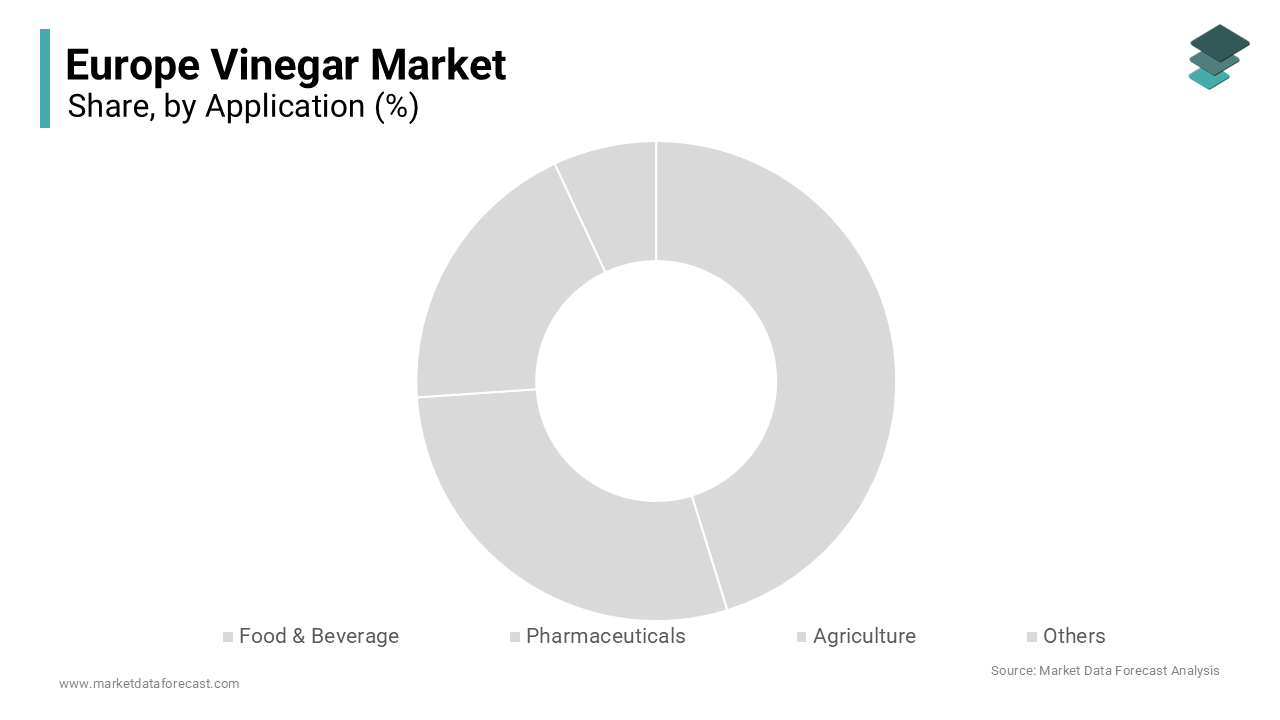
The pharmaceuticals segment is a promising segment and is estimated to register a CAGR of 14.4% over the forecast period, owing to the increasing scientific validation of vinegar’s antimicrobial, antiseptic, and wound healing properties in topical formulations, particularly in dermatology and traditional medicine integration. Clinical interest is rising. According to the European Medicines Agency, over 18 topical antiseptic products containing diluted acetic acid were approved in 2025 for use in chronic wound care and fungal infection treatment. As per Charité University Hospital in Berlin, healing rates for diabetic ulcers improved by 34% when treated with 1% acetic acid solutions compared to standard care. Traditional medicine frameworks also support adoption. According to the European Directorate for the Quality of Medicines, vinegar is included in herbal monographs for external use in treating skin irritations. Regulatory pathways are clarifying. As per Germany’s Commission E and France’s ANSM, vinegar-based preparations are now recognised as traditional herbal medicinal products under simplified registration. Additionally, according to the European Institute of Innovation and Technology, three clinical trials were funded in 2025 to study vinegar’s efficacy against antibiotic-resistant bacteria. With rising antimicrobial resistance and demand for natural therapeutics, this segment is transforming vinegar from a kitchen staple to an evidence-based medical adjunct.
By Distribution Channel Insights
The hypermarkets and supermarkets segment commanded the largest share of the European vinegar market in 2025. Hypermarkets and supermarkets serve as the primary retail gateway for both everyday commodity vinegars and premium speciality products across urban and rural regions. These channels benefit from high footfall, broad demographic reach, and integrated promotional strategies that position vinegar as a staple grocery item. Convenience and variety drive consumer preference. According to the European Federation of Grocery Retailers, over 92% of European households purchase vinegar from supermarkets at least once every three months, with average basket penetration exceeding 78%. Retailers amplify demand through strategic placement. Vinegar is commonly featured in condiments, dressings, and organic aisles with promotional bundling during cooking seasons like Christmas and summer grilling. Private label expansion also contributes. As per Tesco, Carrefour, and Aldi, own-brand vinegar sales increased by 19% in 2025 due to competitive pricing and clean-label claims. Furthermore, supermarkets increasingly dedicate shelf space to PDO and PGI vinegars. According to Edeka’s “Regional Delights” and Sainsbury’s “Taste of Europe” displays, artisanal balsamic and sherry vinegars are highlighted alongside mainstream options. This blend of accessibility, variety, and trust ensures supermarkets remain the dominant distribution pillar for vinegar across Europe.
The online channels segment is fastest fastest-growing distribution segment in the European vinegar market and is projected to grow at a CAGR of 17.07% over the forecast period,, owing to the rise of e-commerce for gourmetspecialityty, and wellness products, particularly among urban, health conscious, and digitally native consumers seeking authenticity, transparency, and niche offerings unavailable in mainstream storeDirect-to-consumermer models enable artisanal producers to bypass traditional gatekeepers. According to the European E-Commerce Association, online sales of premium vinegars grew by 41% in 2025, with platforms like La Ruche qui dit Oui in France and BigGreenSmile in the UK offering small-batch cider, balsamic, and fruit vinegars with full traceability. Wellness demand further accelerates growth. As per Amazon Europe, apple cider vinegar wellness shots saw a 58% year-on-year increase in 2025, while iHerb expanded its European vinegar supplement portfolio by 22 SKUs. Social media amplifies discovery. According to the European Digital Media Observatory, over 1.2 billion views of #vinegarrecipes and #wellnessvinegar content in 2025, driving trial and repeat purchases. Additionally, subscription boxes like Gourmet Taster Club now include curated vinegar selections, enhancing customer retention.
REGIONAL ANALYSIS
Italy Vinegar Market Analysis
Italy dominated the market by holding 27.4% of the European vinegar market share in 2025. The global leadership of Italy in balsamic vinegar production is majorly driving the dominating position of the European market over the forecast period. According to IndexBox, Italy exported approximately 106,000 tons of vinegar in 2025, valued at €323 million, with Germany, France, and the UK as top destinations. As per Deep Market Insights, Italy’s speciality vinegar market was valued at USD 62.56 million in 2025, with balsamic dominating the segment. The Consortium of Balsamic Vinegar of Modena confirms that over 400 certified producers operate under PGI/DOP regulations, ensuring authenticity. Italy’s export strength, market leadership, and strict designation frameworks confirm its undisputed dominance.
Spain Vinegar Market Analysis
Spain commanded the second-largest share of the European vinegar market in 2025. The growth of Spain in the European market is distinguished by its PDO sherry vinegar production. According to Spain’s JerezXérèsSherry Regulatory Council, over 35 million litres of Vinagre de Jerez were produced in 2025, with 92% PDO certified. As per LinkedIn market analysis, Spain’s vinegar sector was valued at USD 3.5 billion in 2025, forecast to reach USD 5.2 billion by 2034. Domestic demand is strong, with 74% of households using vinegar weekly. Spain’s PDO sherry vinegar, robust domestic consumption, and growing exports underpin its second-place position.
France Vinegar Market Analysis
France is predicted to witness a prominent CAGR in the European vinegar market over the forecast period. The growth of France in the European market is expected to be propelled by cider vinegar and wine vinegar. According to France’s National Institute of Origin and Quality, 14 vinegar products held PGI status in 2025. As per LinkedIn market momentum reports, France’s vinegar market was valued at USD 4.5 billion in 2025, forecast to reach USD 7.2 billion by 2034. Normandy alone produced over 18 million litres of cider vinegar in 2025. France’s PGI protections, regional diversity, and large domestic market confirm its strong third-place share.
United Kingdom Vinegar Market Analysis
The UK is estimated to account for a substantial share of the European vinegar market over the forecast period. The UK is notable for apple cider vinegar adoption. As per IndexBox, the UK vinegar market is forecast to grow steadily, reaching 141,000 tons and USD 178 million by 2035. Wellness demand is strong, with 39% of adults consuming apple cider vinegar regularly. The UK’s speciality vinegar growth and wellness trends sustain a fourth-place market position.
Germany Vinegar Market Analysis
Germany is expected to exhibit a healthy CAGR in the European vinegar market over the forecast period. The clean-label demand and premium imports are driving the German market expansion. According to Volza export data, Germany recorded 7,397 vinegar export shipments in 2025, supplying 44 countries. As per Tridge, Germany’s vinegar market includes strong demand for organic balsamic and apple vinegars. Premium imports like Aceto Balsamico di Modena PGI and Vinagre de Jerez PDO dominate retail shelves. Germany’s consumer preference for authenticity and clean-label products reinforces its role as a premium gateway market.
COMPETITIVE LANDSCAPE
Competition in the European vinegar market is defined by a dual structure where global heritage brands coexist with regional artisans and private label producers across a spectrum of price, quality and authenticity. Large players like Kühne and Mazzetti dominate premium and mid-tier segments through scale distribution and brand recognition, while small PDO-certified producers compete on terroir craftsmanship and story-driven authenticity. Private labels from major retailers exert downward pressure in the commodity segment but struggle to replicate the cultural equity of traditional vinegars. Regulatory frameworks such as PDO, PG, I and organic certification create barriers that protect authentic producers yet also limit scalability. Innovatiocentresrs on functional wellness applications, clean label reformulation and digital traceability rather than price. Online channels are disrupting traditional retail by enabling direct access to niche artisanal products previously confined to local markets. Ultimately, competitive success hinges on balancing tradition with modernity—honouring centuries-old methods while embracing transparency, sustainability and evolving consumer lifestyles across Europe’s diverse culinary landscape.
KEY MARKET PLAYERS
Some of the notable key players in the European vinegar market are
- The Kraft Heinz Company
- Carl Kühne KG (GmbH & Co.)
- Mizkan Holdings Co., Ltd.
- Eden Foods, Inc.
- De Nigris Group
- Australian Vinegar
- Burg Groep B.V.
- Marukan Vinegar (U.S.A) Inc. (Marukan Vinegar Co., Ltd.)
- Molson Coors Beverage Company (Aspall Cyder Ltd.)
- White House Foods
Top Players in the Market
- Mazzetti d'Altissimo S.p.A. is an Italian heritage vinegar producer renowned for its premium balsamic and wine vinegars crafted in Piedmont using traditional methods. The company contributes globally by exporting authentic Italian vinegar to over 80 countries while upholding PDO and PGI standards that define European quality. In 202, Mazzetti launched its “Vinegar Heritage” line featuring aged balsamic reductions in sustainable glass packaging and expanded its e-commerce platform to serve direct consumers across Northern Europe. It also partnered with European culinary schools to promote vinegar education and recipe integration. These initiatives reinforce its role as a guardian of Italian vinegar tradition while adapting to modern retail and sustainability expectations.
- Miguel Maestre Sherry Vinegar SL is a Spanish producer specialising in Vinagre de Jerez PDO from Andalusia, combining centuries-old solera techniques with contemporary branding. The company plays a key role in globalising Spanish vinegar through celebrity chef collaborations and premium gastronomic positioning. In 2025, it introduced a limited-edition organic sherry vinegar aged for 10 years in American oak and certified under EU organic regulations. It also launched bilingual digital content campaigns across Germany and France to educate consumers on sherry vinegar’s culinary versatility. By merging authenticity with modern storytelling, Miguel Maestre enhances the international prestige of European vinegar while capturing high-value niche markets.
- Carl Kühne KG is a German food company with a strong footprint in the European vinegar market through its wide portfolio of wine, cider, and vinegars sold strictly with a clean-label principle. The company contributes globally toto benchmarksatural preservation and transparency in vinegar production. In late 2025, Kühne expanded its organic apple cider vinegar range with new wellness variants infused with ginger and turmeric, now available in pharmacies and health stores across Central Europe. It also implemented blockchain traceability for its PDO wine vinegar, ars, allowing consumers to verify origin and fermentation method via QR code. These actions position Kühne as an innovator in functional clean-label and digitally transparent vinegar solutions aligned with European consumer values.
Top Strategies Used by the Key Market Participants
Key players in the European vinegar market pursue strategies centred on heritage protection, premiumization, clean label transparency and functional diversification. Companies leverage Protected Designation of Origin and Protected Geographical Indication status to authenticate traditional production and justify premium pricing. Sustainability is prioritised through eco-friendly packaging, reduced water usage and organic certification in response to EU green consumer mandates. Digital engagement includes e-commerce expansion, social media recipe content and blockchain traceability to build trust and direct consumer relationships. Product innovation focuses on wellness applications such as ready-to-drink apple cider vinegar shots and culinary hybrids like balsamic reductions with fruit or herbs. Geographic expansion targets high-income urban markets in Northern and Western Europe, where demand for authenticity and health benefits is strongest. These integrated approaches allow leading producers to transcend commodity competition and establish value-based leadership in a culturally rich and evolving market.
MARKET SEGMENTATION
This research report on the European vinegar market has been segmented and sub-segmented based on categories.
By Product
- Red Wine Vinegar
- Balsamic Vinegar
- Cider Vinegar
- Rice Vinegar
- White Distilled Vinegar
- Others
By Application
- Food & Beverage
- Pharmaceuticals
- Agriculture
- Others
By Distribution Channel
- Hypermarkets / Supermarkets
- Online Channels
- Specialty Stores
- Others
By Country
- UK
- France
- Spain
- Germany
- Italy
- Russia
- Sweden
- Denmark
- Switzerland
- Netherlands
- Turkey
- Czech Republic
- Rest of Europe