- Product Description Description
- Table of Contents TOC
- List of Table & Figure LOT
- Get Free Sample PDF Sample PDF
Market Size, 2025
$1.03 BnMarket Estimate, 2026
$1.23 BnMarket Forecast, 2034
$5.09 BnCAGR, 2026–2034
19.47%Executive Summary: Europe Virtual Data Room Market
- Market Scope: Comprehensive European virtual data room (VDR) industry analysis covering deployment models, enterprise size tiers, business functions, regional country leadership frameworks, strategic corporate developments, and competitive landscapes.
- Market Valuation: Valued at USD 1.03 billion (2025), estimated at USD 1.23 billion (2026), and projected to reach USD 5.09 billion by 2034, registering a strong CAGR of 19.47% (2026–2034).
- Primary Growth Drivers: Escalating cross-border M&A activity, GDPR and NIS2 compliance mandates, functional shift from episodic deal tools to persistent ESG/regulatory reporting platforms, AI integration for intelligent redaction/classification, and sovereign cloud adoption. Restraints include fragmented national data residency interpretations, cybersecurity threats, and configuration expertise shortages.
Key Market Segment Metrics (2026–2034)
| Category | Leading Segment / Country (Position) | Fastest-Growing Segment |
|---|---|---|
| By Deployment Model | Cloud-based deployment (dominated with an 87.4% share in 2025 due to scalability and EU data sovereignty) | On-premise deployment (expected to register a CAGR of 9.1% driven by defense and critical infrastructure security) |
| By Enterprise Size | Large enterprises (captured 76.1% of market share in 2025 owing to complex cross-border transactions) | Small & Medium Enterprises / SMEs (anticipated to grow at a CAGR of 12.4% via tiered pricing & succession planning) |
| By Business Function | Mergers and acquisitions (held leading business function position with 58.3% share in 2025) | General enterprise activities (expected to register fastest CAGR of 14.7% driven by mandated ESG reporting) |
| By Region / Country | United Kingdom (led regionally with a 24.1% share in 2025, followed by Germany at 21.3% and France at 17.6%) | Advanced financial & legal hubs across Western Europe prioritizing auditable compliance infrastructure |
Major Market Players & Market Structure
Market Structure: Highly secure and competitive European virtual data room ecosystem driven by ISO 27001 data center certifications, GDPR-aligned dynamic watermarking features, AI document redaction, and Corporate Sustainability Reporting Directive (CSRD) reporting modules.
Key Companies: iDeals Solutions, Intralinks (SS&C Intralinks), Firmex, Brainloop GmbH, Ansarada, Citrix Systems Inc. (ShareFile), Box Inc., Dropbox Inc., Citadel Secure Collaboration Services, Drooms GmbH, Merrill DatasiteOne, CapLinked Inc., SecureDocs, EthosData, Watchdox (by BlackBerry), SmartRoom Inc., Veemly, Imprima (Avenir), RR Donnelley (Venue), NetDocuments Inc., and BlackBerry Limited.
Europe Virtual Data Room Market Size
The Europe Virtual Data Room Market is projected to grow from USD 1.03 billion in 2025 to USD 1.23 billion in 2026 and reach USD 5.09 billion by 2034, registering a CAGR of 19.47% from 2026 to 2034.
A virtual data room is a secure and cloud-based repository designed for the controlled sharing, collaboration, and management of sensitive documents during high-stakes transactions such as mergers and acquisitions, due diligence, initial public offerings, and regulatory compliance processes. In Europe, virtual data rooms have evolved from facilitators of deal-making into essential infrastructure for corporate governance, legal discovery, and cross-border collaboration under strict data protection regimes. Unlike generic file sharing platforms, these environments offer granular permission controls, dynamic watermarking, audit trails, and multi-factor authentication to meet the demands of regulated industries. According to Eurostat, the European Union recorded hundreds of thousands of cross‑border business transactions in 2023, each requiring secure document exchange frameworks. According to the European Commission, a large majority of large enterprises conduct at least one complex corporate transaction annually and require structured data room protocols to safeguard sensitive information. Furthermore, the General Data Protection Regulation (GDPR) imposes stringent obligations on the handling of personal and commercially sensitive data, which is effectively disqualifying non‑compliant collaboration tools. In this context, the virtual data room (VDR) transcends its transactional roots to become a strategic instrument of legal defensibility, operational transparency, and digital trust across Europe’s increasingly interconnected business landscape.
MARKET DRIVERS
Escalating Volume of Cross‑Border Mergers and Acquisitions Involving European Entities
The surge in cross‑border M&A activity across Europe is one of the key drivers of virtual data room (VDR) market growth in Europe. According to Refinitiv, European M&A volumes rose by 12% in 2023 compared to 2022, with nearly 9,800 announced transactions. These deals are increasingly complex, involving multilingual legal teams, auditors, and regulators accessing thousands of confidential documents. As per the UNCTAD’s World Investment Report 2025, FDI inflows into the EU reached $470 billion in 2023, reflecting strong investor appetite. According to the European Central Bank, strategic acquisitions in finance and energy sectors often involve tens of thousands of documents per deal, far exceeding manual handling capabilities. VDRs address this complexity by enabling time‑bound access, real‑time Q&A logs, and automatic redaction of sensitive clauses. As geopolitical uncertainty fuels consolidation in defense, renewables, and semiconductors, reliance on VDRs as secure transaction backbones continues to intensify. The rising deal volumes are directly driving demand for secure VDR platforms and contributing to the regional market expansion.
Stringent Compliance Requirements Under GDPR and NIS2 Directive
The European regulatory environment is also driving the virtual data room market expansion in Europe. GDPR mandates strict principles of data minimization, purpose limitation, and secure transmission, with the European Data Protection Board noting that 63% of M&A due diligence exercises in 2023 involved personal data. This compels organizations to adopt VDRs with auditable security and territorial data control. According to ENISA, 71% of regulated firms now mandate VDRs with ISO 27001 certification and EU‑hosted infrastructure for sensitive transactions in 2025. The NIS2 Directive, effective October 2025, requires critical entities in energy, transport, and finance to implement advanced cybersecurity measures, including secure document exchange protocols. These legal imperatives have transformed VDRs from optional conveniences into compliance necessities, with features like dynamic watermarking, access expiration, and jurisdiction‑locked storage becoming baseline expectations. The regulatory pressure is a key driver of VDR adoption in the European region.
MARKET RESTRAINTS
Persistent Reliance on Legacy Document Management Systems in Mid‑Sized Enterprises
Despite clear advantages, the adoption of VDRs across Europe’s mid‑market segment is restrained by entrenched reliance on outdated practices. According to the Eurostat’s SME Digitalisation Report 2023, 55% of EU SMEs with 50–249 employees still rely on basic cloud storage or email for confidential file sharing. Many SMEs continue to use on‑premises servers or shared drives, lacking the security granularity required for sensitive transactions. As per the European Investment Bank, only 30% of SMEs allocated dedicated IT security budgets in 2023, which is limiting their ability to procure advanced collaboration tools. German and Italian industrial SMEs frequently conduct asset sales or partnership negotiations using ad hoc PDF bundles sent via email and exposing them to data leakage and version confusion risks. Until providers develop tiered pricing models and demonstrate clear risk mitigation value, this segment will remain underpenetrated despite its transactional activity. The reliance on legacy systems restrains VDR adoption in Europe and impacts the regional market growth negatively.
Fragmented National Interpretations of Data Residency and Cross‑Jurisdictional Rules
The regulatory fragmentation is further hindering the European virtual data room market growth. According to the European Data Protection Board, 14 EU countries impose additional restrictions on the transfer of corporate transaction data outside national territory, even within the EEA. France’s Digital Republic Act requires that documents containing strategic industrial information be hosted exclusively on French soil during M&A processes involving national champions. Germany’s Federal Cartel Office mandates that competition authority submissions be processed through data rooms with servers located domestically. As per a 2025 survey by the European Confederation of Directors’ Associations, 67% of corporate legal teams reported delays in deal timelines due to compliance verification across jurisdictions. These divergences force VDR vendors to maintain multiple sovereign cloud instances, increasing costs and complicating user experience. This cross‑border compliance complexity restrains the scalability of standardized VDR solutions, which further impacts the VDR market growth in the European region.
MARKET OPPORTUNITIES
Integration of Artificial Intelligence for Intelligent Document Classification and Redaction
AI integration is a major opportunity for the European VDR market. As per the European Institute of Innovation and Technology, legal teams spend an average of 180–220 hours per transaction manually identifying and masking personal data, a process AI can reduce by up to 70%. The European Legal Tech Association confirmed that AI‑assisted redaction tools were deployed in 41% of large deals in 2023. Vendors are training models on European legal corpora to recognize GDPR‑relevant fields such as national IDs, health records, or financial account details. Natural language processing enables semantic search across multilingual documents, which is accelerating the resolution of cross‑border queries. As firms face pressure to shorten deal cycles while maintaining compliance, AI‑enhanced VDRs offer a compelling value proposition. The AI reduces manual workloads and thereby creates strong opportunities for VDR innovation.
Expansion of Virtual Data Rooms Beyond M&A into ESG and Regulatory Reporting
The functional expansion is another promising opportunity for the European virtual data room market. The Corporate Sustainability Reporting Directive requires over 50,000 EU companies to publish detailed ESG data starting in 2025. According to the European Financial Reporting Advisory Group, each ESG audit package averages 8,500 documents, which makes controlled sharing essential. Similarly, the European Medicines Agency mandates that pharmaceutical companies submit clinical trial dossiers through secure portals with full auditability. National competition authorities in Germany, Italy, and the UK now accept merger filings exclusively via certified VDRs. An OECD study in 2025 found that 54% of European listed companies have established standing VDRs for recurring compliance cycles. This transforms VDRs from episodic deal tools into persistent governance platforms to ensure continuous engagement and recurring licensing. VDRs are expanding into governance workflows, which is expected to create new revenue streams for the market participants.
MARKET CHALLENGES
Shortage of In‑House Expertise to Configure and Manage Advanced VDR Features
A shortage of skilled personnel is a major challenge for the European market. According to the European Cybersecurity Organisation, 48% of VDR breaches in 2023 stemmed from misconfigured permissions or excessive user rights granted by non‑specialist staff. Mid‑sized industrial firms often assign VDR management to administrative or legal assistants without formal cybersecurity training. According to the European Institute of Professional Secretaries, only 31% of corporate governance teams in the EU received formal instruction on secure document handling in 2023. This skills gap leads to underutilization as vendors observe that clients activate fewer than 40% of available security features on average. Without certified administrators, organizations cannot enforce data expiration policies or detect anomalous download patterns and undermining the purpose of using a secure repository. The workforce skill gaps compromise secure VDR use, which challenges adoption and resilience.
Heightened Cybersecurity Threats Targeting High‑Value Transaction Data
Cybersecurity vulnerabilities are another challenge for the European VDR market expansion. ENISA’s Threat Landscape 2023 reported that cyber incidents targeting digital platforms increased by 55% year‑on‑year. VDRs represent high‑value targets because they concentrate sensitive data during periods of organizational vulnerability, such as acquisition negotiations. The European Central Bank has warned that attackers increasingly use AI‑generated phishing lures impersonating legal counsel to trick users into revealing credentials. In one notable 2023 incident, a ransomware group exfiltrated preliminary bid documents from a French energy company’s data room, later leaking them to influence deal terms. These risks compel enterprises to demand advanced protections such as biometric authentication, zero‑trust architecture, and real‑time anomaly detection. However, many platforms still rely on legacy security models, creating a gap between user expectations and actual resilience. The escalating cyber threats are further challenging resilience and trust in VDR platforms.
REPORT COVERAGE
| REPORT METRIC | DETAILS |
| Market Size Available | 2025 to 2034 |
| Base Year | 2025 |
| Forecast Period | 2026 to 2034 |
| Segments Covered | By Deployment, Enterprise Type, Business Function, and Region. |
| Various Analyses Covered | Global, Regional, and Country-Level Analysis, Segment-Level Analysis, Drivers, Restraints, Opportunities, Challenges; PESTLE Analysis; Porter’s Five Forces Analysis, Competitive Landscape, Analyst Overview of Investment Opportunities |
| Countries Covered | UK, France, Spain, Germany, Italy, Russia, Sweden, Denmark, Switzerland, Netherlands, Turkey, Czech Republic, Rest of Europe |
| Market Leaders Profiled | iDeals Solutions, Intralinks (SS&C Intralinks), Firmex, Brainloop GmbH, Ansarada, Citrix Systems, Inc. (ShareFile), Box, Inc., Dropbox, Inc., Citadel Secure Collaboration Services, Drooms GmbH, Merrill DatasiteOne, CapLinked, Inc., SecureDocs, EthosData, Watchdox (by BlackBerry), SmartRoom, Inc., Veemly, Imprima (Avenir), RR Donnelley (Venue), NetDocuments, Inc., BlackBerry Limited |
SEGMENTAL ANALYSIS
By Deployment Insights
The cloud deployment segment dominated the European virtual data room market by accounting for 87.4% of the regional market share in 2025. The dominance of the cloud segment in this European market is attributed to the accelerated shift toward scalable, secure, and compliant cloud infrastructure aligned with digital sovereignty principles. According to the European Commission, nearly three‑quarters of public sector procurements in 2023 required data residency within the European Economic Area, a criterion satisfied by sovereign platforms such as GAIA‑X in Germany. As per the European Data Protection Board, cloud‑hosted data rooms reduced cross‑border data transfer violations by more than 50% compared to ad hoc email sharing. The Digital Operational Resilience Act further compels financial institutions to use ICT providers with robust auditability, reinforcing cloud adoption. This segment is expected to remain dominant over the forecast period as regulatory imperatives and compliance needs sustain demand.
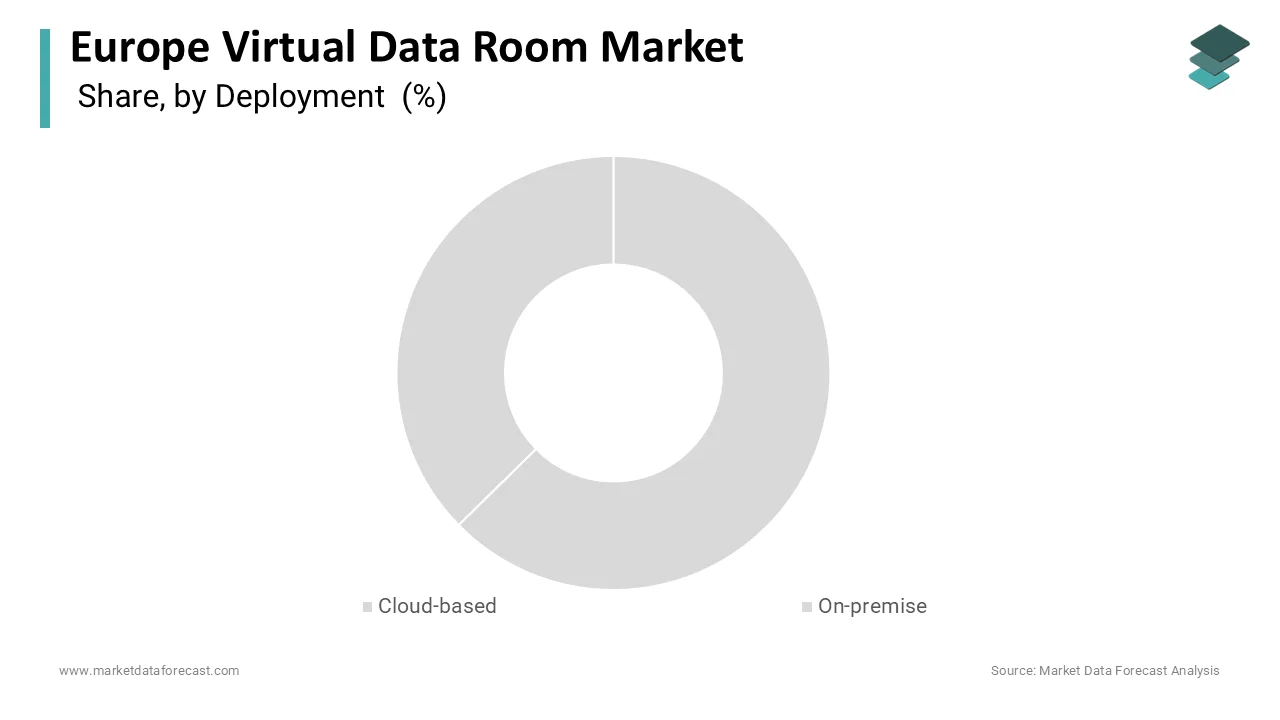
The on‑premise deployment segment is expected to register a CAGR of 9.1% over the forecast period in the European market, owing to the growing security requirements in defense and critical national infrastructure are propelling the growth of the on‑premise segment in this European market. According to the European Defence Agency, more than two‑thirds of classified acquisition processes in 2023 required repositories to operate on air‑gapped networks. As per France’s Nuclear Safety Authority, cloud storage is prohibited for documentation related to reactor decommissioning or fuel handling. Germany’s Federal Office for Information Security certifies on‑premise installations for critical infrastructure transactions under the IT Security Act 2.0. This segment is expected to expand steadily over the forecast period as geopolitical tensions amplify demand for sovereign‑sensitive deployments.
By Enterprise Type Insights
The large enterprises segment captured 76.1% of the European virtual data room market share in 2025. The leading position of the large enterprises segment in this European market is attributed to frequent engagement in complex, high‑value transactions and stringent compliance obligations. According to the European Commission’s Corporate Transactions Monitor, firms with more than 250 employees accounted for nearly 90% of EU cross‑border acquisitions in 2023, each requiring virtual data rooms for due diligence. As per the London Stock Exchange, 42 European companies completed IPOs in 2023, with thousands of documents shared per offering via virtual data rooms. Large multinationals such as Siemens and Unilever manage multiple concurrent transactions, necessitating enterprise‑wide licensing and advanced security protocols. This segment is expected to remain dominant over the forecast period as transaction intensity and institutional capacity sustain adoption.
The small and medium enterprises segment is anticipated to grow at a promising CAGR of 12.4% over the forecast period in the European market. Rising mid‑market M&A activity driven by succession planning and sector consolidation is supporting the growth of the SME segment in this European market. According to the European Small Business Portal, more than 85,000 SMEs changed ownership in 2023, with over 60% involving external buyers requiring formal due diligence. As per the European Investment Fund, its SME Acquisition Loan program supported thousands of transactions in 2023, all mandating secure document exchange. Affordable tiered pricing has made entry‑level virtual data rooms accessible, with average setup costs falling below €3,000. This segment is expected to expand rapidly over the forecast period as demographic and financial drivers accelerate SME adoption.
By Business Function Insights
The mergers and acquisitions segment held the leading position in the European virtual data room market in 2025 and occupied 58.3% of the regional market share. The dominance of the M&A segment in this European market is driven by reliance on secure, scalable, and auditable document exchange during high‑stakes negotiations. According to the European Commission, the energy sector recorded more than 300 cross‑border acquisitions in 2023, each requiring strict access control. As per the European Tech Alliance, 180 European tech firms were acquired in 2023, with intellectual property documentation central to due diligence. The European Central Bank noted that average due diligence document volumes have grown by over 30% since 2020 due to expanded ESG and cyber risk assessments. This segment is expected to remain dominant over the forecast period as consolidation across energy and technology sectors sustains demand.
The enterprise activities segment is expected to register the fastest CAGR of 14.7% over the forecast period in the European market. Mandated use for ESG and sustainability compliance reporting is favouring the growth of the enterprise activities segment in this European market. According to the European Financial Reporting Advisory Group, each ESG audit involves thousands of documents, including supply chain certifications and emissions inventories. As per the OECD, nearly 60% of European listed companies established standing virtual data rooms in 2025 specifically for annual ESG cycles. The European Securities and Markets Authority now recommends their use for non‑financial statement submissions. This segment is expected to expand rapidly over the forecast period as regulatory frameworks transform virtual data rooms into a persistent compliance infrastructure.
COUNTRY LEVEL ANALYSIS
United Kingdom Virtual Data Room Market Analysis
The United Kingdom played the leading role in the European virtual data room market in 2025 and accounted for 24.1% of the regional market share. The lead of the UK in the European market is primarily driven by London’s global financial hub status, mature legal frameworks, and high transaction density. According to the Office for National Statistics, professional legal and accounting services contributed nearly 10% to UK GDP in 2023, which reflects deep transactional activity. The Financial Conduct Authority mandates secure document exchange for regulated acquisitions, while the Competition and Markets Authority enforces strict protocols in merger reviews. UK law firms and investment banks have institutionalized virtual data rooms as standard practice, creating a culture of secure collaboration. English common law’s emphasis on disclosure in litigation further drives adoption in legal discovery. With thousands of active private equity firms, the UK is expected to remain Europe’s leader in virtual data room usage.
Germany Virtual Data Room Market Analysis
Germany held a substantial share of the European virtual data room market in 2025. The growth of Germany in the European market is attributed to its dense industrial base, frequent ownership transitions, and strong data protection culture. According to Destatis, thousands of family‑owned Mittelstand companies initiated ownership transitions in 2023, many using virtual data rooms to protect proprietary processes. The Federal Cartel Office enforces rigorous standards in merger reviews, requiring German‑hosted infrastructure. The Fraunhofer Institute reports that most DAX 30 companies use virtual data rooms for M&A and compliance reporting under the Corporate Sustainability Reporting Directive. Germany’s IT Security Act 2.0 mandates secure document handling for critical infrastructure operators. With thousands of private equity deals involving German targets and a preference for GAIA‑X data sovereignty, Germany is expected to remain a high‑volume, regulation‑driven market.
France Virtual Data Room Market Analysis
France captured a considerable share of the European virtual data room market in 2025 due to state‑led consolidation in strategic sectors and centralized legal frameworks. According to the Ministry of Economy, state‑backed entities executed dozens of strategic acquisitions in 2023, mandating sovereign data handling under the Digital Republic Act. The Autorité de la Concurrence enforces strict document parity rules in multi‑bidder auctions, institutionalizing virtual data rooms as the compliant medium. France’s AFEP‑MEDEF Corporate Governance Code requires listed companies to use secure platforms for board materials and ESG reporting. The Banque de France notes that mid‑market successions increasingly involve virtual data room usage, supported by chambers of commerce offering subsidized platforms. With Paris emerging as a fintech hub and IPO activity rising, France is expected to expand adoption across public and private sectors.
Netherlands Virtual Data Room Market Analysis
The Netherlands is expected to account for a notable share of the European virtual data room market over the forecast period, owing to its role as a corporate structuring hub and progressive digital governance. According to the Netherlands Chamber of Commerce, tens of thousands of foreign enterprises maintain Dutch holding structures, often requiring secure documentation. The Dutch Authority for the Financial Markets mandates virtual data rooms for public takeovers and IPOs on Euronext Amsterdam. Amsterdam handled a significant share of EU private equity exits in 2023, reflecting its role in cross‑border deals. Dutch multinationals such as Philips, ASML, and Shell manage global M&A through EU‑hosted virtual data rooms. The government’s “Secure Digital Collaboration” program subsidizes adoption for SMEs engaged in international trade. The Netherlands is expected to remain a pivotal market blending legal neutrality, digital maturity, and transactional efficiency.
Switzerland Virtual Data Room Market Analysis
Switzerland is projected to grow at a healthy CAGR in the European virtual data room market over the forecast period. The global financial center status of Switzerland, strict banking secrecy traditions, and neutrality are driving the virtual data room market growth in Switzerland. According to the Swiss Federal Statistical Office, thousands of cross‑border M&A deals involving Swiss entities occurred in 2023, particularly in pharmaceuticals and precision engineering. Swiss data protection law, aligned with GDPR through the EU adequacy decision, permits seamless data flows while maintaining enhanced confidentiality controls. The SIX Swiss Exchange requires virtual data rooms for IPO due diligence, while the Swiss Takeover Board enforces strict document access parity. Major banks such as UBS mandate virtual data rooms for client asset transactions to prevent information leakage. Switzerland’s neutrality also makes it a preferred venue for sensitive arbitrations and joint ventures. With hundreds of private equity firms and a culture of discretion, Switzerland is expected to remain a high‑value market for confidentiality‑critical transactions.
COMPETITIVE LANDSCAPE
The European virtual data room market features intense competition among global innovators and specialized regional providers, each vying for dominance through security depth, regulatory alignment, and user experience. The landscape is shaped by Europe’s stringent data protection laws and fragmented national interpretations, which create high barriers to entry but also reward vendors with localized infrastructure and compliance expertise. Global leaders leverage scale, AI-driven automation, while niche European firms emphasize sovereignty, transparency, and sector-specific workflows. Competition extends beyond core functionality to include professional services, multilingual support, and integration with legal tech ecosystems. As ESG reporting and internal governance drive recurring use, the market is shifting from episodic transaction tools to persistent compliance platforms. This evolution intensifies pressure on vendors to deliver continuous value through innovation and trust. With private equity activity, succession planning, and regulatory mandates fueling demand across Western and Northern Europe, the market remains dynamic, resilient, and highly sensitive to both technological and legal developments across the region.
KEY MARKET PLAYERS
Some of the companies that are playing a dominating role in the global Europe virtual data room market include
- iDeals Solutions
- Intralinks (SS&C Intralinks)
- Firmex
- Brainloop GmbH
- Ansarada
- Citrix Systems, Inc. (ShareFile)
- Box, Inc.
- Dropbox, Inc.
- Citadel Secure Collaboration Services
- Drooms GmbH
- Merrill DatasiteOne
- CapLinked, Inc.
- SecureDocs
- EthosData
- Watchdox (by Blackberry)
- SmartRoom, Inc.
- Veemly
- Imprima (Avenir)
- RR Donnelley (Venue)
- NetDocuments, Inc.
- BlackBerry Limited
TOP LEADING PLAYERS IN THE MARKET
- Intralinks Holdings Inc. is a globally recognized leader in secure collaboration solutions with a deeply established presence across Europe’s finfinancialeg, a l and corporate sectors. The company pioneered the virtual data room concept and continues to serve major investment banks, private equity f,firmsrms, and multinational corporations throughout the region. Intralinks contributes to the global market through AI-powered due diligence tools, multilingual support,t, and compliance with international data protection standards. In recent years, the company has strengthened its European position by achieving ISO 27001 certification for its Frankfurt and Dublin data centers and launching GDPR aligned features such as dynamic watermarking and automatic data residency routing. These initiatives reinforce its reputation as a trusted partner for high-stakes transactions in a region defined by regulatory rigor and data sovereignty expectations.
- Merrill Corporation is a prominent player in the European virtual data room market, known for its itsuser-centricc design and deep integration with legal and financial workflows. The company serves clients across the United Kingdom, Germany, and France with tailored solutions for mergers and acquisitions capital markets, and regulatory compliance. Globally, Merrill has driven innovation in secure collaboration by embedding artificial intelligence for document classification and real-time translation capabilities. To enhance its European footprint, the company expanded its EU-based support team in 2023 and partnered with sovereign cloud providers to ensure all client data remains within the European Economic Area. It also introduced industry-specific templates for ESG reporting and board governance aligned with the Corporate Sustainability Reporting Directive. These strategic moves demonstrate Merrill’s commitment to regulatory alignment and localized service excellence.
- Ansarada Group Limited maintains a significant role in the European virtual data room landscape through its data-driven approach to deal readiness and compliance. The company’s platform combines virtual data room functionality with material information management to help organizations prepare for transactions well in advance. On the global stage, Ansarada has differentiated itself by integrating risk intelligence and readiness scoring that anticipates due diligence gaps. In Europe, the company has strengthened its market position by certifying its infrastructure under the EU Cloud Code of Conduct and establishing data residency in Sweden and the Netherlands. It also launched a dedicated module for European ESG disclosure requirements in early 2025, enabling clients to structure sustainability data for auditor review. These actions reflect Ansarada’s focus on proactive governance and regulatory foresight in a complex European transaction environment.
TOP STRATEGIES USED BY THE KEY MARKET PARTICIPANTS
Key players in the European virtual data room market prioritize data sovereignty by operating certified data centers within the European Economic Area to comply with GDPR and national data laws. They embed artificial intelligence to automate document classification, rredactionand readiness assessment, reducing manual due diligence effort. Companies develop industry-specific compliance modules for ESG reporting, corporate governance, a nd merger control, aligned with EU directives. Strategic partnerships with sovereign cloud providers and legal advisory firms enhance credibility and distribution reach. Vendors also offer tiered pricing and guided onboarding to capture small and medium enterprise demand driven by succession planning and private equity activity. Continuous investment in multilingual support, dynamic watermarking, and forensic audit trails reinforces trust among legal and financial professionals. These strategies collectively address Europe’s unique blend of regulatory stringency, transaction complexity, and market fragmentation.
MARKET SEGMENTATION
This research report on the European virtual data room market is segmented and sub-segmented into the following categories.
By Deployment
- Cloud-based
- On-premise
By Enterprise Type
- Large Enterprises
- Small & Medium Enterprises (SMEs)
By Business Function
- Mergers & Acquisitions
- Initial Public Offerings (IPOs)
- Enterprise Activities
- Legal & Compliance
- Others
By Country
- United Kingdom
- Germany
- France
- Netherlands
- Switzerland
- Rest of Europe