- Product Description Description
- Table of Contents TOC
- List of Table & Figure LOT
- Get Free Sample PDF Sample PDF
Market Size, 2025
$30.36 BnMarket Estimate, 2026
$33.29 BnMarket Forecast, 2034
$69.57 BnCAGR, 2026–2034
9.65%Europe Wind Energy Market Size
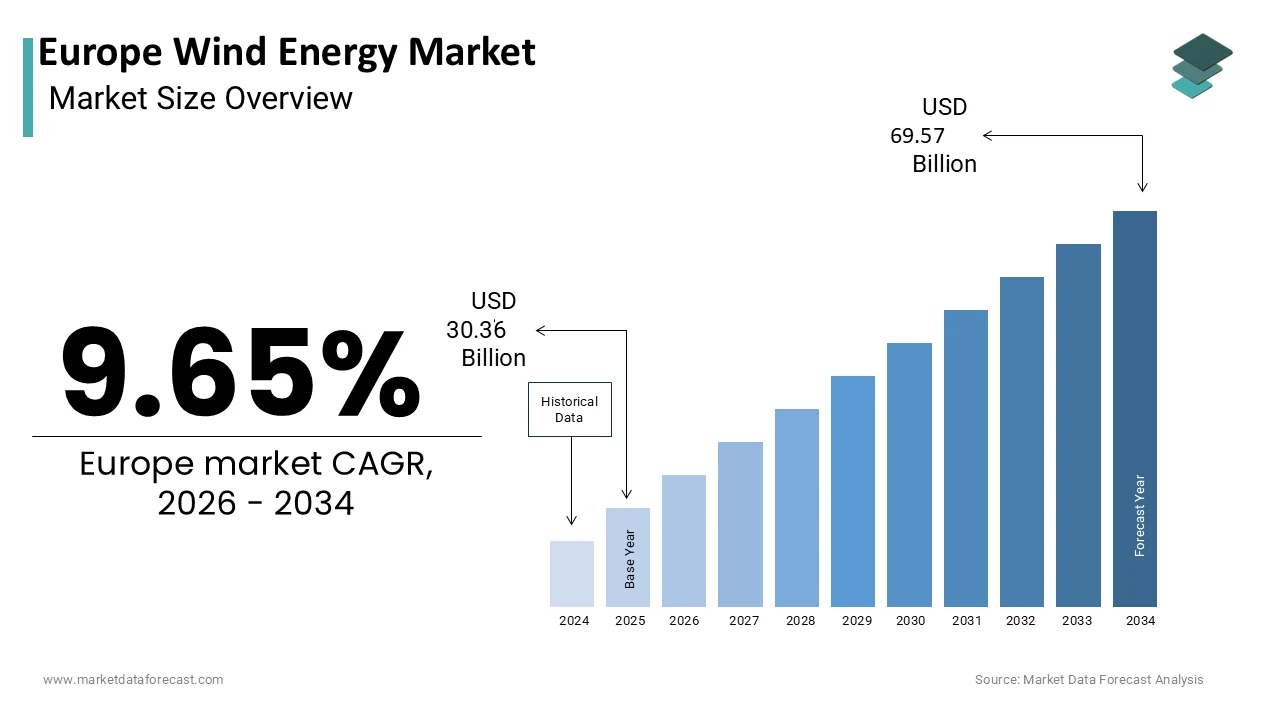
The Europe wind energy market was valued at USD 30.36 billion in 2025, is estimated to reach USD 33.29 billion in 2026, and is projected to reach USD 69.57 billion by 2034, growing at a CAGR of 9.65% from 2026 to 2034.
 /
/
Wind energy encompasses the comprehensive ecosystem of onshore and offshore turbine installation, grid integration, operation, and maintenance dedicated to harnessing kinetic air currents for electricity generation across the continent. This sector serves as the cornerstone of the European Green Deal, functioning as the primary engine for decarbonizing the power grid and reducing reliance on imported fossil fuels. The market is defined by a complex interplay of maritime spatial planning, terrestrial zoning laws, and cross-border transmission infrastructure that facilitates the movement of power from windy northern coasts to industrial southern centers. According to Eurostat, wind power has become a significant contributor to electricity generation in the European Union, which is surpassing natural gas in several member states and establishing itself as a dominant energy source. As per the European Environment Agency, the technical potential for wind energy in Europe is far greater than current consumption levels, particularly in the North Sea and Atlantic regions, where wind speeds are consistently high. According to the International Energy Agency, Europe hosts some of the world's most advanced wind farms, utilizing turbines with very large rotor diameters to maximize capture efficiency. This market does not merely represent a utility sector but acts as a strategic industrial pillar driving manufacturing, engineering innovation, and energy security independence for the entire region.
MARKET DRIVERS
Legislative Mandates for Renewable Energy Shares Driving Capacity Expansion
Legislative mandates for renewable energy shares serve as the primary driver for the Europe wind energy market by establishing legally binding targets that compel member states to accelerate wind farm deployment. As per the European Commission, the revised Renewable Energy Directive sets binding EU targets for renewable energy in the final energy consumption mix by 2030, which is creating an urgent imperative for national governments to approve and construct wind projects. According to the European Commission, this regulatory framework requires each member state to contribute to the collective goal through National Energy and Climate Plans and effectively guarantees a long-term demand pipeline for wind developers. As per WindEurope, the continent must install significant new wind capacity annually to meet these targets, a rate much higher than historical averages. According to the European Commission, the legal obligation to phase out coal and reduce greenhouse gas emissions under the Fit for 55 package further amplifies the necessity for wind power as the most cost-effective and scalable solution. These binding commitments provide the policy certainty needed for financiers to back multi-billion euro investments, making legislation the fundamental engine propelling market expansion across both onshore and offshore segments.
Declining Levelized Cost of Energy Enhancing Economic Competitiveness
The declining levelized cost of energy is further propelling the expansion of the Europe wind energy market by making wind power the cheapest source of new electricity generation in most European regions, outcompeting fossil fuels even without subsidies. Technological advancements, including larger rotors, taller towers, and improved aerodynamics,s have drastically increased capacity factors, allowing modern turbines to generate more electricity at lower operational costs. As per the International Renewable Energy Agency, the levelized cost of energy for onshore and offshore wind in Europe has fallen significantly in the last decade, reaching parity with or below natural gas combined cycle plants. This economic advantage drives utilities and corporate buyers to prioritize wind power in their procurement strategies to minimize electricity bills and hedge against volatile fossil fuel prices. According to BloombergNEF, recent auction results in countries like Germany and France have recorded strike prices lower than wholesale market averages, demonstrating the financial viability of wind projects in a merchant environment. The ability to secure long-term power purchase agreements at fixed low rates provides stability for investors and encourages further capacity additions. This cost competitiveness ensures that wind energy remains the preferred choice for new power generation, driving sustained market growth driven by pure economic logic rather than just regulatory compliance.
MARKET RESTRAINTS
Complex Permitting Procedures and Administrative Bottlenecks Delaying Projects
Complex permitting procedures and administrative bottlenecks impose significant restraints on the Europe wind energy market growth by causing extensive delays in project timelines and increasing development costs to prohibitive levels. The process of securing approvals involves navigating a labyrinth of regulations across multiple jurisdictions, including environmental impact assessments, aviation safety clearances, and grid connection agreements, which often leads to years of uncertainty. As per the European Court of Auditors, the average time required to obtain all necessary permits for a wind farm in Europe can be very long, severely hampering the pace of deployment needed to meet climate goals. These delays force developers to hold capital for extended periods without generating revenue, while inflation erodes the projected profitability of the projects. Additionally, conflicting interests between defense ministries, local communities, and conservation groups often result in legal challenges that can halt projects indefinitely. According to WindEurope, several gigawatts of planned capacity have been pushed back by multiple years due to these bureaucratic hurdles, creating a gap between government targets and actual installation rates. The lack of streamlined one-stop shop approval mechanisms in many member states exacerbates the issue, making the administrative burden a primary obstacle that stifles market momentum and discourages new entrants.
Strain on Transmission Grid Infrastructure and Connection Queues
Strain on transmission grid infrastructure and connection queues acts as a severe restraint on the Europe wind energy market by limiting the ability to evacuate generated power from remote windy sites to inland consumption centers. The rapid expansion of wind capacity, particularly in northern offshore locations, has outpaced the development of high-voltage transmission lines and converter stations, leading to significant bottlenecks that prevent new farms from connecting to the grid. According to the European Network of Transmission System Operators for Electricity, there is a growing backlog of renewable projects waiting for grid connection, with some developers facing very long wait times in certain regions. This infrastructure deficit forces grid operators to curtail wind production during periods of high generation, resulting in lost revenue and inefficient use of installed assets. The high cost and long lead times associated with building subsea cables and onshore substations further complicate the situation, as upgrading the grid requires substantial public investment and complex cross-border coordination. As per national grid operators, congestion management costs have surged, reflecting the physical limitations of the current network to handle the influx of variable wind power. Until transmission infrastructure is upgraded to match the scale of wind ambitions, the market will remain constrained by its inability to deliver clean energy to where it is needed most.
MARKET OPPORTUNITIES
Development of Floating Wind Technology for Deep Water Deployment
The development of floating wind technology is a major opportunity for the Europe wind energy market by unlocking vast wind resources in deep waters where fixed bottom foundations are technically unfeasible or economically prohibitive. Traditional monopile and jacket structures are limited to shallow coastal shelves, whereas floating platforms can be deployed in much deeper waters. As per the Offshore Renewable Energy Catapult, a large share of Europe's offshore wind potential lies in waters deeper than 60 meters, representing a massive untapped resource base that floating technology can access. This innovation allows countries with steep continental shelves like France, Portugal, and Norway to become major producers of offshore wind, diversifying the geographic spread of generation. According to the International Renewable Energy Agency, floating wind costs are expected to decrease significantly by 2035 due to economies of scale and technological learning, making it competitive with fixed bottom solutions. Several pilot projects in the Atlantic and Mediterranean have already demonstrated technical viability, paving the way for commercial-scale farms. By enabling access to stronger and more consistent winds further offshore, this technology expands the total addressable market and ensures sustained growth long after shallow water sites are fully developed.
Integration of Wind Power with Green Hydrogen Production
The integration of wind power with green hydrogen production is another potential opportunity for the Europe wind energy market by creating a new demand vector that alleviates grid congestion and stores excess energy. Instead of transmitting all generated electricity to the shore, wind farms can power electrolyzers directly on site or on nearby platforms to produce green hydrogen, which can then be transported via pipelines or ships. According to the European Hydrogen Backbone Initiative, extensive plans are underway to build hydrogen pipelines across Europe by 2040, much of which will be fed by wind-derived hydrogen. This approach solves the issue of grid saturation by converting electricity into a storable fuel that can be used in hard-to-electrify sectors like heavy industry, shipping, and aviation. As per the Fuel Cells and Hydrogen Joint Undertaking, producing hydrogen offshore could reduce costs by avoiding grid fees and utilizing full load hours more efficiently. Major energy companies are already announcing hybrid projects that combine wind turbines with electrolysis units, which signals a shift toward multi-purpose energy islands. This synergy not only expands the revenue streams for wind developers but also accelerates the decarbonization of the broader economy, positioning wind energy as a central pillar of the future hydrogen economy.
MARKET CHALLENGES
Escalating Supply Chain Costs and Inflationary Pressures on Components
Escalating supply chain costs and inflationary pressures on components constitute a promising challenge for the Europe wind energy market by eroding profit margins and threatening the financial viability of planned projects. The industry relies on a complex global supply chain for critical materials such as steel, copper, and rare earth magnets, all of which have experienced significant price volatility and increases in recent years. According to the International Monetary Fund, global commodity prices have surged, driving up the cost of turbine towers, foundations, and cables substantially. These rising input costs have forced several developers to cancel or postpone projects because the fixed strike prices agreed upon in earlier auctions no longer cover the expense of construction. As per BloombergNEF, the levelized cost of energy for new wind projects has increased recently, reversing years of cost reduction trends. Furthermore, logistical bottlenecks in the shipping sector have raised the cost of installing massive components, adding further financial strain. The inability to pass these costs onto consumers quickly due to long-term contract structures creates a cash flow squeeze that jeopardizes the pipeline of future developments, making cost management a critical survival challenge for market participants.
Skilled Labor Shortages Impeding Installation and Maintenance Operations
Skilled labor shortages impeding installation and maintenance operations are further challenging the expansion of the Europe wind energy market by slowing down project execution and increasing operational risks. The rapid scaling of the industry requires a vast workforce of specialized engineers, technicians, vessel captains, and divers, yet the current talent pool is insufficient to meet the surging demand. As per the European Centre for the Development of Vocational Training, the renewable energy sector faces a significant deficit of skilled workers across the continent, with wind energy being particularly affected due to the niche nature of offshore operations. This scarcity drives up wage costs and leads to delays in installation schedules as companies compete for limited qualified personnel. Moreover, the lack of experienced technicians for maintenance can result in longer downtime for turbines, reducing overall energy output and revenue. According to industry associations, training programs are struggling to keep pace with the speed of deployment, creating a bottleneck that threatens the timely completion of gigawatt-scale farms. Without a coordinated effort to upskill the workforce and attract new talent through education and vocational training, the market risks being unable to physically build and maintain the infrastructure required to meet its ambitious capacity targets.
REPORT COVERAGE
| REPORT METRIC | DETAILS |
| Market Size Available | 2025 to 2034 |
| Base Year | 2025 |
| Forecast Period | 2026 to 2034 |
| Segments Covered | By Type, Application, Component, and Region. |
| Various Analyses Covered | Global, Regional, and Country-Level Analysis, Segment-Level Analysis, Drivers, Restraints, Opportunities, Challenges; PESTLE Analysis; Porter’s Five Forces Analysis, Competitive Landscape, Analyst Overview of Investment Opportunities |
| Countries Covered | UK, France, Spain, Germany, Italy, Russia, Sweden, Denmark, Switzerland, Netherlands, Turkey, Czech Republic, Rest of Europe |
| Market Leaders Profiled | Vestas Wind Systems A/S, Siemens Gamesa Renewable Energy S.A., Nordex SE, Enercon GmbH, General Electric Company, Ørsted A/S, Iberdrola S.A., Enel Green Power S.p.A., RWE AG, EDF Renewables, Acciona Energía, Vattenfall AB |
SEGMENTAL ANALYSIS
By Type Insights
The onshore wind turbine segment dominated the market by commanding a major share of 70.7% of the Europe wind energy market in 2025. The dominance of the onshore segment in the European market can be credited to the mature deployment history, lower installation costs, and the vast availability of suitable land areas across the European continent compared to maritime zones. As per the International Renewable Energy Agency, the levelized cost of energy for onshore wind in Europe remains among the lowest of all power generation technologies, making it the most economically attractive option for utilities. According to WindEurope, the majority of newly installed capacity in recent years has been onshore, reflecting the industry preference for projects that can be permitted and constructed within shorter timeframes. This economic advantage ensures that onshore wind remains the backbone of European renewable expansion, securing its majority share through sheer volume of installations and financial viability.
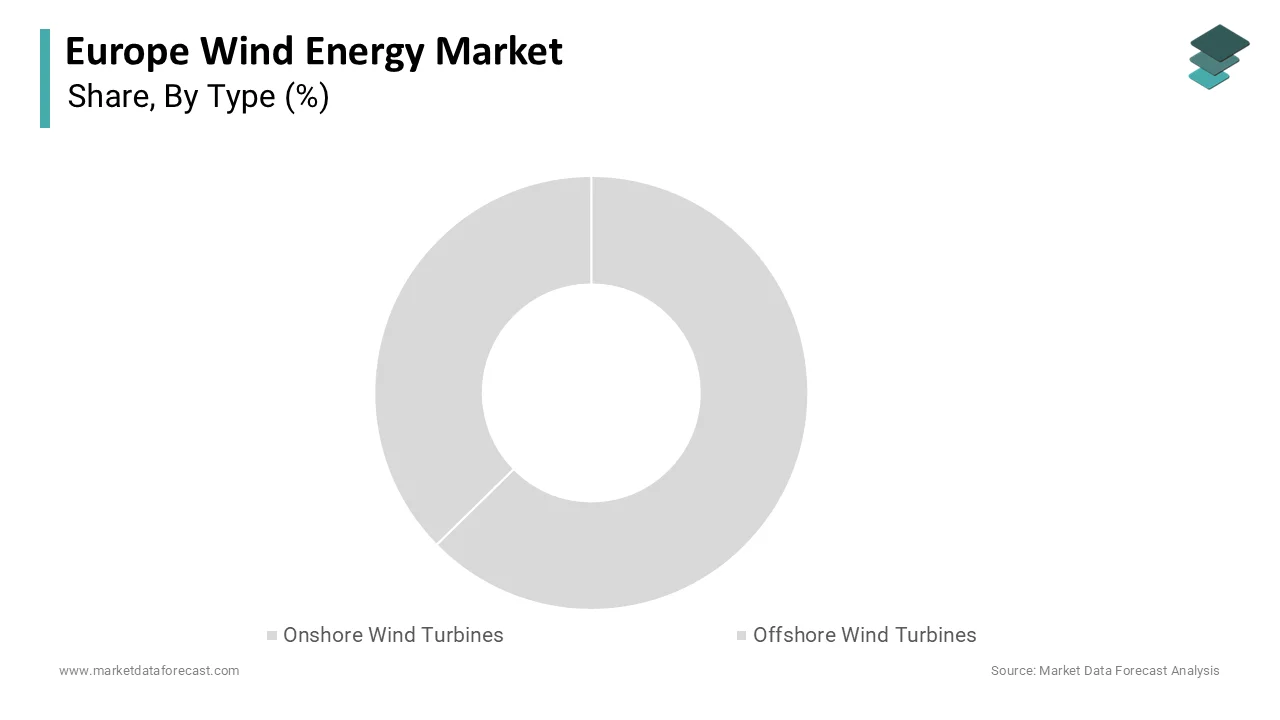
On the other hand, the offshore wind turbine segment is the fastest-growing sector within the Europe wind energy market and is expected to record a CAGR of 17.9% over the forecast period, owing to the urgent need to access stronger and more consistent wind resources in deep waters and the strategic push by coastal nations to meet ambitious climate targets. As per the International Energy Agency, offshore sites typically experience higher wind speeds than onshore locations, resulting in superior capacity factors. According to the Global Wind Energy Council, new offshore turbines with very large rotor diameters are capturing unprecedented amounts of kinetic energy, driving down the levelized cost of energy. By tapping into high-yield zones such as the North Sea and Baltic Sea, developers can maximize returns and meet large-scale energy demands, propelling the offshore segment to the forefront of market growth.
By Application Insights
The power generation segment held the dominating spot in the Europe wind energy market in 2025 by accounting for 94.4% of the regional market share. The growth of the power generation segment in the European market is majorly driven by the fundamental role of wind energy as a primary source of electricity for national grids, residential consumption, and industrial operations across the continent. As per Eurostat, wind energy has generated hundreds of terawatt hours of electricity in the European Union in recent years, supplying a significant portion of total demand and surpassing fossil fuels in several member states. According to the European Network of Transmission System Operators for Electricity, grid operators prioritize wind integration due to its scalability and decreasing costs, making it the cornerstone of future energy mixes. This structural shift secures the segment's leading position as the primary mechanism for delivering clean energy to consumers.
However, the hybrid systems segment is emerging as the fastest growing sector in the Europe wind energy market and is anticipated to register a CAGR of 24.3% over the forecast period due to the increasing integration of wind farms with solar photovoltaic arrays and battery storage systems to optimize grid utilization and provide dispatchable power. As per the European Distribution System Operators, hybrid plants can achieve very high capacity factors by combining complementary generation profiles. According to Wood Mackenzie, hybrid projects reduce balance of system costs compared to standalone installations, making them highly attractive for investors facing grid congestion issues. The ability to smooth out power output fluctuations through integrated storage enhances grid stability, encouraging transmission operators to prioritize hybrid connections.
By Component Insights
The rotor blades component segment led the market by capturing 26.9% of the regional market share in 2025. This dominance is anchored in the critical importance of blade size and aerodynamic design in determining the overall energy capture efficiency and power output of modern wind turbines. As per the Global Wind Energy Council, the swept area of new turbines has doubled in the last decade, directly correlating with a substantial increase in the cost and complexity of blade production. According to manufacturer specifications, larger blades allow turbines to operate efficiently at lower wind speeds, expanding the viable geographic range for wind projects. As manufacturers continue to push the boundaries of blade size to compete with offshore potential, the rotor blade segment maintains its position as the highest value component in the turbine supply chain.
On the other side, the control systems component segment is projected to be the fastest-growing category in the Europe wind energy market and record a CAGR of 12.7% over the forecast period, owing to the increasing reliance on digitalization, artificial intelligence, and advanced sensors to optimize turbine performance, predict maintenance needs, and ensure grid compliance. As per the International Energy Agency, AI-driven control systems can reduce operation and maintenance expenses while extending the operational life of turbines. According to industry pilots, real-time adjustment of blade pitch and yaw based on wind forecasts improves energy yield. The shift from reactive to proactive maintenance strategies requires increasingly complex and valuable control software and hardware, driving demand in this segment.
COUNTRY LEVEL ANALYSIS
Germany Wind Energy Market Analysis
Germany held the position of the largest wind energy market in Europe by commanding 25.8% of the regional market share in 2025. The country serves as the primary engine for wind power development and innovation on the continent. As per the Federal Ministry for Economic Affairs and Climate Action, the nation aims to allocate 2% of its land area specifically for onshore wind use. According to the German Wind Energy Association, Germany hosts a robust pipeline of offshore projects in the North and Baltic Seas. The presence of world-leading turbine manufacturers like Siemens Gamesa and Enercon fosters a strong domestic supply chain and continuous technological advancement. Furthermore, the phase-out of nuclear and coal power creates an urgent baseload replacement need that wind energy is uniquely positioned to fill.
Spain Wind Energy Market Analysis
Spain occupied the second biggest share of the Europe wind energy market in 2025. The high capacity factors and a strong export-oriented manufacturing sector are primarily driving the Spanish wind energy market expansion. As per the Spanish Wind Energy Association, the country consistently adds new capacity annually, with a strong focus on repowering older sites to boost efficiency. According to Red Eléctrica de España, wind power frequently becomes the leading source of electricity generation, covering a significant portion of annual demand. The presence of global giants like Iberdrola and Acciona Energía ensures strong domestic investment and international expansion capabilities. Additionally, Spain is investing heavily in green hydrogen projects powered by wind, creating a new demand vector for excess generation.
United Kingdom Wind Energy Market Analysis
The United Kingdom is estimated to account for a promising share of the Europe wind energy market during the forecast period due to its innovative contract-for-difference schemes and vast maritime resources. As per the Department for Energy Security and Net Zero, the UK hosts some of the largest operational offshore wind farms in the world. According to RenewableUK, wind energy regularly supplies a substantial portion of the country's electricity, with records set for consecutive days of high wind output. The Crown Estate's proactive leasing rounds provide a clear pathway for future development, attracting international investors. Furthermore, the UK is pioneering floating wind technology and sector coupling with hydrogen, positioning itself at the forefront of next-generation wind solutions.
Sweden Wind Energy Market Analysis
Sweden is expected to exhibit a healthy CAGR in the Europe wind energy market during the forecast period due to rapid onshore expansion and significant export potential. As per the Swedish Energy Agency, the country has seen strong growth in onshore wind capacity, particularly in the northern regions. According to Svenska Kraftnät, wind power now accounts for a significant share of total electricity production, with projections to increase further by 2030. The involvement of local cooperatives and municipal ownership models has fostered high social acceptance, reducing permitting delays compared to other regions. Furthermore, Sweden's surplus wind generation is increasingly exported to neighboring countries like Finland and Germany, enhancing its economic viability.
France Wind Energy Market Analysis
France has emerged as a notable key player in the Europe wind energy market with a rapidly growing share. The vast untapped potential, both onshore and offshore, is driving the expansion of the French market. As per the French Ministry of Ecological Transition, the country aims to double its onshore wind capacity and launch multiple offshore projects by 2030. According to France Énergie Éolienne, there has been a surge in project pipelines, with several large offshore farms reaching financial close. The vast coastline of France offers immense offshore potential, particularly in the Atlantic and Mediterranean, where floating wind pilots are demonstrating commercial viability. Furthermore, the inclusion of wind energy in regional planning documents is becoming mandatory, ensuring local alignment.
COMPETITIVE LANDSCAPE
The competition in the Europe wind energy market is characterized by intense rivalry among established utilities, specialized developers, and global turbine manufacturers striving to secure limited seabed leases and supply chain capacity. Market participants compete based on bid prices in government auctions, where the lowest strike price often determines the winner of lucrative development rights. The entry of oil and gas majors into the renewable sector has heightened competitive pressures as these entities leverage their massive capital reserves and offshore engineering expertise to capture market share. Companies are increasingly differentiating themselves through innovations in turbine size and efficiency while promising faster deployment timelines to meet urgent national climate targets. The scarcity of specialized installation vessels and skilled labor creates a bottleneck where logistical capability becomes a key competitive advantage over pure financial strength. Strategic partnerships across the value chain are common as firms seek to mitigate risks associated with inflation and supply chain disruptions. The overall landscape remains dynamic with continuous shifts in leadership driven by technological breakthroughs and the ability to navigate complex regulatory environments across multiple European jurisdictions.
KEY MARKET PLAYERS
Some of the companies that are playing a dominating role in the global europe wind energy market include
- Vestas Wind Systems A/S
- Siemens Gamesa Renewable Energy S.A.
- Nordex SE
- Enercon GmbH
- General Electric Company
- Ørsted A/S
- Iberdrola S.A.
- Enel Green Power S.p.A.
- RWE AG
- EDF Renewables
- Acciona Energía
- Vattenfall AB
TOP LEADING PLAYERS IN THE MARKET
- Siemens Gamesa Renewable Energy stands as a preeminent force in the Europe wind energy market with a comprehensive portfolio spanning onshore and offshore turbine manufacturing. The company contributes significantly to the global sector by pioneering direct drive technology and massive rotor designs that set new efficiency benchmarks for the industry. Recent actions to strengthen its position include the launch of its next-generation fifteen-megawatt offshore turbine, specifically engineered for European sea conditions and harsh weather environments. Siemens Gamesa continues to expand its service network across the continent to ensure maximum uptime for existing fleets through digital monitoring solutions. The firm actively collaborates with grid operators to enhance system stability and integration capabilities for large-scale wind farms. Its strategic focus on localizing supply chains within Europe ensures faster delivery times and reduced logistical risks for developers while maintaining technological superiority in a competitive landscape.
- Vestas Wind Systems serves as a dominant player in the Europe wind energy market, leveraging its extensive global installed base and deep expertise in sustainable energy solutions. The company plays a crucial role worldwide by providing advanced turbine models combined with sophisticated digital optimization tools that maximize energy yield for operators. Recent efforts to enhance its European footprint include securing major contracts for upcoming wind farms in the North Sea and Baltic Sea regions while investing in new manufacturing facilities to meet surging demand. Vestas has also strengthened its recycling capabilities to address end-of-life turbine management and promote circular economy principles throughout the value chain. The firm focuses on hybrid solutions that integrate wind with storage to provide dispatchable power for unstable grids. Its strategy of offering flexible commercial models and long-term service agreements ensures customer loyalty and project bankability across diverse European markets.
- Ørsted operates as a leading developer in the Europe wind energy market, having transformed from a fossil fuel utility into a pure play renewable energy powerhouse. The company contributes to the global market by setting benchmarks for large-scale offshore project execution and sustainable operations across international waters. Recent actions to strengthen its position include securing final investment decisions for massive wind farms in the North Sea and expanding its portfolio in emerging European markets. Ørsted continues to invest heavily in floating wind technology pilots to unlock deeper water resources off the coasts of France and Norway. The firm actively partners with industrial consumers to secure long-term power purchase agreements that guarantee revenue stability for new projects. Its strategic focus on integrating offshore wind with green hydrogen production positions it at the forefront of the future energy landscape while maintaining a robust pipeline of fixed-bottom projects.
TOP STRATEGIES USED BY KEY MARKET PARTICIPANTS
Key players in the Europe wind energy market primarily employ vertical integration strategies to control the entire value chain from component manufacturing to installation and maintenance services. Companies actively form strategic consortia and joint ventures with utility providers and industrial partners to share the substantial financial risks associated with multi-billion euro projects. Another major strategy involves investing heavily in research and development to create larger and more efficient turbines that reduce the levelized cost of energy. Market participants also focus on securing long-term power purchase agreements with corporate buyers to guarantee stable revenue streams independent of volatile wholesale electricity prices. Additionally, firms are diversifying their portfolios by entering the floating wind segment to access deep water resources that are unavailable to traditional fixed bottom technologies. Continuous expansion of specialized installation vessels and port infrastructure remains a priority to overcome logistical bottlenecks and ensure timely project completion across the region.
MARKET SEGMENTATION
This research report on the europe wind energy market is segmented and sub-segmented into the following categories.
By Type
- Onshore Wind Turbines
- Offshore Wind Turbines
By Application
- Power Generation
- Hybrid Systems
By Component
- Rotor Blades
- Nacelle
- Towers
- Gearbox
- Generator
- Control Systems
By Country
- Germany
- Spain
- United Kingdom
- Sweden
- France
- Rest of Europe