- Product Description Description
- Table of Contents TOC
- List of Table & Figure LOT
- Get Free Sample PDF Sample PDF
Market Size, 2025
$10.09 BnMarket Estimate, 2026
$11.03 BnMarket Forecast, 2034
$22.47 BnCAGR, 2026–2034
9.30%Europe Yoga Clothing Market Size, Growth, Trends & Forecast (2026–2034)
The Europe yoga clothing market size was calculated at USD 10.09 billion in 2025, is anticipated to reach USD 11.03 billion in 2026, and is projected to reach USD 22.47 billion by 2034, registering a compound annual growth rate (CAGR) of 9.30% during the forecast period from 2026 to 2034. Driven by the formal integration of mindfulness practices into public health policies, high consumer demand for eco-conscious materials, and a cultural fusion of lifestyle fashion with functional performance, the market continues to expand rapidly across the European region.
Key Executive Metrics (At-a-Glance)
- 2025 Base Valuation: USD 10.09 Billion
- 2026 Current Valuation: USD 11.03 Billion
- 2034 Forecast Valuation: USD 22.47 Billion
- Compound Annual Growth Rate (CAGR): 9.30% (2026–2034)
- Dominant End-User Segment: Female (occupying a substantial majority share in 2025)
- Fastest-Growing End-User Segment: Male (projected to witness a CAGR of 16.2% from 2026 to 2034)
- Dominant Distribution Channel Segment: E-commerce (capturing 52.6% of the market share in 2025)
- Fastest-Growing Distribution Channel Segment: E-commerce (exhibiting a CAGR of 14.8% during the forecast period)
- Dominant Product Type Segment: Bottom Wear (accounting for a 63.4% share in 2025)
- Fastest-Growing Product Type Segment: Top Wear (predicted to witness the highest CAGR of 15.1% over the forecast period)
- Regional Highlights: Germany led the market in 2025, accounting for 19.7% of the regional share, followed closely by the United Kingdom, France, Sweden, and the Netherlands.
Core Market Drivers
- Institutional Integration: Formal adoption of yoga into public health frameworks and corporate wellness programs by employers and health authorities.
- Sustainable Preferences: Strong consumer demand for ethically produced activewear using certified organic, recycled, or circular materials.
- Aesthetic Versatility: Seamless blending of studio apparel with everyday urban lifestyle wear, driving consistent baseline consumption.
Primary Market Restraints & Challenges
- Discretionary Spending Pressure: Macroeconomic challenges reclassifying premium wellness apparel as non-essential, leading to extended garment lifespans.
- Fast Fashion Imitations: Proliferation of low-cost, algorithm-driven copycat apparel diluting brand differentiation and pricing power.
- Greenwashing & Compliance Burdens: Vague sustainability claims and complex EU regulatory frameworks increasing operational hurdles for ethical brands.
Europe Yoga Clothing Market Segmentation Breakdown
| Segment Category | Largest Segment in 2025/2026 | Fastest Growing Segment / Growth Rate |
|---|---|---|
| By End User | Female (Dominant share in 2025) | Male (16.2% CAGR from 2026 to 2034) |
| By Distribution Channel | E-commerce (52.6% share in 2025) | E-commerce (14.8% CAGR during the forecast period) |
| By Product Type | Bottom Wear (63.4% share in 2025) | Top Wear (15.1% CAGR over the forecast period) |
| By Region | Germany (19.7% share in 2025) | United Kingdom, Netherlands & Sweden (Driven by high digital adoption and eco-wellness) |
Major Industry Players Profiled
Key prominent companies operating in the Europe yoga clothing market include Lululemon Athletica, Sweaty Betty, Vaude, Nike, Adidas, PUMA, Under Armour, ASICS, Manduka, Prana, Hugger Mugger, Aurorae, Alo Yoga, Athleta, Beyond Yoga, Teeki, Onzie, and Varley.
Europe Yoga Clothing Market Size
The Europe yoga clothing market size was calculated to be USD 10.09 billion in 2025 and is anticipated to be worth USD 22.47 billion by 2034, from USD 11.03 billion in 2026, growing at a CAGR of 9.30% during the forecast period.
Yoga clothing refers to the specialized apparel engineered for flexibility, breathability, and moisture management, designed specifically for yoga and adjacent mindful movement practices such as Pilates and barre. Unlike generic sportswear, yoga clothing emphasizes minimalist aesthetics, body-conscious fits, and sustainable material innovation aligned with Europe’s eco-conscious consumer ethos. This segment is distinct in its fusion of functional performance and lifestyle identity, where garments often transition seamlessly from studio to street. As per research, millions of adults across the European Union now practice yoga regularly, indicating a significant rise in its popularity as a common wellness activity. A majority of consistent yoga practitioners in Western Europe are making environmentally conscious choices, focusing on clothing made from certified organic or recycled materials. Furthermore, Government health and wellness initiatives are increasingly incorporating practices like yoga into official public health strategies and workplace programs, which in turn boosts demand for suitable apparel. This market thrives not on athletic competition but on values of sustainability, body positivity, and mental resilience, positioning it uniquely within Europe’s broader textile and wellness economies.
MARKET DRIVERS
Rising Integration of Yoga into Public Health and Corporate Wellness Programs
Yoga’s formal adoption by European public health systems and employers is a primary driver of the Europe yoga clothing market. This transforms practice from optional leisure to institutionalized routine. According to a review of physical activity promotion in healthcare, the WHO European Office emphasizes the integration of various healthy lifestyle behaviors, including movement and relaxation practices, into national health policies to address chronic conditions and mental health challenges. This policy shift has normalized regular practice among demographics previously unengaged, including older adults and office workers. Simultaneously, the European Agency for Safety and Health at Work (EU-OSHA) highlights the growing trend of workplace mental health initiatives, which often include a variety of stress-reduction and physical activity programs. Research indicates that such programs are viewed as effective in improving psychological well-being and reducing burnout. Companies such as Siemens and L’Oréal provide branded yoga kits to employees, creating consistent apparel demand. This institutional embedding ensures recurring participation, which in turn sustains baseline demand for dedicated yoga clothing that meets performance and comfort expectations distinct from general sportswear.
Consumer Preference for Sustainable and Ethically Produced Activewear
European yoga consumers exhibit a pronounced preference for environmentally responsible production, which directly shapes material innovation and brand loyalty in the apparel segment, fueling the expansion of the European yoga clothing market. A significant majority of individuals who practice yoga in the EU consider specific sustainably produced materials, such as certified organic cotton, recycled polyester, or Tencel, as essential criteria when making purchases, as per various studies. This preference is notably higher among yoga practitioners compared to general sportswear buyers. This ethical stance is reinforced by regulatory momentum. In addition, new regulations are coming into effect that will require digital product passports for textiles, making full traceability of raw materials mandatory across the market. One major outdoor apparel company has observed a strong upward trend in sales of its ethically sourced yoga product lines within the European market, a result of transparent supply chain mapping. Similarly, the number of yoga apparel items receiving a prominent regional ecolabel certification has experienced substantial growth, indicating increased industry focus on meeting specific environmental standards. Brands use algae-based dyes and closed-loop water systems, which align with the European Green Deal’s circular economy targets. This convergence of consumer values, policy direction, and brand response makes sustainability not a niche appeal but a market imperative.
MARKET RESTRAINTS
Economic Volatility and Discretionary Spending Compression
Macroeconomic pressures that reclassify wellness apparel as non-essential amid rising cost of living are obstructing the growth of the Europe yoga clothing market. In addition, consumers are extending garment lifespans and shifting to value segments. Many European shoppers postponed replacing worn-out yoga apparel, even when it was visibly in poor condition, as per sources. Premium yoga brands, which often retail leggings above 90 euros, are particularly vulnerable. Specialist activewear, particularly yoga apparel, has been negatively impacted by the decline in spending on specialized gear. This fiscal caution contradicts the market’s growth narrative, which reveals sensitivity to economic cycles despite yoga’s cultural entrenchment.
Market Saturation with Fast Fashion Imitations Undermining Brand Differentiation
The proliferation of low-cost, look-alike yoga apparel from fast fashion retailers dilutes the perceived value of authentic performance and sustainable brands, and it creates pricing pressure and consumer confusion that inhibits the expansion of the Europe yoga clothing market. Retailers such as Shein and Temu offer visually similar items at under 15 euros, leveraging algorithmic trend replication without investing in functional fabric R&D. The misinformation erodes the premium segment’s justification for higher prices based on durability and eco credentials. Consequently, even established ethical brands face downward pressure to reduce margins or compromise on material quality to remain competitive, which threatens the market’s sustainability foundation.
MARKET OPPORTUNITIES
Expansion into Inclusive Sizing and Adaptive Yoga Apparel
The growing emphasis on body inclusivity and accessibility creates an opportunity for the Europe yoga clothing market. This opportunity allows the market to broaden its demographic reach and deepen social relevance. As per research, a large number of adults identify as plus-size, yet only a small fraction of mainstream yoga brands offer extended sizing. This gap is rapidly closing. Inclusive labels have expanded their size ranges to include larger sizes by incorporating reinforced seams and wider waistbands. Simultaneously, adaptive yoga apparel, designed for people with disabilities, is gaining institutional support. Advocacy groups have partnered with textile innovators to develop magnetic closure leggings and sensory-friendly seamless tops, which are being tested in rehabilitation centers. Funding initiatives have awarded significant resources to startups focused on developing size-inclusive and disability-responsive yoga wear, which signals policy alignment with market evolution.
Integration with Digital Wellness Platforms and Smart Textiles
The convergence of yoga apparel with digital health ecosystems offers a key prospect for the acceleration of the Europe yoga clothing market. This opens ga rowth frontier through embedded sensor technology and virtual class integration. Guided digital yoga sessions have become a common practice for many yoga enthusiasts in Europe, as per studies. Companies, integrated into Lululemon’s European offerings, have developed leggings with woven electromyography sensors that sync with apps to provide real-time posture correction. In addition, a new trend is the creation of "smart" yoga equipment, like mats and apparel, that can monitor users' balance and heart rate variability. These products are being designed to meet the standards for medical devices. As per sources, there is a clear upward trend in European patents for conductive yarns, which are a key component in smart textiles for sportswear and fitness apparel. Furthermore, Public programs are investing heavily in projects that integrate innovative textile technology with mental health apps, showing a strong commitment to this area, which positions smart yoga wear at the intersection of preventive care and wearable technology.
MARKET CHALLENGES
Greenwashing Accusations and Lack of Standardized Sustainability Claims
Widespread greenwashing that erodes trust and complicates purchasing decisions impedes the growth of the Europe yoga clothing market. According to sources, Yoga apparel brands frequently make sustainability assertions that are often vague or lack verification from an independent third party. The majority of garments labeled as "recycled" often do not provide information regarding the origin of their fibers or the specific percentage of post-consumer content used, as per studies. This opacity is exacerbated by the absence of a unified textile eco-label. Existing official ecolabels for apparel are not widely adopted within the yoga apparel market due to rigorous water and chemical usage criteria. Consequently, even conscientious consumers struggle to differentiate genuinely sustainable brands from marketing facades.
Supply Chain Fragmentation and Compliance Burden Under New EU Textile Regulations
Operational complexity from fragmented manufacturing networks and escalating regulatory obligations under the EU’s new textile sustainability framework is another aspect constraining the expansion of the Europe yoga clothing market. Most European yoga brands source fabrics from Turkey or Portugal but outsource cut and sew operations to Eastern Europe or North Africa, creating multi-tiered supply chains difficult to monitor. Authentic, sustainable brands, often lacking shared recycling infrastructure or cooperative compliance platforms, struggle to compete with vertically integrated fast fashion giants who can more easily absorb regulatory costs, which jeopardizes the market’s ethical foundations.
REPORT COVERAGE
| REPORT METRIC | DETAILS |
| Market Size Available | 2025 to 2034 |
| Base Year | 2025 |
| Forecast Period | 2026 to 2034 |
| CAGR | 9.30% |
| Segments Covered | By End User, Distribution Channel, Product Type, and Region |
| Various Analyses Covered | Global, Regional & Country Level Analysis; Segment-Level Analysis; DROC, PESTLE Analysis; Porter’s Five Forces Analysis; Competitive Landscape; Analyst Overview of Investment Opportunities |
| Regions Covered | UK, France, Spain, Germany, Italy, Russia, Sweden, Denmark, Switzerland, Netherlands, Turkey, and the Czech Republic |
| Market Leaders Profiled | Lululemon Athletica, Nike, Adidas, PUMA, Under Armour, ASICS, Manduka, Prana, Hugger Mugger, Aurorae, Alo Yoga, Athleta, Sweaty Betty, Beyond Yoga, Teeki, Onzie, Varley |
SEGMENTAL ANALYSIS
By End User Insights
The female segment continued to dominate the Europe yoga clothing market by occupying a substantial share in 2025. The leading position of the female segment is attributed to higher participation rates, cultural normalization of yoga as a wellness practice for women, and stronger alignment with fashion-driven activewear trends. Women make up a majority of regular yoga practitioners. Men constitute a smaller proportion of individuals who regularly practice yoga. A segment of the population identifying outside the binary also engages in regular yoga practice. This gender disparity is amplified in apparel purchasing. Retailers respond by dedicating extensive design resources to female silhouettes with features like sculpting, compression, moisture-wicking waistbands, and seasonal color palettes. Brands allocate a notable share of their European product development budgets to women’s lines, reflecting commercial reality. Furthermore, national wellness campaigns in countries explicitly target women in stress reduction messaging, reinforcing yoga as a socially endorsed self-care ritual. This confluence of behavioral preference, marketing focus, and cultural framing sustains female dominance in the segment.
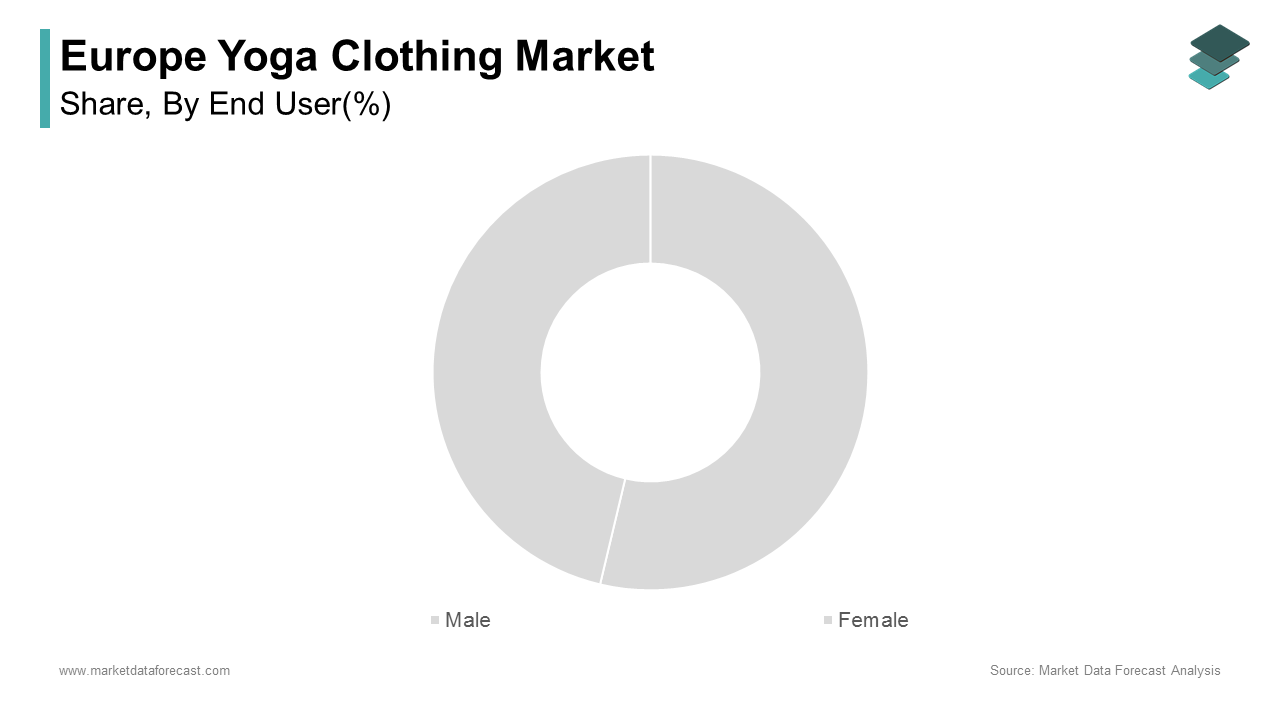
The male segment is on the rise and is expected to be the fastest-growing segment in the market by witnessing a CAGR of 16.2% from 2026 to 2034, and is driven by shifting perceptions of wellness, masculinity, and targeted product innovation. Participation in yoga among men in Europe is rising, driven by declining mental health stigma and the inclusion of men in workplace wellness programs. Brands have responded with functional redesigns. The launch of men’s yoga apparel tailored for comfort and flexibility has seen significant sales increases in key European markets. A majority of urban yoga studios now provide classes specifically for men, which concentrate on improving mobility and preventing injuries. Apart from these, the rise of hybrid athleisure has normalized fitted yoga tops for men in casual settings. These social behavioral and product-led shifts are dismantling outdated gender norms and unlocking consistent male market expansion.
By Distribution Channel Insights
The e-commerce segment captured the majority share of 52.6% of the Europe yoga clothing market in 2025. The prominence of the e-commerce segment is attributed to convenience, algorithm-driven personalization, and the dominance of direct-to-consumer brand models. Pure play brands built their European presence almost exclusively through digital channels, offering virtual fit assistants, size guides, and carbon-neutral delivery. The pandemic accelerated this shift. Besides, e-commerce enables agile inventory management for sustainable brands using made-to-order models. Consumers also value digital access to detailed material certifications and supply chain transparency features rarely available in physical stores, further reinforcing e-commerce as the preferred channel.
Also, the e-commerce segment is expected to exhibit a noteworthy CAGR of 14.8% during the forecast period. The swift expansion of the e-commerce segment is fuelled by advancements in immersive shopping technologies and seamless cross-border logistics within the EU single market. Similarly, one European e-platform integrated augmented reality yoga pose simulations showing how fabric moves during downward dog or warrior II, enhancing functional understanding. Apart from these, regulatory harmonization under the EU Digital Services Act has reduced cross-border delivery friction. Returns have also become more sustainable. These innovations in experience efficiency and sustainability ensure e-commerce maintains its accelerated growth trajectory.
By Product Type Insights
The bottom wear segment led the Europe yoga clothing market by accounting for a 63.4% share in 2025, as leggings and tights serve as the foundational garment for both practice and athleisure wear. Consumers prioritize fit performance and aesthetic versatility in bottoms, often purchasing multiple pairs while relying on fewer tops. As per a Study, bottom wear accounted for a notable share of all yoga apparel units sold in the EU, with high waist compression leggings alone representing a key share of that volume. This dominance stems from functional necessity; yoga demands unrestricted hip and knee movement, which only engineered four-way stretch fabrics can provide, and stylistic flexibility as leggings transition easily into casual urban settings. Brands reinforce this focus. Besides, sustainability efforts concentrate here. The dual role of bottom wear as both performance gear and fashion staple solidifies its market leadership.
The top wear segment is predicted to witness the highest CAGR of 15.1% over the forecast period, which is driven by innovation in adaptive design, climate-responsive fabrics, and expanding gender inclusive silhouettes. Unlike static basic tees, modern yoga tops now incorporate features like cross-back straps for shoulder mobility, seamless construction to prevent chafing, and plant-based antimicrobial finishes. The rise of hot yoga and outdoor summer sessions has accelerated demand for formoisture-wicking cropped tanks. Moreover, inclusive sizing has transformed the category. Brands offer many cup size variations in sports bras, addressing a historic gap for plus-size and fuller-busted practitioners. These advancements elevate top wear from afterthought to essential performance layer, fueling rapid growth.
REGIONAL ANALYSIS
Germany Yoga Clothing Market Analysis
Germany led the Europe yoga clothing market and occupied a share of 19.7% in 2025. The demand for yoga clothing in the country is attributed to its strong wellness culture, high disposable income, and stringent sustainability expectations. The country has the highest density of certified yoga studios in Europe, with a significant number of registered centers. This institutional infrastructure drives consistent apparel demand, especially among urban professionals in Berlin, Munich, and Hamburg. German consumers exhibit exceptional eco-consciousness. Domestic brands like Vaude and Bleed respond with closed-loop production using Tencel and recycled ocean plastics. Apart from these, workplace wellness subsidies reimburse annually for yoga classes and apparel, further stimulating consumption. These structural, behavioral, and policy factors consolidate Germany’s top position.
The United Kingdom Yoga Clothing Market Analysis
The United Kingdom followed closely in the Europe yoga clothing market and captured a share of 16.3% in 2025, with its cosmopolitan fitness culture, strong digital retail penetration, and influential wellness media. London alone hosts numerous yoga studios with demand extending to Manchester, Birmingham, and Bristol. British consumers heavily engage with social wellness influencers. As per sources, many yoga apparel purchases were influenced by Instagram or TikTok content featuring functional yet stylish outfits. E-commerce dominates with Zalando and ASOS capturing significant volume, but homegrown DTC brands like Sweaty Betty and TALA thrive through ethical storytelling. The NHS’s social prescribing initiative, which refers patients to yoga for anxiety, also indirectly boosts apparel needs. This blend of digital fluency, cultural openness, and health policy sustains the UK’s strong market presence.
France Yoga Clothing Market Analysis
France remains a significant country in the European yoga clothing market because of its integration of yoga into national public health strategy and fashion-forward consumer expectations. The institutional backing normalizes regular practice and associated apparel investment. Parisian consumers demand designs that merge elegance with function, and brands have launched yoga lines featuring lace accents, minimalist cuts, and neutral palettes reflecting French aesthetic codes. The government also enforces strict green claims regulations. France’s Anti-Waste Law for a Circular Economy mandates fiber composition transparency, which has elevated trust in certified sustainable labels. These cultural regulatory and policy dynamics define France’s unique market character.
Sweden Yoga Clothing Market Analysis
Sweden is gradually moving ahead in the Europe yoga clothing market, which is propelled by its leadership in ethical consumption, gender equality, and outdoor wellness lifestyles. Domestic brands like Asket and Nudie Jeans have expanded into yoga wear using traceable organic cotton and repairable construction, aligning with the country’s “less but better” ethos. Yoga is also deeply embedded in corporate culture. Besides, the popularity of “friluftsliv” or open-air life has spurred demand for all-weather yoga layers made from recycled wool and biobased membranes. This fusion of sustainability, functional design,, nature-based practice defines Sweden’s progressive market stance.
Netherlands Yoga Clothing Market Analysis
The Netherlands is anticipated to expand in the European yoga clothing market during the forecast period, owing to high urban participation rates, progressive gender norms, and a strong cycling yoga hybrid culture. Amsterdam, Rotterdam, and Utrecht feature dense networks of boutique studios. The country’s cycling infrastructure influences design; brands like MATE the Label Europe develop high waist leggings with reinforced seams and sweat-resistant panels suitable for bike commutes to and from studios. Dutch consumers prioritize circularity. Additionally, the government’s “Beter Gezond” public health campaign promotes yoga for sedentary workers, resulting in corporate partnerships with studios that include apparel vouchers. These urban functional and systemic factors shape the Netherlands’ distinct and resilient market position.
COMPETITION OVERVIEW
Competition in the Europe yoga clothing market is defined by a three-tiered landscape comprising global premium brands, European ethical specialists, and fast fashion imitators. Differentiation hinges not on price alone but on demonstrable sustainability credentials, inclusive design, and cultural resonance with local wellness values. Authentic players invest heavily in material traceability, third-party certifications, and functional innovation, such as odor-resistant plant-based finishes or adaptive thermal regulation. The threat from greenwashing fast fashion remains significant, yet discerning European consumers increasingly favor brands with transparent supply chains and circular business models. Regulatory pressures, including the EU Strategy for Sustainable Textiles, further raise the barrier to entry, favoring established players with robust compliance infrastructure. Consequently, competition is shifting from product aesthetics to system integrity, where trust, sustainability, and community integration determine long-term market viability.
KEY MARKET PLAYERS
A few major players of the Europe yoga clothing market include
- Lululemon Athletica
- Nike
- Adidas
- PUMA
- Under Armour
- ASICS
- Manduka, Prana
- Hugger Mugger
- Aurorae
- Alo Yoga
- Athleta
- Sweaty Betty
- Beyond Yoga
- Teeki
- Onzie
- Varley
Top Strategies Used by the Key Market Participants
Key players in the Europe yoga clothing market prioritize sustainability through certified organic and recycled materials while implementing circular initiatives such as take-back and resale programs. They invest in localized product design reflecting regional aesthetics and climate needs, particularly in color palettes and fabric weight. Community engagement via studio partnerships, free classes, and instructor collaborations builds brand authenticity beyond retail. Digital innovation, including virtual fitting tools and transparent supply chain storytelling, enhances e-commerce trust and conversion. Companies also align with national wellness policies and workplace health subsidies to embed their products into institutional procurement channels, ensuring consistent demand.
Leading Players in the Europe Yoga Clothing Market
Lululemon Athletica
Lululemon Athletica maintains a strong presence in the Europe yoga clothing market through its premium performance fabrics and community-centric retail model. The company contributes globally by setting benchmarks in moisture-wicking four-way stretch materials and fit engineering tailored for mindful movement. It also partnered with certified yoga studios across France and the Netherlands to host free community classes, reinforcing brand loyalty. These initiatives deepen engagement beyond transactional relationships and position Lululemon as a cultural participant in Europe’s wellness ecosystem rather than merely a retailer.
Sweaty Betty
Sweaty Betty is a leading European yoga and activewear brand known for blending British design sensibility with technical functionality. The company contributes to the global market by pioneering inclusive sizing and sustainable fabric innovation, including the use of ECONYL regenerated nylon. It also collaborated with the British Wheel of Yoga to certify instructors and host wellness events across major cities. These actions reinforce its commitment to circularity, community, and localized relevance while strengthening its identity as a homegrown European wellness leader.
Vaude
Vaude, a German outdoor and activewear brand, has emerged as a key player in the Europe yoga clothing segment through its uncompromising focus on ecological integrity and transparency. The company contributes globally by demonstrating that high-performance yoga apparel can be produced using certified organic cotton, recycled polyester, and anPFC-freeee membranes under its Green Shape label. It also integrated yoga wear into its outdoor mobility concept, promoting seamless transitions from studio to trail. Supported by Germany’s federal sustainability grants, Vaude’s science-based approach sets a standard for ethical production in the European wellness apparel landscape.
MARKET SEGMENTATION
This research report on the Europe yoga clothing market has been segmented and sub-segmented based on end user, distribution channel, product type, and region.
By End User
- Male
- Female
By Distribution Channel
- Specialty Stores
- Supermarkets/ Hypermarkets
- E-commerce
- Other Distribution Channels
By Product Type
- Bottom Wear
- Top Wear
By Region
- UK
- France
- Spain
- Germany
- Italy
- Russia
- Sweden
- Denmark
- Switzerland
- Netherlands
- Turkey
- Czech Republic
- Rest of Europe