- Product Description Description
- Table of Contents TOC
- List of Table & Figure LOT
- Get Free Sample PDF Sample PDF
Market Size, 2025
$2.05 BnMarket Estimate, 2026
$2.15 BnMarket Forecast, 2034
$3.11 BnCAGR, 2026–2034
4.72%Executive Summary: Global Food and Beverage Foaming Agent Market
- Market Scope: Comprehensive global market assessment of the food and beverage foaming agent sector covering product types, physical nature, application segments, regional performance, and key industry players.
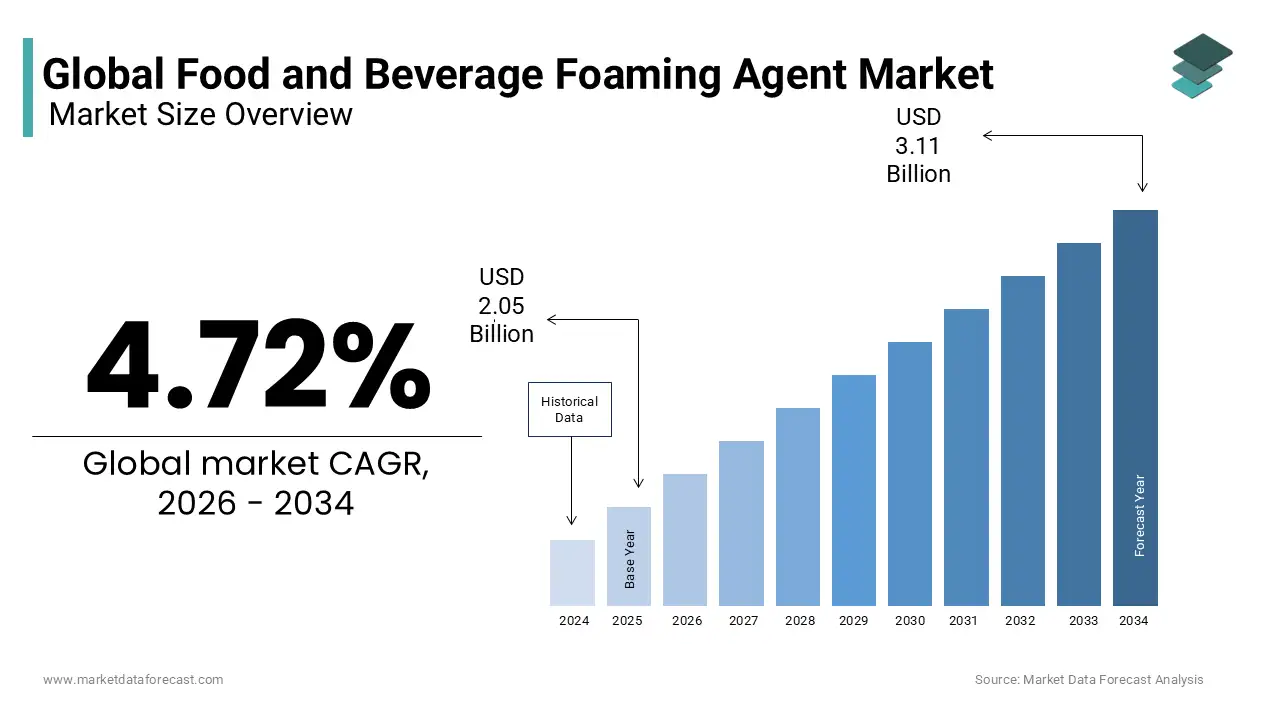
- Market Valuation: Valued at USD 2.05 billion in 2025, estimated at USD 2.15 billion in 2026, and projected to reach USD 3.11 billion by 2034, expanding at a compound annual growth rate (CAGR) of 4.72% during the forecast period from 2026 to 2034.
- Primary Growth Drivers: Rising demand for versatile and innovative food presentations (such as flavored culinary mousses), increasing disposable incomes in developing economies, growing consumption of beverages, dairy, baked goods, and desserts, and the shift toward natural foaming agents.
Key Market Segment Metrics (2026–2034)
| Category | Leading Segment Focus | Fastest-Growing / High-Impact Focus |
|---|---|---|
| By Type | Natural options like Yucca Schidigera, Quillaja Saponaria, Agar, and Lecithin | Plant-derived natural surfactant extracts |
| By Application | Beverages (carbonated drinks, beer, syrups, juices) & Food Products (bakery, dairy, sauces) | Aerated desserts and culinary mousses |
| By Nature | Solid and Liquid formulations | Natural liquid surfactant concentrates |
| By Region | Asia-Pacific (dominant global market driven by high F&B consumption) | North America (fastest-growing regional market) |
Major Market Players & Market Structure
Market Structure: Competitive global landscape shaped by strategic corporate acquisitions (such as Naturex expanding its Quillaja/Yucca portfolio and Ingredion acquiring TIC Gums), focusing on natural ingredient expansion and sustainable development.
Key Companies: Ingredients Inc., Naturex, Ingredion, Riken Vitamin, Desert King International, Garuda International, Adams Food Ingredients Ltd., Rousselot, Nature S.A. Gelita, and ABITEC.
 Download Free Sample Report
Global Food and Beverage Foaming Agent Market Size
The global food and beverage foaming agent market size was valued at USD 2.05 billion in 2025 and is expected to reach USD 3.11 billion by 2034 from USD 2.15 billion in 2026. The market is growing at a CAGR of 4.72% during the forecast period.
The food and beverage foaming agent is the specialized surfactants and stabilizers that facilitate the creation and maintenance of gas bubbles within liquid or semi solid matrices to enhance texture mouthfeel and visual appeal. These agents are important in products ranging from carbonated soft drinks and beers to whipped toppings and cappuccinos where foam stability directly influences consumer satisfaction. These statistics illustrate how beverage sophistication and sensory expectations create a robust foundation for advanced foaming technologies. Manufacturers must balance surface tension reduction with long term stability to meet the rigorous demands of modern food processing lines and discerning consumers who associate dense persistent foam with product quality and freshness.
MARKET DRIVERS
Expansion of Premium Beverage Culture Drives Demand
The proliferation of premium beverage culture, significantly favors the adoption of specialized foaming agents to ensure consistent sensory experiences, which is boosting the growth of the food and beverage foaming agent market. Baristas and automated machines require foaming agents that can withstand high temperatures and varying pH levels without collapsing prematurely. Foam stabilizers such as hydrolyzed proteins and saponins help maintain bubble structure during pouring and consumption enhancing perceived value. These applications demand agents that provide creamy texture while maintaining structural integrity over extended periods. The integration of foaming agents into ready to drink formats further expands their utility allowing manufacturers to replicate fresh preparation qualities in packaged goods.
Growth in Convenience Food Sector Supports Market Expansion
The rapid expansion of the convenience food sector for foaming agents that enhance the appeal of instant and ready to eat products, which is additionally bolstering the growth of the food and beverage foaming agent market. Foaming agents improve the volumetric appearance of whipped toppings and mousses making them more attractive to consumers seeking indulgent experiences at home. These agents prevent collapse during rehydration ensuring that the final product matches consumer expectations for texture and richness. Japanese food processors utilize alginate based foaming systems in instant matcha lattes to achieve stable froth without manual whisking according to the Japan Food Processors Association technical bulletin. Indian snack manufacturers incorporate foaming agents in aerated chocolate coatings to reduce calorie density while maintaining volume as documented by the Indian Snack Foods Association. The ability of these agents to function in dry mix formulations simplifies manufacturing processes and extends shelf life. This alignment with convenience trends ensures that foaming agents remain integral to product innovation in the fast paced ready to eat segment.
MARKET RESTRAINTS
Stringent Regulatory Scrutiny on Synthetic Additives Limits Usage
The strict regulatory frameworks governing synthetic food additives is to act as a barrier for the growth of the food and beverage foaming agent market. These regulatory actions force manufacturers to reformulate products often at higher costs and with reduced performance characteristics. The Australian New Zealand Food Standards Code requires extensive labeling for specific foaming agents, which can deter consumer acceptance due to perceived chemical complexity. Chinese regulations now mandate clear disclosure of all synthetic additives in infant formula effectively banning most conventional foaming agents in this sensitive category as stated by the State Administration for Market Regulation. Compliance with divergent international standards increases operational complexity for multinational companies. These constraints limit the pipeline of new synthetic options and push the industry toward natural alternatives that may lack equivalent functional efficacy.
Consumer Preference for Clean Label Ingredients Restricts Options
The growing consumer preference for clean label ingredients restricts the use of many effective but chemically complex foaming agents is additionally declining the growth of the food and beverage foaming agent market. Natural foaming agents such as quillaja, saponin, or egg white powder often exhibit lower stability and higher variability compared to synthetic counterparts. Egg white based foams are susceptible to salmonella risks requiring pasteurization, which can denature proteins and reduce foaming capacity, according to the study. Plant based alternatives like chickpea water face supply chain inconsistencies and seasonal variations affecting performance reliability. This perception gap forces brands to remove effective agents even when scientifically validated. Reformulating with natural alternatives often results in shorter shelf life and higher production costs. The limited availability of high-performance natural foaming agents constrains innovation and forces compromises in product quality.
MARKET OPPORTUNITIES
Innovation in Plant Based Protein Foaming Systems Creates New Avenues
The surge in plant-based protein consumption for developing specialized foaming agents tailored to non-dairy matrices, which is a major factor to amplify the growth of the food and beverage foaming agent market. Traditional dairy foaming agents often fail to interact effectively with plant proteins due to differences in charge and hydrophobicity. Developing enzymatically modified plant proteins or combining them with natural saponins offers a pathway to superior performance. Companies are exploring combinations of fava bean protein and acacia gum to create dairy free whipped toppings with acceptable texture. The Australian Legume Industry Council notes that lupin protein exhibits excellent foaming properties when processed correctly opening new sourcing avenues. These innovations allow manufacturers to cater to vegan and lactose intolerant consumers without compromising on sensory experience. The ability to patent specific protein modification techniques provides competitive advantage.
Advancements in Encapsulation Technology Enhances Functionality
The advancements in encapsulation technology to protect sensitive foaming agents and control their release during consumption or preparation is also to fuel the growth of the food and beverage foaming agent market. The microencapsulated foaming agents can withstand harsh processing conditions such as high temperature extrusion or acidic environments. Encapsulating volatile aroma compounds alongside foaming agents allows for synchronized release enhancing overall sensory impact. The German Society for Food Science reports that spray dried foaming agents showed 30% longer shelf life compared to liquid forms in humid storage conditions. This technology enables the inclusion of foaming agents in dry mixes for instant beverages without premature activation. Japanese researchers developed lipid based capsules that release foaming agents only upon contact with hot water improving convenience for instant soup applications according to the Journal of Food Engineering. Such precision delivery systems reduce the required dosage lowering costs and minimizing potential off flavors. The ability to combine multiple functional ingredients within a single capsule simplifies formulation processes. This technological evolution allows manufacturers to create more sophisticated products with enhanced user experience.
MARKET CHALLENGES
Volatility in Raw Material Prices Disrupts Supply Chains
The fluctuating prices of key raw materials used in foaming agent production is likely to act as a major challenge for the growth of the food and beverage foaming agent market. Egg white powder prices varied by 22% between 2022 and 2023 due to avian influenza outbreaks disrupting supply, according to the study. These fluctuations make it difficult for manufacturers to maintain stable pricing for downstream customers. Such volatility forces companies to either absorb costs reducing margins or pass them on risking loss of market share. Synthetic precursors derived from petroleum also face price instability linked to global energy markets. The ethylene oxide prices fluctuated by 15% in 2023 by impacting production of polysorbate based foaming agents, according to the study. Long term supply contracts are becoming less common as suppliers seek flexibility amidst uncertainty. This environment complicates budgeting and strategic planning for foaming agent producers. It also incentivizes search for alternative raw materials which may require costly reformulation and regulatory reapproval.
Technical Limitations in Extreme Processing Conditions
The technical limitations of current foaming agents under extreme processing conditions for industrial applications, which is also to decline the growth of the food and beverage foaming agent market. High pressure homogenization processes used in dairy alternatives can shear foam structures reducing stability, according to the Dairy Science and Technology Journal. Acidic environments with pH below 3.5 often cause precipitation of protein based foaming agents rendering them ineffective in citrus flavored drinks. The Carbonated Soft Drink Association notes that maintaining foam in high sugar content syrups remains difficult due to increased viscosity interfering with bubble formation. Freeze thaw cycles in frozen desserts can cause coalescence of air cells leading to texture defects upon thawing. Developing agents that withstand such diverse and harsh conditions requires complex molecular engineering. Current solutions often involve trade offs between stability and sensory attributes. The lack of universal foaming agents forces manufacturers to maintain multiple formulations increasing inventory complexity.
REPORT COVERAGE
| REPORT METRIC | DETAILS |
| Market Size Available | 2025 to 2034 |
| Base Year | 2025 |
| Forecast Period | 2026 to 2034 |
| CAGR | 4.72% |
| Segments Covered | By Type, Application, Nature & Region. |
| Various Analyses Covered | Global, Regional and Country Level Analysis; Segment-Level Analysis; DROC; PESTLE Analysis; Porter’s Five Forces Analysis; Competitive Landscape; Analyst Overview of Investment Opportunities |
| Regions Covered | North America, Europe, APAC, Latin America, Middle East & Africa |
| Market Leaders Profiled | Ingredients Inc., Naturex, Givaudan, Ingredion, Riken Vitamin, Desert King International, Garuda International, Adams Food Ingredients Ltd., Rousselot, Brenntag, Nature S.A. Gelita, and ABITEC. |
SEGMENTAL ANALYSIS
By Type Insights
The lecithin segment was accounted in capturing 47.4% of the Food and Beverage Foaming Agent Market share in 2025 due to its widespread availability and multifunctional properties. Lecithin reduces surface tension effectively allowing for easy incorporation of air into batters and beverages during mixing processes. The lecithin is essential in chocolate production not only for flow control but also for creating aerated varieties that appeal to health-conscious consumers. Its ability to function across a wide pH range makes it suitable for diverse applications from acidic fruit juices to alkaline baked goods. Japanese confectioners use refined lecithin to stabilize foam in matcha flavored desserts ensuring consistent texture despite high polyphenol content as documented by the Japan Confectionery Association. Lecithin is generally recognized as safe by regulatory bodies worldwide facilitating its use in infant formulas and medical nutrition products.
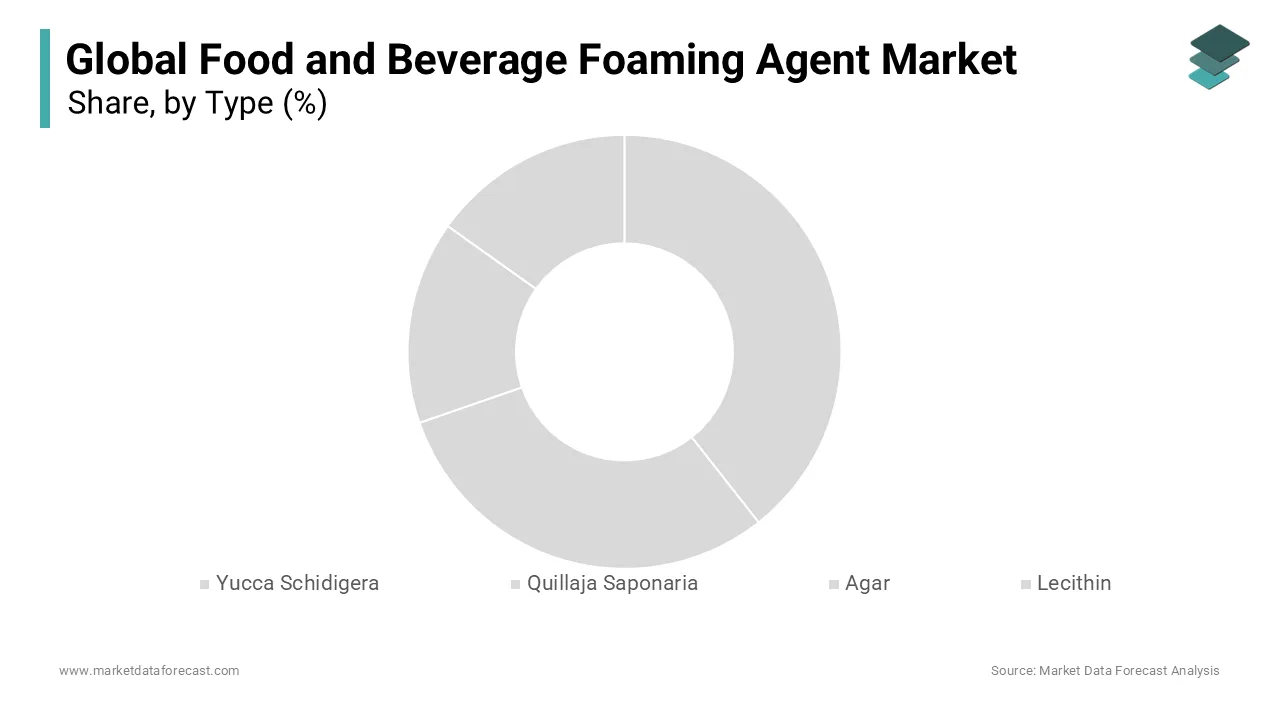
The quillaja sponaria segment is likely to grow at a fastest CAGR of 7.5% during the forecast period with the demand for natural and plant based foaming solutions. Quillaja extract offers superior foam stability in acidic environments making it ideal for carbonated beverages and fruit based drinks where protein based agents fail. Its heat stability allows for use in pasteurized beverages without loss of functionality providing a significant advantage over egg white derivatives. Mexican beverage manufacturers utilize Quillaja extract in traditional horchata and fruit aguas frescas to create appealing foam layers that signal freshness. The extract is also gaining traction in plant based milk alternatives where it helps mimic the frothing capability of dairy milk. Regulatory approval in major markets including the United States and European Union has facilitated broader adoption.
By Application Insights
The beverages segment held a significant share of the Food And Beverage Foaming Agent Market in 2025. The coffee shops worldwide served 1.2 billion cups of espresso based drinks in 2023 with milk foam quality being a primary determinant of customer satisfaction, according to the study. Foaming agents such as casein and whey proteins are essential for creating the microfoam texture desired in lattes and cappuccinos. The head retention is the second most important quality attribute for beer consumers after taste driving breweries to invest in advanced foam stabilizers. Ready to drink cocktail producers are increasingly incorporating foaming agents to replicate the sensory experience of freshly mixed drinks. The expansion of bubble tea culture in Asia has created new demand for cheese foam toppings requiring specialized stabilizers. These diverse beverage applications ensure sustained demand for high performance foaming agents that can withstand varying pH levels and carbonation pressures.
By Nature Insights
The liquid segment was the largest by accounting for 35.6% of the Food And Beverage Foaming Agent Market share in 2025 due to its ease of integration and superior solubility in aqueous systems. This efficiency is crucial for manufacturers aiming to maximize throughput while maintaining consistent foam quality across large batches. The carbonated soft drink manufacturers prefer liquid stabilizers because they prevent clogging in automated dosing equipment. Liquid formats allow for precise metering, which is essential for maintaining uniform bubble size distribution in premium beers and sparkling wines. These agents dissolve instantly without requiring additional hydration steps reducing energy consumption and labor costs. Japanese sake producers utilize liquid rice protein hydrolysates to enhance foam stability during fermentation as documented by the National Research Institute of Brewing. The ability to blend liquid foaming agents with other liquid ingredients simplifies supply chain logistics and storage requirements.
The solid segment is expected to witness a fastest CAGR of 6.8% from 2026 to 2034 with the demand for clean label ingredients and extended shelf life stability. Solid forms offer superior stability against microbial degradation allowing manufacturers to store products for up to 24 months without significant loss of functionality. The Global Baking Industry Association states that solid foaming agents are preferred in dry mix formulations for cakes and mousses because they activate only upon hydration ensuring consistent volume. Australian confectionery manufacturers utilize solid marshmallow bases containing gelatin and sugar to create stable aerated structures according to the Confectionery Manufacturers Association technical guidelines. Indian instant dessert mix producers rely on solid foaming powders to maintain product integrity in humid climates where liquid alternatives might clump or degrade. The rise of home baking trends has further accelerated demand for user friendly solid foaming agents that require minimal preparation.
REGIONAL ANALYSIS
North America Food and Beverage Foaming Agent Market Analysis
North America was the largest contributor by holding 39.2% of the food and beverage foaming agent market share in 2025 with the high consumption of premium beverages and convenience foods. Craft beer production in Canada and the United States totaled 40 million barrels in 2023 with head retention being a key quality metric for brewers, according to the data. The region leads in innovation for plant based foaming agents due to strong vegan and lactose free trends. Regulatory frameworks under the Food and Drug Administration are stringent but clear facilitating the introduction of novel natural ingredients. Major players invest heavily in research and development centers in the region to customize solutions for local preferences. The demand for clean label products pushes manufacturers to replace synthetic agents with organic certified alternatives. High disposable income supports premiumization in both food and beverage sectors allowing for adoption of higher cost foaming technologies. Supply chain infrastructure is well developed ensuring reliable distribution of both liquid and solid agents to end users.
Europe Food and Beverage Foaming Agent Market Analysis
Europe food and beverage foaming agent market held second position by holding 22.3% of the share in 2025 with the strict regulatory standards and strong tradition in beer and dairy consumption. The European Food Safety Authority has approved several novel plant based foaming agents in recent years supporting innovation in clean label formulations. Consumer preference for natural ingredients is particularly strong in Northern Europe driving demand for Quillaja and egg white based solutions. Sustainability concerns are influencing sourcing decisions with manufacturers preferring suppliers who demonstrate ethical harvesting practices. Technical expertise in enzymatic modification of proteins is advanced allowing for customized foaming solutions.
Asia Pacific Food and Beverage Foaming Agent Market Analysis
Asia Pacific food and beverage foaming agent market growth is likely to have prominent growth opportunities throughout the forecast period with the urbanization and rising disposable incomes. Japan remains a leader in technological innovation for foaming agents with applications in sake and ready to drink beverages. The Japanese Society of Brewing Science states that sake producers are experimenting with protein hydrolysates to enhance foam persistence in premium grades. Southeast Asian countries are seeing growth in carbonated soft drink consumption with local manufacturers adopting natural foaming agents to differentiate products. The ASEAN Food and Beverage Alliance notes that regional trade agreements are facilitating the flow of raw materials such as Quillaja extract from South America. India is emerging as a significant market for bakery foaming agents due to the growth of organized retail and western style baking. Government initiatives to support food processing industries are encouraging investment in modern production facilities. Cultural acceptance of textured beverages is driving experimentation with new foaming ingredients.
Latin America Food and Beverage Foaming Agent Market Analysis
Latin America food and beverage foaming agent market growth is likely to grow with the strong potential in beer and traditional beverage sectors. Mexico is a major producer of agave based spirits and beers where foaming agents are used to enhance presentation and mouthfeel. Traditional beverages such as horchata and fruit punches are being modernized with foaming agents to appeal to younger consumers. The Andean Community notes that Peru and Chile are expanding their export of Quillaja extract leveraging native resources for global markets. Economic volatility in some countries affects purchasing power but premium segments remain resilient. Local manufacturers are partnering with international suppliers to access advanced foaming technologies. Regulatory frameworks are evolving to align with international standards facilitating trade. The growth of supermarket chains is improving distribution networks for packaged foods requiring foaming agents. Awareness of clean label trends is gradually increasing among urban consumers.
Middle East and Africa Market Food and Beverage Foaming Agent Market Analysis
The Middle East and Africa food and beverage foaming agent market growth is driven by hospitality sector expansion and changing dietary habits. The beer consumption remains high with local breweries investing in quality improvements, including foam stability. Halal certification requirements influence the selection of foaming agents with plant based and synthetic options preferred over animal derived ones in many countries. The Gulf Cooperation Council Standardization Organization has established guidelines for food additives facilitating regional trade. Egypt and Nigeria are seeing growth in packaged beverage production with multinational companies introducing foaming stabilized products. The hospitality sector in Dubai and Doha drives demand for premium dessert foams and cocktail presentations. Limited local production capacity means reliance on imports from Europe and Asia. Infrastructure improvements are enhancing cold chain logistics allowing for wider distribution of perishable foaming agents.
COMPETITIVE LANDSCAPE
The food and beverage foaming agent market features intense competition among global ingredient giants and specialized niche providers vying for dominance. Multinational corporations leverage extensive research capabilities and broad distribution networks to offer comprehensive solutions, while smaller players compete on specialization and unique natural sources. Innovation serves as a key differentiator with companies investing heavily in developing plant based and organic certified foaming agents to meet evolving consumer demands. Regulatory compliance and safety certifications increasingly influence purchasing decisions especially in North America and Europe driving consolidation among suppliers, who can meet stringent standards. Price sensitivity remains moderate in premium segments but high in mass market applications forcing manufacturers to balance cost and performance. Strategic collaborations with end users for co-development of tailored solutions create sticky customer relationships that are difficult for competitors to disrupt.
KEY MARKET PLAYERS
Some of the key players in the global food and beverage foaming agent market are
- Ingredients Inc.
- Naturex
- Ingredion
- Givaudan
- Riken Vitamin
- Desert King International
- Garuda International
- Adams Food Ingredients Ltd.
- Rousselot
- Nature S.A. Gelita
- ABITEC
- Brenntag
Key Market Players in the Market
- Givaudan leverages its extensive flavor and fragrance expertise to develop innovative natural foaming solutions for the global beverage industry. The company recently launched a new range of plant based foam stabilizers derived from citrus and berry extracts to meet clean label demands. These products are designed to enhance mouthfeel and visual appeal in sparkling waters and craft beers without synthetic additives. Givaudan collaborates with major coffee chains to create customized milk foaming agents that maintain stability at high temperatures. Their research centers in Switzerland and Singapore focus on enzymatic modification of proteins to improve foaming capacity. Technical support teams work closely with customers to optimize dosage and application methods for specific production lines.
- Ingredion utilizes its broad portfolio of texturants and sweeteners to offer integrated foaming solutions for food and beverage applications. The company introduced advanced pea protein isolates specifically engineered for superior foaming performance in plant-based milk alternatives and desserts. These ingredients help manufacturers achieve dairy like texture and volume while meeting vegan certification requirements. Ingredion partners with bakery producers to develop solid foaming powders that simplify formulation processes for aerated cakes and mousses. Their innovation centers in North America and Europe conduct extensive testing on foam stability under various storage conditions. The company also focuses on reducing sugar content in whipped toppings by using air incorporation technologies supported by specialized stabilizers. Recent investments in fermentation technology allow for the production of consistent and high purity foaming agents.
- Brenntag operates as a leading global distributor providing access to a wide variety of foaming agents from multiple manufacturers. Brenntag recently expanded its distribution network in Asia Pacific to serve growing demand for specialty ingredients in emerging countries. They facilitate the supply of lecithin and saponin based foaming agents to small and medium enterprises that lack direct supplier relationships. The company invests in quality control laboratories to ensure product consistency and regulatory compliance for imported ingredients. Brenntag also develops private label foaming formulations tailored to specific regional preferences and processing capabilities. Their logistics infrastructure enables just in time delivery reducing inventory costs for customers.
Top Strategies Used by Key Market Participants
Key players in the Food And Beverage Foaming Agent Market employ several strategic approaches to maintain competitive advantage and drive growth. Companies focus heavily on developing natural and plant based alternatives to replace synthetic agents in response to clean label trends. Strategic partnerships with raw material suppliers ensure sustainable sourcing of ingredients such as Quillaja bark and egg whites. Investment in research and development centers allows firms to create customized foaming solutions tailored to specific applications like craft beer or plant based milk. Mergers and acquisitions of specialized ingredient companies help large players broaden their product portfolios and access niche technologies. Providing comprehensive technical support and application testing services helps customers optimize usage and overcome formulation challenges. Expanding distribution networks in emerging markets like Asia Pacific and Latin America enables deeper penetration into growing consumer bases. Launching ready to use liquid formats simplifies integration for manufacturers improving operational efficiency.
MARKET SEGMENTATION
This research report on the global food and beverage foaming agent market has been segmented and sub-segmented based on type, nature, application & region.
By Type
- Yucca Schidigera
- Quillaja Saponaria
- Agar
- Lecithin
By Application
- Food Products
- Beverages
By Nature
- Liquid
- Solid
By Region
- North America
- Asia Pacific
- Europe
- Latin America
- Middle East and Africa