- Product Description Description
- Table of Contents TOC
- List of Table & Figure LOT
- Get Free Sample PDF Sample PDF
Market Size, 2025
$146.77 BnMarket Estimate, 2026
$156.16 BnMarket Forecast, 2034
$256.51 BnCAGR, 2026–2034
6.40%Executive Summary: Germany Food Service Market
- Market Scope: Comprehensive analysis of the German food service sector, detailing restaurant models, commercial and institutional service types, digital transformation trends, and labor/inflationary challenges (forecast period: 2026-2034).
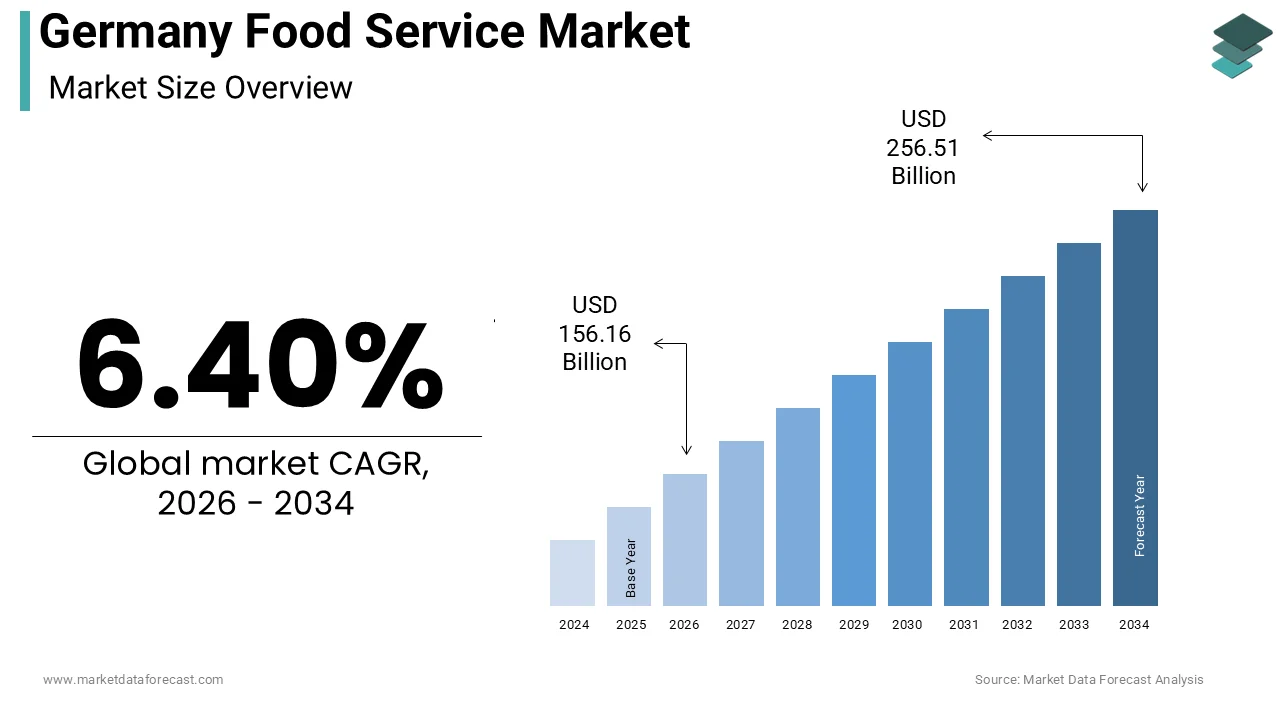
- Market Valuation: Valued at USD 146.77 billion in 2025, reaching USD 156.16 billion in 2026, and projected to expand to USD 256.51 billion by 2034, growing at a robust CAGR of 6.40% from 2026 to 2034.
- Primary Growth Drivers: Rising demand for international and health-conscious culinary trends, expanding online food delivery platforms, ghost/cloud kitchens, and vibrant tourism across Europe's largest retail consumer market.
Key Market Segment Metrics
| Category | Leading Segment (Base Position) | Fastest-Growing / High-Growth Segment |
|---|---|---|
| By Type | Full-Service Restaurants (dominated market share owing to cultural appreciation for fine dining, regional culinary heritage, and immersive tourism experiences) | Quick-Service Restaurants (QSRs) & Cloud Kitchens (projected to grow prominently, driven by rapid digital ordering apps and delivery-first convenience) |
| By Service Type | Commercial Segment (held the most significant share, propelled by fast-food outlets, takeaway services, and rising disposable incomes) | Institutional Segment (expanding steadily through hospital dining services, corporate catering, and school cafeterias) |
Major Market Players & Industry Landscape
Market Structure: Highly competitive landscape balancing established domestic culinary chains, global fast-food giants, and innovative tech-driven delivery models throughout the 2026-2034 forecast period.
Key Companies: Block Gruppe, Domino's Pizza, Coffee Fellows GmbH, Sausalito Holding GmbH, Hans im Glück Franchise GmbH, McDonald's Corporation, Starbucks Corporation, AmRest Holdings, Darden Restaurants Inc., and Yum! Brands, Inc.
 Download Free Sample Report
Germany Food Service Market Size
The German foodservice market size was calculated to be USD 146.77 billion in 2025 and is anticipated to be worth USD 256.51 billion by 2034, from USD 156.16 billion in 2026, growing at a CAGR of 6.40% during the forecast period.
Foodservice refers to the preparation, handling, packaging, and distribution of food, beverages, and related services by various establishments. This industry majorly involves different types of industries, such as restaurants, cafes, bars, cafeterias, catering, and institutional food providers. Around 83 million consumers make Germany the largest retail market for European food and beverages. Germany is the third-largest exporter and importer of agricultural and food products worldwide. Around one-third of the processed foods manufactured in Germany are exported. The German food service market accounted for prominent growth finthe past years due to the presence of a well-established food and beverages industry across the country. The market is anticipated to have considerable growth during the forecast period due to rising technological advancements, demand for authentic culinary heritage, and the presence of international cuisines in Germany creating market growth opportunities.
MARKET DRIVERS
Germany's food industry is being driven by enhancing demand for new cultural influences and culinary trends, which contributed to the expansion of the food services market in Germany.
The increasing health-conscious and aging population across the country is resulting in the demand for healthy food, contributing to various niche market players becoming significant market players in the food service industry. Various trends in the food service market include casual food service concepts like Mediterranean and Asian cuisines and better burgers, and the rising vegan population, which is influencing the implementation of vegan nutrition concepts, is boosting the growth of the Germafoodservicece market. The presence of international food chains in Germany and the vibrant tourism in Germany are attracting food enthusiasts from around the world, which encourages culinary exploration by creating growth opportunities for the foodservice market in the country. The rising disposable incomes of the people are accelerating the purchasing power, changing consumer interest towards outside food, growing urbanization, and the people's busy lifestyles, accelerating the demand for delicious dining options, which boosts the food service market share growth.
Expanding technological advancements in the food and beverages industry positively impact the food service market growth. Rising online ordering platforms due to the escalating trend of buying food online fuel the market growth in the region. Most market players and new players are adopting the trend of online food delivery, which is creating market share growth opportunities.
The embrace of delivery apps and innovative service models is helping to reach a broader customer base, augmenting the market growth opportunities during the forecast period. The shift in consumer preference towards Germany's rich cuisine and the different authentic regional dishes offered by the various market players attract locals and tourists, providing market growth opportunities. The growing technological advancements leading to the introduction of robotics in restaurants for specific tasks, personalization, and customization options for consumers are raising the dining out experiences for the people, boosting the growth opportunities for the German food service market in the coming years. The rising ghost and cloud kitchens with no physical storefronts operating through delivery platforms are enhancing the food service market size growth.
MARKET RESTRAINTS
Labor shortages and staffing issues are major market expansion problems, as food service industry jobs have low pay scales and don't offer career advancement opportunities.
This limits potential employees and hampers the growth of the German food services market. Another factor is the rising food costs for various reasons, such as climatic changes, supply chain disruptions, labor turnover, and food safety regulations. These are all estimated to hinder food costs and restrict foodservice market growth. According to the World Economic Outlook, a 1 percent drop in global harvests raises food commodities by 8.5 percent, and a 1 percent increase in oil prices raises the prices by 0.2 percent. As the global temperature rises and weather becomes unpredictable, NASA has predicted that greenhouse gas emissions will continue to increase, which highly affects the maize yield; it is projected to decline by 24% by 2030. Another primary factor is food wastage, which impedes the growth of the food service industry. According to a report, around 13 percent of food produced is lost between harvest and retail. Approximately 17 percent of global food production is wasted in households, food service, and retail. These factors are estimated to impact the German food service market's expansion negatively.
The intense competition in the food service industry due to diverse establishments and the adaption to evolving consumer preferences and dietary needs requires constant innovation, which will be challenging for market players in expanding their market revenue. The presence of stringent rules and regulations by the food safety authorities acts as a challenge for new product entries and to ensure consistent quality, safety, and freshness of food. Balancing tradition and innovation will be a primary challenge to the market players as German people seek culinary heritage but are open to experiencing innovative and unique cuisines.
This Research Report on Germany Food Service Market is segmented and sub-segmented into the following categories.s
Germany Food Service Market Analysis By Type
- Full-service Restaurants
- QuickServicee Restaurants
- Institutes
- Others
The full-service restaurant segment dominated the German food service market with a dominant market share. Full-service restaurants are gaining traction in Germany due to the expansion of tourism and the unique cuisines of the region's food establishments. Most tourists seek to explore the local cuisine of Germany; the local restaurants offer innovative menus, international cuisines, and health-conscious recipes with professionally trained chefs, which augment the segment growth. Asian cuisine has recently made a mark in the culinary scene of Germany. Indian curries are gaining traction among the people due to their innovative flavors. Japanese cuisine is also experiencing a surge in popularity as many restaurants offer sushi and dragon rolls on their menus. Cloud kitchens had the highest order value in Germany compared to other food service types, contributing to German market revenue.
The quick-service restaurant segment is estimated to grow prominently during the forecast period. Quick-service restaurants like McDonald's, KFC, and Domino's Pizza are gaining traction nationwide. These restaurants have limited menus, and the food is delivered rapidly, which boosts the segment growth.
Germany Food Service Market Analysis By Service Type
- Commercial
- Institutional
The commercial segment held the most significant market share in the Germanfood servicee market. The growing demand for fast-food outlets and the escalating takeaway edible services, full-service, and quick-service restaurants are all boosting the segment growth. The rising disposable incomes of the people are enhancing the people to spend more on the culinary heritage, fueling the segment growth. Various major market players are making a mark in the international food service industry, attracting most of the consumers in the local region.
The institutional segment is expected to grow moderately in the coming years due to rising revenue from hospital dining services and school cafeterias.
KEY MARKET PLAYERS
Germany food service market key players include Block Gruppe, Dominos, Coffee Fellows GmbH, Sausalito Holding GmbH, Hans im Gluck Franchise GmbH, McDonald's Corporation, Starbucks Corporation, AmRest Holdings, Darden Restaurants Inc, Yum! Brands, Inc.
RECENT DEVELOPMENTS IN THE MARKET
- In February 2023, McDonald's announced the addition of its McPlant Burger and nuggets to menus in Germany.
- In December 2022, Domino's Pizza introduced "Oh Jacky" Jackfruit pizza for the vegan population. It became the first QSR chain in Germany to launch JackfruitPizzaa. Domino's initiative is to meet the demand of vegan consumers.
- In December 2022, Germany's Coffee Fellows opened its first store in Malta. The German coffee chain entered its ninth European market and became one of only five coffee-focused branded café chains operating in Malta.