- Product Description Description
- Table of Contents TOC
- List of Table & Figure LOT
- Get Free Sample PDF Sample PDF
Market Size, 2025
$4.83 BnMarket Estimate, 2026
$5.30 BnMarket Forecast, 2034
$11.20 BnCAGR, 2026–2034
9.80%Executive Summary: Agrigenomics Market
- Market Scope: Comprehensive global agrigenomics market analysis covering next-generation sequencing advancements, climate-resilient crop demand, livestock precision breeding, marker-assisted selection, and agricultural biotechnology R&D.
- Market Valuation: Valued at USD 4.83 billion (2025), estimated at USD 5.30 billion (2026), and projected to reach USD 11.20 billion by 2034, registering a steady CAGR of 9.80% (2026–2034).
- Primary Growth Drivers: Rapid next-generation sequencing advancements, climate-resilient crop demand, precision breeding adoption, declining sequencing costs, and government-supported R&D initiatives. Key challenges include high implementation costs, technical expertise shortages, and genetic data privacy concerns.
Key Market Segment Metrics (2026–2034)
| Category | Leading Segment (Position) | Fastest-Growing Segment |
|---|---|---|
| By Application, Objective, Sequencer & Region | Crop application segment (holds largest share due to yield/disease improvement) & Marker-assisted selection (dominates objectives) & Illumina HiSeq Family (leads sequencer type) & North America (dominates market) | Asia-Pacific (anticipated to expand at the highest CAGR driven by government support and tech upgrades in China and Australia) |
| By Regional Leadership | North America (supported by robust R&D infrastructure and technological innovation in the U.S.) | Asia-Pacific (fastest-growing regional market fueled by unmet agricultural tech upgrade demands) |
Major Market Players & Market Structure
Market Structure: Highly collaborative global agricultural biotechnology and genomic sequencing landscape featuring technology providers and agribusinesses driving custom sequencing solutions and genetic testing capabilities.
Key Companies: Thermo Fisher Scientific Inc., Agilent Technologies Inc., Illumina Inc., Eurofins Scientific SE, LGC Limited, Neogen Corporation, Agrigenomics Inc., Zoetis Inc., Galseq Srl Via Italia, and Biogenetic Services Inc.
Global Agrigenomics Market Size
The global agrigenomics market size was valued at USD 4.83 billion in 2025 and is anticipated to reach a valuation of USD 5.30 billion in 2026 and USD 11.20 billion by 2034, growing at a CAGR of 9.80%, from 2026 to 2034.
Agrigenomics refers to the application of genomics, which is used in agriculture to improve the productivity and sustainability of crop and livestock production. Genomics helps reduce the trials and failures involved in scientific research to some extent, which results in improving the quality and quantity of crop production. Agrigenomics in modern agriculture works as a vital technology for the analysis of plant and livestock genetic makeup. Agroigenomics helps in the establishment of a unique DNA identity in food and agriculture products. Also, it offers more effective control of food fraud at multiple stages of the supply and processing chain. Moreover, by adopting agronomic technology, there can be rapid identification of pathogens and beneficial microorganisms in biological samples, and it also enables marker-assisted breeding to select desirable characteristics. Agrigenomics applies to both crops as well as livestock to assist production, reproduction, and health. There are different types of sequencing tests depending on the objective. The protection of genetic resources with lower costs and eco-friendly genetic analysis drives the growth of the agronomic market during the forecast period between 2022 and 2027.
MARKET DRIVERS
The driving force of the Agrigenomics Market is rapid advancement in the functioning of the genomic sector because of the adoption of extremely parallel sequencing technologies and the development of protocols to efficiently analyze the cell behavior at a molecular level. In applied genomic agriculture, molecular marker-assisted breeding is very beneficial as compared to conventional breeding programs concerning the increasing scope, speed, and efficiency of crop selection.
Moreover, the advancement in genome characterization is driving the growth of the agrigenomic market by increasing the quality and yield of crops at the sa, me time, requiring less fertilizers, water, and pesticides. The increasing adoption of agrigeneomic solutions for the development of specific varieties of crops having the ability to resist different diseases, drought tolerance, nutritional enrichment, as well as increasing the quality of crops.
Furthermore, the governments of various nations are supporting research and development in the agronomic field, as well as the decreasing price of sequencing tests, which is driving the growth of this market in the forecast period.
MARKET RESTRAINTS
The adoption of automated systems in agronomic research is low due to the low budget. Therefore, in developing countries, the researcher still prefers manual methods even though they know the benefits of automated systems, which is hampering the growth of the market.
COVID-19 Impact on the Global Agrigenomics Market
The outbreak of COVID-19 has created many serious medical, social, and economic challenges globally. During the pandemic, the medical community is focused on developing successful diagnostic and medical treatment, the agricultural & food processing industries are channelizing their efforts to restore efficient food production, logistics, and supply chain efficiency, and results to buffer systems to meet future supply-demand shocks. Apart from commodities producers & suppliers, seed manufacturers, trait developers, and genomics researchers have increased their focus to bring new solutions for capacity-building in the wake of the COVID-19 pandemic. Also, Agricultural genomics is advancing in the direction of harnessing gene-editing techniques to develop a plethora of anti-bacterial, anti-fungal, and anti-viral solutions, which is expected to fuel the market in the coming years.
REPORT COVERAGE
| REPORT METRIC | DETAILS |
| Market Size Available | 2025 to 2034 |
| Base Year | 2025 |
| Forecast Period | 2026 to 2034 |
| CAGR | 9.8% |
| Segments Covered | By Application, Sequencer Type, Objective, and Region. |
| Various Analyses Covered | Global, Regional & Country Level Analysis, Segment-Level Analysis, DROC, PESTLE Analysis, Porter’s Five Forces Analysis, Competitive Landscape, Analyst Overview on Investment Opportunities |
| Regions Covered | North America, Europe, APAC, Latin America, Middle East & Africa |
| Market Leaders Profiled | Thermo Fisher Scientific, Inc. (US), Agilent Technologies, Inc. (US), Illumina, Inc. (US), Eurofins Scientific SE (Luxembourg ), LGC Limited (UK), Neogen Corporation (U.S), Agrigenomics' Inc. (U.S.), Zoetis' Inc. (U.S.), Galseq Srl Via Italia (Italy), Biogenetic Services' Inc. (U.S.) and Others. |
SEGMENT ANALYSIS
By Application Insights
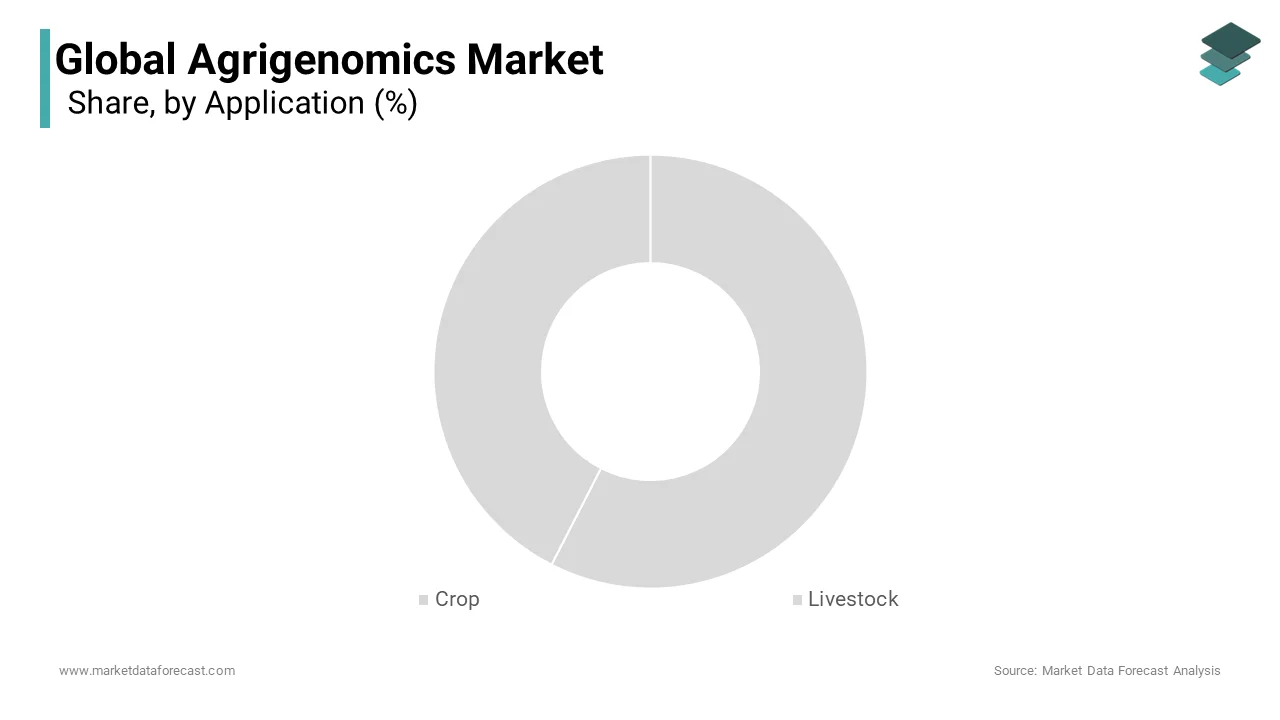
Based on Application, the global Agrigenomics market is segmented into crops and livestock. The crop segment holds the largest share of the agrigenomics market because researchers have significantly made use of genotyping and next-generation sequencing technologies to study a variety of agricultural species and gain a better understanding of the genetic variation influencing phenotypes. In the crop segment, agrigenomics helps in the establishment of a unique DNA identity for used food and agricultural products. Additionally, it helps reduce the trials and failures concerned in scientific research to a certain extent, which could enhance the quality and quantity of crop yields in agriculture. Moreover, gene editing homogenizes the development of engineered plants.
By Sequencer Type Insights
Based on sequencer type, the global Agrigenomics market is segmented into Sanger sequencing, Illumina HiSeq Family, Pac BioSequencer, and Solid Sequencer. The HiSeq Family segment is holding the largest share of this market for sequencing tests. Illumina HiSeq Family is a powerful sequencing system that has the flexibility to perform various applications. Sanger sequencing is the second most preferred type of test among research institutions after next-generation sequencing because of the limited machine cost associated with it. The Sanger method depends on a primer that binds to a denatured DNA molecule and helps in initiating the synthesis of a single-stranded polynucleotide in the presence of a DNA polymerase enzyme. Moreover, Sanger DNA is widely used for research purposes, which include targeting smaller genomic regions in a large number of samples, sequencing of variable regions, and validating results from next-generation sequencing studies.
By Objectives Insights
Based on objectives, the global Agrigenomics market is segmented into DNA Extraction & Purification, DNA/RNA Sequencing, Genotyping, Gene Expression Profiling, Marker-Assisted Selection, GMO/Trait Purity Testing, and Other Objectives. Marker-assisted selection is estimated to hold the largest share of the Arigenomic Market during the forecast period due to its ability to increase the efficiency and effectiveness of breeding compared to conventional breeding. Marker-assisted selection is gaining popularity in North America because of its strong research support and the presence of key technology providers in the United States.
REGIONAL ANALYSIS
North America is expected to dominate the Agrigenomic Market in the forecast period due to strong research & development, technological innovation, and increased mergers and acquisitions in agrigenomics in the region. In this region, countries like the United States hold the largest share in 2020 because of the advancements in sequencing and molecular breeding that are used in applications like food & agriculture, animal health, and public health. Additionally, various countries in this region are producing a large quantity of crops every year, such as canola, corn, soybeans, and beets. However, cross-contamination between GMOs and non-GMO crops produces new proteins that could potentially cause allergic reactions in human beings. Hence, the regulations require safety tests to be conducted on novel traits that have been introduced by conducting GMO/trait purity tests on samples. These kinds of developments, along with great effort on R&D activities in agricultural biotechnology, have intensified the market for agrigenomics in the region. Owing to these factors North America region will fuel the growth of the agricultural Market in the future.
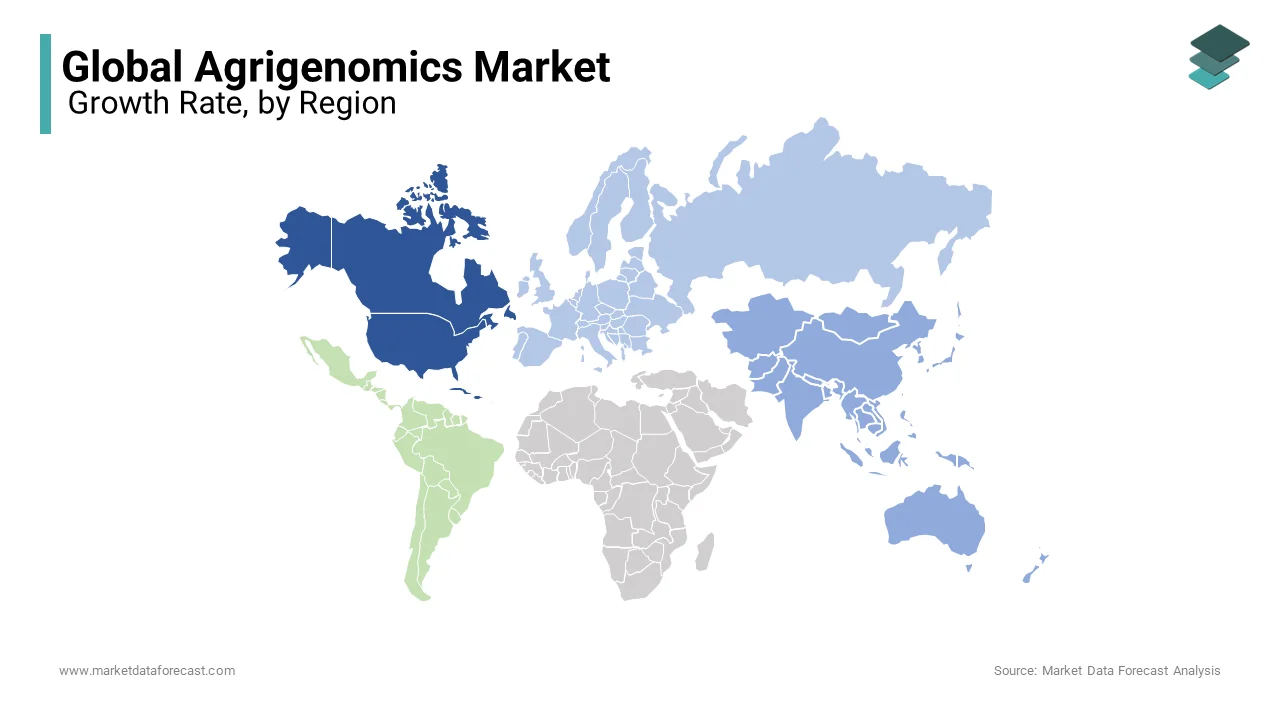
Asia-Pacific is expected to expand at the highest CAGR during the projected period because of increasing government support for research and development in the field of agronomics, decreasing prices of sequencing technologies, and significant technological advancements. In this region, countries like China and Australia are rapidly upgrading their technology and services in ortonce their growth in agriculture boosts and the growth of the agricultural market in the coming years.
Leading Company
Thermo Fisher Scientific Inc. had the largest share of the world’s Agrigenomics in terms of sales revenue.
KEY MARKET PLAYERS
Some of the leading companies operating in the Global Agrigenomics Market are Thermo Fisher Scientific, Inc. (US), Agilent Technologies, Inc. (US), Illumina, Inc. (US), Eurofins Scientific SE (Luxembourg), LGC Limited (UK), Nogen Corporation (U.S), and AgriAgrigenomics. (U.S.), ZoetiZoetis (U.S.), Galseq Srl Via Italia (Italy), Biogenetic Services. (U.S.), Some of the market players dominate the global agrigenomics market.
RECENT HAPPENINGS IN THE MARKET
- In JJanuary2022, Thermo Fisher Scientific IInc. is a global leader in serving science an,d PeproTech InInc.isleading developer and manufacturer of recombinant proteins has completed its acquisition of PeproTech in December 2021 in otove pharma and biotech custcustomers January 2020, Arbor Biosciences (a division of Chiral Technologies Inc. and a worldwide leader in next-generation sequencing target enrichment) announced its partnership with LGC, Biosearch Technologies. By this acquisition, the organization would use its extensive resources for genetic testing and marker discovery to deliver custom sequencing solutions to the agronomic market.
MARKET SEGMENTATION
This research report on the global agregenomics market is segmented and sub-segmented into the following categories.
By Application
- Crop
- Livestock
By Sequencer Type
- Sanger sequencing
- Illumina HiSeq Family
- Pac BioSequencer
- Solid Sequencer
By Objectives
- DNA Extraction & Purification
- DNA/RNA Sequencing
- Genotyping
- Gene Expression Profiling
- Marker-Assisted Selection
- GMO/GMO Purity Testing
- Other Objectives
By Region
- North America
- Europe
- Asia Pacific
- Latin America
- The Middle East and Africa
- Rest of the World