- Product Description Description
- Table of Contents TOC
- List of Table & Figure LOT
- Get Free Sample PDF Sample PDF
Market Size, 2025
$43.98 BnMarket Estimate, 2026
$46.30 BnMarket Forecast, 2034
$69.82 BnCAGR, 2026–2034
5.27%Global Herbicides Market Size, Growth, Trends & Forecast (2026–2034)
The global herbicides market size was valued at USD 43.98 billion in 2025, is anticipated to reach USD 46.30 billion in 2026, and is projected to scale up to USD 69.82 billion by the end of 2034, registering a compound annual growth rate (CAGR) of 5.27% during the forecast period from 2026 to 2034. Driven by the rising global demand for food production, increased efficiency requirements to counter weed competition, and technological innovations in precision application, the market continues to expand steadily worldwide.
Key Executive Metrics (At-a-Glance)
- 2025 Base Valuation: USD 43.98 Billion
- 2026 Current Valuation: USD 46.30 Billion
- 2034 Forecast Valuation: USD 69.82 Billion
- Compound Annual Growth Rate (CAGR): 5.27% (2026–2034)
- Leading Regional Market: Asia Pacific
- Fastest-Growing Regional Market: North America
- Covered Regional Markets: North America, Europe, Asia Pacific, Latin America, Middle East & Africa
Core Market Drivers
- Food Demand Growth: Rapidly rising global populations necessitate enhanced crop yields and effective weed elimination to secure food production rates.
- Weed Resistance Challenges: Increasing global incidents of herbicide-resistant weeds driving R&D investments into novel, highly effective formulations and AI-driven precision tools.
Primary Market Restraints & Challenges
- Herbicide Resistance & Costs: Widespread weed adaptation strains current compositions, while high costs for selective herbicides limit farmer affordability.
- Environmental & Regulatory Pressures: Stringent regulatory frameworks restricting inorganic chemical usage due to health concerns and ecological safety risks.
Global Herbicides Market Segmentation Breakdown
| Segment Category | Largest Segment | Fastest-Growing Segment |
|---|---|---|
| By Type | Synthetic (Glyphosate, 2,4-D, Diquat) | Bioherbicides |
| By Crop Type | Cereals & Grains | Fruits & Vegetables |
| By Mode of Application | Selective Herbicides | Non-Selective Herbicides |
| By Region | Asia Pacific | North America |
Major Industry Players Profiled
Key enterprises shaping the global herbicides market include BASF SE, The Dow Chemical Company, E.I. du Pont de Nemours & Company, Monsanto Company, Syngenta AG, FMC Corporation, Platform Specialty Products Corporation, Nufarm Ltd., Nissan Chemical Industries Ltd., and Drexel Chemical Co.
Global Herbicides Market Size
The global herbicides market size was valued at USD 43.98 billion in 2025 and is anticipated to reach USD 46.30 billion in 2026 to reach USD 69.82 billion by 2034, with a CAGR of 5.27% during the forecast period from 2026 to 2034.

Current Scenario Of The Global Herbicides Market
The herbicides are the chemical agents used to control the weed production on the crops. The herbicides will kill or inhibit the growth of unwanted plants, such as agricultural weeds or others. Chemical herbicides are far more advantageous than traditional mechanical weed control, enhancing the demand for chemical herbicides, as this provides ease of application by reducing labor costs for the farmer. Most of the herbicides are not considered toxic to humans and animals, but they are expected to kill the non-targeted plants and insects. Chemical weed control was implemented for a long time when industrial by-products and oils were first introduced. According to the data sources, the worldwide agricultural use of herbicides is expected to increase to a volume of around 2.4 million metric tons by 2027 from around 2.3 million metric tons in 2023.
MARKET DRIVERS
The growing demand for food production worldwide is the primary factor escalating the demand for herbicide adoption, contributing to the growth of the global herbicide market.
The growing population worldwide is enhancing the demand for food, increasing food production practices to satisfy the people with food, and enlarging agricultural production. Farmers widely adopt herbicides as they enhance crop yield with high efficacy, which offers improved food production rates, which is a significant factor leading to market revenue expansion. The increasing concerns regarding the weeds in the crops as they compete with the crops for nutrients, water, and sunlight limit crop productivity, escalating the demand for herbicides worldwide and leading to market size growth.
Various advantages of the herbicides include their effectiveness in removing deep-rooted weeds, which is difficult with mechanical methods, and their efficacy towards different crop arrangements. The herbicides are practical for a long time as they do not allow the weed plants to grow for extended periods. All these advantages of the herbicides are escalating in adoption among farmers, leading to enhanced market revenue growth.
The growing incidence of weed resistance cases across the globe, where various types of weeds are becoming resistant to several herbicides, is enhancing the demand for innovative and highly effective herbicides. These scenarios are influencing the market players to invest in R&D activities for the development of novel herbicide compositions that have high efficacy towards the weed type. These initiatives are expected to accelerate the market growth opportunities during the forecast period.
MARKET RESTRAINTS
The primary factor restraining the herbicide market growth is the cases of herbicide resistance.
Most of the weed types are becoming resistant to different herbicide compositions, where the resistant weeds start as individual plants in a field that spreads over the entire field; this acts as a significant challenge to market growth. The high costs associated with selective herbicides, which restrict the affordability of most farmers, hamper the global herbicides market growth. The increased usage of inorganic herbicides poses various environmental risks, and the increasing environmental concerns are expected to hinder the market growth rate. The presence of stringent regulations by the authorities regarding the safety and efficacy of the herbicides challenges the market growth. The increased cases of health concerns due to farmers' wide use of herbicides and environmental concerns are influencing the regulatory authorities to take initiatives to restrict the usage of various inorganic herbicides, which impedes market revenue growth. The unfavorable weather conditions for herbicide application, difficulty in handling herbicides, and some herbicides affecting the crops are restraining the market growth opportunities.
REPORT COVERAGE
| REPORT METRIC | DETAILS |
| Market Size Available | 2025 to 2034 |
| Base Year | 2025 |
| Forecast Period | 2026 to 2034 |
| CAGR | 5.27% |
| Segments Covered | By Type, Crop Type, Mode of Action, and Region |
| Various Analyses Covered | Global, Regional & Country Level Analysis, Segment-Level Analysis, DROC, PESTLE Analysis, Porter’s Five Forces Analysis, Competitive Landscape, Analyst Overview on Investment Opportunities |
| Regions Covered | North America, Europe, APAC, Latin America, Middle East & Africa |
| Market Leaders Profiled | BASF SE, The Dow Chemical Company, E.I. du Pont de Nemours & Company, Monsanto Company, Syngenta AG, FMC Corporation, Platform Specialty Products Corporation, Nufarm Ltd., Nissan Chemical Industries Ltd., and Drexel Chemical Co. |
SEGMENT ANALYSIS
By Type Insights
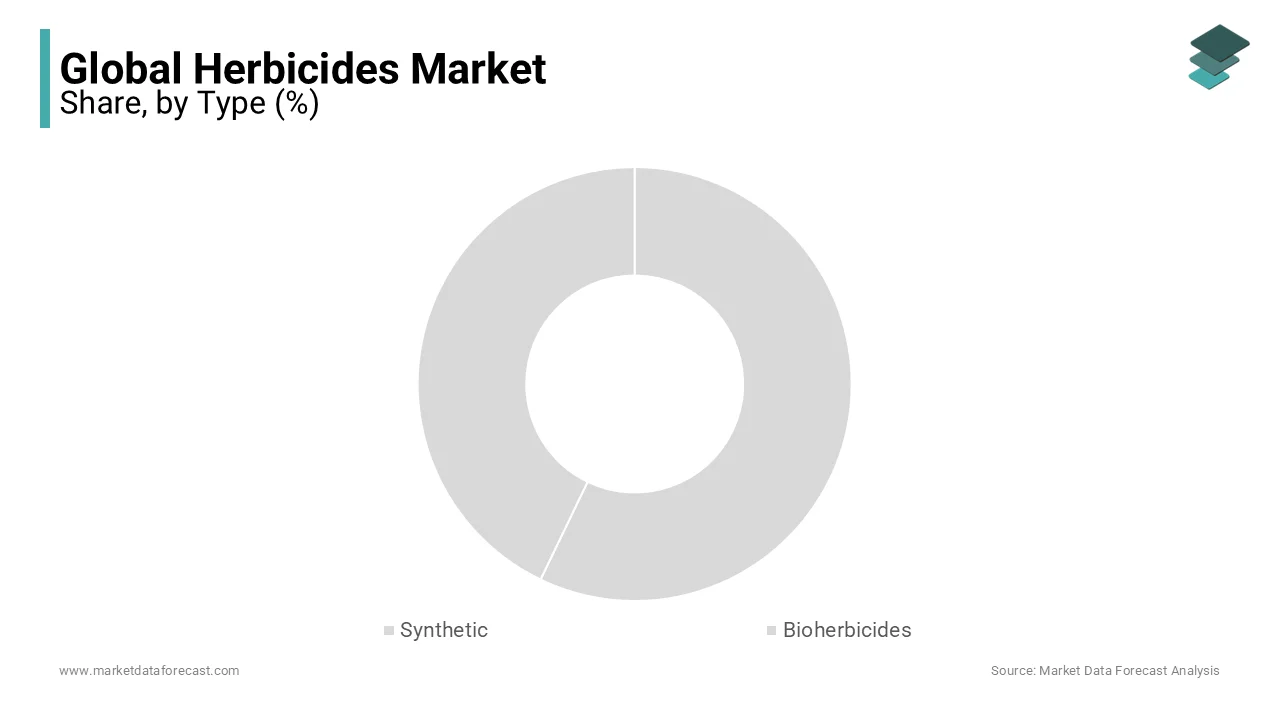
The synthetic segment held the most significant share of the global herbicides market revenue and is expected to maintain its domination with a prominent growth rate in the coming years. Synthetic herbicides involve chemical components that kill various types of weeds by ignoring the harmful effects on the crops, enhancing their adoption among most farmers worldwide. This is the major factor propelling the segment's growth rate. The synthetic segment consists of various types of herbicides, which are of high efficacy and have an effective cost, boosting farmers' adoption rate and leading to expansion. Synthetic herbicides are extensively used for large-scale agricultural operations and crop management, enhancing the segment revenue.
The bioherbicides segment is expected to grow considerably during the forecast period due to rising environmental concerns. The growing awareness among the people regarding eco-friendly methods and the rising R&D investments to develop sustainable and eco-friendly products are fueling the segment's growth.
By Crop Insights
The grains and cereals segment dominated the global herbicides market with a notable share and is estimated to witness significant growth during the forecast period. The farmers extensively utilize herbicides to cultivate staple crops such as wheat and rice, boosting the segment growth. The increased demand for these crops worldwide and the need for effective crop yield boost the segment growth. The herbicide application enhances crop uniformity, which is expected to boost productivity by reducing weed production, driving the segment revenue expansion.
The fruits and vegetables segment is projected to witness a prominent growth rate in the coming years due to consumers' growing demand for fruits and vegetables. The increased awareness among people regarding the health benefits produced by fruits and vegetables is escalating the demand, leading to increased usage of herbicides and augmenting the segment growth opportunities.
By Mode of Application Insights
The selective segment accounted for the dominant share in the herbicides market and is expected to multiply the segment growth during the forecast period. The Selective herbicides are specifically designed to target specific types of weeds without harming the crop, which is the primary factor driving the segment growth rate. Selective herbicides are widely adopted for their benefits, such as maintaining crop health and yield by controlling a wide range of weed species competing with the crops for nutrients and water, augmenting the segment revenue growth. This is propelling the key players to focus on the introduction of innovative products, which escalates the market growth opportunities.
The non-selective segment is projected to record a steady growth rate during the forecast period. The growing utilization of non-selective herbicides by farmers due to their affordability and efficacy is boosting the segment growth.
REGIONAL ANALYSIS
Asia Pacific Market Analysis
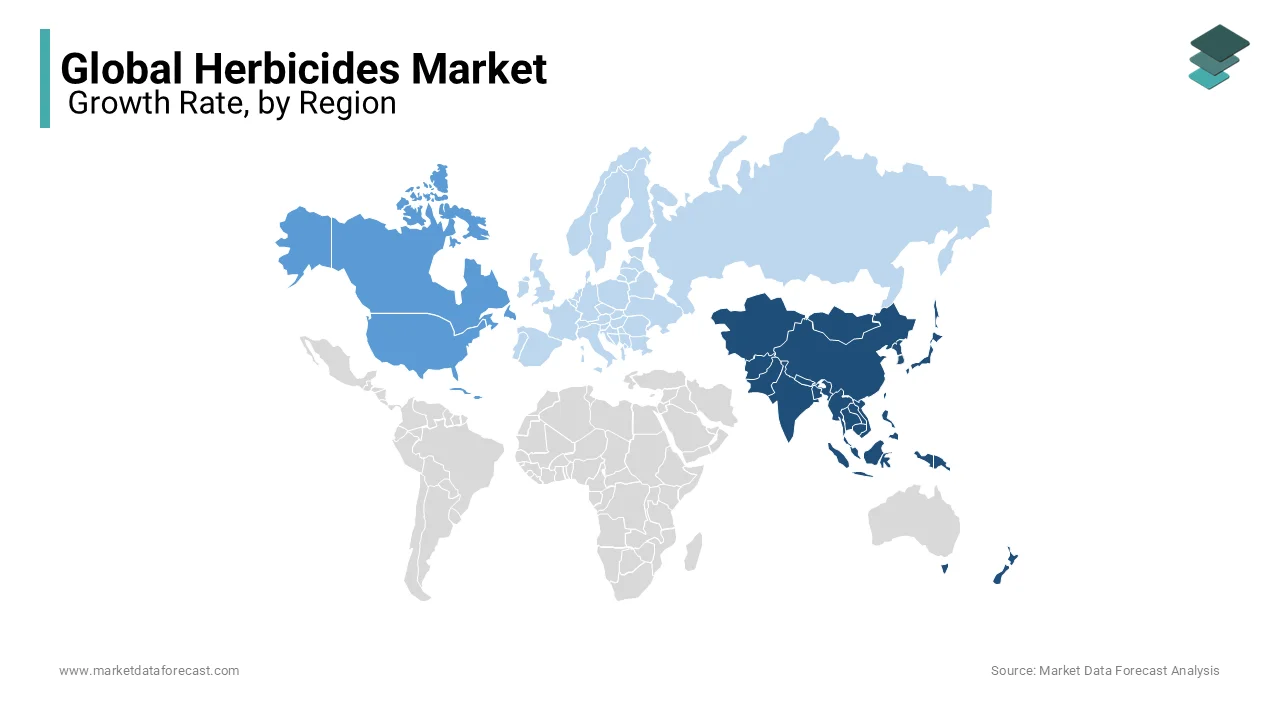
The Asia Pacific region accounts for the largest market share in the herbicides market revenue globally, and it is estimated that the region will witness significant growth during the forecast period. The significant factor contributing to regional market growth is the increase in agricultural practices across regional countries such as China, Japan, and India. The growing adoption of modern agricultural techniques, the escalating demand for crop yield production across the region, and growing government support initiatives are accelerating regional market share growth. The rising introduction of various government policies for agricultural practices that support farmers is positively influencing global herbicide market growth.
North America Market Analysis
The North American region is expected to have the fastest growth during the forecast period, owing to its expanding agricultural industry across the regional countries. The presence of well-established infrastructure in the region and the growing adoption of technological advancements in the agricultural industry are propelling the regional market growth. The presence of significant market players in the United States and the escalation in the acquisitions and mergers among the manufacturers and organizations are augmenting the market growth opportunities in the region.
Europe Market Analysis
The European region is projected to have considerable growth during the forecast period. The growing awareness among farmers regarding the necessity of herbicides, rising government support initiatives, and the escalating demand for eco-friendly and higher crop yield production are driving the regional market growth.
COMPETITIVE LANDSCAPE
KEY MARKET PLAYERS
- BASF SE
- The Dow Chemical Company
- E.I. du Pont de Nemours & Company
- Monsanto Company
- Syngenta AG
- FMC Corporation
- Platform Specialty Products Corporation
- Nufarm Ltd.
- Nissan Chemical Industries Ltd.
- Drexel Chemical Co.
RECENT MARKET NEWS
- In December 2023, ADAMA launched the most advanced cross-spectrum herbicide known as Kampai for the grains. This new product is expected to provide the broadest application window for broadleaf and narrow-leaf weed control for cereal crops.
- In July 2023, ADAMA introduced its new products, Davai A Plus and Clearfield Broad-Spectrum Herbicide solutions for imidazolinone-tolerant plants such as lentils, peas, and soybeans.
- In July 2023, UPL Ltd. announced its collaboration with the University of Arkansas System's Division of Agriculture (UADA) to gain exclusive access to Fenclorim Seed Treatment patents.
- In June 2023, Canadian startup Precision AI introduced its development of the world's first AI drones for plant-level herbicide application. Precision AI is aiming for sustainable, eco-friendly, and healthier farms.
MARKET SEGMENTATION
This research report on the global herbicides and herbicides market is segmented and sub-segmented based on type. Crop type, Mode of Application, and Region.
By Type
- Synthetic
- Glyphosate
- 2
- 4-D
- Diquat
- Others
- Bioherbicides
By Crop Type
- Cereals & Grains
- Oilseeds & Pulses
- Fruits & Vegetables
- Others
By Mode Of Application
- Selective
- Non-Selective
By Region
- North America
- Europe
- Asia Pacific
- Latin America
- The Middle East and Africa