- Product Description Description
- Table of Contents TOC
- List of Table & Figure LOT
- Get Free Sample PDF Sample PDF
Market Size, 2025
$678 MnMarket Estimate, 2026
$726.82 MnMarket Forecast, 2034
$1,268 MnCAGR, 2026–2034
7.2%Executive Summary: Global Glucagon Market
- Market Scope: Comprehensive global review of pancreatic hormone therapeutics, emergency kits, and specialized formulations utilized for treating severe hypoglycemia and managing blood glucose homeostasis.
- Market Valuation: Valued at USD 678 million in 2025, estimated to reach USD 726.82 million in 2026, and projected to expand to USD 1,268 million by 2034, registering a compound annual growth rate (CAGR) of 7.2% from 2026 to 2034.
- Primary Growth Drivers: Rising global prevalence of diabetes and chronic metabolic conditions, growing geriatric populations requiring close glycemic monitoring, and continuous pharmaceutical advancements in emergency delivery systems.
Key Market Segment Metrics
| Category | Leading Segment (Base Position) | Fastest-Growing / High-Growth Segment |
|---|---|---|
| By Product Type | Injectable Glucagon (commanded the major market share owing to high clinical familiarity, efficiency, and widespread availability) | Nasal / Needle-Free Glucagon (projected to expand rapidly due to enhanced ease of use during acute hypoglycemic emergencies) |
| By Application | Emergency Kits (secured the largest market portion supported by protocol requirements for rapid severe hypoglycemia intervention) | Diagnostic & Motility / Specialized Uses (growing steadily as clinical applications broaden into imaging and metabolic testing) |
| By Region | North America (market leader anchored by high diabetes prevalence, sophisticated healthcare infrastructure, and strong emergency treatment protocols in the U.S. and Canada) | Asia-Pacific (projected to register a substantial CAGR propelled by rising disposable incomes, improving healthcare access, and expanding patient populations in developing nations) |
Major Market Players & Industry Landscape
Market Structure: Competitive global landscape consisting of dominant pharmaceutical conglomerates, specialized biotech innovators, and regional drug manufacturers.
Key Companies: Pfizer Inc., Fresenius SE & Co. KGaA, Eli Lilly & Co., Xeris Pharmaceuticals Ltd., Taj Pharmaceuticals, Amgen Inc., Avalon Pharma Private Limited, Bachem Holding AG, Fujifilm Holdings, Svar Life Science AB, and Novo Nordisk A/S.
 Download Free Sample Report
Global Glucagon Market Size
The global glucagon market was worth US$ 678 million in 2025 and is anticipated to reach a valuation of US$ 1,268 million by 2034, from US$ 726.82 million in 2026, and it is predicted to register a CAGR of 7.2% during the forecast period (2026 to 2034).

Glucagon is a pancreatic hormone used to treat severe hypoglycemia. It prompts the liver to convert glycogen to glucose, increasing blood sugar levels rapidly. Glucagon and insulin are two different but equally significant hormones connected to the glycemic control system of the human body, which monitors and maintains normal blood glucose levels. In cases of hypoglycemia, glucagon functions as a signal, prompting the body to release more glucose into the bloodstream, thereby maintaining normal blood sugar levels. Glucagon is crucial for preventing dangerously low blood glucose levels, which can be detrimental to the body. Glucagon stimulates glycogenesis to maintain stable blood sugar levels. In addition, it prevents the liver from absorbing and storing excess sugar, which causes blood deficiency, ensuring adequate metabolic hormone levels in the circulation. Additionally, glucagon supports the body in acquiring glucose from alternate sources, such as amino acids, in the event of a sugar deficiency. Rarely, inadequate glucagon levels in infants result in an inability to maintain blood sugar levels. Glucagon administered by prescription can successfully treat people with diabetes with severe hypoglycemia. As a result, global glucagon market participants are firmly positioned alongside younger competitors who are upending the old order.
MARKET DRIVERS
The growing prevalence of chronic diseases and the geriatric population worldwide are propelling the global glucagon market.
The diversification of growth in the global glucagon market can be attributed to a firm reliance on an increasing geriatric population, accelerated therapeutic practices, and an increase in the number of out-patients and chronic disease incidences across the globe, with diabetes, and an increase in the prevalence of chronic ailments in young adults. In addition, accelerating technological advancements in the pharmaceutical industry and government funding are anticipated to be significant growth drivers for the worldwide glucagon market.
On the other hand, research and development activities to develop the next generation of capabilities for severe hypoglycemia are expected to represent a significant opportunity for market expansion. Apart from this, the key strategies by the market players, such as partnerships, mergers, and collaborations for developing new research, further expand the market growth. Furthermore, the new entrants are offering highly innovative ideas and technologically advanced concepts to the next generation to accelerate the scientific advancement of the therapy and displace industrial behemoths. In addition, the increasing modernization of the pharmaceutical industry and the increased research exploration by major participants have resulted in a more cohesive market.
MARKET RESTRAINTS
Despite the remarkable efficacy of glucagon therapy in treating hypoglycemia, the global market for glucagon is obstructed by obstacles such as severe side effects. In addition, some reported allergic reactions in specific individuals with symptoms of vomiting and nausea impede adoption and expansion. However, in the coming years, ongoing research and development efforts to develop next-generation glucagon capabilities for severe hypoglycemia represent a significant opportunity for market expansion.
REPORT COVERAGE
| REPORT METRIC | DETAILS |
| Market Size Available | 2025 to 2034 |
| Base Year | 2025 |
| Forecast Period | 2026 to 2034 |
| Segments Covered | By Product Type, Application, and Region. |
| Various Analyses Covered | Global, Regional, and Country-Level Analysis, Segment-Level Analysis, Drivers, Restraints, Opportunities, Challenges; PESTLE Analysis; Porter’s Five Forces Analysis, Competitive Landscape, Analyst Overview of Investment Opportunities |
| Regions Covered | North America, Europe, Asia Pacific, Latin America, Middle East & Africa |
| Market Leaders Profiled | Pzier Inc, Fresenius SE & Co. KGaA, Eli Lilly & Co., Xeris Pharmaceuticals Ltd., Taj Pharmaceuticals, Amgen Inc, Avalon Pharma Private Limited, Bachem Holding AG, Fujifilm Holdings, Svar Life Science AB, Novo Nordisk A/S, and Others. |
SEGMENTAL ANALYSIS
By Product Type Insights
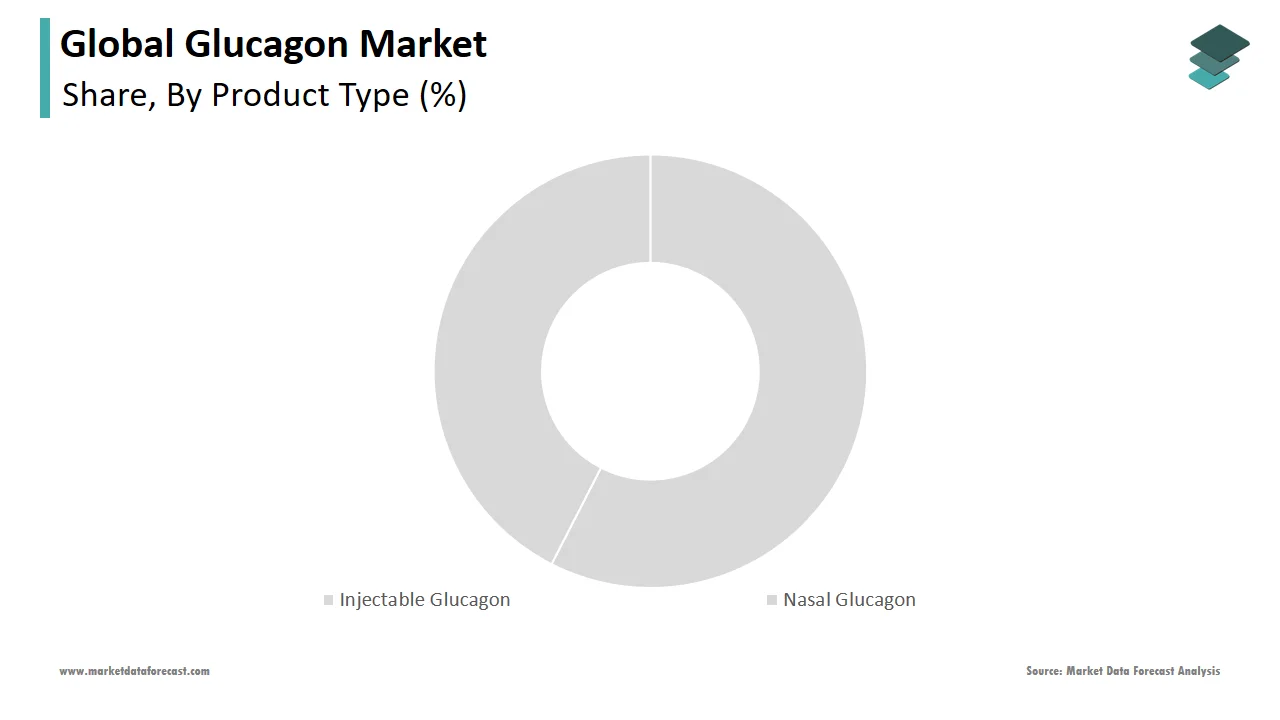
Based on the product type, the injectable glucagon segment will have the major share of the global glucagon market during the forecast period. The injectable glucagon's efficiency and ease of availability favor its market growth.
By Application Insights
Based on application, the emergency kits segment is anticipated to hold the major share of the global market during the forecast period.
REGIONAL ANALYSIS
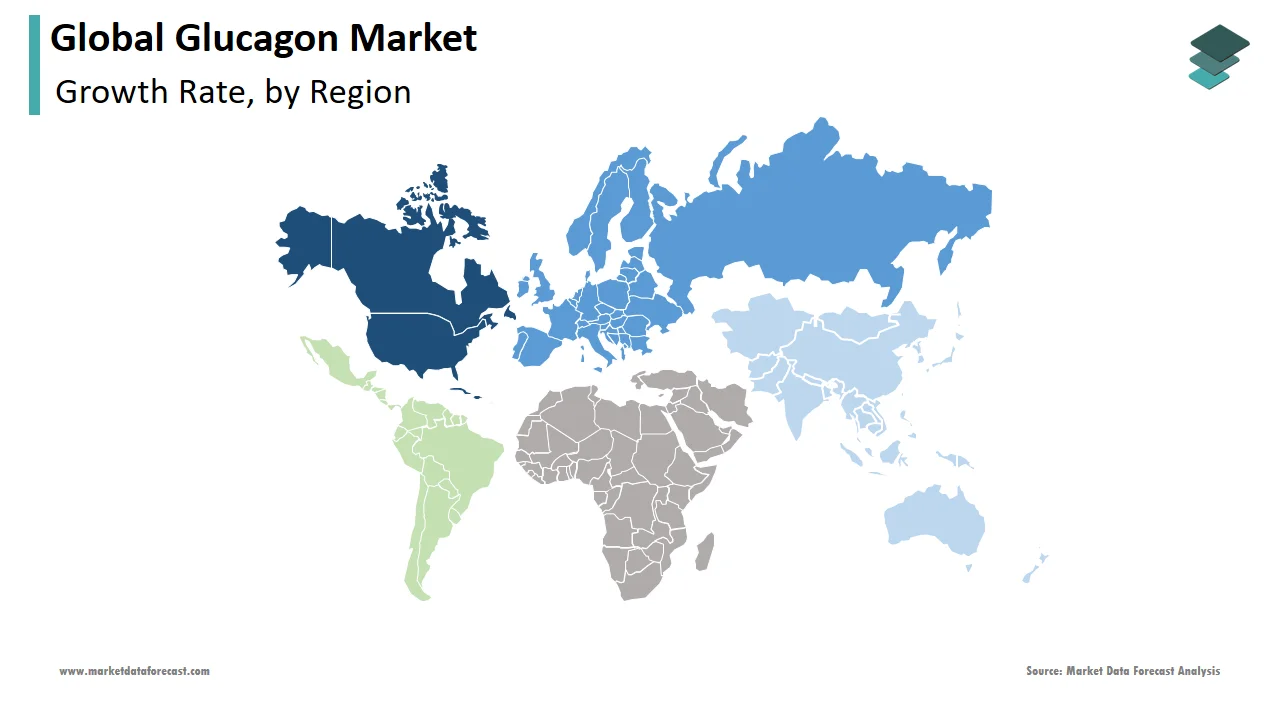
Due to its fully developed and mature market, North America is anticipated to account for the most considerable portion of the global Glucagon market over the forecast period. In addition, the region accounted for the largest revenue share of the worldwide glucagon market in 2020, indicating that it would continue to dominate this sector over the following decade. Countries like the U.S. and Canada are expected to contribute more to the market due to the growing rate of diabetes patients and the need for better health care.
The countries of the European region, like the UK, Germany, Italy, and France, are also expected to show growth in the market due to rising awareness of healthcare and increased need for glucagon-related treatments.
During the forecast period, the Asia-Pacific market is anticipated to expand at a substantial CAGR due to rising product awareness and increased healthcare spending. In addition, increased disposable incomes and the urgent need for healthcare in developing countries are expected to fuel the fast-growing CAGR in the region.
Latin America, with countries like Mexico and Argentina, and the Middle East and Africa, with countries like UAE and South Africa, are expected to show lucrative progress in the glucagon market.
KEY MARKET PLAYERS
The leading companies operating in the global glucagon market include:
- Pzier Inc
- Fresenius SE & Co. KGaA
- Eli Lilly & Co.
- Xeris Pharmaceuticals Ltd.
- Taj Pharmaceuticals
- Amgen Inc
- Avalon Pharma Private Limited
- Bachem Holding AG
- Fujifilm Holdings
- Svar Life Science AB
- Novo Nordisk A/S
GLOBAL GLUCAGON MARKET NEWS
- Recently, Xeris Biopharma announced its first-quarter financial reports and its new product revenue of $21.9M. In addition, the company launched Recorlev and Groke Kit and some of its comping events.
- Lilly's mounjaro has entered the diabetes market and plans on releasing more diabetes-related medicine. At the same time, companies like Biogen and Esai Lecanemab are leading the neuroscience market.
- Zealand Pharma has announced positive results from its phase 3 trial of dasiglucagoon in pediatric patients with congenital hyperinsulinism. In this trial, dasiglucagon medication was determined to be well-tolerated, and 11 of 12 patients are continuing onto a long-term safety extension study.
- Innocent is catching up with competitors like Lilly and Novo Nordisk due to its phase 2 obesity data findings. The study evaluated the effects of mazdutide on 230 Chinese volunteers who were overweight or obese. 58.1 percent of those receiving a 3-mg dose, 82.5 percent of those receiving 4.5 mg, and 80.3 percent of those receiving 6 mg lost 5 percent or more of their body weight compared to 4.8 percent of those receiving a placebo after 24 weeks. While no patients on placebo saw a weight loss of 10 percent or more, 19.4 percent of those on the 3-mg dose, 49.2 percent on the 4.5-mg dose, and 50.8 percent on the 6-mg dose did.
MARKET SEGMENTATION
This research report on the global glucagon market has been segmented and sub-segmented based on the product type, application & region.
By Product Type
- Injectable Glucagon
- Nasal Glucagon
By Application
- Emergency Kits
- General Use
- Diagnostic & Motility
- Cardiogenic Shock
- Others
By Region
- North America
- Europe
- APAC
- Latin America
- MEA