- Product Description Description
- Table of Contents TOC
- List of Table & Figure LOT
- Get Free Sample PDF Sample PDF
Market Size, 2025
$3,182.36 BnMarket Estimate, 2026
$3,572.20 BnMarket Forecast, 2034
$9,003.82 BnCAGR, 2026–2034
12.25%Global Halal Food Market Size, Growth, Trends & Forecast (2026–2034)
The Global Halal Food Market size was calculated to be USD 3,182.36 billion in 2025, is estimated to reach USD 3,572.20 billion in 2026, and is projected to expand to USD 9,003.82 billion by 2034, registering a compound annual growth rate (CAGR) of 12.25% during the forecast period from 2026 to 2034. Driven by rapid growth of urban Muslim populations, expanding certification infrastructures, and a broader lifestyle shift toward digital transparency, the market is experiencing massive global adoption.
Key Executive Metrics (At-a-Glance)
- 2025 Base Valuation: USD 3,182.36 Billion
- 2026 Current Valuation: USD 3,572.20 Billion
- 2034 Forecast Valuation: USD 9,003.82 Billion
- Compound Annual Growth Rate (CAGR): 12.25% (2026–2034)
- Leading Region: Asia-Pacific (holding a dominant 37.3% share in 2025 anchored by heavy institutionalization in Indonesia and Malaysia)
- Key Growth Hubs: Middle East & Africa (high-value import hubs) and Europe/North America (expanding via multicultural demographics)
Core Market Drivers
- Urban Muslim Population Growth: Rising middle-class consumers in high-density regions demanding certified Halal products across mainstream organized retail.
- Certification & Trade Integration: Institutionalization of cross-border digital platforms (such as Indonesia’s BPJPH) streamlining international trade compliance.
Primary Market Restraints & Challenges
- Lack of Global Standardization: Fragmentation across diverse international certification bodies causing regulatory duplication, export delays, and re-certification hurdles.
- Supply Chain Fraud & Climate Pressures: Risks of mislabeling/cross-contamination alongside extreme climate disruptions impacting livestock and feed availability.
Market Segmentation: Largest and Fastest-Growing Segments
| Segment Category | Largest Segment | Fastest-Growing Segment |
|---|---|---|
| By Product Type | Meat and Poultry (48.3% share in 2025) | Cereals and Confectionery (CAGR of 9.8%) |
| By Distribution Channel | Supermarkets and Hypermarkets (44.3% share in 2025) | Online Distribution Channel (CAGR of 12.6%) |
| By Region | Asia-Pacific (37.3% share in 2025) | Middle East & Africa & North America |
Major Industry Players Profiled
Key market participants shaping the global Halal food landscape include Nestlé, BRF S.A., Cargill, Al Islami Foods, QL Foods Sdn Bhd, Saffron Road, Kawan Food Berhad, Midamar Corporation, Tahira Foods Ltd, Al-Falah Halal Foods, Prima Agro Products, Amana Foods, and Al Kabeer Group.
Global Halal Food Market Size
The global halal food market size was calculated to be USD 3,182.36 billion in 2025 and is anticipated to be worth USD 9,003.82 billion by 2034, from USD 3,572.20 billion in 2026, growing at a CAGR of 12.25% during the forecast period.
Halal food is a global ecosystem of food production, processing, and distribution that complies with Islamic dietary laws derived from the Quran and Hadith. These regulations prohibit the consumption of pork, alcohol, and non-certified meat, while mandating humane animal slaughter (dhabiha) and contamination-free processing environments. As per the World Health Organization (WHO), over 1.9 billion Muslims worldwide adhere to Halal dietary principles, making it one of the most widespread religious food systems.
MARKET DRIVERS
Rapid Growth of Muslim Populations in Urban and High-Income Regions
The expansion of Muslim communities in urban centers across Asia, the Middle East, and Western countries is a primary driving factor for the growth of halal food market. According to the Pew Research Center, Indonesia, Pakistan, and India collectively account for over 600 million Muslims, with urban populations growing at 3.2% annually. In Southeast Asia, Malaysia and Indonesia are witnessing a surge in middle-class Muslim consumers who prioritize certified Halal products in supermarkets and foodservice outlets. Supermarkets such as Carrefour and Tesco have dedicated Halal sections, while fast-food chains like KFC and McDonald’s have obtained Halal certification in multiple markets, which is reflecting institutional recognition of this sustained demand.
Expansion of Halal Certification Infrastructure and Global Trade Integration
The institutionalization of Halal certification has enabled cross-border trade and consumer trust is significantly boosting the growth of halal food market. According to the Dubai Islamic Economy Development Centre (DIEDC), over 120 countries now recognize at least one form of Halal certification, with Malaysia’s JAKIM and Indonesia’s BPJPH MUI leading international standards. In 2023, Indonesia launched the Halal Product Assurance Organ (BPJPH) digital platform, streamlining certification for over 50,000 local producers, as stated by the Ministry of Religious Affairs.
MARKET RESTRAINTS
Lack of Global Standardization in Halal Certification Processes
The absence of a unified international Halal standard creates fragmentation, complicating compliance for multinational food producers is majorly restraining the growth of halal food market. According to the Organisation of Islamic Cooperation (OIC), over 50 different Halal certification bodies operate globally, each with varying requirements, inspection protocols, and recognition levels. In 2023, a study by the Gulf Standardization Organization (GSO) found that 40% of Halal-certified products in the UAE required re-certification when entering Saudi Arabia due to differing technical criteria. This duplication increases costs and delays market entry. In the U.S., lack of federal oversight has led to inconsistent labeling, with the USDA reporting 22% of products claiming to be Halal lacking third-party verification in 2022.
Risk of Fraud and Mislabeling in the Halal Supply Chain
Instances of Halal fraud, including false certification and cross-contamination, have undermined consumer trust and regulatory credibility is also to degrade the growth of halal food market. According to Indonesia’s Halal Watch, over 15,000 food products were suspended in 2023 for unauthorized use of the Halal logo, with penalties totaling IDR 230 billion. In India, a 2022 investigation by the Food Safety and Standards Authority (FSSAI) revealed that 12% of meat labeled as Halal contained pork DNA, as confirmed by laboratory testing. vulnerabilities in traceability and enforcement. The complexity of global supply chains increases the risk of substitution in processed and imported goods.
MARKET OPPORTUNITIES
Rising Demand for Halal Pharmaceuticals and Cosmetics (Halal Lifestyle Expansion)
The Halal concept is expanding beyond food into pharmaceuticals, cosmetics, and personal care, creating a broader "Halal lifestyle" economy, which is likely to create new opportunities for the growth of halal food market. According to the State of the Global Islamic Economy Report 2023, the Halal pharmaceutical and cosmetic market is projected to reach USD 143 billion by 2027, growing at 11.3% annually. In Malaysia, the government has established the Halal Development Corporation to certify non-food products, with over 5,000 Halal-compliant cosmetics registered by 2023. In Saudi Arabia, the Vision 2030 initiative includes developing a domestic Halal pharma industry to reduce import dependency. Muslim consumers are increasingly scrutinizing ingredients for alcohol, pork derivatives, and non-Halal gelatin in medicines and skincare.
Digitalization of Halal Verification and Blockchain Traceability
The technological innovation is addressing transparency gaps in the Halal supply chain through digital certification and real-time tracking, is addition to leveraging the growth of the halal food market. According to a 2023 report by the Islamic Chamber of Commerce and Industry (ICCI), blockchain adoption in Halal logistics has increased by 35% across Southeast Asia and the Gulf. Malaysia’s MyHalal Trace system enables consumers to scan QR codes on meat packaging to view slaughter location, certification status, and cold-chain history.
MARKET CHALLENGES
Geopolitical Tensions and Regulatory Divergence in Key Export Markets
The geopolitical instability and divergent regulatory frameworks in Muslim-majority regions complicate Halal export strategies is likely to inhibit the growth of halal food market. According to the World Trade Organization (WTO), non-tariff barriers related to Halal compliance increased by 25% between 2020 and 2023, particularly in the Middle East and North Africa. In 2023, Saudi Arabia suspended meat imports from Brazil and Australia over concerns about slaughterhouse monitoring, affecting USD 1.2 billion in trade, as reported by the International Meat Secretariat.
Climate Change and Water Scarcity Impacting Livestock Supply for Halal Meat
Climate change is disrupting livestock production in key Halal meat-exporting regions, which is ascribed to hampers the growth of the halal food market. According to the Intergovernmental Panel on Climate Change (IPCC), prolonged droughts in the Horn of Africa reduced cattle populations by 30% between 2020 and 2023, affecting Halal meat exports from Somalia and Ethiopia. In Australia, a major supplier of Halal-certified lamb to the Middle East, the 2022–2023 drought led to a 15% decline in sheep inventory, as reported by the Australian Bureau of Agricultural and Resource Economics. Water scarcity in Pakistan and Egypt has constrained feed production, increasing the cost of raising livestock. These environmental pressures elevate prices and reduce availability, particularly during peak demand periods like Eid al-Adha.
REPORT COVERAGE
| REPORT METRIC | DETAILS |
| Market Size Available | 2025 to 2034 |
| Base Year | 2025 |
| Forecast Period | 2026 to 2034 |
| CAGR | 12.25% |
| Segments Covered | By Product Type, Distribution Channel, and Region |
| Various Analyses Covered | Global, Regional & Country Level Analysis; Segment-Level Analysis; DROC, PESTLE Analysis; Porter’s Five Forces Analysis; Competitive Landscape; Analyst Overview of Investment Opportunities |
| Regions Covered | North America, Europe, APAC, Latin America, Middle East & Africa |
| Market Leaders Profiled | Nestlé, BRF S.A., Cargill, Al Islami Foods, QL Foods Sdn Bhd, Saffron Road, Kawan Food Berhad, Midamar Corporation, Tahira Foods Ltd, Al-Falah Halal Foods, Prima Agro Products, Amana Foods, Al Kabeer Group |
SEGMENTAL ANALYSIS
By Product Type Insights
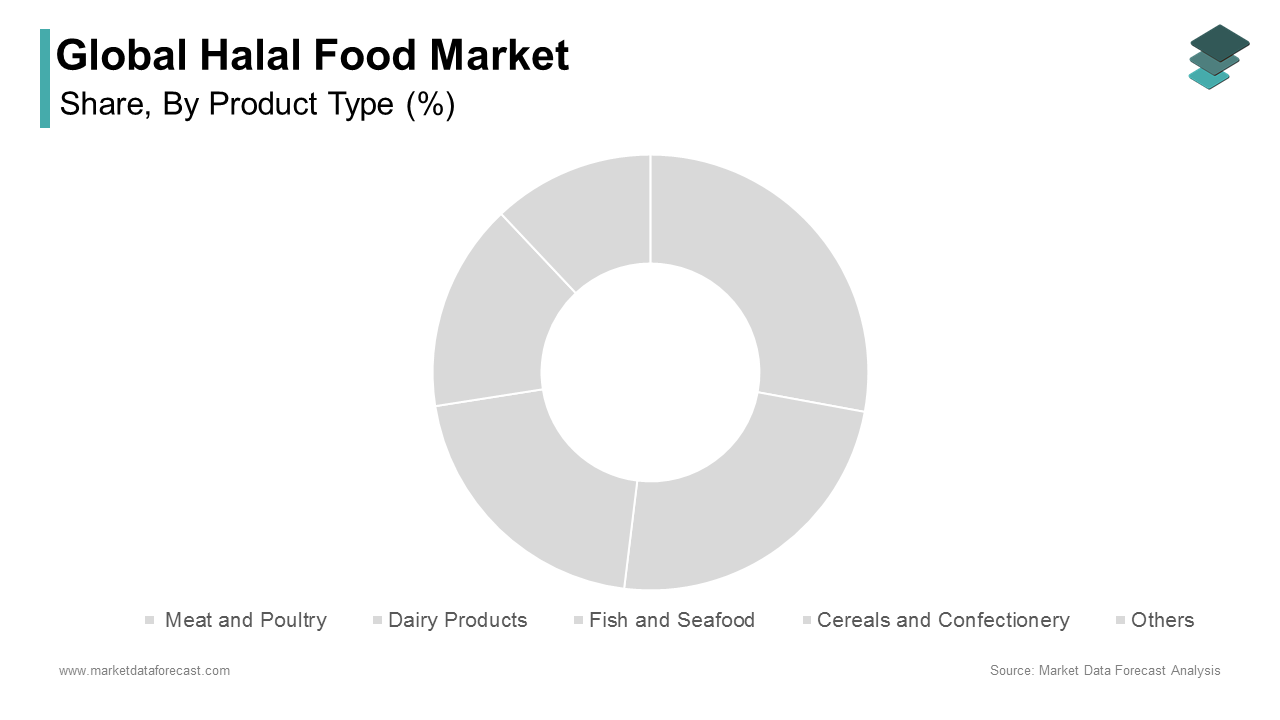
The Meat and Poultry segment dominated the global Halal food market by accounting for 48.3% of share in 2025 with the centrality of meat in Islamic dietary culture, particularly during religious festivals such as Eid al-Adha, when demand surges for Halal-certified lamb, goat, and beef. In Saudi Arabia alone, per capita meat consumption exceeds 65 kilograms annually, with 95% sourced from Halal-certified suppliers, as stated by the Saudi Ministry of Environment, Water and Agriculture.
The Cereals and Confectionery segment is expected to grow with an estimated CAGR of 9.8% from 2026 to 2034 with the rising demand for Halal-compliant baked goods, snacks, and processed foods among Muslim youth and urban populations. In Indonesia, the world’s largest Muslim-majority country, the packaged snack market reached IDR 120 trillion (USD 7.8 billion) in 2023, with over 70% of products now carrying Halal certification, as reported by the Indonesian Consumer Protection Institute (YLKI). The expansion of Halal-certified confectionery is also evident in global supply chains; Nestlé reported that 95% of its confectionery products in the Middle East and South Asia were Halal-certified by 2023.
By Distribution Channel Insights
The supermarkets and hypermarkets segment was the largest and held 44.3% of the Halal food market share in 2025 with the increasing formalization of food retail in urban centers across Muslim-majority countries and diaspora communities. In Malaysia, over 80% of Halal-certified food is sold through organized retail chains such as AEON, Tesco, and Giant, where dedicated Halal sections enhance consumer confidence, according to Malaysia’s Ministry of Domestic Trade and Cost of Living. In the UAE, Carrefour and Lulu Hypermarket allocate up to 30% of shelf space to Halal products, including meat, dairy, and frozen meals. The integration of Halal certification labels on packaging, combined with cold-chain integrity and traceability systems, ensures compliance and freshness.
The Online distribution channel is projected to expand at a CAGR of 12.6% in the coming years with the digital adoption, e-commerce infrastructure development, and shifting consumer preferences for home delivery. In Indonesia, Halal food sales via e-commerce platforms such as Tokopedia and Shopee grew by 38% in 2023, with over 60 million consumers purchasing packaged Halal products online, as reported by the Indonesian E-Commerce Association (iDEA). In the UK, Halal grocery delivery platforms like Mumzz and Salaam Gateway have reported a 50% year-on-year increase in subscriptions, catering to Muslim households seeking certified meat and ready meals.
REGIONAL ANALYSIS
Asia Pacific Halal Food Market Insights
Asia Pacific Halal food market was the top performer in the halal food market by capturing 37.3% of share in 2025 with the anchored in Indonesia, the world’s most populous Muslim-majority country, where Halal food consumption is deeply institutionalized. Indonesia mandates Halal certification for all food products under Law No. 33 of 2014, with over 500,000 products certified by 2023, according to BPJPH, the national Halal authority. Malaysia, a regional leader in Halal standards, hosts the world’s most advanced Halal certification and logistics infrastructure, facilitating exports to 120 countries.
Middle East and Africa Halal Food Market Insights
Middle East & Africa Halal food market growth is with the Gulf Cooperation Council (GCC) nations serving as high-value consumption hubs, according to the Dubai Islamic Economy Development Centre (DIEDC). Saudi Arabia, the UAE, and Qatar import over 70% of their food, with Halal compliance being a non-negotiable requirement for market entry. The UAE alone imports over 85% of its food, spending USD 24 billion annually, of which Halal-certified meat, dairy, and processed foods constitute the majority, as reported by the Emirates Authority for Standardization and Metrology (ESMA). Egypt and Nigeria, with large Muslim populations, are expanding domestic Halal production to reduce import dependency. In Saudi Arabia, Vision 2030 includes a national Halal development strategy to localize production and become a global Halal hub. The region’s high disposable incomes and religious adherence make it a premium, compliance-driven market with strong growth potential.
Europe Halal Food Market Insights
Europe Halal food market growth is ascribed with significant demand concentrated in Western and Central European countries with large Muslim populations, according to the European Foundation for Democracy. France, Germany, and the UK collectively host over 20 million Muslims, driving demand for Halal meat, dairy, and ready meals. In the UK, Halal food sales exceeded GBP 2.5 billion in 2023, with over 1,200 certified slaughterhouses and 15,000 retail outlets offering Halal products, as stated by the Halal Monitoring Committee (HMC). Major supermarkets like Carrefour France and Tesco UK have expanded Halal sections in response to consumer demand.
North America Halal Food Market Insights
North America Halal food market growth is leveraging with the United States and Canada emerging as dynamic, multicultural consumption zones, according to the Islamic Food and Nutrition Council of America (IFANCA). The U.S. Muslim population reached 4 million in 2023, with annual Halal food expenditure estimated at USD 20 billion, as reported by the Pew Research Center. Major retailers such as Walmart and Kroger now stock Halal-certified meat and frozen meals, while restaurants like Zabiha Halal and Boston Halal Grill have gained national recognition. The USDA does not regulate Halal claims, but third-party certifiers like IFANCA and ISWA ensure compliance.
Latin America Halal Food Market Insights
Latin America Halal food market growth is driven by the Brazil, Argentina, and Colombia leading in production and export potential. Brazil is one of the world’s largest exporters of Halal-certified beef and poultry, shipping over 1.2 million metric tons to the Middle East in 2023, as reported by the Brazilian Association of Halal Industries (ABIHALAL). Argentina has developed dedicated Halal slaughterhouses to meet Gulf demand, with exports valued at USD 800 million annually. In Colombia, the government has established a national Halal certification body to boost agri-food exports. While domestic Muslim populations remain small, the region’s high-quality livestock and competitive pricing make it a strategic supplier.
LEADING PLAYERS IN THE HALAL FOOD MARKET
Ajinomoto Co., Inc.
Ajinomoto, a global food and seasoning leader, plays a pivotal role in the Asia Pacific Halal food market through its extensive portfolio of Halal-certified seasonings, frozen foods, and amino acid-based ingredients. The company has secured Halal certification from JAKIM Malaysia and MUI Indonesia, enabling broad distribution across Muslim-majority nations. In 2023, Ajinomoto launched a new line of ready-to-cook Halal meal bases in Thailand and Indonesia, tailored to local flavors such as rendang and soto. It operates dedicated Halal-compliant production facilities in Malaysia and Vietnam, ensuring no cross-contamination with non-Halal substances. The company also collaborates with foodservice providers to supply Halal-certified flavor enhancers for instant noodles and soups. Its investment in R&D focuses on clean-label, umami-rich formulations that meet both taste and religious requirements, reinforcing its position as a trusted ingredient supplier across the region’s fast-growing processed food sector.
Charoen Pokphand Foods (CPF)
Charoen Pokphand Foods, a Thai agribusiness giant, is a dominant force in Asia Pacific’s Halal meat and poultry sector, supplying certified products to over 40 countries. The company operates integrated Halal-certified farms, feed mills, and slaughterhouses across Thailand, Indonesia, and Malaysia, adhering to MUI and JAKIM standards. In 2023, CPF expanded its Halal poultry processing capacity in West Java by 30% to meet rising demand from the Middle East and domestic markets. It introduced blockchain traceability for its “CP Fresh” brand, allowing consumers to verify the Halal status of chicken products via QR codes. CPF also supplies Halal-ready meals to airlines and convenience stores in Muslim-majority regions. Its vertically integrated model ensures compliance from farm to fork, while strategic partnerships with Islamic councils enhance certification credibility.
Prima Taste (A Subsidiary of Prima Group)
Prima Taste, a Singapore-based food manufacturer, has emerged as a key innovator in premium Halal-certified ready meals and instant noodles, targeting urban consumers across Asia Pacific. All its products are certified by MUIS (Islamic Religious Council of Singapore), enabling export to Malaysia, Indonesia, and Brunei. In 2023, the company launched a Halal-certified "Laksa" and "Rendang" microwaveable meal line in collaboration with Singapore Airlines, enhancing its presence in the aviation catering sector. Prima Taste also expanded into Japan and South Korea, where Halal ramen variants cater to Muslim tourists and residents. Its focus on authentic regional flavors, long shelf life, and elegant packaging differentiates it in the premium convenience food space.
TOP STRATEGIES USED BY KEY MARKET PARTICIPANTS
Key players in the Halal food market are deploying a multifaceted strategic approach to strengthen their position in a faith-driven, compliance-intensive sector. Obtaining internationally recognized Halal certification from bodies such as JAKIM, MUI, and IFANCA is fundamental to market access and consumer trust. Companies are investing in dedicated Halal production lines and closed-loop supply chains to prevent cross-contamination. Product localization is critical, with firms developing region-specific flavors and formats that align with cultural preferences. Expansion into e-commerce and digital traceability platforms enhances transparency and consumer engagement. Strategic partnerships with Islamic councils, airlines, and retail chains amplify distribution. Additionally, investment in R&D is driving innovation in plant-based Halal alternatives and shelf-stable ready meals. Sustainability and ethical sourcing are increasingly integrated to appeal to younger, values-conscious Muslim consumers.
KEY MARKET PLAYERS AND COMPETITION OVERVIEW
Major Players of the Halal Food Market include Nestlé, BRF S.A., Cargill, Al Islami Foods, QL Foods Sdn Bhd, Saffron Road, Kawan Food Berhad, Midamar Corporation, Tahira Foods Ltd, Al-Falah Halal Foods, Prima Agro Products, Amana Foods, Al Kabeer Group
Competition in the Halal food market is intensifying as global food corporations, regional producers, and specialty brands vie for dominance in a rapidly expanding, values-driven sector. The market is characterized by high regulatory scrutiny, requiring rigorous certification and traceability, which creates both barriers and opportunities. Incumbents face pressure from new entrants offering plant-based Halal alternatives and digitally native brands leveraging social commerce. Differentiation is achieved through authenticity, certification credibility, and product innovation tailored to local tastes. In Asia Pacific, local champions dominate fresh and traditional categories, while multinationals lead in processed and packaged segments. Price sensitivity varies, with premiumization gaining traction in urban centers.
MARKET SEGMENTATION
This research report on the global halal food market has been segmented and sub-segmented based on product type, distribution channel and region.
By Product Type
- Meat and Poultry
- Dairy Products
- Fish and Seafood
- Cereals and Confectionery
- Others
By Distribution Channel
- Meat and Poultry
- Dairy Products
- Fish and Seafood
- Cereals and Confectionery
- Others
By Region
- North America
- Europe
- Asia-Pacific
- Latin America
- Middle East and Africa