- Product Description Description
- Table of Contents TOC
- List of Table & Figure LOT
- Get Free Sample PDF Sample PDF
Market Size, 2025
$9 BnMarket Estimate, 2026
$10.13 BnMarket Forecast, 2034
$25.98 BnCAGR, 2026–2034
12.5%Global Hand Cream Market Size, Growth, Trends & Forecast (2026–2034)
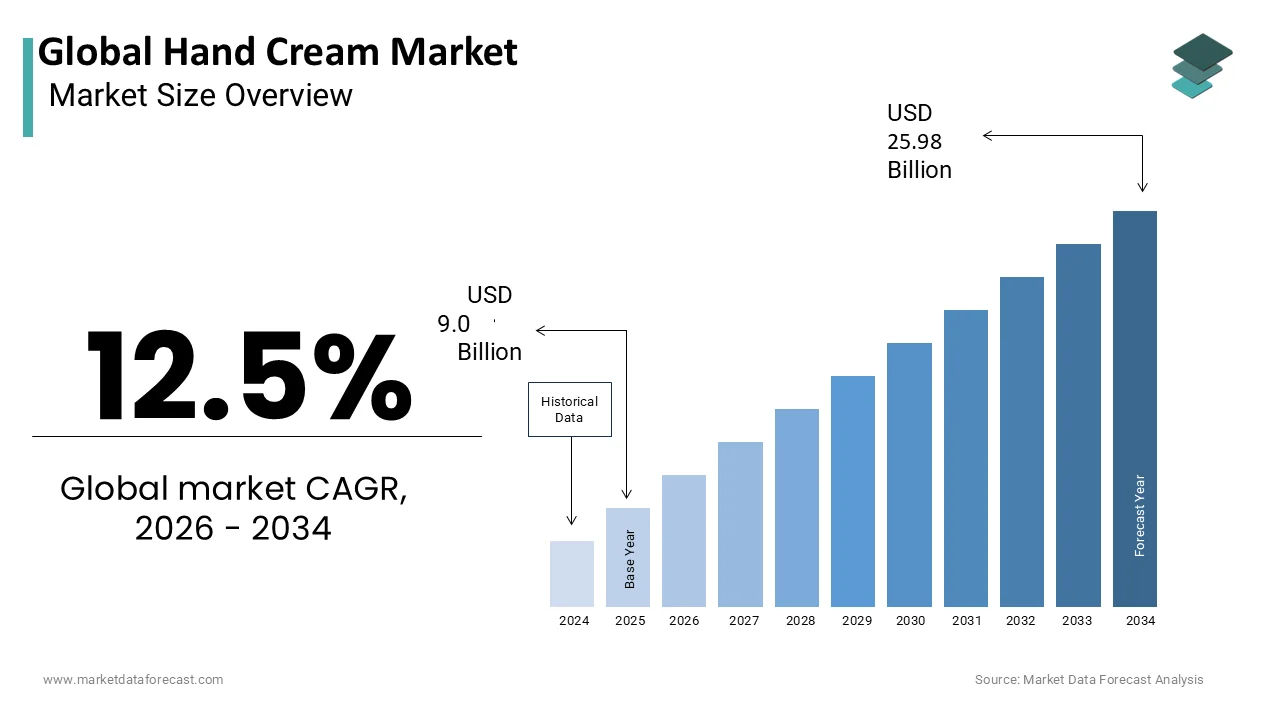
The global hand cream market size was valued at USD 9.0 billion in 2025, is estimated to reach USD 10.13 billion in 2026, and is projected to scale up to USD 25.98 billion by 2034, registering a compound annual growth rate (CAGR) of 12.5% during the forecast period from 2026 to 2034. Driven by rising skincare awareness, anti-aging demands, and consumer pivots toward clean, natural, and organic ingredients, the market continues its robust expansion.
Key Executive Metrics (At-a-Glance)
- 2025 Base Valuation: USD 9.00 Billion
- 2026 Current Valuation: USD 10.13 Billion
- 2034 Forecast Valuation: USD 25.98 Billion
- Compound Annual Growth Rate (CAGR): 12.5% (2026–2034)
- Dominant Type Segment: Repair Hand Cream (expected to rule the market with specialized barrier-restoring ingredients like shea butter and oils)
- Dominant Age Group Segment: Generation X (dominating through a primary focus on overall skin health, nourishment, and anti-aging properties)
- Dominant Demographic: Female (leads due to established self-care routines and extensive product availability)
- Dominant Distribution Channel: Supermarkets (preferred for broad brand variety and convenience during routine shopping)
- Dominant Regional Market: North America (anchored by high consumer awareness, climate variations, and prominent beauty brands)
Core Market Drivers
- Heightened Skin Health Awareness: Consumers actively investing in targeted hand care routines to maintain hydrated, protected skin.
- Clean & Green Beauty Trends: Rising preference for natural, organic, and sustainably packaged formulations free of harsh chemicals.
Primary Market Restraints & Challenges
- Cost Sensitivity & Pricing Dynamics: Consumer hesitation regarding premium or high-cost luxury hand creams during periods of financial uncertainty, requiring a balance between affordability and efficacy.
Global Hand Cream Market Segmentation Breakdown
| Segment Category | Leading Sub-Segment | Fastest-Growing Sub-Segment |
|---|---|---|
| By Type | Repair Hand Cream | Protective Hand Creams |
| By Age Group | Generation X | Generation Z & Millennials |
| By Demographics | Female Segment | Male Segment (Steady growth in hygiene awareness) |
| By Distribution Channel | Supermarkets | Online Retail / E-commerce |
| By Region | North America | Asia-Pacific (Driven by K-beauty/J-beauty trends) |
Major Industry Players Profiled
Key enterprises shaping the competitive global hand cream market include Proctor & Gamble, Johnson & Johnson, Unilever, Beiersdorf AG, Coty, Inc., Whaelthfields Lohmann, Shanghai Jahwa United Co. Ltd., Galderma, Philosophy, Alba Botanica, and Avalon Organics.
Global Hand Cream Market Size
The global hand cream market was valued at USD 9.0 billion in 2025, is estimated to reach USD 10.13 billion in 2026, and is projected to reach USD 25.98 billion by 2034, growing at a CAGR of 12.5% from 2026 to 2034.
MARKET DRIVERS
The global hand cream market is thriving in response to growing skin health awareness. Consumers now prioritize maintaining healthy, hydrated skin, which causes demand for hand creams.
With a rising focus on skincare, individuals are more willing to invest in products that nurture skin health, particularly their hands. This trend improves the market's evolution, with hand cream brands focusing on innovative formulations and ingredients to meet consumer expectations. As skin health becomes a central concern, the hand cream market continues to flourish, serving the growing demand for effective solutions to keep hands moisturized and protected.
Natural and organic ingredients are thriving in the growth of the hand cream market by mirroring the broader clean and green beauty trends.
Consumers are now more ingredient-conscious, seeking skincare products, including hand creams, that are free from harmful chemicals and embrace the goodness of nature. This demand has led to the formulation of their products with organic and naturally sourced components, delivering safer and environmentally friendly solutions. This shift not only reflects changing consumer values but also offers opportunities for sustainable and natural hand cream brands to thrive in a more conscious and environmentally responsible market.
MARKET RESTRAINTS
Cost and pricing dynamics pose a significant restraint in the hand cream market. Consumers prioritizing budget-friendly products may hesitate to invest in premium or high-cost hand creams, which leads to a decrease in market growth. As financial constraints become more important, affordability often takes place over luxury. Therefore, balancing quality and affordability is crucial to address the price-conscious segment of the market, ensuring that consumers of all economic backgrounds can access effective hand care solutions, even during times of financial uncertainty.
REPORT COVERAGE
| REPORT METRIC | DETAILS |
| Market Size Available | 2025 to 2034 |
| Base Year | 2025 |
| Forecast Period | 2026 to 2034 |
| Segments Covered | By Type, Age group, Distribution Channel, and Region |
| Various Analyses Covered | Global, Regional & Country Level Analysis, Segment-Level Analysis, DROC, PESTLE Analysis, Porter’s Five Forces Analysis, Competitive Landscape, Analyst Overview on Investment Opportunities |
| Regions Covered | North America, Europe, Asia Pacific, Latin America, The Middle East and Africa |
| Market Leaders Profiled | Proctor & Gamble (United States), Johnson & Johnson (United States), Whaelthfields Lohmann (China), Unilever (United Kingdom), Coty, Inc. (United States), Philosophy (United States), Lynx (United States), Beiersdorf AG (Germany), Olay (United States), Shanghai Jahwa United Co. Ltd. (China), Alba Botanica (United States), Avalon Organics (United Kingdom) and Galderma (United States). |
SEGMENTAL ANALYSIS
Global Hand Cream Market By Type
The repair hand cream segment is expected to rule the hand cream market, accounting for the leading share during the forecast period.
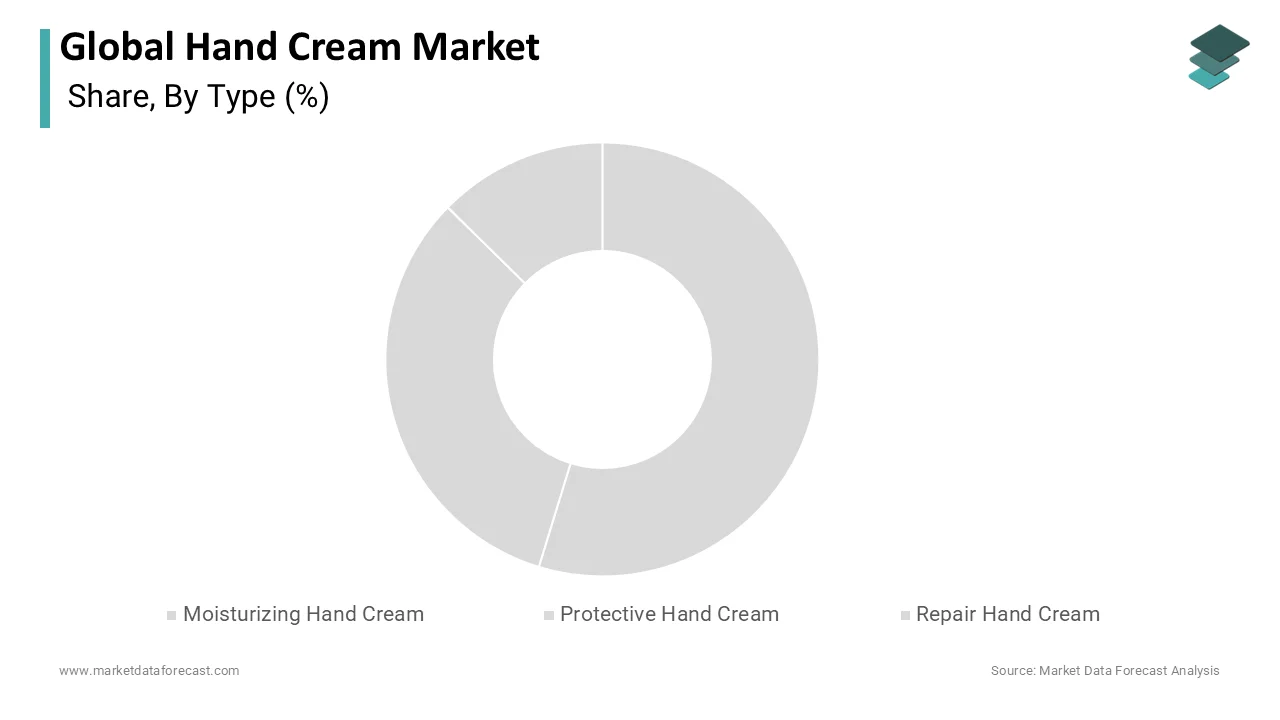
Hand creams address skin damage, including chapped or cracked skin. They often contain ingredients like shea butter and oils that promote healing and restoration of the skin's barrier function. This also acts as an anti-aging product and increases market share.
The moisturizing hand creams segment is anticipated to hold the second-largest share of the worldwide market during the forecast period. Moisturizing hand creams are formulated to provide deep hydration to the skin. They help to recover dryness and keep the skin soft and supple. These creams are popular in many skincare routines.
The protective hand creams segment is projected to witness a healthy CAGR in the worldwide market during the forecast period. Protective hand creams are designed to create a barrier on the skin's surface, shielding it from external harsh weather conditions, pollutants, and frequent handwashing. These creams are particularly valuable in harsh environmental settings.
Global Hand Cream Market By Age Group
The Generation X segment is predicted to account for the most dominating share of the global market during the forecast period. Generation X is typically looking for hand creams that provide effective moisturization and protection. They are focused on maintaining overall skin health and slowing the signs of aging. Creams with nourishing ingredients and UV protection may appeal to this age group.
The generation Z segment is another promising segment and is expected to occupy a substantial share of the global market during the forecast period. Generation Z seeks hand creams with customizable formulations and unique textures. Clean beauty and affordability are also significant factors for this group.
The baby consumer segment is expected to occupy a substantial share of the global hand creams market during the forecast period. Baby boomers are a significant consumer group for hand creams. As they age, they often prioritize anti-aging and moisturizing products to combat skin dryness and wrinkles. Hand creams with anti-aging properties and those designed to address mature skin concerns are in demand among this group.
Millennials are a diverse group with varying skincare needs. They often prioritize products that are natural, sustainable, and multipurpose. Hand creams with eco-friendly packaging and clean, organic ingredients are popular among this age group.
Global Hand Cream Market By Demographics
The female segment is estimated to account for the largest share of the global hand cream market during the forecast period.
The female segment dominates the hand cream market through established consumer behavior and a wider range of product options. Women have traditionally been using hand creams for skin care and moisturizing, making this demographic a prominent consumer group. The dominance of female consumers is due to the importance of skincare and self-care routines among women.
The male segment of the hand cream market has also been growing steadily. Men are becoming increasingly conscious of skincare and hygiene, which has led to a rise in demand for hand cream designed specifically for their needs. These products often have fewer fragrances and a more neutral or masculine packaging.
Global Hand Cream Market By Distribution Channel
The supermarket segment is expected to hold the leading share of the global market during the forecast period.
Supermarkets offer a wide range of brands and products, making it convenient for consumers to purchase hand creams along with their regular groceries. This channel is often preferred for its accessibility and variety.
The online retail segment has been growing consistently at a good pace over the last few years and is estimated to account for a substantial share of the worldwide market during the forecast period. Online retail has become a second dominant as E-commerce offers consumers the convenience of shopping from home, a wide product selection, and the ability to read reviews and compare products. Online stores often dominate due to their reach and accessibility.
The specialty stores segment is predicted to capture a considerable share of the global market during the forecast period. Specialty stores that focus on skincare or cosmetics may offer a various selection of premium hand creams. This channel provides a personalized shopping experience and often caters to consumers seeking specific skincare solutions.
REGIONAL ANALYSIS
North America was the largest regional segment for hand creams worldwide and is expected to continue playing the dominating role in the global market throughout the forecast period.
This region's dominance can be attributed to the high consumer awareness of skincare, changing weather conditions, and the presence of established beauty and skincare brands. Products with natural and organic ingredients and anti-aging properties are popular in this market.
Europe held the second biggest regional market share in the global market in 2022 and is predicted to progress at a noteworthy CAGR during the forecast period.
The European hand cream market is driven by a strong skincare culture, which emphasizes moisturizing and protection against cold weather. European consumers often prefer high-quality and luxury hand cream brands, making premium and natural products popular.
The Asia-Pacific region has seen rapid growth in the global hand cream market due to the beauty-conscious culture, emphasis on youthfulness, and innovations in skincare.
K-beauty and J-beauty trends have played a significant role in popularizing hand creams, often with unique ingredients and formulations.
Latin America also has a growing market for hand creams, as it includes the desire for soft and moisturized skin in a tropical climate, along with a growing focus on personal care and beauty.
In the Middle East and Africa, the need for intensive moisturization in these regions drives the demand for hand creams. Many products here cater to consumers seeking hydration and protection from harsh weather conditions.
KEY MARKET PLAYERS
Companies that are playing a promising role in the global hand cream market are Proctor & Gamble (United States), Johnson & Johnson (United States), Whaelthfields Lohmann (China), Unilever (United Kingdom), Coty, Inc. (United States), Philosophy (United States), Lynx (United States), Beiersdorf AG (Germany), Olay (United States), Shanghai Jahwa United Co. Ltd. (China), Alba Botanica (United States), Avalon Organics (United Kingdom) and Galderma (United States).
RECENT HAPPENINGS IN THE MARKET
- In 2025, Neutrogena introduced hand creams with enhanced moisturizing properties, emphasizing relief for dry and cracked skin. The company expanded its product lines to include hand creams with sun protection to prevent sun damage.
- In 2025, Estée Lauder focused on luxury hand creams with anti-aging and skin rejuvenation properties. The company introduced hand creams enriched with botanical extracts and vitamins for comprehensive hand care.
- In 2025, L'Oréal launched a range of hand creams with natural and sustainable ingredients, catering to eco-conscious consumers. The company emphasized hand creams designed for specific skin concerns, such as aging and pigmentation.
- In 2025, Dove expanded its hand care offerings to include moisturizing and nourishing hand creams with a focus on gentle and sensitive skin. The company introduced eco-friendly packaging and emphasized sustainable practices in production.
MARKET SEGMENTATION
This research report on the hand cream market has been segmented & sub-segmented based on the type, age group, demographics, distribution channel, and region.
By Type
- Moisturizing Hand Cream
- Protective Hand Cream
- Repair Hand Cream
- Others
By Age Group
- Baby boomers
- Generation X
- Millennials
- Generation Z
By Demographics
- Male
- Female
By Distribution Channel
- Supermarkets
- Speciality Stores
- Beauty Salons
- Pharma & Drug Stores
- Online Stores
By Region
- North America
- Europe
- Asia-Pacific
- Latin America
- Middle East and Africa